


Introduction
The development of innovative network applications marches on at an astounding rate. Ten years ago, who could have predicted the impact of the World Wide Web? Who could have predicted the impact of Napster just two years ago? And who knows what will be next? Such is the conundrum of the instructional technologist who struggles to employ everemerging technologies in the service of learning.
But not all advances in instructional technology come about through the development of new hardware or software; some emerge from the creative applications of existing technology . In this article we discuss such an innovation, the online self-organizing social system (OSOSS). Briefly described, the OSOSS structure allows large numbers of individuals to self-organize in a highly decentralized manner in order to solve problems and accomplish other goals. The OSOSS structure is neither an instructional design theory (such as those described by Reigeluth, 1999) nor an application or Internet protocol (such as Netscape or HTTP). However, due to its distributed and highly decentralized nature, the authors feel that the OSOSS structure could prove as disruptive to traditional notions of online learning as Napster proved to traditional conceptions of the Internet.
Our discussion of self-organizing social systems online will begin with an exploration of the issue of scalability and bandwidth in online learning, and the means currently proposed for overcoming these issues: “learning objects” automatically assembled by intelligent instructional systems. We will discuss what we feel are weaknesses in the automated learning objects approach. Finally, we will use these explorations and discussions as a context for describing the OSOSS structure.
Issues of Scalability and Bandwidth in Online Learning
When bandwidth issues are discussed in the context of online learning, one frequently thinks of the speed with which a large amount of data can make its way to students’ homes. In the past five years, broadband deployment has increased significantly, and it is possible that eventually there may be high speed Internet access generally available in student homes.
Let us assume momentarily that this access is broadly available. Are the problems of online learning solved? No. We believe that the most significant bandwidth problem in online learning has nothing to do with pushing data through pipes. The idea of “teacher bandwidth” analogizes students to data, and teachers to pipes, and formulates the problem thus: how many students can a teacher support in an online learning environment? While some distance education organizations see the Internet as an opportunity to expand their student base to hundreds of thousands of students, providing feedback and learning support for such large numbers is problematic. Traditional instructional methods were designed to support tens of students in a course, not tens of thousands. When these “tried and true” instructional methods are moved intact online and the number of students increases by one thousand, the number of “teachers” required to personalize the learning experience must also increase. As the following quote from the Sharable Content Object Reference Model produced by the U.S. Department of Defense’s Advanced Distributed Learning Network (ADL, 2001) points out, increasing the number of teachers proportionately is an expensive proposition:
Empirical studies have raised national interest in employing education and training technologies that are based on the increasing power, accessibility and affordability of computer and networking technologies. These studies suggest that realizing the promise of improved learning efficiency through the use of instructional technologies—such as computer-based instruction, interactive multimedia instruction and intelligent tutoring systems— depends on the ability of those technologies to tailor instruction to the needs of individuals. In contrast to classroom learning, these approaches enable the pace, sequence, content and method of instruction to better fit each student’s learning style, objectives and goals_
The dilemma presented by individually tailored instruction is that it combines an instructional imperative with an economic impossibility. With few exceptions, one instructor for every student, despite its advantages, is not affordable. Instructional technology promises to provide most of the advantages of individualized instruction at affordable cost while maintaining consistent, measurable, high-quality content (p. 17-18).
The ADL quote summarizes many approaches to solving the scalability or “teacher bandwidth” problem:
A one-on-one instructional model in which a teacher tailors instruction to individual student needs is preferable to other instructional models,
Human (teacher-student) interaction in large scale learning environments is not economically feasible, therefore
Automating feedback and other learning support via intelligent instructional systems is the only viable solution to providing scalable online learning.
How does an organization scale to provide individualized learning support to a large number of students? The solution that is becoming increasingly popular replaces human teachers with intelligent, automated systems. These systems sequence instructional modules or “learning objects” (Wiley, 2002) for users in real time according to intelligent algorithms, and provide predefined or “intelligent” feedback based on assessments of learners.
While a significant amount of energy and financing has gone into the automated learning objects approach to overcoming the teacher bandwidth problem, it suffers from a number of critical weaknesses.
Automated instructional systems completely lack human interaction and social negotiation, which learning theorists are increasingly stressing as crucial to supporting meaningful learning (Edwards & Wiley, 2002).
Highly decontextualized learning objects are reusable in the greatest number of learning contexts, but they are also the most expensive and difficult for instructional designers to reuse, creating a “reusability paradox” (Wiley, Recker, & Gibbons, 2001).
Computers are currently incapable of participating in the very human meaningmaking activities required of instructional design and development based on finegrained components (Edwards & Wiley, 2002).
While the automated systems approach has its place, we believe that these and other weaknesses prevent the method from supporting scalable solutions to human-interaction intensive learning. However, we are not advocating a return to the “one teacher for every student.” The dualism of “teacher-supports-students” or “automated-system-supports-students” is a false dichotomy. There is another option: “students-support-each-other.”
The Phenomenon of Selforganization
It may seem highly unlikely that any uncoordinated group of students could come together without a guiding authority to accomplish any significant purpose. Looking in on thousands of students using technology without a teacher’s direction, one might ask with Maeterlinck (1927), “What is it that governs here? What is it that issues orders, foresees the future, elaborates plans, and preserves equilibrium?” The subject of Maeterlinck’s wonder was not people, however; it was the white ant. Many species of ants, bees, termites and other social insects forage for resources, store resources, provide needed resources to others at the proper place and time, discriminate between optimal sources of food, build nests, hives, or domes, and solve a variety of other complex geometric, economic, and engineering problems.
Self-organizational models have been applied to human communities for decades, at least since Jacobs’ (1961) groundbreaking work on urban planning. Jacobs argues that communities self-organize in a manner similar to social insects: instead of thousands of ants crossing each other’s pheromone trails and changing their behavior accordingly, thousands of humans pass each other on the sidewalk and change their behavior accordingly. In the days before central planning authorities zoned city areas for specific uses, the simple local interactions of people on sidewalks led to complex global behavior at the level of the city, with upscale neighborhoods, slums, commercial and red light districts all emerging without anyone directing them to do so.
Researchers have continued to fruitfully apply self-organizational models to other human systems such as economics (Krugman, 1996). More recently, Eriksson and Wulf (1999) have begun exploring the relationships between self-organizing systems and the notion of computer-supported collaborative work; Wulf (1999) has examined the ways in which “groupware” systems support self-organization.
Current research brings us to the point where the self-organizational potential of human social systems has been recognized and documented, and investigations are beginning into the ability of networked technology to facilitate this self-organizing activity for individuals who are geographically distributed. Next, we will present a necessarily brief discussion of an existing online self-organizing social system.
Online Self-Organizing Social Systems
Online self-organizing social systems (OSOSS) are facilitated by a particular type of software infrastructure, one that is generally Web-based and characterized by a high degree of management decentralization. (Similar structures can exist within other technological environments such as mailing lists or Usenet newsgroups, but these frequently have Web-enabled front ends.) The Website genre known as the “Web log” or “blog” is such an infrastructure, and provides a fertile primordial soup from which online self-organizing social systems can emerge. The day-to-day tasks of creating new content, adding commentary, evaluating the quality of submitted material, providing user support and answering questions, and other tasks are distributed across the entire community via the blog infrastructure.
OSOSS vary in the degree of decentralization they employ (from very limited centralized editorial control to absolutely no central control), the content domain they cover (from the very specific to the self-proclaimed “Everything”), and the explicitness of their learning facilitation (from news OSOSS that help people keep up with current events to OSOSS explicitly created for the purpose of facilitating collaborative online problem solving). While none of the existing OSOSS consider themselves learning communities, learning is happening among their users, and happening in an extremely innovative manner.
Slashdot (http://slashdot.org/) is undeniably one of the most popular OSOSS. With a subscriber base of over 30,000 generating over 1,000,000 page impressions per day (OSDN, 2001), one might expect that the task of managing such a site would require scores of people. And it does. It takes approximately 30,000 people to keep Slashdot running, via an infrastructure supporting story submissions, threaded discussion, moderation, and metamoderation.
Slashdot is a news site, carrying stories of interest to “geeks” and “nerds.” Frequent topics include bleeding edge hardware and software developments, intellectual property law and lawsuits, Japanese anime, and reviews of science fiction books and movies. Users contribute “news stories”—which are frequently summaries of stories, reviews, and other information found on other sites across the Web, along with links to the original content—for the editors to approve. Editors review the material for appropriateness (alignment with Slashdot’s content areas) and originality (is this story already running on the front page?) and then either approve or discard the submission. Accepted submissions run in a box on the site’s front page (see Figure 1), and each story box contains a link to an area where threaded discussion dedicated to the story occurs (see Figure 2).
The threaded discussion itself is equally interesting. Community members meeting certain criteria have the ability to “moderate” or evaluate the quality of individual comments. These evaluations are aggregated to produce scores from -1 (“Flamebait”) to 5 (“Insightful”). Using these comment ratings and an infrastructure that dynamically generates HTML, Slashdot allows users to set thresholds for the quality of comments to which they want to be exposed. Generally speaking, the authors have found that using the website with this threshold set at 4 or higher is an intellectually satisfying experience (see Figure 2).
“Meta-moderation” allows other members of the community to evaluate the appropriateness of moderators’ ratings. For example, if a moderator with an axe to grind against Microsoft moderated an informative comment regarding the XP operating system down to -1, meta-moderators would mark this moderation as “Unfair.” This system of meta-moderation provides the larger community a powerful balance against “the tyranny of the moderators.”
The combination of Slashdot’s moderation system with its meta-moderation system creates a powerful infrastructure for real-time peer review. This infrastructure supports the community’s efforts to bring the best information, questions, and answers to the attention of the community, while making it difficult for misinformation and half-baked ideas to propagate across the network. In short, it functions much like the peer review process that provides the gateway to academic journals. It impressively fills this role a) in real-time, b) with input from a larger proportion of the community, and c) with meta-moderation checks in place to prevent abuse.

A Screen Capture of the Slashdot Website Located Online at http://slashdot.org/
A Screen Capture of the Slashdot Website Located Online at http://slashdot.org/
The software that distributes the responsibility for content creation, commentary, and quality control across the community provides the users of Slashdot the tools they need to self-organize. While individuals follow rules strictly local to them (e.g., expressing preference for one type of content over another), these strictly local rules result in a complex macro-behavior that emerges within the system.
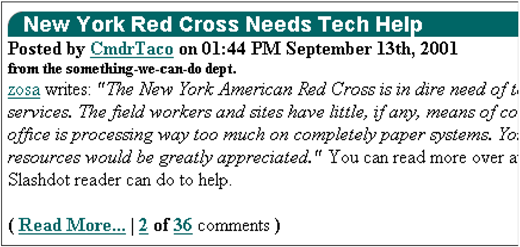
Detail of the Slashdot Website Front Page. The “Read More” Link Takes Users to a Threaded Discussion Specific to This Story. “2 of 36 comments” Represents the Number of Current Comments At or Above the Users’ Comment Quality Threshold
Detail of the Slashdot Website Front Page. The “Read More” Link Takes Users to a Threaded Discussion Specific to This Story. “2 of 36 comments” Represents the Number of Current Comments At or Above the Users’ Comment Quality Threshold
OSOSS, Learning Objects, and Online Learning
“But where is the learning?” one may ask. In this section we connect together OSOSS, learning objects, and online learning by discussing a sample OSOSS interaction. Table 1 contains an excerpt taken from the PerlMonks website (http://perlmonks.org/) section titled “Seekers of Perl Wisdom.” PerlMonks is an OSOSS where a variety of people learning the PERL programming language and working through the problems common to those learning the obtuse language interact and collaborate to teach each other and solve problems.
The resources referenced in the interaction in Table 1 are not employed in the traditional learning objects manner—“content prepackaged to teach a specific instructional objective.” Instead, the resources themselves are relatively free of artificially imposed, embedded instructional strategies - the community members who initially identify the resources supply strategies and techniques for using the resources in a context-dependent manner. This utilization suggests a new definition of learning objects; one that changes from “any digital resource that can be reused to facilitate learning” (Wiley, 2000) to “digital tools used to mediate learning.” We consider the focus on mediation (Wertsch, 1985, 1991) and distinction from facilitation to be significant.
The researcher is also prone to notice that the Website software itself is mediating the problem solving process by taking questions and responses, displaying these in a threaded manner, etc. These affordances are important to consider: just as environmental variables such as access to food sources and proximity of competing colonies mediate an ant colony’s ability to succeed, the OSOSS infrastructure itself plays a large role in the ability of the OSOSS to self-organize successfully. For example, individuals who use OSOSS without moderation and meta-moderation capabilities will self-organize differently from those whose environments provide these affordances.
Slashdot, the OSOSS described above, nearly self-destructed in early 2000 due to the noise-to-signal ratio among user comments. Comments such as “First post! I commented before anyone else!” and “Natalie Portman is sooo hot!”, unrelated to the actual topic of discussion, began to drown out the more meaningful dialog. The moderation system evolved in order to help the community self-sustain. Meta-moderation evolved in response to similar needs. One can easily imagine a number of circumstances (such as a lack of technical sophistication by community members) that would have prevented this adaptation, resulting in the death of the system. In their ability to self-maintain while preserving their identity, OSOSS are autopoietic.
Because learning objects mediate the activities of individuals within an OSOSS, it stands to reason that the structure may be susceptible to the same weaknesses as the traditional methods of using learning objects. This is not the case, however, as OSOSS are rich in human interaction, can utilize arbitrary resources efficiently, and excel at mediating collaborative meaning making.
The most significant departure of the OSOSS from conventional learning objects approaches is that it relies on human beings to locate, assemble, and contextualize the resources. Although the tragedy of the commons (Hardin, 1968) would suggest that such voluntary collaborations are not sustainable over time, the emergence of the Internet, and specifically the Free/Open Source Software movements, have shown peer-to-peer communications technology’s ability to put people in symbiotic, “you answer my question, I’ll answer yours” relationships. The gift culture described by ethnographers of the Free/Open Source movements such as Raymond (1999) and Himanen (2001) is one explanation of this phenomenon. Another explanation is that a distributed expertise model obtains in suffi-ciently large distributed learning communities, meaning that because expertise exists across the community, no individual community member is overly burdened with the primary responsibility for answering questions and providing feedback. As problems arise related to the expertise of an individual, that individual may or may not choose to provide help. If the community is of sufficient size, the distribution of expertise and effort provides timely problem solving support without unduly burdening any individual.
A Sample Interaction from an OSOSS. Portions of the Interaction Have Been Removed in Order to Preserve Space; The Full Excerpt is Available Online at http://www.perlmonks.org/index.pl?node_id=98134&lastnode_id=479. The Right Column Contains Our Annotations of the Interaction.
| Unique ID by nlafferty on Jul 19, 2001 at 16:39 | A user named nlafferty asks a question about creating unique identifiers for data entered into a database. |
| nlafferty has asked for the wisdom of the Perl Monks concerning the following question: | |
| I want to know how to generate a unique id for every row i enter into my postgreSQL DB. So that a unique id is specified to a variable, which i can INSERT into the row along with my other information. | |
| Re: Unique ID by lhoward on Jul 19, 2001 at 16:46 The two easy ways to do this with Postgres. One is to specify the ID col. as serial type, which will cause it to be auto-incrementing (i.e. when you insert a row, it will automagically get a new, unique val in the serial col). | User lhoward responds with three alternative solutions to the question. One involves using functionality already existing in the database (he is providing documentation). Another involves accomplishing the task by using additional software code (he is providing sample code that solves the problem). The final method is described as being inefficient and described in less detail. |
| Additionally, you can use a postgres sequence to keep track of the ID, and query it with postgres“s nextval function whenever you need a new value: | |
| my $sth=$dbh->prepare(“select nextval(?)”); $sth->execute(“seq_name”); my $id=$sth->fetchrow(); $sth->finish(); | |
| Of course, you can also do this the old-school way too (but its less efficient to do it this way): Have a table to store the last assigned ID. When you need an ID, lock that table, read the value out of it, write the value+1 back to the table, and then unlock it. | |
| Re: Re: Unique ID by nlafferty on Jul 19, 2001 at 17:05 So if i use a serial type then i do not have to use the sequence as well. Or do i have to use a combination of both? | nlafferty asks lhoward to expand on his first alternative. |
| Re: Re: Re: Unique ID by lhoward on Jul 19, 2001 at 17:28 The serial type creates and uses a sequence behind the scenes, but its operation is transparent to you. You do not need to create an additional sequence to use it. See… (using psql, Postgres’s command line tool): | lhoward responds with an explanation including actual program input and output, and a description of the scenarios in which this alternative would be most effective. |
| test=# create table foo(ID serial NOT NULL,bar text, constraint foo_pk primary <program output removed to preserve space> I find postgres sequences to be most useful when you want to share one unique ID across tables and when you don’t have a master table to store it in (or don’t have a table that will always be inserted first). Or when you want to assign something outside of the DB (at least at the time of assignment) a unique ID. | |
| Re: Unique ID by lachoy on Jul 19, 2001 at 17:00 | User lachoy responds by linking to existing software that solves nlafferty’s problem, along with sample code for integrating the software into nlafferty’s program. |
| ObPerl: You can also use a wrapper like (plug plug) SPOPS (link) module to do this for you -- there is example code at this node (link). | |
| Chris M-x auto-bs-mode | |
| Re: Unique ID by lestrrat on Jul 19, 2001 at 17:07 | User lestrrat responds with further database documentation, describing a solution already built into the database package. He includes sample code for accessing this functionality. |
| If this unique ID does not have to be any thing in particular, you might as well use the oid column. oid is unique for every single row in the database, and is created when you insert a row. | |
| It’s sort of a “hidden” field, so when you query, you have to do | |
| SELECT oid,* FROM table; | |
| # if you already know your oid.. SELECT * FROM table WHERE oid = x; | |
| This is so much easier than maintaining a sequence.… and is universal for Postgres. | |
| Re: Re: Unique ID by nlafferty on Jul 19, 2001 at 17:14 This is originally how i thought would be a good way to handle this. I’ll give it a shot…thank you ;) | nlafferty thanks lestrrat and states that he will try this solution. |
| Re: Re: Unique ID by nlafferty on Jul 19, 2001 at 19:36 So how would i do a delete statement WHERE oid = “$oid” ? | nlafferty has succeeded in using lestrrat“s solution and returns to ask a follow-up question. |
When learning objects are considered as mediational means that learners employ in problem solving and other types of activity, seemingly heterogeneous digital content chunks, assessments, simulations, and applications rotate into a single mediational factor. OSOSS provide a conceptual framework for a new method of indexing, discovering, combining, using, and evaluating digital educational resources.
Indexing and Discovery: Learning objects are not cataloged with metadata and submitted to a central curatory repository. Community members know of existing resources and local resource collections. Individual resources are discovered through “community queries” in which community members respond with pointers to resources they know about personally. When a sufficient portion of the community responds in this manner, the learner locates satisficing resources.
Combination: Learning objects are not automatically populated into one of many instructional templates. Without the direction of any single grand architect, peers contribute relevant resources and descriptions of how they might be employed within the context of the initiator’s problem. Much like a colony of ants, peers autonomously build on one another’s work and create a satisficing resource structure without centralized direction (Bonabeau, Dorigo, & Theraluaz, 1999).
Use: Learners do not sit through a temporal sequencing of resources and assessments linked to decontextualized instructional objectives. They employ resources provided by peers as mediational means in the solution of a selfselected problem or accomplishment of another self-selected goal.
Evaluation: Learning objects are not critiqued out of an instructional context with a summative quality rating of 1-5. Learners evaluate the relevance and suitability of resources within a specific learning context. (Williams (2001) contains an excellent description of the impasse created by attempting to apply current context-dependent evaluation methodologies to extremely decontextualized educational resources.)
We have argued above that current approaches to overcoming the “teacher bandwidth” problem, specifically those based on learning objects, suffer from a number of practical and pedagogical difficulties. As an alternative structure, we introduced the construct of an online self-organizing social system (OSOSS). Reviewing a sample case from an OSOSS in light of previous learning objects criticisms reveals that none seem to apply. That is, it would appear that learning object use “in the wild” (educational resource use unmarred by instructional design and development methodologies), exhibits none of the weaknesses of contrived approaches to employing learning objects.
So what? Why are online self-organizing social systems important to the future of online learning? OSOSS include a large number of learners, yet scalability is not an issue. Learners are provided with meaningful learning support “anytime anywhere,” yet the support is rich with human-to-human interaction. Learning objects are successfully embedded in a meaningful learning context, but the discovery and contextualization of the objects are done by humans—again without scalability becoming an issue. It is because these naturally occurring methods seem in some ways superior to existing approaches that we believe that online self-organizing social systems will be an integral part of the future of online learning.
The Instructional Design Underlying OSOSS
Like any other instructional technology, the success of OSOSS in facilitating learning will depend on the degree to which instructional design principles are obeyed, whether this obedience is conscious or otherwise on the part of the learner. The sample OSOSS interaction in Table 1 reveals that community members are unknowingly employing methods from several instructional design approaches. In this section we present three brief comparisons of the PerlMonks excerpt and modern notions of instructional design.
Collaborative Problem Solving
Nelson’s (1999) Collaborative Problem Solving process synthesizes literature on collaborative learning and problem solving to provide guidance to teachers and learners interested in learning through group problem solving. Nelson’s process appears intact in the PerlMonks example above:
Problem solving group membership is implied by membership in the community,
learners negotiate a common understanding of the problem through a series of questions and restatements,
learners’ roles in the problem solving are implied as one learner poses the problem and responds with further clarifications, thoughts, or ideas,
learners gather information from a variety of sources, including PERL modules, code samples, Postgres output, and Postgres documentation,
a solution is agreed upon and implemented, and
further questions are raised, beginning the problem-solving cycle anew.
Nelson summed up the important characteristics of OSOSS when she spoke of the attributes of the ideal CPS learning environment: “one conducive to collaboration, experimentation, and inquiry, an environment which encourages an open exchange of ideas and information” (p. 247).
Goal-based scenarios
Schank, Berman and Macpherson (1999) present goal-based scenarios as a teaching model that stresses student learning of “how to” over student learning of “know that,” claiming that the model is “the ideal method of instruction, appropriate for any subject and any student age, and for both school and business” (p. 165). The methods of the goal-based scenario also exist intact in the PerlMonks example:
The mission is not only somewhat realistic, it is student selected at the moment of greatest motivation,
the “cover story” exists in the learner’s life, and does not need to be concocted by an instructional designer,
the student’s role as problem solver is clear, as the student initiates the problem solving process herself,
a variety of resources which provide the information necessary to complete the mission are supplied by the student and other group members, and
feedback comes through the learner’s application of the proposed problem solution.
Schank, Berman, and Macpherson (1999) may as well have been talking about OSOSS when they said that goal-based scenarios will succeed only “as long as they contain a rich amount of content, support interesting and complex activities, and are inherently motivating to the student” (p. 165).
Legitimate peripheral participation
While the PerlMonks example may seem haphazard and without the overarching guidance necessary to take learning in meaningful directions, Lave and Wenger (1991) called for this type of decentralization over a decade ago. In describing apprenticeship structures in a variety of settings, they conclude that resources are not generally structured for apprentices’ use by a “master”—a broader community of practice into which the apprentice is working to insert herself assembles them.
We argue that a coherent explanation of these observations [that masters are present in widely varying degrees in different apprenticeship communities, and that learning resources are generally structured by the larger community] depend upon decentering common notions of mastery and pedagogy. This decentering strategy is, in fact, deeply embedded in our situated learning approach—for to shift as we have from the notion of an individual learner to the concept of legitimate peripheral participation in communities of practice is precisely to decenter analysis of learning. To take a decentered view of master-apprentice relations leads to an understanding that mastery resides not in the master but in the organization of the community of practice of which the master is part_Similarly, a decentered view of the master as pedagogue moves the focus of analysis away from teaching and onto the intricate structuring of a community’s learning resources (p. 94).
When we acknowledge the decentralized nature of learning, as in legitimate peripheral participation, it makes sense to build an architecture to support such decentralization. Rogoff (1990) echoes appreciation of the role of putting novices in direct contact with each other.
The apprenticeship model has the value of including more people than a single expert and a single novice; the apprenticeship system often involves a group of novices (peers) who serve as a resource for one another in exploring the new domain and aiding and challenging one another (p. 39).
The PerlMonks excerpt provides a clear example of peers attempting to structure resources in order to support an individual’s learning, and providing additional support as necessary.
Instructional design super-theory?
Finally, while educators and instructional designers work to move “tried and true” pedagogical methods online, the self-organization analogy suggests another interesting perspective. PTAs and school boards bicker over the maximum number of students that can be placed in a traditional classroom because the teaching methods employed there work best with a certain number of students; for example, 30 or fewer. This inability to think “outside the box” is at least partially responsible for the scalability problem in online learning: moving “tried and true” classroom methods online dictates the maximum number of students that can engage in an online course. Conversely, computer models of self-organizing phenomena show that without sufficiently large numbers of agents, morphogenesis looks qualitatively different if it ever takes place at all (Johnson, 2001). This means that online self-organizing social systems could provide the foundation for a new instructional design science; namely, instructional design super-theory, which would deal with instructional design models in the spirit of Reigeluth (1983, 1999) for facilitating learning in very large groups of learners.
Potential Problems with OSOSS and Future Research Directions
OSOSS are no more the “cure to all instructional ills” than any predecessor instructional technology has been. And while they have the potential to improve online learning in meaningful ways (e.g., by overcoming problems of scalability while humanizing online learning by increasing levels of human interaction), OSOSS lacks a number of characteristics that are considered “strengths” of automated instructional approaches. Among the challenges or difficulties are:
A standard curriculum may be difficult to impose on individuals in an OSOSS.
Assessment of individuals may be difficult to carry out in an OSOSS.
Required feedback may not be immediate in an OSOSS.
Establishing identity and trust relationships within an OSOSS may take longer than in higher bandwidth channels (Ubex, 2001).
We see the prime areas for future research in OSOSS as twofold: more thorough ethnographic and discourse studies of existing OSOSS, including grounded theory studies that could guide the creation of software infrastructures to facilitate the development of these communities, and studies of ways around the weaknesses in OSOSS. The main obstacle to this research will be the large numbers of participants necessary for self-organization to occur, but the promise of the OSOSS approach merits the effort on the part of researchers.
Conclusion
In looking to the future of online learning, we have suggested that existing approaches to overcoming online learning’s key obstacle— teacher bandwidth—have critical weaknesses that will limit their success. Online self-organizing social systems, while not without their own weaknesses, exhibit strengths unseen in existing methods of learning facilitation. The OSOSS is thick with principles found in modern instructional design theories, yet creatively overcomes weaknesses in the very latest instructional technology fads. The OSOSS may also open previously unexplored areas of large-scale instructional design research, and provide fruitful linkages between instructional design research and that of other fields such as biomathematics, artificial intelligence, and complexity theory. As interest in problembased learning (Albanese & Mitchell, 1993; Vernon & Blake, 1993) and online PBL environments increases, we believe that the OSOSS, or something like it, will play a significant role in the future of online learning, because the OSOSS is so well suited to facilitating and mediating problem-solving and problem-based learning.

