


An instructor or designer who views teaching and learning from a constructivist philosophy creates a context for learning-a learning environment-where learners can become engaged in authentic projects, problem-solving, and other learning activities. The instructor is not a spectator; rather, a co-explorer and co-discoverer who guides learning and encourages intrapersonal interaction or reflection, and interaction with content, with peers, and with the instructor. The article places interaction into the context of an effective eLearning environment, which occurs when there is alignment among the learning goals, the learning activities, and feedback. It discusses basic components of effective constructivist eLearning environments and details the importance of active, interactive, and reflective eLearning
While it is a widely believed that a high level of interaction is desirable and positively affects the effectiveness of education, it is not clear from research or evaluation data that interaction improves the quality of instruction in most distance education programs (Kearsley, 1995). King and Doerfert (1996) stated that what research does indicate is that interaction is important to learner satisfaction and the persistence of distance students. Citing the works of Beare (1989) and Souder, (1993), Simonson, Smaldino, Albright, and Zvacek (2000) concluded that ..research comparing differing amounts of interaction showed that interaction had little effect on achievement” (p. 61). Such findings, however, seem antithetical to conventional wisdom. Interaction is necessary to provide feedback and, thus, is central to the expectations of teachers and learners in education and to that extent, it is a primary goal of the educational process. For these reasons, interaction will continue to be seen as a critical component of formal education, regardless of whether there is research showing a direct link to increased effectiveness.
Still, it is somewhat short-sighted to focus on interaction solely for its own sake. Interaction in the service of teaching and learning should be viewed in context and in relationship with teaching methods and delivery systems available to the person or persons designing instruction. This article generally assumes the perspective of adult learners in formal education. An example of this may be a post-secondary undergraduate or graduate program, where there are students whose purpose it is to learn something, a sponsoring organization whose purpose it is to sanction and support student learning, and a teacher to structure and create a positive learning environment. The emphasis here is also on what has been labeled for the last several decades as a constructivist, learner-centered environment (e.g., Duffy, Lowyck and Jonassen, 1993; Wilson, 1996) within an eLearning delivery system.
This article presents an eLearning design model and describes important factors to consider when establishing an eLearning environment. A detailed discussion of active eLearning, interactive eLearning, and reflection eLearning ensues, ending with a brief exploration of the implications these activities have for the field of eLearning.
ELEARNING DESIGN MODEL
In thinking about teaching and learning, I have been developing a framework that will allow one to speak about a wide range of learning models with different theoretical foundations. Simply put, the secret to designing successful learning is to align three elements: learning goals, learning activities, and feedback and evaluation (Figure 1). This is true whether the instruction is designed and delivered from a constructivist or a behaviorist perspective or if the learning is done completely online, in-person, or in a blended environment. Blended or hybrid environments require careful attention to media characteristics and to the use of the most appropriate delivery system, including in-person, if called for. The appropriateness of a delivery system is based on the benefits of each medium, the course content, and the needs of the learner, not on the convenience to the designer or instructor. This places the focus on learning and the learner, rather than on instruction or teaching. I encourage the reader to see other articles in this special issue and elsewhere for an in-depth look at interaction from the instructor’s perspective (McMahon, 1997; Northrup, 2001; Wilson, 1995).
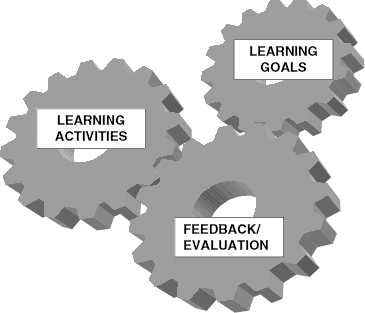
Secret of Designing Learning: Aligning Learning Goals, Activities, and Feedback..
Secret of Designing Learning: Aligning Learning Goals, Activities, and Feedback..
Along with the three key elements shown in Figure 1, let me quickly note that the learning process occurs, among other things, within a particular infrastructure; it relies on support services from the organization, and exists within a learning environment created for the purpose of learning. In the limited space here, I will mention some of the characteristics of an effective eLearning environment, given the perspective taken above as prelude to discussing active, interactive, and reflective learning and the interrelationship among these three concepts.
The eLearning Environment
To take full advantage of active, interactive, and reflective learning, the learning environment should be designed in a way that learning is situated within context, it is learning-centered, and there should be planned pre-learning activities.
Learning-Centered Environment
As the control of learning shifts from teacher to learner, and as the value of the student’s time becomes more important, individualized learning becomes critical. Students often wish to set their own pace, time, and place where learning will occur, and can use the seemingly infinite resources and learning materials available through the Internet, along with those resources provided by the instructor and the institution sponsoring the course. This allows the learners to make their choice among the many learning paths that may be available to them (Lansdell, 2001) that match the learning goals of the course. These are some of the key reasons eLearning is exploding at the post-secondary level of education. Given the learner-centered perspective described above, contemporary approaches accept that learning is a dynamic process and that it depends on a subtle interaction between active and reflective learning.
Situated-Learning Environment
A learner-centered environment should help students make meaning of what they are learning and why they are learning it. One way to accomplish this is to have learning situated in context. Context is critical for determining meaning. For example: “I do” takes on different meanings when spoken in response to a waiter asking if more water is wanted by anyone at the table compared to the same person responding to the minister’s question at her wedding. This article strives to place interaction in context of eLearning. Thus, an active learning environment is designed to encourage students to read, speak, listen, write, and think in deep, meaningful ways. Students must assume responsibility for organizing what they learned (Dodge, 1996). Interaction is two-way communication among two or more persons with the purposes of completing the learning goals (tasks) and building the necessary social relationships. Or, in the case of a student interacting with course content (e.g., textbook or reading assignments) there is one-way communication from the author of the learning material to the student. Engagement, reflection, or study by the student aids in the selfconstruction of competency of the learning goals (Berge, 1999). By reflection on learning, I mean the learner’s cognitive activity of looking back at relevant social interactions and their own or group learning activities and also looking forward in hopes of shaping and improving future learning interactions and activities (de la Harpe and Radloff, 1998; Tabachnick and Zeichner, 1991).
Pre-Learning Activities
Planning how to situate the learning into meaningful context for particular learners includes attention to certain critical pre-learning activities. These activities should accomplish several things: they should provide an explanation of the course materials and the organization, priorities, deadlines and responsibilities of the student, the instructor and the course. The expectations for the course should be made clear, both in terms of learning activities and competencies to be acquired. This goes beyond providing a syllabus. Clear and specific details about the course structure, assignments, activities, and evaluation are needed, along with concise instructions for navigating the online environment (Lansdell, 2001). Details include an orientation to both the particular course and the teaching style of the instructor. The goals of pre-learning activities in the eLearning environment are to make clear the structure and expectations of the course, give an advance organizer for the learning goals that are essential to the course, to indicate the requirements for success, and to alleviate as much isolation and confusion from the student’s perspective as possible.
Active eLearning
Active learning involves putting students in situations that compel them to read, speak, listen, think deeply, and to write. The responsibility of organizing what is to be learned is put into the hands of the learners themselves, rather than resting in the hands of the instructor. Learning is generative. Each learner generates knowledge that should be directed toward learning goals that include:
increasing higher-order thinking analysis, synthesis, evaluation.
increasing the ability to apply course concepts,
illustrating the links between course material and practical contexts,
encouraging students to “own” the material to construct their own meanings.
encouraging student exploration of their own attitudes and values,
increasing feedback and,
decreasing student dropout rate (fewer students “disappear” or drop the course) (Dodge, n.d.; Paulson and Faust, n.d.).
Constructivist environments engage learners in the construction of knowledge through collaboration and individual activities that embed the learning of salient knowledge and skills in meaningful contexts, and through reflection on what has been learned through interaction with content and other people (Jonassen, Davidson, Collins, Campbell, & Haag, 1995).
Science learning is also an introduction to a community of practice, and this means that science learners need to be involved in the type of activities that real scientists perform. Therefore, all students need to experience practical work and all students need to experience collaborative working mediated by information and communications technologies, as these are the contemporary experiences of working scientists. (Cooper, 2000, p.1)
Active learning involves students in authentic projects and problem-solving situations, the heart of which is inquiry. The essence of inquiry is when the student is personally challenged with a problem to solve, a project to complete, or a dilemma to resolve. This challenge, it is hoped, causes the inquiry to be personally meaningful for the student, and through individual or group investigation, the student’s curiosity leads to explicit formulation of the subject to be investigated and the process that will be used for solving the problem or project. Both the process and the tentative solutions are studied, reflected upon and thereby improved. Through discussion and interaction with others, the students share their experiences, try out different ways of looking at their own experiences, and explore multiple perspectives and views that often conflict with their own. All this occurs while students respect and value other students’ experiences, and individually and socially construct new knowledge-adjusting and augmenting prior knowledge. Through continuing, first-hand experience using authentic problems and projects, reflection, reorganization of concepts and attitudes, and stimulation catalyzed by interaction with others, students generate and co-generate solutions, implement them, and build new knowledge-often discovering new lines of inquiry as well.
The student needs to develop self-awareness about the personal meaning of the inquiry he or she is undertaking to sustain the drive and interest in meeting the challenge with the best possible individual and collaborative work. In an environment that fosters trust, contains low levels of structure and high levels of dialog, encourages respect for a variety of viewpoints, flexibility, and risk-taking, students will assume responsibility for their own learning and become less dependent on direct instruction from the teacher. Through such processes as application, analysis, synthesis, evaluation, and attention given directly to these experiences, more powerful ways of knowing are created, new questions are discovered, and significant learning within each student is fostered—an indication that significant transformative learning has occurred.
Interactive eLearning
Hirumi (in this issue) posits a comprehensive framework that defines three levels of planned eLearning interactions. In this section, I focus my attention on three level II interactions (learner-content, learner-learner and learner-instructor interactions) and two aspects of level III interactions (feedback and evaluation) that are particularly important to the design and development of effective constructivist eLearning environments. Such interactions form the keystone of learning activities, which is one of the three elements for effective eLearning design. Feedback, including evaluation, is another aspect of interaction, and the second of the three critical eLearning components depicted in Figure 1.
Interaction with Content
The phrase “interaction with content” occurs frequently in the literature (Moore, 1989), but it is a problematic formulation, as content cannot interact, hold a dialogue, or answer back. Interaction about course content can occur within the students’ own heads as they dialog within themselves while attempting to construct meaning, answer questions, or find the appropriate places to integrate incoming information into their existing schema. Even when studying alone, students must engage in this kind of internal dialogue in order to code and retain information. The content cannot merely pass before their senses but must be actively cognitively processed (Bower & Hilgard, 1981). Typically, in formal schooling, much just-in-case content delivered to the student quickly becomes “inert” (Gagné, Yekovich, & Yekovich, 1993) as it has little relevance or use in their life circumstances, eventually becoming “lost” to retrieval. Hence, instructors, especially in business, are exploring the advantages of just-in-time learning. It appears that knowledge and skills acquired immediately prior to a need for their use may reduce retraining because the original instruction occurred too long before an opportunity for use arose. In the classroom, the more authentic the problem or task, the more the student taps into the retention advantages of relevant instructional activities.
Interaction with Peers
Northrup (2001) reminded us that the nature of eLearning is learning anytime and anywhere, which sets the stage for student isolation during learning. To overcome this sense of isolation, among other reasons, teamwork, collaboration, or some type of group work is often assigned. Part and parcel of teamwork is interpersonal relationship-building, which is necessary but insufficient to accomplish learning in groups. The main reason for team assignments is to accomplish part or all of the learning goals, and replicate authentic working conditions.
However, the value of peer or social interaction goes beyond teamwork and relationship-building and goal achievement. Social constructivists, drawing on the work of Vygotsky (1978, 1986), theorize that a great deal of learning takes place in a social context, and is spurred by interactions with other people. Vygotsky’s findings suggested learning environments should involve guided interaction, permitting novices to reflect on inconsistency and to change their conceptions through speech and communication (Boudourides, 1998), as well as through intelligent action (Piaget, 1952).
The importance of interpersonal interaction in learning is well accepted (Fulford & Zhang, 1993), although some distance educators still advocate an “independent learner” model. Even while an independent learner is cognitively processing course content in a learning situation divorced from peer interaction, he or she does not live in isolation, but in the contexts of home and work. The ideal situation is for independent learners to take what they have learned and apply it, making it meaningful in the context of actions and interactions within their own lives as they seek personal satisfaction, credentials, and advancement on their life path. When students have the opportunity to interact with one another and their instructors, they can analyze, synthesize, and evaluate course content and use their new learning to construct a shared meaning, making sense of what they are learning in the context of their own community of practice (Lave, 1991).
Well-designed interaction can move learning from the lower levels of cognitive processing, such as recognition and comprehension, to the higher levels of analysis, synthesis, and evaluation (Bloom, 1956; Garrison, 1993; Moore, 1993). Formal schooling can most effectively occur in situations in which intellectual operations can be practiced with adequate feedback from the community with whom the scholar, or apprentice scholar, is attempting to build meaning. As the instructor encourages interaction, learners can become personally engaged, which is essential to effective mediated learning (Hackman & Walker, 1990).
Interaction with Instructor
Laurillard (1993) focused on the learning process as iterative and involving discursive, adaptive, interactive, and reflexive qualities. She also emphasizes the instructor-student or mentoring relationship (McMahon, 1997; Daloz, 1986). One job of the instructor or facilitator is to interact with the learner to help fill or bridge the gaps the learner may face with the content and within the learner’s other learner-directed social interactions. Additionally, specific interactions must be designed to make sure feedback and evaluation are communicated to the learner.
Feedback and Evaluation
Communication and feedback, including evaluation, is such a critical component of interactivity in eLearning that it is one of the three key elements chosen for the overall framework presented in Figure 1. The goals of feedback in eLearning include:
ensuring accuracy of content acquisition, performance, and understanding
providing guidance, coaching, and modeling of the learning goals
facilitating social interchange and building relationships
increasing student motivation and maintain the focus of the learning activities
linking the learning goals of the course to relevancy in the workplace
providing evidence for certification of credit
providing information helpful for improving the course now and in the future
Feedback can take the form of instructor-to-student, student-to-instructor, and student-to-student interactions. There must be opportunities for feedback in all these forms throughout the eLearning process.
Formative and summative evaluation are important forms of feedback. Basically, they are processes for collecting information about the student’s level of performance so that decisions can be made (either by the students them selves or by the instructor) regarding the pace and degree of their mastery of the learning goals. Formative evaluation may suggest “course corrections” to improve the quality of the course or the level of student learning, as the learning experience proceeds. Summative evaluation usually differs from formative evaluation in that the results are reported to the program and institutional administration to make decisions about course continuation, termination, or revision and the academic standing of the student regarding credit or certification.
Reflection in eLearning
Active reflecting is described as learning by reflection upon experience. In Hirumi’s (in this issue) framework, reflection is integral to self-regulation (i.e., Level 1, learner-self interaction). Learning from intrapersonal interaction or reflection can also be based, vicariously, on someone else’s experience, with both instances leading to valuable learning process (Neil and Yoong, 2000). One of the characteristics of eLearning is that it can include asynchronous communication features that allow students more time for reflection.
Brookfield (1995) suggested looking to developmental psychology for evidence that reflection is one way that adults come to thinking contextually. Brookfield indicates that the idea of critical reflection focuses on three related processes:
the process that adults use when questioning and then replacing or reframing an assumption that up to that point has been uncritically accepted,
the process through which adults try out alternative perspectives of previously taken-for-granted ideas, actions, forms of reasoning, and ideologies, and
the process by which adults come to recognize “the hegemonic aspects of dominant cultural values and to understand how self-evident renderings of the ‘natural’ state of the world actually bolster the power and self-interest of unrepresentative minorities” (n.p.).
Concepts such as embedded logic, dialectical thinking, working intelligence, reflective judgment, post-formal reasoning and epistemic cognition that are found in the developmental psychology literature (Brookfield, 1987, 1991) are directly related to reflection on learning, should the reader wish to explore these processes more thoroughly.
Implications for eLearning
Meaning-making is the goal of learning. It requires articulation and reflection on what we know. Often when face-to-face traditional classroom instruction is replaced or supplemented at a distance, it replicates ineffective instructional methods. eLearning environments must provide rich, authentic, contextualized problem-solving activities that learners can experience individually or collaboratively (Jonassen et al., 1995).
There are a dozen or more instructional interventions that, if done properly, have consistently improved learning. Table 1 summarizes the effect size of many of these, and indicates that such interventions as positive reinforcement, feedback, and cooperative learning have worked in face-to-face classrooms over the years. While research could be extended to eLearning for these interventions, there is no reason to believe, at this point, they will be any less effective in an eLearning environment. This paper suggests we design instruction to incorporate these features.
Finally, in general, to take advantage of the benefits described or implied above, I believe that where it is possible to do so, a blended delivery model needs to be used. While I agree with Peters (2000) that eLearners can interact “more easily and more often, individually or in groups—asynchronously or synchronously” (p. 8, emphasis in original), it takes careful planning, delivery, and feedback regarding pre-learning, learning activities, interactivity, and reflection for eLearning to be successful.
Effect Size of Instructional Interventions On Learning
| Method | Effect Size |
|---|---|
| Instructional Quality | |
| Reinforcement | 1.17 |
| Acceleration | 1.00 |
| Reading Training | .97 |
| Cues and Feedback | .97 |
| Science Mastery Learning | .81 |
| Cooperative Learning | .76 |
| Reading Experiments | .60 |
| Personalized Instruction | .57 |
| Adaptive Instruction | .45 |
| Tutoring | .40 |
| Instructional Time | .38 |
| High-Order Questions | .34 |
| Diagnostic Prescriptive Methods | .33 |
| Individualized Instruction | .32 |
| Individualized Mathematics | .32 |
| New Science Curricula | .31 |
| Teacher Expectations | .28 |
| Computer Assisted Instruction | .24 |
| Sequenced Lessons | .24 |
| Advance Organizers | .23 |
| New Mathematics Curricula | .18 |
| Inquiry Biology | .16 |
| Homogeneous Groups | .10 |
| Class Size | .09 |
| Programming Instruction | -.03 |
| Mainstreaming | -.12 |
| Home, Peer, Class Morale, and Media Effects | |
| Graded Homework | .79 |
| Class Morale | .60 |
| Home Interventions | .50 |
| Home Environment | .37 |
| Assigned Homework | .28 |
| Socioeconomic Status | .25 |
| Peer Group | .24 |
| Television | .05 |

