The term “blended learning” is being used with increased frequency in academic journals and conferences as well as industry trade shows and magazines. However, closer scrutiny reveals that there is considerable disagreement regarding the meaning of the term. The following exchange between the lead author and a newspaper journalist who was writing an article on blended learning exemplifies this lack of agreement:
“If I understand it correctly, blended learning occurs anytime a teacher uses the internet in the classroom.”
“Not exactly. That definition is too broad. Say a teacher shows a page from a website in class? That's not very different from showing an overhead transparency, a video, or even writing something on the blackboard. In each case the teacher is using media, but I wouldn't call that blended learning.”
“So how do you define it?”
“Blended learning combines face-to-face with distance delivery systems. You're right, the internet is involved, but it's more than showing a page from a website on the classroom screen. And it all comes back to teaching methodologies—pedagogies that change according to the unique needs of learners. Those who use blended learning environments are trying to maximize the benefits of both face-to-face and online methods—using the web for what it does best, and using class time for what it does best.”
Background on Blended Learning
During the past decade the availability of computer technologies, such as the Internet, have greatly expanded the educational options available to learners and instructors alike. Innovative uses of technology have begun to blur the distinctions between traditional face-to-face and more recent distance learning environments. As the learning environments have been combined, many have recognized the inherent strengths and weaknesses associated with both. For example, increasing numbers of working adults have been attracted to post-secondary distance programs because of the time flexibility these programs provide. However, these programs often suffer from limited human interaction, and when interaction does occur, it tends to be less spontaneous than face-to-face communication (Molinari, 2003). This isolation from others during the learning process can reduce motivation and eventually cause students to leave the course before completing it (Islam, 2002).
The strengths and weaknesses of the distance learning paradigm are complemented by the weaknesses and strengths of the face-to-face paradigm. For example, a weakness of traditional university courses is their lack of time flexibility, requiring learners to be present in class two or three times per week. On the other hand, a strength of such courses is that they bring learners together in an environment where they can question, experiment, and “enjoy the energy and enthusiasm of group learning” (Schacht, 2002). This interaction occurs between learners as well as between learner and teacher. And the communication includes verbal comments, as well as nonverbal cues.
Fenstermacher (1999) argues that teachers are more than a collection of methods: they also display “manner,” and “style.” Teaching methods (the way a teacher sequences topics, mixes explanations with questions, tests for knowledge, etc.) are susceptible to observation and codification. One might say that a certain teacher has a superb way of eliciting response from students in a discussion. But a teacher's style and manner are much less obvious and more difficult to describe. One teacher might have a manner that inspires students to be more supportive of others; another teacher may have a manner that builds confidence in students' ability to master challenging tasks. Those who experiment with blended learning environments typically believe that manner and style are at least as important as method, and that the benefits of effective manner and style are much more easily experienced when learners and instructors have sustained contact.
Those who use blended approaches base their pedagogy on the assumption that there are inherent benefits in face-to-face interaction (both among learners and between learner and instructor) as well as the understanding that there are some inherent advantages to using online methods in their teaching. Thus the aim of those using blended learning approaches is to find a harmonious balance between online access to knowledge and face-to-face human interaction.
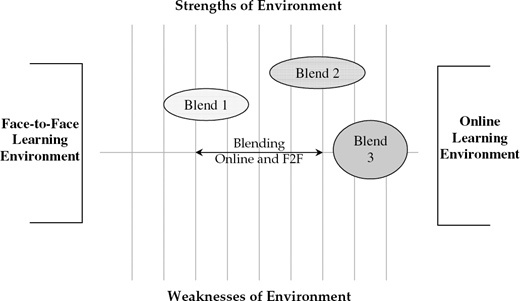
The balance between online and face-to-face components will vary for every course. Some blended courses, because of the nature of their instructional goals, student characteristics, instructor background, and online resources, will include more face-to-face than online strategies. Other courses will tip the balance in favor of online strategies, using face-to-face contact infrequently. Still others will mix the two forms of instruction somewhat equally. Figure 1 shows the various mixes that can occur in blended learning environments. The main point of the figure is that no two courses will be exactly the same. Some may emphasize asynchronous student-to-student contact (Blend 2) while others will require significant amounts of synchronous interaction (Blend 1). The aim in either case is to find that harmonious balance—the balance of instructional strategies that is tailored specifically to improve student learning.
The important consideration is to ensure that the blend involves the strengths of each type of learning environment and none of the weaknesses. Blend 3 illustrates an undesirable example of blended learning, a course that combines face-to-face and online approaches but emphasizes some of the weaknesses of each. Perhaps the face-to-face contact features a poorly-delivered lecture with no student participation, and the online portion of the course includes tedious, over-prompted forms of practice. This is clearly not the type of blended learning environment that an institution wants to offer.
Why the Term “Blended”
Some have suggested the term hybrid when referring to courses that mix face-to-face with distance delivery systems (Brown, 2001; Young, 2002).The authors prefer the word “blended”. The origin of the word “hybrid” is the interbreeding of two different species of animals or plants to create a new species. According to the Oxford English Dictionary (OED), “hybrid” is defined as follows: “Derived from heterogeneous or incongruous sources; having a mixed character; composed of two diverse elements; mongrel.” The word blend, on the other hand, focuses on the mingling together in ways that lead to a well-balanced combination—in OED's words: “To mix, mingle; esp. to unite intimately, so as to form a uniform or harmonious mixture.”
Our experience with blended learning environments shows that the instructor and designer struggle with the question of balance or harmony, perhaps, more than any other issue as they determine the nature of the course delivery method. How often will students and teacher meet face-to-face, and how often will they complete assignments online? What will be accomplished during these face-to-face meetings versus the online experiences? How often will students and teacher interact on the discussion board? What will be the purpose of such interaction? How will community be built during both types of contact? Based upon its nature, each course may have a different balance point—a different way of harmonizing delivery methods. And there is always the threat of an out-of-balance, discordant blend that frustrates both student and teacher.
What can be Blended?
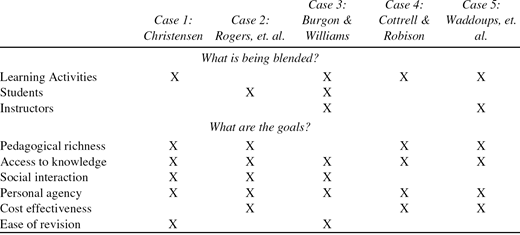
If balance and harmony are the qualities that are sought for in blended environments, one must first identify precisely what is to be mixed together. The most common way to create a blended learning system is to design part of the course for the classroom and part for the internet. For traditional courses this often results in less face-to-face class time, replaced by some type of online activity. But this is only one type of blended learning environment. The authors suggest that there are at least three elements that one might consider mixing together in a blended course:
online and face-to-face learning activities,
online and face-to-face students, and
online and face-to-face instructors.
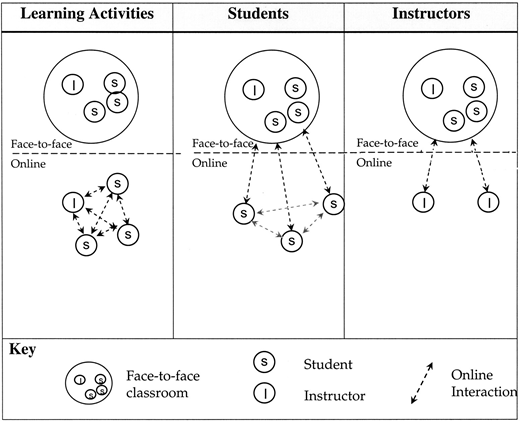
Figure 2 provides simple visual models of these three types of blends, recognizing that combinations and variations on these are possible.
The top portion of each of the models represents the learning interactions that occur in a face-to-face environment and the bottom portion represents the interactions that occur in an online environment. Arrows that cross the boundaries are interactions that connect online and face-to-face learners. The first model shows that a blended classroom can involve the same learners in both face-to-face and online activities.
The second model depicts a blend of online and face-to-face students participating in the same class with the online students interacting with the individuals in the face-to-face classroom. And the third model occurs when a face-to-face course is team taught by multiple instructors—some in-class and others from a distance.
What are the Goals of Blended Learning?
Those who are currently experimenting with blended learning environments are doing it with certain purposes in mind, and the purposes often differ from one course to another. The authors of each of the cases that follow this introduction begin by explaining what they were trying to achieve by implementing a blended system. The purposes vary widely from one case to another. And this only shows the potential of blended learning to adapt itself to different settings, students, and content. The authors have identified six goals that educators might espouse as they design blended environments:
pedagogical richness,
access to knowledge,
social interaction,
personal agency,
cost effectiveness, and
ease of revision.
As each goal is described, it will be tied to at least one of the cases described in the articles that follow.
Pedagogical Richness
Instructional designers and teachers each may employ blended learning environments for a different set of reasons. The central purpose that should drive all other motives is to improve student learning. Blended approaches permit faculty to change the way they use class time. For example, an accounting professor pre-records audio-synched PowerPoint presentations that students view online, allowing him to use class time to discuss students' questions. In his words, “This has completely changed what I do in class. I used to spend time dispensing information. Now they get that online, and we can go deeper in class than ever before.” (Swain, 2002)
Access to Knowledge
The accounting example shows that blended approaches can increase a teacher's pedagogical options—all for the purpose of helping students master the content more effectively. In addition, some teachers may use blended environments to increase accessibility to information for students. The Christensen article, for example, describes a web-based set of resources of teaching initial instructional design skills. When students encounter the unit on “instructional design models,” rather than viewing a single example—which is the common practice for textbooks—students are encouraged to compare and contrast six different design models. In addition, students may access the comments of four design experts about the design models they prefer to use in their varied professional settings. This type of access to knowledge would be difficult for a textbook to match.
Social Interaction
As Meiklejohn (1882) once said, “learning is a social act.” When students share questions, insights, and perplexities, they not only experience higher levels of mastery, but they open themselves to redefining and repositioning themselves in the world. According to Richard Rorty, this is the ultimate purpose of a liberal education—to help individuals see themselves in a new light, to help them relate to others in new and more productive ways (see Arcilla, 1995). Purely distance delivery systems limit this kind of social contact, while blended environments enhance the possibilities both in class and online. The Burgon & Williams case, for example, shows that distance learners value the interaction that the blended system afforded with other students, as well as with the instructor.
Personal Agency
From the earliest research in the field of instructional design, theorists have spoken of the importance of “learner control”—offering to students a means for directing their own learning rather than submitting themselves to the direction of the teacher or designer (Pask, 1969).The authors prefer to call this construct personal agency. If students are to develop a sense of self-directedness in their learning, they need to be given the opportunity to make choices, nontrivial decisions about what they will study and how they will study it. They need to practice exercising their personal agency. Blended delivery systems can increase the range of personal choice for learners.
Cost Effectiveness
Some emphasize the benefit of cost reduction that blended environments offer. Such proponents argue that by reducing time in class, additional tuition-paying students can enter an institution to fill the seats left vacant by those who are spending part of their time learning online. Blended approaches also offer the possibility of replacing full-time faculty involvement with less expensive part-time faculty or graduate teaching assistants. The authors are not inferring that blended approaches eliminate full-time faculty, only that some of their time may be supplemented by teaching assistants. In the Waddoups case, the institution estimated that it would be able to increase face-to-face contact with graduate students and still save approximately $100,000 on the course by using a blended system. Cost benefit analysis for course delivery systems is complex, and more experimentation needs to be completed before drawing firm conclusions, but cost savings will continue to be one of the goals of those implementing such approaches.
Ease of Revision
Most blended learning environments are developed by teachers themselves. The Waddoups case—an institutionally sponsored project—is an exception to this, but all other cases are homegrown experiments with the faculty member leading the way. This means that the online resources for the course are relatively simple, easy to change, and do not require sophisticated programming, graphic arts, or video and audio production skills. In a purely distance delivery system, the online resources are often complex and require the assistance of design and technology specialists to revise them. The experience of educators at our institution has shown that most blended environments grow out of face-to-face, rather than out of distance models. Because of this grass-roots approach to curriculum reform, emphasis is on ease of revision. Those who use blended environments want to be able to change what will happen during class time an hour before the class begins—e.g., responding to students online questions or comments. The ease of revising a blended system has the potential to create a learning atmosphere that is flexible, responsive, and spontaneous.
Five Cases
Following this introduction are descriptions of five case studies of blended learning environments. Each case is unique in the topic taught, the nature of what is blended, and the goals for creating a blended course. As shown in Figure 3, the cases have commonalities but also some distinct differences. Some blend all three components—i.e., learning activities, students, and instructors—while others blend only one. Access to knowledge and personal agency are emphasized in all five cases, while only two consciously aimed for the goal of “ease of revision.” The important point is that blended learning environments are diverse, and the five cases we've included illustrate some of this diversity. And in comparing various approaches to blended learning will come, we believe, greater understanding of how to maximize the benefits of such learning environments while minimizing the potential pitfalls.