


A methodological framework for the delivery of knowledge, performance, and learning (KPL) systems is presented. The role of the KPL system is currently taken by learning management systems or learning and content management systems, and many of these systems facilitate the technical aspects of learning objects. However, they are still rooted in the thinking that formal courses are the only solution to learning and performance problems. A framework for delivery of a system supporting knowledge, performance and learning is described and illustrated, with a focus on problem solving, analysis, and supporting performance in all its forms.
Introduction
Considerable effort has been devoted recently to development of systems or platforms that manage the learning, performance, or knowledge development processes of students and employees. These systems are generically labeled learning management systems (LMS), learning and content management systems (LCMS), performance support systems, and knowledge management systems. Many educational institutions use an LMS to manage either courseware and/or the entire learner records system. Organizations also use an LCMS designed to deliver content objects to learners. Such systems frequently also have the functionality of an LMS but are driven by underlying content object architecture. Business and industry also use LMS and LCMS but also appear to be more frequent users of dedicated knowledge and performance support systems (Rosenberg, 2000).
While systems are being developed that efficiently manage learning or knowledge or performance, it seems desirable to consider how integration of each of these areas into a single system would benefit organizations. A major challenge to developing such systems has been the degree to which they are interoperable and the components within each are reusable. Interoperable systems “talk” to one another and data or information developed in one will be recognized by another. Reuse of data or information for learning or performance solution development is considered the primary driving force behind the movement toward object-based architectures for such systems (Douglas & Schaffer, 2002).
Conceptualizations of how such solution development will actually happen in education and business/industry have begun to take shape. For example, the U.S. Department of Defense has, through its Advanced Distributed Learning Initiative (www.adlnet.org), developed the concept of a sharable content reference model (SCORM). In terms of educational pedagogy, Collis and Strjker (2002) conceive the learner as contributor of knowledge to an LCMS that is designed to capture and store various contributions for reuse by other learners. They also foresee major shifts in the economic model of the university relative to this contribution-based conceptualization of learning.
The intent of this article is to discuss a framework for developing an integrated knowledge, performance, and learning (KPL) system based on object- or component-based architecture. A model for a system to support the delivery of performance support in all its forms including knowledge and learning support systems is described.
Beyond E-Learning
Advances in technology have made integration of various types of information for the purpose of learning and performance development more viable. The Internet and World Wide Web, along with various authoring tools, have facilitated development of digital materials that are easily accessible by learners and performers. The process technology that has lagged is the pedagogy and design thinking required to make all of this digital information reusable and value-added (Clark & Meyer, 2002).
Developers of knowledge, performance, or learning management systems have already begun to integrate various types of information. It is not uncommon to find a knowledge base built into a performance support tool or LMS, or performance support built into an LMS to support a particular task such as entering a new course or adding new students to a course. Furthermore, LCMS’ are becoming object-based and will allow learners and designers to actively “pull” learning content on an as-needed basis. The development of tools to support the selection of content and to guide this kind of designing “on-the-fly” is also on the rise, as the new wave of user support tools are being designed with an object-oriented architecture in mind (Spector, 2002).
Integrating knowledge, performance, and learning within a single system requires thinking of both the whole and the parts. The learners and performers who use the system will interact with an interface that is integrative and allows them to filter and select information most important to them (Gery, 1991). The system itself will be a set of interrelated yet disparate parts that may be accessed from many different vantage points. The kinds of information made more readily available to a particular user can be determined by various user inputs such as course number, job role, function, performance objective, and organizational goal.
The KPL system supports learners and performers as they: access and construct knowledge; perform a specific task; and learn about a topic or objective. Figure 1 illustrates how these three system elements interact and collectively support organizational or institutional learning.
Such systems take many forms. The functionality of learning management systems and LCMS’ has been previously described. A knowledge management system may essentially be a digital library of artifacts such as manuals, guides, and company records that are stored in a database for retrieval on an as-needed basis. More recently, such systems support collaboration that builds and promotes sharing of knowledge across learners, roles, or organizations through the use of tools such as discussion forums and online whiteboards (Shadbolt & Wielenga, 1990). Performance support systems are typically role- or job related and guide performers as they perform specific tasks. An example of performance support could be an electronic job aid with procedures for calibrating a monitoring device in a chemical facility. These kinds of systems purport to offer users a greater level of simplicity and efficiency as they seek to manage courseware, knowledge, and performers.
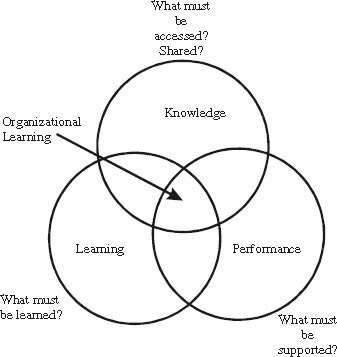
Integrating knowledge, performance and learning support
Integrating knowledge, performance and learning support
Object and the Content Repository
Object-oriented systems thinking represents the next step in the progression toward using reusable objects to create KPL systems. When developing objects, it is not sufficient to have object-oriented technologies and standards alone; it is also necessary to incorporate analysis and design thinking. By integrating object orientation and analysis, a higher level of reusability as well as adaptability, interoperability, and durability may be achieved. An object-oriented approach with a results focus applied to analysis, design, and implementation will make it easier to obtain, develop, and implement the solutions to organizational problems or opportunities.
What is an Object?
Gibbons, Nelsons, and Richards (2002), refer to a “learning object,” “educational object,” “knowledge object,” “intelligent object,” or “data object” as an “instructional object.” However, because the focus of this framework is problem solving, any learning, performance, knowledge, or instructional object is referred to as a sharable content object (SCO), taken directly from SCORM v.1.2.
The SCORM defines an SCO as “a set of representations of media, text, images, sounds, web pages, assessments objects, or other pieces of data that can be delivered to a Web client” (SCORM v.1.2). A single representation, according to SCORM 1.2, is called an asset. A single asset is unusable in an educational/performance setting but, by conjoining these assets, a shareable content object is created. A set of shareable content objects is referred to as content aggregation. Content aggregation consists of “a map (content structure) that can be used to aggregate learning resources into a cohesive unit of instruction, to apply structure, and to associate learning taxonomies” (SCORM v.1.2).
For an object to be SCORM compliant, it must meet specific criteria. Any object developed for performance/instructional purposes must be accessible, interoperable, durable, and reusable. “Without them [the criteria], anyone with a significant investment in either content or a learning system is locked in to that particular content or system” (Robson, 2001, ¶ 5).
To ensure that the criteria exist within an object, metadata are “tagged” to each asset, SCO, and/or content aggregate. Metadata are tagged to an asset, SCO, and content aggregate to ensure that during the process of content creation, the information within each is reusable as well as discoverable. By integrating metadata from the basic asset level, content aggregation will be fully accessible, durable, interoperable, reusable, and available to a repository as a “whole, autonomous unit” (SCORM v.1.2).
Figure 2 illustrates the manner in which SCO’s may be packaged to create customized performance support solution packages. In the example shown, a personal digital assistant-based (PDA) electronic performance support system (EPSS) is developed and slotted together with other solutions available to support a particular role. Other support solutions are a mentor network, which is a type of knowledge-based solution, and computer-based training, which is based on learning content.
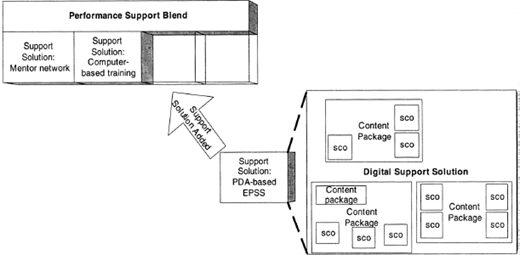
Example performance support solution blend.
Example performance support solution blend.
Why are Objects Important Within the Framework?
The reasons for using objects are simple: they enhance the resulting solution package, provide methods for standardization, and offer potential economic advantages through reuse.
There has been a growing emphasis on objects within the fields of instructional design and performance technology. Peters (1995) stated that
...objects enabled by [an] emergent artifact of digital libraries will be much more like “experiences” than they will be like “things,” much more like “programs” than “documents,” and readers will have unique experiences with these objects in an even more profound way than is already the case with books, periodicals, etc. (¶ 3)
This statement led Gibbons, Nelson, and Richards (2001) to suggest the need for “model components that can be brought together in various combinations to create the environments and systems” (p. 34) to represent a variety of problems.
A comprehensive framework combining an analysis, design, and object orientation in a sequential process would allow such problem representation. Repositories of analysis and design knowledge provide analysis and design teams with support throughout their respective processes, while a content object repository has the potential to provide designers with solution packages that match the recommend solutions identified during analysis.
Overall, objects play a very important role within this framework. They not only serve as a guide but provide both analyzers and designers with value “that in most cases will pay off many times over (in terms of costs, development time, and learning [and performance] effectiveness)” (Longmire, 2000, ¶ 3). The representation of problems as a result of collaborative and systematic analysis ensures that resulting objects created through design and development processes may be evaluated following use.
Repositories
The purpose of repositories is to support problem solvers, designers, or learners by providing a centralized location for the storage and reuse of standard artifacts and objects. An artifact generally refers to any template, documentation, data, visual model, or component of a visual model that can be accessed and used during any phase of an analysis and design process, for example. It is anticipated that standard documentation formats and modeling notations would be set for such artifacts. We envision that interlinked artifacts will exist for various levels of performance (organizational, process, and individual). For example, an object could contain specifications for the support requirements of a specific task, which will enable early identification of content objects that may be useful in the construction of customized solutions related to performance of that task.
The purpose of providing users with a repository is to create an easier, adaptable, and reusable analysis, design, and development process. This process would also support the development of organizational problem-solving capacity and ultimately link to the identification of solutions. Creating a common standard for artifacts and objects will enable the sharing of information about common problems or opportunities across different organizations.
System Development
In system and object development, there are two parallel tasks. Initially, at the systems level for each solution selected, we must decompose the system into subsystems (e.g., a course unit in the case of a training system), distribute the objects to the subsystems, and create the packaging and sequencing structure to bind the objects together. Secondly, for those analysis objects that were not matched against pre-existing objects, we must design and develop the content, package it into a SCORM-compliant object, and submit a copy to the repository. Figure 2 illustrates how these packages and sequencing structures might be bound to create support solutions.
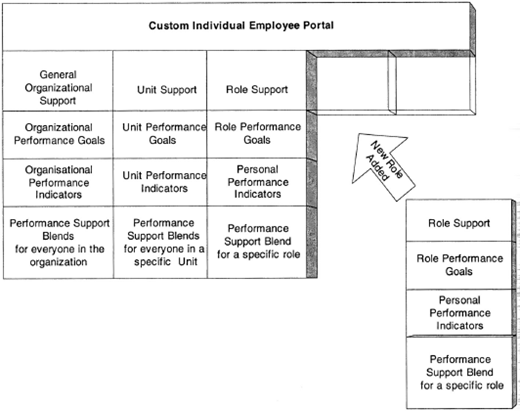
A model for the services provided by a performance support portal.
A model for the services provided by a performance support portal.
Decomposing the system into subsystems is critical if aligning the results of KPL systems across individual, functional, and organizational levels is desired. For example, in Figure 3, a custom individual employee (student) portal is modeled that illustrates the emphasis on roles that a problem solver in an organization would play rather than using the traditional job title to identify required performance. Roles often cut across traditional job title designations and may be performed by many different employees. Consider the many roles related to a formal title such as manager. Roles often include: budgeting, staffing, developing people, proposing projects, and so on. These roles may be performed by many other employees in various job titles across an organization in much the same way.
Learning organizations are able to store and share relevant knowledge, performance, and learning support related to each of these roles. Figure 3 illustrates how goals, indicators of success in achieving goals, and related support are aligned across the organization, unit (department, function), and individual levels. A new role is shown as it is being added to a particular employee’s portal. This employee has likely assumed this role as part of changing job requirements or as a member of a problem solving team.
Integrating the Silos
There is still a training-oriented bias within the standard-setting community, in that objects are conceived as learning objects. The main solution considered is computer-based training delivered through a learning management system. As noted in the introduction, the trend is towards thinking in terms of integrated solutions rather than being fixated on the training solution that assumes a knowledge or skill gap for the performer. This not only requires research into how problems are analyzed and solutions are selected, it also requires a reconsideration of how solutions are delivered and managed.
If we look at the current state of KPL support solutions, we see a lack of integration, with systems often developed and delivered independently in silos. Such silos often require that learners and performers discover, integrate, and synthesize the resources that are available to support them. This can lead to usability problems, as users have to contend with a variety of different systems with different interface designs. There may also be reduced utility in some of the systems due to the redundant, irrelevant, inadequate information. Learning management systems solve some of these problems for online learning, but they do not solve the problem for performance support in general.
A KPL is a dynamic performer/ learner-defined system that links to a database of packaged KPL support systems. Performers using personal digital assistants, wearable computers, or desktop PCs can access available system and subsystem packages. Performance managers or instructors can create a customized performance support environment for a particular individual based on the roles they will perform or tasks to be completed. We would envisage the possibility for a certain amount of re-sequencing and packaging of systems within this environment. In addition to providing customized access to available performance support systems, the management system should act as a collection point for evaluation information concerning the systems use.
Figure 4 presents an initial model for how a KPL organizational support system might work. The view shown in figure 4 is from the perspective of the performance support system. A similar, parallel view could be shown from the perspective of knowledge or learning systems.
The model features two types of repositories. At the top is the reusable analysis knowledge repository which supports problem solvers by providing access to previous problem cases. These cases are linked to objects that may be useful in solving the current problem. Another repository, the reusable solution repository, supports solution developers by linking them to potentially useful objects that are related to the problem identified in the analysis.
The core of the model is on-the-job performance or, in the case of a learning environment, learning goals. Analysis of performance roles or specific goals results in solution recommendations to close gaps between desired and actual role performance. The performance support development system locates reusable solutions if any exist, or supports the design and development of SCO’s to be packaged into a performance support system. This system is then made available to the performer via the performance support portal. This portal would automatically be made available to any performer with the responsibility of performing that role.
A key element of this model is the connection between on-the-job performance, performance evaluation, and the performance support portal. Indicators of successful performance as related to the performance support for a given role is constantly fed back to the performer. The evaluation subsystem is a key to continuously improving the quality and fidelity of the objects created within this model. Data from actual performance are relayed through the evaluation system to the performer and to the analysis team. Evaluation data are key ingredients to successful integration of KPL systems, as they allow for determination of the effect of a particular type of support systems on unit and organizational effectiveness. Over time, patterns of particularly successful solutions may be quickly identified and made accessible to performers automatically. An automated system could monitor patterns of access and use, and automatically generate and administer questionnaires to gather qualitative data from performers when certain patterns are detected.
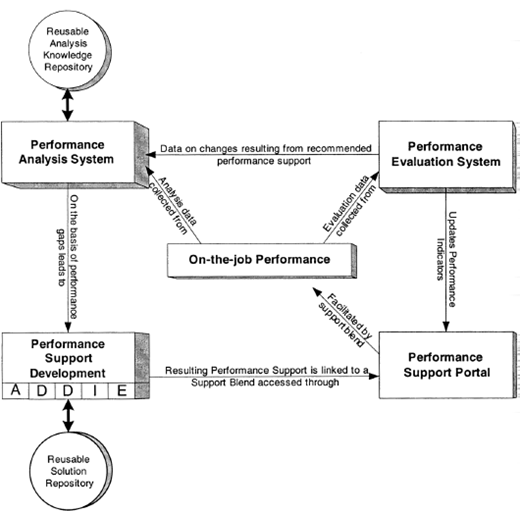
A model for a comprehensive organizational support system incorporating reuse
A model for a comprehensive organizational support system incorporating reuse
Final Thoughts
An outline of a new methodological framework for the development and delivery of knowledge, performance, and learning (KPL) management systems has been presented. The unifying strands of the framework are that it be performance-, learning-, and object-oriented. The role of the KPL is currently taken by learning management systems (LMS) or learning and content management systems (LCMS), and many of these systems are facilitating the technical aspect of learning objects; however, they are still rooted in the thinking that formal courses are the only solution to learning and performance problems. If we develop an object-oriented performance orientation in analysis, it makes sense to follow that through to the delivery of a system supporting knowledge, performance, and learning.

