


This study investigated students’ use of an asynchronous communication tool as part of a “hybrid” class that included face-to-face meetings and Web-enhanced instructional activities. The researchers analyzed communication patterns used during asynchronous discussions about class projects and case studies. Also, they examined type of interactions that occurred among and between students. Through review of online discussion transcripts, the researchers identified patterns of communication and types of interaction including how the e-board supported student learning. Findings and implications to teaching and learning were discussed.
Introduction
The availability of new technologies such as email, listservs, and computer conferencing has begun facilitating new ways of communicating in instructional settings. Several communication tools now exist to support asynchronous discussions that can be incorporated into existing classes. These tools support messaging between individuals and facilitate the ability of participants to read and respond to messages or to add their own new messages to which others can respond. Discussions can take place among individuals in widely dispersed geographic locations or among persons unable to participate in a discussion at a specific time.
In these new instructional environments, technology can be used for content transmission or as a communication support tool, or these two roles can be combined, as they often are in online learning, to support educational activities (Benbunan-Fich & Hiltz, 1999). E-learning tools can create systems that allow students to exchange messages and participate in discussions in an organized way (Hiltz & Wellman, 1997). The challenge is to design pedagogically effective learning environments in the online world in order to enhance the quality of education (Althaus, 1997).
Some researchers have identified advantages and disadvantages in implementing computer-mediated discussions as an instructional tool (Hiltz, Johnson, & Turoff, 1986; Straus & McGrath, 1994; Walther, 1996). While computer-mediated group interactions may be more focused on tasks and less on personal interactions, they also may result in greater processing time and create difficulty in consensus building. Studies have found more equal participation and more idea generation in computer-mediated environments as participants have more equal “speaking” time. Lack of structure in the online context and a reduced likelihood of leadership emerging are other disadvantages pointed to in the literature. Hiltz, et al. (1986) indicated that a leadership void may inhibit consensus building and organization of a group in approaching a problem. Farnham, Chesley, McGhee, Kawal, & Landau (2000) found that enhancing structure in an online environment contributed to higher levels of consensus and better decision-making in group activities. Some contend that asynchronous interaction improves in-depth reflection and topic development (Harasim, 1990).
Hammond (1997) looked at the use of online learning for professional development, focusing particularly on the usefulness of the medium for discussion-oriented activities. While concluding that the medium can be used effectively, Hammond also pointed to a number of issues to consider in developing online discussions. Issues such as acquiring sufficient technical skills, constraints on writing skills, reticence, and access to technology were noted; however, the author discussed in more detail the difficulty of maintaining the debate and structuring the discussion so as to provide openness and at the same time control over learning. While the instructor can initiate a discussion, there may be little control over who responds and there may be a sense of being removed from the interactions. The online tools provide convenience for participation when and where the individual likes, and thus increases opportunities for contributions. At the same time, adding structure may reduce flexibility and the sense of being “distant” may contribute to delays in participation.
Muscella and DiMauro (1995) discussed maintenance of online debates, suggesting that an assertion followed by personal experience and a statement of belief will trigger a response to a message. They also suggest starting with non-controversial topics as participants learn together in order to reduce contentiousness and build a comfortable learning environment. Use of the online medium for interactive discussions and collaborative learning has been recommended. Such strategies require students to take a more active role in the learning process (Lindeman, Kent, Kinzie, Larsen, Ashmore, & Becker, 1995).
Some researchers have analyzed online discourse from listservs and Web-based discussion groups and looked at interaction patterns (Chase, Macfadyen, Reeder, & Roche, 2002). Chase, et al. identified nine emergent themes from their sample of text discourse from an online class:
An online culture developed reflecting the values of the developer of the Web environment. That culture was maintained by the guidelines created, and by the facilitators and participants.
Formal and informal participation was affected in the online environment and distinct communication pattern differences were apparent between the two.
Individuals varied with their level of comfort in online discourse.
Individuals created their own online identity.
Technical issues and formatting influenced communication.
Participant expectations of the course, the instructor, and the medium influenced the environment.
Facilitator expectations also affected the learning environment.
Differences in communication related to the use of academic discourse versus the telling of stories or narratives were observed and created variation in participation in online debate.
Explicit and implicit assumptions about time were evident.
Another way to look at online discourse is to look at the types of communication or levels of communication that occur. Research on questioning and discussion (Dillon, 1990; Roby, 1988) has some interesting implications for examining online communication.
Discussion Behavior Classification System
For instructional purposes, it is important not only that students communicate in the online environment, but that we examine their patterns of that communication. Research on questioning and discussion (Dillon, 1990; Roby, 1988) has provided the researchers basis in developing a system for categorizing types of communication based on five patterns. Initiating patterns of communication include such things as stating an opinion or insight to get the conversation started, formulating a question to open a discussion topic, injecting a new insight or new information into an ongoing discussion, restarting a discussion by suggesting a new approach or idea not previously discussed, or asking for an opinion from someone who is not actively participating in the discussion. In a supporting communication pattern, the student may share evidence to support a position, provide an example of a concept being discussed, ask for clarification, restate a position in different words, or introduce a nuance that enriches the original information. Examples of challenging communication patterns include simple statements of disagreement, offering different opinions, or correcting facts. Summarizing patterns occur when a participant states in a concise way the essence of someone else’s remarks or condenses a whole series of remarks from different participants into a concise statement. Monitoring is defined as statements that keep the group on task and focus the discussion on the topic.
Context
This study investigated students’ use of one asynchronous communication tool used as part of a “hybrid” class that included face-to-face meetings as well as Web-enhanced instructional activities. The researchers analyzed communication patterns used during asynchronous discussions about case studies and also examined the type of interactions that occurred among the students.
Two graduate courses at two public universities (Midwest and Southeast) were the focus of a study to examine communication patterns in online asynchronous discussions. One course was in curriculum and instruction (Midwest Case) and the other in counseling (Southeast Case). Students in the curriculum and instruction course studied concepts in program evaluation and designed evaluation plans for educational programs. Students in the counseling course studied ethical and legal aspects of counseling. Students in both courses worked in teams, used case studies, and had projects and assigned readings. The two courses were traditional courses with Web-enhancements, including Web pages, chat rooms, and the use of asynchronous communication tools. An electronic bulletin board (e-board) was used to facilitate group discussions. Through review of transcripts from the e-board, the researchers looked at how students used the e-board to support online discussions, what patterns of communication emerged and what types of interactions occurred.
Methods
The researchers used a qualitative content analysis approach. Data were collected from transcripts generated on the e-board that students used during the online discussion component of the courses. For the Midwest Case, the online discussion component of the course used for this study included four group discussions. The transcript of the group discussion covered the communication and interaction that transpired between group members during the semester pertaining to the accomplishment of a group project.
For the Southeast Case, the qualitative data analyzed came from transcripts of four online class discussions of cases involving legal and ethical issues in a counseling context. The following legal and ethical issues in counseling covered in these case studies were:
question of informed consent,
confidentiality and clients with HIV/ AIDS,
question of boundaries, and
dual relationship between student and professor.
The identified categories of communication were used to code the transcripts from each of the online discussions. Initiating (I), supporting (SP), challenging (C), summarizing (SM), and monitoring (M) communications were coded using the identified definitions as a way to look at patterns in the discussion. Reponses were also coded as an initial posting (IP), response to a post (RP), reply to a response (RR), or reply to a reply (RR#) to look at interaction patterns among the students. In an initial posting, a student started a thread in the online discussion by posting a message. In a response to a post, the student responded to the initial message posted in a given thread. A reply to a response occurred when a student replied to the responses on an initial posting. A reply to a reply occurred when the student replied to one of the replies made by another student. In the discussion thread, the patterns might appear as below in Figure 1. The researchers referred to this as the Initiate-Response-Reply Framework (IRR).
Higher levels of responses and replies (level 4 is high and level 1 is low) mean more interactions among the participants in the online discussion. To summarize, the transcript data from the e-board discussions that occurred during four case-study assignments was categorized in two ways: (1) type of communication (based on identified definitions), and (2) interaction level observed (the IRR framework).
Findings
Three sets of findings are reported below. First the results of examining the comments on the e-board based on the communication patterns as defined are reviewed. Second, a summary of the interaction pattern evident in the postings and responses is presented. Third, additional patterns in the content of the discussions and the use of the e-board space that emerged during the analysis will be reported.
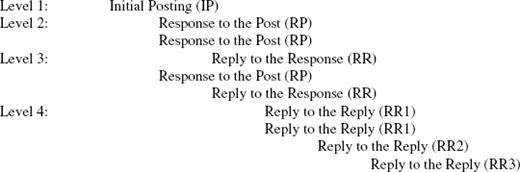
Response patterns in a discussion thread: The IRR Framework
Response patterns in a discussion thread: The IRR Framework
Patterns of Communication
One primary pattern in both cases was that of initiating responses. The Midwest Case had a high frequency of initiating communication, while initiating behavior ranked third in the Southeast Case. Examples of initiating behavior are noted below.
Initiating Example 1
What seems as such a distinct difference, formative as process and summative as final; I find (as I usually do) gray areas. Principal evaluations of teachers. Formative, right? They go on year after year in attempt to help the teacher become better and better. But, usually the evaluation is done for a specific lesson, which the principal looks at in detail and gives a summative report.
Initiating Example 2
Does a key audience have to be one individual group or could it be multiple groups?
Both cases exhibited high supporting patterns of communication. Supporting responses were the most prevalent type of communication overall and in each of the cases. Examples of comments coded as supporting are noted below.
Supporting Example 1
I agree with your decision points for the counselor. And of course, this is assuming that John disclosed his condition to his counselor. I think there are more decision points that Mary’s counselor has to make. Mary’s counselor now has the responsibility to look into John’s case to see if John told his counselor about his condition. If he did, then he is obligated to the ethical codes H.2.a., H.2.b., H.2.d., and H.2.e.
Supporting Example 2
I was working on the revision and I notice something I need clarification on. In my answer, I used the example of consumer-oriented as my Language Arts department and their evaluation of curriculum materials for an adoption next year. You said this was incorrect. In our notes, it says “evaluation of curriculum packages.” How is this different? Please clarify?
Challenging patterns seemed to emerge in both cases when controversial topics were involved. In one case, challenging communication was actually second highest in frequency. Overall, the challenging pattern was lower than initiating or supporting patterns. An example of a comment coded in the challenging category is listed below.
Challenging Example
Let’s say the counselor did know John was in a relationship with Mary, Maria, or whoever. I think Kitchener’s principle of Nonmalficence applies. The counselor was to avoid doing harm. He did not harm John but in the long run he did harm to Mary because he had a duty to inform her of the danger she was in. Also, the principal of truthfulness because informed consent is part of that. The counselor should have told John that there were limits and exceptions to confidentiality.
Both cases exhibited low monitoring patterns. An example of a comment coded as monitoring is noted below.
Monitoring Example
FYI, In case you haven’t checked the Q&A section. Dr. C. said we need to make sure that we adapt that checklist on p. 218 to meet the needs of our program evaluation. We still have to do that, right?
Summarizing communications were observed in only one of the cases (Southeast Case). An example is identified below.
Summarizing Example:
This is a great example of problems of working in rural communities with only one therapist available. I also see some similarity to what ministers and clergy must inevitably deal with: multiple relationships. What I see here that seems most striking is the counselor’s discussion on informing the parent and discussing this duality. But she did not make the same attempt with Chris who is the CLIENT. Hence, I believe he was treated in a second-class manner and the mother was given more power in the counseling process than, again, Chris the client. Also, there is the divergence of obligations due to the counselor again putting the parent’s needs before the child.
Overall, initiating and supporting communication patterns dominated the online discussions. Challenging and monitoring patterns were exhibited lower overall. However, in one case, these patterns came out higher than initiating. Summarizing occurred in only one of the cases. Table 1 provides data on the patterns of communication coded using the identified criteria.
Interaction Patterns
Responses to a posting (RP) patterns of interaction (level 2) were high in both cases. Reply to a response (RR) patterns (level 3) tended to be lower in occurrence compared to RP patterns. Only in the Southeast Case did students use level 4 replies. Certain topics seemed to generate higher levels of interactivity, perhaps due to members’ orientation and motivation. Also, time to complete an activity or discussion affected the interaction patterns with a positive relationship between level of interaction and time. In the Southeast Case, the levels of replies to replies were further developed than in the Midwest Case. The Southeast Case was the course in which some initial training occurred for students in how to use the online tools. Data are summarized in Table 2.
Topics of Discussion and Use of E-board Space
In addition to looking at the data by communication patterns and interaction levels, other patterns became apparent during the analysis. The data were sorted into five categories related to the topic or thread of the discussion (administrative, project/assignment, feedback, technology, and personal). The topic categories were developed as the analysis was done and different topic areas emerged. Table 3 summarizes the common threads in the online discussions.
Administrative threads occurred related to postings that students needed to do for the course (requirements or instructions). In the Midwest Case there was a high number of administrative postings (N = 154) compared to almost none in the Southeast Case (N = 3) (see Table 3, above). The Project/Assignment topic was related to project tasks and their completion. In both cases, the number of postings related to projects was high. Feedback was related to responses made by the instructor or other students on how students were doing with completing their projects or with administration of the e-board. Only students in the Midwest Case posted feedback comments. Technology comments related to issues with the e-board technology itself. Twenty-five such comments appeared in the Midwest Case and none in the Southeast Case. This might be attributed to initial student training in the Southeast Case. Discussion postings with topics not related to the course were coded as “personal.” While these postings were minimal, the content of the messages seemed important to the community-building aspects of the courses.
Patterns of Communication Generated by Group/Case Discussion Online
| Midwest Case | Group 1 Discussion | Group 2 Discussion | Group 3 Discussion | Group 4 Discussion | Total Postings |
|---|---|---|---|---|---|
| Initiating | 32 | 22 | 26 | 83 | 163 |
| Supporting | 38 | 25 | 29 | 92 | 194 |
| Challenging | 0 | 0 | 0 | 0 | 0 |
| Monitoring | 2 | 0 | 0 | 0 | 2 |
| Summarizing | 0 | 0 | 0 | 0 | 0 |
| Southeast Case | Case 2 Class Discussion | Case 3 Class Discussion | Case 4 Class Discussion | Case 5 Class Discussion | Total Postings |
|---|---|---|---|---|---|
| Initiating | 10 | 8 | 5 | 5 | 28 |
| Supporting | 40 | 16 | 15 | 13 | 84 |
| Challenging | 22 | 14 | 10 | 9 | 55 |
| Monitoring | 3 | 5 | 2 | 2 | 12 |
| Summarizing | 1 | 3 | 1 | 1 | 6 |
Patterns of Interaction Generated by Group/Case Discussion Online
| Midwest Case | Coding | Group 1 Discussion | Group 2 Discussion | Group 3 Discussion | Group 4 Discussion | Total Postings |
|---|---|---|---|---|---|---|
| Initial Posting | IP | 32 | 22 | 26 | 83 | 163 |
| Response to a Post | RP | 21 | 15 | 18 | 50 | 104 |
| Reply to a Response | RR | 8 | 8 | 9 | 20 | 45 |
| Reply to a Reply | RR1 | 7 | 2 | 2 | 12 | 23 |
| Reply to a Reply | RR2 | 3 | 0 | 0 | 7 | 10 |
| Reply to a Reply | RR3 | 1 | 0 | 0 | 3 | 4 |
| Reply to a Reply | RR4 | — | — | — | — | — |
| Reply to a Reply | RR5 | — | — | — | — | — |
| Reply to a Reply | RR6 | — | — | — | — | — |
| Reply to a Reply | RR7 | — | — | — | — | — |
| Reply to a Reply | RR8 | — | — | — | — | — |
| Southeast Case | Coding | Case 2 Class Discussion | Case 3 Class Discussion | Case 4 Class Discussion | Case 5 Class Discussion | Total Postings |
|---|---|---|---|---|---|---|
| Initial Posting | IP | 10 | 8 | 5 | 5 | 28 |
| Response to a Post | RP | 24 | 11 | 9 | 4 | 48 |
| Reply to a Response | RR | 20 | 9 | 6 | 3 | 38 |
| Reply to a Reply | RR1 | 13 | 7 | 5 | 2 | 27 |
| Reply to a Reply | RR2 | 5 | 3 | 3 | 3 | 14 |
| Reply to a Reply | RR3 | 2 | 1 | 4 | 3 | 10 |
| Reply to a Reply | RR4 | 1 | 1 | 1 | 2 | 5 |
| Reply to a Reply | RR5 | 1 | 2 | 0 | 1 | 4 |
| Reply to a Reply | RR6 | 0 | 2 | 0 | 1 | 3 |
| Reply to a Reply | RR7 | 0 | 1 | 0 | 3 | 4 |
| Reply to a Reply | RR8 | 0 | 0 | 0 | 2 | 2 |
Common Threads Across Online Discussions
| Midwest Case | Group 1 Discussion | Group 2 Discussion | Group 3 Discussion | Group 4 Discussion | Total Postings |
|---|---|---|---|---|---|
| Administrative | 21 | 8 | 45 | 80 | 154 |
| Project/Assignment | 19 | 27 | 9 | 46 | 101 |
| Feedback | 26 | 4 | 1 | 26 | 57 |
| Technology | 6 | 5 | — | 14 | 25 |
| Personal | — | 3 | — | 9 | 12 |
| Total Postings | 72 | 47 | 55 | 175 |
| Southeast Case | Case 2 Class Discussion | Case 3 Class Discussion | Case 4 Class Discussion | Case 5 Class Discussion | Total Postings |
|---|---|---|---|---|---|
| Administrative | — | 3 | — | — | 3 |
| Project/Assignment | 76 | 43 | 33 | 29 | 181 |
| Feedback | — | — | — | — | — |
| Technology | — | — | — | — | — |
| Personal | — | — | — | 1 | 1 |
| Total Postings | 76 | 46 | 33 | 30 |
Four common patterns of use of space were observed in both cases: social space, communication space, discussion space, and information sharing space. Social space was used when students used the e-board to share personal messages that contributed to a sense of community. This occurred in both cases, but was minimal. Communication uses included using the space for assignment-related interactions, but not content-related; for example, students discussing appropriate roles for team members or progress on individual components of the assignment, setting up meetings, and answering questions in order to complete the assignment on time. These uses occurred in both cases. Discussion use was coded when content-appropriate interactions occurred directly related to the course assignment; for example, students discussing the merits of various points in the case. These interactions facilitated collaboration and assignment completion. These were the primary interactions in the e-board space. Information sharing use included providing facts and data for team members and sharing written products for assembly into a team product. This was the second most prevalent use of the e-board space.
Summary of Findings
It seems that lower levels of communication patterns (initiating, supporting) were most evident in the online discussions. Students may need to learn new roles and new communication patterns in the online environment to stimulate the higher-level communication patterns (challenging, summarizing, monitoring). Requiring students to demonstrate these higher-level communication patterns may facilitate not only an in-depth discussion of issues but also promote metacognition; i.e., thinking about thinking.
Structuring online activities and following sound instructional design principles may lead to more synthesizing (summarizing) and challenging communication patterns. Given the Midwest Case, because the online discussion was provided to support project/assignment completion, it had a more open-ended format that limited interaction between and among group members. The interaction between members ends once a question was posted and answered by another member. In the Southeast Case, structure in the online discussion was evident because students need to prepare a report at the end of the activity. The structure in the online discussion promoted student interaction vis-à-vis expectations to be met and products to be produced.
Initial levels of response or interaction patterns were also more evident in the cases. Students were most likely to respond to an initial posting (level 2), and much less likely to reply to a response (level 3) and not likely at all to reply to a reply (level 4). Thus, the interactions appear much less like a discussion, in which conversation builds upon previous responses, and more like a question-and-answer scenario. This was particularly true in the Midwest Case. Perhaps orienting and training students in how to respond in the asynchronous e-board may lead to more complex reply and response patterns.
Administrative and technology comments appeared primarily in the course where no initial student orientation to the technology occurred. The primary topics evident related to the projects, which was appropriate. Communicating about the project guidelines and organizing group activities, discussing content, and sharing information were all achieved in the online environment. Social comments appeared to contribute to the sense of community online.
Implications for Practice
Given the findings, the researchers provide the following suggestions that may lead to enhanced communication patterns in online instructional environments. First, the researchers reiterate the need for better and increased orientation and training of students to operate in the online environment. Students should be provided with examples and criteria of “good” discussions. If possible, the instructors and their students should be allowed to have a practice session that provides opportunities for feedback on their performance as discussants online.
Second, instructors cannot assume that their students know how to discuss or behave in a discussion format. If this is a hybrid course (having a face-to-face component), the instructor can use role-play exercises to model expected online discussion behavior. If the course is totally online, the instructor can use a video streamed vignette of expected behaviors in an online discussion format. Also, instructors can discuss with their students about roles in a discussion format. Students need to be informed beforehand that they need to perform certain roles during online discussion. These roles need to be explicitly defined and accompanied by text examples. Further, instructors need to ensure that students understand the technical aspects of how to post responses may increase the higher levels of responding. Students may also need time to practice using the technology.
Third, providing structure seems to enhance the communication patterns. Instructors should select topics that lend themselves to a discussion format. In the Southeast Case, the topic to be learned (legal and ethical issues) and materials used (case studies) provided students opportunities to converse, share, argue, and challenge the views put forward in their small group or class. Also, students need specific guidelines of engagement that will help them understand the expectations for the discussion. Sharing with the students the IRR framework may help them understand how interactivity can be enhanced in an online environment. Further, students should be provided opportunities for both group interactions as well as one-on-one exchanges. Instructors can encourage their students to become reflective practitioners by asking them to include lessons learned from their experiences and to explain how they would respond to certain incidents differently given a similar scenario.
Finally, instructors who use online discussion as an instructional strategy need to pay attention to instructional design principles that enhance the learning environment. The use of online discussion should allow learners to focus on key components of what they are learning. They must be able to connect what they know prior to this experience and to make those connections to what they are currently learning. This means that students need to be active participants in the learning process and should be receiving feedback on their learning attempts. If all of these occur in a learning environment that uses asynchronous discussion areas, then student learning should result from enhanced, active, online participation.

