


Online discussions are an effective method used to enhance interactions among learners and the instructor. The study examined the differences in communication based on whether the discussions were instructor-moderated or peer-moderated and based on whether the classes consisted of undergraduate or graduate students. Results indicate that student classification had no significant effect on the level of participation in the online discussions. However, there were significant differences in the amount of student participation in the discussions that were moderated by their peers rather than the instructor.
The development of online courses has the potential to change our educational learning environment and has caused many educators to integrate technology into their courses for learning effectiveness. Courses offered via the Internet provide learning opportunities for those who have difficulty accessing traditional classrooms (Koszalka & Bianco, 2001). Students can now access courses for college credit anytime, anywhere.
The National Center for Education Statistics (1999) reported that 44% of two- and four-year degree-granting institutions offered distance education courses in 1997-98, and the number of online courses is still on the rise. Developing and delivering courses at a distance depends on faculty members’ ability to use technology to enhance the teacher/learner process, and overcome barriers to implement distance education courses and programs.
Perrin and Mayhew (2000) indicate that distance education courses might not be able to create the level of interaction achieved in face-to-face courses. However, Miller and Webster (1997) found that faculty teaching distance education courses could provide their online students with levels of interaction similar to their on-campus students. The need to pay close attention to online interaction has been emphasized in many studies (Gunawardena & Zittle, 1997; Haythornthwaite, 2001; Vrasidas & McIsaac, 1999). Moore (2001) indicated that in order to successfully deliver online courses, faculty must allow student-to-student interaction with minimal faculty intervention; engage students in regular assignments in order to monitor progress and intervene when needed; provide specialized attention to students with low levels of self-directedness; and help students become more self-directed. Current research is examining not only student-to-instructor interactions, but also student-to-student interactions. Student-to-student online interactions have become as important as student-to-instructor online interactions and in some cases are more important (Driver, 2002; Wegerif, 1998). The purpose of this study was to examine the amount of discussion that occurs when the online class discussions are instructor-moderated and when they are student-moderated, to determine if there is a significant difference in student participation based on the discussion moderator. This study was conducted using both graduate and undergraduate students, so the discussions were also examined to determine if the students’ classification (undergraduate/graduate) had a significant impact on the amount of student participation in the online class discussions. The results of this study will provide information that will aid in making online courses more learner-centered.
Literature Review
One of the main characteristics of distance learning is the separation of instructor and learner by time and geography. For distance education programs to be successful, Murphy (1997) indicated that they must provide “for appropriate and sufficient synchronous and asynchronous interaction between faculty and students and among students” (p. 8). Relan and Gillani (1997) pointed out that the asynchronous, virtual, and network features of Web-based instruction can facilitate constructivist learning approaches. Kozalka and Bianco (2001) stated that this support of the learning process can be achieved by providing multiple means of presenting instruction, information, and activities. The achievement of this variety in instructional design can best be accomplished through instructor involvement and intervention.
Online Interaction
Effective learning environments often require some type of social interaction. A number of studies (Moore, 1989; Northrup & Rasmussen, 2000) classified interaction as engagement in learning through
interaction among students, which refers to the student’s relationship with other students in the class,
interaction between students and instructor, which refers to interaction between the learner and the creator of the subject material, and
interaction between students and content, which refers to the student’s relationship with the course materials.
While many studies have focused on one or the other type of interaction, Fulford and Zhang (1993) concluded that “overall interaction dynamics may have a stronger impact on learners’ satisfaction than strictly personal participation. Vicarious interaction may result in greater learner satisfaction than would be the divided attention necessary to ensure the overt engagement of each participant” (p. 9). Their findings may suggest that students perceive interaction as a general characteristic of a class that could be attained in a variety of ways, with some ways being more effective than others. The level of interaction among students and between students and their instructors has a major impact on the quality of Web-based instruction and, therefore, it is crucial that distance educators have a clear understanding of how to promote interactivity in their online courses.
Different levels of interactivity are embedded within both content and social interaction (Gilbert & Moore, 1998). Increasingly, studies have emphasized linking online communication technology with the context of learning (Crook, 1994). For example, online discussion technology can be a major means for fostering the development of collaborative skills among learners (Harasim, 1993; Kaye, 1995). To create instructionally sound collaborative tasks for online use, Bernard, Rubalcava, and St-Pierre (2000) indicated that several factors must be taken into account. Bernard and Lundgren-Cayrol (2001) indicated the need to “…create positive interdependence among students, which is also a necessary ingredient for successful collaborative learning” (p. 244). Hiltz and Wellman (1997) recommended that optimal Web-based learning environments “…create the feeling of a true ‘class’ or group of people learning together…and support carefully planned collaborative learning activities…” (p. 47). The moderator plays an important role in the successful development of the collaborative learning environment (Rohfeld & Hiemstra, 1995).
Discussion moderators
There is a limited amount of research that examines the use of student moderators, and comparisons between student-moderated discussions and instructor-moderated discussions are even more limited. Jordan (1999) examined the use of student moderators within a listserv discussion. Student moderators were not actual students in the course and the listserv was open to anyone who wanted to join, so the online discussion wasn’t a structured element of the specific course examined in the study. Students indicated that serving as the discussion moderator was a rewarding experience. Jordan’s findings prompt speculation that if the moderating experience was rewarding for students not enrolled in the class, then the experience might be even more rewarding for students who are enrolled in the class. Jordan concluded that student moderators can provide technical leadership and create a welcoming online environment as new members enter the discussion.
Requiring students to serve as moderators can positively effect online discussions (Cifuentes, Murphy, Segur, & Kodali, 1997; Poole, 2000; Tagg, 1994). Rohfeld and Hiemstra (1995) argued that the effectiveness of online discussions is dependent on the instructor and student being involved in both the teaching and learning. The role of the moderator is to maintain the flow of the discussion. Tagg found that the instructor and student moderators complemented one another. Using Feenberg’s (1989) typology of moderator functions (Figure 1), Tagg delineated between the moderating functions that were more appropriate for student moderators and those functions that were more appropriate for the instructor. Student moderators were given the responsibility of opening the discussion and setting the agenda, both contextualizing functions, while the instructor was better suited to perform the monitoring functions of encouragement and guidance. Even though the students served as moderators, there was still an obvious instructor presence in the discussions, such that there was an instructor-student team approach to discussion moderation.
Poole (2000) also examined the role of student moderators with a class that met completely online. The instructor presented material on a course topic and then students completed a quiz related to the topic. After completion of the quiz, a student moderated an online discussion on the topic just completed. So the instructor performed the contextualizing functions that the student moderators performed in Tagg’s (1984) study. In Poole’s study, the student moderators were given the responsibility of performing the monitoring functions, which Tagg described as instructor functions. Poole found that the discussions moderated by students created a more learner-centered environment and also empowered the students. The number of discussion postings also exceeded expectations, but one potential confounding factor was the creation of a fictitious class member. This fictitious class member usually posted content that “generated lots of discussion among class members” (p. 173). Therefore, it is unclear what role the peer moderators played and what role the fictitious class member played in generating the greater than expected number of postings. Yet, Poole did conclude that the moderator role enhanced the sense of community among the students, because all students served in the moderator role.
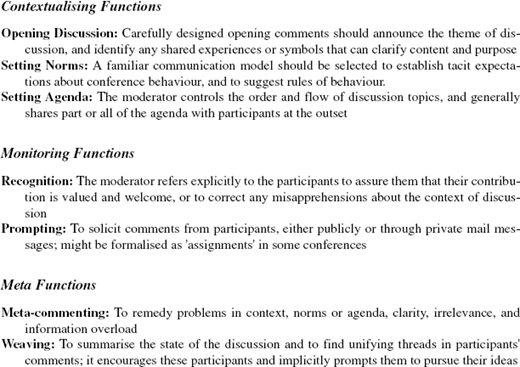
Summary list of the contextualizing and monitoring moderator functions identified by Feenberg (Source: Feenberg, 1989, 35)
Summary list of the contextualizing and monitoring moderator functions identified by Feenberg (Source: Feenberg, 1989, 35)
By moderating discussions, students take an active role in the course and it forces the instructor to move away from the role of teacher (Poole, 2000; Tagg, 1994). But, in all of these studies, the instructor is still playing an outward role either in the discussions or the introduction of the discussion material. It is still unclear what effect peer moderation has on the level of discussion when the peer moderator is responsible for performing both the contextualizing and monitoring functions.
Methodology
This research study was carried out using undergraduate and graduate technology education courses offered at a major southeastern university. These courses were offered online and there were no face to face components in any of these courses. One of the undergraduate courses dealt with the use of telecommunications in the K-12 classroom. The other undergraduate course was an office systems technology course related to effective online communications. The graduate course dealt with issues in distance education. All of these courses were offered using the WebCT courseware package. All three courses were taught by the same instructor. As part of the course, a number of discussions related to the course content served as required elements of the course. Some of these discussions were moderated by the instructor and others were moderated by the students in the class. As a required element of the courses, each student was required to select and introduce a topic related to the course curriculum and moderate an online discussion related to the selected topic. Rather than provide students with a list of topics to choose from, students were responsible for determining the topic they would introduce and discuss, the only criteria being that the topic had to be related to the course curriculum and it had to have the instructor’s approval. The approval of the instructor was necessary to make sure that students had selected a topic that related to the course and to make sure the topic could be researched and developed into an online discussion. Some of the instructor-led discussion topics included social equality online, Internet privacy, and learning styles in distance education. Examples of discussion topics that students selected to moderate included technology course requirements for undergraduates, women on the Internet, and distance learning and disabilities. The instructor was also a participant in the student-moderated discussions. Each student moderated only one discussion per class and the instructor moderated six discussions in each class. Initially, the instructor-moderated discussions were the only discussions occurring. Student-moderated discussions began during the fourth week of classes. There were times when only student-moderated discussions were occurring, and other times when both student-moderated and instructor-moderated discussions were occurring.
The purpose of this study was to determine if there was a difference in the frequency of student contributions when the discussions were instructor-moderated versus when the discussions were peer-moderated. As mentioned previously, in Tagg’s (1994) study, the students were responsible for performing Feenberg’s (1989) contextualizing functions, because he indicated that the instructor is more adept at carrying out the monitoring functions of encouragement and guidance. Poole (2000) took the opposite approach in her study, because the instructor performed the contextualizing functions. In this study, the peer moderators were expected to perform both the contextualizing and monitoring moderator functions. Demographic information as well as student reflections related to the course and online discussions were also gathered.
Characteristics of Students
There was a total of 61 students in the three classes. In the two undergraduate courses there were 37 students (20 in the education oriented class and 17 in the office systems-oriented class) and 24 students in the graduate course. Even though the two undergraduate classes were oriented toward a certain degree program, students pursuing other degrees were permitted to enroll in these classes (Table 1). The majority of the participants were female (82%); more specifically, approximately 88% of the graduate students were female and approximately 78% of the undergraduate students were female. In terms of ethnicity, 62% of the students identified themselves as Caucasian, while 35% of the students identified themselves as Black, and one student was identified as American Indian/Alaskan Native. The ethnic composition of the undergraduate students was 68% Caucasian and 32% Black, while the ethnicity of the graduate students was 54% Caucasian, 42% Black, and 4% American Indian/Alaskan Native.
The majority of students in the three classes fell into three age categories: under 23 (21%), 23-27 (26%), and over 42 (26%). These same three age categories also made up the majority of the undergraduate students, where 32% of the students were under the age of 23, 24% of the students were in the 23-27 age range, and 22% of the students were over 42. Among the graduate students, the two main age groupings were the 23-27 age range (29%) and the over 42 age group (33%). The grade point average of the undergraduate students was relatively evenly distributed ranging from 2.01 to 4.00, with one student falling below this range. The majority of the undergraduate students were majoring in either office systems and technologies or elementary education (Table 2). The majority of the graduate students were working towards a master’s degree (58%). Instructional technology was the most prominent concentration for the master’s students. All of the doctoral students were pursuing Ph.D. degrees in education with an emphasis in educational technology.
Demographic Data of Participants
| General Characteristics | Undergraduate | Graduate |
|---|---|---|
| Gender | ||
| Female | 29 | 21 |
| Male | 9 | 3 |
| Ethnicity | ||
| Caucasian | 25 | 13 |
| Black | 13 | 10 |
| American Indian/Alaskan Native | 0 | 1 |
| Age | ||
| Under 23 | 12 | 1 |
| 23-27 | 9 | 7 |
| 28-32 | 2 | 2 |
| 33-37 | 4 | 3 |
| 38-42 | 2 | 3 |
| Over 42 | 8 | 8 |
| GPA | ||
| 4.0-3.51 | 11 | 18 |
| 3.50-3.01 | 8 | 3 |
| 3.00-2.51 | 9 | 2 |
| 2.50-2.01 | 8 | 1 |
| 2.00-1.51 | 1 |
Program of Study by Classification
| Undergraduate Program of Study | |
| Office Systems & Technologies | 10 |
| Elementary Education | 9 |
| Business Information Systems | 5 |
| Interdisciplinary Studies | 5 |
| Technology Teacher Education | 2 |
| Undeclared | 2 |
| Secondary Education | 1 |
| Sociology | 1 |
| Computer Science | 1 |
| Gen Business Admin | 1 |
| Graduate Program of Study | |
| Masters | |
| Instructional Technology | 9 |
| Technology | 3 |
| Undecided | 1 |
| Education Specialist | 1 |
| Doctor of Philosophy | 10 |
Findings
Within the three classes there was a total of 2326 postings with an average of 38 postings per student and 31 postings per discussion. Each discussion averaged 9.8 discussion threads and each discussion thread averaged 2.1 levels. Initial t-tests were performed to examine differences in computed means for the total number of postings, the total number of original postings, and the total number of follow-up postings based on classification (Table 3) and discussion moderator (Table 4). The t-test analysis based on classification indicated that there was no significant difference in the frequency of overall postings based on classification. In addition, the test indicates that there wasn’t a significant difference between the two groups in terms of initiating discussions and following-up or replying to the postings of their peers.
The t-test analysis comparing the discussion moderators (Table 4) indicated that there was a significant difference in the number of postings between instructor-moderated and student-moderated discussions. Students participated significantly more when the discussions were student-moderated as opposed to instructor-moderated (p < .01). Analysis related to differences in original postings and follow-up postings indicated that there was no significant difference in the number of original postings based on the discussion moderator. However, students responded to each other significantly more in the student-moderated discussions as opposed to the instructor-moderated discussions (p < .001).
A multivariate analysis of variance was used to explore the interaction between student classification and moderator leader with respect to the number of total postings, the number of original postings and the number of follow-up or reply postings. Significant multivariate effects were obtained for discussion (Pillai’s Trace = 0.124, F(2,117) = 8.297, p < .01) and for the interaction effects of discussion and classification (Pillai’s Trace = 0.124, F(2,117) = 8.288, p < .002). Analysis of the univariate effects demonstrated a significant effect for the discussion moderator on the total number of postings (F(1,118) = 6.978, p < .01), the number of original postings (F(1,118) = 5.697, p < .05), and the number of follow-up postings (F(1,118) = 11.863, p < .001). In addition, the interaction between classification and discussion moderator was found to have a significant effect on the total number of postings (F(1,118) = 7.059, p < .01) and the number of original postings (F(1,118) = 13.403, p < .001). The interaction did not indicate a significant effect on the number of follow-up postings. In addition, classification had no significant effect on any of the posting categories examined (Tables 5-7).
Based on these results, whether the students were graduate students or undergraduate students had no significant effect on the number of postings made by an individual student during the course discussion. This may be due to the fact that distance learners are found to be highly motivated (Simonson, Smaldino, Albright, & Zvacek, 2003). However, who the moderator is does appear to have a significant effect on not only the total number of postings, but also on the number of original and follow-up postings made by students. Interestingly, the students tended to have more overall postings and follow-up postings in the student-moderated discussions, but had more original postings in the instructor-led discussions. This could indicate that there are fewer and longer discussion threads in the student-moderated discussions, but further research will need to be completed to determine if this is the case. The findings do indicate that students preferred posting and responding in the student-moderated discussions as opposed to the instructor-moderated discussions.
T-test Analysis of Postings Based on Classification
| Undergraduate | Graduate | |||||
|---|---|---|---|---|---|---|
| Postings | M | SD | M | SD | t-value | p |
| Total number of postings | 40.49 | 35.36 | 41.75 | 36.60 | -0.133 | 0.894 |
| Total number of original postings | 14.32 | 9.94 | 15.25 | 7.51 | -0.389 | 0.693 |
| Total number of follow-up postings | 26.19 | 32.39 | 26.50 | 34.43 | -0.36 | 0.972 |
T-test Analysis of Postings Based on Discussion Moderator
| Instructor-led | Student-led | |||||
|---|---|---|---|---|---|---|
| Postings | M | SD | M | SD | t-value | p |
| Total number of postings | 9.23 | 8.55 | 18.00 | 19.51 | -3.22 | 0.002** |
| Total number of original postings | 5.25 | 3.05 | 3.95 | 5.73 | 1.56 | 0.122 |
| Total number of follow-up postings | 3.98 | 7.40 | 14.05 | 18.94 | -3.87 | 0.000*** |
p<.01;
p<.001
Two-Way ANOVA for Classification and Discussion Moderator on Total number of Postings
| Source of variation | Sum of squares | df | Mean square | F | Sig. |
|---|---|---|---|---|---|
| Classification | 1.036 | 1 | 1.036 | 0.005 | 0.945 |
| Discussion Moderator | 1518.719 | 1 | 1518.719 | 6.978 | 0.009** |
| Classification * Disc. Mod. | 1536.293 | 1 | 1536.293 | 7.059 | 0.009** |
| Error | 25681.458 | 118 | 217.639 |
p<0.01
Two-Way ANOVA for Classification and Discussion Moderator on Total number of Original Postings
| Source of variation | Sum of squares | df | Mean square | F | Sig. |
|---|---|---|---|---|---|
| Classification | 40.359 | 1 | 40.359 | 2.133 | 0.147 |
| Discussion Moderator | 107.775 | 1 | 107.775 | 5.697 | 0.019* |
| Classification * Disc. Mod. | 1536.293 | 1 | 1536.293 | 7.059 | 0.009** |
| Error | 2232.260 | 118 | 18.917 |
p<.05;
p<.01
Two-Way ANOVA for Classification and Discussion Moderator on Total number of Follow-up Postings
| Source of variation | Sum of squares | df | Mean square | F | Sig. |
|---|---|---|---|---|---|
| Classification | 28.463 | 1 | 28.463 | 0.139 | 0.710 |
| Discussion Moderator | 2435.640 | 1 | 2435.640 | 11.863 | 0.001** |
| Classification * Disc. Mod. | 541.608 | 1 | 541.608 | 2.638 | 0.107 |
| Error | 24227.766 | 118 | 205.320 |
p<0.01
In examining the postings of the student moderators, the researchers looked for examples of Feenberg’s (1989) moderating functions. One moderator began her discussion with confusion, before setting the context. In her moderation of a discussion on spam, “Diane” intentionally posted a message that appeared to be unrelated to the discussion topic (italicized text indicates author changes to maintain anonymity):
Posted by Diane
Subject spam
Just heard a way I could sign up for classes and get a guaranteed A, so since this is an on line communication class I felt obligated to share this with my classmates. I didn’t realize our university would approve something like this but I have checked it out. Here’s the site and pass it along. gradshif.xom Another thing that hits college students and working folks, bad credit occasionally, get your debts wipe away at nucredlife.xom Just thought before I get into my subject on spam, I would let my hard working friends in on these secrets. Let me know how you come out once you check out the sites. I’ll check back and don’t forget to pass the info around. You wouldn’t want your friends to miss out on a chance of being Suma Cum Laude, would you?
As she expected, the students began posting messages indicating they weren’t able to access the sites indicated, in desperation one student finally posted:
Posted by Peggy
Subject Re: spam
Diane, I think we are all screaming HELP! It seems that nobody can get into those sites.
Peggy
Then later that day, another student caught on to what Diane had done:
Diane,
HA hahahaha I love it. I got half way through your message and realized what you had done. Brilliant example! Reads just like all those messages I get in my junk mail.
It’s very easy to get sucked into spam messages, especially when they come from friends. You will be thinking you got a real message from them and it turns out to be some advertisement that was forwarded to you just to keep the e-mail alive.
Jeff
After Jeff’s posting, the discussion on spam took off and Diane proceeded to provide background information and asked her peers to identify their experiences with spam. Diane’s opening and subsequent postings demonstrate them as contextualizing functions identified by Feenberg, which Tagg (1994) indicated as functions well suited for student moderators.
Tagg (1994) indicated that peer moderators couldn’t perform the monitoring functions effectively. Analysis of the discussion postings also showed clear examples of student moderators performing monitoring functions. Travis was moderating a discussion on partnerships in distance education and had raised the issue of funding for such endeavors. A fellow student related her personal knowledge and experiences related to the funding issue and Travis replied:
Posted by Travis
Subject Re: Collaboration
Carol:
You possess some insight that I do not, which is not unexpected since I am not from this state. Did you happen to discuss distance learning with any officials at university X? Did they give you any idea as to what their future plans are for distance learning?
For the rest of you, I sense that some of you are K-12 teachers. Are you aware of collaborations existing at that level in distance learning. One thought that I had along those lines (and I realize this is not distance learning) regards my profession of law enforcement. I am seeing many regional jails where counties are combining to share resources and operate one jail for several counties. Do you envision something similar happening in distance education between county school boards?
Regards, Travis
In this posting, Travis clearly displays an example of Feenburg’s (1989) monitoring functions by referring explicitly to the participant and recognizing the backgrounds of other participants in the discussion (recognition) Travis then develops the discussion further by soliciting comments from other discussion participants about what they envision for the future in their professional arenas (prompting) related to funding.
In discussing the moderating functions, Feenberg (1989) indicated the importance of having one person be responsible for performing these functions in order to keep the discussion alive, but he also indicated that “discussions are most absorbing and successful when the members of the group share these functions with the moderator” (p. 36). When analyzing the postings, there were indeed examples of discussion participants also performing moderating functions. Below is an example of a discussion thread related to the effectiveness of distance education, which wasn’t posted by the student moderator. The first posting beginning the thread is an example of a contextualizing function and then the peer’s response to this new thread is an example of a monitoring function:
Posted by Kayla
Subject First Discussion Topic
I feel that some courses would be quite difficult to take through a distance learning environment. For example more difficult courses such as engineering, harder mathematic courses, etc. that require a lot of explanation. I also feel that it takes a very special type person to do well in an online course. They have to be a student that can organize their time wisely and most of all not be the type person to procrastinate.
I feel that your performance in an online situation can be just as effective, if not more effective, as your performance in a traditional classroom. Actually, in an online setting, you are able to work at your own pace and it probably wouldn’t be as stressful as if you were in a traditional classroom setting with limited class time and the stress caused by knowing that someone is monitoring you constantly.
Also, in numerous readings that I have come across, they say that females tend to perform better and are much appreciative of online classes than males.
Posted by Tanner
Subject Re: First Discussion Topic
Kayla:
Your post triggered a thought that we haven’t really discussed here. What if a particularly difficult course is offered and the student needs tutoring on the side. How will that be accomplished? On campus, it’s relatively easy to find upper classmen (pardon the term) or graduate students willing to tutor. However, when you live In The Middle Of Nowhere, USA, that may not be available.
Regards, Tanner
Kayla has added a new element to the effectiveness of distance education, by introducing the topic of whether some content areas lend themselves more to the distance learning environment than others (contextualizing function). Tanner then responds to Kayla’s posting by specifically addressing her by name and then expanding on her thought by bringing up the topic of accessing tutoring for courses (contextualizing & monitoring functions). The use of contextualizing and monitoring functions among not only the moderators, but also the discussion participants as well, may help to explain the significant differences found in the amount of discussion. This would be consistent with Wegerif’s (1998) research on the importance of the social dimension in online learning.
Conclusions
Despite the increasing asynchronous and synchronous avenues of communication, a major concern is the lack of personal interaction between the professor and student (Roberson & Klotz, 2002). Hiltz and Wellman (1997) spoke of the importance of planned collaborative learning activities for class or group identity. The use of student-moderated discussions can be one way of developing planned collaborative learning activities for an online class. Further research needs to be completed to identify other factors that can contribute to and enhance online discussion, such as possible predictors that contribute to the amount of discussion. In addition, a content analysis of discussions in future classes where this technique is used will help us to attain a better understanding of the dynamics of the online discussions that are occurring. The content analysis will help us obtain a better understanding of the context in which postings, both original and follow-up occur. Along these same lines, a sequence analysis of messages and responses similar to the one performed by Jeong (2003), shows great promise in helping to develop a greater understanding of what people are saying and how they are saying it in online discussions. Jeong’s Discussion Analysis Tool has the potential to provide new insight into the different levels of the threaded discussions. The state transitional diagram combined with social network theory also has the potential to further analyze the flow of the online discussions. The rapid advancement in technology and communications has changed the way we teach and the opportunities students have for learning. As a result, distance education has deeply affected the form and structure of our teaching and learning in both the face-to-face and distance education environments as we strive to effectively use these communication and learning avenues to promote collaborative learning.

