


Introduction
E-learning, sometimes referred to as online learning, Web-based learning, distance learning, and technology-based learning, among other names, is a concept that has garnered significant global attention (Gotschall, 2000; Hall, 1997). Though the history of e-learning (primarily distance learning) dates to the early 1950s and even before (Clark, 2000; Rosenberg, 2001; Saba, 1999), not until the last 8 years has it become a momentous, collective imperative of several entities. This broad attention to e-learning has resulted in numerous e-learning reports. In doing extensive Web searches for e-learning reports, the researchers estimate that more than 250 e-learning reports, excluding white papers, have been released worldwide over the last 3 years by governments, business, academia, and professional associations.
Problem Statement
The significance and relevance of technology and education has gained momentum; research on e-learning is imperative. The discourse on e-learning has focused on topics such as the effectiveness of e-learning (Harasim, Hiltz, Teles, & Turoff, 1996; Strommen & Lincoln, 1992; Webster & Hackley, 1997), evaluation of distance education (Clark, 2000; Magalhaes & Schiel, 1997; Thomas, 2000), e-learning issues (Banas & Emory, 1998; Jonassen, 1992; Sherry, 1995), comparison of traditional and online learning (Ponzurick, France, Russo, & Cyril, 2000; Saba, 1998), and learning needs of organizations and their human resources amidst the technological, social, and economic forces affecting the world (Gotschall, 2000; Karon, 2000; Wentling, Waight, & King, 2002). Though not exclusive, and with little synthesis existing among these topics, the importance and challenges of e-learning is omnipresent.
Because e-learning is imperative for government, business, academia, and professional associations, and because these institutions are major players in the advancement of e-learning, it is important to recognize and synthesize what these institutions say about the purpose and features of—and trends in—e-learning. This basic information can be the foundation for focusing research on e-learning. Thus, this narrative analysis of e-learning reports focuses on the following questions:
What is the purpose of e-learning reports?
What are features of e-learning?
What are the trends affecting e-learning?
Conceptual Background
E-learning is the acquisition and use of knowledge distributed and facilitated primarily by electronic means. This form of learning currently depends on networks and computers, but will likely evolve into systems consisting of a variety of channels (e.g., wireless, satellite), and technologies (e.g., cellular phones, personal digital assistants) as they are developed and adopted. E-learning can take the form of courses as well as modules and smaller learning objects. E-learning may incorporate synchronous or asynchronous access and may be distributed geographically with varied limits of time (Wentling, Waight, Fleur, Wang, & Kanfer, 2000).
The history of the technological revolution reveals that of all the sectors of society, education has lagged in its integration of information technologies (Strommen & Lincoln, 1992). The initial slow integration of technology into education can be a derivative of the early visions of distance education. Matthews (1999) indicated distance education was first and foremost a movement that sought not so much to challenge or change the structure of higher learning, but to extend the traditional university and to overcome inherent problems of scarcity and exclusivity.
As we moved into the twenty-first century, this vision of distance learning changed, as the delivery of education now extends to commercial centers. Along with personal productivity software, Windows environments, local area networks, client-server computing, the Internet, intranets, and extranets has come the introduction of personal digital assistants (PDAs), and mobile and wireless technologies. These technological advances have enabled electronic commerce systems, anytime/anyplace data retrieval and updating, education, professional development, and the rapid growth of e-learning (Close, Humphreys, & Ruttenbur 2000; Wentling, Waight, & King, 2002; Webster & Hackley, 1997).
As the integration of technology and education becomes addressed and as innovative information technology continues to surprise us, it is critical that a systemic approach to the organizational, process, and individual (Rummler & Brache, 1992) issues such as insufficient empirical research, minimal application of research to practice, and application of traditional instructional design and teaching methods, need to be addressed. In addition, the ineffective use of technology, the absence of the learner in the instructional design, antiquated policy, inadequate online teacher training, and intellectual property are other issues affecting the effective integration of technology and education. Swanson (1999) related that a wide range of systemic disconnects adversely affect performance. McNamarra (2001) noted that “a system is a collection of part unified to accomplish an overall goal. If one part of the system is removed, the nature of the system is changed as well” (p. 1). Awareness that there are multiple factors that need concerted, consistent attention is crucial if e-learning is to move from promise to practice. Learning and performance need to be seen, by every organization that implements e-learning, as outcomes of all the resources that go into any e-learning effort. To collectively achieve learning and performance in all e-learning initiatives, a strong partnership needs to be recognized and realized among all individuals and institutions involved in e-learning.
At present, the systemic disconnects run across four main institutions: government, business, academia, and professional associations. Very few studies, for example, capitalize, extend, or review existing research studies. Even more so, very few studies move from research to practice. Thus, e-learning continues to be plagued by learner, faculty, and administrative issues. The issue of learner interaction, for example, has been researched in various but limited contexts (Moore & Thompson, 1990, 1997; Ponzurich et al., 2000; Sherry, 1995; Thomas, 2000; Webster & Hackley, 1997). E-learning reports, another example, are growing in number, and they are coming from different entities. We do not know, however, what is common across these reports. Simply stated, there is presently a flurry of e-learning research projects, but few, if any, are making an impact on practice.
Methodology
This study is the first part of a three-phase research project on e-learning. The phases are: identifying e-learning themes, identifying research directions of e-learning, and comparing themes and research directions between U.S. and European e-learning reports. The major method of data collection used in this first phase was Web searches using the Metacrawler, Yahoo!, Google, and Lycos search engines. The reports were content-analyzed to identify recurrent themes. Content analysis is a research technique for systematically examining the content of communications, in this case, the e-learning reports (Gall, Borg, & Gall, 1996).
Selection of Reports
Public e-learning reports published in the United States in the years 1999-2001 were examined. Reports in this study do not include research articles; they represent reports written by a group or organization. The reports used in the analysis needed to have some sort of impact on the knowledge base in e-learning. Thus, the reports most commonly cited were considered significant and these reports were generally the most recent.
To identify the e-learning reports, the researchers searched the Web extensively using Metacrawler, Yahoo, Google, and Lycos. Understanding the dynamic nature of the Web, an estimated 250 e-learning reports were published worldwide from 1999 to 2001. Of these, at least 100 were published and are presently sold by private companies for prices between $100 and $3,000. Of the remaining 150, at least 70 reports were published outside of the United States. The researchers reviewed research articles, white papers, and e-learning portals to identify which among the remaining 80 reports were the most-cited reports. Fifteen reports were the most recurrent and their sources were government, business, and professional associations. These 15 reports altogether contained 1,169 pages. The following is a description of the reports and their sources.
Government Reports
President's Information Technology Advisory Committee (February 2001). Using information technology to transform the way we learn. Report to the president. http://www.itrd.gov/pubs/pitac/pitac-tl-9feb01.pdf
U.S. Department of Education (December 2000). e-Learning: Putting a World Class Education at the Fingertips of all Children. http://www.ed.gov/about/offices/list/os/technology/reports/e-learning.html
Web-based Education Commission (December 2000). The Power of the Internet for Learning: Moving from Promise to Practice. http://interact.hpcnet.org/webcommission/index.htm#report
US Department of Labor (September 1999). Futurework: Trends and Challenges for Work in the 21st Century. http://www.dol.gov/asp/programs/history/herman/reports/futurework/report.htm
Business Reports
Bank of America Securities. Education Industry Overview (September 1999). The e-bang Theory. http://www.masie.com/masie/researchreports/ebang.pdf
Wit Capital (August 1999). The e-Knowledge Industry. E-Knowledge: New Ways to Build the New Economy. http://www.witcapital.com/research/reports/eknow_19990811/eknow_990811.pdf
WRHambrecht+CO (March 2000). Corporate e-learning: Exploring a New Frontier. http://www.wrhambrecht.com/research/elearning/ir/ir_explore.pdf
Thomas Weisel Partners (January 2000). Riding the big waves. http://www.masie.com/masie/researchre ports/b2breport.pdf
Suntrust Equitable Securities (March 2000). E-learning and Knowledge Technology. http://www.masie.com/masie/researchreports/e-learn0.pdf
Morgan Keegan & Co (June 2000). The Engine of the Knowledge Economy. http://www.masie.com/masie/researchreports/elearning0700nate2.pdf
Merrill Lynch & Co April, 1999). Distributed Learning: Building Schools Without Walls. http://www.e-commerce.research.ml.com/30209833.PDF
Association Reports
Commission on Technology and Adult Learning -ASTD, NGA (June 2001). A Vision of e-learning for America's Workforce. http://www.nga.org/cda/files/elearningreport.pdf
ASTD Report. http://www.masie.com/masie/researchreports/ASTD_Exec-Summ.pdf
Hodgins, H. W. (2000). Into the Future. A Vision Paper. Commission on Technology & Adult Leaming. American Society for Training & Development (ASTD) & National Governors’ Association (NGA). http://www.intemettime.com/itimegroup/astd_web/index.htm
Software & Information Industry Association (SIIA) (2001) Trends Shaping the Digital Economy 2001 Summary. http://www.TrendsReport.net/summary/summary.pdf
Analysis of Reports
The first level of analysis involved reviewing the first three pages of the reports for their sources. Second, the researchers reviewed the reports for keyword and phrases by using ThemeWeaver content analysis software, developed by the Automated Learning Group (ALG) at National Center for Supercomputing Applications (see Figure 1). ThemeWeaver is a text mining application that is supported by the Text-to-Knowledge (T2K) modules library, the Data-to-Knowledge (D2K) core modules library, and the D2K execution engine—all of which are ALG research products. ThemeWeaver employs an intuitive user interface that guides users directly to important, isolated information typically discarded when a traditional statistical-based search engine is used. It delivers “clustered knowledge” to the user, enabling rapid information exploration and convergence on relevant information. ThemeWeaver's data clustering is built on an object-oriented foundation based on semantic elements that are extracted from text and multimedia. Upon receipt of a query, ThemeWeaver will return a clustering of semantic elements from the data that are related to that initial query. The user can then interactively explore the meaningful elements in these clusters.
Some of the themes that ThemeWeaver produced were: training technology, learning learner, information, workers work, time technology, technology learning, training time, work user learning, and performance learning technology. Figure 1 shows the theme results of one search using ThemeWeaver.
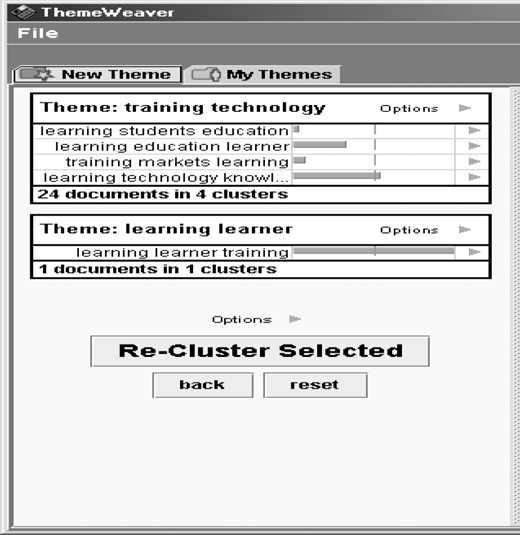
Theme results of one search using ThemeWeaver
Theme results of one search using ThemeWeaver
Third, the researchers used NVivo, a qualitative software tool, to further understand the keywords produced by ThemeWeaver. NVivo produced the specific paragraphs where the keywords appeared in the reports. The researchers then reviewed the paragraphs to understand the context of the keywords and phrases. This review led to the identification of the research questions:
What are the purposes of e-learning reports?
What are features of e-learning?
What are the trends effecting e-learning?
The fourth level of analysis was content analysis of the reports using the research questions as keywords. The researchers independently reviewed each report by research question. Emergent themes were ranked by their frequency of mention and were ultimately categorized. A quantitative method in the form of frequencies and percentages supported the qualitative data.
Results
Research Question 1: What are the purposes of e-learning?
The analysis revealed six purposes among the 15 reports. Table 1 provides a description of the purposes and their frequency.
Upon reviewing the reports, the most recurrent purpose was to inform investors about e-learning opportunities. The seven business reports provided detailed descriptive business models to inform investors of the strengths and weaknesses of the e-learning market. The second most recurrent purpose was on learning, workforce, and workplace. Five reports provide an in-depth picture of the changing nature of the learning, the workforce and workplace and how e-learning positions itself in this change. Looking at informing policy makers, educators, employers and the public, this purpose was found in all the government reports. Overall, associations’ reports looked at the workforce and workplace, while business dealt with investment opportunities, and government paid more attention to policy makers, educators, employers, and the public at large. Concertedly, however, “learning, workforce and workplace” and “discuss the contribution of technology to learning” purposes were dealt with by government, business, and professional associations.
Purpose of e-learning
| No. | Purposes | n | % | Government | Business | Professional Association |
|---|---|---|---|---|---|---|
| 1 | Inform (help) investors about e-learning opportunities | 7 | 46.6 | 7 | ||
| 2 | Discuss learning, the workforce and the workplace | 5 | 33.3 | 1 | 1 | 3 |
| 3 | Inform policy makers, educators, employers, and the public about e-learning | 4 | 26.6 | 4 | ||
| 4 | Identify the key drivers/players of e-learning | 4 | 26.6 | 4 | ||
| 5 | Discuss the contribution of technology to learning and performance | 4 | 26.6 | 1 | 2 | 1 |
| 6 | Identify major trends and winning strategies | 3 | 20.0 | 3 |
Features of e-learning
| N | Features | N | % | Government | Business | Professional Association |
|---|---|---|---|---|---|---|
| 1 | Anytime, anywhere | 15 | 100 | 4 | 7 | 4 |
| 2 | Cost effective | 15 | 100 | 4 | 7 | 4 |
| 3 | Reach global customers | 15 | 100 | 4 | 7 | 4 |
| 4 | Just-in-time access to needed knowledge | 15 | 100 | 4 | 7 | 4 |
| 5 | Personalization | 15 | 100 | 4 | 7 | 4 |
| 6 | Improved collaboration and interactivity | 15 | 100 | 4 | 7 | 4 |
| 7 | Addresses learner diversity | 11 | 73.3 | 4 | 5 | 2 |
| 8 | Learner-centered | 9 | 60.0 | 4 | 3 | 2 |
| 9 | Working and learning lines blur | 7 | 46.6 | 1 | 4 | 2 |
Research Question 2: What are the features of e-learning?
The analysis revealed nine major features of e-learning among the 15 reports. Table 2 provides a description of the features and their frequency.
Of all the research questions, the most recurrent themes surfaced in question 2. Six features of e-learning were identified in all 15 reports. This communicates that the government, business, and professional associations see e-learning as being anytime/anywhere, cost effective, as having a global reach, is just-in-time, allows personalization, and improves collaboration and interactivity. All these descriptors tell of a vision of integrating technology into education and how learning and performance can be facilitated. Learner diversity, identified 11 times, was seen as a major breakthrough for e-learning because of technology that could be used to support e-learning. Learner diversity was included but was not exclusive to learning styles, location, experience, skills, language, and learning pace. Of the nine reports that identified the learner-centered feature, the government reports were unanimous while, of the seven reports that cited the lines of working and learning disap pearing, four of the seven business reports were unanimous on this issue.
Research Question 3: What are the trends affecting e-learning?
The analysis revealed that 19 trends were recurrent in the 15 reports. Table 3 provides a description of the trends and their frequency.
Seven trends appeared in all 15 reports. These trends all capitalize on technology, education, the human capital, and the intertwined impact of these three. E-learning was also identified in 12 reports as a mechanism for sustaining the growth of intellectual capital, while 10 reports cited the introduction of business models on e-learning by investors. Along this topic, the growth of the e-learning market, the need for private and public partnerships, and e-learning becoming a core educational experience were mentioned in nine reports. That corporate universities are growing and that education has been the least affected by technology were cited by one report from each category. Overall, the trends show that e-learning is moving forward and that the business as well as the education aspects holds promise.
Discussion and Conclusion
The content analysis of the 15 reports revealed basic but significant information. Although the results from this study touch only the tip of the e-learning iceberg, it holds significance for many professionals researching or writing about e-learning. In essence, this basic study gives educators, researchers, and developers from all institutions a quick glance into the recurrent themes of 1,169 pages of e-learning reports. Given that the study is in its first stage, the study provided a peripheral insight into the purpose, e-learning features, and trends of 15 reports. The second part of this study will focus on the research directions of e-learning as indicated by the reports government, business, and professional associations. The last part of the study will compare themes and research directions between the U.S. and European reports.
Trends Affecting e-learning
| No | Trends | N | % | Government | Business | Professional Association |
|---|---|---|---|---|---|---|
| 1 | Lifelong learning | 15 | 100 | 4 | 7 | 4 |
| 2 | Improvements in technology | 15 | 100 | 4 | 7 | 4 |
| 3 | Demand for high level skill workers | 15 | 100 | 4 | 7 | 4 |
| 4 | Pervasiveness of computers | 15 | 100 | 4 | 7 | 4 |
| 5 | Globalization | 15 | 100 | 4 | 7 | 4 |
| 6 | New technologies bring new way of learning | 15 | 100 | 4 | 7 | 4 |
| 7 | Technology will improve the quality of learning | 15 | 100 | 4 | 7 | 4 |
| 8 | A way of sustaining and maintaining the human capital in the knowledge economy | 12 | 80 | 3 | 6 | 3 |
| 9 | Innovative business models that can attract investment in technology-based instructional materials and methods | 10 | 66.6 | 1 | 7 | 2 |
| 10 | Public and private partnerships will be a major requirement | 9 | 60 | 3 | 4 | 2 |
| 11 | e-learning market is growing | 9 | 60 | 1 | 7 | 1 |
| 12 | A core educational experience | 9 | 60 | 4 | 3 | 2 |
| 13 | Shortening product development cycle | 7 | 46.6 | 7 | ||
| 14 | Corporations are the fastest to explore and adopt e-learning at a large scale | 4 | 26.6 | 3 | ||
| 15 | e-learning movement is strong in corporate learning | 3 | 20 | 3 | ||
| 16 | Corporate universities are growing | 3 | 20 | 1 | 1 | 1 |
| 17 | Education is the only aspect of society least affected by technology | 3 | 20 | 1 | 1 | 1 |
| 18 | Accessibility to Internet and e-learning may not be as wide spread in disadvantaged areas | 3 | 20 | 2 | 1 | |
| 19 | Branding of content | 2 | 13.3 | 2 |
From this part of the study, it can be concluded that the government, business, and professional associations converge in many aspects of e-learning. The integration of education and technology will be strengthened as technology improves and leaders in private and public institutions create partnerships to improve learning and performance. Learning and performance are outcomes of e-learning that hold promise, given the identified features of e-learning. The learner will have control of the learning, a model that has been advanced as the most appropriate in an online environment (Harasim et al., 1996; Jonassen, 1992). The just in time, anywhere/anytime capabilities will be topped off by the opportunities for collaboration, interactivity, and personalization. All reports indicate an agreement that a paradigm shift in the way education is viewed and delivered has occurred. In essence, the perceptions of learning have undergone radical change.
Therefore, as business organizations discuss the growing markets of e-learning and develop business models to attract investors, the government targets policy makers, educators, employers and the public at large, and while professional organizations focus on the workforce and workplace, it is imperative that all three entities become aware of their convergences and divergences. As Banas and Emory, (1998) stated, “while there is a growing recognition of and attention to distance learning in higher education, its growing inclusion in academia significantly changes the educational environment and experience. These changes need to be acknowledged and discussed by all stakeholders” (p. 5). This study opens the door to a much-needed discussion—the research directions of e-learning.
Implications
The first implication of this study is for all educators and researchers as they write grants or conduct research on e-learning. The findings are basic, but help to create a reflection of how different entities are approaching their e-learning discussions. Second, this study gives e-learning practitioners a snapshot of the e-learning features and trends that they can use to assess their e-learning environments, and provides practitioners with a basic synopsis about e-learning that they can use to create collaborative partnerships that can impact their deliverables in their respective organizations.
The third implication of this study is the need for more research. This study, although preliminary in its findings, highlighted recurrent themes in purpose, features, and trends across government, business, and professional associations. Reports from academia, however, were unexplored, a source that needs to be reviewed. In addition, the results of this study are limited to public Web-based reports. Thus, research that includes all types of reports is necessary. The last implication is for professionals directing government, business, academia, and professional associations’ e-learning efforts. This study's preliminary findings show that there is some overlap in their purposes, features, and trends. It is important that each stakeholder is cognizant of each other's efforts and that they work together to move the e-learning promise to a practice that underlies learning and impacts performance.

