


This study describes an investigation of the intellectual property policies of a stratified random sample of public and private Carnegie Doctoral Research-Extensive Universities. University policies were examined to determine whether or not they included provisions for distance education materials or courseware, what provisions were made for ownership, and what exceptions, if any were applicable. Using a framework based on earlier work, policy differences between public and private universities and changes across time were analyzed. Results were interpreted in terms of the need for explicit policies to support online course development and delivery.
OVERVIEW AND INTRODUCTION
The purpose of this study was to investigate current intellectual property policies of doctoral research universities with respect to copyright ownership of online course materials. As the proliferation of distance-learning opportunities continues in this era of educational accountability, educators, administrators, and institutions need to ensure that institutional policies protect and support an environment that fosters creativity, productivity, and academic freedom. This study provides a foundation upon which to analyze, critique, and further develop coherent and comprehensive copyright and ownership policies at academic institutions.
This research is intended to build on the findings of Lape (1992) and Packard (2002) by analyzing current copyright policies and specifically focusing on faculty intellectual property ownership issues related to courseware and other educational digital media. Online courses are flourishing at institutions of higher learning. The National Center for Education Statistics reported: “In 2000–2001, 90 percent of public 2-year and 89 percent of public 4-year institutions offered distance education courses” (Waits & Lewis, 2003, p. iii). In addition, Growing by Degrees: Online Education in the United States, 2005, reported: “The overall percent of schools identifying online education as a critical long-term strategy grew from 49% in 2003 to 56% in 2005” (Allen & Seaman, 2005, p. 2). The trend toward online courses raises questions about the ownership of course materials and can increase tensions between faculty members and their universities regarding rights and responsibilities associated with intellectual property. These questions and tensions are especially important issues for digital resources because of the portability of such courses. As Twigg (2000) pointed out, “there has never been much need to figure out if one party owned a course as a commodity that could be sold elsewhere. But information technology and the Internet appear to have changed the status quo” (p. 1).
BACKGROUND
Previous research suggests university policies are in a state of flux. For example, Lape (1992) investigated 70 research universities and found that 11 had no written policy and 5 had only draft policies. Less than 10 years later, Packard (2002) studied the same sample of universities and found that all but one had adopted a policy. In both studies, all of the policies that were analyzed asserted the university’s claim to ownership of at least some faculty works. The typical justification for such ownership was that faculty works were created with university resources.
Of note is that Lape (1992) found 16 policies that disclaimed ownership of “traditional” scholarly works and Packard (2002) found 49 policies with such disclaimers. However, only 12 universities in the latter study evidenced policies giving explicit control of educational materials to faculty. The American Association of University Professors (AAUP) takes the position that the traditional practice of faculty copyright ownership of academic work should extend to courseware that is used in distance education, but does admit that there are situations in which a college or university could claim copyright ownership (AAUP, 2006).
With the implementation of distance learning through digital delivery tools such as courseware, electronic mail, and other Internet technologies, care must be taken to ensure that both faculty and institutional rights are provided for. In fact, the AAUP’s Statement on Copyright recommends that ownership, control, and use rights be negotiated in advance and contained in a written agreement (AAUP, 2006). The statement further articulates that except in unusual circumstances, academic work is not “work made for hire,” and that while faculty should retain copyright ownership, the institution should be reimbursed for
unusual financial or technical support. That reimbursement might take the form of future royalties or a nonexclusive, royaltyfree license to use the work for internal educational and administrative purposes. Conversely, where the institution holds all or part of the copyright, the faculty member should, at a minimum, retain the right to take credit for creative contributions, to reproduce the work for his or her instructional purposes, and to incorporate the work in future scholarly works authored by that faculty member. In the context of distance-education courseware, the faculty member should also be given rights in connection with its future uses, not only through compensation but also through the right of “first refusal” in making new versions or at least the right to be consulted in good faith on reuse and revisions. (AAUP, 2006, p. 216)
While the Association of American Universities (AAU) generally concurs with the AAUP’s statement regarding traditional copyright ownership for textbooks, journal articles, and other scholarly works regardless of medium, the AAU sets forth the following policy guidelines on Intellectual Property and New Media Technologies (AAU, 1999):
The university should own the intellectual property when substantial use of facilities or financial support is provided.
Works are inherently collaborative in nature, so returns should be shared among scholars, scientists, schools, departments and the larger university.
Any generated revenue should be reinvested in new initiatives.
The works should protect the university’s name and reputation when that work is presented as sponsored by the institution.
The institution should provide its community with a formal written policy
Until revenue approaches a stated threshold, the faculty member or researcher should be able to receive the entire returns.
COPYRIGHT LAW
Article I, § 8 of the U.S. Constitution provides Congress with the power “to promote the Progress of Science and useful Arts, by securing for limited Times to Authors and Inventors the exclusive Right to their respective Writings and Discoveries.” The first Copyright Act was passed in 1790, and there have been a number of subsequent revisions.
Copyright is an author’s independent and original expression recorded in a fixed and tangible form. As soon as the copyrighted material is recorded in a tangible format, such as a manuscript or an electronic file, it automatically becomes protected; however, registration with the U.S. Copyright Office provides additional protections in case of infringement and is often in the best interest of the author if infringement becomes an issue. A copyrighted work can be reproduced, adapted to create derivative works, distributed, displayed, or performed in public by the author. The author can also transfer rights to others. If copyrighted material is reproduced without the permission of the owner, the violator can be liable for copyright infringement. Some examples of copyrightable works are poems, software, and multimedia materials. In the context of copyrightable works in an academic setting, with which this paper is primarily concerned, examples consist of books, scholarly publications, syllabi, PowerPoint files, Web-based course content, and lecture notes.
Work Made for Hire
A revision to the Copyright Act in 1909 specified that the “author” of a copyrightable work “shall include an employer in the case of works made for hire” (Copyright Act of 1909, §26), however “work made for hire” was not defined. In the 1976 revision to the Copyright Act, work made for hire has two definitions, the first of which is “a work prepared by an employee within the scope of his or her employment” (Copyright Act of 1976, 17 U.S.C § 101). In 1989, the U.S. Supreme Court concluded that an individual is an “employee” for the purpose of the work made for hire provision when the copyrighted work is created in a traditional employer-employee relationship, characterized by factors such as a long-term employment relationship with salary and benefits for the employee, the employer provides the work resources and space to produce the copyrightable material, and the employer assigns the work schedule and projects (Committee for Creative Non-Violence v. Reid, 1989). The second definition is
a work specially ordered or commissioned for use as a contribution to a collective work, as a part of a motion picture or other audiovisual work, as a translation, as a supplementary work, as a compilation, as an instructional text, as a test, as answer material for a test, or as an atlas, if the parties expressly agree in a written instrument signed by them that the work shall be considered a work made for hire. For the purpose of the foregoing sentence, a “supplementary work” is a work prepared for a publication as a secondary adjunct to a work by another author for the purpose of introducing, concluding, illustrating, explaining, revising, commenting upon, or assisting in the use of the other work, such as forewords, afterwords, pictorial illustrations, maps, charts, tables, editorial notes, musical arrangements, answer material for tests, bibliographies, appendixes, and indexes; and an “instructional text” is a literary, pictorial, or graphic work prepared for publication and with the purpose of use in systematic instructional activities. (17 U.S.C. § 101)
Faculty Exception
Faculty have traditionally benefited from an exception to the work for hire doctrine even though they may enjoy a long-term employment relationship, with benefits covered by academic institutions, are assigned a teaching and research load by the employer, and use university resources to produce their work. This exception was established by case law subsequent to the 1909 revision of the Copyright Act (see, for example, Williams v. Weisser, 1969).
The exception reserved to faculty work was often explained by academic institutions’ policy, custom, and effort to promote academic creativity and freedom of thought and expression. Traditionally, faculty members have been free to select their research agenda, course materials, and presentation materials.
But when the Copyright Act was amended in 1976, no faculty exception to the work for hire doctrine was incorporated therein. While some concluded that this omission meant that the faculty exception had been eliminated, others took the view that a specific provision was not necessary inasmuch as the faculty exception was so widely acknowledged to exist (Townsend, 2003). Townsend (2003) supports this theory by comparing two cases, Weinstein and Hays, both of which influence current court decisions. In Weinstein v. University of Illinois (1987), the court found that an article written by a professor did not fall within the categories specified by the university’s copyright policy for university ownership and, therefore, the copyright belonged to the professor. In so holding, the court recognized the existence of a historical academic exception, while noting that the revisions to the Copyright Act did not incorporate any such wording. Likewise, in Hays v. Sony Corporation of America (1988), the court did not reach a decision based on the existence of an academic exception, but it strongly suggested that the exception still exists.
Lape (1992) asserted that “the 1976 Act did not disturb the professors’ exception from the work-made-for-hire doctrine; to the extent that such an exception ever existed, it continues to exist” (p. 246). Nevertheless, since the statute is silent on the faculty exception and there has been no definitive case law subsequent to the 1976 Copyright Act revision, ownership rights to faculty materials should be clarified in writing.
PREVIOUS RESEARCH ON INTELLECTUAL PROPERTY POLICY
Stretching over a decade, two previous studies sought to document the rights of university professors as they related to the creation of intellectual work. Lape (1992) and Packard (2002) reviewed the policies related to intellectual property rights policies of 70 Research I universities. They found that a primary reason for a university to claim a faculty member’s work is the use of a substantial amount of university resources in the work’s creation. There are many variations to the definition of “substantial” across the universities, but Lape (1992) found that 42 of the 70 universities studied included this type of claim. Packard found that this number increased to 52 universities in 2002.
In cases of disagreements about claims of ownership, some policies delineate arbitration processes to be followed to resolve such disputes. In the policies that address arbitration, most rely on a committee of some sort within the university system to make judgments and clarifications. The Lape study does not provide numbers, but Packard notes that 33 of the reviewed institutions require this type of inhouse arbitration. It is also interesting to note here that both studies found that many policies contained conflicting information, and were poorly worded with confusing language and undefined terms.
There was a shift in addressing “academic freedom” across the two studies. Lape (1992) found that 26% of the university policies recognized academic freedom for professors, while Packard (2002) found that 42% of the university policies recognized academic freedom almost 10 years later. This corresponds to a change in protection of what a university policy defines as traditional scholarly work. In 1992, 23% of the universities studied protected this work. This figure rose to 71% in 2002.
The “work made for hire” concept is used by many universities to define what faculty work can be owned by the university. The number of universities using this justification jumped from 25 to 37 from Lape in 1992 to Packard in 2002. It is important not to look at just these numbers in comparison, but also at how the university defines work made for hire. Some define this work as it relates to the first definition of “work made for hire” under the Copyright Act while others have created their own unique definitions within their policies and may even require faculty member signatures before they begin such work.
Packard found that 34 universities include software in some way in their policies. Almost ten years earlier, Lape found that 19 policies listed computer programs in their policies. Intellectual property issues associated with software and other electronic materials are more complex with the growing number of online courses and programs at universities, and the increasing use of technology by faculty members to administer their courses. The advent of digital formats may affect how universities define traditional scholarly work in future policies. It is also not clear how well university policies hold up under the scrutiny of the courts. The outcome of future cases will likely mean changes in how these policies are written and enforced.
DIGITAL COURSE MATERIALS
In the context of distance education, some institutions and faculty tend to face an impasse when no policy is present to dictate who owns produced materials. One of the reasons advanced for university ownership is that digital course content development often consumes a significant amount of institutional resources such as instructional design and multimedia time, server space, management and maintenance, specialized software, and other infrastructure-related expenditures. Conversely, faculty members devote considerable time and effort, and wish to be recognized accordingly to help fund and develop their future research and publications.
One element that complicates matters is that materials developed by faculty with institutional resources can easily be transferred through digital media, and can rapidly reach large audiences. Therefore, the need to have a clear understanding of who owns the digital materials becomes extremely important to ensure creators are compensated appropriately, institutions are awarded a return on their infrastructure and other investments, and both conflicts and frustration are minimized for everyone.
METHOD
A stratified random sample of 42 Carnegie Doctoral Research-Extensive universities was drawn, consisting of 28 public universities and 14 private universities. A sample of 42 policies provides statistical power of .80 for tests of differences in proportions, if the effect size is at least medium (Cohen, 1988) and provides 95% confidence intervals that are no larger than ±13%. Although some of the universities are the same as those studied by Lape (1992) and Packard (2002), many are different because Carnegie classifications have changed over the years. However, the sample for each study represents the top classification of research universities at the time. This research design represents a cohort study (a separate sample selected from the population of top research universities at each time point) rather than a panel study (the same sample of institutions followed across time.
Copyright and intellectual property policy documents were obtained from university Web sites (Appendix A). In some cases, more than one Web document was located for a single university. Common locations for the policies included faculty rules, administration rules, faculty manuals or handbooks and, in some cases, a stand-alone Intellectual Property policy.
A preliminary framework for content analysis was developed based on the work of Lape (1992) and Packard (2002). The preliminary framework resulted in 36 categories, including copyright, compensation, use, portability, third-party licensing, and exclusions/limitations. Additional themes (focusing on distance education) were then incorporated into the framework. The final worksheet used to code the universities’ policies contained 40 categories. It is attached as Appendix B. Coding was limited to yes, no, or not mentioned.
Eight researchers worked on coding the university policies using the 40-item framework. After extensive discussion and agreement on terms by the entire research team, each university’s policy was independently coded by two individuals who then resolved any differences in item ratings. Inter-rater agreement for these data was 87%.
RESULTS
The results of this study are presented in three sections: an analysis of differences between public and private research universities in the 2005 sample, an analysis of policy changes across the three samples, and a description of the typical research university policy in 2005.
Public Versus Private Research Universities
The initial analysis of the universities’ policies investigated differences between public and private institutions. The framework percentages by type of university are displayed in Table 1. Differences in sample percentages were tested using a chi-square test of independence for each item in the framework.
Of the 40 items in the framework, only three items evidenced statistically significant differences between public and private universities: claiming works created with substantial resources, explicit statement of commitment to academic freedom, and citation of the works made for hire aspect of the Copyright Act (Figure 1).
Although a majority of both types of institutions claimed works created with substantial resources, a significantly larger percentage of private universities (93%) asserted such claims than did public universities (64%). Similarly, 79% of the private universities in the sample claimed works made for hire pursuant to the Copyright Act or within the scope of employment in their copyright policies, while only 46% of the public universities did so. In contrast to these aspects of the universities’ policies, 100% of the private universities’ policies stated a commitment to academic freedom, but only 64% of the public universities included such a statement.
Policy Changes Across Time
The framework percentages by year are displayed in Table 2. Differences in sample percentages were tested using logistic regression for each item in the framework (logistic regression was used instead of the usual Pearson chi-square because the former allows the overall test of significance to be disaggregated into specific contrasts between pairs of years). Although the analysis of public versus private universities suggested few differences, the analysis of policy changes across time indicated that statistically significant differences were obtained on 26 of the 40 items in the framework.
Intellectual Property Policy Characteristics of Public and Private Research Universities
| Institution Type | ||
|---|---|---|
| Policy Characteristic | Private | Public |
| Online policy | 100% | 100% |
| U claims some faculty works | 100% | 93% |
| U claims works created with any university resources | 36% | 36% |
| U claims works created with substantial resources* | 93% | 64% |
| U defines substantial resources | 71% | 50% |
| U disclaims ownership of traditional scholarly works | 93% | 93% |
| U lists exceptions to (J) | 79% | 68% |
| U includes courseware or DL materials in definition of scholarly works | 36% | 43% |
| U cedes control of syllabi, tests, notes, etc. to professors | 50% | 50% |
| U includes materials posted on the Web in (M) | 36% | 29% |
| U says it is committed to academic freedom or free dissemination of ideas* | 100% | 64% |
| U claims ownership using academic freedom as basis | 14% | 4% |
| U distinguishes computer programs from other works | 79% | 61% |
| U has separate policy dealing with software | 29% | 25% |
| U treats computer programs under patent policy | 36% | 29% |
| U has separate policy or section for distance learning courses or courseware | 21% | 21% |
| U claims ownership of courseware or distance learning materials | 50% | 29% |
| U claims works produced due to specific, direct, or written job assignment/duties | 64% | 82% |
| U claims works produced by persons hired to produce such works | 86% | 71% |
| U claims commissioned works | 57% | 71% |
| U claims works for hire pursuant to Copyright Act or within scope of employment* | 79% | 46% |
| U considers work made for hire to be extra work assigned to professor | 14% | 32% |
| U requires work made for hire agreement to be signed before work begins | 21% | 25% |
| U claims joint ownership | 21% | 29% |
| U claims royalty-free license | 64% | 43% |
| U offers to share a percentage of royalties | 93% | 96% |
| Provisions for allowing professors to control use of a work within university | 21% | 25% |
| Policy allows professors to revise their works | 14% | 32% |
| Policy grants authors right to continued use for nonprofit academic purposes | 29% | 21% |
| Policy grants authors the right to make derivative works | 14% | 21% |
| Policy gives professors unilateral control of work licensed for use outside university | 7% | 14% |
| Copyright ownership transfer to professor if commercialization or publication does not take place within period of time | 43% | 50% |
| Even if ownership transfers to professor, university retains license or right to derivative work | 43% | 21% |
| Committee decides ownership | 57% | 54% |
| Binding arbitration | 21% | 4% |
| Administration settles disputes | 71% | 61% |
| Agreement signed by professor | 29% | 46% |
| Agreement signed by university | 14% | 25% |
| Policy provides provisions for enforcement | 43% | 29% |
| Policy contains undefined terms, inconsistencies or vague language | 36% | 39% |
* p < .05
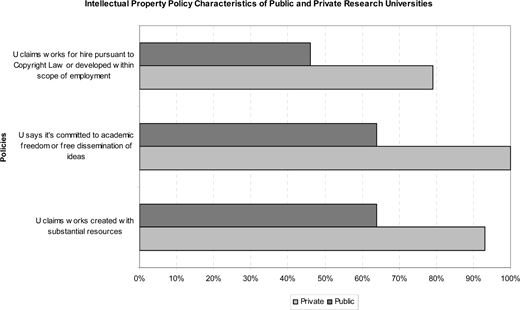
Significant Differences Between Public and Private Universities
Significant Differences Between Public and Private Universities
The percentage of universities with adopted policies increased from 77% in 1992 to 100% in 2002 and remained at 100% in 2005. Further, policies that claim at least some faculty works increased from 77% in 1992 to 100% in 2002, then dropped slightly to 95% in the 2005 sample (with both the 2002 and 2005 sample percentages being significantly larger than the 1992 sample). Policies that claim works produced with “substantial resources” increased significantly from 60% to 83%, then reduced to 74% in 2005 (a decrease that was not statistically significant). Conversely, the 2005 sample evidenced a significantly larger percentage of policies that explicitly defined substantial resources (57%, vs. 23% and 29% for 1992 and 2002, respectively).
Policies that disclaimed ownership of traditional scholarly works increased from 23% to 71%, and further increased to 93% in the 2005 sample. A similar pattern of significant increases across each of the 3 years was evident for the percentage of policies that contain explicit statements of commitment to academic freedom (26%, 42%, and 74% for 1992, 2002, and 2005, respectively).
The percentage of policies addressing software and computer programs showed no change between 1992 and 2002, but increased significantly in 2005. Specifically, policies that distinguished computer programs from other works increased from 27% and 28%, to 67%; and separate policies dealing with software increased from 7% (in both 1992 and 2002) to 26% in 2005. Finally, the treatment of computer programs under the patent policy increased from 6% and 3%, to 31% in 2005.
The 2005 data evidenced significant increases in the percentage of policies that asserted university claims to works produced as a result of specific, direct, or written job assignments or duties (76% vs. 36% and 54% for the earlier years). Similarly, policy statements claiming works produced by persons hired to produce such works increased from 13% and 17%, to 76%; and the claiming of commissioned works increased from 14% and 33%, to 67% in 2005. Finally, the inclusion of works made for hire claims increased from 9% in 1992, to 26% in 2002, and to 57% in 2005.
Changes in Intellectual Property Policy Characteristics Between 1992 and 2005
| Year | |||
|---|---|---|---|
| Policy Characteristic | 1992 | 2002 | 2005 |
| Adopted Copyright Policy* | 77% | 100% | 100% |
| U claims some faculty works* | 77% | 100% | 95% |
| U claims works created with any university resources | — | — | 36% |
| U claims works created with substantial resources* | 60% | 83% | 74% |
| U defines substantial resources* | 23% | 29% | 57% |
| U disclaims ownership of traditional scholarly works* | 23% | 71% | 93% |
| U lists exceptions to (above)* | 3% | 1% | 71% |
| U includes courseware or DL materials in definition of scholarly works | — | — | 40% |
| U cedes control of syllabi, tests, notes, etc. to professors* | — | 17% | 50% |
| U includes materials posted on the Web in (above) | — | — | 31% |
| U says it is committed to academic freedom or free dissemination of ideas* | 26% | 42% | 74% |
| U claims ownership using academic freedom as basis | — | — | 7% |
| U distinguishes computer programs from other works* | 27% | 28% | 67% |
| U has separate policy dealing with software* | 7% | 7% | 26% |
| U treats computer programs under patent policy* | 6% | 3% | 31% |
| U has separate policy or section for distance education courses or courseware | — | — | 21% |
| U claims ownership of courseware or distance education materials | — | — | 36% |
| U claims works produced due to specific, direct, or written job assignment or duties* | 36% | 54% | 76% |
| U claims works produced by persons hired to produce such works* | 13% | 17% | 76% |
| U claims commissioned works* | 14% | 33% | 67% |
| U claims work made for hire pursuant to Copyright Act or within scope of employment* | 9% | 26% | 57% |
| U considers work made for hire to be extra work assigned to professor | — | — | 26% |
| U requires work made for hire agreement to be signed before work begins | — | — | 24% |
| U claims joint ownership* | 26% | 7% | 26% |
| U claims royalty-free license* | 14% | 23% | 50% |
| U offers to share a percentage of royalties* | 66% | 72% | 95% |
| Provisions for allowing profs to control use of a work within university* | 7% | 10% | 24% |
| Policy allows professors to revise their works | 10% | 14% | 26% |
| Policy grants authors right to continued use of work for nonprofit academic purposes | — | — | 24% |
| Policy grants authors the right to make derivative works* | 1% | 9% | 19% |
| Policy gives professors unilateral control of work licensed for use outside university* | — | — | 12% |
| Copyright ownership transfer to professor if commercialization does not take place* | 9% | 23% | 48% |
| Even if ownership transfers to professor, U retains license or right to derivative work | — | — | 29% |
| Committee decides ownership | — | 48% | 55% |
| Binding arbitration | — | 4% | 10% |
| Administration settles disputes* | — | 43% | 64% |
| Agreement signed by professor6 | 9% | 12% | 40% |
| Agreement signed by university* | 9% | — | 21% |
| Policy provides provisions for enforcement* | — | 12% | 33% |
| Policy contains undefined terms, inconsistencies or vague language | — | — | 38% |
*p < .05 from logistic regression.
Twenty-six percent of the universities claimed joint ownership of some works in 1992, a percentage that dropped significantly to 7% in 2002, but returned to 26% in the 2005 sample. Conversely, increases were evident in the percentage of universities that claimed royalty-free license (14%, 23%, and 50% in 1992, 2002, and 2005, respectively), the percentage that offered to share royalties (67%, 72%, and 95%), and the percentage that transferred copyright ownership to the work’s creator if commercialization did not occur in a specified time period (9%, 23%, and 48%). Further, increases were seen in the percentage of universities that allowed the author to control the use of the works (7%, 10%, and 24%), and the percentage that granted authors the right to make derivative works (1%, 9%, and 19%), although both aspects were present in only a minority of universities’ policies.
An increase was evident in the percentage of universities’ policies that asserted settlement of disputes by the university administration (64% in 2005 vs. 43% in 2002), and the percentage that required written agreements signed by the professor (9%, 12%, and 40%) and signed by university officials (9% in 1992 and 21% in 2005). Finally, the proportion of universities with policies that provided a provision for policy enforcement increased from 12% in 2002 to 33% in 2005.
Typical Policy at a Research University in 2005
An examination of the percentages of universities in the 2005 sample that include specific characteristics in their policies can suggest a profile of the intellectual property policy at a “typical” research university. The following characteristics were identified in more than 50% of the universities, indicating that they are likely to appear in university policies related to intellectual property (see Table 2):
University has adopted an online policy for intellectual property;
University claims some faculty works;
University claims works created with substantial resources;
University defines substantial resources;
University disclaims ownership of traditional scholarly works;
University lists exceptions to traditional scholarly works;
University cedes control of syllabi, tests, notes, etc., to professors;
University says it is committed to academic freedom or free dissemination of ideas;
University distinguishes computer programs from other works;
University claims ownership of courseware or distance education materials;
University claims works produced due to specific, direct, or written job assignment/duties;
University claims works produced by persons hired to produce such works;
University claims commissioned works;
University claims works made for hire pursuant to Copyright Act or within scope of employment;
University claims royalty-free license;
University offers to share a percentage of royalties;
Committee decides ownership; and
Administration settles disputes.
All of the universities selected for this study had an online policy related to intellectual property—in fact some had more than one! The policies were located via Web searches (such as Google) as well as targeted searches on university Web sites. In many cases, the policy was a part of the faculty handbook; in others, it was located in the “Research” area of a Web site. Some of the policies were very concise—a paragraph or two; others were extremely comprehensive. At some universities, two or more, sometimes contradictory, policies were located. For example, the Oregon University Systems’ Policies relating to Inventions, License Agreements, Educational and Professional Materials Development, Patents, and Copyrights specify that “Educational and professional materials, whether or not registered for copyright, that result from the instructional, research or public service activities of the institutions” (Section 580-043-0011) be assigned to the Oregon Board of Higher Education. In contrast, the Internal Management Directives of Oregon State University stipulate:
the ownership rights to all forms of educational and professional materials in the form of books, musical, or dramatic composition, architectural designs, paintings, sculptures, or other works of comparable type developed by institution and Board employees, either in conjunction with or aside from their employment, shall accrue to the author, unless the material is prepared in compliance with contractual provision or as a specific work assignment, or significant institutional and Board resources were utilized. (Section 6.215)
All of the universities claimed they were committed to academic freedom and almost all (93%) disclaimed ownership of traditional scholarly works. For example, the policy at Notre Dame states: “In keeping with the University’s general policy of not claiming ownership in the scholarly works of its creators, educational materials produced in the normal course of our educational mission will, generally speaking, be owned by the creators of the material” (University of Notre Dame, Faculty Handbook, p. 133). However, most of the universities claimed at least some of the faculty works, generally those that were commissioned or that were created with “substantial” university resources. The definition of “substantial” varied slightly from university to university, but was generally interpreted to mean the use of equipment and resources beyond the professor’s office computer and university library. For example, Virginia Commonwealth University policy states, “customary and normal usage of University facilities, telecommunications systems (telephone and internet access), web and file servers, course management software (e.g. Blackboard), library resources, secretarial help, office equipment, or other support services do not constitute a significant use” (Virginia Commonwealth University, p. 6).
The “typical” university policy has a separate section or separate policy related specifically to computer programs. In many cases, computer programs are covered in a specific section of the copyright or intellectual property policy; in other cases, they are included with the policies related to patents. It is also interesting to note that materials related to distance education would not appear in a separate section of a “typical” policy, since only 21% of the universities specifically addressed distance education materials.
If the “typical” university obtains royalties from works that are created by its employees, the university will share a percentage of the royalties with the creator(s). For example, at the University of Illinois, “the creator (or creator’s heirs, successors, and assigns) normally shall receive forty percent (40%) of net revenue” (Intellectual Property Policy, Section 8). However, if the creator retains ownership, the university may claim a royalty-free license. The Marquette University policy states, “Authors of teaching and classroom materials, such as class notes, syllabi, curriculum guides, or laboratory notebooks, shall grant the University a non-exclusive, Royalty-free, perpetual license to use, display, copy, distribute, and prepare derivative works for internal University use” (Marquette University Intellectual Property Policy, Section 4.A.1).
Typical policies related to intellectual property would also include verbiage related to the settlement of disputes. Although most universities have committees (consisting of faculty members and administrators) to decide ownership, the final decision (in the case of a dispute) often rests with the administration. For example, the University of Kansas policy states, “Final decisions on disputed matters will be made by the Chancellor or designee and shall constitute final University action” (Section D, The University of Kansas Intellectual Property Policy).
DISCUSSION AND CONCLUSIONS
The interpretation of the results of this research must be tempered with recognition of its limitations. First, the university policies analyzed in this project represent only a sample of policies rather than the complete corpus. Although the stratified random sampling design employed provides a representative sample of policies, the potential impact of sampling error must not be neglected. In addition, the policies obtained from the sample universities were those provided online as part of the universities’ Web site. The currency and accuracy of these policies were assumed but were not verified with university administration. The potential exists that some of the policy documents may not be the most recent employed at the studied institutions.
In light of these limitations, the following interpretations and conclusions are suggested. Although few differences were evident between public and private institutions, substantial changes are clear in the comparison of policies in 1992, 2002, and 2005. Lape (1992) found that most of the universities’ copyright policies tried to protect some of the interests of professors. She concluded that university copyright policy must be written into the employment contract and signed by both the university and the professor in order to protect and maintain the copyright ownership of the professor. Nearly 10 years later, Packard (2002) found that although universities were disclaiming some faculty works in their policies, they were claiming others. Many of the universities in her study did protect faculty rights to their traditional scholarly works; however, in order to enforce these policies and assure the rights of faculty to control these works, contracts had to be signed by both the professor and the university. In our study, this continues to be an area of concern, since 40% of the intellectual property policies require faculty to sign agreements, but only 21% also require the university to sign.
By 2005, all of the universities in our study had published their intellectual property rights policy on the Internet. Our investigation found that most universities are writing intellectual property rights policies to delineate the rights of faculty to their works. Although 93% of these policies designated that professors should have control of their traditional scholarly works; 71% of these universities specifically listed exemptions to this policy. Most universities (95%) claimed some faculty works, especially if the works required substantial use of university resources (83%). On a positive note, when the university did claim rights to the intellectual property of a faculty member, 95% offered to share a percentage of the royalties.
Our research also revealed some areas of concern. Although half of the universities gave control of syllabi, tests, and notes to faculty, only 31% of these institutions also included materials posted to the Web, and 36% of the universities claimed ownership of courseware and distance learning materials. A substantial majority of universities claim the intellectual property rights for materials that faculty are given specific assignments to produce (76%), are specifically hired to produce (76%), or are commissioned to produce (67%). Another area of concern is the increase in the number of universities that make some claims in their policies to works developed within the scope of employment or according to the Copyright Act for works made for hire (currently 57%). The last trend of concern is the significant increase in having administration settle copyright disputes with the faculty (64%).
From a budget and finance perspective, as the trend of digitizing course content to meet the needs of learners continues to expand and provide significant sources of income for universities, the need increases for comprehensive and coherent policies that will not only ensure the quality of products delivered with the university’s stamp, but also ensure future sources of income in an era of decreasing state funding. Conversely, from a scholarly perspective, as the demand for distance learning and digital courseware increases, we expect that universities will be pressed by both their boards of trustees as well as their faculty senates and unions to protect the abilities of both the university and the faculty to retain control over their creative educational endeavors. Unless universities and their faculty are willing to allow outside private enterprises to capitalize on their efforts without recompense, they must assure the rights of the professor by writing specific intellectual property rights policies that are signed by both the faculty member and the university. Without the support of the institution in protecting the rights of its faculty to their creative products, faculty may be unwilling to publish to the Internet and the universities will be hard-pressed to meet the demand of their students for distance education courses. Ultimately, faculty and universities must work together in order to specify and protect ownership of their scholarly work.
Acknowledgments
This work was supported, in part, by the University of South Florida and the Fund for the Improvement of Postsecondary Education, under Grant No. P339Z000006. $2,774,950 in federal funds were provided for the project, representing 50% of the total project costs. The remaining 50% of the project costs ($2,774,950) were financed by nonfederal sources. The opinions expressed are those of the authors and do not reflect the views of the United States Department of Education or the University of South Florida.
Appendices and References follow.
APPENDIX A: WEB SOURCES FOR INTELLECTUAL PROPERTY POLICIES
APPENDIX B: POLICY CODING FRAMEWORK
| University |
| URL |
| Date Accessed |
| Name of document |
| 1. On-line policy |
| 2. U claims some faculty works |
| 3. U claims works created with any university resources |
| 4. U claims works created with substantial resources |
| 5. U defines substantial resources |
| 6. U disclaims ownership of traditional scholarly works |
| 7. U lists exceptions to (6.) |
| 8. U includes courseware or distance learning materials in definition of scholarly works |
| 9. U cedes control of syllabi, tests, notes, etc. to profs |
| 10. U includes materials posted on the Web in (9.) |
| 11. U says it’s committed to academic freedom or free dissemination of ideas |
| 12. U claims ownership using academic freedom as basis |
| 13. U distinguishes computer programs from other works |
| 14. U has separate policy dealing with software |
| 15. U treats computer programs under patent policy |
| 16. U has separate policy or section for distance learning courses or courseware |
| 17. U claims ownership of courseware or distance learning materials |
| 18. U claims works produced due to specific, direct, or written job assignment or duties |
| 19. U claims works produced by persons hired to produce such works |
| 20. U claims commissioned works |
| 21. U claims works for hire pursuant to Copyright Act or developed within scope of employment |
| 22. U considers work-for-hire to be extra work assigned to prof |
| 23. U requires work-for-hire agreement to be signed before work begins |
| 24. U claims joint ownership |
| 25. U claims royalty-free license |
| 26. U offers to share a percentage of royalties |
| 27. Provisions for allowing profs to control use of a work within U |
| 28. Policy allows profs to revise their works |
| 29. Policy grants authors right to continued use of work for nonprofit academic purposes |
| 30. Policy grants authors the right to make derivative works |
| 31. Policy gives profs unilateral control of work licensed for use outside univ |
| 32. Copyright ownership transfer to prof if commercialization or publication does not take place w/i period of time |
| 33. Even if ownership transfers to prof pursuant to (32.), U retains license or right to derivative work |
| 34. Committee decides ownership |
| 35. Binding arbitration |
| 36. Administration settles disputes |
| 37. Agreement signed by prof |
| 38. Agreement signed by univ |
| 39. Policy provides provisions for enforcement |
| 40. Policy contains undefined terms, inconsistencies or vague language |
Note. Items are coded yes, no, or not mentioned

