


Distance education has been at the forefront of forging unique partnerships to facilitate learning. The purpose of this case study was to describe a business-education collaboration between General Nutrition Corporation, Inc. and the University of Florida, involving a series of online courses in introductory nutrition. Utilizing a competency-based approach to assess students’ change/gain in career and personal use of nutrition concepts, and use of computer technology, findings indicated that significant growth occurred in all three competency clusters. Overall, participants indicated growth in knowledge and confidence in applying each of the concepts, indicating potential for similar types of business-academic partnerships.
INTRODUCTION
Nutrition educators face many challenges and opportunities with respect to the difficult job of educating citizens about the links between nutrition and good health. Nutrition information has perhaps never been so readily available—in the schools, in our homes and via the mass media. Yet, despite a multitude of public education campaigns and a focus in the popular media on what constitutes healthy eating behaviors, it has been argued that nutrition-related health issues such as obesity have reached the stage of a national crisis (Decklebaum & Williams, 2001). Conversely, due to coverage in the mass media and, increasingly, the Internet, the general public has become more aware of the role that diet can play in preventing and/or curing many diseases. According to the American Dietetic Association (ADA), consumers are taking greater responsibility for self-care and are hungry for food and nutrition information. But while more awareness and greater knowledge of basic nutrition concepts is desirable, it also creates potential opportunities for nutrition misinformation, confusion, and health fraud to occur.
The need for development and delivery of effective nutrition education in the public sector has never been greater. Fortunately, the advent of communication technologies in general and technology based distance education in particular has provided models for reaching audiences in new and innovative ways. For example, in academic settings, Web-based distance education courses are gaining in popularity (Farrier & Gallagher, 2000). With respect to the general public, studies of Web-based computer-tailored nutrition education indicate that it is a more effective tool than general nutrition education delivered in traditional ways (Brug, Campbell, & Van Assema, 1999; Oenema, Brug, & Lechner, 2001).
One area where distance education technology is being used extensively, yet has received relatively little attention, is the workplace. Knowledge is a vital asset for companies, and the success of companies is due, in part, to what their employees know and how effectively they acquire and incorporate new knowledge into their job (Davenport & Prusak, 1998). According to Galbraith and Lawler (1993), effective employees must be able to respond to changing conditions, which requires knowledge and the ability to access additional information. Learning organizations are effective in assimilating new knowledge and modifying their behavior to reflect their new knowledge (Senge, 1990). Institutions are operating in a competitive world marketplace where businesses must train their workers and educational institutions must offer innovative programs. These two facts create a need for more business-education partnerships for distance education (Gunasekaran, McNeil, & Shaul, 2002).
Fifty-four billion dollars were budgeted in 2002 for formal training programs in the United States. Most organizations provide training for their employees. However, initial training is usually inadequate for continued job competence (Guglielmino & Guglielmino, 2001). Chan and Welebir (2003) suggest organizations engage in strategic alliances or joint ventures to provide training via distance education. Sharing resources or outsourcing components of distance education to a third party can significantly reduce personnel and equipment costs. Educational institutions can compete in this market by providing substantive, high-quality courses and making them available to businesses and other organization (Chan & Welebir, 2003).
CASE STUDY—GNC UNIVERSITY
General Nutrition Corporation, Inc. (GNC), headquartered in Pittsburgh, is a producer and marketer of nutritional supplements and dietary products. As the largest specialty retailer of vitamins and supplements (“GNC to Stop,” 2003), the company manages more than 5,000 retail stores and kiosks in the United States, and its products are also available online for purchase. GNC also operates stores in 26 foreign markets, including Canada and Mexico. Finding that their managers lacked knowledge of the nutrition concepts needed to help their customers effectively, in 2002, GNC contacted the University of Florida’s (UF) Division of Continuing Education (DOCE) who then contacted the Department of Food Science and Human Nutrition (FSHN) to collaborate in offering a series of three online courses in introductory nutrition for GNC employees over a 2-year period.
All three courses were developed and delivered using the WebCT course management system for access via the Internet. The aim of this educational program was to educate GNC employees in fundamental nutritional concepts. The rationale for using distance education technology to deliver instruction was to provide education for a geographically diverse population in a convenient, private setting, where participants can work at their own pace.
All GNC managers are required to participate in a set amount of training for which GNC University courses count. Managers at the top 500 stores (in financial earnings) with at least one year of experience were eligible to enroll in the first offering of the courses developed as a result of the UF-GNC partnership. Additional enrollees included headquarters staff, frachisees, and sales associates. They were not required to complete the courses; however, for each course they completed, they received a small bonus. Employees worked on the courses on their own time.
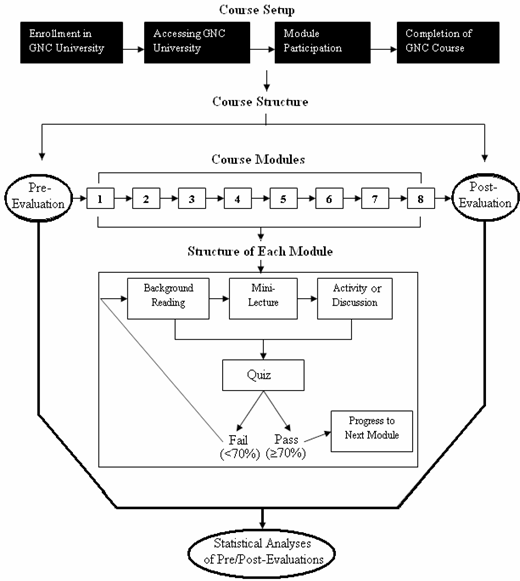
GNC University Service Utilization Model
GNC University Service Utilization Model
Each course consisted of eight modules to be completed in 10 to 11 weeks. GNC contributed suggestions for topics to be included in the courses, including nutrient functions and food sources, effects of nutrient deficiency and excess, nutrient requirements, the role of nutrition in physiologic systems, and the changes in nutrient requirements and nutrition concerns at various life cycle stages.
Criteria for mastery of each module, defined as passing the associated objective quiz with a score of at least 70%, was set so continuation with the next module was not possible until a previous module was mastered. Each module consisted of background reading, a minilecture, activities, discussion, and a quiz to evaluate understanding of the module topic and ability to apply the information in a practical manner (see Figure. 1).
Based on the above, the objectives of this study were to utilize a competency-based approach to (1) identify the set of competencies most relevant to participants’ expectations and perceived ability to apply knowledge and skills learned as a result of taking the GNC University courses to their jobs; (2) evaluate the extent to which GNC University produced a change in the identified set of three competency clusters related to career and personal use of nutrition concepts and usage of computer technology; and (3) describe authentic verification indicators in terms of self assigned level and areas where growth occurred.
METHODS/PROCEDURES
In a speech given to project directors of grants, Ehrmann (2001) offered a model for evaluating technology-mediated education. The model includes discerning the desired impact of the program, deciding how to measure that attribute, conducting a pretest of the attribute, offering the educational program, conducting a posttest of the attribute, and making sense of the data for the project sponsors. Ehrmann’s (2001) model informed the research design for this study. The design for this evaluative study was a repeated-measures reflexive controls design.
The population for this study was derived from all GNC managers. The frame for the study included managers who enrolled in GNC University. The self-selected sample was limited to the managers who accessed the course and completed both the pretest and the posttest for all of the courses they took. The pretest and a posttest were both administered through the WebCT course management software system. An expert panel of university faculty in distance education and the content area of food science and human nutrition established face and content validity for each of the instruments. The pretest consisted of items measuring participant expectations for the course, self-efficacy regarding distance education, educational and technological experience, opinions about nutrition, perceived nutrition knowledge, and several nutrition behaviors. The posttest consisted of items measuring selfefficacy regarding use of nutrition concepts in one’s career, as well as personal life, and use of computer technology.
The scaled items on each instrument were Likert scale (1 = strongly agree to 5 = strongly disagree). The initial Course 1 pretest provided GNC University’s first information about the participants and was administered as they prepared to begin the first course. The goal for this instrument was to give the instructors some information about the students. Instrument reliability for the pretest was established using Cronbach’s alpha to be =0.7683. The posttest was administered to students as they finished each course in GNC University. Instrument reliability for the posttest was established using Cronbach’s alpha to be =0.7725.
The electronic data were collected through the online instruments in WebCT and automatically deposited in to a text file. The text file was transferred to Excel, and then the data collected from this study were analyzed using the SPSS for Windows statistical package.
RESULTS/FINDINGS
Characteristics and Matriculation of Participants, Course 1, Fall 2002
For Course 1, first conducted in fall 2002, GNC University students represented all 50 states, as well as eight Canadian provinces. The majority of the students had completed some college coursework, but not a full degree program. The students ranged in age from 18 to 81 years. Beginning a series of courses for online delivery, it was important for the project administrators to know about the technology access and patterns of technology use for the participants (Table 1). Approximately 82% of respondents had a computer at home. This was important because the coursework was to be completed on the participants’ personal time, not while they were at work. About 52% of respondents used a computer daily, and nearly all (94.3%) had an e-mail account. Respondents also reported they would be more likely to contact their teaching assistant via e-mail than by phone. Most respondents expected to spend between 2 and 5 hours per week on their coursework.
There were 1,125 managers eligible for the first offering of Course 1. The project coordinators expected 80% (900) of those eligible to enroll. Initially, 886 participants enrolled in the course, but only 724 actually accessed the course account in WebCT. Five hundred and twelve participants completed the first course offered by GNC University in fall 2002; this is 71% of the participants who accessed the course (Table 2).
Student Expectations Beginning First Course in GNC University, Course 1, Fall 2002
Formal evaluation design typically includes both formative and summative data collection. Formative evaluation is used to assess program participants’ expectations and needs, and to diagnose potential problems and refine program characteristics. For the current study, at the beginning of Course 1, students were asked to finish the sentence, “After this course, I should be able to ….” After reading through the responses, several themes emerged. The students’ expectations for their experience in GNC University can be associated with three main categories: increased professional nutrition knowledge, increased personal nutrition knowledge, and increased technological skills. These expectations are integral to achievement of long-term outcomes, such as increased customer satisfaction, increased customer patronage and sales, fewer sick days used by employees, increased ease of GNC-employee communication, and increased ease of employee training.
Participant Computer Access and Use
| Frequency | Percent | |
|---|---|---|
| When using a computer, I … | ||
| Have a computer at home | 375 | 82.1 |
| Use a friend’s computer | 38 | 8.3 |
| Use a computer at a library | 7 | 1.5 |
| Use a computer at work | 17 | 3.7 |
| Other | 12 | 2.6 |
| I use a computer | ||
| Never | 23 | 5.0 |
| Monthly | 44 | 9.6 |
| Weekly | 62 | 13.6 |
| Several times per week | 80 | 17.5 |
| Daily | 240 | 52.5 |
| I have an e-mail account | ||
| Yes | 431 | 94.3 |
| No | 18 | 3.9 |
Student Matriculation in GNC University—Course 1, Fall 2002
| Number | Percentage of Students Accessing Course Who Completed Each Module | |
|---|---|---|
| Number of students enrolled in Course 1—Fall 2002 | 886 | |
| Number of students accessing course at least once | 724 | |
| Module 1—Introduction to nutrition | 587 | 81% |
| Module 2—Recommended nutrient intake | 562 | 78% |
| Module 3—Carbohydrates | 544 | 75% |
| Module 4—Fats | 532 | 73% |
| Module 5—Proteins | 523 | 72% |
| Module 6—Vitamins | 520 | 72% |
| Module 7—Water & Minerals | 514 | 71% |
| Module 8—Nutrition Research | 512 | 71% |
| Number of students who completed Course 1—Fall 2002 | 512 | 71% |
Student Reactions Ending First Course in GNC University, Course 1, Fall 2002
Students took the time to offer many comments on their initial experience with GNC University. Several areas were particularly useful in designing subsequent distance education experiences. First, students reflected on their interaction with other students in the course, commenting that more interaction should be built into the course based on pre-existing relationships they had with employees in their store or nearby. Many students said that they did not have time for online student-to-student interaction, but would enjoy interacting with coworkers in a more formal way related to their shared GNC University experience. Students enjoyed the flexibility and convenience of distance learning, but realized the need to develop discipline in their study habits.
Development of Participant Competencies
According to Kirkpatrick (1994), training programs should be evaluated on four levels. First, participant reactions can be used to determine whether the training was meaningful or enjoyable. Participants should be asked what skills, knowledge, or attitudes have been changed or acquired. The skills participants have implemented should be measured by asking participants what they are applying to their jobs, as well as through observations and conversations with managers. Finally, the evaluation should look at whether the training produced increases in productivity and efficiency, decreases in absenteeism and occupational accidents, or decreases in customer complaints.
The principal component of the evaluation for this project involved participants indicating their competencies at the beginning and the end of each of the courses in which they participated. Competencies, according to Buford and Lindner (2002), are a group of related knowledge, skills, and abilities that affect a major part of an activity.
Themes for Student Pretest Expectations
| Increased professional nutrition knowledge |
|
| Increased personal nutrition knowledge |
|
| Increase technological skills |
|
In order to measure participants’ ability to implement skills and knowledge acquired via GNC University, growth/change was measured in three competency areas or clusters. These three competencies, professional nutrition knowledge, personal nutrition knowledge, and technological skills, were distilled from the themes extracted from the students’ expectations for learning expressed in the pretest for Course 1, and later assessed in pretest/posttest data collection in Courses 2 and 3 (Table 3).
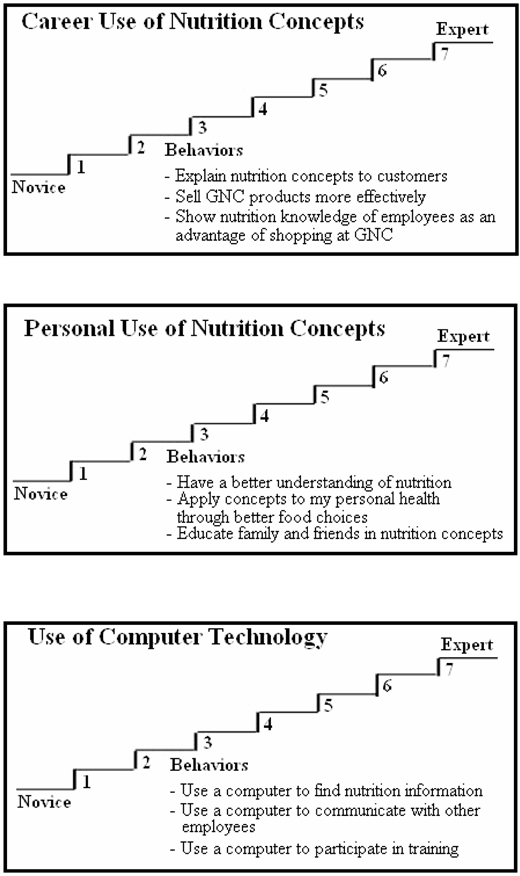
The use of competencies is grounded in the qualitative research paradigm. Qualitative research follows an inductive reasoning pattern that recognizes that theories are grounded in observations of phenomena (Crotty, 2000). In this study, competencies refer to the group of knowledge, skills, and abilities related to distance education and instructional design that affect participants in their jobs. A self-assessment instrument was created to serve as a reflection tool for participants to measure their growth in the three core competencies. A stair-step approach (Figure 2) was used to visually represent progression from novice (0) to expert (7).
Students were provided behavioral anchors on which to base their pre- and post-assessment competencies. The behavioral anchors, or characteristics of core competencies associated with the mastery of content (Dooley & Lindner, 2002) were taken from qualitative responses provided by participants in Course 1, describing what competency would entail in each area. For example, participants would demonstrate the acquisition of knowledge, skills, and abilities in the area of “Career Use of Nutrition Concepts” by their capability to explain nutrition concepts to customers, sell GNC products more effectively, and show nutrition knowledge of employees as an advantage of shopping at GNC.
An open-ended question was used for verification of the competencies. For example, students were asked, “Please explain why you gave yourself the above competency level regarding your ability to use nutritional concepts in your career.”
Competency Results
To evaluate the effectiveness of this project, a competency based approach, focused on measuring growth in participants’ ability to implement a set of specific skills and knowledge, was utilized for the second and third courses in the sequence. A paired t test was applied for comparison of competence questionnaire scores between pretest and posttest. For purposes of comparison, data were excluded pairwise for participants across all iterations of Courses 2 and 3. Alpha was set at 0.05.
For Course 2, results indicated that significant growth occurred in all three competency clusters. The greatest mean change occurred in the career use of nutrition concepts competency (see Table 4).
For Course 3, results showed significant growth in all three competency clusters, with the greatest mean change occurring in both the career use of nutrition concepts and personal use of nutrition concepts competencies (see Table 5).
Authentic Verification of Growth
As part of the competency-based measurement of change/growth in the three competency clusters, participants were asked an open ended question designed to elicit verification of their self assigned level as well as pinpoint where growth may have occurred. Overall, in each of the three competency areas, participants indicated growth in knowledge and increased confidence in applying each of the concepts. For example, with respect to career use of nutrition concepts, one respondent indicated, “I have been given the tools to succeed through GNC, both in the university program and in sales training meetings. I am confident in my ability to provide comprehensive and informative decision assisting to my customers.”
With respect to personal use of nutrition concepts, many respondents indicated that they try to apply nutrition concepts to their life. “I practice the concepts of nutrition and personal health, even though I don’t get to eat a well balanced meal every day. I will continue educate myself and family, as well as strive to professionally and thoroughly represent GNC as a reliable and confident employee.”
Said another, “I am continually discussing nutrition with my friends and family and I am always careful with what I eat. I have a better understanding of nutrition since doing this course.”
Interestingly, many respondents indicated that their use of computer technology had improved as a result of taking the GNC University courses. “i have improved so much with my computer skills … (sic) i am plnning on taking more classes online … i love all the reference material avilable online” was a typical response. Not all respondents felt this way, however. Some respondents indicated that they already knew a fair amount about computer technology, and/or that their technical level did not change as a result of taking the courses. “I did not learn anything new when it comes down to using comjputers (sic) with this training,” was a representative comment.
Finally, there was an acknowledgement by at least one participant that growth in the use of computer technology competency might be beneficial in general terms, but not necessarily with respect to the participant’s current role as a GNC manager. “There is not a lot of room for advancement of my ability to use existing hardware and software to find info, communicate, and train re: nutrition and my career, but since i have not written the perfect custom software to that end i cannot score seven.”
IMPLICATIONS AND DISCUSSION
Results of this study provide support for the use of a competency-based approach to identify and analyze participants’ perceptions of knowledge and skills they would obtain, as well as change in level of competency as a result of participating in the GNC University courses. Participants were able to identify a set of competencies related to career use of nutrition concepts, personal use of nutrition concepts, and use of computer technology. Results indicated that for students who participated in Courses 2 and 3, significant growth occurred in all three competency clusters. Participants were able to verify that growth occurred through application and practice of specific nutrition concepts in their daily lives and jobs, and through discussion of nutrition and interaction with friends and family.
Interestingly, participants both strongly identified as a competency, as well as indicated they saw growth, in the use of computer technology. A definite byproduct of taking the classes, for many participants, was the opportunity to become more aware of technology as well as to practice specific skills. Although 82.1% indicated they owned a computer at home, only 3.7% used a computer at work, and although 240 participants said they used their computer daily, 209 respondents indicated that their usage ranged from several times a week to never, a finding which suggests that most participants’ previous experience and knowledge of computers was limited. In such a context, the combination of nutrition education content and online delivery mechanism seemed to be perceived as a value-added benefit. These findings point out the fact that, for many employees, the technology-rich academic environment is not the norm. As a case study, these results cannot therefore be generalized, but these findings do suggest that novel approaches to nutrition education via distance delivery can be effective and that access to the online learning environment can be a boon for many industry employees.
Traditionally, most research that has been conducted with online health education programs has focused on programs that target students in formal instructional settings. Even studies of nonformal health education programs delivered via distance are more likely to focus on teachers, extension and health education workers, and groups with some familiarity with either the instructional context or the educational content. Few studies have looked at the impact of a program designed to educate groups who interact with and may potentially influence the general public, such as health store employees, but who may not have formal subject matter training. The objective of the GNC University project was to provide members of one such group, GNC employees, with an easy-to-access, credible, and organizationally sanctioned channel for nutrition information, with the goal of enhancing these managers’ knowledge and competencies so as to educate their own customers. As such, based on the results of this study, the project was successful in achieving its objective of increased competency development, as well as in improving managers’ overall computer familiarity and literacy.
As a unique university-industry partnership in non-formal distance education efforts, this approach is innovative and may set a new direction for efficient leveraging of resources to enable the targeting of groups who have the potential to influence a wider range of consumers. Partnerships between academic institutions, which have the distance-delivered instructional expertise and research-based educational content, and relevant industry partners, such as health club chains, fitness centers, catering companies, and so forth, may offer enhanced opportunities to reach employees, managers, and their clientele with sound, research-based nutrition information.

