


With the increasing number of online courses within many higher education institutions, experienced instructors are facing the possibility of teaching online. These faculty members may face the task of converting their well-established face-to-face teaching strategies into an online environment. To better understand this transition, we analyzed the practice of one senior professor and his face-to-face teaching strategies. This single-case study gave us insight into these strategies and enabled us to describe how current and emerging online tools could accommodate these strategies.
Online learning environments have become a commonly accepted instructional method in higher education. With historical roots in cor-respondence courses, the number of computer- and Internet-based courses (Moore & Kearsley, 2005) has increased dramatically and these courses are now prevalent in higher education. In a recent Sloan Report survey of over 1,000 higher education institutions, Allen and Seaman (2006) reported that online course enrollment increased 18.2% between 2003 and 2004. This growth is expected to continue. Fifty-six percent of the university administrators noted that online education has become a critical long-term strategy at their respective institutions (Allen & Seaman, 2006). Simonson, Smaldino, Albright, and Zvacek (2006) reported that “1,680 institutions offered over 54,000 online courses” during 2005 (p. 10) and Saba (2005) remarked, “Almost all institutions of higher education offer some form of distance teaching and learning.” (p. 258). Wilson (2002) asserted that online education is not just an alternative educational method, but has “shaken up the educational establishment, especially at higher education and corporate levels” (p. 91).
Despite the growing presence of online courses, it is apparent that this type of learning environment has not reached its full potential for enabling meaningful and effective learning. Visser, Visser, and Schlosser (2003) observed that critical thinking can be inhibited in traditional distance learning environments. Online learning environments should incorporate activity-based learning, as opposed to learning governed by content (Jonassen, 2002). Online students need to focus on a particular problem and interact in a learning environment that promotes reflective thinking. Marra and Jonassen (2001) commented, “very few online learning employs constructivist, problem-oriented approaches to learning in any significant way” (p. 304). Essentially, content-driven online courses are not taking advantage of the affordances of online learning environments to enable students to collaborate with instructors and other students (Dabbagh, 2004; Marra & Jonassen, 2001).
One of the key elements in ensuring an effec-tive online learning environment is interaction among students and instructors (Bannan-Ritland, 2002; Berge, 2002; Leh, Kouba, & Davis, 2005; Zheng & Smaldino, 2003). Topper (2005) noted the existence of a “strong relationship between student perceptions of learning, quality of instruction, and their participation or interaction in a course” (p. 56). Online learners who collaborated with each other performed significantly better on an ill-defined problem than did learners who solved the problem by themselves (Uribe, Klein, & Sullivan, 2003). Durrington and Yu (2004) found significant differences in the amount of student participation in the discussions that were moderated by their peers rather than the instructor. In their study on three types of learner interaction, Jung, Choi, Lim, and Leem (2002) concluded, “social interaction with instructors and collaborative interaction with peer students are important in enhancing learning and active participation in online discussion” (p. 153).
Coupled with the need for learner-to-instructor interaction and learner-to-learner interaction are the preferences and characteristics of adult distance learning students. These students typically have multiple responsibilities in their lives beyond taking online courses. Distance educators and programs must accom-modate these additional demands (Moore & Kearsley, 2005) and attempt to provide unlim-ited access to course content. Simonson et al. (2006) stated that online programs should “provide a valuable learning experience to students who might not have otherwise have access to learning” (p. 56). These extra requirements for online courses signify a different class of students with regards to face-to-face students. Dillon and Greene (2003) observed online learners “typically learn in more independent environments” (p. 235). Successful distance learning students are often described as “independent” and self-disciplined” (Connick, 2004). Realizing the profile and needs of an independent and self-disciplined distance student is critical to developing effective curriculum and activities that are delivered in an online environment.
Many obstacles have been documented for instructors who are beginning to teach online. Instructors face the challenge of the preponder-ance of online courses, a distinct set of online student needs (e.g., independent learning, unlimited access to course content) and the need to promote interaction in distance learning envi-ronments. This certainly has placed a burden on experienced instructors who have taught exclu-sively in face-to-face settings. The acceptance of online instruction within universities and individual curricula has challenged previously established teaching methods and faculty responsibilities (Dabbagh, 2004). The transition to online teaching for experienced faculty members is not easy, and has been labeled as “daunting” (Grosse 2004). For pretenured professors, developing and teaching online courses may be perceived as not helping one towards tenure (Howell, Saba, Lindsay, & Williams, 2004). There is considerable evidence that teaching online courses requires additional preparation time (e.g., Lorenzetti, 2004). Veteran face-to-face instructors must revise their teaching methods (Grosse, 2004).
With this new teaching role, faculty members have expressed “concerns for loss of personal and intimate interactions” with their online students (Campbell, 2006, p. 378). Some veteran faculty members who are new to online instruction have stated concerns about their lack of ability to teach skills requiring “hands on” instruction at a distance (Nelson & Thompson, 2005). Despite known extrinsic incentives (e.g., exposure to new technologies) and intrinsic incentives (e.g., flexible teaching schedule) to teach online (Parker, 2003), it is imperative to address instructors’ concerns and obstacles to teaching at a distance.
There is a “steep learning curve associated with learning to teach online” (Gerlich, 2005, p. 8). Becoming a successful online instructor requires a change of the instructor’s perspective and role as well as effective professional development (Lee & Busch, 2005). Shifter (2004) cautions that an institution needs to get faculty “buy-in” and help faculty members change their perception of the teaching and learning process in order to develop a successful distance learning program. Traditional faculty face-to-face teaching roles are shifting (Howell et al., 2003). In summary, faculty members who are experienced teachers in a face-to-face environment face a major transition to teach online. While preserving the core of one’s established instruction and activities, faculty members are faced with the question of how to convert well-established face-to-face curricula to an online environment and, at the same time take advan-tage of the affordances of electronic media.
PURPOSE OF STUDY
In this study we completed a comprehensive analysis of an experienced professor’s face-to-face course. The intent of this single-subject case study was to provide insight into the instructional activities that were employed in a face-to-face course and also to allow us to hypothesize the degree to which an online environment could accommodate the key activities and interactions of face-to-face instruction. Specifically, our study sought answers to these two questions:
What types of interactions and activities are prevalent in a face-to-face course?
Once identified, can these interactions and activities be effectively transformed, recreated or enhanced via the affordances of an online environment?
Responses to these questions will provide knowledge to instructors who are making the transition from a face-to-face classroom to an online teaching environment.
METHODS
Description of the Course
This investigation was focused on a face-to-face graduate-level course in science education titled advanced methods in teaching science. A large public university located in the eastern region of the United States offered this course. Thirteen students were enrolled in the course. Seven students were current practicing teachers. The other six students were enrolled in the master of arts in teaching (MAT) program and did not have teaching experience. The MAT program is an intensive, year-long program of study in which students actively participate in a public school classroom and also take on-campus courses.
This particular graduate course focused on current efforts to reform science education by focusing on its content, methods, and outcomes. The syllabus stated:
In order to promote student learning, teachers must understand and apply current learning science research into their respective classrooms. Teachers who understand the new science of learning implement coherent instructional and assessment practices that promote the development of understanding and are aligned with learning goals.
The required textbook for the course was Bransford, Brown, and Cocking’s (1999) edited book: How people learn: Brain, mind, experience, and school. The purpose of this book was to provide a research-based perspec-tive on how students come to learn science, with implications for teaching. The students completed a total of five projects to fulfill the requirements of the course including two case studies. One case study was of a public school students’ prior knowledge of a core science concept and the other case study was of teachers’ success in using students’ prior knowledge in planning for and teaching a lesson on the same core science concept. At the beginning of the course the students wrote about their prior experiences, both as a science student and as a science teacher. The main project for the course was to develop a curriculum unit that was aligned with research and science teaching standards. Prior to developing this curriculum unit, students completed a “road map” for teaching and learning core science concepts included in the unit. This “road map” included a concept map of the unit’s topic, specific standards and objectives, an overview of the instructional sequence, and daily lesson plans. Students presented sections of the “road map” and curriculum unit during designated class sessions.
Instructor
The instructor for this course received a doctorate of education degree in science edu-cation from the University of Georgia and held the academic rank of full professor. He had taught in a higher education setting for more than 30 years and had been a high school physics teacher for 6 years. At the time of the study, he was a member of the National Science Teachers Association Program Review Board. This review board evaluates universities’ science teacher preparation program folios for initial and continual accreditation in conjunction with the National Council for Accreditation of Teacher Education. In addition, the professor had published numerous research studies pertaining to science teacher education and professional development. His teaching had been rated as “exemplary” (average score of 4.5 on a 5-point scale) based on a 5-year cumulative review of his teaching effectiveness by his university.
Data Collection and Analysis
The researchers videotaped each of the pro-fessor’s thirteen class sessions. The total class time for these sessions was 31 hours, 8 minutes and 26 seconds. The primary activities for each class session and the duration of each class are listed in Table 1. A normally stationary and unobstusive video camera was used to record the class discussion and activities. We occasionally repositioned the video camera to record specific class activities and student demonstrations such as, in particular presenta-tions of their concept maps and curriculum unit projects.
Using a modified version of the constant comparative method (Glaser & Strauss, 1967; Lincoln & Guba, 1985), two researchers inde-pendently analyzed and coded the entirety of each videotaped class session. Intermittently the evaluators checked with each other about the specific observation categories and made appropriate adjustments to the overall list of categories. From this analysis, we identified three general categories: instructor interactions, student interactions, and class activities.
We reviewed the videotapes for the thirteen class sessions again to determine if the three general categories could be further subdivided, thus performing a more defined analysis. Within the general categories we identified six instructional activities. These activities included: video presentations, discussion of course assignments, presentation of an overview of an upcoming lesson, class discussions (teacher-to-student, student-to-student, student-to-teacher), in-class activities, and student demonstrations. We noted the duration of each of the six categories of activity for each class session and aggregated our findings for the 13 sessions.
Class Sessions for “Advanced Methods in Teaching Science”
| Class Session | Class Session |
|---|---|
Class #1—1 hour, 32 minutes and 42 seconds
| Class #2—1 hour, 56 minutes and 50 seconds
|
Class #3—2 hours and 52 seconds
| Class #4—2 hours, 21 minutes and 12 seconds
|
Class #5—2 hours, 16 minutes and 32 seconds
| Class #6—2 hours, 43 minutes and 44 seconds
|
Class #7—2 hours, 34 minutes and 39 seconds
| Class #8—2 hours, 50 minutes and 10 seconds
|
Class #9—2 hours, 45 minutes and 4 seconds
| Class #10—2 hours, 53 minutes and 55 seconds
|
Class #11—2 hours, 53 minutes and 48 seconds
| Class #12—2 hours, 15 minutes and 29 seconds
|
Class #13—2 hours, 23 minutes and 29 seconds
|
RESULTS
Key Course Activities
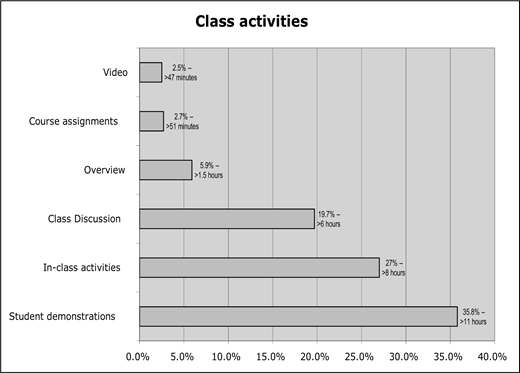
The relative time allotted for each course activity throughout the 13 class sessions is depicted in Figure 1. These activities included class discussions, in-class activities, videos, student demonstrations, course assignments, and overviews of course content. The six activities accounted for 28 hours and 8 minutes of the total instructional time of 31 hours and 8 minutes—approximately 90% of the instructional time. The 13 class sessions consisted mostly of student demonstrations of completed assignments (35.8%), in-class activities (27%), and class discussion (19.7%), accounting for 25 hours (82.5%). To a lesser extent, students listened to the instructor as he provided an overview of the day’s lesson (5.9%) or course assignments (12.7%) or they viewed a video pertinent to the lesson content (2.5%). In the sections that follow we describe lesson seg-ments in which each activity was instantiated.
During the first class session, the instructor conducted the typical activities that occur in an initial class meeting. He provided an overview of the course content, delineated his assumptions and expectations, demonstrated guiding questions, and explained relevant information from the syllabus. He introduced himself and then students took turns introducing themselves to each other and to the instructor. During these introductions he asked students about their current teaching experiences and their respective classrooms. In six subsequent class sessions he set aside time at the beginning of class for students to share teaching experiences and related issues. Throughout the semester the instructor would refer to these experiences and integrate them with current course content.
A portion of the class sessions (20% of the entire course, or approximately 6 hours) was spent in whole-group discussion on specific issues dealing with the course content. Topics included:
Developing science education lessons according to current national and state standards;
An overview of science education reforms;
Comprehension of science education reforms and relating these reforms to students’ current classroom;
Value of standardized testing;
Reviewing learning science principles found in the textbook;
Implications of the No Child Left Behind Act on selection of science content and teaching standards; and
How to effectively apply scientific prin-ciples into “real classroom contexts” and other similar topics.
The instructor also engaged the students in two discussions regarding their own experiences. During session 5, the instructor facilitated a discussion about types of science course content, objectives, and how these courses are currently taught. During session 8, students discussed the types of science classes they experienced as students in middle and high school.
The students also participated in several in-class activities. These activities usually involved working in small groups. These small group activities included: discussing effective ways to model a scientific principle; making multiple observations of an apple; performing an experiment with mirrors; discussing ways to improve individual lesson plans; and, discussing how to teach particular lessons using concept maps. During session 10, the entire class discussed ways to motivate students with individualized lesson plans and content. During sessions 2 and 3 the students viewed and critiqued videotapes of younger students’ intuitive understanding of specific science concepts. These videos illustrated students’ misconceptions of core science concepts and principles. While showing these videotapes, the instructor noted important points and discussed effective ways to rectify students’ misunderstandings. During session 5 students individually prepared their concept maps, which was one of their major course projects.
A significant portion of this course was devoted to student demonstrations (36% of the entire course or approximately 11 hours). Students displayed, explained and illustrated specific aspects of their course projects. These projects included presentations of individual concept maps of a science topic, current progress on lesson plan development, and a final course project. In fact, the last two classes (sessions 12 and 13) were almost exclusively devoted to student demonstrations.
Periodically the instructor provided addi-tional information about the upcoming course assignments (3% of the entire course, or approximately 50 minutes). For example, he presented illustrative examples and answered students’ questions about his expectations for course assignments, offered overviews of upcoming course topics, or reviewed course content that was discussed in previous classes. This “course assignment” activity accounted for 3% of the entire course or approximately forty minutes of total course time.
Key Instructor Interactions
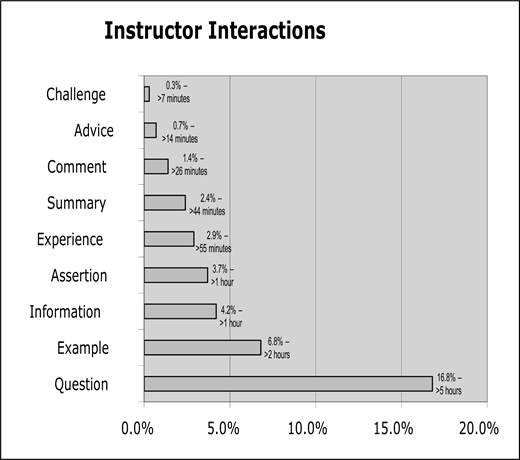
We examined how the instructor interacted with the students. To do this we revisited the 13 class sessions and noted the forms and duration of interaction between the instructor and students. Of the total of 31 hours and 8 minutes of class time, we identified 11 hours and 26 minutes during which one or more forms of interaction took place (36.7% of the 13-session total time). We identified nine distinct forms of instructor interactions: information, question, summary, advice, comment, example, experience, assertion, and challenge. The instructor used each of these forms to teach the students about course content and enable them to apply this knowledge in their science teaching. Figure 2 illustrates the frequency and percentage of class time for each of these instructor inter-actions. We describe the nine types of instructor interactions below.
Information
This instructional activity is similar to lec-turing to students. During the initial class meetings (i.e., sessions 1, 2, 3, and 5), the instructor frequently presented information that was relevant to a particular class topic or activity. For example, the instructor described three ways to represent scientific knowledge. He told students:
It gets at something that was talked about years ago in terms of forms of knowledge of representation. There are three ways that we can represent knowledge. The first way is through an enactive mode of representation. Not “i-n”, but “e-n-a-c-t-i-v-e,” enactive mode.
After asking a question to check for com-prehension of the term “enactive,” the instructor summarized a student’s response. Then he proceeded:
Physically start doing something with objects. Like putting the rocks in water and watching the water level rise or fall. I take the term density and represent that knowledge through an enactive means by having students actually play with objects and play with the concepts.
After this explanation, the instructor described two other modes of representation (iconic and symbolic). Other informational topics included instructor-student communication and tradi-tional versus innovative ways of teaching sci-ence. During these interactions students usually took notes or listened to the instructor. Toward the end of the course the instructor provided information less frequently than he did at the beginning. For example, he presented information to students for 37 minutes during sessions 1 through 6 but only 19 minutes during the remaining seven sessions.
Questions
The instructor frequently asked students questions, as depicted in Figure 2. Questioning was the “engine” of his instructional approach. He questioned students for approximately sixteen percent of the entire course time. He would pose a question to “jumpstart” or extend a class discussion, to help students apply lesson content to actual classroom settings, and for other similar purposes. The instruction was often dependent on students’ responses to, and interactions stemming from the questions.
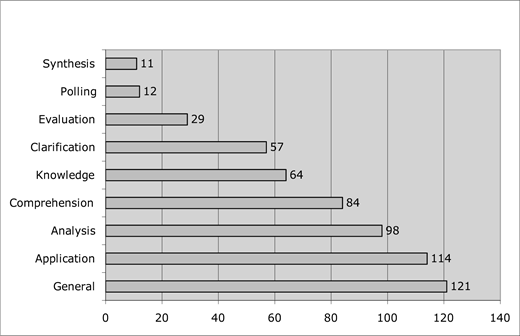
We categorized these questions according to the six types of questions identified by Bloom’s taxonomy (Bloom, Engelhart, Furst, Hill, & Krathwohl, 1956), including: knowledge, comprehension, analysis, application, evaluation, and synthesis. Results of our categorization of 400 content questions revealed most questions to be application (114 or 28.5%), followed by analysis (98 or 24.5%), comprehension (84 or 21%), knowledge (64 or 16%), evaluation (29 or 7%), and synthesis (11 or 3%).
We also noted that the instructor asked 190 other questions including general (121 or 64%), clarification (57 or 30%), and Polling (12 or 6%) questions. Clarification questions were used to seek additional information and encourage students to clarify their intent. For example, during a student demonstration of a class project the instructor asked for clarification with the question, “did the students actually compute the work?” During discussion of an upcoming class assignment the instructor polled the class with the question, “How many people will have difficulty in obtaining a video camera?” Polling questions were somewhat similar to Clarification questions in that the instructor checked for student comprehension or basic facts. With a polling question, the instructor conducted an informal tally of students about a particular topic. For example, during session 4, he asked, “first of all, do you have a general idea of the topic that you want to cover [for your project]?” The instructor employed general questions to promote responses and discussion among students and to check for understanding. For example, he would ask, “any other comments or questions?”
We tabulated the nine question types, as illustrated in Figure 3. The most prevalent question types were: general, application and analysis. The occurrence of application and analysis questions illustrated the emphasis of the course, namely to elicit knowledge, clarify beliefs, and analyze and apply course content. Almost 40% of the instructor’s questions were focused on having students think about, apply, and analyze course content from the perspective of actual science classrooms.
Summary
The instructor provided summaries of stu-dent responses, as shown in Figure 2. The majority of these summaries actually occurred during the first part of the semester (i.e., sessions 1 through 8). The instructor interspersed these summaries with a variety of question types. A typical interaction occurred in the following way: the instructor initially posed a question to the class. Then one or more students would respond to his question. Then the instructor summarized the student’s response with a brief, concise statement. For example, during session 7 he posed the question, “What can we say about knowledge-centered learning?” A student responded:
One of the things that we have been talking about is that we cannot gear [lessons solely] towards students. There are some things that [all students] have to learn. An approach [for teaching students] would be: “this is the basis for your understanding.”
The instructor commented, “So many of you have set out goals that students are expected to accomplish in the program and attaining [a set] level [of understanding]. Regardless of Wellcome or Bethel [two middle schools], [students] still need to meet these levels of expectations.” This summary instructional strategy helped solidify the instructor’s teaching strategy and provided definitive guidelines for the students.
Advice
Periodically, the instructor would offer advice on a particular topic. This guidance was not necessarily information that directly per-tained to course content, but was information generally related to science education. For example, he advised one student regarding the use of scientific investigations in class. He counseled:
Obviously, you do not want to start [the lesson with] an investigation first. You can present [students] with phenomena [and] say, “What kinds of questions can we ask of this?” In other words, instead of giving the universe [of information], you can create little events for them [to examine].
Throughout the semester, the instructor offered advice on how to connect related scientific principles, recognize misleading statements in science textbooks, develop science lab experiments, and other related topics.
Comment
The instructor also commented on specific issues throughout the semester. These comments were related to the course content and were general, neutral remarks about specific class activities. For example, after viewing a student’s concept map on the topic of chemical reactions, he observed, “[The number and levels of concepts] point out how complex and difficult it is to teach those topics.” And after a student commented that she was teaching a “boring topic.” he responded, “That makes [learning] even more difficult. You have to get into it, to somehow make it interesting.” These comments were brief statements that provided informal instruction, feedback, or encouragement to students.
Example
Throughout the semester the instructor would provide examples to emphasize a specific science concept, to provide instances to further exemplify course content, or to emphasize a student’s response. This instructional technique helped connect students’ understanding of the lesson content with the reality of a classroom setting. For example, during session 2, he emphasized the role of the traditional transmission model of teaching. A student’s [Danielle] clinical teacher frequently used the transmission teaching model in her classroom. The instructor said:
I [i.e., the teacher] just give the information to the student. But, it is not a matter of just reading to them from a textbook. Danielle’s teacher works really hard to put together good lessons—good presentations and she searches her own understanding and tries to put things together in ways that she understands. So, Danielle’s teacher is worried about encoding and that means taking her knowledge and understanding and putting it into words that kids will likely understand.
On another occasion in response to a student’s demonstration of her lesson plan, the instructor commented:
How many of you [have] heard of a television series sponsored by Readers’ Digest called “I am Joe’s....” “I am Joe’s heart”, I am Joe’s this, I am Joe’s that. Absolutely, fantastic voyages through different [body] systems to actually see what happens. While listening to you [the student], I was thinking that it would be nice if kids could have at least read [the article I Am Joe’s .] because they [the television series] gave such wonderful insights to what the systems were like and what the various processes were going on, such as the digestive system.
The instructor frequently used this Example strategy when teaching these students, and it was a key component of his overall instructional approach.
Experience
Similar to the example instructional interac-tion was the instructor’s reference to personal experience. Comparable to providing illustrative examples to emphasize a topic, the instructor often recounted his experiences as an undergraduate student, a high school science teacher, and a university professor. At appropriate times, he used his experiences to explain course content. Examples of personal experiences include the following:
Previous teaching experiences as high school physics teacher;
Former graduate students’ teaching methods;
Instructor’s own experiences as an undergraduate student with science content;
Former professor’s teaching style, use of “wonderful” chemistry lab experiments;
Observations of public school students’ understanding of a biome;
A science teacher’s “fantastic” way to teach students about rocks using a “Talking Rock”;
Habits of the most difficult student that he had in public schools and universities;
Attending a presentation by Senge;
Using the Texas landscape to teach about geology; and
Instructor’s experience with another state’s department of education and their plans to restructure the course standards.
The instructor’s use of personal experiences and stories provided vivid and memorable examples for the students, and helped them more fully understand key course content. These experiences also stimulated a more empathetic relationship between the instructor and the students. Recounting his teaching experiences enabled the instructor to empathize with his students’ struggles in teaching science to middle school students, developing innovative lesson plans, and utilizing curricular materials. Experience helped authenticate the instructor’s role with his students.
Assertion
Along with information, the assertion tech-nique was the primary means of communicating with students about course content. During class sessions the instructor frequently acted like a lawyer, building a case with information and examples. After presenting appropriate information and examples, he would introduce an assertion. Occasionally he reversed the order and introduced an assertion then supported it with supplementary information and examples. Use of assertions served as the foundation of the advanced methods course and offered the students information essential to attaining course objectives. For example, during session 2, the instructor described his “most profound moment” as an instructor. In prior methods courses he use an activity in which students, working in groups, documented observations about the exterior features of an apple. The students then cut the apple to observe the apple’s interior. To observe the inside of the apple, most students cut it along its axis, which resulted in one set of observations. During one semester a group of students cut the apple, not along, but across its axis, which resulted in a set of apple observations quite unlike those made by students using an axial cut. In describing this experience, he declared:
Philosophically, I began to say, “If you want to see things differently, if you want to do things differently, if you want to change your teaching, you have to try to learn what it means to “slice the apple” differently in the classroom. That means to take a different lens into the classroom. It is the same classroom, but it is looked at through a different lens.
He also used the assertion technique to teach students about the course content and their professional role as science teachers. During session 12, a student described her current struggle to motivate a difficult student of hers who simply did not want to learn. The instructor noted:
[Teaching] is the most difficult profession that you can pursue. You do not get paid according to what you are worth, as in business. You are in a [profession] that is like an emergency room of life and you help shape [the futures of] kids. You can give some kids a future and other kids [who opt out of school may] not have a future.
The instructor’s questions, examples, information and assertion techniques were interwoven to create an instructional experience. His use of these techniques created a dynamic, interactive lesson, built upon students’ responses. During session 10, the instructor’s description of qualities of a problem-based teaching method exemplified this dynamic interaction. First, the instructor stated, “It is important to establish an environment in which students and the teacher understand their understanding. This is done through the use of ongoing formative and summative assessment.” Then, he affirmed, “Assessments included in your lessons reveal to what students understand and what they do not understand.” He continued, “Promoting students’ use of scientific discourse and model-based reasoning requires that you scaffold instruction in ways that lead to understanding. Use readings, presentations, and discussions as your students begin to understand the science concepts you expect them to learn.” Then, he asserted:
I do not want to eliminate presentations and lectures [from science teaching]. Once [your students] have an understanding of the key concepts, presentations by teachers are powerful [ways to teach] because you are talking to an audience that has some understanding and [students] can stop [the presentation] and ask questions. Asking a question, contrary to popular opinion, is not a sign of ignorance. It is a sign of [emergent] understanding. A person, who asks questions, does have understanding, because he or she has [reached] a point that they don’t understand [and needs the teacher’s help]. That is when you know you are on target when you have students beginning to ask questions.
These interrelated instructional techniques cannot be further categorized into information or an assertion category without losing the efficacy of this synergistic instructional approach.
Challenge
The instructor occasionally issued a direct challenge to students. Whereas the instructor employed the assertion technique as a primary means of summarizing key course content, his challenges were like a crescendo in the course, urging the students to have high aspirations. The instructor offered several assertions, asked many questions, summarized student comprehension, and then issued a challenge to the students. He challenged the students to use their understanding of the lesson’s content in an actual classroom setting. An example of this interaction type occurred in session 8. In describing differences in questions on state end-of-the-year exams and performance-based assessments, the instructor issued the following challenge to science teachers.
How can we use these [performance-based assessments] in developing lessons? If you are going to [set the mark] high and “leave no child behind,” pardon the expression (maybe we should say, leave no child unengaged from thinking about the concepts that we have talked about in class) then how would you go about doing that? We have the opportunity to say, “How would we teach the best that we know in a situation where we want kids to reason and think at the levels that Meg’s [i.e., a teacher] project [aims] for and Tim’s [i.e., a teacher] project [aims] for?”
The instructor issued other challenges regarding how best to organize high school science curriculum, to use alternative forms of assess-ment in teachers’ instructional practices, to develop a lesson that engages students in higher levels of thinking, and to incorporate generative questions into science lessons for students.
In addition to these interactions, the instruc-tor also provided other verbal and non-verbal cues to emphasize specific points during instruction. The instructor would begin a new section with key words, such as, “so,” “again,” or “O.K.” These words served as verbal cues for him and for the students to shift to a new topic. When discussing the concept of “time on task,” the instructor emphasized the factory model of expecting students to complete tasks even though they may not be learning. He noted that students are often asked to complete “cookie cutter types activities, the same repetitious types of assignment every week. Bing, bing, bing, the same tasks whether the kids are ‘in’ the classroom or not.” The instructor emphasized repetitive, monotonous assignments by using a unique “bing, bing, bing” verbal expression. The instructor’s gestures and nonverbal communication were similar to those used by an actor on stage. For example, he would affirmatively shake his head while a student was responding or would move his hands to emphasize an important point.
Key Student Interactions
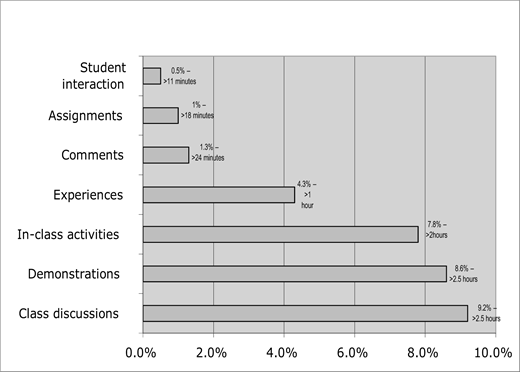
In Figure 4, we illustrate the various types of student interactions and the duration of course time during which these interactions took place. Students discussed class assignments for 1% of the time, or approximately 18 minutes, and their responses were directly linked to the specific class assignment. Students described their current and previous classroom teaching experiences for 4.3% of the time, or approximately 1 hour, and the instructor often queried individual students about their experiences. Occasionally a student responded to a question or activity by recounting his or her experiences. Over the course of the entire semester, students asked a total of 58 questions. These questions were about upcoming assignments, course content, student dem-onstrations, science education curriculum, education reforms, and other similar topics. Unsolicited comments related to course content occurred 1.3% of the time or approxi-mately 24 minutes. On these occasions the instructor did not ask a direct question. Instead a student offered a comment regarding the par-ticular topic. Students interacted with each other (as opposed to interacting directly with the instructor) for approximately 11 minutes. These interactions always focused on the individual student’s teaching experience in rela-tion to the course content.
Student interaction occurred most frequently during class demonstrations, in-class activities, and class discussions of course content. During class demonstrations, students had great latitude to communicate with each other about class activities. Though students some-times responded directly to a follow-up question posed by the instructor, students had the opportunity to elaborate on key aspects of their individual projects. For example, in describing her biology lesson, a student observed, “It seems like the ones [students] that did know the content had the phrases and the definitions memorized. They did not think about the content much more.” “How systems intercon-nect?”, the instructor asked, to which the student replied, “They did not really get the connection between the systems.” During these demonstrations, students had the opportunity to reflect on the successes and failures of their projects. During a demonstration on his lesson on the topic of “velocity” a student teaching physical science noted:
Overall, I [was] surprised that they did not have a grasp of [the proper] units. One of the things that I got out of it [lesson], just because they are putting units down it does not mean they understand the meaning of the unit. They put meters per second down because the teacher told them to do this.
During these demonstrations students responded directly to each other. These discus-sions offered several benefits for students, including providing additional information and relevant instructional resources to enhance their lessons, offering overall feedback on stu-dents’ individual projects and ways to improve the project, getting clarification on a particular aspect of a lesson, and discussing how students learn and understand specific scientific concepts and principles. Occasionally these demonstration discussions prompted students to examine their own classroom and teaching experiences.
Students engaged in various in-class activi-ties for 7.8% of the time (approximately 2 hours). They also discussed various class topics for 9.2% of the time (approximately 2.5 hours). Unlike in class demonstrations, students usually responded to direct questions from the instructor or to the actual in-class activity. On one occasion for example, when discussing the results of a mirror exercise during session 3, the instructor posed the question, “You see yourself in a small mirror. If you want to see your whole body would you move close to the mirror, step back from the mirror, or does the distance matter? Explain your reasoning.” After a few minutes, a student answered and explained her reasoning. In session 5, the instructor asked students to use information from a textbook chapter to explain a recent occurrence in a student’s classroom, instructing them to “use the language of chapter 3 to explain to me what was going on” in the student’s classroom. One student promptly responded to this question and correctly applied the chapter’s information to describe the other student’s situation.
DISCUSSION
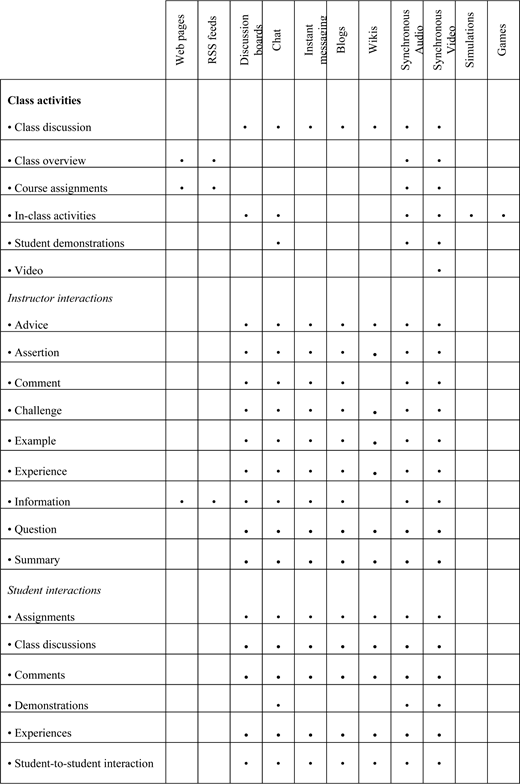
To understand how easily the types of interac-tions and activities prevalent in a face-to-face discussion course can be transformed, recreated or enhanced in an online environment, we first completed an analysis of the identified face-to-face activities found in this examined class and available online tools (see Figure 5). In this figure we indicated whether a particular activity could conceivably take place using a particular tool. This figure identifies the following online tools.
A common online tool is the static HTML page. These pages are often found within a course management system (e.g. Sakai, Moodle). An instructor typically provides pertinent course documents and information on these pages. Another online tool is RSS (Really Simple Syndication). By subscribing to a RSS feed, a student can receive notification when any sort of update or interaction occurs in the online environment. Social bookmarking (e.g., del.icio.us), is a web service which allows course participants to identify and easily share web resources and sites. Participants can annotate and “tag” sites and so develop a shared vocabulary (often called a “folksonomy”) to categorize and build an organized collection of learning resources.
Online communication tools (i.e., discussion boards, chat, instant messaging, blogs, and wikis) give learners and instructors the ability to communicate with each other. Discussion boards, blogs, and wikis enable participants to communicate asynchronously. Conversely, communication via chat and instant messaging occurs synchronously and connotes a sense of immediacy (as in a classroom) without having to be physically present.
With the increasing availability of highspeed Internet connections, the use of networked audio and video in distance education is becoming more common. The audio or video could potentially be produced by the instructor or the students, and could be a synchronous or asynchronous experience. Podcasting (audio distributed with an RSS feed) and videocasting (video via RSS) are becoming prevalent in higher education. Instructors and students are also using dedicated software to create screencasts (procedural demonstrations on a computer screen). Screencasts are particularly useful in teaching complex processes such as learning to use a professional software program. An advantage of these online tools is that all the instructor and student communication can be archived for later viewing or review.
Simulations and instructional games are also increasingly being employed in higher education instruction. Simulations allow learners to participate in virtual environments that would be dangerous, expensive, or even impossible to replicate in the real world. These environments might include defusing mines, operating a nuclear reactor, flying a plane in various weather conditions, or simulating the development of a galaxy. By participating in instructional games, learners can apply complex strategies and problem solving skills to learn about a content area. A student can also play various roles in an instructional game. By participating in an immersive game, learners may become so engrossed that they do not realize that they are indeed learning.
In addition to simulations and games, learn-ers also can participate in several online discussion activities, such as case studies, panel discussions, and debates (Tu & Corry, 2003). In all of these interactive activities, learners have the option of repeating the activity in order to maximize their instructional experiences.
In reviewing Figure 5, several instructional activities performed in our observed face-to-face course could technically be conducted with existing online tools. In fact, an instructor could conceivably teach his entire face-to-face course as an online course that would be transmitted via live two-way Web-based videoconferencing, while changing none of the instructional strategies or activities. This is not an advisable option. Teaching via video as if it were a face-to-face audience has a number of limitations. Students would have to attend the online video conference and interact with the instructor synchronously. A video conference of a live class does not correspond to the current preferences and characteristics of adult distance learning students or what Connick (2004) labeled as “independent” and self-disciplined,” A synchronous video conference obviously does not provide unlimited access. That is, participating learners must attend at the same time. Most instructors do not have the skill to keep learners engaged in an extended interactive video session. Furthermore, student expectations of the production quality of video are fairly high. Most instructors would need significant support to produce video that would approach these high expectations.
In reviewing the other possible online activ-ities, we identified four main categories: activities that are simple to translate, translate with effort activities that require some effort to translate; activities that are quite difficult to translate; and activities that can be potentially enhanced when translated. These activities are explained in the following paragraphs.
Some of the class activities that the instructor conducted can easily and almost seamlessly be translated into an online environment. The description and preliminary explanation of class assignments can be static text on a web page. An instructor also can organize and present specific information in a planned sequence to ensure student comprehension of the particular topic. Though the instructor may need to modify the discussion questions, class discussions in a course could take place via a discussion board or via synchronous chat. Current commonly available online tools enable instructors to effectively convey content-based information and give learners the opportunity to discuss pertinent class topics either asynchronously or synchronously.
Other observed class activities also can be conducted in an online environment, but would require considerable effort and in some cases significant resources (equipment and expertise). For example, some in-class activities could be transformed into simulated modules, created with computer-based authoring tools. However these tools are both expensive and challenging to use.
The instructor’s in-class analysis and discussion of videos would require the transfer of both the actual videos and the accompanying analysis and discussion into an online environment. In video vignettes, the instructor could describe his own experiences as a high school physics teacher, his own experiences as an undergraduate student comprehending science content, how he used the Texas landscape to teach about geology and other experiences that he previously discussed in his face-to-face class.
As seen in our study, instructor experiences are valuable in that they can convey the richness of a particular content area. And in the advanced methods course that served as the context for the present study, personal experiences arise spontaneously in response to stu-dents’ comments, their classroom experiences, and situational constraints. These are teachable moments that instructors experience in face-to-face higher education classrooms. Each of these activities would require the instructor to spend considerable effort and most likely, acquire new skills to make this change. Alternatively, the instructor could employ an instructional technology specialist to develop these instructional materials. But of course both the personnel and the funding must be readily available.
It is apparent that it would be quite difficult to directly translate some observed class activ-ities. Theoretically, these activities can be con-verted to an online environment, but this conversion would lose the essence of the intended face-to-face activity. It would be dif-ficult to entirely encapsulate the dynamic nature of this instructor’s interactions with his students that occur a face-to-face setting. The current online technologies present responses in a linear fashion and do not allow for the varied, dynamic, spur-of-the-moment nature of this instructor’s interactions with science teachers. Participating in a typical threaded discussion, the instructor and students are forced to converse with each other in a delayed format which lacks the spontaneity and nimble style exhibited in his in-person course. For example, to directly transfer all of this instruc-tor’s face-to-face questions to a discussion board format would require him to create more than 500 discussion threads, not to mention interspersing individual questions with examples, assertions and summaries of the lesson content. Reading over 500 discussion threads obviously would be prohibitive for students and the instructor.
To accommodate the instructor’s primary use of analysis and application questions employed in this course, one must have a more complex, sophisticated format than available currently in discussion boards and chats. Emerging critical thinking and constraint-based innovative tools have the potential to enabling students to apply an idea or analyze an issue. These systems offer online tools within a scaffold participation environment containing pre-structured forms that “impose different conversational or argumentation structures onto the discussion” (Marra 2002, p. 23). McAlister, Ravenscroft, and Scanlon’s (2004) AcademicTalk client is designed to promote and manage complex synchronous online dialogue with its explicit sentence openers. Learners can select these starter sentences (e.g., “An alternative view is ...”, “What I think you are saying...”) from a pull-down menu to initiate a reasoned discussion on a particular topic. These starter sentences offer a possibility to effectively incorporate higher-levels of interactive questioning. For example, an instructor can develop specific sentence openers to directly elicit analysis responses (e.g., “what are the similarities and differ-ences.?”) and application responses (e.g., “how would you apply [fill in the blank] at your school?).
In addition, to depict the essence of the instructor’s questions, examples, and assertion method would be virtually impossible to capture in a typical online discussion thread. It does not allow the instructor to interact with students in a dynamic, instantaneous discussion. Yes, the instructor can first pose a question in an initial discussion thread. Then, the instructor can provide an example related to the intended question and subsequently, posit an assertion in a follow-up discussion thread. But, this coupling of question, example and assertion is artificially composed and does not translate the dynamic interchange of these elements within a face-to-face environment. The availability of visual and auditory elements (e.g., real-time and archived video and audio) within online environments may begin to remedy this linear, static discussion format. However, this still would require students and instructors to interact synchronously and would limit the distance student’s independence and access. It may be that the instructor’s dynamic questions, examples, and assertion method only can only be used in synchronous face-to-face and online environments. Future online tools and processes may go beyond this linear format and attempt to capture and expand on this complex, dynamic approach to group discussions.
Another missing element in current textbased online environments is the ability to convey verbal, nonverbal and visual cues. These cues can convey tacit yet vital instructional messages to learners. For example, the instructor in this study often nodded his head to affirm a student’s correct response, or he would verbally provide brief and immediate positive feedback in the midst of a student pre-sentation by responding, “That is good ...”, “Excellent ...”, or using other similar statements. Both asynchronous and text-based online environments do not offer instructors and students this instantaneous and informal feedback. These cues can provide the opportu-nity for dynamic, immediate, and spontaneous instructor-student interactions. Computer-gen-erated avatars within a virtual online environ-ment, such as Active Worlds (Dickey, 2005), represent one possible method for expressing nonverbal cues and tacit social messages.
Switching over to an online environment certainly does have advantages and can poten-tially enhance the examined face-to-face class activities. Students in the instructor’s proposed online course could have their own blog. Students and the instructor can view and write comments on a particular student’s blog. Emu-lating this activity in a face-to-face environment would be cumbersome. Wikis and other collaborative writing tools enable students to easily compose a document together. Students can easily share documents and resources in a common online space. Also, the shared artifact that the students and instructor create can persist and be available to all long after the course has concluded. This online collaborative envi-ronment is an obvious enhancement over its face-to-face counterpart.
Accommodating the independent and self-disciplined student in an online environment also is a distinct advantage. Instead of having face-to-face students, who potentially may withdraw from interacting the instructor and other students, all online students are virtually required to interact with the instructor and often with other students. Interacting with an entire class of self-disciplined learners is a clear benefit.
CONCLUSION
The purpose of this study was to examine the types of activities in a typical face-to-face course and to determine how those interactions would be afforded or constrained by current online learning environments. In this case study, we found a rich array of interactions occurring in the classroom and explored ways that currently available technologies could capture the rich complexity evidenced in the instruction that took place in this classroom. Overall, the review was mixed. Some face-to-face activities can be easily replicated in an online environment, and some activities can be incorporated with considerable effort. It would be quite difficult to transfer certain activities that are dependent on the dynamic interaction between the instructors and students. Future online technologies should accommodate these course interactions by providing critical thinking support with content. Online environments should be able to support and foster dynamic and instantaneous interaction between instructors and students, and allow instructors and students to communicate tacit, visual, and nonverbal messages and cues. These innovations could dramatically enhance online learning environments. We look forward to further development of online tools and processes to remake and usurp the advantages of face-to-face contact with students and instructors.

