


Adventure learning (AL) is a hybrid distance education approach that provides students with opportunities to explore real-world issues through authentic learning experiences within collaborative learning environments. Within hybrid environments, designers habitually attempt to replicate traditional classroom pedagogy resulting in experiences that do not support or afford meaningful collaboration and transformational learning. This article details the educational, social, and technological affordances for the effective design, implementation, and research of AL environments, providing insights for designers and researchers of hybrid online learning.
Ms. Anderson, a nineth grade social studies teacher, was teaching her favorite lesson on the Louvre museum. One of Ms. Anderson’s most exciting days was when she took her class on a “virtual fieldtrip” to visit the Louvre and understand how it has progressed from a royal fortress to the museum it is today. Ms. Anderson developed an activity for her students to visit the Louvre Web site and “explore” the current and past exhibits. Her students progressed through the exhibits, viewed the numerous online photo galleries, and were excited to get started. After about 10 minutes, Jenna, a student in Ms. Anderson’s class, raised her hand and asked, “What do we do now? Ms. Anderson replied, “This is the lesson.”
Even with online learning growing in higher education (Lewis, Snow, Farris, & Levin, 1999) and K-12 environments (Davis & Roblyer, 2005; Setzer, Lewis, & Greene, 2005), the levels of implementation vary greatly from student to student, classroom to classroom, and district to district (Setzer et al.). Ms. Anderson’s use of an online resource is typical in the social studies classroom—online lesson enhancements that augment individual face-to-face lessons (Doering, Hughes, & Scharber, 2007). However, as Jenna’s comment reveals, students do not always perceive the connection to the bigger picture—the learning outcomes. They view their time on the Internet visiting a Web site as a disparate activity from the goals of the curriculum. That is, the learning activities and curriculum goals do not align—an equation that does not enhance student learning. Although these disparate activities and types of integration are common, the movement to all-inclusive online environments (Doering et al. 2007), where the goals of the curriculum, pedagogy, and media are in synch, is less widespread.
An example of an all-inclusive environment is an adventure learning environment. Adventure learning (AL) is a hybrid distance education approach that provides students with opportunities to explore real-world issues through authentic learning experiences within collaborative learning environments (Doering, 2006). An AL curriculum and online environment provides collaborative community spaces where traditional hierarchical classroom roles are blurred and learning is transformed. AL has most recently become popular in K-12 classrooms nationally and internationally, with millions of students participating online. However, in the literature, the term “adventure learning” many times gets confused with phrases such as “virtual fieldtrip” and activities in which someone “exploring” is posting photos and text. This is not AL, but merely a slideshow of their activities. The learning environment may not have any curricular and/or social goals, and if it does, the environment design many times does not support these objectives. AL, on the other hand, is designed so that both teachers and students understand that their online and curriculum activities are in synch and supportive of the curricular goals. In AL environments, there are no disparate activities as the design considers the educational, social, and technological affordances (Kirschner et al., 2004); in other words, the artifacts of the learning environment encourage and support the instructional goals, social interactions, collaborative efforts, and ultimately learning.
In this article, we detail the educational, social, and technological affordances of AL environments. An understanding of such artifacts will enable teachers, teachers/designers, and teacher/adventurers to effectively design, implement, and research AL environments. Our paper follows an incremental level of complexity. We first examine the meaning of adventure learning and introduce the concept of affordances. Next, we examine the educational, social, and technological affordances of AL, and propose the use of established methodological frameworks for the effective investigation of AL environments. We conclude by looking into what the future holds for AL.
What is Adventure Learning?
Adventure learning, a hybrid distance education approach, provides students and teachers with the opportunity to learn about authentic curricular content areas while interacting with adventurers, students, and content experts at various locations throughout the world within an online learning environment (Doering, 2006). AL is grounded in two major theoretical approaches to learning—experiential and inquiry-based learning. As Kolb (1984) noted, in experiential learning, a learner creates meaning from direct experiences and reflections. Such is the goal of AL within the classroom. Additionally, AL affords learners a real-time authentic online learning experience concurrently as they study the AL curriculum. AL is also grounded in an inquiry-based approach to learning where learners are pursuing answers to questions they have posed rather than focusing on memorizing and regurgitating isolated, irrelevant facts. Both the curriculum and the online classroom are developed to foster students’ abilities to inquire via “identifying and posing questions, designing and conducting investigations, analyzing data and evidence, using models and explanations, and communicating findings” (Keys & Bryan, 2001, p. 121). Since Dewey (1938), numerous learning theorists have argued for the importance of providing education that involves students in authentic or real-world experiences in which they engage in dialogue, take action, and reflect on possible outcomes (Kolb, 1984; Rogers, 1969). The union of experiential and inquiry-based learning is the foundation of AL, guiding and supporting authentic learning endeavors.
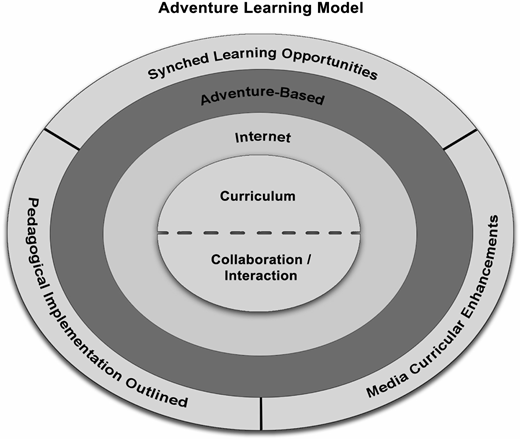
Based on these theoretical foundations, the design of the adventure learning experiences follows seven interdependent principles that further operationalize AL (Figure 1):
a researched curriculum grounded in inquiry;
collaboration and interaction opportunities between students, experts, peers, and content;
utilization of the Internet for curriculum and learning environment delivery;
enhancement of curriculum with media and text from the field delivered in a timely manner;
synched learning opportunities with the AL curriculum;
pedagogical guidelines of the curriculum and the online learning environment; and
adventure-based education (Doering, 2006).
Some examples of AL programs are the online education programs delivered at the University of Minnesota since 2004. These programs include Arctic Transect 2004: An
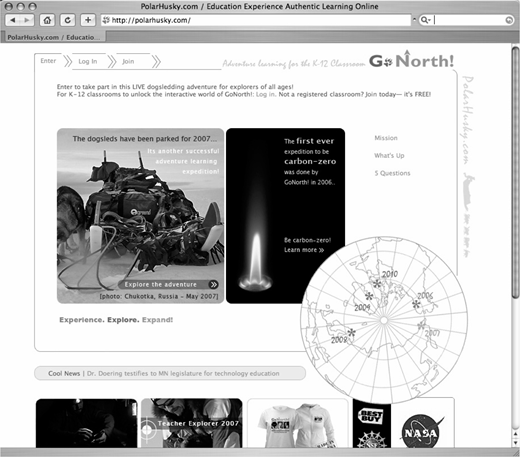
Educational Exploration of Nunavut (http://www.polarhusky.com/2004); and the latest circumpolar GoNorth! AL series—GoNorth!: Arctic National Wildlife Refuge 2006 (http://www.polarhusky.com/2006) and GoNorth!: Chukotka, Russia 2007 (http://www.polarhusky.com/2007) (Figure 2). In all of these programs, adventurers and educators dogsled throughout the Arctic location of study/exploration as learners around the world collaborate and learn about the region of travel and the supportive content-based curriculum. Upon identifying the region of travel and the issues to be investigated, an inquiry-based curriculum and online learning environment is designed, developed, and delivered accordingly. For example, in preparing for Arctic Transect 2004 (AT2004), the development of the curriculum and online learning environment focused on the region of travel, the newest territory in Canada—Nunavut, and the seven Native communities the AL team would interact with during the 6-month exploration. The curriculum consisted of 10 modules that were written based on three levels of curricular activities—experience, explore, and expand.
Parallel to the development of the curriculum, the online learning environment was designed to support the curricular goals through the development of several online spaces. These spaces afford collaboration among learners, interaction with real-time authentic media from the field (i.e., the location of travel), delivery of authentic media that supports the curricular learning, and an overview of pedagogical principles and support for successful teaching of AL (Doering, 2006; Doering & Veletsianos, 2008). Examples of the seamless connection between the curriculum and the online learning environment are the online learning environment’s weekly trail updates. Every Friday during the live program an “education day” is taken in the field when the adventurers and educators stop and the various media that were collected during the week are downloaded, edited, and sent to education basecamp via satellite technologies. The basecamp manager then makes the trail report available via the Web site by Monday at 8 A.M. CST. The trail report wholly supports the curricular goals. For instance, if a curricular unit is focusing on climate, all photos, movies, QuickTime virtual reality (QTVR) files, interviews, and trail reports, reinforce the climate lessons. At the same time, the education basecamp manager is updating the online learning environment content, scheduling the expert speaker for the week, moderating the collaboration zones where students from around the world are posting project files, and answering all questions from students and teachers to support learning and integration respectively— with all actions scaffolding the relevant curricular unit. In essence, the curriculum units, media, and interactions between the actors engaged in learning (i.e., learners, teachers, explorers, and experts) support the curricular goals of the AL environment. In the following sections, we exemplify the ways we view this support by providing an overview of affordances.
Affordances: A Call For Action
As learning technologists, we are experiencing a tension in the field between what we understand about learners and how we design technology-based environments that afford learning (Gaver, 1991; Kirschner et al., 2004). [Note: We use the designation “learning technologist” with reference to an instructional designer focused on designing experiences, as opposed simply to designing instructional products or processes. Instructional designers must surpass the pedagogical and technical issues of developing theory-based processes and products; only then will we as a field design truly meaningful learning experiences (Wilson, 2005).] In other words, our understanding of prospective learners’ needs and abilities seldom reflects our awareness of the capabilities and limitations that technologies offer for instructional design. Institutions tend to develop, implement, and research computer supported collaborative learning (CSCL) environments and online hybrid learning environments with a focus on the surface-level characteristics of the pedagogical and technological foundations of the environment (e.g., identifying optimal group sizes, performing comparative media studies, etc.). These approaches often result in disappointed students and instructors, diminished motivation, wasted efforts and resources, and ultimately an absence of meaningful learning (Kirschner et al., 2004). What remains are merely “showcase environments” (p. 48) that simulate traditional face-to-face communication and collaboration through little more than computer-assisted page turning, media galleries, and embedded chat boxes. As a result of past approaches, we must focus our efforts not only on the technological prerequisites for meaningful collaboration, but also on the educational and social conditions that fuel the nature of this interaction and experience.
When designing an online collaborative learning environment, the selection and implementation of an appropriate pedagogy supportive of the instructional aims of the project, taking into account the characteristics of the selected media, is the primary concern (Kirschner et al., 2004). The social characteristics of the design must enrich the chosen pedagogy by providing engaging opportunities that encourage the social dynamics and collaborative interactions that exist habitually in traditional face-to-face learning (e.g., group formation, learner-learner and learner-instructor communication, generative problem solving, etc.). Likewise, the technological foundation and design of the environment must not only allow for these social interactions to emerge, but ultimately thrive by providing an effective and efficient structure that satisfies users as they accomplish tasks and collaborate with peers in the environment. In this design scenario, Kirschner et al. (2002) refer to technology as an affordance for learning and education, essentially a guide for the educational and social contexts of the collaborative learning environment.
Wells (2002) illustrated affordances as ecological concepts (i.e., concerned with what an environment offers to an unconstrained perceiver) that are relational to the user and environment (Gibson, 1979). That is, affordances are those artifacts of an environment that determine if and how the environment can be used by an observer (Kirschner et al., 2004; Norman, 1988). The archetypal example of an affordance is the door handle. Certain door handles are shaped in ways that lead the observer to perceive they should be pulled, rather than pushed. In terms of affordances, the curved C-shape of certain handles affords that the handle be pulled to open the door, whereas a metal plate slightly-larger than the size of a human hand leads us to believe that the plate should be pushed for a similar interaction (Kirschner et al., 2004). These relationships between the properties of an object and the characteristics of a user are what enable particular interactions to take place (Gibson, 1979). Though these examples seem fitting for the field of product design, we will discuss how affordances impact education and, more specifically, provide a real-world example of how they can be used to influence the design of AL online learning environments.
Although instructional designers are intent to design and develop digital learning environments in which the media and interactions are self-evident to learners and instructors (i.e., the design of the software makes it immediately clear to users how they can interact with and manipulate the environment), artifacts in the environment are often perceived or used quite differently than the designers’ original intention (Krippendorf, 1989).
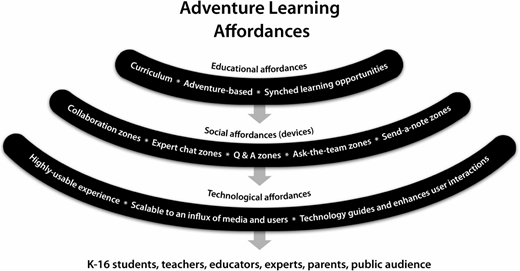
The educational affordances of an online collaborative environment are those characteristics of the design that determine if and how learners exhibit a particular learning behavior within the given instructional context (Gibson, 1979; Kirschner et al., 2004; Norman, 1988). In other words, educational affordances are the properties and features of the environment that stimulate, engage, and maintain collaboration amongst users and encourage learners to interact with the instructional content in meaningful ways aligned with the chosen pedagogy. For example, when learners in the AL environment explore the weekly trail report (i.e., an interactive journal of photographs, movies, narratives, and rich descriptions from the weekly experiences on the trail during the week), they are presented with a number of supportive activities (e.g., collaboration zones, weekly chats, quizzes, Q&A, explorer chats, etc.) that not only build on the current expedition events and topics, but also encourage learners to explore these issues in their local surroundings. The embedded educational affordances guide and scaffold the learner to interact with the environment, make use of the instructional media, and collaborate with online peers in a manner aligned with the AL model.
Social affordances are defined as the characteristics of an online collaborative environment that “act as social-contextual facilitators relevant for the learner’s social interaction” (Kreijns, Kirschner, & Jochems, 2002, p. 13). Accordingly, tools and objects in digital learning environments that posses these social-contextual properties are called social affordance devices. Social affordances are a major facet of AL, encouraging collaboration at multiple levels. For example, during each week of the AL expedition, per the curriculum, students are encouraged to participate in collaboration zones by submitting observations and creative work (e.g., drawings, riddles, essays, presentations, songs, etc.) to share and discuss with other learners, teachers, and experts (both synchronously and asynchronously) (Doering, 2006, 2007; Doering & Veletsianos, 2008). These collaboration zones are social affordance devices of the AL environment that promote learners to engage in activities that support the social-contextual properties and goals of the AL model (Kirschner et al., 2004). Collaborative learning environments devoid of social affordances are “likely to isolate learners from their peers” (p. 51), ultimately rendering the environment little more than a simple repository of instructional content and media. On the contrary, AL environments allow and encourage millions of students throughout the world to seamlessly collaborate online, an affordance that significantly impacts learning and motivation (Doering, 2006).
Analogous to the social affordances of an AL environment are the technological affordances, or those properties of the environment that are concerned with the efficient and effective accomplishment of tasks that satisfy the user’s instructional intentions (Kirschner et al., 2004). Norman (2004) identifies technological affordances as the usability of an environment. Successful AL environments must not only be highly usable in design, but must also be structurally sound systems that are scalable to an influx in use. AL designers must strive to make these properties transparent to the users’ interactions with the environment. An online learning environment rich with educational and social functionalities is useless to teachers and learners if the usability aspect of the design was disregarded or overlooked by designers (Kirschner et al., 2004). In other words, the technological affordances of the environment must support the educational and social interactions. Sound usability guidelines, clear design layouts, and consistent navigation themes throughout an environment are a necessity as the dynamic nature and magnitude of the media content evolves and becomes more sophisticated over the progression of an AL program. Paired with sound educational and social functionalities, efficient usability and appropriate technological affordances collectively determine the usefulness of a hybrid distance education environment (Kirschner et al., 2004).
The quality and effectiveness of collaborative distance education is contingent upon the “design of, and student’s engagement in, the learning environment” (Duffy & Kirkley, 2004, p. 4).Kirschner et al. (2004) suggest that the use of appropriately designed and implemented educational, social, and technological affordances is the foundation for stimulating, engaging, and maintaining collaboration amongst learners. Accordingly, AL makes use of anchor-based, collaborative, and situated pedagogies (educational) between students, teachers, experts, and adventurers (social) using the Internet as a means for efficient and useful collaboration (technological). A shortcoming in any of these areas will result in an environment with minimal learning, interaction, and collaboration; in effect, a mere online journal of a person’s desire to explore the earth with education as the final phase of development (Doering, 2006). It is important to note at this point that affordances are not simply tools or objects that can be developed as independent components for implementation into any digital collaborative learning environment (Kirschner et al., 2004). Rather, designers, teachers, and researchers of AL environments must understand and embrace the relationship between users and artifacts (i.e., devices) that exhibit the aforementioned educational, social, and technological characteristics.
Affordances Of Adventure Learning
In the following sections we describe the design and implementation of three internationally acclaimed AL environments—Arctic Transect 2004, GoNorth!: Arctic National Wildlife Refuge 2006, and GoNorth!: Chukotka 2007, by providing examples and recommendations of three prerequisites for effective collaboration in AL environments: educational, social, and technological affordances.
Educational Affordances of Adventure Learning
Educational affordances are those characteristics that determine if and how effective learning takes place (Gibson, 1979; Kirschner et al., 2004; Norman, 1988). Within adventure learning (AL), these affordances are vital to the success of learners’ experiences becoming transformational (Doering, 2006). The path to transformation begins with the affordance of the AL curriculum, the heart of adventure learning. The curriculum is what sets AL apart from an adventurer’s blog. That is, the online environment and project goals support the curricular goals. As noted earlier, the curriculum is written with three levels of activities—experience, explore, and expand. The words experience, explore, and expand ultimately coincide with the level of complexity in a particular lesson within the module. For example, experience activities introduce students to basic ideas or concepts. These lessons create awareness of a topic or issue. In some instances, students form questions that can be answered in the explore or expand lessons. Explore activities use experience related ideas and increase the scale in which they are viewed. Students are required to demonstrate an understanding of a topic as it relates to new systems and larger perspectives. An experience activity may introduce students to a particular plant or animal whereas an explore activity would look at population dynamics, predator/prey interactions, or habitat distribution within an ecosystem. Expand activities take ideas or concepts and relate them to new situations. Students are required to use their previous knowledge and skills to predict, project, manage, relate, or solve a particular question or problem. Expand activities most often involve inquiry-based methodology, cross-curricular research, and real-world applications.
Each module also has two major sections— one section that focuses on the Native culture, perspective, and region of travel and a section that focuses on the Western perspective. This curricular design affords the opportunity to compare and contrast the curricular content across cultures while integrating the curriculum according to the type of learners. Furthermore, the curriculum is written to encourage the learner to use the online resources while also collaborating with peers and experts around the world. For example, as learners investigate the impact of climate change on native cultures within a module, they are also encouraged to participate in the weekly expert chat with a climatologist from the Weather Channel, post project files they create within the collaboration zone, ask questions to the adventurers/educators in the field, read the trail reports, view the media of the week, and participate in the online games within the online learning environment. All facets of the program are designed and developed within the curriculum and support each other. There are no disparate activities that do not relate to the curricular goals. Thus, learners are encouraged and motivated by the design of the AL program to meet these curricular goals.
The second educational affordance, adventure based, motivates learners and teachers to become and stay involved in the real-time story that is unfolding. Simply, what is “normal” and boring to one individual is many times unknown and motivating to another. Thus, as the team travels throughout the Arctic delivering the story, students and teachers have the opportunity to experience and live the story virtually. From traveling to the northernmost regions of Canada, Alaska, and Russia, to exploring a local town or river, the idea of an adventure motivates. Moreover, although it may sound simple, when the adventure involves something that everyone can relate to—dogs—the motivation for curricular investigation grows exponentially (Doering, 2007). Students across the world “adopt” their favorite sled dogs and their dog is the hook to bring them to the online learning environment in school and at home almost on a daily basis. Students are motivated to return to the online learning environment where they are going to read about the updated weekly trail report and the latest adventures of their adopted dog. For example, Doering and Veletsianos (2007) found that learners repeatedly returned to the AL online learning environment after school and during the weekends to see “what the team and the dogs have gone through recently” and also to showcase what they “were working on in school” to their parents/guardians at home.
The third educational affordance is the synched learning opportunities. All facets of the AL design have the curricular goals and social opportunities in mind. Within an AL program, the weekly trail updates from the field, the weekly media updates (e.g., photos, movies, QTVR, etc.), the local case studies, the weekly online chats, the weekly driving questions within the collaboration zones, and the weekly quizzes are all synched with the curriculum. Learners are able to receive the scaffolding and reinforcement from the design so their personal investigations into the curricular outcomes become transformational. Doering and Veletsianos (2007) found that students investigated a curricular goal (i.e., understanding the impact of climate change on native cultures) in five separate locations within the AL program 80% or more of the time. For example, students studying climate change discussed the impact of climate change with their teacher and fellow students, posted project files that related to climate change, discussed climate change in the weekly chats, played online games related to climate change, read the weekly trail report about climate change, and watched the weekly media that consisted of interviews with natives about climate change.
Social Affordances of Adventure Learning
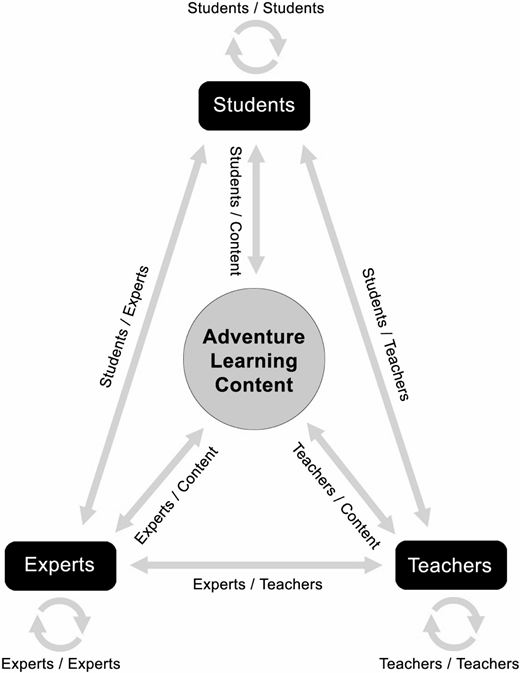
Adventure learning social affordances are those characteristics that are instrumental in determining if and how social collaboration and interaction within the project take place. Within the AL model, residing next to the curriculum is collaboration and interaction. AL cannot be successful at a transformational level unless there is successful interaction and collaboration at multiple levels—between students and teachers; between students and subject matter experts; between teachers and subject matter experts; between students, teachers, subject matter experts, and the AL content; and lastly, between students themselves, teachers themselves, and between the subject matter experts (Figure 3). The layers of interaction and collaboration occur within the social affordance devices within the project. These devices include “Collaboration Zones,” “Expert Chat” zones, “Question and Answer” (Q&A) zones, “Ask the Team” zones, and “Send-a-Note” zones.
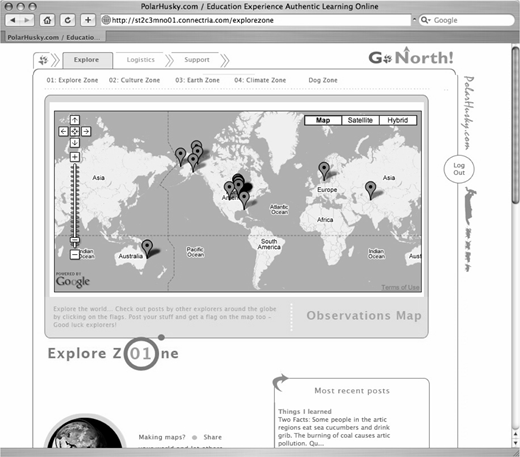
The collaboration zones, unique to each curricular unit, are socially designed spaces within the online learning environment that afford learners from around the world to post and view AL project files created within the curriculum. For example, a learner who creates a movie for the unit on flora and fauna will upload the file to the “Flora and Fauna” collaboration zone. Once the movie is moderated by the basecamp manager, an interactive map on the front page denotes the file has been posted and the geographical location from which the post originated. Then, from either the Observations Map or the Web page navigation, learners can view and collaborate on all the collaboration zone postings (Figure 4). Essentially, the design of each collaboration zone is specific to the curriculum unit and the curriculum design scaffolds learners to post their project files within this environment.
Although the collaboration zones are asynchronous, other features of the learning environment such as the expert chats are synchronous and occur multiple times throughout the week to accommodate multiple time zones. On a weekly basis, an expert chat is held that supports the curricular goals. For example, if the module unit is focused on sustainability, an expert on sustainability is asked to participate in the synchronous environment fielding and answering questions from students around the world. For those learners whose questions are not answered within the expert chats, they have the opportunity to use the Q&A zone. This zone is populated with questions that learners pose to the AL team throughout the program. For those questions and words of encouragement that are more personal, learners can ask the AL team questions or send them words of encouragement within the “Ask the Team” and “Send a Note” zones.
All of these social affordance devices encourage learners to interact with the AL content and collaborate with AL participants around the world. The mixture of “professional and personal,” depending on the zone that is utilized, affords the opportunity for learners to learn more about the curricular goals while also gaining insight into the AL team and the daily demands of delivering an AL project from the field. This personal look into the AL team (people and dogs) brings the learner closer to the content and the numerous participants within the program, enabling learners to engage with learning experiences that are transformational (Doering, 2006).
Technological Affordances of Adventure Learning
From kindergarteners to high-school students, parents to grandparents, and studentteachers to university professors, the AL environments have been used by several million visitors over the past 3 years (Doering, 2006). This feat, due in large part to an expansive curriculum supported by engaging social affordance devices, was attainable through an efficient online design grounded in user-centered research and successful technological affordances. The technological affordances of an AL environment are designed to ensure a highly-usable experience for children and adult users alike, scalable to an influx of both media (e.g., trail reports, photos, videos, collaboration activities, etc.) and users over the course of AL project, and use technology to enhance and guide user interactions within the environment, avoiding the use of technology for technology’s sake (Kirschner et al., 2004; Norman 2004). Between 2003 and 2004, the Arctic Transect environment endured a surge of visitors as user statistics escalated from figures in the thousands to records in the millions, with users from nearly every country following the expeditions and participating in the collaboration zones. Usability and scalability played a key role in this scenario. Had the online environment become a cluttered depository of unorganized expedition media and poorly managed navigation, the environment, and more importantly the AL project as a whole, would have failed.
Parallel to the development of usable and scalable AL online environments, it is imperative that AL designers select and implement technologies that support and advance the instructional aims of the project, rather than simply piecing together a concoction of off-the-shelf technologies that provide interactions similar to the social affordance devices discussed above. The selection, design, and implementation of technologies must not ignore the human side of the AL environment, that is, the students and teachers who will be exploring the online media and interacting with others in the collaboration zones (Kirschner et al., 2004). For example, the Observations Map (located on the overview page of each Collaboration Zone) uses technologies powered by Google Maps to provide a visual placemark that denotes the geographic origin of each interaction (see Figure 4). The visualization technology implemented in the Observations Map not only provides learners with an easy-to-use reference and navigation of current Collaboration Zone posts but, more importantly, helps learners discover and understand the foundation of authentic global collaboration—the collective generation of knowledge across cultural and geographic barriers.
Adventure Learning Affordances: Summary
The thoughtful implementation of educational, social, and technological affordances in an AL online environment is a critical component of the AL design process (Figure 5). Engaging a wide audience of teachers and learners in a collaborative effort to explore an authentic context can be a complex instructional task. Thus, the use of sound technological affordances to mediate the social and educational interactions of users in an AL environment is an important framework for designers, teachers, and researchers. As more AL projects begin to surface in the distance education community, we encourage researchers to explore the intricate nature of these learning experiences through multi-methodological and multiparadigmatic examination. The following section presents an overview of three such research endeavors.
Exploring The Affordances of Al Environments
Theoretical propositions regarding learning and teaching need to be empirically examined as to their applicability, viability, effectiveness, and efficiency. To investigate the educational, social, and technological affordances of AL environments, we propose the use of three established frameworks that inform each other in terms of the type of knowledge they generate. These three are (a) traditional performance and evaluation studies, (b) phenomenological investigations, and (c) design-based research explorations. In the sections that follow, we explain each framework with respect to AL and present an example of a research study we have conducted to illuminate the results that each approach may yield. It is important to note that the evaluation of the affordances of AL environments should not be limited by philosophical arguments of the type of knowledge generated by different methodological approaches. Each approach complements the other two and, in conjunction, these methodologies can provide a more holistic picture of AL environments with respect to variables of interest.
Traditional Performance and Evaluation Studies
By traditional performance and evaluation studies we refer to research that falls under the umbrella of the experimental, quasi-experimental, and qualitative case study approach that examines aspects of AL in relation to teaching and learning. It is important to note that the label traditional should not be taken to mean that we do not value the importance of such research. On the contrary, such research endeavors can reveal relationships between variables of interest (e.g., teacher motivation, degree of AL integration, etc.), indicate new research directions, and inform researchers as to the feasibility of a theoretical construct (in this case AL).
As an example, Doering, Reidel, and Scharber (2007) examined one aspect of the social affordances of AL—specifically, how student motivation relates to (a) student and teacher characteristics, and (b) the ways in which the AT 2004 program was used within the classroom. Results from a factor analysis approach indicated that students were motivated by interacting with the media such as photos, videos, and audio updates (social affordance devices); reading about the dogs, explorers’ progress, and the Inuit communities; and using the learning activities from the AT 2004 curriculum. Additionally, a structural equation model indicated that (a) teachers employing a traditional teaching pedagogy utilized AL less often than those teachers with a more constructivist teaching style, (b) AL activities significantly impacted student motivation, and (c) teaching style did not impact student motivation. Overall, the model suggests that constructivist teachers influence students’ motivation in relation to AL purely through how strongly they implement the AL program within their classroom.
Phenomenological Investigations
Even though the use of the phenomenological method is not popular in educational technology circles, we hold that it is of utmost importance in understanding the authentic and contextual experiences of teachers, learners, and designers. Phenomenology is an interpretive research methodology rooted in psychological inquiry aiming to examine, understand, and interpret observable, yet special events in our everyday life (Heidegger, 1962).
For example, Miller, Veletsianos, and Doering (2008) wrote a hermeneutic phenomenological manuscript describing the experiences of an educator/designer/adventurer when delivering AL from the Arctic. One of the constituents of this experience is the continuous struggle and frustrations with the technology used to deliver education from the Arctic to the rest of the world, a struggle to maintain the technological affordances of the environment to enhance the social affordances of the AL program. The adventurer notes,
So, for 3 or 4 hours, I will be working on trying to get 2 Megs sent out. I’m getting frustrated. I’m getting very frustrated. I’m getting mad at the technology. I’m getting really tired. It’s now midnight. I know I have to get up the next morning to get back on the trail again.
We are often presented with convoluted ideals about technology: technology is simple; technology will make things better; technology will make life better. Even though these statements may be true, they may hold accurate only in the environments where they were birthed: businesses, homes, cities, coffee shops, and so forth. In the Arctic, connecting with the satellite to send a mere 2 or 3 megs of photos “meant a day of fighting the technology to try to write up the report.” Technology wasn’t so simple.
We would position ourselves in a way that had a clear bearing to the southeast. If we had sea ice in the way, we knew we wouldn’t be able to transmit the report. You jump back in and fight with the server because you will connect, but it won’t transmit data.
The adventurer endured a great deal every week just to shape the data into a manageable form and was rarely compensated by the acknowledgement that his data was actually going somewhere. It was as if he was throwing bottled notes into the Arctic Sea, hoping they would somehow find their way south around Maine, along the costal Atlantic, around Florida, and zigzag their way up the Mississippi river to the university to get published for the world to consume.
Design-Based Research
Design-based research (DBR) is a relatively new research methodology that aims to assist in truly understanding learning in context (Brown, 1992; Collins, 1992). In short, DBR attempts to understand the “how” while valuing ecological validity and exploration in the messy educational contexts of the classroom and the distance learning environment. For example, we could ask, how do the educational and social affordances inherent in AL environments influence the outcomes of interest? DBR is concerned with solving real-world problems by interventions (Wang & Hannafin, 2005) that modify the educational, social, and technological affordances of AL endeavors. More formally, DBR is a multistep methodological approach aimed at enhancing learning and teaching processes by means of theory development, research in authentic and naturalistic environments, and the sharing of knowledge amongst practitioners and researchers (The Design-Based Research Collective, 2003). Phenomena are studied in their “messy contexts,” outside of convoluted labs (Brown, 1992) because any insights gained from investigations undertaken in out-of-context environments have limited applicability in the classroom. As such, DBR affords us the opportunity to experiment with interventions in authentic environments to explore what happens in the “real world.” In line with these ideas, Collins (1992) noted the need to methodically investigate variants of an intervention to accurately capture their influence. For instance, we could explore social affordances in the context of varying degrees of collaboration between students and teachers. Such an endeavor requires an understanding of the complexities of the environment in which learning occurs (e.g., for a description of school culture and its intricacies see Firestone & Louis, 1999), especially in the face of dominant cultural beliefs about learning and teaching that may prevent change (Cuban, 1993; Lortie, 1975).
As evidenced by our proposal to investigate the affordances of AL environments with respect to varying and complementary research methodologies, we are in support of a multi-paradigmatic approach to research that may inform different facets of AL theory, programs, curricula, and learner/teacher experiences. Equally important, we perceive the use of the DBR framework as a valuable tool to guide us towards systematic approaches to designing interventions and examining ecologically valid learning and teaching processes. Finally, as DBR emphasizes the sharing of knowledge between researchers and practitioners, collaborating with teachers and immersing ourselves in contextual and authentic environments, may allow us to better comprehend what AL in the classroom affords.
Exploring Adventure Learning Affordances: Summary
To understand phenomena of interest, researchers need to engage in systematic research endeavors. To be useful, such endeavors need to be multimethodological and multi-paradigmatic, being able to inform each other in terms of the knowledge they generate. Additionally, such research needs to be based on solid theoretical grounds; nevertheless, we must be prepared to amend such theories should such a change be warranted by the results of our research endeavors. The investigation of the educational, social, and technological affordances of AL environments not only warrants, but demands, the use of theory-based multimethodological and multiparadigmatic research endeavors.
Conclusion
In this article we discussed how the design of adventure learning addresses the educational, social, and technological affordances (Kirschner et al., 2004) needed for successful collaborative online learning. As the success stories of AL in the K-12 classroom are increasing, we can identify what is working and apply it to other online hybrid distance education programs while studying their effectiveness per the discussed research approaches. Although the design, development, and delivery of the described AL programs represents an elite approach where success is based on large amounts of funding, we must now use what we are learning and make it sustainable for all educators. The future of AL begins with educators learning to design and deliver their own AL programs while taking into account all AL affordances. AL does not need to be an elite form of developing learning opportunities where the region of travel is as remote as the Arctic. Rather, AL can be a class investigation to study an issue/ problem within learners’ own locale using the principles and affordances of AL, leading to meaningful and transformational learning.

