


This paper aims to systematically review, discuss and synthesize the current state of research in the realm of hedge fund activism (HFA). By exploring HFA-related literature through a transparent and rigorous method, this study identifies unexplored areas for future research to develop a comprehensive understanding of the subject.
The authors perform a systematic database survey procedure as recommended in the prior literature. The review includes 74 articles published in high-impact journals from 2008 to January 2024, sourced from the Web of Science and Scopus databases and filtered using several exclusion/inclusion criteria.
This review offers a detailed analysis of the selected papers, highlighting trends in HFA research, the most influential journals and authors and additional insights into current studies. By systematically presenting the state-of-the-art, this paper categorizes the current research into three main streams and provides a critical evaluation of existing knowledge, identifying gaps and potential directions for future research.
This study makes two significant contributions to the literature. First, this study systematically reviews HFA-related research and provides a comprehensive examination of our existing scientific understanding of the factors shaping activism and its implications. Especially, this paper adopts a rigorous methodological protocol to ensure transparency and replicability in the review process, while earlier reviews focus on specific areas and are primarily narrative. Second, this study identifies research gaps and questions across all three streams of literature, offering valuable insights for future scholars aiming to expand our knowledge of the dynamic and evolving nature of HFA.
1. Introduction
In the vast financial landscape, where corporate decisions and strategies are the chess pieces on a board of intricate moves, activist hedge funds emerge as masterful manipulators strategizing each move to drive the corporate realm while achieving optimal outcomes. Their influence on targeted firms is a constantly growing phenomenon and is now largely recognized to be a governance mechanism that leads to substantial changes in firms’ capital structure, business strategies and governance reforms, in the effort to unlock the latent companies’ value. In 2023, global campaign activity reached a record high of 252 new interventions (Lazard, 2023). Although the majority of activism events have previously occurred in the USA, the most significant contribution to the recent surge in activism came from Europe and APAC, with 69 and 44 new campaigns, respectively (Lazard, 2023) [1]. This seems to be a sign that activism’s overall success led to a saturation of US market while also creating growth opportunities outside the USA. The year 2023 has also been a record year for the number of investors initiating an activist agenda (183, 21% higher compared to 2022) and for the number of first-time activist investors (77, raised about 40% from 2022 and 75% higher than the five-year average). Again, Europe has been the primary driver of “first-time” activity, with the number of activism events started by new investors more than doubling from 2022 to the present (Lazard, 2023).
Prior literature suggests that the effects of activism campaigns vary across countries and their success or failure depends on the type of investor (Brav et al., 2008a; Filatotchev and Dotsenko, 2015; Becht et al., 2017). Earlier activist campaigns were mainly carried out by pension and mutual funds, but multiple factors, including regulatory and structural barriers, led to poor results (Black, 1990) [2]. Indeed, while the positive short-term market reaction to the announcement of activism appeared to suggest positive changes in market participants’ beliefs about companies’ value, such investors have actually failed to generate real positive economic effects in the medium to long term (Gillan and Starks, 2007). Conversely, the later generation of activist investors has proven to be a valuable vehicle for shareholder value creation. Currently, activism scenario is dominated by hedge funds, whose special qualities have been shown by a large body of empirical evidence to have several positive implications in terms of firm value maximization (Boyson and Mooradian, 2007; Brav et al., 2008a; Clifford, 2008; Klein and Zur, 2009; Brav et al., 2015b; Brav et al., 2018; Swanson et al., 2022).
This has prompted academics to become extremely prolific, providing a great deal of empirical research aimed at expanding our understanding of the factors that influence activism, the effects on companies’ long-term value and the possible channels for value creation. In this regard, some scholars have made attempts over time to collect and organize the massive knowledge in this field with several approaches and objectives (Brav et al., 2010; Ahn and Wiersema, 2021; Aguilera et al., 2021). However, nobody has addressed this urge by adopting a rigorous methodological protocol to guarantee a transparent and replicable review process (Tranfield et al., 2003). Brav et al. (2010) remain the sole contribution in this regard, but the activism landscape has changed significantly in the past 15 years, and the more recent review studies have been mainly designed to provide a research agenda especially for management scholars (Ahn and Wiersema, 2021) or to capture differences in the effects of activism in distinct jurisdictional contexts (Aguilera et al., 2021), while still adopting a merely narrative approach.
The aim of this article is to synthesize the relatively nascent research in the hedge fund activism (HFA) realm within a systematic literature review framework, to provide a comprehensive examination of our existing knowledge of the factors shaping activism, the implications for targeted firms and market participants and to identify future research directions, especially in the field of finance. The outcome of this review indicates the surge in HFA popularity over the past 20 years, reflected by the notable increase in the number of publications. Ideologically, research efforts can be categorized into three primary streams. In the early stage of this literature, scholars were concerned with observing the key elements of activism, such as the objectives and tactics of interventions as well as the factors affecting the fund’s target selection strategy. A second stream of the literature has examined the short- and long-term implications of activism events, as well as the effectiveness of such “new” governance mechanisms for value creation. The current body of research, instead, evolves as the phenomena of shareholder activism spreads internationally, and it is keeping an eye out for differences in the repercussions of these interventions and the underlying mechanisms that may be responsible for their impact.
By systematically illustrating the state-of-the-art overview of HFA adopting a clear and strict scientific method, this study sheds light on the recent research trends and provides a critical analysis of the comprehensive current knowledge as well as gaps and equivalent avenues for future research in the field.
The remainder of this paper is organized as follows. In Section 2, we offer a summary of the peculiarities of hedge funds and activism events, and in Section 3, we discuss systematic database survey procedure used. The sample is descriptively analyzed in Section 4. Sections 5 and 6 present the findings and suggest future directions for investigation, respectively, while Section 7 concludes.
2. Hedge fund activism
A hedge fund is an investment vehicle privately organized, administered by professional money managers, and not widely available to the public (U.S. Securities and Exchange Commission, 2003). The term “hedge fund” originally appeared in 1949 to denote a type of private investment fund that combines long and short equity positions to “hedge” the portfolio’s exposure to market fluctuations. Only 300 funds and about $40bn in assets under management comprised the hedge fund sector in 1990 (Ahn and Wiersema, 2021). By 2032, the market size (measured by the assets under management value) is predicted to reach $7.1tn from its current $5tn level (Global Market Insights, 2023).
In the modern era, hedge funds no longer “hedge” in the traditional economic sense, but rather they carry out numerous complex strategies and risk management techniques to achieve positive returns. Among these, a relevant share is constituted by activist strategies, consisting in acquiring minority stakes in targeted companies and, subsequently, pressuring management to make significant changes with the intent to improve shareholder value. Figure 1 shows the number of activism campaigns launched by hedge funds in the USA between 2008 and 2023, which clearly indicates the importance of this phenomenon in the current financial landscape. Nonetheless, the slightly downward trend suggests a reassessment of investment strategies in the sector. Indeed, comparing our data with Ahn and Wiersema (2021) reveals an increasing interest of hedge funds in international markets, supporting the idea of market saturation in the USA and a dynamic search of new opportunities globally (as also indicated by Lazard, 2023).
 The chart presents the number of activist hedge fund campaigns in the United States from 2008 to 2023. Annual values include 301 in 2008, 223 in 2009, 270 in 2010, 214 in 2011, and 181 in 2012. Counts rise to 271 in 2013, 280 in 2014, 290 in 2015, 292 in 2016, and 283 in 2017. Values then decline to 255 in 2018 and 237 in 2019, followed by 249 in 2020 and 250 in 2021. Campaigns drop to 192 in 2022 and increase to 242 in 2023.
This figure shows the number of activism campaigns conducted by hedge funds in the USA from 2008–2023 (yearly average = 252 campaigns)
The chart presents the number of activist hedge fund campaigns in the United States from 2008 to 2023. Annual values include 301 in 2008, 223 in 2009, 270 in 2010, 214 in 2011, and 181 in 2012. Counts rise to 271 in 2013, 280 in 2014, 290 in 2015, 292 in 2016, and 283 in 2017. Values then decline to 255 in 2018 and 237 in 2019, followed by 249 in 2020 and 250 in 2021. Campaigns drop to 192 in 2022 and increase to 242 in 2023.This figure shows the number of activism campaigns conducted by hedge funds in the USA from 2008–2023 (yearly average = 252 campaigns)
In the USA, still representing the largest hedge fund market, investors are required to file a “beneficial ownership report” upon reaching 5% ownership of a voting class company shares (Section 13 of the Securities and Exchange Act of 1934). Most important, the disclosure regulation makes it possible to distinguish active from passive investors, as they are required to submit two distinct reports, that is, Schedule 13/D and Schedule 13/G, respectively. Schedule 13/D has to be filed within five days of crossing the 5% threshold; [3] additionally, each time the beneficial owner’s holdings change by 1% or more (material change), he must file an amendment (Schedule 13D/A) to the original Schedule 13D within two days of the transaction. Further, activist investors are required to disclose additional relevant information regarding their involvement in the target company, which can be summarized in the following two topics: the purpose of the transaction; the strategies that are going to be pursued to achieve that purpose.
The purpose of the transaction is the object of Item 4 of Schedule 13/D, and it encompasses four distinct categories (Brav et al., 2010):
undervaluation of targeted companies;
capital structure and corporate payout policy;
changes to business strategy; and
changes to corporate governance.
In the first case, the intent of activists is to help managers of the undervalued company to maximize shareholder value, which represents the most common purpose of active investment [consisting of 48.3% of the sample of Brav et al. (2008a) and 45.5% of the sample of Greenwood and Schor (2009)]. For the purpose defined as (2) above, the goal is to intervene in the capital structure choices through debt restructuring and/or excess cash reduction by increasing leverage or paying out to shareholders. Category (3) includes multiple types of intervention, such as enhancing operational efficiency by cutting operating costs, giving recommendations on how to effectively pursue business growth, encouraging the creation of spin-offs in case of excessive diversification and, when the target company is involved in an M&A transaction, to prevent inefficient acquisitions or to negotiate a higher price (in case the company is the target of the acquisition). Instead, category (4) relates to actions such as challenging board independence, rescinding takeover defenses, replacing the CEO or chairman, demanding more disclosure, contesting the level or pay-for-performance sensitivity of executive compensation and other corporate governance related changes. Except for the first category, the success rate (i.e. full achievement of the main goal) is 40.6% and the partial success rate (i.e. partial achievement of the original goal) is 25.8%, according to Brav et al. (2008a).
In most of the cases, the initial Schedule 13D also provides information regarding the strategies through which the activist hedge fund intends to achieve the objectives declared in Item 4. Again, Brav et al. (2010) classified these strategies into the following seven categories:
regular communication with corporate managers aimed at enhancing shareholder value;
claiming board representation without engaging in a proxy fight or conflict with the current management;
publicly criticizing the business and demanding changes or submitting formal shareholder proposals;
threatening to sue the target company for violation of fiduciary responsibility or to engage in a proxy fight to get board representation;
engaging in a proxy fight to dismiss the board;
filing a lawsuit against the target company; and
declaring the intention to acquire the company through hostile takeover.
Abovementioned strategies are ranked in increasing order of “hostility” toward the target company, starting from the friendliest approach of category (1) to the most aggressive one defined as (7) above. Prior research has classified as “hostile” those tactics fitting under categories (4) to (7), as well as category (3) if a hostile approach (such as removing a member from the board) is explicitly declared. Regular communication with the management represents the most common strategy, according to Brav et al. (2015a), while hostile approaches are verified in roughly 38% of cases, but non-statically significant differences occur in the total (and partial) success rate compared to non-hostile events.
In contrast to other activist institutional investors (Gillan and Starks, 2007), there is robust empirical evidence supporting the long-term value creation following activist hedge funds entry (Bebchuk et al., 2015; Brav et al., 2015a), which confirms their growing importance and their leading role in this regard. Prior scholars have noticed how activist hedge funds’ rise and success are casually linked to the unique features that distinguish them from other institutional investors. The first and probably most important distinction has to do with the financial incentives of fund managers. In contrast to the earlier generations of activist investors, the hedge fund industry is characterized by the notorious “two and twenty” fee structure, that is, a standard management fee of the 2% of asset under management, plus an incentive fee of 20% of fund extra-profits (i.e. profits exceeding a predefined benchmark). The “two and twenty” rule of thumb constitutes a significant incentive for managers to generate profits and, thus, to make appropriate decisions to achieve the activist agenda, especially if we also consider that they usually invest personal money into the fund. Additionally, as hedge funds are not available to retail investors, they are subject to a milder regulation, resulting in numerous benefits. For example, they are exempt from the rigorous fiduciary duty, which involves one party operating in the best interests of another, and they are also not required by law to maintain diversified portfolios, which makes it easier for them to acquire significant stakes in a target company. They do not even need to be concerned about fund shares’ liquidity, as they normally ask their clients to subscribe a lock-up agreement that prevents the withdrawal of invested money for two years or more. Further, to influence the management of the targeted firms, they can use a wide range of trading and risk management strategies unavailable to mutual and pension funds, including leverage, derivatives and short selling. Finally, compared to other institutional investors, hedge fund managers are usually less subject to conflicts of interest. For example, in contrast to mutual funds, hedge funds do not sell products to firms in which they hold shares, and in contrast to pension funds, they are not susceptible to political or governmental influence. Hence, hedge fund managers are highly motivated to generate positive profits on their own.
Viewed collectively, the above arguments provide a clear explanation of the crucial role that hedge funds play in the area of shareholder activism, emphasizing the necessity of conducting an in-depth examination of all prior studies offering a broad framework for comprehending the implications of this phenomenon and pointing out uncharted research directions to push the boundaries of knowledge.
3. Methodology
Over the past decades, the phenomenon of HFA has gained popularity, stimulating the curiosity of academic scholars. As a result, numerous empirical studies have been conducted to determine the causes and potential implications of these events. Despite such a surge in activist hedge fund activity and connected research, few efforts (and with a purely narrative approach) have been made to summarize the extensive knowledge acquired over time (Brav et al., 2010; Ahn and Wiersema, 2021; Aguilera et al., 2021).
To address this gap, this study adopts a systematic literature review approach to synthesize relevant research on HFA. This approach is beneficial for assessing research insights on specific topics, identifying trends, highlighting gaps and proposing future research directions to advance our understanding in the domain. Unlike other review approaches, systematic review uses a rigorous and transparent protocol for research synthesis, with the aim of minimizing bias and ensuring the robustness and generalizability of the findings (Tranfield et al., 2003; Denyer et al., 2008; Sengupta et al., 2018).
To extract relevant research on HFA using a replicable and scientific process, we developed the following procedure (summarized in Figure 2). First, Web of science (WoS) is selected as the primary source for the articles collection given the larger coverage compared to alternative sources. Then, we restrict the search to only English-language articles published in “scholarly” journals. The aim is to guarantee that the emphasis remains on high-quality productions (David and Han, 2004), as journal articles undergo a rigorous peer review procedure (in contrast to book chapters, working papers, etc.). We further limit the search to papers that fall under the following Web of Science categories: “Business Finance”, “Economics”, “Management” or “Business” [4]. Of the papers fulfilling these requirements, we collect each one containing the terms “Hedge fund*” and “activist” or “Hedge fund*” and “activism” in the title, abstract or keywords. To make sure that the articles have empirical content, we also require that at least one of the following seven “methodological” keywords appear in the title or abstract: data, empirical, test, statistical, finding, result or evidence (Newbert, 2007). This initial procedure results in a sample of 161 articles. Nevertheless, we only consider papers published in high-quality journals, which are classified as ABS 3 or higher-ranking journals, to further guarantee that the studies submitted to our review satisfy a high level of conceptual and methodological rigor (Alatawi et al., 2023; Rao et al., 2023) [5]. After reviewing the abstracts and additional contents, we whittled down the remaining studies to remove those that were not empirical or that did not look into HFA, [6] further reducing the sample to 61 papers [7]. To verify that no relevant studies are excluded from the analysis, we combine the 61 articles generated by the discussed process by querying another database using a similar approach [8]. Specially, by demanding the identical parameters and deleting duplicates, we find 13 additional publications using the Scopus database [9]. The final sample resulting from this procedure consists of 74 scientific articles ( Appendix).
 The flowchart summarises the sampling process discussed in section 3. The primary source is Web of Science and the additional source is Scopus. Inclusion criteria for both sources require English journal articles within categories such as business finance, economics, management, business, finance, economics, management, and accounting. Keywords include hedge fund and activist; hedge fund and activism; and data or empirical or test or statistical or finding or result or evidence. Web of Science yields 161 articles. After quality assessment including journals ranked Australian Business Deans Council 3 or higher and removal of non-empirical or irrelevant papers, 61 articles remain. Scopus yields 93 articles. After removing duplicates, excluding journals below Australian Business Deans Council 3, and removing non empirical or irrelevant papers, 13 articles remain. The final sample includes 74 articles.
This figure summarizes the sampling process discussed in Section 3
The flowchart summarises the sampling process discussed in section 3. The primary source is Web of Science and the additional source is Scopus. Inclusion criteria for both sources require English journal articles within categories such as business finance, economics, management, business, finance, economics, management, and accounting. Keywords include hedge fund and activist; hedge fund and activism; and data or empirical or test or statistical or finding or result or evidence. Web of Science yields 161 articles. After quality assessment including journals ranked Australian Business Deans Council 3 or higher and removal of non-empirical or irrelevant papers, 61 articles remain. Scopus yields 93 articles. After removing duplicates, excluding journals below Australian Business Deans Council 3, and removing non empirical or irrelevant papers, 13 articles remain. The final sample includes 74 articles.This figure summarizes the sampling process discussed in Section 3
4. Descriptive analysis
This section descriptively analyzes the final sample of papers resulting from the methodological approach discussed previously. We provide an overview of trends in HFA research realm emphasizing the most influential journals and authors, as well as additional insights of the existing investigations.
4.1 Journals, research trends and disciplines
The 74 papers in our sample come from 28 different journals across a variety of disciplines. Journal of Financial Economics is the main driver with 11 articles (17.46%), followed by Journal of Corporate Finance (9.52%), Review of Financial Studies (9.52%), Journal of Financial and Quantitative Analysis (7.94%) and Strategic Management Journal (6.35%), while the remaining journals have an incidence ranging from 1.59% to 4.76% (Table 1). Accounting for 48.65% of the sample, the “world elite journals” (i.e. ranked as ABS 4*) produce the highest number of articles, followed by “top journals” (ABS 4) with 27.38% of articles and “highly regarded journals” (ABS 3) with 22.97% (Figure 3). Based on these statistics, it can be inferred that results and supporting evidence are remarkably reliable and untainted from methodological or conceptual concerns, as most of the articles evaluated throughout the peer review process are published in journals with the best worldwide standing. In terms of scientific impact, Journal of Finance articles have received 1,771 citations (on average, 590 citations per publication), nearly double that the Journal of Financial Economics, the second-ranked journal in this regard. With an overall number of around 2,700 citations, these two journals surpass the aggregate citation counts of all other journals, establishing themselves as the most influential in this field (Table 2).
This table shows the number of publications, grouped by journal
| Journal | Frequence | % |
|---|---|---|
| Journal of financial economics | 11 | 17.46 |
| Journal of corporate finance | 6 | 9.52 |
| Review of financial studies | 6 | 9.52 |
| Journal of financial and quantitative analysis | 5 | 7.94 |
| Strategic management journal | 4 | 6.35 |
| Contemporary accounting research | 3 | 4.76 |
| International review of financial analysis | 3 | 4.76 |
| Journal of business ethics | 3 | 4.76 |
| Journal of finance | 3 | 4.76 |
| Journal of financial research | 3 | 4.76 |
| Management science | 3 | 4.76 |
| Organization science | 3 | 4.76 |
| Review of accounting studies | 3 | 4.76 |
| Review of finance | 3 | 4.76 |
| Accounting review | 2 | 3.17 |
| Academy of management journal | 1 | 1.59 |
| British journal of management | 1 | 1.59 |
| Family business review | 1 | 1.59 |
| Financial analysts journal | 1 | 1.59 |
| Journal of accounting and economics | 1 | 1.59 |
| Journal of banking and finance | 1 | 1.59 |
| Journal of management | 1 | 1.59 |
| Research policy | 1 | 1.59 |
| European financial management | 1 | 1.59 |
| Financial review | 1 | 1.59 |
| Journal of empirical finance | 1 | 1.59 |
| European journal of finance | 1 | 1.59 |
| Review of corporate finance studies | 1 | 1.59 |
| Total | 74 | 100 |
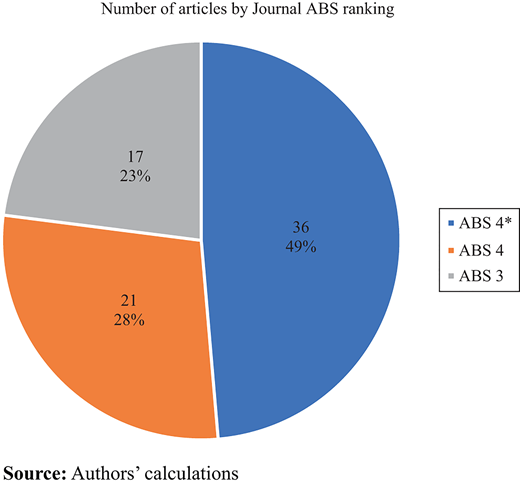
This figure shows the number of articles published, grouped by journal ABS ranking
This figure shows the number of articles published, grouped by journal ABS ranking
This table shows the journals’ research impact
| Journal | Citations | Citations per article |
|---|---|---|
| Journal of finance | 1,771 | 590.3 |
| Journal of financial economics | 931 | 84.6 |
| Journal of corporate finance | 278 | 46.3 |
| Review of financial studies | 216 | 43.2 |
| Accounting review | 203 | 102 |
| Strategic management journal | 161 | 40.3 |
| Journal of business ethics | 100 | 33 |
| Academy of management journal | 73 | 73 |
| Management science | 66 | 22.0 |
| Contemporary accounting research | 57 | 19 |
| Review of finance | 46 | 15 |
| European financial management | 34 | 34.0 |
| Financial analysts journal | 31 | 31 |
| Review of accounting studies | 28 | 9 |
| Review of corporate finance studies | 22 | 22.0 |
| Journal of financial and quantitative analysis | 22 | 4 |
| Journal of management | 16 | 16 |
| International review of financial analysis | 11 | 3.7 |
| Journal of banking and finance | 9 | 9 |
| Journal of financial research | 7 | 2 |
| British journal of management | 3 | 3 |
| Organization science | 2 | 1 |
| Journal of accounting and economics | 2 | 2 |
| Journal of empirical finance | 2 | 2 |
| European journal of finance | 1 | 1 |
| Family business review | 1 | 1 |
| Financial review | 0 | 0 |
| Research policy | 0 | 0 |
The research impact is calculated based on the total number of citations and the average number of citations per publication
Figure 4 shows the distribution of the publications by year. The period 2008–2018 is distinguished by a stable pattern, with 2.2 publications per year on average. Publications begin to proliferate in 2019, with an increasing trend until 2023 and an average number of publications per year around 8. The year that contributes with the highest number of empirical evidence is 2022, where published articles reached a peak of 14.
 The chart presents the number of articles published by year from 2008 to 2024. Early years show low counts, including 3 in 2008, 2 in 2009, and values of 1 or 0 between 2010 and 2014. Publications increase from 2015 onward, with 4 in 2015, 3 in 2016, and gradual growth through 2018. Higher output appears after 2019, with 8 in 2019, 9 in 2020, 8 in 2021, and a peak of 14 in 2022. Counts remain high at 11 in 2023 before dropping to 2 in 2024.
This figure shows the number of articles published, grouped by year (2008–Jan 2024)
The chart presents the number of articles published by year from 2008 to 2024. Early years show low counts, including 3 in 2008, 2 in 2009, and values of 1 or 0 between 2010 and 2014. Publications increase from 2015 onward, with 4 in 2015, 3 in 2016, and gradual growth through 2018. Higher output appears after 2019, with 8 in 2019, 9 in 2020, 8 in 2021, and a peak of 14 in 2022. Counts remain high at 11 in 2023 before dropping to 2 in 2024.This figure shows the number of articles published, grouped by year (2008–Jan 2024)
Based on Web of Science categories, panel A of Table 3 provides the categorization by disciplines of the articles in the sample. Web of Science categories are assigned at the journal level building on the following criteria: “Subject matter and scope of the journal”; “Author and editorial board affiliations”; “Funding agencies providing grant-support”; “Cited references as well as citing and cited reference relationships”; and “Other considerations.” [10] One or more WoS categories may be assigned to journal covered by WoS Core Collection with a maximum of 6. Accordingly, the majority of existing research falls in journals categorized both as “Business and Finance” and “Economics” (44.26%), followed by journals classified only as “Business and Finance” (29.51%) (Table 3). This is in line with the interpretation and analysis of articles, which led to the conclusion that the area of Finance and Accounting matters around 75%, while the remaining 25% having to do with Management studies or other topics. Panel B of Table 3, instead, offers the Scopus’ classification of the 13 additional articles collected.
This table displays the number of publications, grouped by subject area
| Categories | Frequency | % |
|---|---|---|
| Panel A. Web of science categories | ||
| Business, finance; economics | 27 | 44.26 |
| Business, finance | 18 | 29.51 |
| Business; management | 5 | 8.20 |
| Management | 4 | 6.56 |
| Business, ethics | 3 | 4.92 |
| Management | 2 | 3.28 |
| Business | 1 | 1.64 |
| Business; psychology, applied; management | 1 | 1.64 |
| Total | 61 | 100 |
| Panel B. Scopus categories | ||
| Business, manag. and acc.; econ., econometrics and finance | 6 | 46.15 |
| Econ., econometrics and finance | 4 | 30.77 |
| Business, manag. and accounting | 3 | 23.08 |
| Total | 13 | 100 |
Panel A includes the papers gathered and classified by Web of Science database. Panel B contains the papers gathered and classified by Scopus database
Within this sample, approximately 7% (5 out of 74) of scholars concentrated on exploring the underlying drivers of HFA, around 60% (44 out of 74) dedicated their efforts to identifying the impact of the interventions and 22% (16 out of 74) were engaged in a comprehensive analysis encompassing both the antecedent factors and subsequent outcomes (Figure 5).
 The chart presents the number of publications by article aim. H F A effects account for 44 publications. H F A determinants and effects include 16 publications. Other aims include 9 publications. H F A determinants alone include 5 publications. Notes explain that aims classify whether studies examine determinants of activism, consequences of activism, both elements, or additional aspects such as hedge fund returns and campaign costs.
This figure shows the number of publications, grouped by articles’ aim
The chart presents the number of publications by article aim. H F A effects account for 44 publications. H F A determinants and effects include 16 publications. Other aims include 9 publications. H F A determinants alone include 5 publications. Notes explain that aims classify whether studies examine determinants of activism, consequences of activism, both elements, or additional aspects such as hedge fund returns and campaign costs.This figure shows the number of publications, grouped by articles’ aim
4.2 Authors, institutional settings and data sources
Among the scholars who have contributed to the HFA literature, seven authors have been confirmed as the most prolific according to the quantity of articles produced (Figure 6). [11] With five articles each, A. Brav, M. R. DesJardine, W. Jiang and N. Gantchev hold the top place, followed by N. M. Boyson, F. Partnoy and W. Shi with a total of three published works. Overall, these scholars have contributed significantly to the entire research conducted in this field up to this point. However, if we look at research impact, then A. Brav and W. Jiang top the podium with 1,241 citations (248.2 per publication, on average). F. Partnoy, N. Gantchev, M. R. DesJardine and N. M. Boyson follow with 845, 336, 163 and 118 citations, respectively (Figure 7) [12].
 The chart presents authors with the highest number of publications. Five articles are attributed to Alon Brav, Mark R DesJardine, Nickolay Gantchev, and Wei Jiang. Three articles are attributed to Nicole M Boyson, Frank Partnoy, and Wei Shi. The figure includes only authors with a minimum of 3 publications and reflects influence measured by publication count.
This figure shows the most influential authors, based on the number of articles published
The chart presents authors with the highest number of publications. Five articles are attributed to Alon Brav, Mark R DesJardine, Nickolay Gantchev, and Wei Jiang. Three articles are attributed to Nicole M Boyson, Frank Partnoy, and Wei Shi. The figure includes only authors with a minimum of 3 publications and reflects influence measured by publication count.This figure shows the most influential authors, based on the number of articles published
 The chart titled Most influential authors 2 lists author names along the horizontal axis and citation counts along the vertical axis. Two measures are shown for each author: citations and citations per publication. Nicole M Boyson shows 118 citations and 39.33 citations per publication. Alon Brav shows 1241 citations and 248.20 citations per publication. Mark R DesJardine shows 163 citations and 32.60 citations per publication. Nickolay Gantchev shows 336 citations and 67.20 citations per publication. Wei Jiang shows 1241 citations and 248.20 citations per publication. Frank Partnoy shows 845 citations and 281.67 citations per publication. Wei Shi shows 18 citations and 6.00 citations per publication. A note states that only authors with at least 3 publications are included.
This figure shows the most influential authors, based on their research impact
The chart titled Most influential authors 2 lists author names along the horizontal axis and citation counts along the vertical axis. Two measures are shown for each author: citations and citations per publication. Nicole M Boyson shows 118 citations and 39.33 citations per publication. Alon Brav shows 1241 citations and 248.20 citations per publication. Mark R DesJardine shows 163 citations and 32.60 citations per publication. Nickolay Gantchev shows 336 citations and 67.20 citations per publication. Wei Jiang shows 1241 citations and 248.20 citations per publication. Frank Partnoy shows 845 citations and 281.67 citations per publication. Wei Shi shows 18 citations and 6.00 citations per publication. A note states that only authors with at least 3 publications are included.This figure shows the most influential authors, based on their research impact
In terms of the empirical setting, almost all research efforts in high-quality journals have focused on the USA (Figure 8), accounting for 93.24% (69 out of 74), with the remaining articles exploring the phenomenon of HFA in other contexts, such as Germany, the UK or using an international sample. However, looking at the year of publication, it seems clear that this research realm is emerging now, which is in line with the actual US market saturation and the growth of opportunities outside of the USA. Consistently, activism data is primarily hand-collected from different sources (e.g. Schedule 13D filings through the SEC website and news articles), while the alternative sources include FacSet’s Shark Watch and Shark Repellent databases, Activist Insight, Audit Analytics, Factiva and others (Figure 9) [13].
 The chart titled Articles by geographical context lists geographical categories and article counts. The United States category shows 69 articles. Germany shows 2 articles. United States and others shows 2 articles. The United Kingdom shows 1 article.
This figure displays the number of published articles categorized by the geographical contexts considered in the analysis: the USA, Germany, the UK and an international sample that includes the USA (i.e. the USA and others)
The chart titled Articles by geographical context lists geographical categories and article counts. The United States category shows 69 articles. Germany shows 2 articles. United States and others shows 2 articles. The United Kingdom shows 1 article.This figure displays the number of published articles categorized by the geographical contexts considered in the analysis: the USA, Germany, the UK and an international sample that includes the USA (i.e. the USA and others)
 The chart titled Activism Data Source lists databases on the vertical axis and number of articles on the horizontal axis. Hand collected data shows 45 articles. Shark Watch shows 11 articles. Shark Repellent shows 10 articles. Activist Insight shows 6 articles. Audit Analytics shows 5 articles. Factiva shows 3 articles. Shareholder Activism shows 1 article. Morningstar Document Research shows 1 article. Proprietary data shows 1 article.
This figure displays the number of published articles categorized by the sources used for collecting information about activism events
The chart titled Activism Data Source lists databases on the vertical axis and number of articles on the horizontal axis. Hand collected data shows 45 articles. Shark Watch shows 11 articles. Shark Repellent shows 10 articles. Activist Insight shows 6 articles. Audit Analytics shows 5 articles. Factiva shows 3 articles. Shareholder Activism shows 1 article. Morningstar Document Research shows 1 article. Proprietary data shows 1 article.This figure displays the number of published articles categorized by the sources used for collecting information about activism events
5. Determinants and outcomes of hedge fund activism
5.1 What are the characteristics of targeted companies?
Understanding the triggers of the HFA phenomenon is the first major issue that scholars have addressed. Are targeted firms systematically different from others? Which features distinguish firms that activist hedge funds target, increasing their likelihood of being targeted? The first comprehensive evidence in this regard comes from Brav et al. (2008a, 2008b). According to these studies, targeted firms are typically smaller than others because of the lesser amount of capital required to obtain a meaningful equity stake, which is in line with the hedge funds’ need to avoid taking on a significant amount of idiosyncratic risk in their portfolio. Significant differences between targets and other firms also occur in terms of market valuation, as the probability of becoming a target by activist hedge funds is inversely related to the market-to-book ratio. This indicates that such investors aim to profit from firms for which whose stock market fails to reflect their potential growth (i.e. undervalued firms), consistent with the main objective stated when announcing activism events (as described in Section 2). Further, targeted firms are significantly better in terms of operating performance but display higher leverage, lower cash-to-assets ratio, smaller dividend payout and greater investment diversification. This may suggest that, rather than profitability, target companies seem to suffer from free cash flow agency problems, which is detrimental for shareholders. Analyst coverage is another significant element for activist targets selection decisions: the number of analysts covering target firms is, on average, 4.4, 0.5 higher than peer non-target firms. Indeed, activist hedge funds use data from analyst reports to support their involvement and to signal concerns about target firms to other investors. Indeed, such reports usually contain quantitative data on issues that can be of interest to activists (e.g. financial performance, business strategies, risk exposure, management efficacy and M&A activity) before the intervention, positively affecting the probability of being selected (Brav et al., 2008a; Brav et al., 2008b; Chen and Shohfi, 2022; Barko et al., 2022). Finally, hedge funds tend to target firms with higher institutional ownership and higher trading liquidity. While the first factor increases the odds of having support and collaboration in implementing changes within the target firm, the second is crucial for quickly accumulating stocks while minimizing illiquidity-driven transaction costs.
The need for activist hedge funds to leverage on the support of other institutions is also pointed out by more recent studies (He and Li, 2022; Francis et al., 2021; Kedia et al., 2021). Ownership by other institutional investors is generally associated with a positive probability of being targeted, which becomes even higher in the presence of activism-friendly institutional ownership (Kedia et al., 2021). Typically, activist hedge fund managers attempt to take advantage of their social connections communicating the activism agenda to other institutional investors in an effort to gain cooperation. These interactions result in lessening information asymmetry for connected investors, who increase their positions in the targeted firm to support activism engagement, thereby positively affecting the firm probability of getting selected (He and Li, 2022). The benefits of managers’ social ties tend to be stronger for connected investors who identify as “non-activists” as opposed to “non-campaign activists”, as passive investors generally face more asymmetric information problems (He and Li, 2022). Additionally, firms led by female CEOs are more likely to be targeted (Francis et al., 2021), as they have been observed to be more prone to collaborate with the activist, which drives down costs and boosts the chance of campaign success.
As mentioned above, higher stock liquidity increases the odds of being targeted, as it allows faster stock accumulation (Brav et al., 2008a, 2008b). Indeed, for activist hedge funds, the ability to purchase stocks rapidly is crucial, as the event must be publicly disclosed within a few days of reaching the 5% ownership threshold. When the activism event becomes public, the stock price adjusts in response to the market reaction, accounting for the potential effects of the hedge fund involvement. This means that the fund has a limited period to consolidate its position within the company before some of the potential gains being burned up by market players’ response to the announcement. Hence, hedge funds tend to avoid illiquid stocks, as trading in an environment with limited liquidity produces a larger price impact (Mihov, 2016). Thus, the price impact of trading affects the approach used by funds: the higher (lower) the trading price impact, the higher (lower) the probability of private (open market) transactions (Mihov, 2016). Similarly, Gantchev and Jotikasthira (2018) analyze the role of institutional trading, finding that institutional investors’ stock sales raise a firm’s probability of being targeted, through enabling activist hedge funds to camouflage the accumulation of stocks and rapidly develop their position without dealing with a negative profit-sharing market reaction in response to the event revelation.
Nevertheless, the initial findings provided by Brav et al. (2008a, 2008b) have not always been fully confirmed by subsequent research. For example, Klein and Zur (2009) find that activist hedge funds are more likely to target firms with higher cash holdings, higher short-term investments and lower leverage. Similar conclusions are reached by von Lilienfeld-Toal and Schnitzler (2020), who observe activist hedge funds’ preference toward firms with higher cash holdings and lower dividend yields, in contrast, again, with Brav et al. (2008a, 2008b). Instead, if we look at operating performance, in contrast to the prior literature, then more profitable firms appear to be less likely to get targeted in their analysis.
Recalling that the goal of activist hedge funds is to uncover the hidden potential of their targets, their focus on firms with efficiency issues and/or firms which do not always maximize shareholder value may seem reasonable. For example, firms seeking long-term development may appeal more to such investors when adopting a short-term perspective given the broader opportunity for reallocating resources to investments with a stronger short-term pricing effect. According to this view, recent research indicates a positive association between corporate social responsibility initiatives and the likelihood of being targeted by activist hedge funds, as they recognize the potential of short-term cost reduction and raised value for shareholders (DesJardine et al., 2021; Bae et al., 2023). Likewise, the likelihood increases when firms use an “exploration” approach in pursuing innovation (Xiao and Shen, 2024). The unpredictable nature of exploration outcomes and their eventual attainment over an extended period impact efficiency, especially when compared to the exploitation of existing knowledge. Again, this implies that hedge funds have an opportunity to boost short-term returns for owners while assuming less risk by freeing up capital to allocate alternatively. Keeping this in mind, the companies’ M&A history is a significant additional factor influencing the targets selection strategy: firms engaging in value-destroying acquisitions have a superior likelihood of being invested in Gantchev et al. (2020). For these companies, activists ask for removal of CEOs, modifications to compensation schemes and the appointment of new directors in the effort to reshape the effectiveness of M&A operations. After the intervention, the targeted corporations actually curb their “empire building” desire by being more selective in their acquisition choices and by selling off more of their previous inefficient decisions. Finally, recent literature has also pointed out that activist hedge funds frequently look for firms with more diverse demographic representation on their boards (DesJardine et al., 2023). The rationale is that, in contrast to more homogeneous boards, firms’ performance may be adversely impacted by governance issues because of slower decision-making and lack of unanimity, which offers potential to boost shareholder value.
Finally, in line with the recent geographical spread of activist campaigns, the determinants of activism events by hedge funds have been observed outside the USA as well. Analyzing the setting of Germany, Bessler and Vendrasco (2022) show that targets tend to be more profitable and financially healthy (i.e. less indebted), while payout policy and cash holdings are not systematically associated with the probability of selection (in contrast to US evidence). Once again, the probability of getting targeted increases with the extent of institutional ownership and the level of trading liquidity, which is in line with the empirical findings for the USA (Brav et al., 2008a, 2008b; Klein and Zur, 2009). However, this area of research is just now beginning to take shape in light of the US market saturation and the expansion of opportunities globally. As a result, little is known about the factors influencing activist hedge funds’ selection process outside the USA, and further investigation is needed.
Overall, the evidence produced so far suggests that the activist hedge funds identify the group of candidate targets based on fundamentals (i.e. operating performance, market evaluation, payout policy, leverage and cash holdings) and financial visibility (institutional ownership and analyst coverage), while stock liquidity (as well as liquidity shocks) drives the timing of investments.
5.2 How does the stock market react to the announcement of hedge fund activism?
After discussing the screening criteria of activist hedge funds, we hereby address the following two questions:
How do market players react when hedge funds publicly announce an activism event?
How does such reaction differ depending on the fund’s features, the purpose of the intervention and the response of targeted firms?
Once again, we start the discussion based on the evidence provided by Brav et al. (2008a, 2008b). Positive market reactions are observed in these studies, with average abnormal returns ranging from 7% to 8% during the [−20, +20] announcement window. This indicates that the majority of market participants have a favorable opinion of hedge funds’ ability to increase shareholder value through their engagement. They also point out that investors recognize a higher value adding effect when activists state the intention to sell the company or to change business strategies, while not significant results arise from market response to activism associated with capital structure or governance concerns. Announcements of activism without revealing specific goals produce positive abnormal returns as well. When comparing short-term market reactions following friendly and hostile approaches, evidence suggests that these latter are more successful in handling company sales and governance problems but less effective in handling business strategy and capital structure issues. This evidence further reinforces the idea of hedge funds as a value creation channel, rather than simple skilled “stock pickers,” given the value-adding effect linked to hostile events that would likely not occur otherwise. This appears to be even more reliable when one takes into account that hedge funds do not sell their stocks immediately as a way to profit from the price adjustment to the appropriate “fair value” following the announcement. To exclude that market reactions are not temporary and caused by buying pressure, instead, Brav et al. (2008a, 2008b) conduct a longer-term analysis as well (using a [−3, +3] months’ time-window, continuing up to one year) and abnormal returns do not reverse. Finally, the lack of differentiation in terms of abnormal returns among firms with varying levels of leverage also appears to rule out the hypothesis of bondholders’ wealth as a way for making profits to shareholders following the event.
More generally, numerous studies have shown that the market responds favorably to activism announcements, demonstrating how companies targeted by activists get higher returns than those engaged by passive investors (Clifford, 2008) or other activists (Klein and Zur, 2009; Swanson et al., 2022). By measuring the value adding effect of activist investors through the decomposition of Schedule 13D filings announcement, Albuquerque et al. (2022) conclude that their contribution (especially in the case of hedge funds) is primarily related to their active engagement in the targeted firms, rather than simple stock picking. Further, such value adding effect does not revert in the medium-long term (Brav et al., 2008a, 2008b; 2010; Swanson et al., 2022).
Despite a few exceptions, these considerations are actually well supported by the predominant body of literature [14]. Thus, most recent research has focused on examining the cross-sectional variation of stock market reactions in relation to the fund’s characteristics, the intervention’s objective and the targeted firm’s response. Krishnan et al. (2016), for instance, have noted that interventions by hedge funds recognized for their “financial clout and expertise” produce larger positive abnormal returns (on average, 12.4% vs 6.6% in a 21-day announcement period). Classified as “Top Investors,” these hedge funds commonly possess a longer history than others and adopt a more aggressive approach to persuade boards of directors to comply with their demands. Similar evidence comes from Boyson et al. (2022) who argue that hedge funds whose managers have previously worked in investment banking (i.e. possessing greater analytical and quantitative skills, transaction expertise and deal-making experience) and private equity sector (i.e. having close client experience, active involvement in operations and governance and patience for longer holding periods) typically produce a more favorable market response to the announcement than non-financial experts.
Looking at the objectives of activism events, we know that activist hedge funds are frequently engaged to address issues related to corporate governance. In this respect, Keusch (2023) emphasized how these investors may help reduce the uncertainty surrounding CEO’s appointment. Indeed, by taking advantage of their extensive network, HFA increases the likelihood of hiring more experienced CEOs (Keusch, 2023), as well as new directors who are usually younger, more financially educated and less likely to be female. These appointments are linked to higher stock price performance, with empirical literature observing higher abnormal returns (by around 300 bps) than where activists do not participate in the CEO recruitment process, with no reversal over the medium-long term. This supports the argument of hedge funds’ board representation as a vehicle for successfully advancing the activist agenda (Gow et al., 2023).
However, post-intervention positive abnormal returns uniquely occur when the activist hedge fund’s intervention regards board-related issues (14.1% in [−20,+20] time window) or board-unrelated issues (11.5% in [−20,+20] time window), but not a combination of them (Hartmann, 2023) [15]. One of the common board-unrelated demands by activist hedge funds is to divest some of business divisions to reorient corporate efforts on more profitable business areas. Even in such a case, market participants mostly react positively given the agency cost-mitigating role attributed to activist hedge funds in these decisions (Chen and Feldman, 2018; Gow et al., 2023). Indeed, managers’ personal interests may prevent them from making some divestments, but activist hedge funds can exert pressure to convince management to take these actions to increase shareholder value by re-aligning market value with fundamentals. Rather than a combination of multiple types of demands, a positive market response to the hedge fund engagement stems from the early communication approach to activism (Aiken and Lee, 2020; Hartmann, 2023). In that instance, activists initiate talks with the managers of the target company before the event is required to be disclosed, even though doing so is costly. Obtaining approval for operational changes within the company for which the initial talks is difficult may be one of the advantages, and once again, the market responds favorably to this, as noted by Aiken and Lee (2020).
We now turn our attention to the features of targeted firms and their reaction to HFA. Based on the short-term market reaction observed by Brav et al. (2008a, 2008b), hostile approaches by activists entail a larger value adding effect, as they are assumed to be more successful in managing corporate reforms, particularly when it comes to governance issues. Interestingly, when targeted firms try to fend off the hedge fund attack (e.g. by filing a lawsuit or publicly criticizing the activist), the potential benefits of activism may be jeopardized. Indeed, adopting moderate resistance appears to have no effect on stock price performance in the short term and companies embracing hostile opposition trigger a negative initial market reaction. However, market players return to react positively when opposition is not experienced passively by the hedge fund, in turn adopting a counter-resistance (Boyson and Pichler, 2019). In short, strategies used by the funds in targeting companies are crucial, and more recent investigations have further confirmed that a more aggressive approach produces a better short-term stock reaction (Bessler and Vendrasco, 2022; Bessler et al., 2015) [16]. Another important point is the level of institutional ownership. We know that activist hedge funds normally own only a minority stake, and therefore, they look to other institutional investors for cooperation and support in advancing their activism agenda. Accordingly, it is expected that activists are better able to introduce value-enhancing changes within targeted companies. This is supported by the larger positive market reaction associated with higher levels of passive ownership (Bessler and Vendrasco, 2022; Kedia et al., 2021; Appel et al., 2019), and an additional example in this respect is the “Wolf Pack Activism,” which refers to the simultaneous attack by activists on the target (Bessler and Vendrasco, 2022; Becht et al., 2017) [17]. Additionally, keeping looking at the features of the targets, scholars have exhibited that the short-term stock market reaction is positively linked to analysts’ support (Chen and Shohfi, 2022). Pre-interventions analyst reports, in fact, usually offer more quantitative and activism-related information, reducing uncertainty around the event and shedding light on issues hedge funds have to deal with, which is particularly valued by market players. Consistent with the conclusions of DesJardine et al. (2021), research has also revealed an unfavorable relationship between stock price performance and the ex-ante level of environmental, social and governance (ESG) performance (Barko et al., 2022). Stock price performance is negatively correlated with size (DeHaan et al., 2019), and it is lower for firms led by male CEOs than for those led by female CEOs (Francis et al., 2021).
We can then conclude that earlier researchers have made a substantial effort to illuminate how the stock market sees, both in the short and medium-long term, the engagement of activist hedge funds in the companies they target, effectively pushing the boundaries of our knowledge in this field.
5.3 Does hedge fund activism add value for shareholders?
An intriguing issue that still needs to be examined at this point is whether activist hedge funds are actually capable of generating shareholder value in the long term and what economic mechanisms would eventually lead to this outcome. Hence, in this section, we deal with the following two questions: is the short-run investors’ response informative? Does the market really possess the ability to predict what these events may produce? To answer them, we need to concentrate on the real economic implications of activism, as well as the channels through which such effects may be propagated.
Coming back to Brav et al. (2008a), it appears that an improvement in medium/long-term operating performance follows the favorable short-term market reaction (which is also backed by better analyst forecasts). Specifically, in the two years after the intervention, EBITDA/Assets and EBITDA/Sales ratios rose from 0.9% to 1.5% and from 4.7% to 5.8%, respectively. Hedge funds also appear to reduce free cash flow agency costs by increasing leverage and the overall payout ratio following the announcement of activism, consistently with the results of Klein and Zur (2009). However, when looking at the effects on other stakeholders, targeted firms exhibited, during the year after the event, a 10% increase in CEO turnover along with a reduction in CEOs compensation by about $1m, suggesting partial wealth redistribution from executives to shareholders [18].
By improving firms’ profitability, Brav et al. (2008b) show that activist hedge funds are capable of achieving higher returns compared to other non-activist funds. Nevertheless, more recent research has pointed out that assessing returns gained by activist hedge funds need to take into account the cost of activism, which varies according to tactics used (demand negotiations, board representation and proxy contest). For example, Gantchev (2013) estimates that a proxy contest has the highest costs (about $5.94m), followed by demanding negotiations ($2.94m) and seeking board representation ($1.83m). When subtracting costs, the activists’ net returns, on average (median), drop to 0.23% (1.40%), indicating their substantial influence on activists’ decision-making process. Conversely, the 90th percentile of activists’ net returns is substantially high (about 50%), and lager compared to the 90th percentile non-activist returns.
Subsequently, academic researchers, as in the case of the analysis of the investors’ reaction to the activism announcement, have been concerned with observing the real economic effects according to various elements that characterize the activists’ interventions. We know that larger positive abnormal returns are associated with the announcement of activism by hedge funds that benefit from a better past reputation. This indicates that market players see more potential in such activists’ abilities for adding value, and the empirical findings in this respect corroborate the view of the market (Krishnan et al., 2016; Boyson et al., 2022). Hedge funds categorized as “top Investors” based on their past “financial clout and expertise” have been found to stimulate higher growth rates for sales and ROA (2.54% and 9.24%, respectively) than other hedge funds, even if with a low level of statistical power (Krishnan et al., 2016). Instead, Boyson et al. (2022) find that, in the three years after the event, firms targeted by activist hedge funds whose managers have better financial experience outperform, in terms of ROA, targets of nonfinancial experts, with statistical significance of 1% confidence level.
The ability of stock market to anticipate the activism outcomes has also been confirmed when looking at the stated objectives and tactics of activism events. For example, investors respond favorably when activist hedge funds are involved in the selection of the CEO and the appointment of new directors, given the hedge funds’ ability to leverage on their extensive networks, identifying qualified candidates to face with concerns affecting the firms. Accordingly, activist-supported CEO selections are associated with an increase in ROA about 3.8% during the three years following the intervention (Keusch, 2023). The recruitment of new directors during the activism events has been shown to boost operating performance in a similar way, which supports, along with higher efficiency in capital management (M&A and operating assets) and lower cash flow agency costs, the beneficial effects for company market value (Clifford, 2008; Kang et al., 2022; Gow et al., 2023). However, looking at the short-term reaction, while the market seems to recognize potential to activism events with public demands (related to board concerns or others), academic research fails to find significant long-term changes in the financial and operational indicators for targeted firms across countries (Hartmann, 2023). In contrast, market participants do not fail in assessing the adding value effect linked to Wolf Pack activity, which does not provide both favorable short-term stock price performance and long-term accounting profitability, according to Hartmann (2023).
While multiple activist funds working together do not produce beneficial effects for shareholders, hedge funds engaged in activism phenomenon still need cooperation from other institutions to be able to reach their goals, given the minority stakes that are usually owned. Indeed, the empirical findings suggest that, following interventions, targeted companies with greater passive institutional and activists-connected ownership perform better operationally (He and Li, 2022; Appel et al., 2019), validating the informative role of short-term investors’ response to the announcement. The strategic approach toward management also determines differences in terms of value creation, with the markets responding favorably to activist’s non-aggressive approaches involving talks with managers even before the mandatory disclosure of the event. Similar positive reactions are also observed when the activist opposes the management’s resistance to its proposals with hostility. Looking at the company’s long-term market value and profitability, positive implications emerge in both situations, although the early communication approach has less statistical power (Aiken and Lee, 2020; Boyson and Pichler, 2019).
Overall, this initial and preeminent strand of literature confirms that both the positive short-term market reaction and analyst recommendations’ upgrades following HFA are corroborated by positive long-term implications in terms of operating performance and shareholder value, as recently shown also by Swanson et al. (2022). Nevertheless, some scholars argue that no differences in profitability emerge compared to other activist funds (von Lilienfeld-Toal and Schnitzler, 2020), while others point out that the increased shareholder value results, at least partially, from wealth expropriation at the expense of debtholders [because of higher interest rates/yields, rating deterioration and augmented demand for collateral, as noted by Dahiya et al. (2020) and Feng et al. (2021)] and employees [because of the underfunding of employee pension plans, as reported by Agrawal and Lim (2022)] [19]. Also, still other academics have shown that firms’ market value improves merely temporarily and then reverses, and that profitability rises in the first two years following the event but fails to persist (DesJardine and Durand, 2020) or even deteriorates (Klein and Zur, 2009; DeHaan et al., 2019). Empirical findings are even more discordant when examining the few investigations conducted outside the USA. Maffett et al. (2022), for instance, discover that activism campaigns across 56 countries resulted in enhanced operating performance, lower free cash flow and higher efficiency in investment-related decisions, complemented by spillover effects for non-targeted companies when changes in the regulatory framework push up the threat of activism [20]. Conversely, targeted firms’ profitability has been observed to decline after the activist hedge funds intervention in Germany (Bessler and Vendrasco, 2022), while positive (but non-significant) implications for ROA and a reduction in labor productivity emerge looking at takeover-related activism events in UK (Kuvandikov et al., 2022).
Leveraging on the predominant literature, academic research has recently concentrated on examining the economic mechanisms that account for the value-adding effect of activism. The first evidence that partially goes in this direction comes from Giroud and Mueller (2011), who demonstrate that activist hedge funds tend to target companies with poor governance and take initiatives to reduce inefficiencies, which enhances shareholder value. Keeping in the governance realm, Cheng et al. (2015) illustrate how CFO and audit committee adjustments occurring after the hedge fund interventions result in higher accounting conservatism. Such increased conservatism facilitates monitoring and reduces information asymmetry, alleviating agency concerns and easing the value creation process. Consistently, it has been found that HFA enhances tax planning (Cheng et al., 2012) and investment efficiency, by mitigating overinvestment of free cash flow by overconfident CEOs (Kwon et al., 2021; Deb et al., 2023). Also, the engagement in the governance structure contributes to an overall decline in the intensity and complexity of strategic actions, which are usually difficult to execute and reverse, require large amounts of capital and produce returns primarily in the long term, when they are profitable (DesJardine et al., 2022). While this may suggest a short-term orientation of hedge funds, it may also be a strategy to improve operating efficiency, limit excessive diversification and reorient corporate efforts on more profitable business areas. In this regard, it clearly emerges from Brav et al. (2018) that activist hedge funds do not look for short-term gains at the expense of long-term value creation, given how they deal with innovation strategies. Indeed, their study reveals that targeted firms experience an increase in the number and quality of patents in the five years after the event, even while R&D spending declines. This means that HFA improves corporate innovation efficiency, as well as reallocation of innovative resources and redeployment of human capital, with change to board-level expertise found to contribute to this respect. Similarly, corporate governance involvement by activists leads to higher efficiency in M&As decisions by reducing value-destroying operations, increasing divestitures and avoiding diversifying deals, which naturally create value for shareholders (Wu and Chung, 2022; Gantchev et al., 2020; Boyson et al., 2017; Guo et al., 2020). The hypothesis of HFA’s short-termism is further refuted by Clarke and Liu (2019), who note that although hedge funds may take quick profits from the market’s response to announcements of buybacks, such corporate decisions do not seem to be motivated by myopic goals, as these firms have higher cash holdings than others and are more cheaply valued. Despite the share repurchase percentage is larger in targeted companies, there is no evidence that this decision is made at the expense of long-term operating success. Rather, what is unclear from the existing literature is how HFA affects firms’ performance when it comes to ESG issues. For instance, it has been found that ESG performance improves when the fund declares social goals (Bae et al., 2023) or when the pre-intervention ESG engagement is low (Barko et al., 2022). In the other scenarios, however, ESG performance worsens. Finally, prior scholars have also examined the activist hedge funds’ ability for value creation when engaged in distressed firms. Again, these occurrences are marked by higher contracting efficiency, which leads to larger debt reduction, more rapid restructuring and a greater likelihood of completing prepackaged restructuring (Lim, 2015). Such a highly effective restructuring process leads to improved financial stability and investment decisions for these companies in the medium to long term (Choi and Lim, 2022).
In summary, despite the disagreement by a minority of scholars, the empirical evidence produced so far appears to robustly establish that HFA represents a valid governance mechanism that, through significant changes within companies, unlocks their latent value through enhancing operating efficiency, as well as the effectiveness of investment decisions related to both internal and external growth strategies.
6. Future lines of research
The phenomenon of shareholder activism has been a fascinating research realm for more than 20 years, and it still remains a hotly debated topic among academic researchers and practitioners. Over these years, the literature has been extremely prolific, shedding light on the main objectives and strategies used by activists, as well as the antecedents and the outcomes of such phenomenon in the USA. However, the investigation on this topic is evidently in its early stages, and this section aims to identify research spaces that need to be explored for expanding our frontier of knowledge in this domain.
The first issue, which has been only partially addressed, pertains to the tactics of HFA. Ranging from communicating with corporate managers to filing a lawsuit against the company, several are the approaches that can be used during activist campaigns. Nevertheless, prior scholars have dedicated a little attention to factors affecting the activists’ decision-making process in this respect. Do activist hedge funds use the same strategy across similar companies? What characteristics of targeted companies lead hedge funds to choose hostile versus non-hostile tactics? Also, the presence of multiple activists working together in the same target accounts for about 22% in Brav et al. (2008a, 2008b), and it seems to be gaining relevance in recent years. Again, what factors push activist hedge funds to seek cooperation with other activists rather than passive investors? As correctly pointed out by Aguilera et al. (2021), the lack of answers to these questions has consequently led to limited research efforts aimed at understanding how the outcomes of HFA vary depending on the tactics used. Thus, investigating the capabilities of activist hedge funds to achieve their agenda for value creation in relation to strategies used presents a promising opportunity for academic scholars to deepen our knowledge, with both theoretical and practical implications.
Additionally, the knowledge about the short- and long-term effects of HFA is still limited (and sometimes contrasting), calling for further inquiry. For example, previous researchers who focused on financial markets have been primarily interested in stock returns. However, HFA goes beyond the mere impact on stock price performance, and additional market features could be worthy of consideration. In this sense, although we are aware that target selection strategies are influenced by stock liquidity, it is unclear how liquidity evolves after the intervention. Does mandatory disclosure of activism provide an alert about potential investments, mitigating information asymmetry? Or does such disclosure bring uncertainty and exacerbate asymmetry because of the invasive nature of activism? Answering these questions may be crucial, given the role that stock liquidity plays for both financial markets and the real economy. Further, according to Brav et al. (2008a, 2008b), one of the most common objectives mentioned by activist hedge funds is to reshape corporate governance mechanisms, which include demanding more information disclosure. Therefore, another unexplored question is whether and how HFA actually impact firms’ disclosure. Do the targeted firms become more transparent? Or does activism lead to significant changes in operational activity that exacerbate financial reporting readability?
The current knowledge produced so far associates a value-enhancing effect to HFA. Nonetheless, some scholars have expressed concerns about activism’s effectiveness, emphasizing that activists, at least partially, transfer wealth from some individuals to others rather than adding value (Dahiya et al., 2020; Agrawal and Lim, 2022). Hence, figuring out who benefits and who suffers from activism events is an additional research area that has to be explored: does HFA simply result in a different kind of wealth redistribution? If so, then which strategy is most likely to be associated with the hypothesis of value expropriation by other stakeholders? Who are the main parties that activism hurts? It would be valuable to provide answers to these additional questions. Furthermore, we agree with Aguilera et al. (2021) who argue that “a missing piece in the literature concerns HF activists themselves,” emphasizing the heterogeneity among such investors. They suggest delving into the role that activist hedge funds’ characteristics play for success or failure of the campaigns, using a qualitative approach. Building on these considerations, we believe that more research is needed for measuring the returns of activist hedge funds while also accounting for the costs associated with activism. The choice of strategy for their campaigns significantly affects the potential profits achievable, given the various costs they can incur. Thus, attempting to quantify these costs and comprehend how they affect the returns and decision-making process, together with the limited efforts that have previously been undertaken, may further expand our understanding of this phenomenon. In close connection with these aspects, academic scholars should also provide more insights regarding the funds’ exit strategy. When does an early exit tend to occur? When is the activism agenda considered achieved by the fund? Do the investors entirely sell their equity share after the successful achieving of the agenda or do they adopt a passive strategy to keep reaping the benefits of the intervention?
All these unanswered questions make HFA a promising area for future research, especially in light of the fact that HFA phenomenon is now spreading all over the globe. Why are hedge funds increasingly looking for investment opportunities outside the USA? Could it have to do with the potential for greater profits or with the saturation of the US market? What variables affect the decision of selecting a specific country? With this paper, we encourage academic researchers to address these novel challenges and to explore whether the US findings acquired so far can be generalized to other contexts.
7. Conclusions
This paper provides an overview of the HFA phenomenon through a systematic review of the existing empirical research articles published and retrieved from top-notch quality journals to ensure a high level of conceptual and methodological rigor. Drawn by a lack of past attempts made in this direction, the aim is to gather and organize the relatively nascent research in the realm of shareholder activism by hedge funds, adopting a strict scientific framework that minimizes bias, guarantees the robustness of the results and makes the review procedure transparent and replicable.
This approach has led to the coverage of 74 papers. By descriptively analyzing such sample, the evolution of HFA research activity shows a surge in popularity over the past decades, documented by the remarkable growth in the magnitude of publications (Figure 4). The current state of scientific studies is led by prestigious journals, including Journal of Finance, Journal of Financial Economics and Review of financial Studies, among others (Tables 1 and 2), while Alon Brave, Mark R. DesJardine, Gantchev Nickolay and Wei Jiang have been identified as the most prolific authors with the highest research impact (Figures 6 and 7). By adopting a critical lens, the literature can be ideologically categorized into three primary streams. Initial studies have dealt with identifying the key peculiarities of activism events, focusing on the objectives pursued, the strategies used and the general characteristics of the targeted companies. Then, scholars have concentrated their efforts on the main short- and long-run consequences of activism. Regarding the first point, the stock price reaction to the activism announcement has been the core concern of the analyses, emphasizing the sentiment of market participants toward these initiatives’ capacity to create value. As discussed in the above sections, the investor responses have been largely favorable, with differences depending on the funds’ stated goals and their approaches’ degree of hostility. With regard to the second point, the aim has been investigating the HFA real economic implications for shareholder value creation resulting from substantial changes in firms’ capital structure, business strategies and governance reforms. Although some studies have raised doubts about the effectiveness of these interventions, scholars largely agree in considering the HFA as a new governance mechanism capable of unlocking the targeted companies latent value. Hence, by leveraging on this consolidated and predominant body of literature, academic research has recently begun to concern toward the economic channels triggering the value creation process of activism, as well as looking at the possibility of generalizing the current knowledge outside the US context, pushed by the up-to-date internationalization of this phenomenon. However, this paper has identified some gaps in all three research streams that may be addressed by academics, as well as new research direction to advance our comprehension of this domain. Additionally, the implications of this analysis extend beyond academia, offering valuable insights for practitioners as well. For example, corporate managers can use these findings to proactively influence both the drivers and the outcomes of HFA. The board of a company could assess and address internal factors that contribute to the determinants of this phenomenon to influence (positively or negatively) the prospect of being targeted. In cases where intervention is unavoidable, managers could instead strategically and more effectively create the conditions to maximize potential benefits while mitigating any negative effects associated with the activism.
In spite of that, this study is not exempt from limitations. First, we used ABS rating as an exclusion criterion while building the sample, to ensure that the papers considered satisfied a minimal threshold of worldwide scientific research quality and reliability (Alatawi et al., 2023; Rao et al., 2023). In particular, only papers from journals with an ABS score of three or above were taken into consideration. Although this approach is beneficial in focusing on research with a high degree of conceptual and methodological rigor (in line with the goal of this review), we are aware that it may also lead to the exclusion of some prestigious journals’ articles that are not ABS ranked or with an ABS score of less than three. Second, this article systematizes and critically examines the range of articles collected, focusing especially on the conceptual contents while paying little attention to the authors’ methodological choices. These elements could be covered in further research by academics in the future. Third, despite the use of a rigorous strategy provided by prior research and the examination of multiple databases for article collection, most of the literature reviewed in this paper focuses primary on the US market. The latter has certainly been the most active region for HFA, but now the phenomenon is spreading internationally, and legal, regulatory and cultural differences may influence the behavior of activist investors and the responses of target companies. As this geographic concentration may affect the generalizability of the results to other contexts, future authors could fill this gap by relaxing some of the requirements used in this study and expanding the sample analyzed.
In conclusion, although many efforts have been made by academic research in the realm of HFA, this state-of-the-art overview suggests that the field remains largely fertile and open to further investigations. Numerous unexplored areas and emerging trends present ample opportunities for future research, underscoring the dynamic and evolving nature of HFA as a subject of scholarly inquiry.
Notes
Both Europe and APAC have surpassed their five-year average about 26% and 55%, respectively.
These barriers encompass the issue of free riding, stemming from the lack of coordination and cooperation that characterizes pension funds and mutual funds, which leads to collective action problems. Additionally, there are conflicts of interest, such as those mutual funds face when considering activism toward potential future clients.
The regulation varies widely among countries and is frequently less stringent than in the USA. At the European level, the Transparency Directive mandates the disclosure of beneficial ownership whenever the percentage owned reaches, exceeds or falls below specific levels (Directive 2004/109/EC). However, there is no requirement to clarify the purpose of the transaction, even though individual European Union member countries may impose additional obligations. For example, in both Italy and France, investors with ownership stakes in listed companies equal to or exceeding 10% must announce the objectives they intend to pursue over the following six months. Similar disclosure rules exist in Japan, where, upon exceeding the 5% threshold, a statement of intentions is required if the investor intends to influence the company’s management, while in Canada, the obligation is triggered upon reaching 10%. In other EU and APAC countries (main regions involved in activism events), there are obligations to disclose significant shareholdings, but communicating the intention behind the intervention is not expressly required.
Because of this restriction, around 30 articles are not considered. According to WoS, all of them pertain to areas such as law, geography, psychology, political science, mathematics and others.
More information about Chartered Association of Business Schools (ABS)’ Academic Journal Guide are available here: https://charteredabs.org/wp-content/uploads/2022/12/Academic-Journal-Guide-2021-Methodology-Final.pdf
Specifically, we refrained from eliminating papers where the examination of hedge fund activists constituted a minor portion of the research or where certain revelations were solely documented in the notes.
We used the 2023 Journal quality list in the field of business and management provided by Anne-Wil Harzing available here: https://harzing.com/resources. This document takes into consideration the most recent ABS rating available, which is for 2021. The scores assigned to the scientific journals considered remained qualitatively unchanged when compared with earlier versions of the Association of Business Schools’ Academic Journal Quality Guide.
We thank the anonymous referees for this point.
Please note that Scopus’s classification by subject area differs slightly, and we only selected articles from “Economics, Econometrics, and Finance” and “Business, Management, and Accounting”. Furthermore, we limit the search to studies published before the year 2024 (which is the major time frame of this analysis).
Each author with at least three publications was taken into consideration when creating Figure 6.
Please note that the citation count per author is based on the sum of citations per author’s articles provided by WoS, searched across all subscribed resources and the number of citations per author’s articles provided by Scopus.
As some studies use multiple databases, the total number of data sources exceeds the number of articles examined.
For example, von Lilienfeld-Toal and Schnitzler (2020) show that, despite the activist hedge funds interventions are associated with positive abnormal returns both in the short and medium/long run, no statistical differences emerge compared with other activists (i.e. private equity funds, public pension funds, mutual funds, banks and other financial filers). Furthermore, as per Dahiya et al. (2020), the favorable effects of HFA on shareholder value appears to be associated with the expropriation of bondholders’ wealth, considering the rise in interest rates and collateral requirements (i.e. credit risk), particularly for those targets that have experienced larger positive announcement returns.
Please note that statistically significant differences between events with and without public demands emerge only for North America and not for Asia-Pacific and Europe.
However, Bessler et al. (2015) also found that more aggressive hedge funds initially generated higher returns, but their outperformance quickly reversed, whereas non-aggressive hedge funds outperformed their aggressive peers in the medium-long run.
However, in contrast to earlier research, Hartmann (2023) reveals that Wolf Pack engagements do not result in noticeably larger abnormal returns than stand-alone interventions.
This may provoke an adverse reaction from managers when targeted by activist hedge funds. To protect their own interests, managers might engage in opportunistic behavior, strategically manipulating corporate voluntary disclosures to shareholders in an effort to resist the attack during activist campaigns, as noted by Khurana et al. (2018).
In terms of human capital loss, Chen et al. (2021) discover a higher departure rate of valued employees in the post-intervention period (as compared to their peers), which is related with inferior corporate performance in relation to scenarios when businesses do not experience such losses.
Regarding spillover effects following HFA, little efforts have been made in the literature so far, and the evidence is conflicting in the US context, representing a fertile field for future research. Especially, two papers stand out from the examined sample. The first article, from Aslan and Kumar (2016), demonstrates that these interventions have detrimental effects on shareholder wealth of rival firms to those targeted, supporting the notion that improvements for the target firm translate into increased competitiveness, which worsens conditions for non-target rivals. The second study from Gantchev et al. (2019) shows the opposite: the positive effects of activism extend beyond the targets, as non-targeted peers make similar improvements in terms of efficiency and operating performance under the threat of activism, and these spillover effects are not explained by industry conditions or competition.
The authors are grateful to the journal’s anonymous referees for their beneficial suggestions to improve the quality of the article.
Funding: The authors received no financial support for the research, authorship and/or publication of this article.
References
Appendix
List of papers resulting from the sampling process (discussed in Section 3)
| Author(s) | Title | Year | Journal | ABS ranking | Keywords | WoS/scopus categories | Themes |
|---|---|---|---|---|---|---|---|
| Brav, A; Jiang, W; Partnoy, F; Thomas, R | Hedge fund activism, corporate governance, and firm performance | 2008 | Journal of finance | 4* | Business, finance; economics | Target characteristics; market reaction/stock returns; operating performance/firm value; payout policy | |
| Brav, A; Jiang, W; Partnoy, F; thomas, RS | The returns to hedge fund activism | 2008 | Financial analysts journal | 3 | Business, finance | Target characteristics; market reaction/stock returns; operating performance/firm value | |
| Clifford, CP | Value creation or destruction? Hedge funds as shareholder activists | 2008 | Journal of corporate finance | 4 | Shareholder activism; corporate governance; monitoring; hedge funds | Business, finance | Market reaction/stock returns; operating performance/firm value |
| Klein, A; Zur, E | Entrepreneurial shareholder activism: Hedge funds and other private investors | 2009 | Journal of finance | 4* | Business, finance; economics | Target characteristics; market reaction/stock returns | |
| Greenwood, R; Schor, M | Investor activism and takeovers | 2009 | Journal of financial economics | 4* | Investor activism; event studies; hedge funds; corporate control | Business, finance; economics | M&A |
| Giroud, X; Mueller, HM | Corporate governance, product market competition, and equity prices | 2011 | Journal of finance | 4* | Business, finance; economics | Target characteristics; governace | |
| Agnes Cheng, CS; Huang, HH; Li, Y; Stanfield, J | The effect of hedge fund activism on corporate tax avoidance | 2012 | Accounting review | 4* | Tax avoidance, hedge fund activism, corporate governance | Business, management and accounting | Tax efficiency |
| Gantchev, N | The costs of shareholder activism: Evidence from a sequential decision model | 2013 | Journal of financial economics | 4* | Shareholder activism; hedge funds; institutional investors; monitoring; corporate governance | Business, finance; economics | Cost of activism |
| Sunder, J; Sunder, SV; Wongsunwai, W | Debtholder responses to shareholder activism: Evidence from hedge fund interventions | 2014 | Review of financial studies | 4* | Business, finance; economics | Debtholders | |
| Brav, A; Jiang, W; Kim, H | The real effects of hedge fund activism: Productivity, asset allocation, and labor outcomes | 2015 | Review of financial studies | 4* | Information-technology; shareholder activism; corporate governance managers; workers; market; union | Business, finance; economics | Operating performance/firm value; productivity; employees |
| Cheng, CSA; Huang, HH; Li, YH | Hedge fund intervention and accounting conservatism | 2015 | Contemporary accounting research | 4 | Business, finance | Accaunting conservativism | |
| Lim, JH | The role of activist hedge funds in financially distressed firms | 2015 | Journal of financial and quantitative analysis | 4 | Business, finance; economics | Restructuring process | |
| Bessler, W; Drobetz, W; Holler, J | The returns to hedge fund activism in Germany | 2015 | European financial management | 3 | Corporate governance, hedge funds, event studies, long-run performance | Business, management and accounting; economics, econometrics and finance | Market reaction/stock returns |
| Mihov, A | Predisclosure accumulations by activist investors and price impact of trading | 2016 | Review of finance | 4 | Business, finance; economics | Target characteristics | |
| Krishnan, CNV; Partnoy, F; Thomas, RS | The second wave of hedge fund activism: the importance of reputation, clout, and expertise | 2016 | Journal of corporate finance | 4 | Hedge funds; shareholder activism; hedge fund reputation; proxy fights; lawsuits; post-intervention performance | Business, finance | Market reaction/stock returns; operating performance/firm value |
| Aslan, H; Kumar, P | The product market effects of hedge fund activism | 2016 | Journal of financial economics | 4* | Business, management and accounting; economics, econometrics and finance | Operating performance/firm value; spillover effect | |
| Boyson, NM; Gantchev, N; Shivdasani, a | Activism mergers | 2017 | Journal of financial economics | 4* | Hedge fund activism; shareholder activism; corporate governance; mergers and acquisitions; institutional investors | Business, finance; economics | M&A |
| Becht, M; Franks, J; Grant, J; Wagner, HF | Returns to hedge fund activism: an International Study | 2017 | Review of financial studies | 4* | Business, finance; economics | Target characteristics; market reaction/stock returns | |
| Chen, SW; Feldman, ER | Activist-impelled divestitures and shareholder value | 2018 | Strategic management journal | 4* | Activist investors; agency theory; corporate governance; corporate scope; divestitures | Business; management | Market reaction/stock returns |
| Brav, A; Jiang, W; Ma, S; Tian, X | How does hedge fund activism reshape corporate innovation? | 2018 | Journal of financial economics | 4* | Hedge fund activism; innovation; resource allocation; human capital redeployment | Business, finance; economics | Corporate innovation |
| Gantchev, N; Jotikasthira, C | Institutional trading and hedge fund activism | 2018 | Management science | 4* | Shareholder activism; corporate governance; institutional investors; hedge funds | Management; operations research and management science | Target characteristics |
| Khurana, IK; Li, Y; wang, W | The effects of hedge fund interventions on strategic firm behavior | 2018 | Management science | 4* | Voluntary disclosures, earnings management, strategic behavior, shareholder activism | Business, management and accounting; economics, econometrics and finance | Voluntary disclosure/eanring managment strategies |
| Autore, DM; Clarke, N; Liu, BX | Activist investors and open market share repurchases | 2019 | Journal of banking and finance | 3 | Activist investors; open market share repurchases | Business, finance; economics | Operating performance/firm value |
| Corum, AA; Levit, D | Corporate control activism | 2019 | Journal of financial economics | 4* | Acquisition; corporate governance; proxy fight; shareholder activism; takeover | Business, finance; economics | M&A |
| Boyson, NM; Pichler, P | Hostile resistance to hedge fund activism | 2019 | Review of financial studies | 4* | Business, finance; economics | Market reaction/stock returns; operating performance/firm value; M&a | |
| deHaan, E; Larcker, D; McClure, C | Long-term economic consequences of hedge fund activist interventions | 2019 | Review of accounting studies | 4 | Hedge fund activists; long-term economic value of activism | Business, finance | Market reaction/stock returns; operating performance/firm value |
| Appel, IR; Gormley, TA; Keim, DB | Standing on the shoulders of giants: the Effect of Passive Investors on Activism | 2019 | Review of financial studies | 4* | Business, finance; economics | Market reaction/stock returns; operating performance/firm value | |
| Swidler, S; Trinh, T; Yost, K | The effects of activist investors on firms’ mergers and acquisitions | 2019 | Journal of financial research | 3 | Business, finance | Market reaction/stock returns | |
| Griffith, SJ; Reisel, N | Dead hand proxy puts and hedge fund activism | 2019 | Journal of financial and Quantitative Analysis | 4 | Business, management and accounting; economics, econometrics and finance | Target characteristics | |
| Gantchev, N; Gredil, or; Jotikasthira, C | Governance under the gun: Spillover effects of hedge fund activism | 2019 | Review of finance | 4 | Shareholder activism, corporate governance, hedge funds, institutional investors | Business, management and accounting; economics, econometrics and finance | Operating performance/firm value; spillover effect |
| Gantchev, N; Sevilir, M; Shivdasani, a | Activism and empire building | 2020 | Journal of financial economics | 4* | Shareholder activism; corporate governance; mergers and acquisitions; empire building; hedge funds | Business, finance; economics | Target characteristics; M&a |
| Wiersema, M; Ahn, A; Zhang, Y | Activist hedge fund success: the role of reputation | 2020 | Strategic management journal | 4* | Activist hedge funds; corporate governance; executive decision-making; market signaling; reputation | Business; management | Campaign success |
| Bebchuk, LA; Brav, A; Jiang, W; Keusch, T | Dancing with activists | 2020 | Journal of financial economics | 4* | Corporate governance; hedge fund activism; activist settlements | Business, finance; economics | Governance |
| DesJardine, MR; Durand, R | Disentangling the effects of hedge fund activism on firm financial and social performance | 2020 | Strategic management journal | 4* | Corporate financial performance; corporate social performance; hedge fund activism; shareholder activism; sustainability | Business; management | Operating performance/firm value; social performance |
| Aiken, AL; Lee, C | Let’s talk sooner rather than later: the strategic communication decisions of activist blockholders | 2020 | Journal of corporate finance | 4 | Activist blockholders; shareholder activism; shareholder communication | Business, finance | Market reaction/stock returns; operating performance/firm value |
| Mihov, A | Price pressure of trading and equity prices in hedge fund activism | 2020 | Journal of financial research | 3 | Business, finance | Market reaction/stock returns | |
| Dahiya, S; Hallak, I; Matthys, T | Targeted by an activist hedge fund, do the lenders care? | 2020 | Journal of corporate finance | 4 | Hedge fund activism; corporate governance; bank lending | Business, finance | Market reaction/stock returns; debtholders |
| Von Lilienfeld-Toar, U; Schnitzler, J | The anatomy of block accumulations by activist shareholders | 2020 | Journal of corporate finance | 4 | Investor activism; activist blockholders; hedge funds; stock ownership | Business, finance | Target characteristics; market reaction/stock returns; operating performance/firm value |
| Guo, J; Paudyal, K; Utham, V; Xing, X | Investors’ activism and the gains from takeover deals | 2020 | European journal of finance | 3 | Hedge funds, investor activism, mergers and acquisitions, event studies | Economics, econometrics and finance | M&A |
| Guo, F; Lin, CX; Masli, A; Wilkins, MS | Auditor responses to shareholder activism | 2021 | Contemporary accounting research | 4 | Shareholder activism; audit fees; internal controls; going concern; engagement risk | Business, finance | Auditing |
| Francis, BB; Hasan, I; Shen, YJ; Wu, Q | Do activist hedge funds target female CEOs? The role of CEO gender in hedge fund activism | 2021 | Journal of financial economics | 4* | Hedge fund activism; female CEOs; transformational leadership style; collaborative communication; cooperation | Business, finance; economics | Target characteristics; market reaction/stock returns |
| Johnson, TL; Swem, N | Reputation and investor activism: a structural approach | 2021 | Journal of financial economics | 4* | Investor activism; reputation; governance; hedge funds; structural estimation | Business, finance; economics | Operating performance/firm value; campaign frequency |
| DesJardine, MR; Marti, E; Durand, R | Why activist hedge funds target socially responsible firms: the reaction costs of signaling corporate social responsibility | 2021 | Academy of management journal | 4* | Business; management | Target characteristics | |
| Feng, FZ; Xu, Q; Zhu, CH | Caught in the crossfire: How the threat of hedge fund activism affects creditors | 2021 | Journal of empirical finance | 3 | Hedge fund activism; credit market outcomes; corporate governance; shareholder- bondholder conflict | Economics, econometrics and finance | Debtholders |
| Chen, G; Meyer-Doyle, P; Shi, W | Hedge fund investor activism and human capital loss | 2021 | Strategic management journal | 4* | Hedge funds, human capital, investor activism, microfoundations, ownership and governance | Business, management and accounting | Operating performance/firm value; employees |
| Kedia, S; Starks, LT; Wang, X | Institutional investors and hedge fund activism | 2021 | Review of corporate finance studies | 3 | Business, management and accounting; economics, econometrics and finance | Target charateristics; operating performance/firm value | |
| Kwon, S; Ahn, JH; Kim, GH | The impact of shareholder intervention on overinvestment of free cash flow by overconfident CEOs | 2021 | International review of financial analysis | 3 | Investment-cash flow sensitivity, CEO overconfidence, free cash flow, investment distortion, shareholder intervention | Economics, econometrics and finance | Investment efficiency |
| Kuvandikov, A; Pendleton, A; Goergen, M | Activist hedge funds and takeovers: Their effects on employment and performance | 2022 | British journal of management | 4 | Business; management | Operating performance/firm value; employees | |
| Kang, JK; Kim, H; Kim, J; Low, a | Activist-Appointed directors | 2022 | Journal of financial and Quantitative Analysis | 4 | Business, finance; economics | Operating performance/firm value | |
| Swanson, EP; Young, GM; Yust, CG | Are all activists created equal? The effect of interventions by hedge funds and other private activists on long-term shareholder value | 2022 | Journal of corporate finance | 4 | Shareholder activism; activist investors; hedge funds; other private activists; shareholder value; analyst recommendations; institutional ownership; ROA; firm value | Business, finance | Market reaction/stock returns; operating performance/firm value; analyst |
| Bessler, W; Vendrasco, M | Corporate control and shareholder activism in Germany: an empirical analysis of hedge fund strategies | 2022 | International review of financial analysis | 3 | Corporate governance; shareholder activism; hedge funds | Business, finance | Target characteristics; market reaction/stock returns; operating performance/firm value |
| DesJardine, MR; Shi, W; Sun, ZH | Different horizons: the Effects of Hedge Fund Activism Versus Corporate Shareholder Activism on Strategic Actions | 2022 | Journal of management | 4* | Investment horizons; shareholder activism; competitive dynamics; strategic actions; corporate governance | Business; psychology, applied; management | Strategic and tactical competitive actions |
| Chen, HM; Shohfi, TD | Do Sell-Side analysts play a role in hedge fund activism? Evidence from textual analysis† | 2022 | Contemporary accounting research | 4 | Analyst reports; hedge fund activism; hedge funds; information production; sell-side analysts; textual analysis | Business, finance | Target characteristics; market reaction/stock returns |
| Wu, SY; Chung, KH | Hedge fund activism and corporate M&A Decisions | 2022 | Management science | 4* | hedge fund activism; M&A performance; Schedule 13D filings; event study; abnormal stock returns; corporate governance; selection bias | Management; operations research and management science | M&A |
| Boyson, NM; Ma, LL; Mooradian, RM | How does past Experience Impact Hedge Fund Activism? | 2022 | Journal of financial and Quantitative Analysis | 4 | Business, finance; economics | Market reaction/stock returns; operating performance/firm value | |
| Maffett, M; Nakhmurina, A; Skinner, DJ | Importing activists: Determinants and consequences of increased cross-border shareholder activism | 2022 | Journal of accounting and economics | 4* | Shareholder activism; corporate governance; governance; governance regulation; real effects | Business, finance; economics | Operating performance/firm value; investments; payout policy |
| Barko, T; Cremers, M; Renneboog, L | Shareholder engagement on environmental, social, and governance performance | 2022 | Journal of business ethics | 3 | Activism; corporate social responsibility; socially responsible investing (SRI); engagement; environmental; social and governance (ESG) | Business; ethics | Target characteristics; market reaction/stock returns; operating performance/firm value; social performance |
| He, YE; Li, T | Social networks and hedge fund activism* | 2022 | Review of finance | 4 | Hedge fund activism; information asymmetry; social networks; governance | Business, finance; economics | Target characteristics; market reaction/stock returns; operating performance/firm value |
| Albuquerque, R; Fos, V; Schroth, E | Value creation in shareholder activism | 2022 | Journal of financial economics | 4* | Shareholder activism; value creation; passive investors; stock picking; structural estimation | Business, finance; economics | Market reaction/stock returns |
| Agrawal, A; Lim, Y | Where do shareholder gains in hedge fund activism come from? Evidence From Employee Pension Plans | 2022 | Journal of financial and quantitative analysis | 4 | Business, finance; economics | Employees | |
| Choi, W; Lim, J | Did they live happily ever after? The fate of restructured firms after hedge fund activism | 2022 | Financial review | 3 | Financial distress, real effects of hedge fund activism | Economics, econometrics and finance | Restructuring process |
| Gow, ID; Shin, SPS; Srinivasan, S | Activist directors: determinants and consequences | 2023 | Review of accounting studies | 4 | Activist directors; hedge fund activism; shareholder activism; director characteristics; activist demands; activism outcomes | Business, finance | Market reaction/stock returns; operating performance/firm value |
| Bae, J; Khimich, N; Kim, S; Zur, E | Can green investments increase your green? Evidence from social hedge fund activists | 2023 | Journal of business ethics | 3 | Hedge fund; CSR; social fund | Business; ethics | Target characteristics; market reaction/stock returns; operating performance/firm value; social performance |
| Brauer, M; Wiersema, M; Binder, P | Dear CEO and board: How activist investors’ confidence in tone influences campaign success | 2023 | Organization science | 4* | Activist hedge funds; financial activism; impression management; corporate governance | Management | Campaign success |
| Chu, YQ; Li, XM; Zhao, DX | Gender diversity: from Wall Street to Main Street | 2023 | Journal of business ethics | 3 | Gender diversity; Board of directors; Hedge fund activism; G23; G34; J16 | Business; ethics | Gender diversity |
| Hartmann, J | Impact of public demands on the performance of hedge fund activist engagements | 2023 | International review of financial analysis | 3 | Shareholder activism; international evidence; hedge funds; institutional investors | Business, finance | Market reaction/stock returns; operating performance/firm value |
| Leute, M; Bammens, Y; Carree, M; Huybrechts, J | Ownership heterogeneity and corporate innovation output: a Study on Family Blockholders and Activist Hedge Funds | 2023 | Family business review | 3 | Family ownership; institutional ownership; hedge funds; innovation; behavioral agency model | Business | Corporate innovation |
| Keusch, T | Shareholder activists and frictions in the CEO labor market | 2023 | Accounting review | 4* | Executive labor market; corporate governance; shareholder activism | Business, finance | Market reaction/stock returns; operating performance/firm value |
| Appel, I; Fos, V | Short campaigns by hedge funds | 2023 | Review of financial studies | 4* | Activist hedge funds, short selling, strategic communication | Business, finance; economics | Market reaction/stock returns |
| DesJardine, MR; Shi, W; Marti, E | The corporate opportunity structure for shareholder activism: How activist hedge funds exploit board demographic diversity | 2023 | Organization science | 4* | Corporate governance; shareholder activism; demographic diversity; corporate opportunity structure; activist hedge funds | Management | Target characteristics |
| DesJardine, MR; Shi, W | The downside of displaying agentic values: Evidence from shareholder activism | 2023 | Organization science | 4* | Shareholder activism; corporate governance; chief executive officers; stakeholder management; investor relations | Management | Governance |
| Deb, SS; Duong, HN; Singh, A; Singh, H | Does hedge fund activism improve investment efficiency? | 2023 | Review of accounting studies | 4 | Investment efficiency, hedge fund activism, overinvestment, underinvestment | Business, management and accounting | Investment efficiency |
| Benedetti, H; Nikbakht, E; Spieler, AC | Hostile activism: Hostile tactics or hostile hedge funds? | 2024 | Journal of financial research | 3 | Business, finance | Market reaction/stock returns | |
| Xiao, FL; Shen, YJ | Wolves at the door to the unknown: Innovation search and hedge fund activism | 2024 | Research policy | 4* | Innovation; exploitation; exploration; hedge fund activism | Management | Target characteristics |
Articles classified in categories such as “Business Finance”, “Economics”, “Management” or “Business” are retrieved from the Web of Science database, while the others are retrieved from the Scopus database

