Tax noncompliance is increasingly becoming a global challenge, and numerous occurrences indicate that economies in sub-Saharan Africa are the greatest hit. In Ghana, only a few people pay direct taxes. The construction sector is critical for paying taxes, but many indigenous contractors usually fail to honor their tax obligations, which ultimately affects their business success. This study examines the link between indigenous contractors’ tax compliance and their business growth (BG).
We adopt a quantitative approach and cross-sectional survey design to collect data from construction firms’ employees. We utilize descriptive statistics and hierarchical regression modeling to analyze the data.
We discover that indigenous contractors’ tax compliance is above average. Prospects, profit, market share and survival are identified as indicators of BG for construction firms. Furthermore, tax compliance and BG indicators were significantly positively related. However, tax compliance has a stronger effect on BG – prospects than other indicators. We also establish that contractors’ educational level can increase the effect of tax compliance on BG indicators, except that it might not be substantial.
This study provides empirical evidence that businesses, particularly contractors, with higher tax compliance are more likely to exhibit positive business outcomes and vice versa. This study has important implications for policymakers, business owners and stakeholders, as it highlights the importance of tax compliance in supporting business success. Tax administrators can rely on this study to educate indigenous taxpayers on the value of tax compliance, specifically highlighting how it can benefit their businesses.
1. Introduction
Ensuring effective tax compliance has been dreadful for tax administrators worldwide (Silvani et al., 2008; Hassan et al., 2021). Tax noncompliance is becoming an increasingly global challenge with negative consequences on the entire economy (Williams, 2020). Numerous occurrences indicate that economies in sub-Saharan Africa are the greatest hit (Fuest and Riedel, 2009). For instance, Kamasa et al. (2019) observed widespread domestic tax evasion and avoidance in many African economies. Similarly, the Revenue Statistics report of the OECD (2023) indicates that tax-to-GDP ratios have steadily increased in most OECD countries between 2010 and 2022, but there have been many downturns in revenues during this period, especially in Africa. Though OECD (2023) attributed these downturns to “the oil shock, the Global Financial Crisis, and the COVID-19 pandemic,” they did not rule out noncompliance, particularly in most developing countries in Africa, where there is widespread tax avoidance and evasion.
Tax revenue can be enhanced through tax education and preparedness of taxpayers to file and pay taxes (Williams, 2020). Tax revenue helps to create monetary space, make critical services available to the public and decrease foreign monetary assistance and dependence on limited resources (Drummond et al., 2012; Slemrod et al., 2018). Unfortunately, tax revenue mobilizations in Africa are affected by pervasive noncompliance in the form of avoidance and evasion (Kamasa et al., 2019). This has resulted in a low tax-to-GDP ratio in African countries than other countries. For instance, in 2022, the unweighted tax-to-GDP ratio for 31 African countries averaged 16%, below the average of 24 Asian and Pacific economies, which recorded 19.1%, Latin America and the Caribbean recorded 21.9% and the OECD recorded 33.5% (Ghana Revenue Authority, 2023). The widespread tax noncompliance in Africa has attracted researchers and practitioners to explore the factors that account for the noncompliance, leading to an upsurge in studies on tax administration and revenue mobilization in Africa.
In Ghana, the tax authority has struggled to effectively address domestic tax noncompliance over the years. For instance, only 1.5 m taxpayers out of 6 m projected contributed to tax revenues in 2010, consisting of only 25% compliance (Mantey, 2015). In recent times, there has been a decline in the filing and compliance rate of domestic taxes, particularly corporate income tax, from 56.22% in 2021 to 49.12% in 2022 (Ghana Revenue Authority, 2023). There is also a decline in the proportion of personal income tax to overall tax revenue, including taxes accrued from the informal sector that constitutes the greater portion of the economy (Peprah et al., 2020).
The construction sector contributes significantly to Ghana’s tax revenue. For instance, Sasu (2022) submits that the construction sector contributed over GH¢12.8bn to gross domestic product (GDP) in 2020, which was higher than what was recorded in 2019 (GH¢12.49bn) but lower than GH¢13.1bn in 2018. Nevertheless, anecdotal evidence suggests that most indigenous contractors only fulfill their tax obligations to win contracts. This affects their business prospects, market share and survival, as many indigenous construction firms lose contracts because of noncompliance with up-to-date tax obligations (Somiah et al., 2021). Such firms cannot win contracts from top organizations or governmental agencies because of irregularities in their tax payments (Somiah et al., 2021). Since the main activity of construction firms is to bid and win substantial contracts, most indigenous firms rely on minimal jobs for survival, which stifles BG because of inadequate competitive advantage against foreign contractors (Somiah et al., 2021). Unfortunately, studies on tax in Ghana have overlooked how indigenous contractors comply with tax obligations and their effects on their BG. Meanwhile, tax research in the country has largely focused on revenue management and taxation improvement (Richardson, 2006). For example, Terkper (2007) explored ways to enhance small and medium-sized enterprises’ (SMEs) tax bookkeeping systems, Ayee (2007) investigated the techniques for improving tax compliance and Atuguba (2006) examined the tax compliance attitudes and behaviors of Ghanaians, shedding light on the country’s tax culture. Peprah et al. (2020) also explored influential factors of tax compliance among SMEs and recorded lack of tax education, high tax rates, low income levels and high household consumption levels as key factors. In a related study, Somiah et al. (2021) looked at the competitiveness of indigenous construction firms but did not consider tax compliance as a possible determinant.
Tax administrators sometimes have the power to ensure compliance (Batrancea et al., 2019). However, researchers note that power enforcement does not build people’s confidence in the government to comply effectively (Batrancea et al., 2019). It follows that the available literature examines tax compliance from the perspective of tax administrators without recourse to how such compliance will indirectly benefit the taxpayer. Therefore, many taxpayers believe that paying taxes affects business profits and growth (Tomlin, 2008). For instance, in South Africa, Naicker (2018) revealed that firms perceive tax as a threat to BG and sustainability. Since the literature does not focus on how tax compliance could stimulate BG, particularly in the construction sector, to provide evidence to encourage compliance from the perspective of firms’ benefits, we investigated tax compliance as a tool to improve BG for indigenous construction firms. This study is novel for motivating taxpayers from the standpoint of their firms’ advantages. This study also has important implications for policymakers, business owners and stakeholders, as it highlights the importance of tax compliance in supporting business success. Tax administrators can rely on this study to educate indigenous taxpayers on the value of tax compliance, specifically highlighting how it can benefit their businesses.
2. Literature review and hypotheses
2.1 Concept of tax compliance
Tax compliance is a crucial issue in revenue administration worldwide. It is defined from various perspectives but generally centered on the willingness of taxpayers to honor their tax obligations (Hassan et al., 2021). Devos (2008) describes it as the knack and intention of taxpayers to comply with tax laws, which could be influenced by moral attitudes and environmental factors (Hassan et al., 2016). It relates to the propensity of taxpayers to honor their tax obligations in any country (James and Alley, 2004; Kamasa et al., 2019). It has been classified into administrative and technical compliances (OECD, 2009). “While administrative compliance is the situation whereby the taxpayers comply with procedures, payment deadlines, submission of tax forms, and preparation of supporting documentation, technical compliance is the conformance to the tax laws and regulations using the correct accounting treatment and principles” (Hassan et al., 2016).
Barbuta-Misu (2011) defines tax compliance from an economic perspective as “the choice that needs to be made by the taxpayer to honor the tax obligation, or if tax evasion is not committed”. It follows that when a taxpayer fails to fulfill his/her tax obligations, such as filing returns and making payments by due dates, he/she is deemed noncompliant (Ghana Revenue Authority, 2023). “Higher compliance means more revenue can be collected, and hence, more funds can be reserved to develop the country and support the welfare of society, but noncompliance such as tax evasion will severely affect the country’s income” (Cerqueti and Coppier, 2015; Williams, 2020).
Brown and Mazur (2003) assert that tax compliance is better defined from three distinct perspectives or forms (i.e. payment compliance, filing compliance and reporting compliance). Thus, tax compliance is the determination of taxpayers to comply with all available tax laws and regulations by filing correct tax returns and paying the correct amount of tax at due times (Ghana Revenue Authority, 2023). It is the willingness of taxpayers to pay their tax amounts (Kirchler, 2007). Firms’ responsiveness toward tax compliance entails the readiness to be registered for tax purposes and the timely prompting of tax authorities of their business status as taxpayers (Ming et al., 2005). Again, taxpayers should regularly submit their tax returns every year as and when necessary as well as make payments on time. Therefore, tax compliance relates to taxpayers’ willingness to satisfy all tax obligations without being compelled to (Okpeyo et al., 2019).
2.1.1 Factors affecting tax compliance
There are two broadly perceived factors that affect tax compliance, which are economic deterrence and sociopsychological factors (Loo et al., 2012). The economic deterrence factors include the use of sanctions and enforcement such as penalties and regular tax audits, tax rates, tax compliance costs and tax benefits. On the other hand, sociopsychological factors involve “tax knowledge, tax complexity, taxpayers’ attitudes, ethics, and demographic variables like age, gender, ethnicity, and occupation.” Moral and ethical factors are the most prevalent sociopsychological factors that affect taxpayers’ attitudes toward compliance (Lisi, 2015; Shafiq, 2015).
Okpeyo et al. (2019) explain that the use of tax audits ensures that taxpayers do a thorough job in filling their tax returns, as any anomaly detected through tax audits attracts some penalties. Taxpayers who are regularly audited by the revenue authority are more likely to comply voluntarily, as they fear that they may be caught through the audit. On the contrary, taxpayers whose tax returns and activities are not regularly audited are less likely to comply with their tax obligations. Other scholars argue that high tax rates tend to demoralize exertion and business while empowering all exercises to maintain a strategic distance from them (Peprah et al., 2020). For instance, raising minimal assessment rates will probably encourage citizens to impose more (Torgler, 2007), while bringing down duty rates does not expand charge consistency (Trivedi et al., 2005; Kirchler, 2007). Similarly, when citizens pay higher fines for sidestepping charges, they prevent future avoidance (Okpeyo et al., 2019). Again, the taxpayers’ cost of complying with the tax laws in fulfilling their tax obligations as a business influences their level of compliance (Peprah et al., 2020). Compliance costs can be divided into three categories: time spent, money costs and other expenses. The aggregate time spent includes representative expenses (in-house staff) and outer costs (charges paid to outside bookkeepers and counselors). These consistent costs incorporate costs that are caused by an organization; however, they are outside the ability to control its administration (Abdul-Jabbar and Pope, 2008).
2.2 Business growth
Growth refers to “an increase in size, or an improvement in quality as a result of a process of development in which an interacting series of internal changes leads to increases in size accompanied by changes in the characteristics of the growing object” (Penrose, 1959). BG means “increasing sales, assets, net profits, and a chance to take advantage of the experience curve to reduce the per-unit cost of products sold, thereby increasing profits” (Gerald and Elisifa, 2013). BG consists of four indicators: business outcomes, business output, capacity and qualitative indicators (Gerald and Elisifa, 2013).
Business outcomes relate to profit, which is the difference between revenue and cost. Profit is a common target of all private businesses and must be achieved for any other objective to be sustainably realized. The amount of profit that a business makes is a function of the revenue generated and the level of efficiency in the business. An increase in profits signifies an increase in sales and efficiency. Thus, in general, one can observe one’s BG through the increment of these aspects. For a construction firm, profit is realized when the value of the contract exceeds its total operational cost. Thus, in line with Gerald and Elisifa’s (2013) argument, profit can be a key indicator of BG, because it guarantees the success of the firm. Hence, we adopt profit as an indicator of BG for indigenous contractors.
Second, business output is related to the main outputs of a business (i.e. products or sales). The production level can be a reasonable indicator of business size because it is likely to reflect both the capacity of the business and its profit potential. The value of the goods produced is not readily available to outsiders, so sales value is most widely used as a growth indicator. According to Olomi (2004), a business is said to be growing when there is a continuous increase in output. For a construction firm, it can be argued that an increase in output can be determined by the increasing number of contracts the firm wins and successfully executes. This can be further interpreted as an increase in market share or an expansion in operations. Thus, we consider increasing output, which can be measured by the level of market share, as a proxy indicator of BG.
Third, Gerald and Elisifa (2013) explain that business capacity is an indicator that reflects the potential of a business to produce outputs and outcomes. These include the value of the assets, capital invested, production capacity and workforce size. Managers can realize their BG by observing an increase in assets and production capacity without forgetting the capital invested or an increase in the number of employees. For construction firms, the capacity to execute contracts is measured by their prospects in the market. This is because the capacity of construction firms is the most evaluated aspect of the contract award process. This indicates the prospects of a firm. Hence, we employ prospect as a proxy for BG business capacity indicators.
The fourth BG indicator, proposed by Gerald and Elisifa (2013), is qualitative. These indicators include business structure, management practices and degree of formalization. When the structure of the business is expanded to allow decentralization and when management practices increase and become more complicated and the degree of formalization increases, the business grows (Olomi, 2004). In this study, qualitative indicators reflect the ability of construction firms to survive and continue to operate in the industry. Well-structured business and management practices show that the business will be doing things right in the foreseeable future, thereby guaranteeing the survival of such businesses. Therefore, we employ survival as an indicator of BG for indigenous contractors.
Consequently, we employed prospect, profit, market share and survival as BG indicators for indigenous contractors following the literature review above. Research shows that these indicators are important variables that can be used to assess firms’ BG (Olomi, 2004; Gerald and Elisifa, 2013).
2.3 Indigenous construction firms in Ghana
Indigenous construction firms are those fully owned by Ghanaians or in which Ghanaians hold the majority of the shares (Somiah et al., 2021). These firms are sometimes called local or indigenous contractors and are registered to carry out building and civil engineering works in Ghana (Somiah et al., 2021). Local contractors often face competition from foreign contractors, who possess greater capacity and capabilities to secure and deliver large-scale projects, limiting their growth potential.
Ghana’s construction sector is an investment-led industry where the government shows high interest in developing infrastructure related to health, transport and education (Somiah et al., 2021). In this study, indigenous contractors are managers or owners of local construction firms that are involved in the construction of roads, buildings and other construction works but are Ghanaians. Many such firms have failed for several reasons. Studies show that construction firms usually fail if their managers do not comply with regulations and best business practices (Aje et al., 2016). Anecdotal evidence suggests that many local contractors fail due to their inability to attract new contracts, which stems from the fact that they usually do not meet the requirements of contracts, particularly from governmental agencies or state enterprises. We argue that indigenous contractors must meet a critical tax-compliant contract requirement to build the capacity to grow their business and prevent failure. As indicated in the introduction, many indigenous contractors honor their tax obligations to win contracts from top corporate institutions or governmental agencies. Therefore, they are not as competitive as their foreign counterparts (Somiah et al., 2021). It is essential to empirically confirm whether tax compliance influences indigenous contractors’ BG.
2.4 Tax compliance and business growth
This review suggests a possible relationship between tax compliance and BG indicators (prospect, profit, market share and survival). In a related study, Koranteng et al. (2017) observed that small firms hold wrong views about taxes and BG, affecting their compliance level. Koranteng et al. (2017) focus on how the growth of SMEs stimulates tax compliance. While this finding may be applicable in many situations, in the context of construction firms, their compliance with taxes gives them an edge to win more contracts. In addition, Koranteng et al. (2017) did not employ the four indicators of BG, which we considered cardinal in assessing BG. Therefore, a reverse examination is necessary to ascertain a direct link between tax compliance and BG indicators (prospect, profit, market share and survival).
Tomlin (2008) notes businesses could plow back the taxes into their businesses to facilitate growth and increase their profit margins. As a result, many firm owners consider taxation a threat to the growth and sustainability of their businesses (Naicker, 2018). This suggests that businesses may be tax noncompliant for profit and growth motives. We believe that this principle may only work in the short run, as in the long run, regulatory sanctions (such as penalties, lawsuits, etc.) can plunge the business into a loss and survival crisis, particularly in the construction sector, where firms will become unattractive to win meaningful contracts.
Vasak (2008) adds that a strict regulatory environment and numerous taxes put a burden on daily operations, obstructing their growth. These complexities affect BG, motivating businesses to evade taxes or not comply (Masato, 2009). Related issues such as an upsurge in collection fees, time wasting for taxpayers and high tax rates negatively affect businesses in that the compliance cost is relatively high compared to firms in other jurisdictions (Weichenrieder, 2007). The assertions above suggest that tax compliance stifles BG; hence, firms may not comply deliberately. As we indicated early on, failure to comply can also affect business in the future, and in the case of construction firms, they will not be able to win substantial contracts to remain in business. To provide empirical evidence from a developing-country perspective and an overlooked sector, we expect tax compliance to be associated with the BG indicators for indigenous contractors in Ghana. Hence, we set the following null hypotheses:
Tax compliance is not significantly related to BG – prospects.
Tax compliance is not significantly related to BG – profit.
Tax compliance is not significantly related to BG – market share.
Tax compliance is not significantly related to BG – survival.
Additionally, we employed educational level as a control variable to see whether indigenous contractors’ level of education will control their decision to be tax compliant obligations. Education influences how people behave and make decisions (Kumar, 2017). More educated individuals tend to behave consistently with expectations or in a particular manner (Ferguson, 2020). Similarly, highly educated people are more predisposed to entrepreneurial activities with a desire to be successful, thereby meeting stakeholder demands (Arkorful et al., 2022). Therefore, in assessing the relationship between tax compliance and BG, we anticipate that contractors’ educational level may control such a relationship. Accordingly, we set a null hypothesis as follows:
The educational level of contractors will not significantly control the relationship between tax compliance and BG indicators.
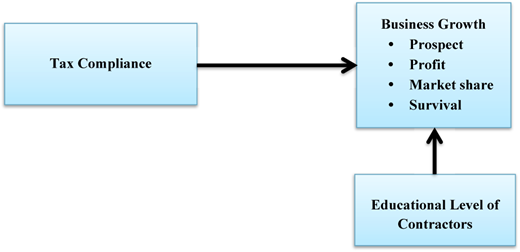
Given the literature review and hypotheses, the potential link between tax compliance and BG indicators, including the educational level of contractors as a control factor, is illustrated in Figure 1, which serves as the research or conceptual model.
3. Methods
3.1 Study designs
A quantitative approach was adopted for this study. This approach is appropriate to use numerical data for a statistical analysis to test the research hypotheses, aiming to find the link between tax compliance and BG from the perspective of indigenous contractors (Creswell and Creswell, 2018). Next, a survey strategy was used to collect cross-sectional data. Both methods are relevant given that we aim to demonstrate the potential association between the study variables using cross-sectional data (Hilton et al., 2024).
3.2 Population and sampling
The study’s population comprises contractors in Ghana, but the sample target includes indigenous contractors within the Accra, Tema, Kumasi and Tamale metropolises, which fairly represent the coastal, middle and northern belts of the country. A sample size of 200 was determined, consistent with Patton’s (2002) standard, and was widely applied in social science studies (see Hilton et al., 2024; Hilton et al., 2023; Martin, 2023; etc.). About 40 construction firms [ten from each metropolis] were chosen randomly from among those operating for not less than 10 years and having at least 25 employees. Respondents from the selected firms were homogenously purposively chosen to get workers who had the desired information (directly involved in operations and tax-related matters) because they were the only people who could best provide it (Sekaran, 2003; Puni et al., 2022). This sampling method is also useful to get respondents with rich information willing and available to participate in the survey (Etikan et al., 2016). Thus, this sampling technique is appropriate for obtaining the right contractors with similar characteristics to provide more accurate, reliable and rich information.
3.3 Instrumentation and data collection
We employed a questionnaire to collect data. The questionnaire contained adapted items that assessed the concept of tax compliance from both legal and economic perspectives (Devos, 2008; Barbuta-Misu, 2011). The questionnaire also contained items that assessed the indicators of BG, adapted from Olomi (2004) and Gerald and Elisifa (2013). A five-point Likert scale, ranging from (1) strongly disagree to (5) strongly agree, was provided for the participants to select. The first section of the instrument relates to demographic factors (i.e. gender, age, marital status and educational level). The second section collected data on the extent of indigenous contractors’ tax compliance. The third section gathers information on the BG indicators. We conducted a pilot test on ten (10) contractors that were not part of the sample to affirm that the questionnaire was valid and reliable. The data collection lasted for two months. To ensure non-response bias, we kept the items simple, straightforward and brief. We also gave the respondents a few days or weeks to complete the questionnaire. At the end of the survey, we retrieved 200 valid responses, constituting the total sample size.
To meet ethical considerations, we first obtained approval from the management of the selected firms to survey their workers. Next, the consent of the respondents was obtained before the survey, and we ensured confidentiality and anonymity of the information they provided.
We conducted content and predicted validity tests to confirm that the instrument correctly predicted outcomes (Thomas, 2006). The content validity test was conducted by referring the instrument to experts for validation, while the prediction validity test was performed using interconstruct correlation, as shown in Table 1 that the instrument is valid. Additionally, we confirmed the internal consistency of the items [reliability] by calculating Cronbach’s alpha (CA) (Cooper and Schindler, 2008). The CA in Table 1 exceeds 0.70, indicating that all scales (tax compliance and BG indicators) are reliable (Cooper and Schindler, 2008).
3.4 Data analysis
In analyzing the data, we conducted descriptive statistics (means, standard deviations, skewness and kurtosis). We determined the normality of the data using skewness and kurtosis. Next, we utilized a hierarchical regression modeling to test the association between tax compliance and BG indicators, including the educational level of contractors as a control. The regression models are specified as follows:
where: BGPP = BG – prospect; BGPF = BG – profit; BGMS = BG – market share; BGS = BG – survival; TC = tax compliance; EDU = educational level of contractors; α1 – α4 are constants; β1 – β8 are coefficients and μ1 – μ4 are the error terms.
4. Results
Table 2 presents the respondents’ demographic information. More males (55%) took part in the survey than females (45%) did. Regarding age, 37% of respondents fall within 31 and 40 years, followed by those in the age bracket of 41 and 50 years (34%), those between 20 and 30 years (19%), and finally, 10% fall within the age groups of 51 and 60. This implies that the youth population works in indigenous contraction firms. In descending order, 60% of respondents obtained their first degree, 26% obtained master’s degrees, 8.5% obtained diplomas and 5.5% obtained secondary education certificates.
Table 3 presents the descriptive statistics – minimum, maximum, mean, standard deviation, skewness and kurtosis. The mean results show that tax compliance and BG indicators are above average on a five-point scale, and the standard deviations depict relatively less spread of the values in the distribution around the mean. The data are normally distributed because the skewness and kurtosis are within +1 and −1 (Field, 2015). Because the data are normally distributed, it is appropriate to perform a parametric statistical test [hierarchical regression modeling] (Hilton et al., 2021, 2023).
Table 4 shows the hierarchical regression modeling results. The table contains four blocks, where block 1 relates to BG – prospect, block 2 relates to BG – profit, block 3 relates to BG – market share and block 4 relates to BG – survival. Each block has two steps, where step 1 represents the entry of tax compliance, and step 2 represents the entry of both tax compliance and educational level. This procedure was followed to assess the direct link between tax compliance and BG indicators, and the controlling effect of educational level.
The beta and t-statistics are reported under the two models, where model 1 relates to step 1 and model 2 relates to step 2. The R-square, adjusted R-square and F-statistics indicate that the independent and control variables contribute significantly to changes in the indicators of BG. Specifically, the adjusted R-square in step 1 of block 1 suggests that tax compliance could explain 44.8% of variations in BG – prospect and the adjusted R-square in step 1 of block 2 implies that tax compliance could explain 17% of variations in BG – profit. Meanwhile, the adjusted R-square in step 1 of block 3 suggests that tax compliance could explain 4.4% of changes in BG market share and the adjusted R-square in step 1 of block 4 indicates that tax compliance could explain 7.8% of changes in BG survival.
From Tables 4 and it can be observed that the beta values in model 1 of all blocks are significant, indicating a significant association between tax compliance and BG indicators. Specifically, tax compliance and BG – prospect recorded beta of 0.719, tax compliance and BG – profit (0.447), tax compliance and BG – market share (0.230) and tax compliance and BG – survival (0.281). This implies that if tax compliance is improved by one unit, the BG indicators will likely improve by their betas, ceteris paribus. Hence, H1–H4 are rejected. Under step 2 and model 2, the controlling effect of educational level is insignificant, indicating that educational level might not contribute to the explanation of the variance in the BG indicators. As the controlling effect is not significant, H5 is accepted.
5. Discussion
Drawing from the tax compliance principle, we tested a conceptual model that describes whether tax compliance and BG of construction firms are associated and the control effect of the educational level of contractors. Our findings underscore the tax compliance principle, which suggests that noncompliance obstructs firm growth. Precisely, the results have confirmed the various BG indicators. Comparing the mean scores of the BG indicators, it can be observed that BG survival has the highest mean. This suggests that firm survival might be a strong BG indicator for indigenous construction firms, while BG – market share might be the lowest indicator. This result supports the assertions of Olomi (2004) and Gerald and Elisifa (2013) that these indicators can be used to measure BG. This implies that construction firms have to evaluate these indicators regularly to assess their performance or growth in the sector. The results on tax compliance also confirm the definitions adopted from Devos (2008) and Barbuta-Misu (2011). It follows that generally, the tax compliance level of indigenous contractors is not high, confirming anecdotal evidence that Ghanaians are generally adamant about paying taxes. Hence, managers of the selected firms must strive to improve their level of tax compliance.
Regarding the hypotheses, even though our findings are empirically new, and so there are no precise existing findings to compare with, they can be discussed in line with a few related studies. Our findings provide a different perspective from Koranteng et al.’s (2017) observation that businesses have negative perceptions about their growth, affecting their willingness to be tax compliant. While Koranteng et al. (2017) investigated how BG stimulates tax compliance, we looked at the potential link between of tax compliance and BG because, in the context of construction firms, their compliance with tax gives them an edge to win more contracts. We further add to Koranteng et al.’s (2017) study by employing the four indicators of BG that are critical in BG assessment. Again, contrary to the belief that businesses are tax noncompliant to plow back money into the business for profit and growth (Tomlin, 2008), our findings suggest that fulfilling tax obligations helps firms in the construction sector to make more profits and ultimately grow. Thus, our findings depart from the assertion of researchers (such as Weichenrieder, 2007; Vasak, 2008; Masato, 2009) that tax compliance stifles BG. Consequently, our findings confirm the link between BG and tax compliance, as alluded to by Slemrod (2018), that tax noncompliance in the form of tax evasion can be costly to businesses and will ultimately impede growth. Hence, this study contributes significantly to the taxation and BG literature by revealing the positive connection between tax compliance and BG. Taxpayers can be motivated to honor their tax obligations from the perspective of firms’ benefits.
It is important to note that the introduction of educational level as a control factor insignificantly increased the effect of tax compliance on the various indicators of BG. Therefore, the educational level of indigenous contractors might influence their tax compliance level. That is, the more formally educated Ghanaian contractors are, the better the knowledge and positive impression they have about the payment of taxes. This finding seems to suggest a solution to the negative impression of paying taxes, as established by Koranteng et al. (2017). Therefore, the introduction of tax education into the formal education curriculum may contribute to citizens’ tax compliance levels in business.
6. Implications
First and foremost, we ascertained that Ghanaian contractors’ tax compliance was above average. However, the average response (mean) is not sufficiently strong to suggest that the tax compliance level is high or effective. Managers of various construction firms should endeavor to increase their tax compliance levels by frequently filing and paying taxes on time. This would enhance the effectiveness of compliance. The Ghana Revenue Authority must intensify tax education and periodic audits to promote effective compliance. Secondly, tax compliance and BG indicators (prospect, profit, market share and survival) were found to have significant positive relationships. Managers of indigenous construction firms should improve their tax compliance levels to improve the BG indicators. This is because effective compliance increases the chance of firms being selected for a project or awarded a contract, thereby creating sustainable BG. Lastly, although statistically the educational level of contractors did not control the association between tax compliance and BG indicators, indigenous contractors are encouraged to improve their educational level and expose themselves to public education on tax, which would stimulate their interest in continually complying with their tax obligations.
Our study, therefore, bridges the gap between theory and practice, as firms were involved in the administration of the questionnaire to seek practical experiences. Our findings can be used by revenue authorities to scale up their tax education to enable taxpayers to improve their tax compliance levels. Our study also demonstrates the need to assess how firms meet their tax obligations from their standpoint rather than purely focusing on approaches of revenue authorities, where many firms consider an unbearable burden that negatively affects their operations. Our findings prove that tax compliance can be encouraged from the perspective of BG, as noncompliance will stifle prospects, market share, profitability and survival, particularly for firms in the construction sector. Tax reforms and education should be organized from the perspectives of both law (authorities) and firms’ benefits.
7. Conclusion
We investigated tax compliance as a BG catalyst for indigenous contractors. Using a hierarchical regression model to analyze the cross-sectional data, we ascertained that indigenous contractors’ tax compliance is above average. We also identified prospect, profit, market share and survival as indicators of BG in the Ghanaian construction sector. Furthermore, tax compliance and BG indicators were significantly positively related. However, tax compliance had a stronger effect on BG – prospects than other indicators. Additionally, we revealed that the educational level of contractors could increase the effect of tax compliance on BG indicators, except that such an increment might not be significant.
Our study is limited in the following ways: First, the focus on tax compliance as a single construct could not provide a broad view of how indigenous contractors comply with various tax types. Second, to a large extent, the generalization of these findings might not apply to firms that are not in construction or other industrial settings where tax compliance might differ. Third, while our study is a useful reference in the literature, its application in decision-making beyond Ghana must consider Ghana’s socioeconomic context. A future study should consider addressing any of these limitations, especially regarding testing compliance levels based on tax types.