The mining industry is driving the growth of global economies; however, the sector faces persistent talent retention challenges. This research sought to investigate the impact of intervening variables on the relationship between talent management practices (TMP) and intention to stay.
Statistical analysis was conducted using SmartPLS4, with data systematically collected from 380 participants.
The results suggested that whilst organisational commitment partially mediates the relationship between TMP and intention to stay, workplace flexibility positively moderates the relationship between the two variables.
Little is empirically known about the moderating role of workplace flexibility on the relationship between talent management and organisational commitment in the SADC mining industry. This study presents a validated model that facilitates managerial decision-making.
Introduction and background
Mining companies now play a unique role among global industries as they feed the world and provide materials for infrastructure development and consumer needs (PwC-Global-Mine-2024). With global revenues exceeding $ 700 billion in 2022 (www.statista.com, 09/09/2024), mining is financing the growth of many economies worldwide. Amid this boom, far-reaching changes are confronting the mining industry, such as the increasing focus on automation, an increasingly mobile workforce and the evolving nature of work (McKinsey Report, 2023). This implies that the mining industry must refocus on its talent management strategy. Traditionally, the value derived from mining companies was underpinned by commodity prices, ore quality and equipment; however, it has since emerged that talent must be elevated from a simple enabler to a true value driver (McKinsey Report, 2023). After all, the mining industry faces an existential talent shortage (PwC-Global-Mine-2024).
The industry’s next-generation talent requires a focus on future skills, including artificial intelligence, robotics, automation and data science. Talent management has therefore become paramount in the mining industry. An investigation of talent management in the mining industry is crucial as it will offer critical managerial insights. Furthermore, talent management has generally been neglected in empirical research (Thunnissen and Gallardo-Gallardo, 2019). To get an understanding of the scope and nature of talent management in organisations, it is critical to explore the perceptions of multiple stakeholders in an organisation, including line managers and employees (Collings et al., 2019). For this reason, this study examined employees' perceptions of talent management practices (TMP) in a regional mining giant with operations in Zimbabwe and South Africa.
With 86% of mining companies stating that it is now challenging to recruit and retain talent, especially in fields such as mining planning, process engineering and data science (McKinsey Report, 2023), mining practitioners must devise strategies to change the attitudes of workers towards mining. Employee attitudes are pivotal in shaping whether employees will stay or leave an organisation. Not only that, given that some major mining organisations are adopting permanent remote working models (McKinsey Report, 2023), it has become critical to investigate strategies that can strengthen employee commitment at the workplace. Considering this, this study sought to examine the moderation and mediation mechanisms of workplace flexibility and organisational commitment on the link between TMP and the intention to stay.
This investigation yields significant contributions for both academicians and practitioners. First, as the mining industry faces employee retention challenges, this study identifies strategies such as workforce flexibility that can be used to strengthen the commitment of employees, thus reducing employee attrition from the industry. Theoretically, this study identifies skills (such as robotics, artificial intelligence, data science, and automation) that are critical for the future sustainability of the industry. This facilitates training programs to be honed towards upskilling the employees in the identified areas. Last, this investigation extends the limited talent management body of evidence in Africa (Anlesinya et al., 2019) by examining the underlying mechanisms that are crucial in influencing organisational outcomes, such as the retention of employees.
The following section deals with a literature review, hypothesis development and a discussion of the results.
Literature review
Human Capital Theory
The Human Capital Theory (HCT) was initially formulated by Becker (1964) and Rosen (1977). It argues that individual workers have a set of skills or abilities that they can improve or accumulate through training and education. Thus, the HCT places education and training at the centre of investment in human talent (Wright and Constantin, 2021; Marginson, 2019). The rationale is that when an individual acquires knowledge through education, this can enhance the marginal productivity of labour and hence earnings to the individual (Marginson, 2019). When the productivity of labour improves, the performance of an organisation can be enhanced. Investment in the education of individuals does not benefit employees and organisations only, but also has a ripple positive effect on the economy (see Wright and Constantin, 2021). Contextualising this theory, a talent management strategy that prioritises training and development can lead to organisational commitment, which in turn reduces turnover intention and actual turnover.
Talent management practices (TMP)
Talent management started to be popular in the 1990s after the publication of the McKinsey war of talent (Younas and Bari, 2020). According to Gallardo-Gallardo et al. (2020), a talented individual is a person who combines excellent input (high potential/excellent abilities) with outstanding output (excellent performance and value creation). Hence, talent management refers to the actions and processes that encompass the methodical attraction, recruitment and development of talent, which is vital for organisational success (Thunnissen and Gallardo-Gallardo, 2019). Previous research identified two approaches to talent management, namely the exclusive and inclusive approaches. An exclusive approach to talent management reflects the managerial belief that only a small percentage of employees are talented, and nature has provided them with special skills and capabilities that are crucial for organisational effectiveness (Meyers et al., 2020). On the other hand, the inclusive approach to talent management posits that every employee can be a star performer; hence, development opportunities must be targeted at all employees in the organisation. The choice of the two approaches is mainly dependent on the strategy of the organisation.
The concept of talent management has been extensively investigated (see Collings et al., 2019; Collings and Mellahi, 2009; Fernandez and Gallardo-Gallardo, 2021; Meyers et al., 2020; Thunnissen and Gallardo-Gallardo, 2019). It has been researched in the context of talent philosophies (Meyers et al., 2020), organisational performance (Collings et al., 2019), employee retention (Gupta, 2019) and organisational citizenship behaviours (Mensah, 2019). Prior studies also show that there are several dimensions of talent management. These include identifying critical positions, competency training, development and reward management (Jayaraman et al., 2018), talent attraction, talent retention, learning and development, career development (Aina and Atan, 2020), talent planning, workplace culture, professional advancement and talent recruitment (Gurbuz et al., 2017). This evidence confirms that the talent management construct is multidimensional; hence, its meaning and impact vary across contexts.
Intention to stay
Employees are the key assets in the determination of organisational effectiveness (Agus and Selvaraj, 2020). This is because it is the people whose efforts are critical for achieving the objective. An organisation can have the best technology and well-crafted strategies; however, technology can be useless without the intervention of people. In the same vein, a well-crafted strategy can remain a pipe dream if people do not implement it. This solidifies the argument that people are at the epicenter of everything in an organisation. In line with this, owing to the enormous expenses associated with hiring, orienting and training recruits, improving employee intention to stay is one of the most important targets for managers (Sobaih et al., 2022). According to Zhou et al. (2020), intention to stay refers to the probability of employees being eager to continue working for an organisation. Given that talent has become scarce, mobile and difficult to replace, it has become increasingly necessary to devise managerial practices that focus on retaining employees. By implementing strategies that enhance intention to stay, the actual turnover can be drastically reduced (Bonneton et al., 2022). What drives employees to stay in an organisation is the leader’s ability to influence, inspire, motivate and satisfy employees. Employees can be satisfied with strategies such as career management. Through career management, employees acquire skills and abilities that enhance their professional development. This improves employee value, thus increasing their probability of staying longer with an organisation (Bonneton et al., 2022).
Organisational commitment
Employees' attitudes influence their commitment to the organisation. Broadly, organisational commitment is defined as the individual’s strong emotional linkage to the organisation. It consists of three dimensions: affective commitment (employee emotional attachment to the organisation), normative commitment (moral duty to stay with the organisation) and continuance commitment (perceived costs related to exiting the organisation) (Labrague et al., 2018). Individuals apply to join organisations with specific needs and wishes in mind, expecting their employers to meet these needs and wishes. This implies that when an organisation provides an environment that fulfils employees’ needs, they become committed to such an organisation (Guzeller and Celiker, 2020). This is supported by Arasanmi and Krishna (2019), who stated that employees whose needs are met exhibit loyalty, psychological attachment towards work and identify with the organisation.
Furthermore, employees with positive perceptions and experiences of their organisations are more prepared to invest in and contribute to their employers' well-being (Kotzé and Nel, 2020). On the other hand, employees with fewer obligations to their organisation are likely to experience disgruntlement (Tetteh et al., 2020). Owing to the demands of the mining industry, the challenge for mining executives is to keep employees committed (Kotzé and Nel, 2020). For this reason, this study examined the mediating effect of organisational commitment in the mining sector because little is known about organisational commitment and retention in developing countries (Tetteh et al., 2020).
Workplace flexibility
Work–family conflict is a form of inter-role conflict in which pressures from work and the family are incompatible (Halinski and Duxbury, 2020). Commonly, a work role can interfere with the family role or vice versa. In such a situation, it is often difficult for employees to balance their family and work duties on their own unless managers devise work–life balance mechanisms. Accordingly, organisations that are concerned about the employee’s ability to balance work and family demands have responded by promoting the concept of workplace flexibility (Halinski and Duxbury, 2020). This concept has received significant interest among researchers and policymakers who are concerned with the demands that employment places on workers and their families (Kim et al., 2020). As a result, flexibility is now regarded as one of the key concepts of the contemporary workplace (Bal and Jansen, 2016). This is because the workplace is now diverse, especially with Generations Y and Z coming into the mainstream workforce. This generational cohort is highly mobile, tech-savvy and continually seeks flexible work schedules (Gabrielova and Buchko, 2021); hence, one strategy for retaining such employees is to implement flexibility mechanisms at the workplace. According to Jeffrey Hill et al. (2008a), workplace flexibility refers to the degree to which workers can make choices to arrange core aspects of their professional lives, especially regarding where, when and for how long work assignments are performed. Prior research suggests that flexible work schedules that provide workers with the ability to change work times are associated with positive work-related outcomes such as job satisfaction, low turnover intentions and organisational commitment (Kim et al., 2020). Jeffrey Hill et al. (2008b) categorised workplace flexibility into three aspects: schedule flexibility (which allows members to modify their work schedule using a variety of policies such as flextime), location flexibility (which allows workers to choose where work-related tasks are completed) and part-time working (which is concerned with the length of time an employee offers labour). These flexible work arrangements can facilitate the attainment of both life and organisational goals.
Hypotheses development
Talent management practices and the intention to stay
Due to high talent mobility, human resource managers face pressure to retain talent. This is because the costs associated with recruiting and developing talent are ever-increasing.
According to Luna-Arocas and Danvila-del-Valle (2022), talent management practices that influence employees to stay in an organisation include financial rewards, social benefits, job enrichment, prospects for developing a professional career, training and development opportunities, a suitable environment for work, and reconciliation of personal and work life. This implies that the adoption of these strategies will reduce work abandonment by employees. Furthermore, talent management practices such as talent attraction are designed to recruit employees whose values match those of the employer (Wang et al., 2024). In such a case, once there is a near or perfect fit between the employer and employee values, employees are inclined to stay longer with the organisation. In terms of talent development, when employees are trained, they acquire skills that facilitate the achievement of both organisational and personal objectives. This can result in the development of positive employee attitudes such as organisational commitment and the intention to stay. Several studies have confirmed a positive link between talent management practices and the intention to stay (see Kumar, 2022; Mokoena et al., 2022; Wang et al., 2024). It can therefore be proposed that:
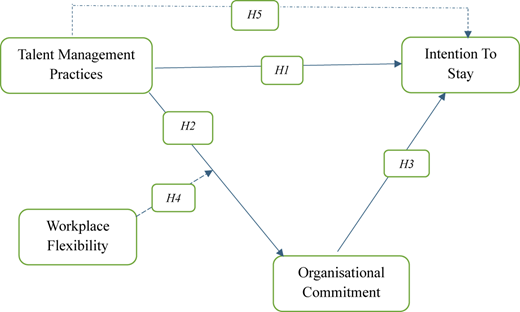
TMP positively influences the intention to stay
Talent management practices and organisational commitment
The business environment has become so volatile that it has become increasingly necessary to invest in human capital. Organisations must be able to effectively manage the workforce so that it becomes a source of the competitive advantage (Luna-Arocas and Lara, 2020). By investing in human capital through strategies such as training and development, employees can become more attached to the organisation as their value increases. Wang et al. (2024) also argued that if the personal objectives of employees are satisfied by the employer, there is a likelihood of organisational commitment being generated. This is because the achievement of personal objectives through the efforts of the employer increases employee motivation and prior studies support the link between motivation and the commitment of employees (Loor-Zambrano et al., 2022). Other talent management practices that are significant predictors of organisational commitment include career development, recognition (Mokoena et al., 2022) and compensation (Sarangal et al., 2020; Mokoena et al., 2022). It can therefore be proposed that:
TMP positively influences organisational commitment
Organisational commitment and the intention to stay
A feeling of gratitude to the employer results in the development of a strong bond between the employee and the employer. Indeed, past research confirms that the different categories of organisational commitment can influence several organisational outcomes, including the intention to stay variable (Masri and Suliman, 2019). If employees are emotionally attached to an organisation, they can stay longer because of the psychological connection between the individual and the organisation. This is also supported by previous research, which identified factors that influence employee retention, such as job satisfaction, burnout and organisational commitment (Bell et al., 2020). Furthermore, in a study of a representative sample of nurses in the Republic of Ireland, organisational commitment was the strongest predictor of intention to stay (Bell et al., 2020). The positive link between organisational commitment and the intention to stay constructive is supported in several studies (see Agus and Selvaraj, 2020; Guzeller and Celiker, 2020; Mokoena et al., 2022; Bell et al., 2020; Sobaih et al., 2022). It can thus be proposed that:
Organisational commitment positively influences the intention to stay
Moderating effect of workplace flexibility
Workplace Flexibility has been widely touted as essential in today’s workplace, as it is positively linked to a variety of individual, family and business outcomes (Pitt-Catsouphes and Matz-Costa, 2008). Workplace flexibility is honed towards achieving work–life balance (Bal and Jansen, 2016). If there is a good fit between employees’ needs and preferences and the policies/programmes offered by employers, an employee can change their attitude towards the organisation. This implies that if workplace flexibility is part of the talent strategy, employees can develop organisational commitment. Hence, workplace flexibility is expected to strengthen the relationship between talent management and organisational commitment.
Workplace flexibility is expected to moderate the relationship between TMP and organisational commitment positively.
The mediating role of organisational commitment
The mediation role of organisational commitment has been confirmed in several organisational behaviour studies (see Afsar et al., 2016; Agus and Selvaraj, 2020; Arasanmi and Krishna, 2019; Oyewobi et al., 2019; Sobaih et al., 2022; Wang et al., 2024). This body of evidence confirms the critical role of organisational commitment in influencing organisational outcomes. In the context of this research, committed employees complement a talent management strategy that is designed to retain employees in the organisation. Committed employees have a low affinity to depart the organisation if their expectations are satisfied within it. For example, an investment in employees through training programmes is perceived as organisational support (Wang et al., 2024); hence, employees can develop a firm psychological contract with the employer. This reduces the intention to quit or the actual quitting. It can therefore be proposed that:
Organisational commitment positively mediates the relationship between talent management practices and intention to stay.
Following the discussion above, this study proposes the research model in Figure 1 below:
Methods
Research context
The data for this investigation were collected from a mining conglomerate with operations in Zimbabwe and South Africa. The diversity of employees in this conglomerate made it a rich reservoir of information. Given the stressful demands of the mining environment, this case study provided a unique opportunity to investigate the variables.
Population and sampling
This study targeted a population of 5,000 middle-level managers who understood the purpose of this study and used simple random sampling to determine the sample size. According to Israel (1992), a sample size of 370 participants is considered sufficient for a population of such magnitude. Since this study was considered a low-risk task, verbal ethical approval was granted, and hence, all ethical guidelines and procedures were followed. Furthermore, participants were assured of confidentiality and could opt out of the research at any time without any coercion.
In collecting data, a structured questionnaire, with a section on informed consent, was developed and uploaded onto the Google Forms platform. This implies that the informed consent was in written form. An online link generated from the platform was sent to the email addresses of the participants, which were obtained from the HR division. Of the approximately 400 potential participants, 380 responses were collected, yielding a response rate of 95%. The participants' demographics are summarised in Table 1 below.
Measures
With slight modifications, each research variable was examined using previously validated measurement items in the literature. The questionnaire items were piloted with individuals from the research population. A five-point Likert scale was used to measure the constructs ranging from 1 “strongly disagree” to 5 “strongly agree.”
Talent management practices: TMP was operationalised with a scale developed by Kumar (2022). A sample item from the scale was: “My organisation has a career development program”.
Organisational commitment: To measure organizational commitment, a scale developed by Eisenberger et al. (2001) was used. A sample item included in the questionnaire was: “I feel emotionally attached to this organisation”.
Workforce flexibility: Workforce flexibility was measured using items adapted from the work of Halinski and Duxbury (2020). A sample item was: “I can vary my working hours.”
Intention to stay: To measure the intention to stay variable, a three-item scale developed by Sobaih et al. (2022) was applied. A sample item from this scale was: “I plan to work at my present job for as long as possible”.
Reliability and validity
The data were assessed for validity and reliability. As shown in Table 2 below, the values were within acceptable limits.
Discriminant validity
Discriminant validity can be assessed using the Fornell–Larcker criterion. As shown in Table 3 below, discriminant validity was achieved. (Values are shown diagonally in italics).
Results
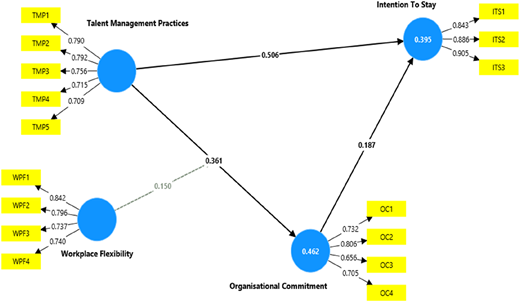
Figure 2 below shows the path coefficients from the PLS-SEM analysis done using SMART PlS 4.
Direct effects
Table 4 below shows that TMP significantly impacted intention to stay and organisational commitment (β = 0.506, p value = 0.00; β = 0.361, p value = 0.00). Hence, H1 and H2 were accepted. Furthermore, the organisational commitment had a significant impact on the intention to stay variable (β = 0.187, p-value = 0.00). Hence, H3 was accepted.
Mediation effects of organisational commitment and the moderating effect of workplace flexibility
The mediation analysis results showed that organisational commitment partially mediated the relationship between TMP and intention to stay (β = 0.07; p-value = 0.03); hence, H4 was accepted. The results also revealed that workplace flexibility positively moderated the relationship between talent management practices and organisational commitment (β = 0.150, p = 0.00).
Discussion
This study investigated the mediation and moderation roles of organisational commitment and workplace flexibility, respectively. There are several viewpoints to be considered. First, as hypothesised, TMP had a positive relationship with the intention to stay variable (β = 0.506, p = 0.00). This resonates with the prior studies (see Bonneton et al., 2022; Kumar, 2022; Wang et al., 2024). If talent management initiatives meet the expectations of the employees, they will be inclined to stay longer with the organisation. For example, if employees acquire skills through training. This increases their value in the workplace, allowing them to stay longer in the organisation due to a higher probability of promotion. Second, TMPs had a positive relationship with organisational commitment (β = 0.361, p = 0.00). This corroborates earlier findings such as those of Dias et al. (2023) and Mokoena et al., (2022). In line with the social exchange theory (Blau, 1964), employees reciprocate if they perceive the existence of organisational support. TMPs, such as recognition and career development programs, are interpreted as forms of organisational support that can influence employee commitment. Third, organisational commitment positively influenced the intention to stay. This is in line with prior research (see Bell et al., 2020; Sobaih et al., 2022). Positive attitudes in the workplace reduce the intention to quit a job as well as the actual turnover. This is attributable to the existence of a psychological contract between the employee and the employer. An employee with an emotional attachment to the organisation will always strive to achieve organisational objectives. Fourth, as hypothesised, workplace flexibility positively moderated the relationship between talent management practices and organisational commitment (β = 0.150, p = 0.00). This result implies that workplace flexibility strengthens the link between talent management and organisational commitment. Mechanisms such as shifts, teleworking and flexitime can facilitate the achievement of work–life balance. If employees believe that the organisation is allocating time for them to meet their personal needs, they can develop an attachment to the organisation. Last, this study confirmed the mediating role of organisational commitment (β = 0.07, p = 0.03). Although the impact is weak, this finding concurs with earlier research (see Wang et al., 2024). Organisational commitment plays a critical role in facilitating important organisational outcomes such as the intention to stay. This is because once an employee develops positive attitudes at work, negative behaviours will decrease and more efforts will be directed toward achieving organisational objectives.
Theoretical significance
This research offers a significant contribution to theory. First, it advances the HCT, which posits that education and training are critical mechanisms in talent management strategy. The research confirms that talent management initiatives, which include upskilling employees through education and training, can positively predict organisational commitment. Second, this investigation also deepens our understanding of the role of mining in the global economy and the talent challenges miners are confronted with in the 21st century. Third, talent management research is confined mainly to multinational corporations in developed countries (see Gallardo-Gallardo et al., 2020; McDonnell et al., 2023). This study enriches and expands our understanding of limited talent management research in Sub-Saharan Africa (Anlesinya et al., 2019).
Last, this research proposed a moderation–mediation model comprising workforce flexibility and organisational commitment. Hence, this research offers a comprehensive understanding of intervening variables in talent management. Prior research has been limited to single variables and, hence, has not proffered deep insights into the factors that affect the link between TMP and the retention of employees (Wang et al., 2024). The model proposed in this study can be validated in other contexts.
Practical implications
This study offers important practical implications for managers. Firstly, this study has validated the predictive power of workforce force flexibility and organisational commitment in influencing the intention to stay of mining employees. Hence, mine managers should continuously update their workforce flexibility strategies and policies. As employees increasingly seek flexibility in balancing their work and personal lives (Bal and Jansen, 2016), mine managers must develop strategies to achieve work-life balance. With Generation Y and Z employees joining the workforce, flexibility can no longer be ignored. This is because the younger generation values their freedom and independence (Younas and Bari, 2020).
Furthermore, as women are also moving into traditionally male-dominated environments such as the mining industry, flexible work arrangements have become even more urgent. Pregnant and working mothers in mining environments must be accorded flexibility that is consistent with their motherly roles. Global mining giants such as Rio Tinto, BHP, Gold Cup, and Fortescue Metals have already adopted flexible mechanisms, including paid parental leave, flexible hours, and childcare facilities (https://magazine.cim.org-30.09.24). These examples serve as case studies for mining companies in the SADC region.
Furthermore, mine managers must devise strategies that influence the organisational commitment of employees. This study has underscored the importance of organisational commitment, both as a mediator and a direct predictor of intention to stay. The upskilling of employees is one strategy that mine managers can adopt to influence the attitudes of employees. As information technology specialists are in short supply in the mining industry (McKinsey Report, 2023), talent upskilling in this area increases the promotional opportunities of employees at the workplace. When employees are trained, their value increases, leading to a commitment to stay longer in an organisation.
Conclusion
Although the concept of talent management research is receiving attention from scholars and practitioners, it is still at the embryonic stage in Africa. Furthermore, the mediation and moderation mechanisms of different factors have not been sufficiently explored. This investigation explored the mediation and moderation effects of organisational commitment and workplace flexibility, respectively, on the relationship between TMP and intention to stay. This research suggests that workplace flexibility positively moderates the relationship between TMP and organisational commitment, while organisational commitment partially mediates the relationship between TMP and intention to stay. Therefore, the study concludes that talent management is critical in mining, especially the intervening variables that are important in influencing the retention of employees. Furthermore, this research supports the HCT, which emphasises the critical role of talent management techniques such as training.
Limitations
This study addresses an important concept in business management and has improved our understanding of talent management. The study was conducted in the African context, which may limit the generalisability of its findings to other parts of the world. The generalisability of findings is affected by two issues, namely culture and the sample size that was applied. In the African context, the general cultural orientation is collectivism. This has an influence on attitudinal behaviours towards work. Furthermore, scholars may need to test our conceptual model in larger sample quantitative studies to assess its validity. Despite these limitations, this study has provided practical empirical evidence that demonstrates the relationship among the variables investigated.
Suggestions for future studies
This study suggests the introduction of other moderating variables in talent management research, especially in the African landscape.