This paper is an analysis of how the concept of paradoxical leadership, which strikes a balance between control and empowerment, influences the performance of employees. It also examines the mediation processes of job motivation and job involvement to give a description of the psychological processes involved in the reality of paradoxical leadership in the Indian automobile sector.
The quantitative research design was followed based on the data gathered in the form of a structured questionnaire survey to 500 of the employees who work in automobile firms in Chennai, India. To analyse the date the structural equation model was used and to test the direct and indirect correlation between variables.
The findings suggest that the paradoxical leadership positively influences the performance of the employees significantly. This relationship is partly mediated by job motivation and job involvement, ensuring the presence of a dual mediation effect. Leaders who can properly combine directive and enabling behaviours can increase performance.
The cross-sectional design and single industry focus limit causal inference and generalizability. Future studies should use longitudinal and multi sectoral designs to enhance validity across diverse contexts and strengthen the rigor of findings.
The results indicate the significance of leadership development programs that enhance paradoxical thinking towards employee motivation, engagement and performance in dynamic organisational cultures.
This work gives preliminary empirical data of a dual mediation model on how paradoxical leadership mediates employee performance within an industrial setting of a developing economy.
1. Introduction
Modern leadership is evolving with the need to address inconsistencies, including being directive and empowering, stable and adjustive, and disciplined and advocating autonomy. Such conflicting demands have attracted the academic interests to the concept of Paradoxical Leadership (PL) that is a tendency of leaders to combine and apply seemingly conflicting behaviours at the same time in order to improve the effectiveness of organisations. Integration of this kind is especially applicable in the case of the contemporary organisations when the employees want not only clarity and liberty but also structure and flexibility, power and input.
The study of paradoxical leadership is partially inconclusive and diversified despite the recent academic attention. According to certain works, paradoxical leadership promotes creativity, engagement, and performance by allowing employees to manage two sets of expectations (Zhang et al., 2015; Waldman and Bowen, 2016). Other studies, on the contrary, point to possible adverse effects, stating that behavioural balancing can lead to confusion and stress as well as lack of motivation when it is overdone (Lee et al., 2018). These inconclusive results demonstrate both a theoretical and a practical gap of understanding on how paradoxical leadership affects the outcome of employees. This is especially acute in the developing countries, where the old forms of hierarchical management co-exist with the growing requirements in the fields of innovativeness and employee independence.
This research based on the paradoxical leadership theory suggests a multi-layered model explaining the relationship between paradoxical leadership and employee performance mediating by job motivation and job involvement theory and hypothesizes empirically. The research will utilize the information that was gathered with 500 participants in an Indian car factory in Chennai and attempt to present an empirical understanding of both direct and indirect outcomes of paradoxical leadership. Through this, it would add value to leadership literature by providing a clarification of the psychological processes in which the paradoxical leadership is applied in a developing economy and provide a practical advice on managing performance in organisations that are dynamic.
1.1 Context of Indian automobile manufacturing industry
The Indian automobile manufacturing industry is a significant source of economic development, job creation, and industrialization. It is typified by high scale and technology intensive production systems experiencing strains in regulatory change, electrification, international competition and supply chain upheavals. Tamil Nadu is one of the major automobile manufacturing centres, with other companies including the Hyundai Motor India, Tata Motors, Ashok Leyland, TVS Motor Company, Renault Nissan and Daimler India. Companies within this industry need to be efficient in their operations, meet quality standards, compete in terms of cost, and be flexible in their work force. All these conflicting needs lead to the managerial tension that persists in the Indian automobile manufacturing sector, especially in the state of Tamil Nadu, and it is a suitable setting to study the paradoxical leadership, its effects on employee motivation and involvement, and organizational performance.
The gap in this study is the paradoxical leadership in the Indian automobile industry, which is a business sector with high-speed technological change, fierce competition, and standardisation flexibility. Although paradoxical behaviours associated with leadership are required in such contexts, empirical evidence on how they influence employee performance based on the inherent processes of psychology is not evident.
2. Literature review
2.1 Paradoxical leadership
Modern organisations are in a greater need of leaders who are capable of resolving the conflicting needs like control and autonomy, stability and change, and discipline and creativity. Such ability to combine contradictions at the same time also defines paradoxical leadership as a response that is based on the both-and thinking, and not on the either–or thinking due to tensions in the organisation (Zhang et al., 2015). This method is based on the paradox theory that focuses on the toleration and embracement of conflicting forces to maintain the performance of an organisation (Smith and Lewis, 2011). Paradoxical leaders encourage flexibility and high performance by ensuring that employees have the discretion they need to work as desired by keeping formal structures (Lee et al., 2023; Li, 2019).
Paradoxical leadership is empirically linked with increased innovation and engagement (Zhang et al., 2022; Keller et al., 2023). Nevertheless, paradoxical behaviours that are either overdone or improperly implemented can cause ambiguity and cognitive overload, thus texting performance and motivation (Lee et al., 2018; McClellan, 2023). Such ambivalent results highlight the importance of investigating the mediating psychological processes, which include job motivation and job involvement, via which paradoxical leadership affects performance levels (Udin, 2025). This view is more applicable in the manufacturing environment in the emerging economies, such as the Indian automobile industry, where efficiency and flexibility have to co-exist.
2.2 Paradoxical leadership and Jo motivation
Job motivation is the internal force that gives employees direction in terms of energy and effort to achieve the organisational goals. Intrinsic motivation theory indicates that when people have a sense of autonomy, competence, and relatedness in their work, they develop intrinsic motivation (Gagné and Deci, 2005). Paradoxical leadership will meet these needs by not only providing employees with a sense of empowerment but also by ensuring performance discipline and thus offering structured freedom to employees. Leaders who are both autonomous and inspiring expect employees to make decisions by giving them discretion but keeping them in line with organisational goals.
Empirical literature points to the fact that balanced leadership behaviours lead to better intrinsic motivation, creativity and proactive work attitudes (Gagné and Deci, 2005; Chouhan and Tiwari, 2025). Other studies in manufacturing and service industries also indicate that autonomy-supportive and directive leadership enhance commitment and motivation among employees (Chartered Institute of Personnel and Development, 2023; Hidayat et al., 2022). Paradoxical leadership fosters self-regulation, problem-solving and adaptive behaviour, which generate motivated energy in the long run in complex industries like automobile manufacturing (AlKhalifa et al., 2024; Durge, 2024). Paradoxical leadership aims at encouraging job motivation by satisfying intrinsic psychological needs and strengthening accountability.
2.3 Paradoxical leadership and job involvement
Job involvement is the level at which individuals engage psychologically with their work roles and get absorbed in these roles (Kanungo, 1982). The Job Characteristics Model assumes that significant work, autonomy and feedback increase the psychological involvement of employees (Hackman and Oldham, 1976). Paradoxical leaders create this state of affairs when they set expectations clearly and promote flexibility and discretion to enhance accountability and role clarity.
According to the Social Exchange Theory, the supportive leadership behaviours will be paid back by increased investment in work positions by the employees (Blau, 1964; Cropanzano and Mitchell, 2005). Paradoxical leadership enhances beliefs of trust, fairness and support that subsequently contribute to job involvement (Hngoi et al., 2022; Praveen, 2024; Bhatnagar and Soni, 2024). Precision and innovation are two aspects that exist in the automobile industry, and in such a case, the increased employment involvement is a factor that results in better performance results and less intent to turnover (Meyer and Allen, 1991).
2.4 Employee performance, job motivation and job involvement
Employee performance entails those behaviours and results that lead to organisational effectiveness. Motivation activates the work behaviour and job involvement concentrates the energy in the tasks and role fulfilment. Previous studies have shown that engaged and motivated employees are characterised by the increased task performance and organisational citizenship behaviours (Judge et al., 2017).
According to the Conservation of Resources, people strive to obtain and defend resources, which are important to them like energy, self-esteem and social support (Hobfoll, 1989). Paradoxical leadership fosters such resources by striking a balance between empowerment and direction, consequently increasing the ability to withstand psychological stress and the capacity to perform (Hobfoll et al., 2018). Employees who are identified and empowered tend to put more of their psychological capital into attaining higher performance results (Harter et al., 2002).
Other recent studies also prove that job motivation and job involvement have significant mediating impacts on the relationship between leadership and employee performance (Alqarni et al., 2023; Patnaik, 2020; Tuffaha, 2020). In this respect, this research paper conceptualizes job motivation and job involvement as two mediators between paradoxical leadership and employee performance to know more about psychological processes behind leadership effectiveness.
2.5 Research gap
Despite the extensive research on the subject of paradoxical leadership in the West and industries that rely on services, the available empirical data on manufacturing industries in emerging economies has been scarce (Lee et al., 2023; Udin, 2025). Furthermore, contradictions among studies highlight the fact that the ways of Paradoxical Leadership in improving results via internal psychological processes should be explored.
Based on this connection, this research seeks to determine the dual mediation impacts of job motivation and job involvement in the connection between paradoxical leadership and employee performance in the Indian automotive sector. This is based on an integrative multi-theoretical approach, which makes progress along both theoretical and practical enlightenment on effective leadership in complex, resource constrained environments.
3. Theoretical framework and hypothesis development
3.1 Theoretical framework
The conceptual framework of the proposed study is based on the five theories that supplement each other to explain how paradoxical leadership can affect employee performance based on job motivation and job involvement. Paradox Theory is the initial prism as it identifies how leaders can successfully balance opposing needs like control, autonomy, stability and change, discipline and flexibility (Lewis, 2000; Smith and Lewis, 2011). Paradoxical leaders embrace a both-and style that can help them maintain the organisational structure and still give the employees discretion to enhance adaptability and effectiveness (Zhang et al., 2015).
Self-determination Theory also describes how the motivational processes of paradoxical leadership take place. Deci and Ryan (2000) hold that employees also develop intrinsic motivation when they feel autonomy, relatedness and competence. When providing direction and at the same time promoting independence, paradoxical leaders would meet these psychological needs and enhance intrinsic motivation among employees (Gagné and Deci, 2005).
The Job Characteristics Model is an addition to this view since it suggests that meaningful work, autonomy and feedback enhance psychological involvement and responsibility (Hackman and Oldham, 1976). Such job characteristics are facilitated through paradoxical leadership, which creates clear expectations of performance and allows discretion in line with job involvement and job engagement (Humphrey et al., 2007).
According to Social Exchange Theory, employees can return supportive leadership behaviours with more commitment and effort (Blau, 1964; Cropanzano and Mitchell, 2005). Lastly, the Conservation of Resources Theory is a theory of motivation and involvement that is a psychological resource that leads to sustainable performance when empowered by enabling leadership practices (Hobfoll, 1989; Hobfoll et al., 2018).
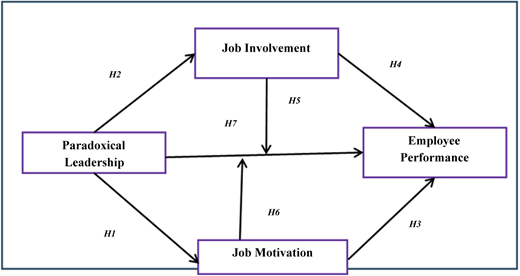
The combination of these theories is the foundation of the proposed framework where paradoxical leadership positively and negatively affects the performance of employees either directly or indirectly via job motivation and job involvement, as shown in Figure 1.
3.2 Hypotheses development
Paradoxical leadership is the term that describes a set of behaviors of leaders that meet conflict but at the same time interrelated tasks by incorporating contradictions instead of making one more important than another (Zhang et al., 2015). Leaders in manufacturing firms like the automobile industry must juggle control and autonomy, standardization and flexibility, and efficiency and innovation. These contradictions influence the motivation levels, mental engagement, and performance results of workers, and paradoxical leadership is therefore an applicable paradigm of organizational effectiveness.
3.2.1 Paradoxical Leadership and Job Motivation
According to Self-Determination Theory, intrinsic motivation is promoted when the employees feel autonomy, competency, and relatedness (Deci and Ryan, 2000). Paradoxical leaders give their employees autonomy as well as structure by offering them explicit goals and performance expectations but giving them discretionary powers in performance of the tasks. This balance meets the competence and self-direction needs of employees, thus reinforcing their intrinsic motivation. According to Gagné and Deci (2005), the same leadership behaviors that can be described as support-accountability encourage internalized motivation because the employees feel empowered without losing focus. Empirical research also shows that autonomous motivation and self-driven work behaviors have a positive correlation with leadership styles that depict paradoxical balance (Chouhan and Tiwari, 2025). In line with this, paradoxical leadership should improve the motivation of employees towards their jobs.
Paradoxical leadership has a positive impact on job motivation.
3.2.2 Paradoxical leadership and job involvement
Job involvement can be defined as the level to which the individuals have a psychological attachment to their job and consider job performance as part of them (Kanungo, 1982). Leadership behaviors are very important in the formation of such attachment. Paradoxical leadership promotes job involvement as it integrates empowerment and role clarity. By giving discretion to the leader when accountable, employees will be motivated to internalize organizational objectives and feel their ownness towards their work. Brown and Leigh (1996) show that enabling work conditions increase effort and engagement, whereas recent reports indicate that paradoxical leadership correlates with a better understanding of the role and engagement (Lee et al., 2023). Therefore, paradoxical leadership should enhance the psychological engagement of the employees to work.
Paradoxical leadership will lead to a positive effect on Job involvement
3.2.3 Job motivation and employee performance
Employee motivation is one of the key drivers of employee performance as it determines the degree, duration and quality of work effort. Employees who are intrinsically motivated depict more creativity, sustained attention, and behavioural adaptation in performing tasks (Judge et al., 2017). Motivated employees tend to dedicate cognitive and emotional resources to the execution of the task more in manufacturing conditions where quality and efficiency are vital. According to the empirical evidence, there is always a positive correlation between intrinsic motivation and the personal performance outcomes (AlKhalifa et al., 2024). Therefore, the increased rates of job motivation will result in better employee performance.
Job motivation has a positive effect on Employee performance
3.2.4 Job involvement and employee performance
Job involvement is the psychological engagement of the employees in their work positions and their readiness to give additional efforts without constraints. Employees who are highly engaged feel that the work has meaning to them and show increased persistence and productivity (Kanungo, 1982). Meyer and Allen (1991) explain that psychological attachment to work improves performance-based behaviors, whereas recent records confirm that job involvement is a positive predictor of performance quality and performance efficiency (Bhatnagar and Soni, 2024). Thus, the performance outcomes of employees, whose job involvement is greater, should be better.
Job involvement will have positive effects on Employee Performance.
3.2.5 Paradoxical leadership and employee performance
There is also the possibility of a direct impact of paradoxical leadership on employee performance. In the process of balancing conflicting managerial demands, the paradoxical leaders are able to establish circumstances under which resilience, adaptability, and creative problem-solving can thrive (Zhang et al., 2015). Li (2019) also shows that the paradoxical leadership style improves the results of innovation, whereas Keller et al. (2023) state that empowerment and control are more efficient when combined to achieve long-term productivity. Paradoxical leadership will therefore directly positively influence the performance of the employees.
Paradoxical leadership positively influences employee performance.
3.2.6 Mediating effects of job motivation and job involvement
The ways through which the paradoxical leadership might affect employee performance are job motivation and job involvement. A balance between guidance and autonomy of leaders leads to intrinsic satisfaction and recognition among employees, which enhances motivation. Based on Self-Determination Theory, motivated employees will be more inclined to transform the leadership support to the persistence of effort and goal-focused behaviour (Deci and Ryan, 2000; Gagné and Deci, 2005). The Conservation of Resources point of view supports the leader to provide the employee with the psychological resources, including energy and confidence, which can be redirected towards performance-promoting activities (Hobfoll, 1989; Halbesleben et al., 2014).
On the same note, the paradoxical leadership promotes job involvement by motivating the employees to internalize the organizational goals but has clarity of the role. According to the Job Characteristics Model, psychological engagement is increased by autonomy and meaningful responsibility (Hackman and Oldham, 1976). Conservation of Resources theory also implies that engaged employees will have better chances to invest and safeguard valuable psychological resources, which will result in long-term performance (Hobfoll et al., 2018). Based on this, job involvement and job motivation are set to mediate the association between paradoxical leadership and employee performance.
Job motivation mediates the correlation between paradoxical leadership and employee performance.
Job involvement is the mediator of the relationship between paradoxical leadership and employee performance.
4. Research methodology
4.1 Research design
The study design that was adopted in this research was an explanatory, quantitative and cross-sectional research study design. The presented design was suitable to investigate all direct and indirect correlations among Paradoxical Leadership (PL), Job Motivation (JM), Job Involvement (JI), and Employee Performance (EP) as the concepts in a theoretical framework. The explanatory type of design allowed establishing causal relationships between constructs, whereas the cross-sectional methodology helped to gain data at one moment of time. Such a methodological framework takes into consideration other previous research works that examined the impact of leadership employing Structural Equation Modelling (SEM) to grant an empirical basis of mediation testing in the study of organizational behaviour.
4.2 Context of the study
The study was carried out in the automobile sector found in the south Chennai, Tamil Nadu, India. The automobile industry was chosen as the main context since it is a high demand, competitive, and high tech where leaders have to juggle between structure and empowerment and stability and flexibility, which are the preconditions of paradoxical relationships between leaders and employees. The industry has car makers, parts providers, and service companies, which provide a perfect environment to investigate the integration of opposites through leadership behaviors. The area also offers a varied workforce with respect to age, education, and experience, and with respect, this will enable a complete understanding of the ways paradoxical leadership affects motivation, involvement, and performance along demographic lines.
4.3 Population and sampling
The target group was full-time employees of the middle and large automobile manufacturing organizations in Chennai. Purposive non-probability sampling was used by selecting employees who had at least two months of experience working under the same immediate supervisor so as to get enough exposure in terms of leadership behaviour. Non-permanent employees and those who had less than two months of a single leader were not included. The accessible sampling frame for the firms that participated comprised about 550 eligible employees. All the eligible respondents received questionnaires, and 500 respondents were able to submit their answers. The last sample meets the requirements of adequacy of SEM (Hair et al., 2019).
4.4 Instrumentation and data collection
A structured, self-administered questionnaire was used to collect data based on validated scales, which have been extensively utilized in earlier studies. The tool was divided into five parts (demographics and four major constructs) that were rated on a five-point Likert scale (1 being strongly disagree, 5 strongly agree). Paradoxical Leadership (PL): 22-item scale was created by Zhang et al. (2015). Job Motivation (JM): Multidimensional Work Motivation Scale, 19 items, Gagné et al. (2015). Job Involvement (JI): 10 item scale by Kanungo (1982). Employee Performance (EP): 10 Items modified based on Borman and Motowidlo (1997)indicating in-role and extra-role behaviors.
Procedural remedies were used to reduce common method bias (CMB); these included instructions that were clear, anonymity guaranteed, items were randomized, and simple words were used. The respondents were told that there would be no right and wrong answers. The initial factor represented 38.7% of the variance, which is below the 50% threshold, suggesting that common method bias is not likely to be a significant issue.
4.5 Validity and reliability
The construct and content validity assessed in the study concern the test’s content and its measurement of the constructs being studied.
4.5.1 Content and construct validity
Expert evaluation and pilot testing were used to determine content and construct validity. Three academic experts and two senior HR practitioners reviewed the questionnaire before it was published to ensure that it is clear, relevant and has enough content. To narrow down the item wording and sequencing, a pilot study was carried out on 30 employees. An approach that was taken was the theory-based measurement with the Confirmatory Factor Analysis under SmartPLS 4.0. The factor loading values were all positive (possibly greater than 0.70), the composite reliability value was recorded to be greater than 0.80, the Average Variance Extracted was greater than 0.50, which verified reliability and convergent validity. The Fornell Larcker criterion was used to determine the discriminating validity.
4.5.2 Reliability
Cronbach’s alpha coefficients of 0.85–0.93 ensured internal consistency and also provided a good measure of robust construct reliability. The measures are consistent with the conventional criteria of leadership and behavioural research.
4.6 Data analysis procedures
Before the hypothesis was tested, the data were filtered in terms of completeness and accuracy. Cases that contained more than the missing values or those that were known to contain outliers were eliminated. First, the descriptive statistics (mean, standard deviation, skewness, and kurtosis) were calculated to analyse the data distributions and to determine whether the variables were acceptable on the assumption of normality. These indicators assisted in making sure that the data was appropriate for further multivariate analysis. The variables were within the acceptable range (−2 to +2 skewness and kurtosis), which means that there was no extreme deviation of normal distribution. This was the move that defined the appropriateness of the data to be analysed using the multivariate. Confirmatory procedures of measurements were then used to validate the measurement model.
4.6.1 Validity of the measurement model
Confirmatory Factor Analysis was conducted on AMOS 24 to assess the quality of the measurement of the scales. Convergent validity was also assessed using standardized factor loading whereby all the numbers were above the recommended standard of 0.60 as well as Average Variance Extracted (AVE) which were above the recommended value of 0.50, which implies that the latent constructs explained a significant proportion of the variance of their corresponding indicators. The criteria of discriminant validation were also established by the Fornell Larcker criterion as well as by the HTMT ratio (HTMT values were less than 0.85), which indicated that the constructs were actually different. Cronbach alpha coefficients and Composite Reliability (CR) values, which were above the 0.70 cutoff, supported the reliability, and hence, ensured the internal consistency of the scale items. Altogether, these findings proved that the measurement model had a high level of psychometric performance, and the constructs have a distinct dimension of the theoretical framework.
4.6.2 Correlation analysis
Pearson correlation coefficients were calculated to analyse the direction and the strength of the bivariate association between the study variables. These correlations had significance with positive values, which offer the initial support of the proposed relationships between the variables Paradoxical Leadership (PL), Job Motivation (JM), Job Involvement (JI), and Employee Performance (EP).
4.6.3 Analysis of variance (ANOVA)
One-way ANOVA was to be used to ascertain the presence of any significant perceptual differences in various demographic groups, including gender, age, and organizational tenure. This discussion has shed light on whether the responses of employees differed significantly among the important demographic segments. The ANOVA demonstrated no significant differences across demographic categories (p > 0.05), showing that age, gender, and tenure did not cause structural model perceptual biases.
It was not employed to make deductions between the main constructs of the model. The findings showed that there were slight differences in perception among age and experience groups; however, no significant differences that would have an impact on the structural model.
4.6.4 Structural Equation Modelling (SEM)
Direct, indirect, and mediating effects between Paradoxical Leadership, Job Motivation, Job Involvement, and Employee Performance were analysed through SEM in order to test H1–H7. The mediation effects were also evaluated using the bootstrapping (5,000 samples) with bias-corrected confidence intervals of 95% significance. Model fit parameters were within the recommended ranges, which ensured that the model was adequate.
4.7 Control variables
The control variables (demographic variables, such as gender, age, and organizational tenure) were included in the model to enhance the analytical and minimize the possibilities of conflicting explanations. Previous literature has shown that these demographic variables can affect the perception of employees towards leadership behaviours, the experience of work-related attitudes, and the reactions to motivational stimuli (Iqbal et al., 2021). The study has eliminated the impact of these background variables by doing so, and the research sought to isolate the specific contribution that paradoxical leadership plays in the observed employee outcomes.
The structural model was also estimated with and without the addition of the control variables to determine their impact. It was found in the comparison that there was no meaningful difference in the size or significance of the primary path coefficients with the addition of these demographic controls. The correlations between paradoxical leadership, job motivation, job involvement, and employee performance were also healthy, and the effect sizes and the correlations were statistically significant. These findings reveal that the fundamental results are consistent and not dependable on demographic variations between the respondents and this supports the validity and reliability of the findings of the study.
4.8 Ethical considerations
Ethical strict procedures were followed during the research. Involvement in the survey was voluntary, and informed consent was signed by the respondents before data collection. At all the processes, anonymity and confidentiality were guaranteed. The researchers followed the rules of institutional ethical issues, and the study was officially approved by the Institutional Review Board (IRB) of the university in which the study was carried out.
5. Result and analysis
5.1 Confirmatory factor analysis
The measurement model using Smart PLS4 demonstrated discriminant, convergent, and reliable results. Factor loadings exceeded the recommended 0.7 threshold values, as stated by Hair et al. (2019). Table 1 shows high indicator reliability, Paradoxical-Leadership (Paradoxical Leadership) loads between 0.728 and 0.842, with Composite-Reliability (CR) = 0.929 and Average Variance Extracted (AVE) = 0.571, which signifies strong convergent validity and internal consistency (∝ = 0.913) based on Hair et al. (2019).
Job Motivation (JM) had a high loading JM2 of 0.952, with a CR of 0.889 and AVE of 0.625. Job Involvement (JI) demonstrated strong factor loading, with a CR of 0.908 and AVE of 0.665. Employee Performance (EP) achieved the highest reliability, with CR = 0.969 and AVE = 0.914, thereby establishing sound convergent validity. The square root of the AVE for each construct with inter-construct correlations confirmed discriminant validity, which ensured the robust measurement model stated by Sarstedt et al. (2020).
Table 2 displays the averages, standard deviations, and correlations of the study variables—paradoxical leadership (PL), work motivation (JM), job engagement (JI), and employee performance (EP)—for a sample of 500 participants. Paradoxical leadership (M = 42.90, SD = 5.96) exhibited moderate to strong positive correlations with job motivation (r = 0.62, p < 0.01), job involvement (r = 0.71, p < 0.01), and employee performance (r = 0.58, p < 0.01), signifying that elevated levels of paradoxical leadership correlate with enhanced employee attitudes and performance results. The correlation between job motivation and job involvement was moderate (r = 0.68, p < 0.01), indicating that driven individuals are often more engaged in their work. Job involvement had a robust positive link with employee performance (r = 0.72, p < 0.01), indicating that employees with greater task engagement are more inclined to exhibit superior performance. The correlations remain within acceptable limits, signifying significant associations without indications of problematic multicollinearity.
5.2 Hypotheses testing
The ANOVA test yielded F = 192.178, p < 0.001 (Table 3), signifying statistically significant disparities in mean perception ratings among demographic groups, as evidenced by the between-group variation (SS = 1949.818) relative to the within-group variation (SS = 327.374). These results indicate solely group-level perceptual disparities, excluding the influence of paradoxical leadership on employee performance.
Bootstrapping was used with 5,000 samples, which yielded strong insights and pathways.
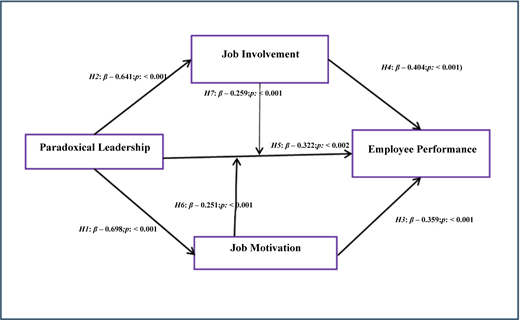
Table 4 shows the results of the structural model test based on Paradoxical Leadership, job motivation (JM), job involvement (JI), and employee performance (EP). The original-sample value(O) = 0.095, standard deviation (STDEV) = 0.044, and t-statistic of 2.162 (p = 0.031) directly affected employee performance (EP). Thus, the hypothesis that Paradoxical Leadership positively affects EP was supported. With a t-statistic of 2.431 (p = 0.015) and a path coefficient of 0.054 for Paradoxical Leadership → Job Motivation → Employee Performance, Job Motivation (JM) mediates the relationship between paradoxical leadership (Paradoxical Leadership) and Employee Performance (EP). Finally, Job Involvement (JI) significantly mediates the relationship between Paradoxical Leadership and EP, as evidenced by (path coefficient = 0.746, t = 20.725, (p = 0.000), and 95% confidence interval = 0.676–0.818), supporting the hypothesis and highlighting the strong mediating role of job motivation and involvement between paradoxical leadership (Paradoxical Leadership) and employee performance (EP) (see Figure 2).
6. Discussion and implications
6.1 Discussion
The current research investigated the connection of the paradoxical leadership with the employee performance mediated by Job Motivation and Job Involvement in the automobile manufacturing industry in Chennai. The results are solid evidence of the suggested dual mediation model, as well it present a valuable theoretical contribution to the operation of paradoxical leadership based on the psychological process.
From Table 5 we could infer that there is a strong positive impact on Paradoxical Leadership and significantly influences Job Motivation (β = 0.698) and Job Involvement (β = 0.641), which can be concluded to mean that a leader who strikes a balance between control and empowerment has a significant impact on the internal states of the employees. The high beta values strongly indicate a robust relationship. The findings can be explained by the fact that, according to the Paradox Theory, the combination of competing demands like discipline and flexibility results in a productive organizational environment, and leaders can effectively balance competing demands. Employees also perceive their work as more meaningful and psychologically involved in their jobs. In organized production environments where standardization has to co-exist with flexibility, both and oriented leaders seem to foster psychological engagement of workers.
The simultaneous correlation among the variables in the case of Paradoxical Leadership and Job Motivation is consistent with the hypotheses of the self-determination theory. Employees feel competent and autonomous when leaders set explicit expectations and leave discretion to them, motivating them intrinsically. Correspondingly, the beneficial impact on the Job Involvement shows the support of the Job Characteristics Model, which presupposes that the clarity of jobs together with autonomy improves the psychological commitment of employees to the job.
This direct impact of the Paradoxical Leadership on Employee Performance (β = 0.332), which is shown in Table 5, indicates that balanced leadership behaviors play a role in influencing the performance results. Nevertheless, the high indirect impact of Job Motivation on employee performance (β = 0.251) and Job Involvement (β = 0.259, p < 0.001), which were mediated, were supported and emphasizes the role of the psychological processes. This mediation style demonstrates the principles of the Social Exchange Theory, according to which employees will pay more effort and engagement in return for supportive leadership actions. It also coincides with the Conservation of Resources theory whereby a leadership style that promotes motivation and engagement contributes to mobilization of psychological resources, which is channelized into performance.
From Table 5 it is observed that both mediators predict employee performance significantly, Job Motivation (β = 0.359, t = 7.842, p < 0.001) and Job Involvement (β = 0.404, t = 9.126, p < 0.001), which positively influence the performance. The mediation effects of H6 and H7 Job Motivation (β = 0.251, t = 6.712, p < 0.001) and Job Involvement (β = 0.259, t = 6.984, p < 0.001) partially mediate the relationship between Paradoxical leadership and employee performance.
The model shows that it explains 52% of the variance in Employee Performance which shows strong significance of the model strength. This indicates that the ability to lead in the automobile industry is not only a matter of direct control but also the capacity of leaders to develop motivation and participation among the employees.
The results clearly indicate that the paradoxical leadership had contributed more to increase the employee performance through the mobilization of the internal motivation and psychological engagement. With the combination of the five theoretical perspectives, the research has offered a holistic explanation on how balancing leadership behaviours leads to better performance results in a complex industrial setting.
6.2 Theoretical implications
This research result is also relevant to theory because it shows that when contradictory demands are accepted and balanced by a leader according to the Paradox Theory, then conditions under which organizational flexibility, adaptability, and learning can be achieved are established. The fact that paradoxical leadership has positive impacts on the motivation and involvement of employees also testifies to the postulates of the Self-Determination Theory that when leaders create a successful balance between empowerment and direction, the employees gain greater levels of intrinsic motivation due to the increased levels of the intrinsic feelings of competence, autonomy and relatedness. The outcomes are also consistent with the Job Characteristics Model, which states that employees get more engaged when they find their work to have a sense of meaning and when they feel that they have a sense of ownership and responsibility in the position they occupy.
Moreover, the results do indicate the assumptions of the Social Exchange Theory, in the sense that workers are more likely to return proportional, balanced, and supportive leadership with a greater commitment and discretionary performance. The trend of the outcomes is also close to the Conservation of Resources Theory as motivation and involvement are regarded as the key psychological resources that lead to an employee maintaining a high level of performance even in harsh conditions. Combined, these theoretical approaches supplement the knowledge on how paradoxical leadership produces positive employee results and the motivation processes that lead to performance in an organization.
6.3 Practical implications
The research results present some practical implications for leadership development and organizational practice in the manufacturing aspect. To start with, paradoxical leadership must be identified as an acquired, as opposed to an inherent, managerial ability. Leadership development programmes designed by organizations can assist managers to be conscious in their balancing of control and empowerment, disciplines and flexibility, as well as standardization and adaptability based on situational needs. These programmes must prioritize paradoxical thinking, which helps the leaders to deal with ambiguity, combine goals of conflict, and maintain psychological safety among employees.
Second, the mediating impact of job motivation and job involvement is an indication that incorporating leadership development programs with the employee engagement and well-being practices holds significance. By empowering workers at the same time and holding them responsible, managers can enhance intrinsic motivation, increase engagement, and eventually improve performance. The strategy is especially applicable to the automobile manufacturing agencies where quality and efficiency should be coupled with innovation.
Third, the capability of paradoxical leadership can be included in human resource systems in performance appraisal, leadership evaluation, and succession planning procedures. Autonomy, communication, and job design policies in an organization can also be brought to be congruent with leadership practices that can maintain consistent motivation, engagement, and prolonged performance.
6.4 Future research directions
Though cross-sectional design does not allow causal inference, in future studies, longitudinal and multi-industry designs can be taken to investigate the stability in time and context. The data used is subordinate rated, which is one of the limitations; future research can use Dyadic analysis or multisource designs to better capture leader follower dynamics. It might be a good idea to moderate the variables by using psychological safety, the trust of leadership and organizational culture to explain the boundary conditions of paradoxical leadership effectiveness. The qualitative or mixed method would be potentially helpful in investigating the cognitive ways leaders address paradoxes in their practice. It can also be investigated in future studies in paradoxical leadership in hybrid and AI enabled workplaces and cross-cultural comparisons of these settings in the collectivist and individualist context.
7. Conclusion
This paper provides new insights into the concept of paradoxical leadership because it shows how it can be used to improve the performance of employees directly and indirectly. Through the empirical analysis of the mediating effects of job motivation and job involvement, the results indicate how leaders who maintain apparently incompatible behaviours between control and empowerment, discipline and flexibility develop conditions that contribute to the maintenance of employee’s engagement and enhanced performance. The findings support the perception that successful leadership in modern organisations cannot be linear but dynamic, whereby there must be reconciliation of conflicting demands, which makes them stable and achieves effectiveness.
Theoretically, the study has added value to the existing literature on leadership as it has combined various behavioural and psychological theories to understand the manner in which paradoxical leadership works. The research confirms a dual mediation model and thus explains the psychological mechanisms applied in order to turn leadership behaviours into performance outcomes. Significantly, the paper has expanded paradoxical leadership research to its studies to other areas other than predominantly Western and knowledge-intensive by revealing that it applies to a structured, hierarchical industrialized environment in an emerging economy. This is what places the external validity of paradoxical leadership as a universally relevant leadership strategy in a stronger position.
In practice, the results reflect the necessity to promote paradoxical thinking in organisational leaders. Development programs on leadership must aim to make the managers overcome the tensions between task control and autonomy, authority and inclusiveness and efficiency and creativity. Besides this, performance management as well as job design and team structures should be aligned with human resource practices to facilitate leadership behaviours in encouraging employee motivation and involvement, especially where the industry is typified by technological change and operational complexity.
Irrespective of its input, the study has limitations. The research design used is cross-sectional, which limits causal inferences and the sample studied is only in one industry and geographical setting, generalisability. Longitudinal and multi-sectoral designs should be used in future studies to test the time aspect of paradoxical leadership and determine the possible boundary conditions, including organisational culture, trust and psychological safety. The relevance of the contextual values on the execution and success of paradoxical leadership may also be known more in-depth through cross-cultural studies.
In sum, this paper confirms paradoxical leadership as one of the vital skills of the organisations aiming to balance control and empowerment and remain able to keep employees engaged in the work within more and more complicated and dynamic conditions.