


Self-determination theory (SDT) is one of the relatively recent (about two decades) theories of motivation and wellness. Propounded by Prof Edward Deci and Prof Richard Ryan, SDT focuses on volitional (doing things willingly) behavior and strategies to sustain this behavior in several setting – sports, education, health care, corporate, etc. Unlike earlier theories of motivation, which focused on how to control behavior through manipulating external contingencies (rewards and punishments), SDT looks at the two forms of volitional behavior – intrinsic motivation (doing things for the sheer pleasure and enjoyment) and internalization (doing things as we understand the value of the outcome/activity). This paper gives an overview of the basic concepts of SDT and recommends strategies, from the insights drawn from SDT to HR practitioners on how to motivate their workforce employed in Indian software services sector.
Conceptual overview of self-determination theory
Volitional type of motivation is the best form of motivation and SDT looks at various factors and environment that aids or hinders volitional motivation.
Three basic psychological needs (autonomy, competence and relatedness) have to be satisfied for an individual to thrive. These are the essential nutriments needed for holistic growth of the individual.
Autonomy means doing things voluntarily, having high interest levels and valuing the activity per se. The theory differentiates autonomy from independence (not relying on others), freedom (from constraints), individualism (self over group) and absence of demands.
Competence means having the skills to perform the activity, feeling effective at the task, building capabilities and experiencing growth.
Relatedness means feeling connected to others. Feeling that the individual is making a meaningful contribution and being cared for by others. People feel they matter.
Meeting these basic psychological needs results in volitional engagement, better health (both physical and mental), increase productivity/better performance, overall happiness and high energy levels.
Companies can structure roles, environment and interventions such that employees can meet the basic psychological needs.
Excessive focus on rewards significantly reduces intrinsic motivation, as it shifts the perceived locus of causality from internal to external.
Intrinsic and extrinsic motivation autonomy continuum extends from amotivation (a state of apathy/indifference because either the skill is lacking or value of the activity is not understood) to extrinsic motivation (external regulation, introjection [ego involvement, self-esteem], identification [value the outcome and, therefore, voluntarily engaged] and integration [activity aligned to the individual’s value system]) to intrinsic motivation (inherent joy of doing the activity) as shown in Figure 1.
Amotivation, external regulation and introjection form lower motivational quality, where the perceived locus of causality is external, while identification, integration and intrinsic motivation form the higher motivational quality where the perceived locus of causality is internal.
External motivation does not last long after the stimulus that drives it is withdrawn (rewards or punishment), so it is an unstable form of motivation. Identification, integration and intrinsic motivations are stable forms of motivation.
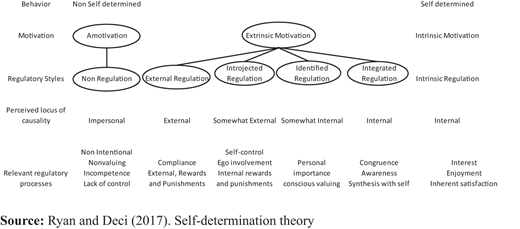
Self-determination continuum showing types of motivation with their regulatory styles, loci of causality and corresponding processes
Self-determination continuum showing types of motivation with their regulatory styles, loci of causality and corresponding processes
Insights to practitioners from self-determination theory
Meeting the basic psychological needs (Autonomy, competence and relatedness) significantly enhances motivation of employees.
Absence of needless pressure, providing wider choices to employees, structuring tasks that are optimal level of challenge and a caring work environment have empirically shown to increase intrinsic motivation of workers across industry sectors. Cognitive growth of individuals comes from intrinsic motivation, which is the most stable form of motivation.
Empathy, perspective taking, wider meaningful choice, providing justification for request, avoiding controlling language increase autonomy.
Aligning skills and challenges, providing support for capabilities building, having increasing degree of challenges with multiple stage gates for feeling a sense of success and accomplishment, providing information feedback rather than the pressure of evaluative feedback and overall task variety and significance designed to master an activity or the feeling of mastery enhances competence.
Collaborative, inclusive work environment that demonstrates feeling of warmth, respect and trust, supervisor and coworkers support where the individual feels respected and valued enhances relatedness.
Meeting the basic psychological needs also enhances overall well-being and happiness at the workplace apart from motivation and employee engagement.
Implications for the industry
Employee involvement in job design and task allocation will increase the ownership to accomplish these tasks and enhances autonomy. Providing them a few of choices in roles, feedback on specific task performed in a non-controlling, non-comparing (with others) language, taking the perspective of employees and task significance also have shown to increase the feeling of autonomy.
Optimal challenge of task, providing structure and framework for developing skills, appreciation for the task well done, designing the tasks in such a manner that there is an increasing degree of difficulty in stages enhances a sense of success and competence.
Supervisor support, a nourishing work environment where employees can feel psychologically secure, active collaborative teams, workplace that demonstrates warmth where the employees are heard and valued enhances the feelings of relatedness.
Several non-monetary levers (career development, work environment, skill building, meaningful and purposeful work, flexible work timings, etc.) have shown to increase intrinsic motivation, which is the most stable form of motivation that continues for a long time. So rewards can be restructured to include non-monetary components as well.
Increase in motivation leads to higher employee engagement which positively impacts productivity. This also leads to increase in well-being and happiness of the employees. SDT provides excellent inputs for practitioners to incorporate these insights into their HR strategy.

