


This paper aims to present a grounded and strategic discussion regarding Supply Chain 4.0 as a management system orientation for the post-COVID-19 period as well as propose some research directions thereof.
For the development of this paper, some theoretical insights were provided based on the literature related to Supply Chain and Industry 4.0. A discussion regarding the constructs of Supply Chain 4.0 on the context of the post-COVID-19 outbreak is developed as well.
The discussion, herein, shows that the disruptive technologies might play a crucial role to become supply chains more responsive and resilient to sudden events such as COVID-19. Then a Supply Chain 4.0 is a transformational strategic orientation to be considered on the aspect of supply chain management for the post-pandemic period. Some research questions are proposed at the end of this paper with the aim to further address this subject.
This paper provides timely insights for researchers and practitioners which might imply on the further research deployments and practical applications although it demands future empirical studies to validate the propositions herein presented.
Practitioners can be benefited from this paper on having new insights and a strategic direction on regards supply chain management for the post-pandemic period with focus on a technology-driven strategy for supply chains.
This paper is unique because it brings an unexplored relationship between Supply Chain 4.0 and COVID-19 pandemic. It also significantly contributes to new directions and views for the supply chain management field from these challenging and difficult times of coronavirus global outbreak.
1. Introduction
The COVID-19 pandemic has drastically affected the world not only in terms of world healthy issues but also in the business environments. Supply chains from different industry segments have strongly been challenged to avoid imminent disruptions on their flows. Haren and Simchi-Levi (2020) have claimed about the disruptions that would occur during the pandemic peak in different sectors of industry because of the severity of COVID-19 event. Many disruptions events were observed (e.g. various personal protective equipment and other supplies shortages in hospitals, empty shelves on supermarkets because of the lack of various foods and personal hygiene products and even electronic products not only in the physical channels as well as on the online shopping platforms). Kutzner and Rajal (2020) pointed out that many problems related to supply chain management, especially linked to sourcing strategies have caused significant disruptions in different supply chains. This includes, lack of management in terms of properly managing risks, adoption of single-sourcing strategies, delivery fails from suppliers and lack of transparency and visibility.
All of those occurrences are generating many lessons on regards supply chain management knowledge, which are being discussed and learned during these difficult and challenging times, encouraging both practitioners and academics to rethink how supply chains should be redesigned in terms of their strategies to be better prepared to future disruption threats. As one of these main topics of discussion, is the digital transformation of supply chains what in this paper is being nominated as Supply Chain 4.0.
COVID-19 pandemic has emerged just in the times when supply chains were being called to be transformed from the phenomenon of the Fourth Industrial Revolution. The implementation of Industry 4.0’s technologies became a strategic imperative to the supply chains with the aim to allow them better compete on the market (Kagermann et al., 2013; Porter and Heppelmann, 2014). Specifically, to the supply chain context, the disruptive technologies will play a crucial role seeking to improve the supply chain processes’ performance and then improve the strategic outcomes (Frederico et al., 2019).
The Industry 4.0 was preliminarily discussed in Germany by Hannover Fair which has been taken in place in 2011. Nowadays, Industry 4.0 subject is being largely discussed through several conferences around the world. Also, it has been part of the German and other countries’ government agenda such as in USA, French, Japan, Singapore, UK and China (Liao et al., 2017 Ghobakhloo,2018; Lu, 2017; Hofmann and Rüch, 2017; Pereira and Romero, 2017). The topic of Industry 4.0 has also been broadly discussing by researchers who have been proposed theoretical and practical insights from different subjects related to the Industry 4.0 context. Included on these, are topics such as organizational structure (Wilkesmann and Wilkesmann, 2018; Belinski et al., 2020), sustainability (Kamble et al., 2018; Jabbour et al., 2018), lean manufacturing (Sanders et al., 2016; Mrugalska and Wyrwicka, 2017), small and medium enterprises (Moeuf et al., 2017), strategic management (Lin et al., 2018) and performance measurement (Frederico et al., 2020).
Not unlike, the relations between Industry 4.0 and supply chains are also being reasonably discussed. At these works stands out Pfohl et al. (2015), Kache and Seuring (2017), Tjahjono et al. (2017), Büyüközkan and Göçer (2018) and Ghadge et al. (2020). Especially in the strategic supply chain context, Frederico et al. (2019) have proposed a conceptual strategic management and maturity framework for Supply Chains 4.0. In that sense, Wu et al. (2016) emphasizes that, besides the technical issues regarding the disruptive technologies, non-technical challenges and management issues are also important subjects to be considered on Industry 4.0 in a supply chain context.
With regards to the studies related to Industry 4.0 and resilience themes, a strong gap may be verified. On that regards there are only some few studies present in the literature (Min, 2019; Chen et al., 2019; Ivanov and Dolgui, 2020; Ralston and Blackhurst, 2020 and Dubey et al. (2020), which evidences the need for more discussions and proposals encouraging the development of this matching subjects, especially in times of COVID-19 pandemic. According to Bhamra et al. (2011), resilience can be understood from three perspectives: readiness and preparedness, response and adaption and recovery or adjustment. According to these authors, a more system approach must be taken into consideration on researches related to supply chains. Moreover, resilience on supply chains must have a strategic perspective considering the dynamic of environments. New strategies should be implemented to enhance supply chain’s resilience on an adaptative perspective (Tukamuhabwa et al., 2015). Also, organizations focused on resilience must seek for an agile adaptation and be prepared to a more proactive response. To achieve these attributes, those organizations need to have a long-term strategic orientation (Burnard et al., 2018). Van Hoek (2020) claims for the relevance in learning with the COVID-19 pandemic to improve the future decisions-making in disruption situations. Also, this author encourages for the new research deployments on supply chains because of this impacting pandemic. Following this sense and connecting with the aim of this paper, it becomes appropriate to discuss a supply chain strategy driven by disruptive technologies in the face of the COVID-19 pandemic and Industry 4.0 phenomenon. Frederico (2020a) points out that the maturity of supply chains may be enhanced by the use of Industry 4.0’s technologies collaborating to becoming supply chains more resilient at disruption situations.
Therefore, this paper brings a discussion regarding how supply chain management should consider a Supply Chain 4.0 approach to become supply chains better prepared and resilient to future and sudden events such as coronavirus global outbreak. Then, firstly the relation between Supply Chain 4.0 and resilience is presented. Second, a discussion linked to the Industry 4.0’s technologies, their applications and benefits for the post-COVID-19 period is developed. Finally, conclusions end this paper.
2. Supply Chain 4.0 and resilience
The concept of Supply Chain 4.0 has been emerged in recent years because of the Industry 4.0 phenomenon. According to Frederico et al. (2019), Supply Chain 4.0 has a management approach much more than only the implementation of disruptive technologies. On the supply chain side, the disruptive technologies play a crucial role for the expected transformation of supply chains (Tjahjono et al., 2017; Muthusami and Srinivsan, 2018; Stevens and Johnson, 2016). These main disruptive technologies of Industry 4.0 that may be adopted by supply chains include big data analytics, Internet of Things (IoT), artificial intelligence, cloud computing, blockchain, robotics, additive manufacturing and augmented reality.
Some few studies have related the subject of resilience with Industry 4.0 and especially on the supply chain context. In a search conducted through Web of Science using and combining the keywords “Industry 4.0,” “Resilience” and “Supply Chain” as well as considering these as the main subject of the articles, it was possible to identify few related studies as presented on Table 1.
Publications regarding Industry 4.0 and resilience in the supply chain context
| Authors | Journal | Aims and main findings |
|---|---|---|
| Min (2019) | Business Horizons | It presents how Blockchain technologies can improve the supply chains’ resilience. It encourages new researches linking the integrations between Blockchain technology and other disruptive technologies (e.g. cloud computing, robotics and artificial intelligence) to enhance supply chain resilience |
| Chen, Das and Ivanov (2019) | International Journal of Information Management | This study identified key factors for the post-disruption recovery of the supply chain. Amongst these, stand out mechanisms to speed up the disruption identification and initial decision-making, the implementation of information tools to enhance the technical recovery of supply chains and ways to enhance coordination, collaboration and agility as well as a supply chain redesign aiming to get a business/ operations recovery |
| Ivanov and Dolgui (2020) | Production, Planning and Control | It proposes the application of Digital Twin technology to enhance resilience of supply chains. According to this research, this kind of technology can improve attributes in terms of real-time data of disruption and end-to-end visibility, facilitating the predictive and reactive decision-making and collaborating for the supply chain processes’ continuity |
| Ralston and Blackhurst (2020) | International Journal of Production Research | It studies if the smart systems and autonomous processes of Industry 4.0 are capable to generate more resilience, reconfiguring and adapting supply chains to the unexpected events and disruptions. According to the findings, companies which are using smart technologies are experimenting improvements on the performance and resilience of their supply chains. These authors have identified that autonomous processes are true capability enhancers to the supply chain resilience |
| Dubey et al. (2020) | International Journal of Production Research | It approaches the Blockchain technology for the humanitarian supply chains as the way to enhance swift-trust, collaboration and resilience. Findings from a survey research shows that Blockchain can improve collaboration and swift-trust in supply chains being able to get a relief on operations amid disaster situations |
In a Supply Chain 4.0 context, disruptive technologies play a central role on the improvement of supply processes which may enhance the capacity of supply chains’ response. In an implementation of a Supply Chain 4.0’s strategy, four constructs should be taken into consideration. They are: managerial and capabilities supporters, technology levers, supply chain processes’ performance requirements and strategic outcomes. Although, the technology levers (i.e. disruptive technologies) play the most crucial role in a Supply Chain 4.0’s initiative, issues related to people, IT infrastructure, leadership, coordination and project management and strategic orientation are the scaffolding to get a successful technology levers implementation and then obtain their benefits. In that way, supply chain processes’ performance requirements might be improved in terms of transparency, efficiency, flexibility, responsiveness, collaboration and process measurement (Frederico et al., 2019). The breakthrough improvement of these performance attributes becomes paramount with the aim to create a more responsive supply chain, leaving it better prepared to perform during unexpected occurrences.
With focus on the technology levers of the Supply Chain 4.0, in Section 3, a more detailed discussion on how disruptive technologies could benefit supply chains in terms of response capacity to the unexpected events such as COVID-19 pandemic is developed.
3. Supply chain 4.0 on the post-COVID-19 pandemic
As aforementioned, the implementation of disruptive technologies is essential with the purpose to achieve a more responsive and resilient supply chain. After this historic pandemic, supply chain management should devote more time and strategic orientation on the search for a more technology-driven supply chain’s processes.
The main supply chain’s strategies which are search with the implementation of a Supply Chain 4.0 program from some practical cases are related to real time data and transparency for a better demand management, enhancement of collaboration with suppliers and retailers and customization of the supply chain to meet business requirements (Hitachi Group, 2020). Also, Supply Chain 4.0 aims to generate a faster, more flexible, customized, accurate and more efficient supply chain (Mckinsey, 2016). Those strategies may directly impact on the supply chain resilience, creating more robustness amid emergency, sudden and high magnitude events such as coronavirus occurrence.
There is a consensus regarding the improvements that the disruptive technologies bring to the performance of the supply chains. On this respect, some researches have been conducted presenting the benefits and impacts of disruptive technologies on supply chains. Some studies which stand out are related to big data analytics (Queiroz and Telles, 2018; Wamba et al., 2015; Gunasekaran et al., 2017; Hazen et al., 2016), IoT (Gunasekaran et al., 2016; Mishra et al., 2016; Ben-Dayaa et al., 2019), additive manufacturing (Durach et al., 2017; Luomaranta and Martinsuo, 2019), artificial intelligence (Min, 2010), cloud computing (Jede and Teuteberg, 2015), blockchain (Gurtu and Johny, 2019; Durach et al., 2020) and robotics (Fitzgerald and Quasney, 2017).
Especially on the context of COVID-19 pandemic, a global survey report showed how important are disruptive technologies for the better response of supply chains. The majority of experts, according to the percentage of responses, from different regions of world with different backgrounds have agreed or strongly agreed that the disruptive technologies such as big data analytics (86 %), IoT (78.7%), cloud computing (82.7%), robotics (73.3%), additive manufacturing (59.3%) and blockchain (60.1%) positively impacts supply chain’s processes and then on the capacity of the supply chain response (Frederico, 2020b).
Then, considering the aspect of COVID-19, the discussion regarding on how each disruptive technology affects the performance attributes of the supply chain’s processes and then enhances the supply chain response is developed on the sequence.
3.1 Disruptive technologies and their benefits
The IoT with the use of sensors, actuators and other devices is one of the key technologies to promote a true cyber-physical supply chain. Aligned with other technologies such as cloud computing, artificial intelligence and robotics, supply chains processes may be self-executed and controlled. For instance, on the upstream supply chain flow, suppliers become more responsive to the demand changes allowing a better inventory coverage. This is possible because of the faster, transparent and more visible supply chain data and information available on a cloud platform. Factories may also respond faster with this real time visibility of information or even automatically receive an order from a cloud platform to manufacture goods. This information may act jointly with IoT, robotics and artificial intelligence to smartly manufacture products. Yet, additive manufacturing also might be considered with the aim to increase flexibility of production, producing on a mass-customized way and then increasing responsiveness and efficiency of the supply chains. Also, on the factory environment, augmented reality, plays an important role with the aim to provide better visibility to the process, improving the proactiveness, assertively solving problems of machines and process and then reducing downtimes and setup times.
Benefits occurs for the downstream supply chain’s flow as well. The demand from dealers and end customers can be transmitted directly to the distribution centers and retailers and with the use of cloud computing, IoT, artificial intelligence and robotics might also generate self-executed processes of handling at distribution centers (e.g. receiving, picking, put-away, dispatching). This may provide significant improvements on the efficiency and responsiveness of the delivery supply chain process. Deliveries may also be benefited from blockchain technology. Transparency, traceability and security are attributes which generates a more reliable and responsive supply chain.
With all of those technologies embedded in the supply chains a large amount of data is generated. Then, big data analytics plays a strategic role on getting data from all those technologies and transforming them in information and on sequence in knowledge. On this aspect, big data analytics may be a true competitive advantage element to provide true knowledge-based supply chain, allowing more rapid and assertive decision-making by supply chain managers in the face of the imminent disruption event.
Important to emphasize that all of those technologies afore discussed must be interoperable one each other. Interoperability (i.e. the capacity of communication and integration between technologies) is an essential requirement to the effectiveness of the technology levers operating. Also, besides technical aspects of the implementation of these disruptive technologies, as already previously discussed, supply chain management should pay attention for the managerial and capabilities issues aiming to succeed on the Supply Chain 4.0’s strategy implementation. Supply Chain leadership should also align the suitable technology according to each supply chain’s process requirements to get the expected improvement on its performance attributes.
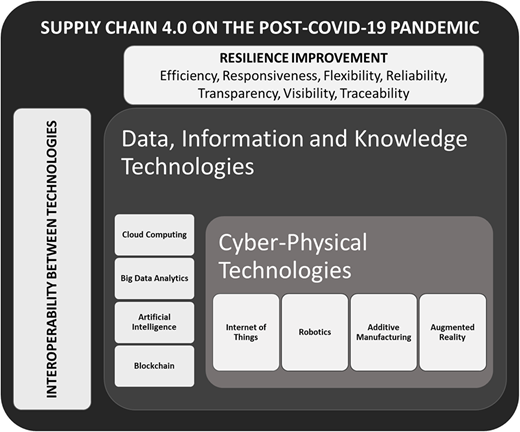
Figure 1 illustrates the summary regarding what has been discussed at this paper. As a proposal for the post-COVID-19 pandemic, supply chains should consider a strategy driven by disruptive technologies to be better prepared and resilient to the emergency situations such as created by coronavirus pandemic. According to the Figure 1, there is a set of disruptive technologies that are based on data, information and knowledge (cloud computing, big data analytics, artificial intelligence and blockchain). These technologies manipulate data, generate and use information and knowledge with the aim to allow a self-executed and controlled supply chain processes by the called cyber-physical technologies (IoT, robotics, additive manufacturing and augmented reality). All these technologies must be interoperable to create a true Supply Chain 4.0. These technologies generate improvements on the performance attributes such as efficiency, responsiveness, flexibility, reliability, transparency, visibility and traceability. Therefore, supply chain resilience is improved as those performance attributes are enhanced by disruptive technologies.
4. Conclusions
Because of the COVID-19 disease pandemic, supply chains are facing their most tough times which has never seen before. Supply chain management needs to be rethought in terms of its strategic approaches on seeking for a better robustness against sudden events. In this context, Supply Chain 4.0 approach becomes timely and appropriate strategy to be considered.
This paper brought an important discussion related to how Supply Chain 4.0 may collaborate to become supply chains more responsive and resilient. In particular, the technology levers which actually are the technologies of Industry 4.0 were presented and discussed on regards in which supply chain process they can be applied and what performance attributes may be improved by them.
The contribution of this paper is on providing theoretical and practical insights related to Supply Chain 4.0 and in particular for its application on the post-pandemic period. Moreover, it aims to encourage supply chain’s leadership to rethink their supply management on the sense to create a supply chain strategy driven by disruptive technologies on the aim to improve the performance of supply chain processes and then achieve more resilience and responsiveness should future disruption events occur. Also, this paper motivates researchers on the new deployments regarding Supply Chain 4.0 and how it can impact supply chains in the emergency situations similar to COVID-19 outbreak.
In that sense, with the aims to deep understand the phenomenon of Industry 4.0 amid the COVID-19 context and obtain evidences about the impacts of disruptive technologies on the improvement of supply chains’ response to the unexpected and impacting events, some research directions are proposed as follows. Empirical studies such as surveys and case studies may be designed to answer the following questions:
How companies with a Supply Chain 4.0–driven strategy has performed amid the COVID-19 pandemic? What are the lessons learned from these organizations?
How disruptive technologies impact on the responsiveness and resilience of the supply chains amid the potential disruption events such as COVID-19 outbreak?
What are the most impacting disruptive technologies that creates a more responsive and resilient supply chain to the emergency situations such as coronavirus outbreak?
What is the impact of big data analytics on creating knowledge that improves the decision-making by supply chains’ practitioners in unexpected and disruption events?
What is the impact of the IoT, cloud computing, artificial intelligence, additive manufacturing, robotics and augmented reality and their integration on the improvement of supply chain processes’ performance amid the changes occurred by an impacting and sudden event such as COVID-19 pandemic?
What is the influence of blockchain technology and its improvement on traceability and security to the supply chain’s responsiveness amid events of COVID-19 magnitude?
Although the research questions afore proposed are not limited to, they provide a good guidance for researches who are interested to investigate Industry 4.0’s technologies and their relations with supply chains’ responsiveness and resilience considering the context of COVID-19.
The author would like to thank the Editor of RAMJ as well as the reviewers who have provided valuable comments to improve the paper. Also, his acknowledgements to Emerald Team for the final formatting and editing services in the paper.

