


Kerala is one of India's most advanced states in human development and other social indices. This study aims to look at the management education scenario in Kerala from a macro-perspective and examines the existing trends, major issues and present challenges facing the sector.
The study is driven by previously unexplored secondary data published by India's apex technical education regulator–All India Council for Technical Education (AICTE). Qualitative and quantitative assessments are assimilated from the organization, dissection and categorization of unit-level data.
Business schools (B-schools) in the state are facing acute distress in enrolments. There are intra-regional variations in institution count and occupancy rates. The vast majority of the institutions have no accreditation at all. The entire sector is facing a protracted decline.
The study has relied primarily on descriptive statistics considering a single discipline within the higher education sector in Kerala. Future studies should look at other disciplines (engineering, medicine) simultaneously. Use of statistical methods like panel data regression would be beneficial to find hidden trends in cross-sectional and longitudinal time-series data.
Management education in Kerala is facing an existential crisis. This has implications for the state's economic development. The paper creates strong imperatives for government policymaking to forestall the complete decline of the sector.
A highly literate state with advanced human development indices need not be a suitable location for building a knowledge-based economy. Government policy has strong implications for the development and sustenance of higher education. The relationship between government and business schools are symbiotic.
The paper maps the progression of B-schools from local to global. A typology of privately funded B-schools is proposed. The conceptual framework advanced in this study can contribute to further literature development. The suggested policy initiatives are applicable not only to Kerala but also to other tightly regulated markets.
1. Introduction
At the present time, India boasts a network of the world's second largest higher education system by numbers behind China (Express News Service, 2020). However, in the field of management education, India stands first globally in terms of number of institutions, surpassing the tally of the USA in the second decade of the millennium (C.S-W, 2016). Business schools’ (hereinafter, B-school) growth since India's economic liberalization in 1991 has been phenomenal (Jagadeesh, 2000). In the 20 years following 2000, the growth in India has been described as “mushrooming” on account of the incredible speed of establishment and commencement of operations (IANS, 2019). While the commercial proliferation of B-schools has been observed with concern (Philip, 2012), B-school education provides benefits both to graduates as well as corporates. Management graduates can contribute to human capital, namely, scholastic capital, social capital, cultural capital and market value capital (Baruch, 2009). Crucially, it supplies a competent and enterprising workforce for managerial and leadership positions in government and industry (Baruch, 2009).
Kerala is a tropical southern state sharing a significant maritime boundary with the Arabian Sea. Historically, the state has been a centre for trade and links as far as 3000 BC due to its bountiful production of spices, with the first European settlers landing on its shores in AD 1498 (Kerala Tourism Newsletter, 2010). In modern times, Kerala is a state of many firsts in India, boasting the highest levels of literacy (PTI, 2020), human development index (HDI) (Suryanarayana and Agrawal, 2013) and average life expectancy (ANI, 2020). It also has India's highest sex ratio (Express News Service, 2019), lowest population growth (Govind, 2021), least levels of impoverishment (World Bank Group, 2017) and the second highest rate of urbanization (GOI, 2021). In 2020, the state topped the national list in achieving the UN's Sustainable Development Goals (SDGs) (GOI, 2020). It also holds the first place with the highest levels of media exposure anywhere in India among both sexes (GOI, 2018).
In 2020, there were 3083 B-schools across the country with Kerala being home to an insignificant 83 (2.6%). Kerala's B-school count languishes behind a backward state like Odisha (97), while significantly behind all its neighbours Tamilnadu (350), Karnataka (250), Andhra Pradesh (335) and Telangana (320) (AICTE, 2020). Reports by Government agencies have emphasized the need for quality management professionals in diverse sectors such as education, healthcare, local government, cooperative societies and civil society (NKC, 2009). The state's poor count in B-schools which is in stark contrast with the prevailing national scenario merits an investigation to identify the underlying factors, especially considering Kerala's advanced position in various national indicators over time.
Kerala has long been in the international limelight for its achievements in education and human development (Express Web Desk, 2016). Dubbed “the Kerala model” for its commendable strides in literacy, near-universal elementary education, gender parity, social and human development indices, it has been likened to an oasis of development in a desert of underachievement (Parayil, 1996). Tornquist (2000) had described Kerala as the “Scandinavia of the third world”. The Kerala model has been well investigated in literature. However, it has also had its fair share of critics (Shah, 2010). Studies have shown the absence of human development indicators translating into economic gains (Tharamangalam, 1998), and Kerala's relatively poorer per-capita income when compared to the national average (Franke and Chasin, 1997). It has prompted one Western scientist to call the state as “a mystery inside a riddle inside an enigma” (Wallich, 1995).
At the present time, Kerala has the only communist-ruled government in India. The influence of communist ideology in resisting private-sector driven expansion of higher education in Kerala has been observed in academic literature (Mathew, 2019). Simultaneously across India, prominent academics have decried the “vulgar commercialization” of education through self-financing educational institutions, and its consequent loss of “public good” character (Tilak, 2020). The need for badly and urgently needed reforms in the higher education sector has also been suggested time and again, both within academia and political circles (Navani, 2020). However, Government intervention in higher education has largely differed from state-to-state because education is in the concurrent list in India's constitution. In Kerala's case, particularly in respect of management education, regulatory intervention in recent years have been very focused and strong and backed up by the state judiciary (TNN, 2017). Signals in this direction include the Justice J.M. James Committee and the establishment of Admission Regulatory Committee (ARC) and Fee Regulatory Committee (FRC) (James, 2015). This was followed up by the Justice Rajendra Babu Committee that continues to remain in force until the present day (Deccan Chronicle, 2016). Judicial intervention from 2016 had resulted in a strict set of systems and processes to be followed in the matters of conduct of examinations, cut-off scores in qualifying test, primacy of meritocracy, publication of prospectus, admission approval, fee approval and so on, exercised via directives from the Admission Supervisory/Fee Regulatory Committee for professional colleges. This has until now been unique and exclusive only to Kerala. The government with the court's backing continues to exercise significant power and influence, bringing the entire umbrella of self-financing institutions under its control (Correspondent, 2020). Attempts to relinquish power and state intervention until now has not manifested under the ruling Left Democratic Front (LDF) regime which is yoked with communist ideology (Thomas, 2016; Kumar, 2018; Vidhyadharan, 2020). The state of the B-school ecosystem in this tightly regulated market has not been examined until now. This is what the paper aims to explore by fact-finding.
In light of the above, the study attempts to gauge the current state of management education sector in Kerala. The paper will identify all the major issues and challenges facing B-schools in the state. Thereafter, the study will attempt to provide a remedial framework to augment the B-school ecosystem, first by crafting a generic B-school roadmap towards globalization, followed by a typology for B-schools and proposed strategic orientations, along with a theoretical framework for public-private partnership. The paper concludes with suggestions for future course of action and policymaking to revive the battered sector.
2. Review of literature
2.1 Higher education and economic development
Higher education is closely linked to economic development. In the international context, studies by Schofer and Mayer (2005) have shown that human capital is necessary for economic progress and that growth in higher education is more rapid where state control is less, and in regions which have strong global connections. Meulemeester and Rochat (1995) demonstrated that efforts in higher education pursued as part of government policy had a significant economic impact on countries like Britain, France, Sweden and Japan. A study by Tin-Chun Lin (2004) in the Taiwanese context showed how education in engineering and natural sciences contributed significantly to Taiwan's economic development. Lazzeretti and Tavoletti's study (2005) in the Dutch context showed that higher educational institutes can engage economically with the local community and suggest that they are especially important to development of backward areas in which they are located. This was mirrored in a similar study by Shaw and Allison (1999) in the Australian context where a conceptual framework is developed to link regional educational clusters to local economic activities. Kruss et al. (2015) discuss how higher education contributes to economic development through skilling, job creation, innovation and production in the South African context. Their study crucially finds that the education–economy relationship has implications at global, local, sector-based and spatial levels. Drucker's (2015) study in the American context showed that there are specific regional impacts which are spatially observed due to the presence of higher educational institutions and also discovered that advanced education is strongly linked to entrepreneurship activities.
2.2 Nexus between B-schools and development
Reports by accreditation organizations such as the Association to Advance Collegiate Schools of Business (AACSB) in (2005) suggest that the contribution of management education to developing societies is highly pertinent, with specific benefits accruing to the students, recruiting organizations as well as socio-economic development of the region. The World Economic Forum assesses the competitive performance of economies in its Global Competitiveness Index by the quality of B-schools (Global Competitiveness Report, 2012/2013), allowing inferences to be made on the importance of management education. Napier et al. (2008) go so far as to suggest that in countries where poverty is high, social and economic development may be accelerated by management education.
2.3 Importance of B-schools for development in India
A macro-level study in the Indian context highlighted the high correlation between industrialization and management institution counts in various states, leading to important conclusions about the trends for growth and spread of management institutes in the country (Khatun and Dar, 2019). A number of recent studies has shown the importance of higher education for building the country's human resources, as well as for economic progress, social upliftment and scientific progress (Chauhan and Pillai, 2013; Sahney, 2016; Yeravdekar and Behl, 2017). Mahajan et al. (2016) particularly emphasize the importance of management education for a developing economy such as India. Sridevi's (2020) study in the Indian context concludes that Master of Business Administration (MBA) graduates will provide qualitative inputs to industries and help build the global economy. Rana et al. (2020) show that strategizing of B-schools in India is necessary, as graduates become business practitioners who are imperative for social and economic development. These studies gain importance against the backdrop of the university affiliated higher education system in India which has been implicated for not helping build competency aspects of quality in teaching, service and merit (Gupta and Gollakota, 2005). Significantly, a number of studies highlight that quality is the biggest impediment for B-schools in India (Jagadeesh, 2000; Mulla, 2007; Mitra Debnath and Shankar, 2009; Gambhir et al., 2016).
2.4 Development of the education sector in Kerala
The history of education development in Kerala significantly predates India's independence. Education reform in its modern form has its roots traced back to Christian missionary activities and the Church, both of whom have substantial contributions all over colonial India (Toppo, 2007). The contributions of Sree Narayana Guru, a pioneering social reformer who brought a multitude of disparate backward castes under the umbrella of the Ezhava category is also significant (Chandramohan, 1987). The contribution of Christian missionary organizations under the Roman Catholic community is particularly noteworthy. Kerala has a considerable number of educational institutions run by various congregations such as Carmelites, Vincentians and Dominicans among others, as well as diocesan authorities. The Catholic institutions which are spread all over the state across the entire spectrum of education are a force to be reckoned with (Jose, 2015).
At present, the number of government institutions in higher education is very small in comparison to private players. Educational initiatives in schools as well as colleges have historically been advanced by certain communities in the state. Prominent among them are the Christian community (comprising of Roman Catholic as well as protestant institutions), Muslim Educational Society (MES) and other Muslim Associations, the backward Ezhava community led by Sree Narayana Dharma Paripalana Yogam (SNDPY) and the Nair Service Society (NSS) comprising of forward-caste Hindu blocs.
2.5 Kerala's policy towards higher education
Kerala was a late entrant into the academic arena of management education. Literature that traces the history of management education in Kerala is sparse (Pylee, 1967). The sole effort made in this direction is by Mavoothu (2006). The work is updated to the contemporaneous context in the Appendix. Kerala boasts an incredible record of literacy and holds the distinction of being “the most advanced state in India in terms of education” (Agarwal, 2012). However, the state has been described as overly cautious in allowing a free rein to higher-education expansion driven by private investment (Mathew, 2019). In massification of higher education and development, Kerala is far behind other states like Maharashtra, Karnataka, Andhra Pradesh and Tamilnadu (Agarwal, 2012) which have got a head start due to their earlier adoption of privatization (Agarwal, 2009). Kerala has been insular in allowing such growth, with attention drawn to the state's reluctance in internationalization, permitting research and academic collaboration with foreign institutions and also allowing an influx of foreign students into the state (Belousova, 2019). Some have criticized this policy as “peculiar” and “apathetic” (Belousova, 2019), while others have been largely supporting of Kerala's government policy, advancing that government resistance is necessary for ensuring social and regional equity, and to ensure that the sector is not commercialized to the detriment of the public welfare (Mathew, 2019). Kerala until the present day continues to resist the establishment of private universities in the state, even as Karnataka has over 30 universities (19 state private universities and 11 deemed universities), adding to the 31 public universities in the state (Ullas, 2020).
The year 2001 was the watershed year for higher education in Kerala, when the then United Democratic Front (UDF) led coalition Government comprising of non-communist parties began issuing “no objection certificates” for setting up unaided private colleges (TOI, 2001; TNN, 2001). In the years that followed, this led to a huge explosion of institutions in the technical streams, including engineering, management and medicine (Centre for Development Studies, 2006). Subsequent governments have become embroiled in protracted and noisy legal battles with associations of private colleges in the state over various issues such as fees, merit quota, collection of donation, etc. (Mohandas, 2016). David's (2014) comparative study provides a contextual relevance, by comparing Kerala and Tamilnadu governments' divergent policies of economic globalization and their higher education system. The study notes that Kerala's resistance to privatization had led to a mass exodus of students towards neighbouring states due to issues of accessibility.
3. Data and analysis
Unit-level data has been drawn from the online database of India's apex technical education regulator, the All India Council for Technical Education (AICTE) for the years 2014–2020 for Kerala. The populated fields consist of the AICTE Institute ID, institute name, address, district, classification by ownership/funding, minority status, affiliating university, intake and enrolment. Year-wise panel data are created and analysed using pivot tables and charts. Only descriptive statistics is used in the analysis. Aggregated data are then compared across the years for trend analysis. Wherever inexplicable peculiarities are observed, qualitative inputs were obtained from reputed academic sources through unstructured interviews. The quoted interviewees are cited with informed consent. Customizable aggregate data are also assimilated from the AICTE dashboard for Kerala. Supplementary data are utilized from metadata at the All India Survey on Higher Education (AISHE) from 2012 to 2019. Supporting data from accreditation agencies such as Association of Indian Universities (AIU), National Accreditation and Assessment Council (NAAC) and National Board of Accreditation (NBA) is used for further exploration in applicable institutions.
4. Investigation
Beginning 2002, there has been a significant growth in the establishment of new private management institutes in the state. Growth in the state over the post-liberalization period is summarized in Table 1. The steepest increase is seen in the decade from 2001 to 2010 where almost 56 new institutions were added. The list contains only institutes listed in the AICTE website and does not include institutions like IIM-Kozhikode, NIT-Calicut School of Management Studies and the 8 campuses of UIM and IMK. The list also does not include the MBA programme offered under Kerala University of Fisheries and Ocean Studies (KUFOS), School of Management Studies (SMS) Cochin University of Science and Technology (CUSAT), Kerala Agricultural University and other university departments.
Growth of management educational institutions in Kerala from 1990 to 2012
| Period | Number of institutions established | Total number of institutions |
|---|---|---|
| Until 1990 | 4 | 4 |
| 1991–1995 | 4 | 8 |
| 1996–2000 | 2 | 10 |
| 2001–2005 | 28 | 38 |
| 2006–2010 | 28 | 66 |
| 2010–2012 | 9 | 75 |
Source(s): Authors' estimations from AICTE, AISHE directory of institutions (AISHE, 2020)
4.1 Trends in management education
Data compiled from 2012 to 2013 to 2020–2021 (Table 2) suggests that the number of management institutes in Kerala has reached a plateau after a steep rise in the previous decade. A few institutes have also shut down during this same period. While MBA courses have also shut down, the bigger casualty seems to be Post-graduate Diploma in Management (PGDM) courses. Table 2 indicates a list of institutions which have been closed down or discontinued over the past decade. The list also includes some well reputed names of institutions that have made their mark over the years. Explaining this predicament, Dr. Jyothi P.T [1], a campus placement expert said:
Growth of management educational institutions and closed institutes/courses in Kerala from 2012 to 2021
| Growth of management educational institutions in Kerala from 2012 to 2020 | |||
|---|---|---|---|
| Year | New Institutions | Closed Institutions | Total Institutions |
| 2012–2013 | 3 | 0 | 76 |
| 2013–2014 | 3 | 0 | 81 |
| 2014–2015 | 2 | 0 | 81 |
| 2015–2016 | 3 | 1 | 83 |
| 2016–2017 | 4 | 3 | 84 |
| 2017–2018 | 0 | 0 | 84 |
| 2018–2019 | 0 | 0 | 81 |
| 2019–2020 | 2 | 0 | 82 |
| 2020–2021 | 2 | 1 | 83 |
| Closed management courses during the period 2012 to 2020 | |||
|---|---|---|---|
| Year | Name of Institute | Programme | District |
| 2012–2013 | Bhavans Royal Institute of Management | PGDM | Ernakulam |
| 2014–2015 | TKM Institute of Management | PGDM | Kollam |
| 2018–2019 | SCMS Cochin School of Business | PGDM (Retail Management) | Ernakulam |
| 2019–2020 | SCMS Cochin School of Business | PGDM (Retail Management) | Ernakulam |
| 2020–2021 | Vedavyasa Institute of Technology | MBA | Malappuram |
| Closed management institutes during the period 2012 to 2020 | |||
|---|---|---|---|
| Year | Name of Institute | Programme | District |
| 2016–2017 | Cardinal Cleemis School of Management Studies | PGDM | Thiruvananthapuram |
| DC School of Management and Technology Media School | PGDM | Thiruvananthapuram | |
| Sankar Institute of Science Technology and Management | MBA | Kollam | |
| 2020–2021 | Institute of Management and Technology | MBA | Thrissur |
Source(s): www.aicte-India.org
“PGDM programmes found few takers in the state despite their industry orientation and higher academic rigour (when compared to MBA courses) due to their inadmissibility in public sector jobs. In Kerala, jobs in Kerala PSU, Public Sector Banks and other government institutions are a big draw. PGDM does not allow students to apply into the management cadre, as it is only a diploma. Only if equivalence is granted by a body like AIU (Association of Indian Universities) are the PGDM programmes considered equivalent to MBA. This is easier said than done. Typically, it takes a few years for any PGDM offering to establish its credibility and reputation before being awarded equivalence. This puts PGDM programmes at high risk in their initial years in admitting student aspirants. This could be a possible reason why so many PGDM offerings in Kerala never took off”.
An examination of court proceedings showed that there were two instances where PGDM students of Kerala were denied final selection in public sector jobs because their diploma was not considered equivalent to an MBA degree [2]. The courts ultimately ruled in favour of the students because their diplomas had equivalence accorded by the AIU. Based on the latest published data by AIU, only two institutions in Kerala offering PGDM programmes have equivalence to MBA (AIU, 2019). The rest do not have equivalence.
When queried about why there is a mismatch in the total institution tally (Table 2) when new institutes were opening every year (and fewer closures), Capt. George Kuriyan [3], a retired academician and a former high-ranking government official explained it like this: “Closing an educational institute by procedure is far more difficult and cumbersome than opening a new institution. The process involves huge investments in time, effort and money. So many institutes do not formally apply for closure of their courses or institutes. They simply stop applying for fresh yearly approvals for student intake from the AICTE. This is why the total institute tally does not increase, and in some years, are found to decrease”. This sentiment was also echoed by the Principal of a management education institution in Kollam under Kerala University which closed down in 2016–2017. “The closure was a traumatic experience for me and my management. We stopped admitting students after 2014, but the closure process took 2 years and endless paperwork. The whole experience was disconcerting.”
Besides the above, data from the AICTE showed several other institutes which had received sanction for PGDM courses, but did not appear to have filled the seats (Refer aggregates in Table 5). There appears to have been a consolidation of PGDM courses in Kerala, with only 5 PGDM courses and 1 post-graduate certificate course offered in 2019–2020. As mentioned earlier, only two have AIU equivalence. Notably, during the period 2010–2019, several prominent PGDM programmes had closed down or were discontinued. Others have stopped applying for fresh approvals without formally closing down as per norms. One PGDM institute converted its management programme into MBA, affiliating its programme under CUSAT.
Approved courses and institutes which have not admitted even a single student and count of institutions which have low levels of admittance
| Approved courses and institutes which have not admitted even a single student | ||||||||||||||
|---|---|---|---|---|---|---|---|---|---|---|---|---|---|---|
| Details | 2014–2015 | 2015–2016 | 2016–2017 | 2017–2018 | 2018–2019 | 2019–2020 | 2020–2021 | |||||||
| PGDM | MBA | PGDM | MBA | PGDM | MBA | PGDM | MBA | PGDM | MBA | PGDM | MBA | PGDM | MBA | |
| Courses | 4 | 0 | 4 | 0 | 2 | 1 | 2 | 0 | 1 | 0 | 2 | 0 | 2 | 0 |
| Institutes | 0 | 3 | 2 | 4 | 0 | 7 | 0 | 5 | 0 | 6 | 1 | 7 | 2 | 0 |
| Distribution of institution count which have low levels of student admittance | |||||||
|---|---|---|---|---|---|---|---|
| Percentage of Intake | 2014–2015 | 2015–2016 | 2016–2017 | 2017–2018 | 2018–2019 | 2019–2020 | 2020–2021 |
| Less than 30% | 14 | 6 | 19 | 17 | 11 | 17 | 8 |
| More than 30% and less than 50% | 11 | 14 | 19 | 20 | 19 | 13 | 10 |
| More than 50% and less than 80% | 22 | 26 | 23 | 20 | 17 | 23 | 22 |
Source(s): Authors' estimations from AICTE website (2014–2021)
Prof. Ramachandra Poduval [4], a highly acclaimed academician and doyen of management education in Kerala explained it like this: “MBA is seen as less risky than PGDM because the degree is granted by a University, and is not so dependent on the reputation of single college or institute. Also, MBA Degrees have near global acceptance, which favours students from Kerala who harbour desires to seek employment in the Arabian Gulf.”
With the establishment of the newly formed APJ Abdul Kalam Technological University (Previously known as Kerala Technological University or KTU), many colleges earlier affiliated with the Big-4 universities of Kerala (University of Kerala, MG University, CUSAT, Calicut University) also moved to the newly established university. Part of the reason was the core technical focus of the university, and also its ramped-up curriculum and updated syllabus which follows the trimester system similar to Indian Institutes of Management (IIMs) and PGDM offerings with a higher number of subjects and electives. Figures 1 and 2 trace this evolution in two time-periods of 2014 (prior to the establishment of KTU) and in 2019–2020. The numbers of institutions which have moved to the new university from earlier university are also listed in Table 3. As of 2020, the highest number of management institutions in Kerala is now affiliated with APJ Abdul Kalam Technological University (See Figure 2).
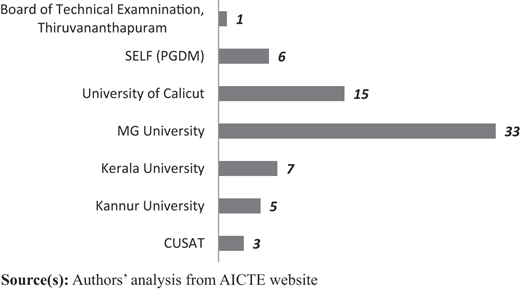
Distribution of management institutes in Kerala by affiliating body in 2014–2015
Distribution of management institutes in Kerala by affiliating body in 2014–2015
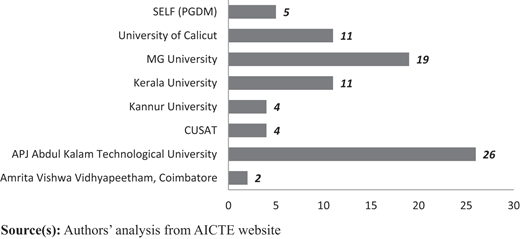
Distribution of management institutes in Kerala by affiliating body in 2019–2020
Distribution of management institutes in Kerala by affiliating body in 2019–2020
Number of management educational institutes moving to KTU
| Year | Transition to KTU or APJ Abdul Kalam Technological University | |
|---|---|---|
| From | Number of institutions | |
| 2015–2016 | CUSAT | 2 |
| Kerala University | 5 | |
| MG University | 12 | |
| University of Calicut | 5 | |
| 2018–2019 | Kerala University | 1 |
Source(s): Authors' analysis from AICTE website (2014–2020)
It is observable that within a year of its establishment, APJ Abdul Kalam Technological University had displaced MG University with the most management institutions affiliated to it. The departure of a large number of colleges from MG University was telling, as could be seen from Table 3. A report published by the Comptroller and Auditor General (CAG) of India in 2017 specifically highlighted issues with the MBA degrees offered by MG University, flagging the large number of unrecognized off-campus centres which offered MBA degrees without proper AICTE approval. Furthermore, the report specifically highlighted that 3 of every 4 MBA degrees awarded from 2011–2012 through 2015–2016 (A total of 4,735 out of 6,303 MBA degrees) were through these unrecognized off-campus centres (CAG, 2017; Deccan Chronicle, 2017). The incidences of identical degrees offered by off-campus centres at par with regular MBA degrees obtained from recognized institutions of the university may have contributed to the erosion of value associated with MBA from MG University.
Notably, the establishment of APJ Abdul Kalam Technological University also helped break the regional hegemony of Kerala's Universities (Mathew, 2019). In the earlier system, universities had jurisdiction in districts or portion of districts in its proximity. However, the latest data from the AICTE shows that management institutions from as many as seven districts have sought affiliation under APJ Abdul Kalam Technological University, breaking the erstwhile trend of affiliating with the university closest to its geographical location. Institutions as far north as Malappuram are now affiliated to the new university. As of 2021, it could be seen that this trend is also applicable to CUSAT, with management educational institutions as far as Thiruvananthapuram and Kannur being affiliated to it.
4.2 Issues in management education in Kerala
Examining Table 4 suggests that enrolments in backward Northern Kerala is the lowest among the regions, with the years 2016–2017 and 2017–2018 showing a precipitous decline. Enrolment numbers are poor for 2020–2021 in this region as well, though the gross enrolment is marginally higher. Absolute enrolment numbers in Northern Kerala are poor. In general however, occupancy across entire Kerala state is poor. During the period 2014–2015 to 2019–2020, the total number of seats has reduced in every single district in Northern Kerala with the overall region intake declining by 27%. Enrolment percentages in Central and Southern Kerala fare only marginally better, though intake is much higher. A geographical spread of institution count indicates skewness towards central and southern Kerala with fewer institutions in the Malabar region. These are shown as well in Table 4 for the year 2019–2020 suggesting that B-schools are more prevalent in developed and commercial regions of the state.
Distribution of B-school count across Kerala (2019–2020) and spread of intake-enrolment numbers across various districts/regions
| Region and district | No. of institutes (2019–2020) | 2014–2015 | 2015–2016 | 2016–2017 | 2017–2018 | 2018–2019 | 2019–2020 | 2020–2021 | ||||||||
|---|---|---|---|---|---|---|---|---|---|---|---|---|---|---|---|---|
| I | E | I | E | I | E | I | E | I | E | I | E | I | E | |||
| North Kerala | Malappuram | 4 | 300 | 80 | 360 | 149 | 360 | 94 | 360 | 124 | 240 | 125 | 225 | 83 | 360 | 109 |
| Kozhikode | 3 | 300 | 176 | 300 | 195 | 300 | 128 | 300 | 119 | 240 | 145 | 240 | 153 | 420 | 74 | |
| Kannur | 3 | 300 | 206 | 300 | 179 | 300 | 139 | 270 | 96 | 210 | 125 | 210 | 118 | 270 | 201 | |
| Kasaragod | 1 | 120 | 73 | 120 | 55 | 120 | 35 | 120 | 20 | 60 | 27 | 60 | 35 | 60 | 33 | |
| Total intake/ enrollment | 1,020 | 535 | 1,080 | 578 | 1,080 | 396 | 1,050 | 359 | 750 | 422 | 735 | 389 | 1,110 | 417 | ||
| Occupancy rate | 52.45% | 53.52% | 36.67% | 34.19% | 56.27% | 52.93% | 37.57% | |||||||||
| Region total/share | 11 (13.41%) | |||||||||||||||
| Central Kerala | Palakkad | 5 | 486 | 348 | 540 | 220 | 540 | 292 | 540 | 188 | 540 | 253 | 510 | 220 | 450 | 280 |
| Thrissur | 7 | 540 | 328 | 600 | 384 | 660 | 268 | 660 | 288 | 780 | 300 | 840 | 252 | 600 | 400 | |
| Ernakulam | 25 | 2,730 | 1769 | 2,640 | 1708 | 2,628 | 1,356 | 2,520 | 1,500 | 2,340 | 1717 | 2,520 | 1,597 | 2,460 | 1763 | |
| Idukki | 3 | 420 | 225 | 480 | 243 | 300 | 213 | 360 | 215 | 360 | 281 | 360 | 239 | 420 | 375 | |
| Total intake/ enrollment | 4,176 | 2,670 | 4,260 | 2,555 | 4,128 | 2,129 | 4,080 | 2,191 | 4,020 | 2,551 | 4,230 | 2,308 | 3,930 | 2,818 | ||
| Occupancy Rate | 63.94% | 59.98% | 51.57% | 53.70% | 63.46% | 54.56% | 71.70% | |||||||||
| Region total/Share | 40 (48.78%) | |||||||||||||||
| South Kerala | Kottayam | 6 | 630 | 376 | 570 | 345 | 510 | 392 | 480 | 414 | 480 | 312 | 477 | 412 | 540 | 488 |
| Alappuzha | 4 | 120 | 59 | 120 | 81 | 180 | 64 | 180 | 107 | 180 | 115 | 240 | 87 | 240 | 149 | |
| Pathanamthitta | 4 | 480 | 285 | 480 | 320 | 480 | 210 | 480 | 234 | 420 | 244 | 360 | 178 | 360 | 233 | |
| Kollam | 6 | 480 | 325 | 420 | 326 | 420 | 190 | 420 | 263 | 420 | 191 | 525 | 285 | 465 | 331 | |
| Thiruvananthapuram | 11 | 1,050 | 486 | 1,050 | 599 | 1,050 | 426 | 1,020 | 595 | 930 | 463 | 855 | 520 | 870 | 672 | |
| Total intake/ enrollment | 2,760 | 1,531 | 2,640 | 1,671 | 2,640 | 1,282 | 2,580 | 1,613 | 2,430 | 1,325 | 2,457 | 1,482 | 2,475 | 1873 | ||
| Occupancy Rate | 55.47% | 63.30% | 48.56% | 62.52% | 54.53% | 60.32% | 75.68% | |||||||||
| Region total/Share | 31 (37.80%) | |||||||||||||||
Note(s): I: Intake, E: Enrolment. Occupancy Rate= (E/I) * 100. Region Share = Region Total/State Total
Source(s): Authors' calculations from AICTE Website
Despite the lower total institution count in Kerala, the poor occupancy rates remain a question that needs to be answered. It needs to be studied whether this is a demand-side problem arising from lack of interest among aspirants or a supply-side problem caused by stringent rules that make conditions unfavourable for aspirants to pursue MBA in the state. A reason for this hypothesis is the enrolment numbers and ratio for 2020–2021, where both central and southern Kerala have breached the 70% mark for the first time even as the gross enrolment numbers have increased overall (Table 5). A reason for this could be the relaxation of admission norms in the wake of the coronavirus disease (COVID-19) pandemic. Facing an unprecedented crisis due to a protracted lockdown that was the most stringent in the world, the AICTE allowed management institutions across the country to admit students on the basis of the graduation performance without a qualifying entrance exam score (Gohain, 2020). This was to provide respite as B-schools could not conduct their routine admission season activities. While it is pertinent not to neglect the influence of other extraneous factors in this increase of enrolment, the preliminary data from Tables 4 and 5 for 2020–2021 suggests that there is demand in the market, which may have been stifled due to the state government's excessive intervention.
Furthermore, it is found that the metric of approved institutions is actually misleading. Table 5 shows the number of institutes and courses which have received approval but which did not admit even a single student. This suggests that the actual number of functioning management institutes in Kerala is less than the number presented in the AICTE dashboard. A close examination of enrolment of students into the MBA programmes in Kerala, when studied at the micro level reveals a dismal picture. A substantial number of institutions during the examined years have admittance at less than 30%, with an equal number admitting less than 50%. This list already excludes the institutions and courses which have not admitted any students. A base heuristic reveals that around half of the total numbers of institutions in the state admit less than 80% of the approved intake (Table 5). The figures portray the state of distress especially when considering the fact that the majority of institutions admit only less than 120 students in a batch, with a significant number under 60 students. This allows for inferences that the management education sector in the state is fragmented and is functioning at sub-optimal levels of efficiency. Only 2020–2021 seems to have reversed this trend for the possible aforementioned reasons.
To better understand how the management education scenario evolved from 2012, a study of Tables 6 and 7 reveals some interesting insights. The only types of institution that has seen any growth are private unaided colleges under the minority category. The general type of private unaided colleges has decreased since 2012. A possible cause could be the relative ease with which minority institutions could be set up due to provisions in the constitution. Almost all other types are either declining or stagnant. The university-managed institution was converted into a university managed-government institution in 2015. This was then converted into a state government university in 2020. Government-aided colleges have decreased since 2012. Government colleges have only shown a minuscule increase, with no major increase in number of seats. By 2019, a deemed university has emerged on the scene.
Number of management institutions under various categories from 2012 to 2020
| Type of institution | Number of institutions | ||||||||
|---|---|---|---|---|---|---|---|---|---|
| 2012 | 2013 | 2014 | 2015 | 2016 | 2017 | 2018 | 2019 | 2020 | |
| University managed | 1 | 1 | 1 | 0 | 0 | 0 | 0 | 0 | 0 |
| University managed-government | 0 | 0 | 0 | 1 | 1 | 1 | 1 | 1 | 0 |
| State government university | 0 | 0 | 0 | 0 | 0 | 0 | 0 | 0 | 1 |
| Government-aided | 3 | 1 | 1 | 1 | 1 | 1 | 1 | 1 | 1 |
| Government-aided (Minority) | 1 | 1 | 1 | 1 | 1 | 1 | 1 | 1 | 1 |
| Government | 2 | 4 | 4 | 4 | 4 | 4 | 4 | 4 | 5 |
| Private unaided colleges (General) | 47 | 45 | 42 | 43 | 43 | 43 | 42 | 42 | 41 |
| Private unaided colleges (Minority) | 22 | 29 | 32 | 33 | 34 | 34 | 32 | 31 | 32 |
| Deemed university (Private) | 0 | 0 | 0 | 0 | 0 | 0 | 0 | 2 | 2 |
| All Institutions Types (Total) | 76 | 81 | 81 | 83 | 84 | 84 | 81 | 82 | 83 |
Source(s): Authors' calculation from AICTE website (2014–2020)
Growth trend for various types of management institutes for the period 2012–2020
| Type | O | F | No. of institutions | No. of institutions | I | E | I | E | I | E | I | E | Growth trend |
|---|---|---|---|---|---|---|---|---|---|---|---|---|---|
| 2012 | 2020 | 2012 | 2012 | 2014 | 2014 | 2019 | 2019 | 2020 | 2020 | ||||
| Unaided-private | Private | Private | 69 | 73 | 6,380 | 4,492 | 7,410 | 4,229 | 6,595 | 3,524 | 6,715 | 4,341 | Peak in 2014. Declined thereafter. 2020–21 is the exception to the trend |
| Government aided | Private | Public | 4 | 2 | 300 | 248 | 240 | 230 | 240 | 234 | 240 | 239 | Reduced in number. Not growing |
| Unaided-private (Minority) | Private | Private | 22 | 31 | 1830 | 1,566 | 2,940 | 1905 | 2,500 | 1,625 | 2,710 | 1816 | Peak in 2014. Decline till 2019. Growing in 2020–21 |
| Government aided (Minority) | Private | Public | 1 | 1 | 60 | 59 | 120 | 119 | 120 | 114 | 120 | 120 | Institutions not growing. Intake increased marginally |
| University managed | Public | Public | 1 | NA | 30 | 31 | 30 | 35 | NA | NA | NA | NA | Discontinued in 2015. Transitioned to University Managed (Govt.). Marginal player |
| Government | Public | Public | 2 | 4 | 150 | 128 | 330 | 232 | 330 | 279 | 390 | 333 | Not growing from 2014. Insignificant numbers |
| Deemed university (Private) | Private | Private | 0 | 2 | NA | NA | NA | NA | 240 | 135 | 120 | 127 | Reduced intake in 2020–21. Emerging on the scene |
| University managed (Govt) | Public | Public | 0 | 1 | NA | NA | NA | NA | 27 | 27 | 0 | 0 | Transitioned from University managed in 2015. Marginal player. Transitioned to State Government University in 2020 |
| State government university | Public | Public | 0 | 1 | NA | NA | NA | NA | NA | NA | 60 | 60 | Transitioned from University Managed (Govt.). Marginal player. Not growing |
Note(s): O: Ownership, F: Funding, I: Intake, E: Enrolment
Source(s): Authors' interpretation from AICTE website (2014–2020)
Furthermore, the number of seats on offer in the state has actually decreased from 2014 to 19. A likely cause may have been the introduction of the ARC and FRC of Justice J.M. James Committee. The committee in its initial years had proposed a number of changes, including the permission for only a few types of entrance examinations for MBA institutions, the introduction of a Kerala Management Aptitude Test (KMAT) exam exclusively for Kerala, the imposition of stringent cut-off scores for students, both in the general and reserved category, and an overall tightening of the admission process in management institutes, both in terms of the quality of intake as well as the fees. Its effect has been reflected since 2015, and more acutely in those districts which are relatively backward, or does not have a strong industrial base. However, the full impact of these changes must be studied in detail in specific context.
Another crucial determinant is that management education in the state is largely driven by the private sector. Government institutions have only a marginal role, especially in intake and admissions. Public investment contribution to capacity increase has been minuscule. Notably, any budget-based support for higher education in Kerala has not been realized by increase, expansion or enrolment in publicly-funded or owned management programmes in the state. Reports suggest that the Kerala government has asked autonomous institutions to find their own ways of financial sustenance and that no public money will be available to finance or support new courses and academic offerings (Krishnakumar, 2015). The Kerala government is also reducing its spending in higher education, evidenced by an announcement which aims to significantly reduce faculty posts in aided colleges (Benu, 2020).
4.3 Challenges in management education in Kerala
Accredited institutions, which serves as an important indicator of quality of management programmes in the state has also been found wanting. Examination of institutions which have received NAAC (National Assessment and Accreditation Council) or NBA (National Board of Accreditation) accreditation shows that less than 20% of the institutes actually have any such pedigree at all. While NAAC Accreditation extends to the institution as a whole, NBA accreditation is for particular courses (like MBA or PGDM) alone. At present, 7 institutions in the state have NBA accreditation for their management programmes. Table 8 provides the relevant details. What this makes very evident is that the numbers of management educational institutions in Kerala which have accreditation are a very small fraction of the total number. Accreditations have quality cues and inferences, and are usually published as a statement of credibility. The absence of accreditation for most management institutes in the state is an area of deep concern.
List of colleges in Kerala which offer management programmes which are accredited by NAAC and NBA
| List of colleges in Kerala which also offer management programmes which are accredited by NAAC in 2021 | |||||
|---|---|---|---|---|---|
| S. No | Name of institution | Accreditation cycle | Score | Grade | Valid upto |
| 1 | Lead College of Management, Palakkad – 678009 | First | 2.35 | B | 10-07-2021 |
| 2 | Mar Athanasios College for advanced Studies, Thiruvalla – 689101 | First | 3.08 | A | 10-07-2021 |
| 3 | St. Albert's College, Ernakulam – 682018 | Third | 3.24 | A | 28-03-2021 |
| 4 | Farook College, Kozhikode (7 Years Validity) – 673632 | Third | 3.51 | A+ | 15-09-2023 |
| 5 | Federal Institute of Science and Technology, Perumbavoor – 683577 | First | 3.06 | A | 04-11-2021 |
| 6 | Mangalam College of Engineering, Ettumanoor, Kottayam – 686631 | First | 2.52 | B+ | 21-02-2022 |
| 7 | St. Berchmans College, Changanassery, Kottayam – 686101 | Fourth | 3.41 | A | 29-10-2022 |
| 8 | Union Christian College, Aluva – 683102 | Fourth | 3.45 | A | 29-10-2022 |
| 9 | DC School of Management and Technology, One School Avenue, Pullikkanam P.O, Vagamon, Idukki - 685503 | Second | 2.74 | B+ | 29-11-2023 |
| 10 | Toc H institute of Science and Technology, Arakunnam Ernakulam-682313 | Second | 2.62 | B+ | 03-03-2024 |
| 11 | Bharata Mata College, Seaport Airport Road, Thrikkakara, Kochi, Kerala - 682021 | Third | 3.46 | A+ | 25-11-2024 |
| 12 | Musaliar College of Engineering and Technology, (PO) Pathanamthitta - 689653 | First | 2.57 | B+ | 17-10-2024 |
| 13 | Rajagiri College of Social Sciences, Kochi, Kerala | Third | 3.83 | A++ | 15-03-2026 |
| 14 | SCMS School of Technology and Management, Cochin, 683106 | First | 3.19 | A | 02-03-2020 |
| List of management programmes in Kerala which have accreditation from NBA in 2021 | ||||
|---|---|---|---|---|
| S. No | Name of the institution | District | Name of Programme | Accreditation dates |
| 1 | Marian International Institute of Management | Idukki | Master of Business Administration | 2019–2020, 2020–2021 upto 30-06-2022 |
| 2 | College of Engineering (CET), Trivandrum | Thiruvananthapuram | Masters in Business Administration | 2019–2020 to 2021–2022 up to 30-06-2022 |
| 3 | TKM Institute of Management | Kollam | Masters of Business Administration | 2018–2019 to 2020–2021 upto 30-06-2021 |
| 4 | Rajagiri Business School | Ernakulam | Post Graduate Diploma In Management | 2015–2016, 2016–2017, 2017–2018, 2018–2019, up to 30-06-2019; 2020–2021, 2021–2022 and 2022–2023 up to 30.06.2023 |
| 5 | SCMS School of Technology and Management | Ernakulam | Masters in Business Administration | 2019–2020, 2020–2021 and 2021–2022, upto 30-06-2022 |
| 6 | SCMS Cochin School of Business | Ernakulam | Post Graduate Diploma In Management | 2017–2018, 2018–2019, 2019–2020 and 2020–2021, i.e. upto 30-06-2021 |
| 7 | Saintgits College of Engineering | Kottayam | Masters in Business Administration | 2017–2018, 2018–2019, 2019–2020 and 2020–2021, i.e. 30-06-2021 |
Source(s): NAAC (2021) and NBA (2020)
Furthermore, the state's performance in the national educational institution ranking metric National Institutional Ranking Framework (NIRF), instituted by the Ministry of Human Resource Development shows a declining picture. Both institutes which offer management programmes and colleges which also have a post-graduate level management offering are considered for this purpose (Table 9). There is an evident decline in management institutions by ranking performance. From four institutions featuring in the national top 50 in 2016, this has reduced every year since, with only one institute in the top 50 in 2020 (IIM-Kozhikode) and another institute in the range of 75–100. Further, the number of participating management institutions in NIRF has been consistently low for Kerala. It was 17 in 2017, 10 in 2018, 14 in 2019 and 16 in 2020, demonstrating only a few participants (NIRF, 2017, 2018, 2019, 2020a).
Management institutes/colleges ranked in NIRF
| Details | Year | ||||
|---|---|---|---|---|---|
| 2016 | 2017 | 2018 | 2019 | 2020 | |
| Management Institutes in rank 1–50 | 4 | 1 | 1 | 1 | 1 |
| Management Institutes in rank of 51–75 | NA | 1 | 1 | 0 | 0 |
| Management Institutes in rank of 76–100 | NA | 2 | 0 | 0 | 1 |
| Colleges with Management Programmes in rank of 1–100 | NA | 1 | 3 | 3 | 4 |
| Colleges with Management Programmes in rank of 101–150 | NA | 0 | 3 | 1 | 1 |
| Colleges with Management Programmes in rank of 151–200 | NA | 0 | 0 | 1 | 1 |
Source(s): Authors' calculation from information published in NIRF (2020b)Note(s): NA ‘Not applicable’ – the NIRF rankings of the particular year did not include rankings of this category
Lastly, the issue of autonomy and its implications in the state must also find mention. Starting in 2014, a number of institutions have received autonomy. At present, five of the 19 institutions published in a report by Kerala State Higher Education Council (KSHEC) are offering management programmes (Kulavelil et al., 2018). Autonomy in the state is predominantly academic with lesser power and freedom in financial decisions (Mathew and Patrick, 2016). However, reports have time and again cited problems, both potential and actual which may have a detrimental effect on the higher education scenario in the state. Prominent issues include high fees charged for self-financing courses, problems of equity and socio-economic discrimination, lack of transparency in admissions, bias in awarding of scores and in conduct of exams, among many others (Nair, 2019a, b). The study conducted by KSHEC has also found that autonomous institutions do not report huge increase in quality, even as students as well as teachers bodies have decried discrimination and violation of rights (Kulavelil et al., 2018).
There is a significant level of overlap among those institutions which feature in NAAC, NBA, NIRF and the autonomous institutions list. An inferred reason is that it is difficult to achieve one without the other. High NAAC score over a 10-year period is a pre-requisite for autonomy status. Also, all institutions from Kerala which are featured in NIRF have accreditation. The implication here is that if these institutions are removed from consideration, the vast majority of institutes in Kerala do not enjoy this recognition, other than offering an AICTE approved programme.
5. Discussion
5.1 The long road to global standards
Private B-schools in Kerala under university affiliation as well as standalone programmes are highly vulnerable. Their viability as going entities is threatened in the current scenario of low enrolment and poor performance indices. Figure 3 indicates the broad classification of institutions in the Indian context for general understanding.
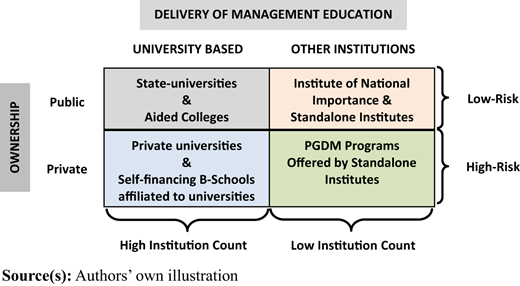
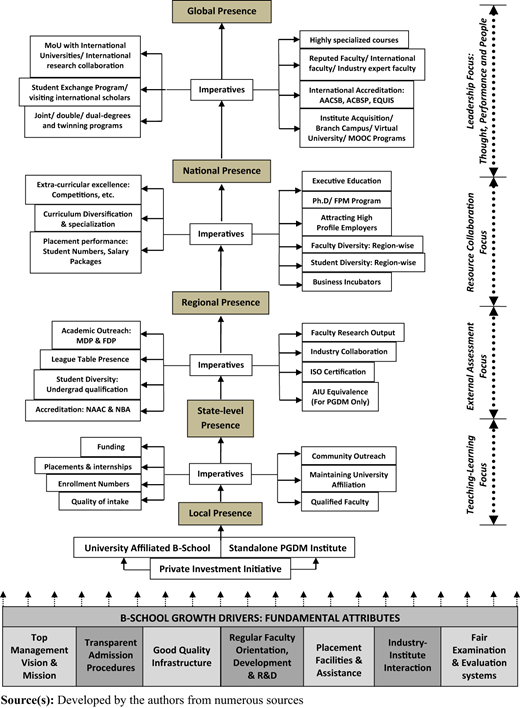
To envisage the inherent difficulties facing these B-schools, a generic roadmap is traced in Figure 4 which highlights the challenges an institution would face as it moves from a highly localized setting into a regional, national and thereafter global space. The path is traced out through four distinct stages. At the most basic level is the institution's need to focus on teaching-learning in order to ensure visible graduate outcomes. The second stage is driven by the institution's pursuit of accreditation and third party certification which are important for signalling quality considerations. Progress into the national level would require resource collaboration to leverage shared externalities with other institutions. Global presence and reputation would require the institution to be a centre of leadership in thought, performance and people. Progress into each subsequent stage builds the B-school's brand value, reputation and entrenchment. Entrenchment is characterized by the presence of a B-school's alumni in senior positions within other B-schools, businesses and organizations in the national or international sphere. Deep entrenchment may help expand the B-school's sphere of influence.
It is possible to segment private B-schools into a two-by-two grid called the 4I's to understand how institutions in Kerala are placed. Figure 5 provides an illustration of the 4I's concept. The 4I's framework is a figurative representation of four extremes in B-school segments.
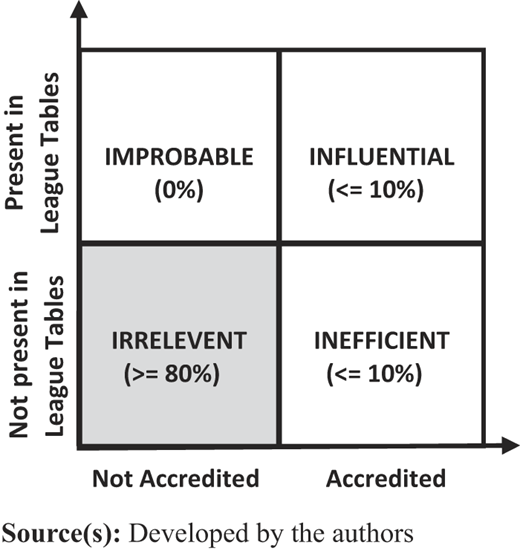
“Improbable” are those institutions which have made it to well-reputed rankings despite not possessing any accreditation. Any presence in this space would be a logical anomaly arising either from an oversight on the part of the ranking agency or possibly false supply of information. Notably, the vast majority of institutions in the state come under the “Irrelevant” category, essentially meaning that they are dispensable and replaceable for offering an MBA that can be substituted by an offering from any other institution. “Inefficient” institutions are those which are unable to capitalize on their accreditation(s) to find a place in reputed and trusted rankings, possibly indicating a lack of management zeal or focus in building the brand. The most valuable B-schools are those which feature in the “Influential” space, helping project the state's educational prowess. These institutions are visible, get attention from aspirants, recruiters and industry, accumulate influence in the corridors of power and are commercially profitable.
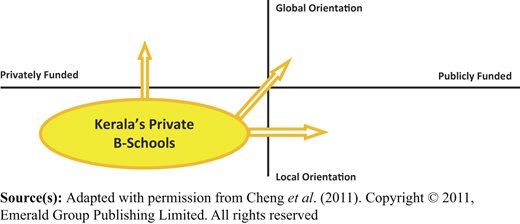
The continued sustenance and growth of private B-schools in Kerala would require a reorientation, driven towards a global outlook and alternate sources of funding. Drawing from the work of Cheng et al. (2011), this study proposes that the shift can only be achieved with government and regulatory support in the Indian context. Figure 6 illustrates this purposeful repositioning needed for the continued survival of this sector.
5.2 The Integrated MAVS-ADRI framework
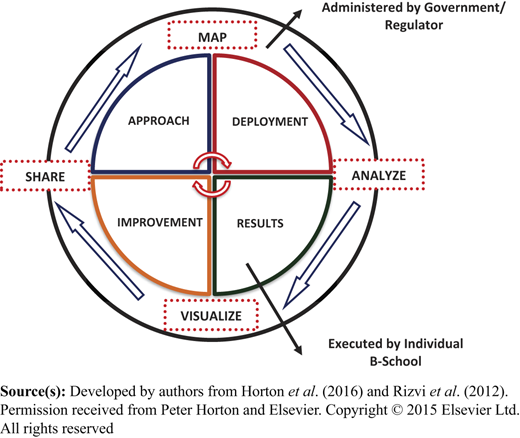
B-schools in Kerala will not be able to achieve sustained growth on their own in the current regulatory landscape. This requires the active support and assistance of the government. The proposed framework is a radically different theoretical remedy for higher education from the prevailing practice of regulators in Kerala. Combining the map–analyze–visualize–share (MAVS) theory advanced by Horton et al. (2016) and the approach–deployment–results–improvement (ADRI) framework for quality augmentation by Razvi et al. (2012), the suggested concept is a synergistic amalgamation of regulator/government and private B-school partnership that goes beyond traditional interactions among these two stakeholders in matters of accreditation, curriculum development, faculty training, etc. The success of implementation of this framework is pivoted on technology and information systems, and the ready availability of real-time data for processing.
The execution is facilitated by two interconnected systems that work in tandem to enable integrated decision making. This would allow the entire B-school scenario to become more resource efficient. The apex MAVS system is administered by a technical regular or government body. The ADRI system is a sub-component of MAVS that is maintained and populated by each individual B-school. The proposed framework is illustrated in Figure 7.
The successful execution of this framework would create a common platform for management education in an environment which in India is highly fragmented, affected by delays in information and resource sharing, absence of timely communication and non-aligned decision-making. The key challenge is the acceptance of a common code of analysis and parameterization. The following section illustrates this concept in the Kerala context:
5.2.1 The apex system: MAVS
This system performs four critical functions, driven by data supplied by the individual institutions.
Map: It geo-locates every B-school in the state. Proposed mapping metrics may be based on geographical region (North-Central-South), district and location (urban/rural).
Analyze: This involves assignment of resource specificities to each institution, based on geo-social placement. A study by Ram (2019) in Kerala context had developed a method to evaluate resource potential of areas where Higher Educational institutions are located through 10 “synergic bands” that holistically examine all major particularities of a region like development, commerce and trade, infrastructure, industry, natural resources, social and cultural aspects, etc. The “band density” which is a summation of each individual synergic band, can help visualize B-school synergies with its immediate region. This can then be coded to allocate risk levels for each institution, allowing high-risk institutions to be identified.
Visualize: This requires data analysis techniques to simulate the entire region's performance in terms of aspirant applications, institute-wise enrolment, placement, faculty-student strength and research to identify changes and devise surgical regulator interventions. It can help identify most sensitive and vulnerable regions/institutes, as well as chart aggregate tendencies in a macro-environment. The visualization can also help identify educational hubs/zones when aggregated with other higher educational institution types. It is reasonably possible to craft a dashboard of key indicators of stress/crisis.
Sharing: Visualization tools from meta-data must be publicly available in a transparent manner for all key stakeholders. It is possible to develop state-level angular dashboards that display a wide variety of information based on well-defined parameters. Archival data can allow for analytics and predictive techniques. This in-turn can influence sound policymaking to alleviate the distress in the sector. The success of this system is based on untrammelled access of unit-level data from individual institutions on a periodic basis.
5.2.2 The sub-system: ADRI
This is an internal quality management system for continuous improvement. The benefit of integrating this system with MAVS in Internet-enabled architecture is real-time quality evaluation as opposed to existing accreditation systems like NAAC and NBA which are periodic and involve significant time gaps. The success of this system largely depends on timely and voluntary disclosure of information by B-schools. An illustration of this approach is provided for student enrolment which is the main pain point for institutions in Kerala.
Approach (Thinking and planning): Identifying graduate aspirations for MBA, specialization preferences, sought-after courses and jobs, preferred educational destinations, views on return-on-investment plans and curriculum expectations.
Deployment (Implementing and doing): Qualitative and quantitative information from academic staff, faculty, placement officers and recent pass-out students. Documentation of employer feedback for past recruits.
Results (Monitoring and evaluating): Examination performance, student satisfaction studies on B-school infrastructure, teaching-learning, placement services, job opportunities, salary packages, placement statistics by gender, industry, organization, destination, job description and specification. Student feedback on faculty/institute, employer forums and labour market-specific training.
Improvement (Learning and adapting): Course/curricula/programme review, internship reviews, inputs of professional management bodies connected with academia, annual action plans and key performance indicators (KPI) for each B-school on admissions.
The ADRI framework requires multiple stakeholder engagement at institute level. This includes the students, faculty, staff and surrounding community. It is possible to improve a host of B-school related issues such as teaching-learning, courses and curriculum, research, training, educational partnerships, etc. The key challenge will be devising benchmarks and compliance. Reporting is also needed to capture annual management reports to the regulator, strategic alignment reports, periodic self-assessment and faculty council reports. Student demand forecasting is possible with accurate reporting of application numbers to the apex regulator. This can help rationalize budgetary spends and evaluate the academic portfolio.
5.2.3 Issues in implementation
Implementation of the MAVS-ADRI framework is complex and can be a mammoth undertaking. However, it can use emergent data as a catalyst for change. Consensus would be needed for devising a common language of reporting and foot-printing. The highly fragmented nature of the system would be an obvious barrier to implementation. The advantage of MAVS-ADRI is that it allows for specific remedies for each B-school rather than generic solutions. However, the success of this framework demands accurate data from diverse sources in useable form. Trust deficit is a major challenge. It might be possible to balance resource efficiency with excess capacity.
5.3 Future of management education in Kerala
The state may be heading for a decline in B-school count. Barely 20 years after the first major push towards establishing B-schools have the trends indicating a contraction. This suggests that a highly literate region need not be a space to build a knowledge-based economy. B-schools are intellectually intensive spaces that create high value and have long-term impact. These institutions through teaching and research can help build skills and develop a knowledge base, which can contribute to economic development. The link between investment in higher education and development has already been established by human capital theory. Human capital is an important asset for projection of soft-power in the global space (Becker, 2002; Brown, 2004). Soft power includes high-quality human capital, a strong human network in the local and global sphere and refined intellectual capacity. Kerala's projection of soft-power would be weaker than its neighbouring states if this decline is not arrested.
The net effect of closure of B-schools would adversely impact Kerala's influence in the region. The need is to develop a global mindset. The strong potential offered by Higher Education to development has been emphasized in recent literature (Boni and Walker, 2016; McCowan, 2016; Oketch et al., 2014; Owens, 2017). These are also important to achieve SDGs – specifically Goal 4 and its Targets 4.3, 4.4 and 4.5 related to tertiary education SDGs (Campbell and Mawer, 2019; McCowan, 2019; Owens, 2017). Institutions need to be internationalized for building an education industry, create economic benefits and reap social benefits. Kerala in the future period may not be able to meet its managerial and leadership requirements for government and industry from B-schools within its own boundaries. This may leave the state at the mercy of its neighbours for high quality professional manpower.
This study presented localized manifestation of problems that can cause developmental impediments. While the study offered indications of orthodoxies of strategic positioning, the research was part of the larger discourse of tertiary sector development. The paper suggests the need for strategic positioning of B-schools in matters of funding and orientation to achieve these ends, after categorizing the segments of privately-funded B-schools in the state. The paper notably builds on the “Glonacal Agency Heuristic” (Global-National-Local) proposed by Marginson and Rhoades (2002) by deriving the reverse analogy of US MBA Programmes. This study maps the path for highly localized MBA programmes to progress into the regional, national and global space, and what it needs to achieve to progress into each subsequent phase. It may be theoretically feasible to achieve this stratified growth through the proposed MAVS-ADRI framework. The MAVS system can also be used to map the B-school spheres for neighbouring states, allowing opportunities to compete strategically.
6. Conclusion and policy recommendations
The admissions fiasco in Kerala amidst the COVID-19 pandemic in 2020 allows reflection of policymaking's impact on higher education. The intervention of the Admission Supervisory Committee (ASC) under Justice Rajendra Babu in Kerala who issued an immediate directive following AICTE's relaxation of admission norms for B-schools, asking that enrolments on the basis of graduating performance be reduced to only 20% of the approved intake from the proposed 100%, with the remaining 80% of the seats available only to entrance test takers is highly indicative (ASC, 2020a). The self-financing management institutions in the state jointly filed an appeal with the Kerala High Court challenging this order, as a result of which a stay order was issued (ASC, 2020b). Regulation is a sword that cuts both ways. Too much would stifle growth and suffocate the sector; too little will give way to opportunism.
Management education is a public good, or at the very least, a quasi-public good. Adequate funding is required to sustain B-schools in Kerala, which cannot survive on student fees. The government must consider these institutions as part of the citizens' commonwealth and intervene to ensure their sustenance. The government must at least facilitate availability of public funds for student enrolment in backward, rural and underserved areas of Kerala. This is particularly important in northern Kerala which faces problems of accessibility due to the topography, infrastructure and also the scattered geographical dispersion of institutions. Year-after-year of poor enrolments will foment a vicious cycle which will financially cripple institutes in the private sector. Self-financing institutions are mostly dependent on tuition fees to sustain their costs. Since these institutes are also bound to maintain adequate faculty numbers on their roster as per University Grants Commission (UGC) rules, this would translate to cost-cutting measures which will have an adverse impact on quality. The end result would be what Tilak (2020) had described as “Para Teachers”. These teachers are underpaid, under-qualified, work in poor conditions and are thus underperforming. Their effect would reflect on the students’ performance, and therefore on educational outcomes.
Government support through student funding and enrolment initiatives are particularly important to tiny self-financing institutions located in backward districts. The government may consider an input based deficit financing scheme for distressed institutions. The State Accreditation and Assessment Council (SAAC) is the need of the hour. This must be buttressed simultaneously by a State Institute Ranking Framework (SIRF-Kerala) and also by voluntary disclosure as well as dissemination of institute enrolment data and other particulars through state-level surveys on higher education. Some policy initiatives are the need of the hour.
First, there should be competition-based funding. This will be determined by various parameters including graduate outcomes, voluntary self-disclosure, best quality practices and visible manifestations of equity, social relevance, public goodwill, academic excellence and achievements in research. Institutions must be given opportunities as well as encouraged to seek state-level accreditation first. Funding should be preferentially awarded to accredited institutes. Secondly, SIRF-Kerala (a proposed ranking framework exclusively for Kerala's B-schools) must be instituted. All institutions must be necessarily included, irrespective of participation to ensure greater competition among colleges. This will be a holistic metric for local aspirants for institutions selection unlike NIRF, where Kerala's is virtually non-present. Lastly, the government must also allow an umbrella representation of management institutions outside the state for attracting students from regions such as the North-Eastern India, to facilitate better utilization of unused capacity. For example, the British Council hosts UK Education Fairs all over the world for attracting international students to its colleges. Kerala must launch a similar initiative for attracting students from the North-Eastern states and also from other developing countries. International students from West Asia, Persia and Africa must also be given opportunities to pursue management education in Kerala.
There is significant congruence in this study with the claims by Tharamangalam (1998) of how “institutional, political and cultural constraints” can affect higher education, particularly in aspects of rationality and freedom. Perceptions of quality which were then described as “dismal” in Kerala, even at the present time has failed to advance to an acceptable standard. It needs to be pondered if the state, with its unique brand of politics and culture may have contributed adversely to the stymied growth of B-schools in Kerala. Retrospectively, the Economist (2005) once mentioned three “near certainties” in higher education: that they were administered as part of national policy while mostly to local students, and were regulated by the government. This narrative has since then changed, both globally, as well as in India (Agarwal, 2009). However, in Kerala even in the present times, it continues to remain the dictum. In a crisis-ridden scenario where several thousands of seats remain vacant in management institutions, the government must launch an exercise to restore faith of the citizens through collective efforts that are innovative, visible, and would transcend policy hurdles. This research is of the opinion that government policy since the 1980s and a harsher regulatory environment at present has largely been responsible for the manifested regional imbalance in institution numbers when compared with the neighbouring states. Affirmative actions are therefore urgently needed to save a sector that is still dynamic, but facing an existential crisis.
7. Limitations and future directions
The study has several limitations. Unit-level data from AICTE was not available prior to 2014. This does not allow for a nuanced longitudinal trend analysis. The data set was encountered with several blank fields. These voids were overlooked during the analysis. Despite data quality efforts by AICTE, the possibility of erroneous fields cannot be ignored which may affect the credibility of the findings. The MAVS cycle was originally proposed in the agri-tech field. Its use has not been suggested in the education sector until now. Any inconsistency between the proposed framework and its use in practice needs to be tested. The framework specifically does not address the issue of environmental sustainability which is of prime importance in the present context. The current study is based only on descriptive data. Future studies could look at inferential analysis driven by panel data regression to identify relationships between B-schools and macro-economic factors.
| Timeline of government established and supported institutions in Kerala | |
| 1960 | The Ramaswamy Mudaliar committee of all India Board of Management Studies (AIBMS) moots the establishment of management institutes |
| 1960–1963 | Management institutes under university management departments are envisaged across the country. School of Management Studies (SMS) under CUSAT is one of the first planned institutes |
| 1964 | SMS becomes the first institute to offer management programmes in Kerala, established under the Ernakulam Centre of the University of Kerala |
| 1964–1971 | SMS offers PG Diploma in Business Management (PGDBM) and PG Diploma in Industrial Management (PGDIM) for working managers |
| 1971 | SMS comes under the aegis of the newly established University of Cochin which takes over the Ernakulam centre of the University of Kerala |
| 1973 | Full-time MBA is offered for the first time in Kerala by SMS as against diploma programmes until then |
| 1982 | MBA offered under University of Calicut by changing the name of Department of Commerce to Department of Commerce and Management Studies |
| 1985 | College of engineering Trivandrum (CET) begins offering part-time MBA |
| 1986 | University of Cochin becomes CUSAT. SMS CUSAT begins offering both part-time (3 years) and full-time MBA. Full-time MBA has an intake of 30 students |
| 1988 | Kerala Institute of Tourism and Travel Studies begins offering Tourism Management courses in Trivandrum (Thiruvananthapuram) |
| 1991 | The Institute of Management in Kerala (IMK) is established under University of Kerala. Initially located within the Karyavattom University campus in Thiruvananthapuram, it later spawned branches in many part of Southern Kerala. There were 8 IMK's until 2013. Of these, all campuses except the Karyavattom campus is spawned off to become University Institute of Management's (UIM) |
| 1994 | The Calicut Regional Engineering College (CREC- Presently, NIT-Calicut) begins offering part-time diploma courses, Post-Graduate Diploma in Business Administration (PGDBA) and Post-Graduate Diploma in Financial Management (PGDFM). It was discontinued in 2001 when CREC became NIT-Calicut by passage of NIT Act in parliament in 2002 |
| 1996 | The Indian Institute of Management Kozhikode (IIM-K) is established offering Post-Graduate Diploma Programmes in Management |
| 1999 | The School of Management and Business Studies under the Mahatma Gandhi University of Kottayam commences functioning, offering full-time MBA |
| 2000 | The Department of Management Studies under Kannur University is established, which offers both Masters and Doctoral programmes |
| 2007 | The College of Co-operation, Banking and Management begins offering 40 seats for MBA in Agri-Business Management established under the Kerala Agricultural University. It is the only Agri-Business Management course offered in the state |
| 2009 | NIT-Calicut School of Management Studies (SOMS) begins functioning, admitting 30 students |
| 2012 | The School of Management and Entrepreneurship of the newly established Kerala University of Fisheries and Ocean Sciences (KUFOS) begins offering 2-year full-time MBA programme in regular management subjects (Finance, Marketing, Human Resource Management) alongside Rural Management, Fisheries Business Management and Energy Management. The Fisheries Business Management course is the only such MBA program in the entire world. 35 seats are offered in all the subjects except Energy Management while 20 seats are offered exclusively for the latter |
| 2013 | 7 former IMK's become UIM's. These are UIM Poojapura (ICM Poojapura), UIM Adoor, UIM Kollam, UIM Kundara, UIM Varkala, UIM Alappuzha and UIM Punalur. IMK and UIMs are spread across 4 southernmost districts and offer 560 seats annually. They also charge the lowest tuition fees among management institutions in Kerala. IMK and UIM were earlier operating as Government financed institutes, but at present function as self-financing institutions |
| Timeline of self-financed institutions in Kerala | |
|---|---|
| 1992 | School of Communication and Management Studies (SCMS) in Cochin begins offering Post-Graduate Diploma Programmes in Management |
| 1995 | Rajagiri College of Social Sciences- School of Management (Ernakulam), St. Berchman's Institute of Management Studies (Kottayam), and TKM Institute of Management (Kollam) are established. The former two become government aided-colleges |
| 2002 | New institutions begin functioning. Explosive growth during the period 2002–2010 |
The first author thanks the Almighty Lord God for guiding and protecting him throughout his research journey at IIT Madras. The first author dedicates this paper to his wife, Aleena Mathew Kavanakuzhiyil and his daughter, Eileen Rebecca John.
Funding acknowledgements: The first author is a fully funded research scholar of IIT Madras and is supported financially under the HTRA (Half Time Research Allowance) scheme of the institute.
Conflict of interest: The first author was an assistant professor who was employed at two business schools in Kerala. However, the research is not centred on these institutions and views the entire sector as a whole. The findings, interpretation and conclusions expressed in this article do not necessarily represent the institute the author is working or associated with.
Notes
Prof. Jyothi P.T. is former head of placements as well as coordinator for public relations at DCSMAT Vagamon. Her career spans over 15 years, with faculty positions in MBA courses at MES College of Engineering (2007–2013), Marian International Institute of Management (2013–2016) and her last designation at DCSMAT (2016–2021). She is presently on maternity leave. https://dcschool.net/faculty/
The litigations were before the Hon'ble High Court of Kerala in the cases of Haridev S vs The Assistant General Manager on 29 August, 2016 vide WP(C) No. 28538 of 2016 (N) and Nimmi Sumesh vs The Assistant General Manager on 29 April, 2014 vide WP(C) No. 2281 of 2017 (I). In both instances, the petitioners who were PGDM students were denied final selection by Canara Bank, a reputed public sector bank because their diplomas were not considered equivalent to an MBA degree. The judgements can be accessed at https://indiankanoon.org/doc/79572234/and https://indiankanoon.org/doc/171146832/
Capt. George Kuriyan is an Indian Army veteran and keen educationist in the Management Scene in Kerala. He joined as a commissioned officer in the Artillery Regiment of Indian Army and served near the Chinese border after 1962. A veteran of the 1965 Indo-Pakistan war, he subsequently had an illustrious career in the corporate sphere of renowned public sector corporations. He worked as a personnel manager (executive division) in Hindustan Aeronautics Limited (HAL) at the Bangalore and Nashik divisions. He thereafter worked as divisional manager at Batliboi and Company in Surat in the Machine Tool Division. Thereafter, he has worked as senior general manager in Heavy Engineering Corporation, Ranchi. He was subsequently selected by the Government and held a government appointment as director personnel in Coal India Limited. After his retirement in 1997, he spent the next 17 years working in prestigious management institutions across the country. He worked as full-time professor in Xavier Institute of Social Service (XISS), Ranchi (1997–2006). He served briefly as associate director-administration at XIME, Bangalore (2006–2007). He worked the last part of his career as a full-time professor at Rajagiri Centre for Business Studies in Kochi from 2007 to 2014.
Prof. Ramachandra Poduval is one of the earliest faculty members in the management education scenario of Kerala. He joined as a faculty member in Kerala University's management campus in Ernakulam (Which subsequently became SMS CUSAT) in 1965. In 1970, he was promoted to reader and became a full-fledged professor in 1979. He served as professor from 1979 to 1993 and became Director of School of Management Studies, CUSAT from 1993 until his retirement in 1998. He also served as the Dean, Faculty of Social Sciences in CUSAT from 1995 to 1998 and much later after his retirement in 2013–2016. He played an important role in the establishment of Bhavans Royal Institute of Management in Thrippunithura in 2002.
References
Appendix

