The purpose of this study is to apply the Elaboration Likelihood Model (ELM) to examine persuasive information processing in live streaming commerce (LSC). This study examines the impact of streamer credibility, viewer mindfulness and control variables (age, gender, viewing frequency and subscription status) on purchase and response intentions in the Indonesian context.
This study uses Partial Least Squares Structural Equation Modeling to analyze responses from 372 individuals aged 18–45 years who had watched or purchased through LSC within the past month. The model incorporates streamer expertise and sociodemographic control variables.
The peripheral route, driven by streamer credibility (trustworthiness, attractiveness and expertise) and co-viewer engagement, strongly influences the persuasiveness of information more than the central route. Viewers are more influenced by social cues than by the quality of product information. Mindfulness does not significantly moderate the relationship between perceived persuasiveness and either purchase or response intention. However, younger, active subscribers demonstrate a higher likelihood of engagement.
These findings contribute to practical enhancements in streamer branding and digital trust-building strategies, enabling LSC platforms to optimize content and strengthen collaborations with streamers and key opinion leaders, thereby increasing purchase and response intentions.
The findings of this study offer actionable recommendations for brands and streamers, including strategies to enhance streamer appeal and create persuasive content that resonates with target audiences.
This study fosters stronger, trust-based interactions between streamers and their audiences, promoting inclusive digital economic growth across diverse demographic segments in Indonesia.
By integrating ELM with streamer credibility, mindfulness and sociodemographic factors, this study provides novel insights into viewer behavior in Indonesia’s emerging LSC landscape.
1. Introduction
Online shopping has evolved beyond the traditional boundaries of browsing static product images and clicking a “buy” button (Zhou et al., 2021). Today, direct, real-time interactions between consumers and sellers play a central role in capturing attention and driving purchasing decisions more effectively (Ma, Zou & Lv, 2022). Consumers now engage with a new generation of platforms and strategies that provide personalized, immersive and interactive shopping experiences. When the camera turns on, the streamer, often a product expert, demonstrates features and benefits live, creating the sense of a virtual storefront (Wang et al., 2022). At the same time, thousands of viewers participate actively, responding to every action and statement made by the streamer.
Live streaming commerce (LSC) represents more than just a trend; it constitutes a paradigm shift in digital retail (Liu, Wang, Gu & Yang, 2023). This emerging format combines the transactional functionality of traditional e-commerce with the social interactivity of live content, offering features such as bullet-screen comments, instant feedback and real-time purchases (Wongkitrungrueng, Dehouche & Assarut, 2020). As one of Southeast Asia’s largest and most dynamic digital economies, Indonesia shows notable levels of e-commerce and social media penetration, recorded at 57% and 33%, respectively (Uzunoglu, 2024). Projections from Google, Temasek and Bain & Company estimate that Indonesia’s e-commerce gross merchandise value could exceed US$160bn by 2030 (Hoppe et al., 2023). With its rapidly expanding digital infrastructure, youthful population and high social media engagement, Indonesia provides both a theoretically rich and empirically relevant setting to examine how users respond to persuasive strategies in emerging digital markets.
Moreover, this context provides a unique opportunity to explore technological adaptation in developing economies. It extends the theoretical literature by investigating how local factors such as digital literacy, income disparities and culturally embedded trust orientations shape the adoption and success of LSC platforms.
Despite the appeal of LSC, only around 36.5% of Indonesian viewers make purchases during live-stream sessions (Ipsos, 2023; Jakpat, 2023). This gap between high engagement and relatively low conversion rates suggests a pressing need for more effective persuasive strategies. Viewers often experience confusion or information overload, which leads to hesitation and a reduced likelihood of completing purchases (Xu, Cui & Lyu, 2021).
A key element influencing purchase behavior is streamer credibility, which encompasses the streamer’s perceived trustworthiness, attractiveness and expertise (Safeer, 2024). As central figures in LSC, streamers act as both product presenters and influencers, and their communication style as well as personal characteristics can significantly shape consumer responses (Luo, Cheah, Hollebeek & Lim, 2024). Streamer expertise, in particular, is critical in shaping viewer perceptions and guiding purchasing decisions (Chen, Liu & Zhang, 2023). Although prior studies have shown that streamer credibility affects both purchase intention and consumer engagement (He, Li & Xue, 2022), few have examined the combined effects of all three dimensions of source credibility.
In addition to these credibility factors, viewer mindfulness influences how consumers process persuasive information. Mindful viewers are better able to filter distractions, think critically and make deliberate purchasing decisions (Yiğit, 2020; Sun, Fang & Zou, 2016). However, mindfulness alone does not fully explain the diversity of viewer responses. Sociodemographic variables such as age, gender, viewing frequency and subscription status also significantly affect how persuasive content is perceived and acted upon (Lv, Zhang, Su & Yang, 2022). For instance, younger viewers may be drawn to fast-paced, visually stimulating streams, while older viewers may place greater emphasis on clarity and informational depth (Zhong, Han & Wang, 2023). As a result, many LSC platforms and marketers now rely on demographic segmentation to tailor their messaging and enhance conversion outcomes (Luo et al., 2023; Punhani, Arora, Sabitha & Shukla, 2021).
This study proposes an analytical model of persuasive information processing in LSC to address these gaps, grounded in the Elaboration Likelihood Model (ELM). ELM provides a robust theoretical framework to explain how consumers process persuasive messages through either the central route (focused on message content) or the peripheral route (influenced by superficial cues, such as attractiveness or trust). In LSC environments, where decisions are often made rapidly in response to live content, both routes may be activated depending on the viewer’s cognitive resources and motivations (Yang & Lee, 2023). This study also incorporates sociodemographic characteristics as control variables to account for their moderating effects on persuasion dynamics. By doing so, the research aims to enhance the effectiveness of persuasive strategies in LSC and contribute to a more nuanced understanding of digital consumer behavior in emerging markets.
2. Theoretical background
2.1 Elaboration likelihood model and its role in live streaming commerce persuasion
The ELM explains how individuals process persuasive information through two distinct pathways: the central route and the peripheral route (Li & See-To, 2023). The central route involves deep cognitive engagement, where viewers critically assess the quality of the information presented, such as detailed product demonstrations, accuracy and real-time responses. Key dimensions including completeness, accuracy and currency enhance perceived reliability and have a significant influence on purchasing decisions (Bhattacherjee & Sanford, 2006; Hussain et al., 2018; Hong, Yu, Wu & Pu, 2020). For example, streamers who respond to viewer questions with current and relevant insights are more likely to persuade audiences through this cognitive pathway.
In contrast, the peripheral route relies on heuristics such as streamer credibility, visual appeal and peer engagement, which are often manifested through bullet-screen comments. Factors such as a streamer’s popularity, tone and emotional expression shape viewer perceptions (Zha et al., 2018). This aligns with the Source Credibility Theory (Ohanian, 1990; Pornpitakpan, 2006), which emphasizes that attractiveness, trustworthiness and expertise are crucial factors in evaluating persuasive messages, particularly when cognitive resources are limited. For instance, high follower counts or engaging visuals can enhance trust even when the informational depth is minimal. In the fast-paced nature of LSC, decisions are frequently made quickly, relying on surface cues and collective behavior (Sun, 2013). The Cognitive Load Theory further supports this perspective by suggesting that under conditions of high informational and sensory input, individuals tend to depend on cognitive shortcuts and prioritize simpler cues, such as streamer appeal, over the detailed evaluation of message content (Sweller, Ayres & Kalyuga, 2011).
2.2 Perceived persuasiveness and viewer decision-making
Both content quality and delivery style shape perceived persuasiveness in LSC. Accurate product descriptions, when combined with engaging presentations, boost viewer confidence and facilitate decision-making (Chang, Lu & Lin, 2020). Both central and peripheral processing routes drive this persuasive effect. Rational evaluations result from the central route, while emotional or social cues, such as a credible streamer announcing a limited-time offer, can trigger spontaneous purchases (Kim & Johnson, 2016; Thomas, Wirtz & Weyerer, 2019).
As explained by the Source Credibility Theory (Hovland & Weiss, 1951; Ohanian, 1990), the peripheral route highlights how cues such as the streamer’s expertise, trustworthiness and attractiveness can serve as substitutes for message scrutiny when cognitive motivation or capacity is low. In fast-paced LSC environments, these characteristics enhance the perceived authenticity of promotional content. Emotional appeals, including the creation of urgency, excitement or social proof, amplify this effect and are often reinforced by real-time viewer reactions and the streamer’s tone.
Additionally, constructs such as Social Presence, which refers to the sensation of being “with others” in a virtual environment, and Parasocial Interaction, which refers to a perceived personal relationship with the streamer, play pivotal roles in LSC persuasion (Hu, Zhang & Wang, 2017; Liu et al., 2023). These factors foster emotional connection and simulated intimacy, encouraging viewers to transfer trust from the streamer to the product. This mechanism aligns with the Trust Transfer Theory (Ng, Law, Lam & Cui, 2023), which suggests that trust in one entity, the streamer, can be extended to the promoted product or brand, thereby minimizing the need for individual cognitive evaluation.
Moreover, viewer response intention, manifested through liking, commenting or asking questions during live sessions, strengthens community involvement, increases the perceived credibility of the streamer and enhances social presence. These interactive behaviors intensify the persuasive experience, reinforcing emotional engagement and collective influence (Chang et al., 2020).
2.3 Mindfulness as a moderator in decision-making
Mindfulness, defined as heightened awareness and present-moment focus, moderates how viewers process persuasive content in LSC. It enables critical engagement and reduces the likelihood of impulsive purchases (Park & Dhandra, 2017; Thomas et al., 2019; Kong, Zhan & Zhu, 2023). According to Brown, Ryan & Creswell (2007) and Karelaia and Reb (2015), mindfulness fosters reflective processing, allowing consumers to align persuasive messages with their personal goals and values.
Mindful viewers are more selective when evaluating streamer credibility and information relevance. This strengthens central-route processing, as they are more likely to engage in thoughtful discussions, pose informed questions and seek additional product information. Such behaviors enhance the live-streaming experience (Chang et al., 2020).
Furthermore, mindfulness interacts with sociodemographic factors such as age and media consumption habits. For example, younger and more tech-savvy audiences may be more responsive to emotional and visual cues, while older viewers typically prioritize message credibility, trustworthiness and social presence (Lv et al., 2022; Zhong et al., 2023). Integrating mindfulness with these psychological and contextual factors enables a more targeted and adaptive persuasion strategy, particularly within LSC environments that combine entertainment, interactivity and real-time consumer engagement.
2.4 Integrating elaboration likelihood model, persuasion and mindfulness in live streaming commerce
Integrating ELM pathways, perceived persuasiveness and mindfulness provides a comprehensive understanding of decision-making in LSC. Central and peripheral routes often operate concurrently, influenced by viewer motivation, cognitive capacity, emotional tone and contextual cues, including social presence and parasocial relationships.
The central route is more likely to be activated when viewers are mindful, highly involved and able to process detailed information. Conversely, the peripheral route becomes dominant under cognitive overload or when viewers respond to heuristic and emotional cues. By leveraging emotional appeals, streamer credibility and immersive social features, LSC platforms can design persuasive strategies that appeal to rational and affective consumer behavior dimensions.
As central agents in the persuasive process, streamers must strike a balance between message clarity and emotional engagement. Their role involves conveying accurate information and building relational trust with viewers. Incorporating mindfulness as a moderating factor allows platforms to develop more ethical, responsive and effective persuasion strategies. These strategies can enhance purchase and engagement intentions, fostering a more dynamic and consumer-centric digital ecosystem.
3. Research methodology
3.1 Research design
This study uses quantitative research design with a descriptive approach, incorporating literature reviews, surveys and data analysis to examine the characteristics of the variables in depth (Edgar & Manz, 2017). The scope includes participants’ experience in LSC and sociodemographic control factors. Partial Least Squares Structural Equation Modeling is used to develop and test the analytical model, selected for its suitability in handling complex relationships among latent variables and non-normally distributed data, even when sample sizes are relatively small (Wang, 2022).
3.2 Sample
The target population consists of individuals aged 18–45 years who have purchased from or watched a live-streaming session on one of Indonesia’s four largest LSC platforms at least once within the past month. This population segment was chosen because of its high digital literacy and consistent internet access, making it an ideal target for research on digital commerce behaviors. The minimum sample size was set at 100 respondents, based on the “10-times rule” commonly applied in Partial Least Squares Structural Equation Modeling, which recommends at least ten times the number of structural paths leading to any construct in the model (Hair, Hult, Ringle & Sarstedt, 2022).
3.3 Data collection
Data were collected using a combination of quota and purposive sampling techniques. Quota sampling ensured demographic representation across variables such as age, gender and frequency of LSC usage. In contrast, purposive sampling was used to recruit participants with relevant knowledge and experience in LSC. To maximize outreach, respondents were recruited via popular social media platforms, including Instagram, WhatsApp, Twitter and LINE. The primary data collection instrument was a structured questionnaire comprising items measured on a seven-point Likert scale ranging from “Strongly Disagree” to “Strongly Agree.” A seven-point scale was selected for its enhanced ability to capture nuanced respondent evaluations and stronger correlation with significance levels compared to traditional five-point scales (Taherdoost, 2019).
The development of the questionnaire followed several important steps. First, all indicators were adapted from validated instruments in previous studies to ensure content validity. Then, a back-translation method was used to maintain semantic consistency between the original English and the final Bahasa Indonesia version. Bilingual experts conducted semantic validation to ensure conceptual equivalence. A pilot test involving 30 respondents was conducted to assess the clarity, readability and interpretability of the items. Based on feedback from the pilot, minor adjustments were made to the wording and layout of the questionnaire.
The final version of the instrument consisted of 45 items across 12 latent variables. These included Information Completeness (COMP) adapted from Nelson, Todd and Wixom (2005); Information Accuracy (ACC) from Popovič, Hackney, Coelho and Jaklič (2012) and Chen (2010); Information Currency (CUR) from Nelson et al. (2005); Streamer Trustworthiness (TRU) and Attractiveness (ATT) from Yuan, Kim and Kim (2016); Bullet-Screen Consistency (BSC) from Luo et al. (2015); Co-viewer Involvement (CIV) from Dolen, Dabholkar and Ruyter (2007); Mindfulness (MIND) from Sun et al. (2016); Perceived Persuasiveness (PERS) from Zhang, Zhao, Cheung and Lee (2014) and Chang et al. (2020); Purchase Intention (PUR) from Kim and Johnson (2016); Response Intention (RES) from Chang et al. (2020); and Streamer Expertise (EXP) from Rungruangjit (2022).
Before full distribution, questionnaire validation was conducted with at least 30 respondents to ensure the clarity of items. The final survey was distributed online using Google Forms from March 1 to April 1, 2024. We received a total of 384 responses, and after eliminating duplicate and ineligible responses, we retained 372 for analysis. This sample size exceeds the minimum requirement of 243 respondents, as determined using the A-priori Sample Size Calculator for Structural Equation Models with an anticipated effect size of 0.3, a power level of 0.9 and 12 latent variables with 45 observed indicators at a significance level of 0.05. Demographic analysis revealed that the majority of respondents were female (83.9%), with the most significant proportion falling within the 22- to 26-year-old age range (32.3%). A significant portion reported watching live streams one to six times per week (42.5%). Additionally, 81.2% of respondents indicated that they subscribed to at least one streamer account.
3.4 Data analysis
The collected data were analyzed using SmartPLS 4 software, following two main analytical stages. The first stage involved evaluating the measurement model, which assessed the reliability and validity of the constructs. This involved checking indicator reliability (with outer loadings above 0.70), internal consistency reliability (composite reliability above 0.70), convergent validity (average variance extracted, or AVE, above 0.50) and discriminant validity (heterotrait-monotrait ratio, or HTMT, below 0.85).
The second stage involved evaluating the structural model. This included assessing collinearity using the variance inflation factor, which should be less than 3, and examining the significance of path coefficients using t-values greater than 1.96 and p-values less than 0.05. The model’s explanatory and predictive power was also measured using R2 and f2 values. Together, these analyses provide insights into the strength and significance of the relationships among constructs, supporting hypothesis testing and guiding further discussion and recommendations.
4. Results
4.1 Model development
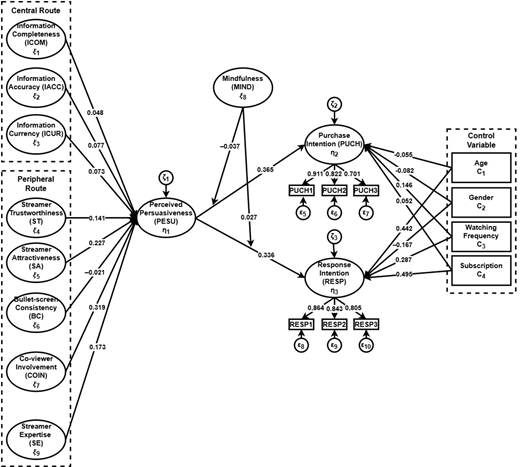
This study develops an analytical model inspired by Gao, Xu, Tayyab and Li (2021), which integrates measurement and structural components, as illustrated in Figure 1. The structural model includes nine exogenous variables categorized along the central and peripheral routes, one moderating variable (mindfulness) and four sociodemographic control variables. The endogenous variables are Perceived Persuasiveness (PERS or η1), Purchase Intention (PUR or η2) and Response Intention (RES or η3).
The central route focuses on information quality and includes three variables. Information Completeness (COMP or ξ1) refers to the comprehensiveness of the information provided, capturing the extent to which it fulfills viewers’ needs for product evaluation (Filieri & McLeay, 2014). Information Accuracy (ACC or ξ2) refers to the clarity and correctness of the presented content, ensuring that viewers perceive the information as reliable. Information Currency (CUR or ξ3) denotes the timeliness and relevance of the information, indicating how accurately it reflects the current status of the product (Nelson et al., 2005).
The peripheral route includes variables related to external cues and social interactions. Streamer Trustworthiness (TRU or ξ4) represents viewers’ confidence in the streamer’s integrity and reliability, which in turn affects their trust in product endorsements (Arai, Ko & Ross, 2014). Streamer Attractiveness (ATT or ξ5) captures the streamer’s ability to captivate attention, enhance emotional appeal and influence viewer decisions (Gong & Li, 2017). Bullet-screen consistency (BSC or ξ6) refers to the perceived coherence of co-viewer comments, which can enhance trust in the streamer or product by creating social proof (Hu et al., 2017). Co-viewer Involvement (CIV or ξ7) measures the perceived engagement of other viewers, fostering a sense of community and shared enthusiasm (Tsaia & Pai, 2013).
Streamer Expertise (EXP or ξ9) evaluates the streamer’s perceived knowledge and competency regarding the promoted product. This variable operates along both routes of the ELM. It can act as a peripheral cue when viewers rely on heuristic judgments, such as assuming expertise based on reputation or appearance. At the same time, it functions as a central cue when viewers actively process product arguments and assess expertise based on the depth of the content (Zheng, Chen, Liao & Hu, 2023). Therefore, EXP is conceptualized as a dual-route variable, influencing persuasion depending on the viewer’s level of involvement and motivation.
The moderating variable, Mindfulness (MIND or ξ8), represents a heightened state of present-moment awareness and attention, influencing the effectiveness of persuasive cues. It enhances information processing and reduces bias by supporting reflective judgment across central and peripheral processing (Kumar & Panda, 2024).
As for the endogenous variables, Perceived Persuasiveness (PERS or η1) measures the extent to which the information presented during a live stream successfully convinces viewers to trust the product recommendation (Zhang et al., 2014). Purchase Intention (PUR or η2) reflects the likelihood that viewers will purchase the promoted product (Kim & Johnson, 2016), while Response Intention (RES or η3) captures viewers’ willingness to engage during the live stream through actions such as commenting or asking questions (Chang et al., 2020).
To account for individual variation, the model includes four control variables: Age, Gender, Viewing Frequency and Subscription. These control variables help ensure the model reflects sociodemographic diversity, which may influence consumer behavior in LSC environments.
This model builds upon prior work by applying the ELM framework to LSC, integrating cognitive and affective persuasion dimensions through the central and peripheral routes. Each construct is grounded in theoretical foundations and supported by prior literature, underscoring both the model’s conceptual rigor and practical relevance to consumer behavior in real-time, interactive shopping contexts.
Based on the theoretical relationships between the exogenous and endogenous variables, as visualized in Figure 1, this study proposes 12 hypotheses:
: Information completeness positively affects perceived persuasiveness in live streaming commerce.
: Information accuracy positively affects perceived persuasiveness in live streaming commerce.
: Information currency positively affects perceived persuasiveness in live streaming commerce.
: Streamer trustworthiness positively affects perceived persuasiveness in live streaming commerce.
: Streamer attractiveness positively affects perceived persuasiveness in live streaming commerce.
: Bullet-screen consistency positively affects perceived persuasiveness in live streaming commerce.
: Co-viewer involvement positively affects perceived persuasiveness in live streaming commerce.
: Perceived persuasiveness positively affects purchase intention in live streaming commerce.
: Perceived persuasiveness positively affects response intention in live streaming commerce.
: Mindfulness negatively moderates the relationship between perceived persuasiveness and purchase intention in live streaming commerce.
: Mindfulness positively moderates the relationship between perceived persuasiveness and response intention in live streaming commerce.
: Streamer expertise positively affects perceived persuasiveness in live streaming commerce.
The next step involves specifying the structural model equations for the measurement and structural components. The equations describe the relationship between the latent constructs and their observed indicators for the measurement model. Each equation includes an outer loading coefficient (λ) and a measurement error term (δ or ε).
The equations for the exogenous variables are defined as follows:
The equations for the four indicators of ACC are shown in:
The equations for the three indicators of CUR are detailed in:
The equations for the four indicators of TRU are provided in:
The equations for the three indicators of ATT are given in:
The equations for the three indicators of BSC are outlined in:
The equations for the four indicators of CIV are described in:
The equations for the six indicators of MIND are detailed in:
The equations for the five indicators of EXP are presented in:
For the endogenous variables, the measurement equations are:
The equation for the three indicators of PUR is presented in:
The equation for the three indicators of RES is outlined in:
The structural model equations capture the influence of the exogenous variables on the endogenous constructs:
4.2 Model evaluation
4.2.1 a. Measurement model.
The evaluation of the measurement model began with an assessment of indicator reliability, resulting in the removal of indicators ACC1 and TRU3 because of their outer loadings falling below the threshold of 0.70. Next, internal consistency reliability was examined, and all constructs demonstrated high reliability, with composite reliability values exceeding 0.70. Convergent validity was then assessed using AVE, and all constructs met the required threshold, with AVE values greater than 0.50, confirming that the indicators sufficiently explained their corresponding constructs.
During discriminant validity assessment, indicator TRU4 was removed because of excessive correlation with the construct PERS, as indicated by the HTMT value exceeding the acceptable limit of 0.85. These results collectively demonstrate that the measurement model satisfies the criteria for reliability and validity, as summarized in Table 1.
4.2.2 b. Structural model.
Following the measurement model evaluation, the structural model was assessed. Indicator EXP2 was removed because of concerns about multicollinearity, as its variance inflation factor exceeded the acceptable threshold of 3, as reported in Table 1. Once the concerns of validity, reliability and multicollinearity were addressed, further analyses were conducted to evaluate the significance and relevance of the model. The path coefficients representing the relationships among the latent variables are presented in Table 2.
Based on the indicator loadings of exogenous variables (λXJ) and endogenous variables (λYJ) in the measurement model [equations (1) to (12)], as well as the structural relationships among latent variables (γᵢ) in the structural model [equations (13) to (15)], the complete analytical results are consolidated and presented in Table 3.
5. Discussion
5.1 Discussion of findings
This study examined factors influencing viewer behavior in LSC, focusing on how individuals process information, form purchase intentions and respond to presented content. The findings below discuss relevant theories, provide detailed analysis and outline their implications, while also addressing inconsistencies with prior research.
5.1.1 Peripheral route factors and persuasion.
Streamer trustworthiness (H4: β = 0.113; t = 3.161; and p = 0.002), streamer attractiveness (H5: β = 0.227; t = 3.618; and p = 0.000), co-viewer involvement (H7: β = 0.319; t = 5.725; and p = 0.000) and streamer expertise (H12: β = 0.173; t = 3.216; and p = 0.001) were found to significantly influence perceived persuasiveness in LSC. These results are consistent with the ELM, which suggests that peripheral cues, such as source credibility (trustworthiness, attractiveness and expertise) and social engagement (co-viewer involvement), are relied upon when cognitive resources or motivation are limited (Chen, Chen & Tian, 2022). The findings highlight the dominance of peripheral processing in LSC environments, where streamer characteristics act as heuristic shortcuts for persuasion. This aligns with Source Credibility Theory (Hovland & Weiss, 1951), which argues that the communicator’s perceived credibility often determines a message’s persuasiveness.
In contrast, bullet-screen consistency (H6: β = −0.021; t = 0.674; and p = 0.500) did not significantly affect persuasiveness. This differs from earlier studies (Zhang et al., 2023), which suggested that consistent co-viewer comments enhance perceived product reliability. A plausible explanation can be found in Cognitive Load Theory (Sweller et al., 2011), which proposes that when individuals are exposed to excessive or fragmented information, such as a continuous flow of bullet-screen comments, their cognitive capacity may be overwhelmed, resulting in distraction rather than reinforcement of persuasive messages.
5.1.2 Central route factors and persuasion.
Surprisingly, information completeness (H1: β = 0.048; t = 0.778; and p = 0.437), accuracy (H2: β = 0.077; t = 1.236; and p = 0.136) and currency (H3: β = 0.073; t = 1.492; and p = 0.136) were not significant predictors of perceived persuasiveness. This finding diverges from earlier research, which emphasizes the importance of information quality in shaping consumer trust and purchasing decisions (Chen et al., 2022). A plausible explanation comes from Trust Transfer Theory (Ng et al., 2023): viewers often perceive streamers as trustworthy intermediaries, reducing the need to independently verify product information. Consequently, central processing of detailed information may be bypassed.
The Cognitive Load Theory further supports this outcome. In high-intensity LSC settings, viewers are exposed to multiple simultaneous stimuli, including visuals, verbal explanations, on-screen text and social interaction, all contributing to cognitive overload. Under such conditions, viewers tend to rely on heuristic cues, such as streamer appeal or follower count, rather than analytically evaluating message content.
5.1.3 Impact on purchase and response intentions.
Perceived persuasiveness significantly influences both purchase intention (H8: β = 0.365; t = 5.771; and p = 0.000) and response intention (H9: β = 0.336; t = 5.749; and p = 0.000), corroborating prior findings (Chang et al., 2020). These results highlight the crucial role of persuasive communication in promoting consumer engagement and transactional behavior in LSC.
Contrary to expectations, mindfulness did not moderate the relationship between persuasiveness and purchase intention (H10: β = −0.037; t = 0.915; and p = 0.360) or response intention (H11: β = 0.027; t = 0.783; and p = 0.434). This contradicts research suggesting that mindfulness enhances resistance to impulsive or emotionally charged messages (Uslay & Ndubisi, 2015). One explanation is that trait mindfulness, being a stable personality characteristic, may have limited influence in highly dynamic and time-pressured LSC settings. Instead, state-based cognitive and emotional triggers may play a more decisive role in shaping immediate behavior. Impulse Buying Theory also supports this, suggesting that real-time promotional strategies (e.g. limited-time offers and scarcity cues) can override mindful awareness, leading to spontaneous purchases (Lo et al., 2022; Kong et al., 2023).
5.1.4 Role of sociodemographic variables.
Age, gender, frequency of LSC viewing and subscription status significantly influenced response intention but not purchase intention. This indicates that sociodemographic factors shape levels of interaction and engagement, but they do not necessarily translate directly into purchase behavior. Notably, younger viewers, particularly those from Generation Z, are more likely to interact with features such as live polls, comments and reactions, which aligns with the findings of Zhong et al. (2023).
5.2 Theoretical implications
This study contributes to the theoretical development of LSC by integrating the full spectrum of Source Credibility dimensions – trustworthiness, attractiveness and expertise – rather than examining them individually, thereby enriching prior literature (He et al., 2022). Applying the ELM to the LSC context shows that peripheral cues dominate in fast-paced, cognitively demanding environments, which limits the feasibility of central processing (Lau, 2022). The study also indicates that mindfulness, although theoretically relevant, may not moderate impulsive behaviors in real-time digital settings, challenging assumptions from previous research. This highlights the need to reevaluate how individual traits, such as mindfulness, operate in rapidly evolving, entertainment-driven platforms. Including sociodemographic controls further enhances theoretical insights by explaining variations in engagement across different viewer segments (Lv et al., 2022).
5.3 Managerial implications
From a practical standpoint, enhancing visual quality through high-resolution streams and interactive features, such as zoom-in functions, can compensate for the limited role of detailed information in persuasion. Brands should prioritize streamers with high credibility, defined by expertise and interpersonal appeal, as they have the greatest influence on viewer attitudes. Additionally, training programs that develop streamers’ communication skills, emotional expressiveness and responsiveness can further strengthen their persuasive impact (Zhang, Huang, Li & Ren, 2022).
To increase viewer engagement, platforms can implement gamified elements such as real-time polls, interactive comparisons and reaction-based feedback tools. These features particularly appeal to Gen Z viewers, who value interactivity and empowerment in decision-making (Lau, 2022). In addition, targeted marketing strategies that take into account demographic profiles, including age, gender and behavioral patterns, can better tailor campaigns to specific audience segments, thereby enhancing both engagement and conversion rates (Punhani et al., 2021).
5.4 Limitations and future research
This study presents several limitations. First, it is geographically restricted to Indonesia, where LSC dynamics may differ significantly from those in more mature digital markets. Future research should explore cross-cultural variations and include a broader demographic representation to enhance generalizability. Second, while this study included key sociodemographic variables, other factors such as income level, education and digital literacy may further enrich the understanding of viewer behavior.
Third, the non-significant moderation effect of mindfulness suggests that trait-based constructs may not adequately capture the real-time decision-making processes in LSC. Future studies should investigate state-based moderators, such as impulsivity, momentary attention or emotional arousal, which may better explain variability in live-stream shopping behavior.
Finally, extending research to alternative live streaming domains, such as gaming or educational streams, could reveal new behavioral drivers, particularly in contexts where virtual gifting or non-transactional engagement is common.
6. Conclusion
This study developed a comprehensive model to investigate the factors influencing viewer behavior in LSC, focusing on streamer credibility, viewer mindfulness and sociodemographic characteristics. The findings emphasize the pivotal role of peripheral cues, such as streamer trustworthiness, attractiveness and co-viewer involvement, in shaping viewer perceptions and driving purchase and response intentions. These results align with the ELM, which suggests that peripheral cues become particularly influential when individuals face time constraints or cognitive overload. Contrary to initial expectations, information completeness and accuracy had a limited impact. This supports the Trust Transfer Theory, indicating that viewers often rely on trusted streamers as intermediaries, reducing the need for extensive product information.
This study also examined the effects of sociodemographic variables, revealing that younger viewers, particularly from Generation Z, are more inclined to engage with interactive features. This underscores the importance of designing tailored engagement strategies for different audience segments. From a practical perspective, the findings suggest that brands should prioritize partnerships with credible streamers and enhance interactive elements within LSC environments to build trust and foster engagement.
To further advance the theoretical framework, future research should examine impulsivity as a potential moderating variable and explore LSC contexts beyond Indonesia, such as gaming live streams, to capture behavioral diversity across settings. Incorporating a broader range of sociodemographic factors, such as income level, may also provide deeper insights into how demographic attributes shape viewer decision-making in live commerce.
The authors would like to thank the Department of Information Systems and DRPM ITS for their support through Contract Number 1939/PKS/ITS/2024, which made this research possible.
Author's contribution: Mudjahidin, Mudjahidin: Corresponding Author, Conceptualization (Equal), Data curation (Equal), Formal analysis (Equal), Methodology (Equal), Project administration (Lead), Resources (Equal), Supervision (Equal), Writing – original draft (Equal) and Writing – review and editing (Equal); Putri, Hosiana Arga: Data curation (Lead), Formal analysis (Equal), Methodology (Equal), Resources (Equal), Software (Equal), Visualization (Equal) and Writing – review and editing (Equal); Aristio, Andre Parvian: Conceptualization (Equal), Data curation (Equal), Formal analysis (Equal), Investigation (Equal) and Methodology (Equal); Junaedi, Lukman: Data curation (Equal), Formal analysis (Equal), Resources (Equal), Validation (Equal) and Writing – original draft (Equal); and Baihaqy, Ahmad: Conceptualization (Equal); Investigation (Equal) and Methodology (Equal).