Economic historian, and self-reported as a reformed Libertarian economist, Deirdre McCloskey published 2980 pages in 7-books over the period of 2006–2022. It is a serious and systematic inquiry using both science & humanities into what led to most if not all now experiencing 16 to 100 times, and more, than the $3/day income throughout recorded history before 1800. Humanomics is used to point to the key role of the ethic that gave content to the Bourgeois Deal which drove the Enrichment. The Deal gave liberty and freedom, dignity and equality to ordinary people who could then have a go at betterment as tested in the Market. The paper examines the McCloskey claims using Dual Interest Theory (DIT) in Metaeconomics, moving beyond the cargo-cult Single Interest Theory (SIT) in Microeconomics that cannot explain the Enrichment. Humanomics with DIT as the core theory is essential to stay on the path to further Enrichment.
The call for Humanomics emerges out of a long story going back 100s of years in economic history, a story weaved by Deirdre McCloskey in 2980-pages of convincing rhetoric. And, it comes out of McCloskey working to sort out what drove modern economic growth, which starts on a leap around 1780, the Great Enrichment especially emerging since 1800 as McCloskey frames the story. McCloskey points to how it was driven by a change in the ethic held in the content of the Bourgeois Deal. The Deal came to represent a new ethic holding the virtues beyond mere prudence, while recognizing liberty and freedom, dignity and equality for the ordinary person. The Deal is about the ordinary person having a go, as in Innovism (coined by McCloskey) with the proposed betterment tested in the Market. Said Deal led to the Great Enrichment. McCloskey speaks to the Great Enrichment as Factor 16, as in per capita per day income increasing by at least 16-times over the typical $3/day for all of history prior to 1800. The claim is that Humanomics is needed to explain Factor 16 (which is often 30, and often well over 100: Divide one’s own income by 365 and compare it to the $3 of ancestors). Humanomics is needed to better ensure the Great Enrichment continues, helping the search for the sufficient reason to make it happen (for details on the search for sufficient reason, see Institutional Economist Bromley, 2006; Reviews in Lynne, 2007; Lynne, 2009).
McCloskey Weaves the Rhetorical Story in 2980 Pages Over 7-Books
The 2980 page story starts in the Bourgeois Virtues (McCloskey, 2006), continues in the Bourgeois Dignity (McCloskey, 2010), and the Bourgeois Equality (McCloskey, 2016). Buried deep in the 3rd volume, McCloskey points to the Polanyi claim (as in Karl Polyani, 1944, The Great Transformation), the Humanomics point is, in trying to sort out the Bourgeois driven Great Enrichment “—that markets are embedded—humbles even the proud economist. It is, for example, the main point of the present book, and indeed of all three books in ‘The Bourgeois Era.’ Headline: Longtime Anti-Polanyist Admits Polanyi Had Basic Idea Right (McCloskey, 2016, p. 751).” Well, Lynne (2020) has the basic idea right, too: The self-interest of the Market is embedded in the widely shared other-interest of the Community, the latter holding the ethic reflecting what the other can go along with. Understanding that the embedded ethic gives context to the Market makes it possible to find the sufficient reason behind the Great Enrichment.
The trilogy is followed by Why Liberalism Works, with the claim by McCloskey (2019, p. 3) that the best ethic is framed by the reasons embedded in a new kind of Libertarianism. One needs to keep the claim in mind in reading the 7-books. Using a new kind of Libertarianism also points to the need for a new kind of rhetoric about the role of the Market. It is not the Rhetoric of the Right using the standard Single Interest Theory (SIT) in Microeconomics based in the old kind of Libertarianism as represented in the standard Language … of the Market (see George, 2013). The new Libertarianism has more empathy-with the other, not just ego at play.
The story continues in alignment with Smith (Vernon, not Adam) and Wilson (2020) in Humanomics, from which McCloskey draws in McCloskey and Carden (2020) in Leave Me Alone and I’ll Make You Rich. So, if the wish is to read only one book, the 2020 book brings the main themes of the 3-earlier books, the trilogy, all pointing to Humanomics, into focus in only 232 pages. The claim is that a Humanomics which is “an economics with the human and their ethics left in (McCloskey and Carden, 2020, p. 176)” is needed to make sense of the Great Enrichment and economic choice in general. And, SIT in Microeconomics is not a Humanomics. Also, again, it is a supposed new form of a Libertarian ethic that is to be brought in to form a Humanomics.
Once the need for a Humanomics is established, McCloskey (2021) works at Bettering Humanomics. It is followed by McCloskey (2022) with the convincing case made that such bettering also means moving Beyond Positivism, Behaviorism and Neoinstitutionalism. The claims in all 7-books are consistent with claims that come out of applying Dual Interest Theory (DIT) in Metaeconomics (as in Lynne, 2020).
Economics Has Become a Cargo-Cult “Science”
The notion of cargo-cult comes from the story weaved in McCloskey (2021) of the highlanders of New Guinea after World War II, who wanted to keep the flow of enriching cargo that had been experienced during the war. The highlanders set up coconut-shell lamps along runway-like clearings hoping for the big war planes to come back. The planes did not come back. It was in effect a cargo-cult, a system without reality. McCloskey (2021, p. xi) points out that cargo-cult science is “… the label the physicist Richard Feynman assigned to projects having the external look of science but that are actually make-believe.” McCloskey (2021, p. xi) claims economics - SIT in Microeconomics - is a cargo-cult science, pointing to shortcomings in both empirical evidence and high-level theorizing. SIT in Microconomics is a cargo-cult science about a make-believe Econ. Lynne (2020) makes the same argument: SIT needs to be transcended with a Humanomics built on a foundation of empirical science & humanities (human science), like DIT in Metaeconomics which is about a real Human.
Also, McCloskey generally uses the word science differently, as in McCloskey (2010, loc 611): “I use throughout the word ‘science,’ by the way, in the wide sense of ‘serious and systematic inquiry….’ Human science, as in the humanities, is a serious and systematic inquiry, also being empirical, too. Economics (as is DIT in Metaeconomics) needs to be built on a foundation of serious and systematic inquiry in a joint consideration of empirical science & empirical humanities. And, a convention herein: The “&” is used to mean joint, inseparable, and interdependent, with elements on either side of it essential to the other.
Call for a Humanomics is Not New
Importantly, the need for a Humanomics is not new news, as Adam Smith framed such an economics back in the 1700s. As McCloskey and Carden (2020, p. 176) say “Though he wrote two and a half centuries ago, he is fresher than today’s newspaper. In particular, the Scottish professor of moral philosophy and father of modern economics never, ever said that ‘greed is good.’ Nor did he, unlike his friend David Hume (1711–1776), lead towards a Benthamite notion (before Jeremy Bentham) that ‘utility’ from benefit minus cost runs the human drama. On the contrary, Smith practiced ‘humanomics’ …”
Yes. Absolutely. The same point about Adam Smith is made in Lynne (2020). Adam Smith had an intuitive, rudimentary theory of jointness in the self & other-interest as formally framed by DIT in Metaeconomics. The Market driven by the ego-based self-interest was embedded within that shared empathy-based other-interest. The ego-based self-interest is the focus of An Inquiry into the Nature and the Causes of the Wealth of Nations (Smith, 1776/1789). The empathy-based other-interest, reflecting what the other could go along with, the ethic, is the focus of The Theory of Moral Sentiments (Smith, 1759/1790). Metaeconomics integrates the two books, by formalizing the Adam Smith frame through DIT, as in Wealth & Sentiments.
Focus is on Bringing a Theory into the Core of Humanomics
The purpose here is twofold. First, it is to see if DIT in Metaeconomics might be empirically supported by the findings in the work of McCloskey on the economic, social, and intellectual history relating to the Great Enrichment which led to the call for a Humanomics. If evidence provided by McCloskey beyond what already exists from 3-decades of testing (see Lynne et al., 2016; Lynne, 2020; Lynne and Czap, 2023) further supports DIT, it could hold substantive potential in being the core theory of the new Humanomics. Second, it is to make clear the content of the new kind of Libertarianism about which McCloskey claims to have found empirical evidence that it is the best ethic to embed in a Humanomics. And, an important aside: DIT in Metaeconomics makes no claim for any particular form of the best ethic. DIT does give a theoretical and analytical framework to guide the search for sufficient reason to choose some best ethic, perhaps the new kind of Libertarianism.
DIT may also play another key role. McCloskey regularly uses SIT in the attempt to argue for the new kind of Libertarianism, while SIT is based on the unfounded claim the Market is inherently ethical, so, in effect the ethic is left out of SIT. Ironically, McCloskey uses SIT regularly throughout the 7-books while at the same time rejecting SIT as a cargo-cult science because it does not have a placeholder for the ethic. It seems DIT which does have said placeholder would serve McCloskey better.
And, some history: The move toward DIT in Metaeconomics as a specific kind of Humanomics recognized the cargo-cult nature of SIT early-on, and solved it in part by the proposal for dual utility theory in Modifying the Neoclassical Approach… (Lynne, 1995) and … the Metaeconomics Approach (Lynne, 1999), followed a few years later by integrating Metaeconomics with Humanomics from Smith and Wilson (2019) in Lynne (2020), through the most recently published paper Towards Dual Interest Theory in Metaeconomics (Lynne and Czap, 2023). Metaeconomics is an integration across the sciences, as Frantz (2022) makes clear. DIT resting on an integration across the sciences was developed over 3-decades of empirical testing. The testing supports the claim that SIT is a cargo-cult science, lacking in due consideration of the other social and biological sciences, and completely devoid of consideration of the humanities.
DIT was tested specifically in the matter of what drives farmers to do soil and water conservation, and consumers to recycle. The history of that testing in the case of conservation choice is summarized in Lynne et al. (2016), Lynne (2020), and the testing continues as represented in Czap et al. (2018). What drives conservation was resolved, and the phrase Empathy Conservation (see Czap et al., 2019) coined to represent the key role of the ethic representing a sensitivity to downstream effects, the conservation farmer embedded with the downstream water user in conservation choices. Also, recyclers see ownself embedded with the other recyclers on the Spaceship in common cause, consistent with 1st (the conservation) law thermodynamics. The empathybased, shared conservation ethic is key in conservation choices, working to temper the primal tendency to max Profit and the max U it can buy.
In general, the matter of the decision or not to use DIT in moving beyond SIT rests on the notion that a substantive testing ground for an alternative theory is “… whether the proposed… is less burdened with empirical anomalies than alternative ones (Khalil, 1998, p. 614).” The testing that has been done to date using substantive empirical evidence based in surveys, focus groups, and controlled experiments in economic laboratories, suggests DIT is far less burdened than is SIT at explaining all manner of empirical anomalies—not just conservation choice - left wanting with SIT (lots of examples in Lynne, 2020; Lynne and Czap, 2023). So, the question here is whether DIT is burdened with fewer anomalies than when using SIT to gain a common sense understanding of what drove the Great Enrichment, looking for empirical evidence that might support DIT in the story weaved in the 7-books.
Basic Analytics of Dual Interest Theory (DIT)
DIT in Metaeconomics is built as an integration of mainstream Chicago-styled economics as practiced by key contributors like Milton Friedman and the line of Institutional Economics tracing back to Veblen and Commons, as practiced in more recent times by key modern contributors like Daniel Bromley. Table 2.1 in Lynne (2020) goes into the detail, highlighting the main features that historically have distinguished and worked at keeping the two different frames of economics separate, as in never the twain will meet. DIT points to the need and real possibility to integrate the two kinds of economics into a coherent framework, drawing on the best from both ways of doing economics. As made clear in Lynne (2020), especially in Chapter 2, and, again Table 2.1, DIT is an integration across Neoclassical (self-interest only) & Neoinstitutional (shared other-interest) Economics as each category draws on mainstream economics and institutional economics. Also, it needs to be made clear that Lynne (2020) sees the same problem with the new version of Neoinstitutionalism (after Williamson, North) as does McCloskey (2022). That kind of Neoinstitutionalism is just another form of SIT in disguise, not seeing the key role of the shared other-interest as reflected in the institution. So, it does not trace back to the original forms of Institutional Economics represented in Veblen and Commons.
Another reason DIT was developed pertains to the analytical power, the scientific rigor of SIT especially in the Mathematical Microeconomics representation of it, in contrast to Institutional Economics being more or less atheoretical and generally not using mathematics (see the detailed argument in Lynne, 2020, p. 36). DIT fixes that problem by bringing Institutional Economics into the core of DIT giving an analytical power transcending and superseding SIT, in that both frames of economics are represented. DIT makes possible a Mathematical Metaeconomics which embeds the Mathematical Microeconomics and Institutional Economics (which now has a Mathematics, too) within a new, integrated analytical system (see the Mathematical Appendix in Lynne, 2020).
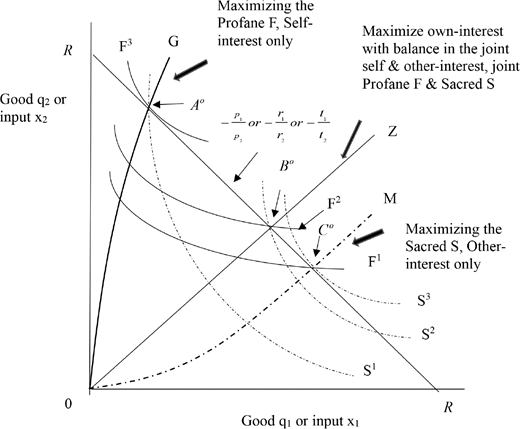
The problem was originally caused in part, perhaps not intentionally, but nevertheless caused in part by Francis Edgeworth—who in effect started the path in the late-1800s to economics being a cargo-cult science. It became cargo-cult because it shifted attention away from what would be demonstrated later in modern behavioral and neuroscience, that a Human has a dual interest (for the details, see Lynne, 2020; Lynne and Czap, 2023). Edgeworth suggested only the indifference curve of the purely ego-based self-interest driven Econ, seeing only the Profane. As McCloskey (2016, p. 137) frames it, the Profane F is represented in the max U on the self-interest only path 0G by the Econ. It is a key feature of SIT as illustrated along path 0G in Figure 1.
Yet, Amartya Sen (again, see Lynne and Czap, 2023) pointed out that even Edgeworth knew that people were impure egoists. So, a huge mistake was made from not inserting the overlapping set of shared other-interest indifference curves, which hold the shared ethic, arising out of the Human capacity to be in empathy-with the other. In McCloskey (2016, p. 137) framing, the Sacred S reflects that shared ethic. As made clear in Sheeder and Lynne (2011), it is the empathy-with the other that leads to said ethic, as in an empathy-based ethic. Said shared ethic with the other, internalized within each Human, the Sacred, is represented in DIT along path 0M. Also, in terms of the Neoclassical & Neoinstitutional integration, it is now clear it is about an integration of the Profane F & Sacred S, the Profane self-interest on path 0G in Neoclassical Economics and the Sacred shared other-interest on path 0M in Neoinstitutional Economics.
Said empathy-based other-interest has always been a main feature of Institutional Economics, now confirmed in modern behavioral science as a key feature of the Human. The Human brain has evolved with the joint ego & empathy (altruistic) tendencies (see Cory, 1999; Singer, 2009; Wilson, 2015, and, the Epilogue to Wilson, 2020), as represented in DIT. Denying that scientific reality is the primary reason SIT is a cargo-cult science. Making that mistake also results in denying any role for the humanities in making common sense of economic choice (McCloskey refers to it as economists sneering), which in effect also denies any role for Institutional Economics which rests heavily on the human sciences represented in the humanities. The humanities address the matter of the shared ethic represented in the shared other-interest. Said somewhat differently, SIT in practice then also denies the validity or any accorded relevance to Institutional Economics, and in effect denies the contribution of modern Neoinstitutional Economics tracing back to Veblen-Commons. The focus is strictly on path 0G, an economics of the Econ who operates only in the Market Forum.
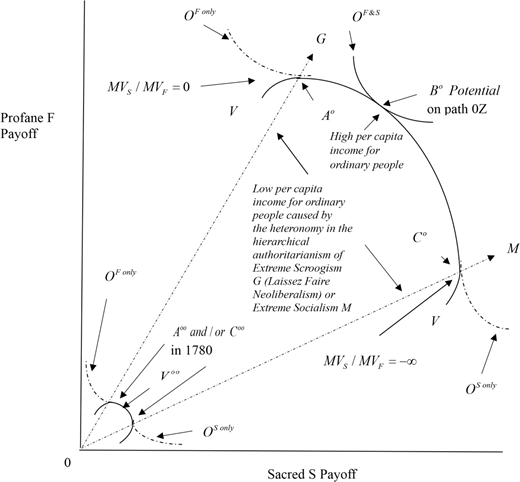
Path 0M in Figure 1, plus the notion of possibility frontiers V and incommensurable value O curves of Figure 2, together, bring in the other side of the Human well recognized in Institutional Economics. As said economics makes clear, the Econ in the Market represented in Figure 1 is tempered and given context in the Market Forum by the Other Forum of shared other-interest in the institution(s) represented in Figure 2. Said institution may be abstract as in the form of such things as rules, norms, traditions, and law as well as in organizational form like in Community organizations represented in a club, church, or labor union as well as the Administrative, Legislative, and Judicial branches of Government. So, together, Figures 1 and 2, especially the overlapping indifference curves in Figure 1, represent an analytical integration of Neoclassical (mainstream) & Neoinstitutional (institutional) Economics.
Also, while Ragnar Frisch, the first Nobel Prize winner in economics, production economics in particular, pointed to the need for two overlapping sets of isoquants, it was never brought into SIT (again, see Lynne and Czap, 2023). Not doing so also contributed to the cargo-cult nature of SIT. Single isoquant focused Econs represented in SIT see only self-interest on path 0G. In production space, path 0G also means the production economy is somehow completely independent of the Spaceship (Earth) systems within which production - in reality - is embedded: Said somewhat differently, SIT denies the reality of thermodynamic science which points to the embeddedness, another reason it is cargo-cult science. Said reality points to including the shared other-interest isoquants on path 0M, also reflecting the shared outcomes with other Spaceship systems, especially the living systems. With some Microeconomists recognizing the problem, SIT has gone through all manner of unsatisfactory fixes like in externality theory. Said fix makes no common (or scientific, as in thermodynamic) sense as nothing is external to the Spaceship except the energy coming in from the Sun.
Similar unsatisfactory fixes to SIT have been made in consumption theory by doing things like inserting the other person’s U function into a person’s U function. Said fix also lacks in common and scientific sense, as it is impossible to know the other person’s U. Said somewhat differently, interdependent utility is non-sensical, as DIT clarifies by pointing to the reality of the always operant shared other-interest which is about internalizing the empathy-based shared other-interest with the other. The best a person can do is work at projection of own-self into the situation of the other, and then speculate about what it might be like: Impartial spectator, Adam Smith said; temper choices from behind the Veil of Ignorance, John Rawls said.
It is through empathy-with the other that all people are jointly intertwined, in both production and consumption, also pointing to joint supply and demand as Travelers on the same Spaceship. SIT presumes, again in a cargo-cult science sort of way, that supply and demand and every Traveler are independent, including being independent from all other living systems on the Spaceship. Not.
Also, DIT resolves another shortcoming in SIT represented in the old pushpins (Profane F) & poetry (Sacred S) problem. Pushpins can be quantified with cost r to produce pushpins and price P to sell same. Poetry poses another problem, as what is being produced cannot be easily quantified, and, well, cost r and price P are not easy to find if the product cannot be easily measured. Also, rather than price P, poetry is more generally thought of as having a priceless value V. So, a way to address incommensurability in price P & value V must also be found. McCloskey (2016, p. 79) points to how material growth is not the only feature of the Great Enrichment: Spiritual growth also must be counted. Absolutely. DIT represents enrichment in the spiritual value O realm beyond the material price P realm: Some things are priceless, as acknowledged in Figure 2 space.
DIT resolves the problem of addressing such things as spiritual enrichment by tracing the possibility frontier of Figure 2 from moving along a RR budget line in Figure 1 (see Lynne and Czap, 2023 for the details) to give possibility VV in Figure 2. Lower and higher RR lines give lower and higher possibility frontiers. Now the value O coming out of the embeddedness represented in Other Forums (including in the arts - in poetry, plays, paintings, and sculptures - as well as novels, other writing of the time such as in newspapers, to list a few kinds) can be considered in choosing the best point in Figure 2, which in turn affects the best point in the Market Forum in Figure 1. The spiritual enrichment in the domain of the Sacred S arises jointly with, and will affect, the material enrichment in the domain of Profane F. Joint enrichment arises on path 0Z. It may work to think of value O as a kind of meta-preference (see George, 2009), a preference about preferences, or a meta U if one prefers to work with Utility U.
DIT also recognizes the possibility for synergy as between the Profane F & Sacred S such that the possibility frontiers V could move out in a way as to be increasingly further apart at an increasing rate for any given increase in resources: It is exactly what happened since the late-1700s. The McCloskey story told in 7-books, shows the synergistic move of the VV possibility frontiers going out in magnitudes SIT cannot explain from 1780 to Now. DIT can explain it easily, as the Factor 16 (or 30 or 100 or more) outcome arises out of the synergy as between the self & other-interest, the Profane F & Sacred S, as the ordinary person attains the liberty and freedom to have a go, with enrichment in both the material & spiritual.
Figure 2 is akin to the possibility frontier figure in McCloskey (2010, Chapter 25, loc 3103), with Stuff on the vertical and Services on the horizontal axis depicting the possibilities. It may be more accurate in pointing to the possibilities frontier as pertaining to the balance in the Profane F & Sacred S rather than Stuff and Services: Stuff relates mainly to the Profane F (ego driven) and Services are mainly about the Sacred S (empathy driven) anyway, so the two figures are very much working to focus on the same issues. Also, point Aoo in 1780 simply reflects the fact that up until then, especially in the middle ages, in most every place on the Spaceship Earth, “… one could buy almost anything for cash - a husband, a marketplace, a kingdom, pardon for crimes, fewer years in purgatory (McCloskey, 2010, loc 3387).” The Profane F - OF only-dominated. Nothing much was sacred, especially not liberty and freedom for the ordinary person. Also, a lot of control over ordinary people was coming from the triad of monarchism & religionism & oligarchism being also at play, as in Coo in 1780.
DIT also represents the incommensurable value O coming out of the Other Forum which works to represent the changes in the Bourgeois Deal that started arising in the 1700s and especially taking hold after 1780, and was in full blossom by 1800. Wealth increases by a Factor 16 - at minimum - as illustrated by Bo Potential in Figure 2 (just as in the figure in McCloskey, 2010, loc 3015), and the Factor is much higher in places like Norway, Sweden, and the US. The Bourgeois innovators were given more credence, the ordinary people could have a go, the value O changed to make it happen. And, like McCloskey (2010, loc 3015) says it, in answering the question why have I (Me too) drawn “ … the so-called production possibility curve for 1780 as a miserable little scrunched-up curve in the very corner of the axes… it has to be a miserable little scrunched-up curve in order to represent Now on the same diagram.”
Also, McCloskey makes much of the fact that the marginals used in SIT explanations of the great leap—marginal changes in such things as trade, imperialism, property rights, rules based institutions, science - at best take one just a bit further, moving slightly away from Aoo up path 0G. SIT marginals presume only that incentives drove the Great Enrichment, the Profane F represented in OF only.
The new value O curve which started to evolve after 1780 came to reflect good balance in the joint Profane F & Sacred S, as represented in OF&S in contrast to only the Profane F in 1780 as in OF. The DIT ethic of path 0M is represented in the OF&S to include the content of the Bourgeois Deal holding the virtues, liberty and dignity, and equality for the ordinary person to have a go through innovation and leading to the Great Enrichment. The value OF&S curve, again, a kind of meta U if one wishes to think in Utility U terms, in Figure 2 came out of conversation - talk, talk, and more talk - in evolving new Ideas D in the Innovism, in the search for the sufficient reason on the common ground of what the other can go along with, the ethic arising in Other Forums in Community: Government. The “:” means the shared other-interest, the ethic, in the Community is also reflected in an inclusive, representative Government, for which a placeholder is held in DIT.
So, DIT also sees the key role of the joint Market & Community: Government like Adam Smith envisioned. Said jointness is recognized in DIT based Humanomics, but not in the Humanomics of McCloskey. Especially in McCloskey (2019), Government causes distortion, and Government is about intervention with coercion. Government does not represent the Community (except in Norway and Sweden, to which McCloskey often points). Well, no, unless the DIT analysis finds it to be excessive, with said analysis pointing to tempering the Government excesses so found.
And, an aside: While Institutional Economics is already well-represented in the foundation of DIT, a Reviewer suggested the work of John B. Davis might also be considered. So, Davis (2011), the most recent book was reviewed (see the detailed Review at https://www.metaeconomics.info/post/individuals-and-identity-in-economics), with the result that DIT now has even more support. After going through a number of key arenas of research on identity of an individual, Davis (2011) lands in a place very compatible with DIT in what is referred to as the capabilities approach. Using DIT framing to help the Davis (2011) claims, an individual has preferences and capacity in the dual areas of ego & empathy, self & other (shared with the other), individual & social, individual & relations. Said joint self & other preferences and capacity results in the investment in self & other (shared) capabilities. The self-capability might be something like a private investment in an education, perhaps the preference and capacity to be an economist—to better serve the ego-based self-interest on path 0G. The shared other-capability might involve investing time and effort into an organization that has a particular focus, like actively engaging and building shared other-interest represented in the relationships with other economists in the Society for the Advancement of Behavioral Economics (SABE) and/or the American Economic Association (AEA). Said relationship also gives capabilities to be a more productive economist, on a better path 0Z. Capability investment as related to shared other-interest might also be made in a social organization (e.g., The Exchange Club, which has the child abuse issue center stage in both local and national programs) helping deal with the child-abuse problem, or perhaps working at building houses for the less advantaged, e.g., Habitat for Humanity. The person is then reidentified by said relationships, seeing several identities, as multiple selves.
As Davis (2011) correctly points out, consistent with DIT, an individual has the capacity to learn and go into empathy-with the other, so the individual not only invests in private (ego-based self-interest) capability but also in community-public-social (empathy-based otber-interest) capability represented on path 0M. The person has a stable identity on path 0G with many reidentified identities on alternative trajectories of path 0M. Like the economist belonging to more than one professional association of economists, the reidentification evolves as that economist connects with different associations (perhaps the mainstream AEA and the heterodox SABE) each giving a different path 0Z, a different identity for each organization, while maintaining a stable identity on path 0G.
Davis (2011) puts a great deal of effort into exploring the notion of identification and then reidentification of an individual through time, pointing to the sub-selves and multiple selves problem. DIT solves that problem through clarifying that the sub-self is composed of the ego & empathy, self & other tendencies, with the homeostatic balance found on some path 0Z. Also, DIT clarifies that the more primal tendency to ego-based self-interest gives a quite stable identity on path 0G. It is the interaction with the other, the relationship with the other, which can involve many shared other-interest path 0M trajectories over time, resulting in many alternative path 0Z trajectories that might appear to be multiple selves. Not. It is still the same person, just with many different reidentified path 0Z trajectories.
Connecting Dual Interest Theory Even More Solidly with the Humanities
The contention about dual interest being the fundamental nature of the Human in support of DIT comes primarily out of behavioral and neuroscience, with help from social psychology and sociology, as well as Institutional Economics (regarding the Sacred S) in addition to evolutionary paleontology and evolutionary biology: Humans have simply evolved, both biologically and culturally with a dual interest. Yet, clearly DIT in Metaeconomics also draws on the humanities.
So, how connect DIT even more strongly with the humanities? Well, all 7-books by McCloskey work to do so, as illustrated especially in McCloskey (2022, p. 102) which is all about introducing new understanding from the serious and systematic consideration of the humanities, as made clear with: “I get the price (N: read SIT) theory: that people are moved by price and property, the variables of prudence, price, profit—or, as I have called Max U’s motivations, the Profane. But the point here is that people are also moved by the S variables of speech, stories, shame, the Sacred, and by the use of the monopoly of coercion by the state, the legal rules of the game and the dance in the courts of law, the L variables. Most behavior, B, is explained by F (McCloskey uses Profane P, changed to Profane F here, because DIT formulations use P for price P) and S and L, together, metaphorically speaking:
The equation is not wishy-washy or feminine or unprincipled or unscientific. The S and L variables are the conditions under which the F variables work, and the F variables modify the effects of the S and L variables.” As Institutional Economists have always argued, S and L matter. And, yes: Figure 1 and Figure 2 point to how each forum influences the other.
DIT clarifies that the Profane F is all about ego-based self-interest on path 0G, the primal driver, going way back in mammalian to include Human evolution. The Sacred S is about what the other can go along with, also coming out of evolution. The Sacred S on path 0M holds the virtues as delineated in McCloskey (2006), the 6-virtues framed by the empathy-based love-virtue, giving mindful attention to faith and hope, on the way to justice made possible with courage to balance the self & other-interest, brought to task with temperance. All the other 6-virtues give context to the 1-virtue of prudence driven self-interest of path 0G. And, self-command is key, as in “Temperence is the cardinal virtue of self-command in the face of temptation (McCloskey, 2010, loc 1767).” So, with temperance on task to make it happen, the result is to bring the person and the system writ large into homeostasis, efficiency, and economic equilibrium on path 0Z. Path 0Z reflects the integration of science & humanities (the latter in the sense of introducing the ethic), too, making common sense of the best path.
After introducing the metaphorical B equation, McCloskey (2022, p. 103) continues: “Of course… The institution is the S, the process of the F, the legal limits L. Or sometimes the other ways around. Anyway, often, all. … You can get as technical as you want about it. For example, econometrically speaking, if the F and S and L variables are not orthogonal, which is to say if they are not entirely independent—or alternatively if there is reason to believe that a combined variable such as FS has its own influence—then an estimate of the coefficients that ignore S (or FS or FL) will give biased results.”
Makes DIT sense, with the F on path 0G, the S and L, the institutions, on path 0M, and the integration resolved on path 0Z. Also, good L is dependent upon good S. And, F & S are in fact interdependent, joint and nonseparable, or at least that is a good starting point for empirical inquiry, with the null hypothesis of not interdependent, no shared other-interest, no influence of the institution. All the complexity here is handled well in Mathematical Metaeconomics (see the Appendix in Lynne, 2020), with the connection made to the Behavior B equation from McCloskey in a Mathematical Humanomics on the Metaeconomics Website at https://www.metaeconomics.info/profane-sacred-and-the-law.
So, keep McCloskey’s Behavior B equation in mind as the search commences in the 7-books on what drove the Great Enrichment, exploring if a DIT in Humanomics is helpful in making common sense of it. And, the intriguing question is which theory, DIT or SIT, works best in consort with a new Humanomics.
Humanomics is Suggested by Economic History in the Effort to Explain the Great Enrichment Since 1800
In the beginning of the 3rd (last) volume, McCloskey (2016) clarifies the 2006, 2010 and 2016 trilogy is about the economic, social, and intellectual history unwinding in the “The Bourgeois Era” which took hold over the period of 1517–1789, giving rise to the Bourgeois Deal that drove the Great Enrichment. As McCloskey (2016) self-describes it, in the 1st volume, McCloskey (2006) documents how the commercial bourgeoisie—the middle-class of traders, inventors, and merchants—not only did a pretty good job, which was the case throughout all of recorded history, but also started to be respected for it. In the 2nd volume, McCloskey (2010) finds little in the way of material causes that could explain the orders of magnitude, huge increases in the wealth of the typical Spaceship Earth traveler that occurred after 1800. Something else was going on, beyond mere marginal changes in such things as property rights or trade or coal or thrift or capital or imperialism or changes in rules of institutions or science.
So, in the 3rd volume, as McCloskey (2016) self-describes, it is all brought together with the claim that the Factor 16 to 100 or more giving the Great Enrichment was due to a change in the ethic as it came to give content to the Bourgeois Deal. Said deal gave the liberty and freedom for the ordinary person to have a go at making some improvement, and, again, with said proposed betterment tested in the Market. Said startling new ideas evolving in the whole society in that 1517–1789 period, many ideas being accidental, led to a revaluation of the efforts by the bourgeosie, giving dignity and equality of opportunity to ordinary people. That revaluation came to be referred to as (classical) liberalism, which led to wide-spread betterment.
It all leads to McCloskey, as alluded to earlier, after finishing the three volumes, calling for a Humanomics. Now, for the whole story.
Bourgeois Virtues on the Way to the New Ethic of Commerce
The main story in McCloskey (2006) is about the virtues on the way to the new ethic giving content to the Bourgeois Deal. As summarized in Khachaturyan and Lynne (2010), the primal virtue is prudence, with other virtues including temperance, faith, love, justice, and courage. The bourgeois virtues, in turn, can be derived from these 7-virtues, viewed in business practice to include enterprise, adaptability, imagination, optimism, integrity, prudence, trustworthiness, affection, self-possession, consideration, responsibility, civility, neighborliness, obligingness, reputability, dependability, and impartiality. And, using the progress that has been made in improving DIT since Khachaturyan and Lynne (2010), it is the empathy-based virtue as related to love, connection, and friendship which brings the other virtues into play to give context to prudence, given enough self-control represented in temperance.
See Khachaturyan and Lynne (2010) for the rest of the details in McCloskey (2006).
Bourgeois Dignity (and Liberty) Became Part of the New Ethic
The 2nd volume, McCloskey (2010) is about economic history. The essence of McCloskey (2010) is represented in the first few paragraphs of Chapters 40 and 41.
McCloskey (2010, loc 5092) starts in Chapter 40 by pointing out the puzzle to be solved, as to why areas around the North Sea in the middle to late-1700s into early-1800s, England especially, suddenly started to produce massive increases in wealth. Even though inventions had been around for centuries, just why the sudden spurt in wealth? McCloskey (2010) goes on to explain that the many marginals suggested by SIT, such as high savings rates, lots of international trade, improved transportation, more private property, education and literacy, science, information flow, thrift and accumulation of capital, coal and natural resources, growing greed, the slave trade or eliminating slavery, moving away from misogyny and other discriminatory frames to be more inclusive, tempering population growth, genetic superiority, and imperialism, incentives driven institutional change, well, none of said marginals, can explain the leap after 1800. Even added together, one gets a point perhaps above that on Voo in 1780 but nowhere near the wealth on VV Now as illustrated in Figure 2.
As McCloskey (2010, loc 5141) says: “The problem with all the economistic (Note: Again, SIT based) explanations lies deep within classical and most of subsequent economic thought: the conviction that shuffling stuff around makes us a little better off, which is true, and therefore that the shuffling makes us as rich as modern people are, which is false.” It was not the Marginals of SIT: It was the institutions of Institutional Economics represented in the shared other-interest in DIT that were changing dramatically.
McCloskey, 2010 goes to the crux of it in the next Chapter 41: “In the beginning was the word. Free innovation led by the bourgeoisie became at long last respectable in people’s words (loc 5129–5220) … there emerged a greater willingness to view commercial society, not as a sink of corruption but as a wholly legitimate sphere of private sociability (loc 5242–5243).” The Bourgeoisie was revalued. In DIT terms, solving the historical puzzle points to how especially in England a best balance was struck in the Profane F & Sacred S, the S reflecting the words, as in Figure 2, with OF&S not OF only.
Now, going back to the beginning of the book, Chapters 1–13, some other key points: “The Bourgeois Revaluation R-shift- … the “Bourgeois Revaluation” (loc 229)… is at play, not just the Reformation after 1517, and not just the Renaissance, Revolts and Revolutions… The Revaluation gave hope and was built on faith. Liberty gives hope. Dignity encourages faith. Liberty and dignity arise together. It is not just liberty, as Libertarians claim “… liberty alone to suffice (loc 237)… ” makes complete sense using DIT: Liberty is represented on path 0G (which is the only path Libertarians see, as represented in SIT), and dignity on path 0M, which must be squared with Liberty & Dignity on path 0Z in Figure 1.
Also, it seems, as McCloskey (2010) says it: “The economists did not notice that something entirely new was happening from 1760 or 1780 to 1860 (loc 1288)….” Economists had overlooked applied innovation by ordinary people. Revaluations were at play, putting value on innovation by said ordinary people. The ethic—the institution—on path 0M matters.
And, perhaps one of the most important events that set the stage for the leap, the Reformation: “On August 18, 1520, the press of Melchior Lotther at Wittenberg issued four thousand copies of, as Luther put it, a ‘broadside to [the Emperor] Charles and the nobility of Germany against the tyranny and baseness of the Roman curia’ … Between 1517 and 1520 about three hundred thousand copies of Luther’s work … were printed and sold. (McCloskey 2010, loc 1576–1580).” The Reformation brought empathy-based love, one of the three Christian virtues, to the fore. And, as DIT makes clear, such empathy-with the other is what gives context to forming the path 0M, forming the institution, forming the shared ethic with the other, all others, not just the hierarchy, bringing all into play.
Chapters 14–39 go through the details as to why the marginalist, SIT based explanations do not explain the leap. As already noted, Chapters 40–41 represent the essence. And, then, in the final Chapters 42–46, a few more final points are suggested by the chapter titles as in dignity and liberty for ordinary people, in short, were the greatest externalities; and the model can be formalized; opposing the bourgeoisie hurts the poor; and the bourgeois era warrants therefore not political or environmental pessimism; and, the last chapter, but an amiable, if guarded, optimism.
The rhetorical call for the key role of the substantive change in the ethic as represented in the dignity and liberty of the now Bourgeois ordinary people is quite convincing. Got it. And, sure, the leap from 1780 to Now helps the poor. Pessimism is offset by the possibility for such leaps, and, intriguingly as McCloskey demonstrates, a leap like change in the ethic—the change in the institution—can occur in just a few decades.
The frame for optimism from McCloskey is somewhat surprising, in that too often the book uses SIT based Libertarian economics reasoning, when the sufficient reason being sought could be better framed with Institutional Economics and DIT. But, in effect, DIT appears at the end of the book, in McCloskey referring to the leap in Sweden (and Norway is also used as another regular example in McCloskey’s books): “The Swedish economy, … retains a good deal of bourgeois and innovative dynamism… (and) one might argue that the welfare state allows Swedes to take an entrepreneurial chance … the nonstigma there attached to bankruptcy… while Roosevelt in the United States was still ranting against economic royalists and terrifying the investing class, the unions and corporations in Sweden were agreeing to industrial peace, under a Social Democratic regime that gave wide latitude to the industrialists for investing in technology, and earning profits. The liberal economic spurt in … Sweden (made Sweden wealthy) … (and) government officials almost always have the public good in mind … (McCloskey, 2010, loc 5974–5976).” DIT clarifies the jointness in private & public good.
Well, the Swedish and Norwegian systems both are anything but Libertarian based economies—especially not living with the kind of Libertarian economics represented in SIT. As made clear in Lynne (2020) such economies are easy to understand using DIT in Metaeconomics, said economies operating on path 0Z. So, in the end, McCloskey (2010) and Lynne (2020) seem to be on much the same page, with both Norway and Sweden in view.
Bourgeois Equality of Opportunity Also Entered the New Ethic
Recall the 2nd volume, McCloskey (2010), was about the history of economic Ideas D. In the 3rd and final volume, a 768-page book in 67 chapters, McCloskey (2016) focuses on how the evolving economic Ideas D relate to and are influenced by changing ideas in the domain of the social and intellectual. The 3rd volume is about changes in the institutions, albeit McCloskey seldom uses the term institution, in effect also ignoring Institutional Economics going back to Veblen-Commons. McCloskey (2016) zeros in on the (classical) liberalism that took hold in northwestern Europe, an “ism” that was accidentally found during the 1517–1789 period. And, as McCloskey frames it, liberalism is the only “ism” that has worked in making most if not all Travelers on the Spaceship richer - compare communism or socialism or religionism or fascism or nationalism - to list a few. And while not mentioned in McCloskey, extreme laissez faire capitalism—as in neoliberalism even without authoritarianism, and even worse when it is, in play—has not worked, either (see Munger and Villarreal-Diaz, 2019; Gerstle, 2022). Historically it has been the driver of all the “badisms” about which McCloskey is concerned.
Due to a great deal of overlap in McCloskey (2016) with key ideas already addressed in McCloskey (2006) and McCloskey (2010), the focus here is on insights of intrigue to Behavioral Economists. So, here goes. McCloskey (2016) sometimes goes after both Left and Right on the political spectrum: “The radical left and the traditionalist right see economic growth as a vine smothering the world, a monopolistic kudzu, bringing on the cultural triumph of the West. (The traditionalist right glories in the cultural triumph of the West, at any rate if the rightist is a Thatcherite Westerner) (p. 118) … and … The left’s trickle-up economics is as illogical as is the right’s trickle-down version. Neither focuses on what actually increases real income, which is bettered production (p. 120).” Yet, McCloskey more often goes after the supposed mistakes and excesses of the Left than the Right: A negative twist is regularly put on the frame of the socialist and socialists. Socialism is pointed to pejoratively dozens of times throughout the 7-books, although often applauded in the form it holds in Norway and Sweden. And, regarding the mistakes and excesses of the Right, as in the primal tendency of an unfettered, unethical liberalism (i.e., laissez-faire capitalism) giving license to the scroogists and scroogism—well, never mentioned as a problem. Rather, the primal tendency of the unfettered liberalism system to concentrate wealth and stir cronyism followed by predictable political economic chaos (again, see Munger and Villarreal-Diaz, 2019) seems to be of no concern to McCloskey.
Specifically, Scrooge is only mentioned 7-times in McCloskey (2010) and 1-time in McCloskey and Carden (2020), all 8-times poking fun at Charles Dickens and cartoonists who depict Scrooge as piling up money. McCloskey uses the Scrooge-pile of money to make the claim that it is not such piles that drive the Great Enrichment, so, in that sense is not supportive of the scroogists or scroogism, although such terms are never used, nor such frames criticized, in any of 7-books. The other reference to Scrooge is in the matter of Government (or anyone else) helping the poor, where Charles Dickens’ Scrooge says: “Are there no prisons?” pointed to in McCloskey (2019). The phrase is used to make the McCloskey claim that the Government has never been effective in helping the poor. McCloskey claims that only liberalism helps the poor. Overall, Charles Dickens, the novelist who pointed to Scrooge, was too socialist for McCloskey.
Yet, as DIT clarifies, and behavioral economists need to test the proposition: It really needs to be about a joint scroogism & socialism, leading to an optimal inequality which has adequate incentives but avoids resentment due to absurd compensation (like CEOs making 300–400 times the typical worker). It is a joint scroogism & socialism that likely works, as demonstrated in the examples regularly alluded to by McCloskey of Norway and Sweden: Good question for behavioral economists to ask.
And, on transcending SIT: “… (economists in general) are unwilling to bring ethics seriously into their history and their economics. As one of them said genially to me, ‘Ethics, schmethics’ (p. 192) … It’s hard to get through to economists on the point, so enamored are they of the Max U story of budget lines and incentives, which they have been taught since boyhood is a complete theory of choice. They have not read the opening pages of Aristotle’s Nicomachean Ethics, for example, or the Exodus of the Jews, or the Mahabharata of the Hindus, all of which exhibit choice as a painful exercise in identity, by contrast with the snappy determinism of a so-called consumer facing a so-called budget line (p. 193).” Economists, try DIT, please, and, yes, institutions holding the shared other-interest do matter.
And, back to political economy, in an intriguing claim: “Modern politics is a four-way tug of war between liberalism in the sensible part of the elite, socialism in the rest of the elite, traditionalism in the peasantry, and populism in the proletariat. Only liberalism works, but the others tug vigorously (p. 221).” DIT has a placeholder for examining the content of such a claim, using Behavioral Economics methods: Put the “ism” into the shared other-interest part of the analytical system and go find the data to test how well it works. And, extreme forms of liberalism do not work, either.
And, on what drives the Human: “People are partly motivated by prudence, to be sure. But that does not imply—though many young, male economists think it does—that all human motivation must therefore be reduced to freakonomics prudence… Contrary to the prudence-only model, we have always known, and have recorded since the invention of writing, that intrinsic virtues beyond prudence—love, justice, temperance, and the rest—are parts of what motivate adults (p. 498).” Absolutely. As DIT makes clear, it is not prudence-only on path 0G, but the other virtues on path 0M bringing the choice by Humans on to path 0Z.
And, built into the core of SIT: “‘economists discuss actors as if they have no families, are citizens of no countries, are members of no communities… In the language of sociology, ‘individuals, in the hands of economists, are typically undersocialized, isolated creatures’ (citing Boettke and Storr). By erroneously depicting businesspeople as creatures only of the restless stirring for gain we paradoxically take away the ethical limits on their greed. Go for it; greed is good, because after all you are merely a disgusting capitalist (pp. 633–634).” Well, DIT fixes it, with the community: government of shared other-interest representing the ethic on some path 0M. And, a path 0G person could indeed be a disgusting capitalist if ignoring the ethic on path 0M.
McCloskey claims mainly good capitalists—ordinary people represented in traders, inventors, and merchants, all into Innovism—operated until about 1848. At that point, something changed: “The bourgeois talk was challenged mainly by appeal to traditional values, aristocratic or religious (‘the old Brahmin idea of service’), which morphed into utopian visions of nationalism, socialism, fascism, and radical environmentalism (p. 688).” It comes to mind that the Communist Manifesto was first published in 1848, probably driven by the perceived if not real excesses of some of the Bourgeoisie in the laissez-faire years leading up to 1848. Not sure it was just appeals to such things as traditional values, but rather a reaction to excesses: Just a MetaEcon asking a questions.
Yet, McCloskey never sees problem in excesses, and so does not provide reasons for the shift after 1848: “For reasons I do not entirely understand, the clerisy (artists, intellectuals, journalists, professionals, and bureaucrats) after 1848 turned toward nationalism and socialism, and against liberalism, and came also to delight in an ever-expanding list of pessimisms about the way we live now in our approximately liberal societies, from the lack of temperance among the poor to an excess of carbon dioxide in the atmosphere (pp. 11–16)… the age of socialism arrives around 1917 …” McCloskey does not seem to realize it arrived because of the excess concentration of wealth and the power it could buy, and, in the U.S. it all crashed in 1929 (and again in 2008).
McCloskey (2016) closes with the contention that none of the pessimisms that came forth after 1848 hold a candle to the reality of what the McCloskey form of liberalism can fix, as in fixing seven old pessimisms and one new one (pp. 842–843): “The old pessimism of 1848 said that the poor were fated by Malthusian logic to stay poor. The pessimism of 1916 said that only Europeans were genetically capable of getting out of $3-a-day poverty. That of 1933 said that anyway the getting out was finished because the final crisis of capitalism was at hand. That of 1945 said that betterment was finished and stagnation was at hand, with excess savings inevitably dragging income down. That of 1968 said that anyway, when we got out of the (nonfinal) crisis and found that technological stagnation didn’t in fact happen, we fell into a consumerism corrupting of our souls. The old pessimism of 1980 said that the consumerism in the core countries, though it had apparently not corrupted or immiserized the proletariat there, depended on an army of exploited people in the Southern periphery. And the not-so-old pessimism of the 1990s—it had been articulated in Britain as early as the 1890s … that Old Europe and the (dis)United States were doomed to fall down the league table … the new, eighth pessimism of our own times is that environmental decay is irreversible.” McCloskey does not mention 2008, which was caused by the excesses of The Neoliberal Order. McCloskey (2016) then makes the case that none of the pessimists have sufficient evidence. Liberalism, left to Innovism, will fix all. Maybe. DIT points to a way to address the matter, pointing to the role of excesses.
Economic, Social, and Intellectual History Points to the Claimed Superiority of Liberalism
Not surprisingly, after finishing the trilogy, liberalism is claimed to be superior. Yet, McCloskey (2019) also points (as elaborated in 400-pages and 50-chapters) to the need for said “ism” to represent the ethic of the Bourgeois Deal, and McCloskey wants a new kind of Libertarianism in play. And, given that the old kind of Libertarianism undergirds SIT, as in “… Chicago School libertarianism (which uses SIT is) fiercely opposed to any ethical reflection whatever… (p. 93)” it seems a new theory, like DIT, is also needed.
The nature of the new ethic, the new Libertarianism, it turns out, comes to be in McCloskey (2019) a seemingly minor tweak on the ethic underlying standard Chicago School Libertarian Economics, because McCloskey does not call for a new theory beyond SIT but only “… for a modern and humane version of what is often called ‘libertarianism.’ It is not right wing, reactionary, or some scary creature out of dark money. It stands in the middle of the road—recently a dangerous place to stand—being tolerant and optimistic and respectful. It’s true liberal, that is, anti-statist, opposing the impulse of people to push other people around. It’s not ‘I’ve got mine,’ or ‘Let’s be cruel.’ Nor is it ‘I’m from the government and I’m here to help you, by force of arms if necessary.’ It’s ‘I respect your dignity and am willing to listen, really listen, helping you when you wish, on your own terms.’ When people grasp it, most like it. Give it a try (McCloskey, 2019, p. 4).” So, it seems McCloskey thinks that SIT is just fine, not seeing that SIT is embedded within and reflects the old Libertarian ethic. McCloskey needs not only a new ethic, a new kind of Libertarianism being one candidate, but also a new theory like DIT which can hold any ethic, the best ethic being preferred.
McCloskey (2019, p. 5) needs to distance own-self from the form of the Libertarianism underlying SIT and go back to Adam Smith, as in: “The Blessed Adam Smith recommended in 1776 ‘the liberal plan of equality, liberty, and justice.’ The first in Smith’s triad is a hoped-for equality in social standing, which he favored. Contrary to the attitude of the country club, and contrary to the pride of some of the men wearing Adam Smith ties, and contrary to a leftist’s assumptions about Smith when she has not actually read a whole page of him with attention, Smith was an egalitarian. A man’s a man for a’ that.” Ah, good, we MetaEcon say, having read Adam Smith, with said reading making it clear Adam was not a Libertarian. Adam Smith would not identify with the Chicago School Libertarian Economists like Milton Friedman, nor with McCloskey before being reformed to include ethics: Adam Smith would likely approve of DIT.
McCloskey started the style in McCloskey (2010) of pointing to the key points in the story with Part and Chapter titles. So, in McCloskey (2019) on Parts: you should become a humane true liberal, in 17-Chapters; humane liberalism enriches people, in 6-Chapters; the new worry about inequality is mistaken, in 10-Chapters; and the other illiberal ideas are mistaken, too, 17-Chapters. So, 50-Chapters covering 400-pages: The book takes a while.
Part One on becoming a humane true liberal: modern liberals recommend both golden rules, that is, Adam Smith’s equality of opportunity; liberalism had a hard coming; modern liberals are not conservatives, nor statists; liberals are democrats, and markets are democratic; liberals detest coercion; liberalism had good outcomes, 1776 to the present; yet after 1848 liberalism was weakened; the “new liberalism” was illiberal; the result of the new illiberalism was very big governments; honest and competent governments are rare; Deirdre became a modern liberal slowly, slowly; the arguments against becoming a liberal are weak; we can and should liberalize; for example, stop “protection”; and stop digging in statism; poverty out of tyranny, not “capitalist” inequality, is the real problem; humane liberalism is ethical.
Lots to unwrap here, but in DIT terms, McCloskey is pointing to the content of the shared other-interest, the content of the institution, that works to bring the Great Enrichment, especially since 1800. McCloskey also claims that the new kind of Libertarianism giving content to the shared other-interest in liberalism was operating well starting in the mid-1700s until 1848, or so, and, not so much since. After 1848, Spaceship travelers, instead, often pursued and/or were subjected to communism and socialism and fascism and religionism and nationalism all with too much authoritarian control (as in the return of the deadly triad pre-1700s of monarchism & religionism & oligarchism), poverty the result of tyranny in same. Such “isms” reduce and restrain the liberty and freedom to have a go, taking too many places too far from the humane liberalism which started in full bloom around the time of Adam Smith. As DIT clarifies, Adam Smith fully realized that reaching a true Enrichment was about good balance in the joint wealth & sentiments (again, see Lynne, 2020), incentives & ethics. And, as Deirdre admits, even she was a slow learner of the fact that Adam Smith already understood what it would take to reach a true Enrichment.
Part Two on humane liberalism enriches people: liberty and dignity explain the modern world; China shows what economic liberalism can do; commercially tested betterment saves the poor; producing and consuming a lot is not by itself unethical; trickle up or trickle down is not how the economy works; the liberal idea, in short, made the modern world.
In a nutshell: “What made us rich was not accumulation or exploitation, but Franklinian innovation—new ideas for blast furnaces, anesthesia, spectacles, computers, German universities, French reinforced concrete, Italian radios, British radar, American assembly lines. A new political liberty to have a go and a new social encouragement to take advantage of it, Innovism, made us rich (p. 114).” So, it is about Innovism, not Capitalism. Got it.
And, sure, as DIT clarifies, it all works as long as Optimal Inequality (see https://www.metaeconomics.info/post/adam-smith-on-income-and-wealth-inequality) and not some presumed trickle down magic is at play: The ethic of optimal inequality is essential, made clear in DIT. A humane liberal Scrooge needs to develop an empathy-based ethic on compensation, tempering the Scroogism at the top while addressing the Cratchitnism at bottom, finding what Cratchit can go along with.
Yet, Part Three starts by claiming the new work about inequality is mistaken: forced equality of outcome is unjust and inhumane; Piketty is mistaken; Europe should resist egalitarian policies; Europe should resist egalitarian policies; Piketty deserves some praise; but pessimism about market societies is not scientifically justified; the rich do not in a liberal society get rich at the expense of the rest; Piketty’s book has serious technical errors; the ethical accounting of inequality is mistaken; inequality is not unethical if it happens in a free society; redistribution doesn’t work.
DIT suggests the new work on inequality is likely not mistaken: Again, pay attention to scroogists and scroogism, as does Piketty, please. And, as a case in point, while SIT always claims raising the minimum wage makes the poor worse off, well, that can only be true if compensation at the top is not reduced to pay more at the bottom, as DIT makes clear. And, if one is wondering if Optimal Inequality is needed, just look at the current political economic chaos around the Spaceship now here in the 2020s, especially indicated by rising populism and nationalism. Said “isms” have been driven by The Neoliberal Order (Neoliberalism, as in Laissez-Faire tried once again) that operated during the period of 1970–2008 (see Gerstle, 2022), with still lingering negative effects: The Order led to extreme inequality with most of the Bourgeois Middle just not doing well financially. Resentment drove economic populism, and, predictably, an Authoritarian Con arrived on the scene to fix it all.
Part Four on other illiberal ideas are mistaken too: The last 17 Chapters are a bit redundant, in being a compendium of interviews and other short releases published in popular outlets.
McCloskey (2019, p. 312) finishes the book with: “Yes, I know, you will lean toward rejecting all these factual findings because they are ‘right wing’ or ‘libertarian.’ I ask you merely to stop imagining alternative facts that suit your politics. I ask you to listen, really listen, and to consider.” Well, yes, a MetaEcon asks McCloskey to do the same. Consider DIT in Metaeconomics to help make common sense of it all. DIT clarifies that the best ethical content of the shared other-interest is an empirical question searching for the best balance in the joint right & left, scroogism & socialism, libertarianism & communitarianism: A bird cannot fly on just one wing of right-wing libertarianism, even the new kind.
Leave Me Alone and I’ll Make You Rich: Humanomics Can Help
As noted, McCloskey and Carden (2020), the Leave Me Alone book, 232-pages in 26-chapters, builds upon and works to represent the essence of the story weaved in the 3-part trilogy. See Lynne (2024) for a detailed Review.
Overall, ethics are again claimed key, as demonstrated using DIT. It is not new news, and Adam Smith is claimed the hero of the book, as Smith “… is fresher than today’s newspaper (p. 176).” As noted in Lynne (2024), Adam Smith is a both a hero and fresher because the Smith claim was, and the claim still holds, that the only path to the true Wealth of Nations is by tempering the primal tendency to excess (it was not about maximizing the Wealth of a Few), doing so with the Moral Sentiments.
The other really important idea from McCloskey and Carden (2020) is brought to light at the end of book, where it is made clear that Adam Smith – as alluded to earlier, but it is important, so repeating it here – “… never, ever said that ‘greed is good.’ Nor did he …lead towards a Benthamite notion … that ‘utility’ from benefit minus cost runs the human drama. On the contrary, Smith practiced ‘humanomics,’ an economics with the humans and their ethics left in (p. 176).” Yes, so does DIT, accomplished through seeing the dual nature of the Human. Again, see Lynne (2024) for the details around how leaving me alone might make you rich. Libertarians will like it.
Humanomics Can Be Made Better
Bettering HumanomicsMcCloskey (2021, p. xi), 144-pages in 16-chapters, frames the matter of making economics better through building a Humanomics by noting the main reason for the cult-like form of SIT economics is “The sneering dismissal (by economists) of ethics … and their accompanying scorn for most of human knowledge…” In DIT terms, sneering denies any role for the institutions represented on any and all path 0M trajectories.
McCloskey (2021) has three parts: the proposal; the killer app; and the doubts. And, in typical McCloskey form, the titles of parts and chapters point to main ideas in the story.
The proposal points with 8-chapter titles to how humanomics and liberty promise better economic science; Adam Smith practiced humanomics, and so should we; economic history illustrates the problems with nonhumanomics; an economic science needs the humanities; it’s merely a matter of common sense and intellectual free trade; after all, sweet talk rules a free economy; therefore we should walk on both feet, like Ludwig Lachmann; and, that is, economics needs theories of human minds beyond behaviorism.
Starting with the last claim: Economics needs DIT, not SIT. The behaviorism of SIT focuses strictly on incentives driving the prudence-only, ego-based self-interest of the Econ, like rats pushing levers for food. DIT sees incentives as primal but also sees what the other can go along with, as represented in the empathy-based ethic holding the other virtues, as key: The Human must temper the primal self-interest. DIT is about tempering the primal self-interest with the ethic representing the other virtues and shared with everyone else as to what is a real betterment. So, as DIT clarifies, it needs to be about testing the betterment in the joint Market & Community: Government.
SIT “science” fails to explain economic history, as it takes, as McCloskey argues and DIT demonstrates, both science & humanities to do so. DIT represents the common sense of Human experience pointing to how operating on the arrogance of self-love (self-interest only) does not work well. Humans have to live with others, as well as need and depend on others, as in Crusoe & Friday. And, intellectual free trade, economists need to read and give due attention to the other social sciences, and, especially give some attention and respect to the humanities. DIT is built on that trade.
And, sweet talk, sweet indeed: Production and trade cannot occur without finding common ground, finding a shared other-interest that works for the other going every direction, and sweet talk makes it all possible. Said sweet talk goes on in the Other Forums beyond the Market Forum, as represented in the DIT styled Figure 2 which operates beyond and influences what is represented in the DIT styled Figure 1. And, Ludwig Lachmann? Lachmann saw the play within the own-self of the quantitative behavioralist and the qualitative humanist, as does DIT, and as did Adam Smith.
The second part of the book, the killer app points with 5-chapter titles to the killer app of humanomics is the evidence that the great enrichment came from ethics and rhetoric; the dignity of liberalism did it; ideas, not incentives, underlie it; even as to time and location; and, the word’s the thing. The overall notion of a killer app arose from a suggestion to McCloskey by noted behavioral scientist Herb Gintis: “I see what you mean, Deirdre. But you need a killer app, an explanation of an important economic event that shows that the humanities matter (p. 53).”
DIT gives analytical substance to the killer app of Humanomics. DIT does so by demonstrating it is not just incentives feeding the arrogance of self-interest that makes for material and spiritual enrichment on path 0Z, which supports the McCloskey story. Ethics matter, liberty matters, dignity matters, equality matters—all such matters represented in the shared other-interest in DIT.
And, the word’s the thing, as in plentiful, open, fact-based & ethics-based (using the facts) conversation, about what the other could go along with. In DIT terms, the word helps fill out, giving content to the shared other-interest which then works to temper the self-interest on the path to betterment, and the Great Enrichment. And, as McCloskey makes clear, it all started in northwestern Europe: As DIT clarifies, it all started from empathy-with, which leveled the hierarchy, likely caused heavily by the Reformation, bringing into play better institutions: Empirical question.
The last part points to: the doubts of analytic philosophers about the killer app are not persuasive; nor by sociologists or political philosophers; nor even by economic historians, all about the McCloskey reaction to and evaluation of reviews of the trilogy. All doubt the key role of the ethic of the Bourgeois Deal: McCloskey wins with the rhetorical claims of the trilogy, made even stronger when framed with DIT.
Making Humanomics Better by Moving Beyond Positivism, Behavioralism, and Neoinstitutionalism
As noted earlier, the word institution is seldom used in the 7-books, although by McCloskey (2022), the call is for going Beyond Positivism, Behavioralism, and Neoninstitutionalism in order to transcend the cargo-cult nature of economics, convincing rhetoric in 192-pages and 14-chapters. Positivism works to downplay the role of the Humanities in making sense of the Science. And, then, when mixed with Behavioralism, it sees only Econs responding to incentives, again, like rats pushing food levers and not Humans who do respond to incentives but hopefully tempered by ethics. In addition, the Douglas North et al styled neoinstitutionalism joins in to make the cargo-cult like claim that the Institutions N that give context to the Market are given form only as rules driven by incentives. As a result, as a true Neoinstitutional Economist represented in Bromley (2019, p. 28; see Lynne, 2021 for Review) says it, “Economics, it turns out, is just a political ideology in disguise.” It is an ideology of excess, based on the cargo-cult premise that people are and need to be Econs not Humans. And, connecting here, Metaeconomics (Lynne, 2020; Lynne and Czap, 2023) is about Tempering the Excesses. It is a Humanomics which also goes beyond the positivism, behaviorism and neoinstitutionalism framed in McCloskey (2022).
Again, as in earlier books, key ideas are put forth in titles of the parts and chapters. The three parts are: economics is in scientific trouble; neoinstitutionalism shares in the troubles; and, humanomics can save the science.
Claims about SIT in Microeconomics being in scientific trouble are organized in 5-chapters, as in: an antique, unethical, and badly measured behaviorism doesn’t yield good economic science or good politics; economics needs to get serious about measuring the economy; the number of unmeasured “imperfections” is embarrassingly long; historical economics can measure them, showing them to be small; and the worst of orthodox positivism lacks ethics and measurement. And, to help frame what is covered in said chapters, it is useful to jump ahead to Chapter 8, where again McCloskey refers to the Behavior B = α + βF + γS + δL + ε.
Behavioralism represented in SIT sees a person as an Econ with only the profane F at play. The Econ acts only on incentives as represented in a budget constraint R, relative price r, and price P, seeing only the Profane self-interest path 0G in the typical DIT styled Figure 1. Nothing Sacred S, as in the ethic, influences the self-interest path, nor does the Law L and the Institution N it reflects. Bringing SIT into explaining political behavior is even worse, wherein the citizen, including the citizen politician, who needs to be about shared other-interest is replaced by the politician serving only self-interest, along with the consumer paying tax T only for things that max U, only for private good and not for public good. Also, in SIT, Law L plays no productive role, but rather is framed as only being for intervention and distortion of the Behavior B. DIT clarifies that both political behavior and ethical Law L must be about seeing the jointness in consumer & citizen, private & public good. Politics needs to reflect not only the Profane F but also both the Sacred S and the Law L, both reflecting the Institution N: All play key roles.
The neoinsitutionalism as framed by Douglas North et al is not the true Neonstitutionalism, which is based in an integration of old Institutional Economics and modern Behavioral Economics as in Lynne (2020, Table 2.1). True Neoinstitutionalism sees the key role of the conversation going on in Community: Government M operating in DIT styled Figure 2 in forming an Institution N as represented on some path 0M in the DIT styled Figure 1. As DIT helps clarify, and McCloskey tells the story, the Behavior B runs on Ideas D and the ethic so formed as represented in the Institutions N and Law L. Innovism also drives the formation of good Institutions N, but also is dependent on that N, with said good Institutions N essential for Enrichment.
McCloskey also claims Innovism needs to be measured, with the focus on sizes of coefficients, magnitudes and not just tendencies, focusing on the oomph not just statistical significance. A list of 108 items needing attention is provided. A few are especially noticeable in the frame of DIT, as in: “5. greed, 11. lack of bargaining strength by the workers, 20. adulterated food if no regulation, 24. self-interested markets, 27. externalities: the master lemma leading to the master postulate of modern economics, 49. economic behavior has motives beyond self-interest, 56. tragedy of the commons, 58. transaction costs.”
As DIT makes clear, all said items pertain to tempering self-interest with the shared other-interest, especially tempering the greed; sees bargaining strength in unions as essential to bring empathy-with into play; acting on the shared other-interest ensures safe food; self-interested markets are tempered by the shared other-interest; externalities do not exist as nothing is external, instead internalized within the shared other-interest; people are motivated primarily by self-interest but work to temper it with what the other can go along with, in effect having both an ego-based and empathy-based motive and interest; the tragedy of the commons is solved with the evolution of a shared other-interest the other can go along with (as Nobel Prize winner Eleanor Ostrom made clear); and, transaction costs are minimized with the best shared other-interest reflecting what the other can go along with. Using DIT will give different answers from using SIT for all 108 items, resolving all the anomalies. And, using SIT, McCloskey claims all the impacts of 108 imperfections are small relative to the role of Ideas D by ordinary people having a go at betterment, to include the ethic held in the Institution N to include the Law L. DIT analysis, which includes the Ideas D, to include the human science represented in the humanities, would likely confirm the McCloskey contention: SIT cannot. Again, DIT clarifies betterment must be tested in the joint Market & Community, with the latter hopefully represented in an Inclusive Government, as in Community: Government.
McCloskey says it is a “childish error” to discount the humanities, as McCloskey (2022, p. 64) says it “… to suppose that the central question in the humanities—What kind is this or that?—is unscientific‥ … The disdain that most economists have for humanistic thought is without scientific or philosophical justification.” So, in addition to searching for magnitude, and not just significance, bringing the humanities into play is the only way to avoid cargo-cult science, which rests on illusions and fantasies, lacking sufficient fact & ethic content.
Claims about the need to go beyond SIT continue with the second part pointing to neoinstitutionalism sharing in the troubles, in five chapter titles: even the best of neoinstitutionalism lacks measurement; and “culture,” or mistaken history, will not repair it; that is, neoinstitutionalism, like the rest of behavioral positivism, fails as history and as economics; as it fails in logic and in philosophy; and, neoinstitutionalism, in short, is not a scientific success.
Lot of old news here for the economist using DIT, which fully allows for the true Neoinstitutionalism that integrates, as noted, the best from old Institutional Economics with modern Behavioral Economics. And, , the integration is a scientific success. DIT becomes the integrating theory, as Institutions N reflect the shared other-interest. Then, modern Behavioral Economics gives empirical support, showing the key role of striking good balance in the joint ego & empathy, self & other(shared)-interest, joint incentives & institutions, the latter holding the ethic. As McCloskey (2022) makes clear, Douglas North et al styled neoinstitutionalism lacks in empirical content from both science & humanities by failing to do said integration.
And, key claim McCloskey (2022, pp. 83–84): “Only humans, so far as we know (though with some emerging exceptions in the brighter animals such as gorillas, elephants, parrots, and even maybe octopuses), exhibit meaning in their courage, temperance, justice, faith, hope, and love. Such are the nonprudent virtues (yet prudence is one of the seven principal virtues), which Amartya Sen gathers under the label of ‘commitment’ … human action is (quoting Alfred Schutz) ‘meaningless apart from the project that defines it’ … The meaning of a lion’s attack on a wildebeest is in order to eat, Prudence Only. Humans, by contrast, in their courage, temperance, justice, faith, hope, and love, and their corresponding vices and derivative virtues, shoot the wildebeest in order to serve other meanings too.” Yes. Again, see Singer (2009) on the matter of the mirror neurons in the mammals, which produces said meaning. Mirror neurons give the capacity for empathy-with the other as the starting point on the way to the other virtues beyond prudence. DIT represents humans and other mammals well, while SIT only represents the reptiles who operate without empathy: Cold-blooded Wall Street trader, it is said.
The third part on saving economic science points to: but it’s been hard for positivists to understand humanomics; yet we can get a humanomics; and, although we can’t save private max U; we can save an ethical humanomics. Absolutely.
It will not be easy, as resistance and rejection by the SIT believers still dominates, as in the economists applying SIT presume every choice reflects only prudence, including even getting married, having a child, following a contract, obeying the law, not obeying the law. As McCloskey (2022, p. 133) says it: “Therefore—non sequitur alert—the behavior is all prudence. Forget about the other six virtues! Maximize a utility function subject to constraints!” All ego based self-interest and no shared empathy-based other-interest here, no ethic on a path 0M. And, it is because of the dual—perhaps even multiple - self: The point is (McCloskey, 2022, p. 151) “… the idea of multiple selves (needs consideration in that)…even the ideas we ‘get’ for ourselves come from communities—this time the ones inside our heads.”’ Yes: DIT makes clear the dual nature of human nature gives rise to at least two sub-selves inside each head, the joint ego-self & empathy-other. The Community: Government gives rise to and reflects the empathy-other, and multiple selves could be found represented on many paths 0M. Also, then, DIT clarifies that the innovism coming from ordinary people is tested not just in the Market but in the joint Market & Community: Government.
Metaeconomics Postscript
The 7-books by McCloskey represent an integration across the humanities, looking for empirical evidence. Lynne (2020), Lynne and Czap (2023) represent an integration across the social and biological sciences, also looking for empirical evidence. Also, both efforts have relied on testing coming out of the experimental economic laboratories, giving the integration with Smith and Wilson (2019). The total integration across the empirical sciences (including experimental) & humanities is suggested by the DIT based analysis herein, all pointing to a Humanomics.
DIT is indirectly suggested by McCloskey in making clear the key role of the ethic in making for the Great Enrichment. DIT in Metaeconomics by including the ethic supports the McCloskey story. And, it goes both ways, with the McCloskey rhetoric about the key role of the ethic giving even more credence to the 3–4 decades of empirical testing of DIT which has made clear the key role of the conservation ethic, as in Empathy Conservation. It seems legitimate to put DIT into the core of the new Humanomics.
Yet, some issues remain. From the frame of DIT, the main issue is that McCloskey (nor do Smith and Wilson, 2019) does not address the core problem of liberalism represented in the tendency to the excessive concentration of wealth and the power it buys. The problem remains whether in the frame of a Christian classical liberal (as McCloskey says on the Home Page, “Not ‘conservative’! I’m a Christian classical liberal”) or a new Libertarianism frame or any other frame of Libertarianism (or any other “ism”) one might propose. It is not a foregone conclusion that the new Libertarianism McCloskey favors is adequate to the task of tempering the excesses.
The point was alluded to earlier in referring to Munger and Villarreal-Diaz (2019), who make it clear that an unfettered liberalism that moves toward a pure capitalism - all private property and private good without regard for public property and public good - just naturally leads to hiring tax lawyers and lobbyists to protect patents and to do other unethical things. The focus just naturally shifts away from Innovism, as demonstrated by resources shifted away from hiring engineers and encouraging innovators, while cronyism sets in through buying politicians to take and keep. Such things as politicians allowing buybacks of stocks used to increase the coffers of owners and CEOs become common in cronyism. Often efforts are also put into changing laws to protect profits and wealth especially in avoiding taxes essential to good balance in the private & public good, shifting to a frame of Leave Me Alone So I Can Take, Keep, and Stay Rich. And, while the Libertarian Milton Friedman, using SIT, supported the plan of the CEO to increase the wealth of owners as long it was legal, even Friedman would have been displeased with changing the law to make unethical taking and keeping “legal.” The ethic of excess as represented in the common practice of changing the Law L to protect the concentrated wealth and power must also be considered.
Optimal inequality which tempers excesses needs attention, learning from ways to address it like in Norway and Sweden, favorite McCloskey examples in the 7-books of places to emulate. As DIT clarifies, some way must be found for Tempering the Excessive Greed along the entire continuum from socialism to scroogism, communitarianism to libertarianism, and on the extreme continuum of pure communism to pure capitalism. The best point on a continuum is an empirical question, answered with sufficient reason (again, see Bromley, 2006), and moving it away from being based in an unfounded, cargo-cult based ideology.
Related directly to tempering the excesses: The McCloskey claims would be given even more credibility by recognizing the scientific fact that the Human brain has evolved with the capacity for empathy-with the other, which is the starting point to the tempering ethic. It is said empathy-based ethic which gives the possibility for striking good balance in the material & spiritual Enrichment, as in a viable economic & cultural evolution (again, as Wilson 2015 makes clear). The Human mind must strike a good, homeostatic balance in the ego & empathy, also essential to economic efficiency in a true enrichment. The claims as tempered by DIT also point to the need for Behavioral and Experimental Economists to flesh-out and give content to the notion of ego-based Scroogism as being at the other end of the spectrum from the empathy-based Socialism, and search for the best balance in Scroogism & Socialism, Incentives & Ethics, the ethic of each “ism” needing attention.
Importantly, Behavioral and Experimental Economists, drawing on both science & humanities, can use DIT to guide a research effort to find the best empathy-based ethic. Continuing research is needed into the best content of the empathy-based other-interest - the content of the institution as Institutional Economists frame it - holding the best ethic as represented in the best Bourgeois Deal.