


This paper discusses Shaun Hargreaves Heap’s (SHH) approach to behavioural political economy. It starts with a summary of SHH’s interpretations of core findings in behavioural economics and the implications he draws for institutional analysis and design. It moves on to his arguments advocating autonomy as a fundamental normative criterion for policymaking and also explains the concept of a ‘constitutional’ perspective on behavioural public policy. The paper then expands upon SHH’s arguments in two ways. First, it elaborates on the notion of agency that we think is implicit in SHH’s writings. In this context, the paper establishes connections between SHH’s framework and self-determination theory (SDT); it argues that SHH emphasises autonomy but pays insufficient attention to two other important dimensions of agency: competence and relatedness. Second, the paper explores the institutional implications of an agentic perspective for behavioural public policy by discussing the economic and political conditions conducive to fostering people’s agentic capabilities and sense of agency. Here, the paper expands on SHH’s framework by connecting it also with the Bloomington School of political economy and the empirical literature on public deliberation. Both explore the reflexive relationship between institutional structure and individuals’ agentic capabilities that is central to SHH’s framework. By developing SHH’s analysis in these directions, this paper aspires to provide a coherent and constructive engagement with his work, thus contributing to the ongoing discourse in the field of behavioural political economy as well as enhancing our understanding of the central roles of agency, agentic capabilities, and civic engagement in the realm of policy formulation and institutional design.
1 Introduction
At the core of the political economy advanced by Shaun Hargreaves Heap (hereafter, SHH) are three fundamental insights (SHH 2017, p. 263). First, experimental evidence from behavioural economics and psychology suggests that people’s preferences are not always clearly defined, raising doubts about the idea of equating a person’s welfare with the satisfaction of a core of stable preferences. Second, liberal political philosophy need not rely on this equivalence and need not prioritize preference satisfaction as the primary focus of policymaking. SHH (2023) highlights in particular how in On Liberty John Stuart Mill presents an alternative justification for valuing individuals. Mill argues that individuals possess a unique capacity for self-direction and individuality that they develop through thoughtful reflection, discourse, and experiential learning, all facilitated by an institutional framework defending individual liberty (Mill, 1859/2003). And third, when considering public policy, SHH argues that it is crucial to consider not only the degree of negative freedom granted by the institutional framework but also how, by affording people resources and positive freedoms conducive to preference learning and experiments in living, the rules governing people’s (inter)actions foster their capacity to live an autonomous, self-endorsed life.
We begin by outlining the key features of SHH’s contribution to behavioural political economy, focusing in particular on the implications he draws from behavioural economics and psychology for institutional analysis and design. We summarize his arguments in favour of autonomy as a core normative criterion for policy-making and briefly explain what he means by a ‘constitutional perspective’ on behavioural public policy. We then seek to extend SHH’s arguments in two ways. On the one hand, we aim to flesh out a conception of agency that we think is compatible with, and to an extent is already implicit in, SHH’s writings. On the other hand, we aim to develop the institutional implications of an agentic perspective on behavioural public policy by discussing economic and political conditions that are conducive to people having a sense of agency and to developing their agentic capabilities. We aim to connect SHH’s work with recent contributions to behavioural normative economics and psychology that take autonomy seriously, in particular one of the most influential theories of agency in psychology, namely selfdetermination theory (SDT). The vantage point provided by SDT suggests that SHH has an under-developed notion of agency, because his account focuses on autonomy but has much less to say about what SDT indicates are two other important aspects of agency, namely competence and relatedness. Further, we connect SHH’s account to the Bloomington School of political economy and recent empirical insights from the literature on public deliberation that have explored the reflexive relationship between institutional structure and agentic capabilities. The liberal constitutionalism supported by SHH requires people to possess certain capabilities not just in their role as private self-determining individuals but also in their capacity as citizens who actively take part in public discourse and can, if necessary, use the provisions of the constitution to defend their liberties.1 In developing SHH’s account in these ways, we hope to engage with his political economy framework in a coherent and constructive manner.
2 The Meaning of Behavioural Economics: Implications for Institutional Analysis and Design
2.1 Behavioural Evidence
Both in his theoretical analysis and policy prescriptions, SHH makes extensive use of insights from behavioural economics. A key finding, which is central to his analysis of normative issues, is that people often do not have stable, well-defined preferences. Rather, the context in which they make decisions shapes their preferences in important ways. For example, experiments on loss aversion and reference dependence indicate that people’s revealed preferences are sensitive to how choice options are framed, as in risk preference experiments when people facing mathematically identical situations are more inclined to take risks when exposed to loss framings (e.g., number of lives lost) than to gain framings (e.g., number of lives saved) (SHH, 2013, pp. 985–88, 2017, pp. 253–54, 2023, pp. 3–4). Experimental evidence also suggests that the extent to which people display so-called pro-social preferences – that is, ones encouraging them to take the interests of others into account when deciding how to behave – is similarly context-dependent (SHH, 2013, pp. 988–89, 2022, pp. 58–59, 2023, p. 5): ‘pro-social’ preferences can be eroded or crowded out when decisions are moved from a non-market to a market setting and when explicit financial incentives are introduced. In a similar vein, institutions which signal that citizens are trusted can strengthen people’s other-regarding concerns, while ones indicating distrust can have the opposite effect (SHH, 2013, p. 988, 2020a, p. 113, 2022, p. 60, 2023, p. 5).2
While the standard models of rational choice can be amended so as to explain some of these anomalies, no single extension can encompass all of them. Behavioural economic findings therefore challenge the generality of the standard rational choice model (SHH, 2013, p. 989). This does not, however, imply that people’s behaviour is erratic or unsystematic. This is because people have a general capacity for reason-directed action; they “latch on to ‘reasons’ for acting that can make their actions intelligible and predictable (even if not in a sense of rational choice or subjective expected utility maximizing)” (SHH, 2013, p. 985). This involves them constructing a ‘balance sheet’ of reasons for each available action and, when the number of reasons in favour of one action reaches some threshold, it is chosen (SHH, 2013, pp. 985–86).3 On this view, rather than decision-making being guided by pre-existing preferences, given prior to the process of choice, people often form their preferences in the course of making a decision, and individuals’ decisions are best understood by considering the cognitive mechanisms through which they gather, process, and act upon information and social cues in their environment, as well as by reference to the social and institutional context in which they find themselves (SHH, 2013, pp. 985–86, 996, 2023, pp. 4–5; also see Lichtenstein and Slovic, 2006; Grüne-Yanoff and Hansson, 2009; Stewart, 2009; McKenzie et al., 2018).4
A second reason why behavioural insights suggest that decisions are often context-dependent is the observation that people follow rules (SHH, 2022, p. 56). When people face complicated or new decisions where they are uncertain about what they want and what the consequences of their actions will be, they tend to rely on behavioural rules of thumb (heuristics) or established habits. Since subjects typically experience laboratory settings as novel and abstract, experiments are typically not identifying preferences directly but rather the rules and habits people use on a daily basis (SHH, 2022, p. 56). People internalize those rules and habits within specific social and institutional contexts and they are activated by contextual cues that are salient to the decision-maker at the moment of choosing (SHH, 2020, p. 113). This way of understanding choice can help explain the comparatively higher rate of cooperation observed in the laboratory in social dilemma situations that are labelled ‘Community Game’ compared to social dilemma situations that are labelled ‘Wall Street Game’ (Liberman et al., 2004). Rule-following behaviour can be socially beneficial, as when people productively overcome free rider problems, for instance by encouraging tit-for-tat behaviour. But it can also be socially problematic when people internalize rules and habits that produce rigid belief systems that prevent collective action, as in the case of people believing in the righteousness of the caste system or denying the existence of global warming (Dold, 2023a).
We end this sub-section on a slightly more speculative note, by making a suggestion that does not feature prominently in SHH’s recent work on behavioural economics but which seems to us to be consistent with his emphasis on the importance of rule-following (and also with his earlier work, undertaken prior to his ‘behavioural turn’, on the importance of rule-following as a way for people to express who they are [SHH 1989, pp. 3–4]). Our suggestion is that the perspective developed by SHH is one whereby rule-following is arguably important for understanding how people are able to develop the preferences they choose to cultivate. Here we follow the work of James Buchanan, who in his paper on “Natural and Artifactual Man”, portrays people as artifactual beings who, within certain limits, possess the capacity to construct their individual characters and identities (Buchanan, [1979] 1999, p. 255). Buchanan uses the term ‘artifactual’ to denote man’s capacity for “becoming different from what he is”, to acknowledge that, within limits, we as human beings enjoy the capacity to construct ourselves as individuals” (Buchanan, [1979] 1999, pp. 247, 252). The way people do so, on Buchanan’s account, is by imposing rules upon themselves, conformity with which helps them to develop aspects of their character and identity. Buchanan considers the example of a repentant smoker, who imposes upon himself a rule prohibiting him from smoking. If he adheres to the rule, then over time, “he will find that he does become different from the person he was. His preferences shift; he becomes the non-smoker that he had imagined himself capable of becoming” ([1979] 1999, p. 253). In this way, Buchanan contends, people are able to cultivate new preferences and thereby forge a new identity. Buchanan’s emphasis on the endogenous creation of rules, whereby people devise a personal ‘constitution’ to constrain their actions and thereby over time shift their preferences and identity, seems to us to be compatible with, but not identical to, SHH’s emphasis – in works such as his book Rationality in Economics – on how acting in accordance with existing, publicly given rules can help people to express a sense of their identity (SHH 1989, pp. 3–6, 148–77; also see SHH 2001).5
2.2 Normative Implications: The Importance of Autonomy
For SHH, behavioural economics’ findings have significant implications for normative and institutional analysis (2013, pp. 986, 991–96; 2017, 2023). Standard welfare economics conceptualizes a person’s well-being in terms of preference satisfaction. But if people’s preferences are context-dependent, and may not even exist prior to decision-making, then that normative standard is called into question. The absence of stable preferences, given prior to the process of choice, makes it hard for welfare economists and policy-makers to identify a set of ‘true’, underlying preferences that can serve as a reliable benchmark for making normative judgments; “there is perhaps”, SHH (2013, p. 995) contends, “no ‘correct’ preference to have that policy should support”.6 The evaluative standard upon which neoclassical welfare economics relies is thereby undermined – as is the standard of behavioural welfare economics with its prominent policy agenda of libertarian paternalism (2017, p. 253).7
SHH argues that behavioural normative economics should focus instead on the assessment of “the conditions under which people’s preferences form and not simply with how best to satisfy them” (SHH, 2013, p. 998; also see p. 986). What matters in particular is the extent to which people are able to form their preferences in an autonomous way:
It … matters (or ought to) for those with liberal instincts that whatever action people take, they should feel they own it in the sense that they have had the resources to reflect on what preferences to hold and how to act on them; that is, they should feel autonomous. (SHH, 2013, p. 995.)
People have a sense of autonomy, according to SHH, if they feel that they are the authors of their own lives. This requires not only freedom from external coercion – that is, negative freedom – but also that people enjoy a measure of positive liberty, as SHH makes clear in quoting a passage from Isaiah Berlin:
The ‘positive’ sense of the word ‘liberty’ derives from the wish on the part of the individual to be his own master … I wish to be a subject, not an object; to be moved by reasons, by conscious purposes, which are my own, not by causes which affect me, as it were from outside. I wish to be a somebody, not nobody; a doer – deciding, not being decided for, self-directed and not acted upon by external nature or by other man as if I were a thing, or an animal, or a slave incapable of playing a human role, that is, of conceiving goals and policies of my own and realizing them. This is at least part of what I mean when I say that I am rational and that it is my reason which distinguishes me as a human being from the rest of the world. I wish, above all, to be conscious of myself as a thinking, willing, active being, bearing responsibility for my choices and able to explain them by reference to my own ideas and purposes. I feel free to the degree this is true, and enslaved to the degree that I am made to realise it is not. (Berlin, 1958, p. 131; quoted in SHH, 1989, p. 149.)
For SHH, then, autonomy understood as self-determination requires that people are able to step back from their momentary preferences or habits and become aware of the ways in which their preferences are shaped by their situational context and wider socio-cultural environment. In SHH’s words: “To own our preferences is to have an identity and to own them requires that we know why we have them” (SHH, 2017, p. 255). In this sense, autonomy demands that people know the reasons why they have the preferences and habits they possess; they must be “able to reflect as sovereign agents on what matters to them and so have reasons to value some substantive ends over others” (2022, p. 61; also see 1989, pp. 4–5, 148–49, 2017, p. 255 and 2023, p. 2). Such self-direction – a genuine sense of personal authorship – is intrinsically valuable (as indicated by the passage from Berlin quoted above). It is also instrumentally valuable, as such individuals are more likely to choose doings and beings that are in their intrinsic and informed interests (SHH, 2017, p. 254; also see Delmotte and Dold, 2022, pp. 89–90).8
2.3 Policy Implications: The Constitutional Approach to Behavioural Public Policy
The move from preference satisfaction to autonomy as the benchmark for normative evaluation is accompanied by a corresponding shift in the focus of policy, away from the outcomes generated by people’s actions and towards the procedures or rules that shape their ability to reflect and act upon their evolving preferences:
Public policy should be concerned with the character of the rules that constrain and enable behavior (e.g., how procedurally fair they are and how much freedom they allow) and not simply the behavioural outcomes themselves (e.g., the extent of preference satisfaction). (SHH, 2017, p. 253.)
SHH terms this “the constitutional approach to public policy” (2017, p. 252). It is a procedural approach, whereby – as he writes – policy “is not directed to achieve a specific outcome … it is directed at getting the rules within which action takes place right” (2017, pp. 255–56). Policies understood as changes in the ‘rules of the game’ are evaluated based on their contribution to people’s autonomy rather than on whether they further specific behavioural outcomes, such as a particular increase in pension contributions or a specific loss in weight. As SHH puts it, the constitutional approach seeks to “avoid taking a view on people’s true interests while still being active … [in being] directed at the conditions under which people acquire the sense of interest on which they act” (2013, p. 995). This alleviates to some extent the epistemic challenge facing (behavioural) welfare economists and policy-makers, because it does not require them to identify people’s ‘true’ preferences (as required by policies that target specific behavioural outcomes). Instead, it requires them only – we use the term advisedly – to identify ways of assessing and improving the process through which people make decisions (Dold, 2023b; also see SHH, 2013, p. 996). In short, the constitutional approach to behavioural public policy aims to devise rule-based interventions that are prior to preference and welfare considerations and that enable individuals to think critically about their goals and the means to achieve them.
More specifically, SHH argues that this perspective has at least two significant policy implications. The first concerns the requisite constitutional framework. Drawing on Mill’s On Liberty, SHH argues that people should be free to act as they see fit, so long as their actions do not harm others.9 Under this general and abstract rule – the harm principle – people are afforded the freedom to explore a wide variety of different lifestyles. The experience of engaging in such experiments in living will help them to make more informed decisions about what preferences – and, ultimately, what character and identity – to acquire, thereby contributing to their sense of autonomy. As SHH puts it, liberty, which in his Millian conception is equally available to all under the rule of law, “makes available the practices of thinking and acting through which we develop the ability to discern and desire what is best” (SHH, 2017, p. 255; also see 2023, p. 6).
However, while liberty in this sense is necessary for individual autonomy, it is insufficient (SHH, 2023, p. 6). If people are to be able to engage in experiments in living in such a way that they can explain why they decided to cultivate certain preferences, as autonomy requires, then they will “need not only a constitution of liberty, but also resources for thinking and reflecting” (SHH, 2017, p. 256).10 Although SHH does not quite put it this way, those resources are both agentic and social-structural (cf. Lewis and Dold, 2020, pp. 1161–62, 1172–75). So far as the agentic side of things is concerned, people need to possess certain “cognitive capacities” (SHH, 2023, p. 6) if they are to be able to think critically about their preferences. There is a role for policy in helping to ensure that people have these capabilities, for example through the education system (SHH, 2023, p. 6).
People’s capabilities are also enhanced by the presence of social-structural or institutional “conditions (e.g. … the media, the family, vibrancy of the arts world) that support reflection on what preferences to hold” (SHH, 2013, p. 996).11 Such institutions facilitate and constrain people’s efforts to cultivate their preferences and identities, as for example when a vibrant arts scene and a thriving cultural life afford people myriad examples of paths and styles of life that can serve as provocation to or role models for one’s way of living – “material for critical reflection and discussion” – to inform their decisions about what preferences to acquire (SHH, 2023, p. 6). SHH also argues in favour of the provision of a basic income, on the grounds that people will not have the time to reflect on and take responsibility for their choices about what kind of person to become if they lack security and material resources (SHH, 2017, pp. 256–58, 2023, p. 6, 9–10). The basic income is constitutional in SHH’s sense because, like public education and health care, it is built into the rules governing society (2017, p. 257). For SHH, those rules are the backdrop against which people develop their individuality. On the public financing side, SHH argues for a constitutionally constrained redistributive tax system (2017, pp. 258–60). The rules of taxation should be updated sporadically in light of the experience of how they seem to have contributed to citizens being able to engage in the development of their individuality (2017, pp. 258–59). But adjustments to these rules should only be made from time to time to preserve their constitutional status and to insulate them against the “unfettered process of democratic politics” (2017, p. 259).
3 Elaborating on Autonomy: Agency and Agentic Capabilities
As we have seen, SHH argues that behavioural normative economics should pay less attention to preference satisfaction and more to the conditions under which people’s preferences form. SHH is in our view correct in doing so and in arguing for the importance of autonomy for behavioural normative economics. However, beyond brief references to “mental capacities”, “cognitive capabilities”, and “critical capabilities” (SHH, 2017, p. 256, 2023, p. 6), he offers relatively little detail either on the types of capacity people need to act autonomously or on the concrete policies that might promote them. In this section of the paper, we build on SHH’s insights, both by elaborating on those concepts and also by connecting SHH’s work with other recent contributions to behavioural normative economics and psychology that take autonomy seriously, locating it as part of a broader emphasis on the role of agency (Banerjee et al., 2023; Dold and Lewis, 2023; Dold et al., 2023; Hertwig and Grüne-Yanoff 2016, 2017; Sher et al., 2022; McKenzie et al., 2018).
The approaches taken by SHH and by those emphasising the importance of agency appear to be broadly compatible (with some terminological differences concealing much substantive agreement). For SHH, ‘autonomy’ requires that people be “able to reflect as sovereign agents on what matters to them”, in particular about “what preferences to hold and how to act on them”, so that people become the “authors of who they are” (2022, p. 61, 2013, p. 995, 2023, p. 2). While SHH uses the term ‘agency’ relatively infrequently in his recent work on behavioural economics, he does appear to be referring to what other recent contributions to behavioural normative economics mean by that term, namely “people’s ability to form intentions and act freely on them” and thereby to “own […] the process of behavioural change” (Banerjee et al., 2023, p. 1) so that they are “the authors of their own lives” (Dold and Lewis, 2023, p. 2).12 Like SHH, these agency-oriented contributions criticise the nudging literature that advocates exploiting citizens’ cognitive biases (e.g., status quo bias or anchoring) in order to directly target behavioural outcomes (e.g., eat less sugar, work out more, etc.). In contrast, agency-oriented approaches aim to enhance people’s reasoning capacities and thereby improve the quality of the cognitive process that precedes choice. Examples of policies to which the agency-centric approach gives rise are (i) assistive cues that improve the quality of the information for people’s decisions and (ii) boosts that target people’s competence by enhancing the cognitive processes through which people process information (McKenzie et al., 2018, Figure 1).
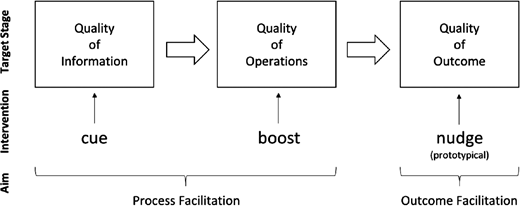
Assistive cuing might involve providing an evaluator charged with the task of assessing an applicant’s score on an unfamiliar standardized test with the mean test score achieved by all candidates. The cue provided by the mean score enables the evaluator to obtain a better picture of the applicant’s abilities by offering a clearer indication of his/her ranking relative to the average (McKenzie et al., 2018). An example of boosting would be to train people in temptation bundling, a simple heuristic that can help people overcome self-control problems. By bundling instantly gratifying ‘want’ experiences (e.g., listening to music or podcasts) with ‘should’ activities that provide delayed rewards (e.g., going to the gym or doing the dishes), it can lead to a higher uptake of ‘should’ activities (Milkman et al. 2013).
Both assistive cues and boosts focus on epistemic factors in process facilitation and understand agency mainly in terms of decision-making competence, that is, as a capacity for making correct means-end calculations (Dold, 2023b). In both cases, people’s reasoning capacities are enhanced by increasing their domain-specific knowledge of what kind of behaviour would lead to a given desired outcome. In doing so, however, these process-oriented interventions only cover one aspect of agentic capacities, namely competence. Insights from positive psychology, in particular SDT, suggest that competence is a crucial ingredient for people to feel that they are the authors of their own lives. SDT defines ‘competence’ as “the experience of effectiveness and mastery … [enjoyed] as one capably engages in activities” and involves people feeling able to act with efficacy in pursuit of their given goals (Vansteenkiste et al., 2020, p. 3). However, SDT also indicates that competence is insufficient for doing justice to the sense of agency SHH has in mind, in particular the idea that people have a comprehensive sense of leading a self-directed life. For the latter to obtain, SDT highlights two other basic psychological requirements besides competence, viz. autonomy and relatedness (Deci and Ryan, 2000; Ryan and Deci, 2006, 2017, 2020). Both of these can also be understood as factors that facilitate the decision-making process, but are not directly concerned with decision outcomes.13
SDT understands autonomy as “a sense of initiative and ownership in one’s actions” which occurs “when one’s actions, thoughts, and feelings are self-endorsed and authentic” (Ryan and Deci, 2020, p. 1; Vansteenkiste et al., 2020, p. 3). Autonomous action is “really proceeding from its reputed author” (Ryan and Deci, 2006, p. 1561). This means that people are not just choosing the ‘right’ means to given preferences, but are aware and in control of their preference formation process and are therefore able to reflect on and pursue preferences that are authentic and non-alienating (Christman, 2009). As Ryan and Deci (2006, p. 1561) put it, “for an act to be autonomous it must be endorsed by the self, fully identified with and ‘owned’.” SDT’s notion of autonomy is similar to the one defended by SHH. For instance, as noted above, SHH (2013, p. 995–96) also emphasises the centrality of individuals’ feeling of being in charge of the preference formation process and their ability to reflect on what preferences to hold as the hallmark of autonomy. However, SDT helps to elaborate on and advance the notion of agency implicit in SHH’s work by distinguishing competence and relatedness as additional aspects of agency, in addition to autonomy.
According to SDT, relatedness refers to people’s intrinsic “need to feel belongingness and connectedness with others” (Ryan and Deci, 2000). On this view, leading a self-directed life requires individuals to be socially embedded in a respectful peer group or community (Kachanoff, 2023). One reason is that an essential part of relatedness is “experiencing oneself as giving or contributing to others” (Ryan and Deci, 2017, p. 11); feeling authorship over one’s life often involves being part of peer groups in which one can develop one’s identity and express one’s pro-social preferences. Second, experiencing social bases of self-respect and nonhumiliation is instrumentally valuable for the development of competence and autonomy; respectful communities nurture one’s self-image as a dignified being of equal worth to others (Ryan and Deci, 2003).
According to SDT, a person feels a sense of agency – of authorship and self-determination – when their psychological needs for competence, autonomy, and relatedness are met: they feel a sense of mastery in what they do (competence); they believe they are in control of the process of preference formation (autonomy); and they feel connected to others in their pursuits (relatedness).14 For the development and satisfaction of all three psychological needs, the availability of opportunities is, of course, crucial. But if people are to have a comprehensive sense of agency, then they arguably need more than just a wide range of opportunities from which to choose (Dold and Rizzo, 2021). They also need certain agentic capabilities, the possession of which enables them to exploit those opportunities and to form preferences in a competent, autonomous, and socially embedded way (Dold and Lewis, 2023, pp. 2, 7–8).15 Those capabilities seem likely to include ones such as the following:
the cognitive capacity to envisage oneself as, at least in part, the product of one’s own making and to reflect critically on one’s current preferences and character;
the imagination needed to envisage new preferences and a new character or identity;
the ability to critically assess situational and social influences on individual preference formation processes;
the ability to evaluate how well certain new preferences will contribute to the development of one’s broader goals and values (e.g., one’s overall character and identity);
the commitment needed to cultivate those preferences until they have been acquired to the requisite degree;
the capacity to discuss successfully with other people whether one has done enough to count as possessing a particular kind of preference (such as a ‘refined’ taste for classical music);
the ability to connect with and care for others, to form bonds, and express one’s identity in nurturing social settings.
From the vantage point provided by SDT, the possession of such capabilities is central to people enjoying feelings of autonomy, competence, and relatedness, and therefore of agency. In short, possessing agentic capabilities will help people to be more able to make the most of whatever opportunities to develop their preferences they enjoy, enhancing their sense of agency and (therefore) their well-being (Ryan and DeHaan, 2023; Kasser and Ryan, 1996).
The term ‘capabilities’ is being used here in the sense in which it is developed by Amartya Sen, namely to refer to the set of ‘functionings’ – the types of activities and goals, including kinds of life – people can achieve (Sen 1985, 1999; also see Dold and Lewis, 2023, pp. 5–7). There are two places in SHH’s writings where he refers to capabilities in ways that suggest he would find our use of that concept to elaborate on the notion of autonomy congenial. First, in Rationality in Economics, SHH briefly suggests that the Senian notion of capabilities can be used to elaborate on what it means for people to be autonomous, writing that “[t]he capability of choosing is what underpins a reflective capacity; without it, the project of autonomy cannot get off the ground.” He also suggests that “Sen’s concept of ‘capability’ corresponds closely with the Berlin (1958) positive sense of freedom” (SHH 1989, pp. 195–96). When taken in conjunction with SHH’s statement, noted in section 2.2 above, that positive freedom – now closely associated with Senian capabilities – is an essential requirement for people to enjoy a sense of autonomy, these remarks suggest that our use of the concept of capabilities to elaborate on the notion of autonomy is consistent with SHH’s views.
The second place where SHH reflects on the notion of capabilities in ways suggestive of the account of agentic capabilities advanced here is in his discussion of expressive rationality. For SHH, expressively rational conduct is action “primarily taken for its symbolic properties: that is, the action says some, usually, evaluative thing about the person taking it. Thus the person appears ‘honourable’, ‘caring’, ‘moral’, ‘just’, ‘fair’, etc. through such expressive acts” (SHH 1999, pp. 142–43; also see n. 8 and n. 12 above). But as SHH has often observed, people cannot simply declare that their actions are worthy in the relevant way; for if the criteria for making such judgements were simply personal, evaluations would become purely “self-serving” and would therefore “prove a weak foundation on which to base on evaluation of worth” (SHH 2021, p. 45).16 It follows, SHH argues, that if such judgments of worth are to enable people to cultivate and express a sense of their identity, then they must be made by reference to intersubjectively shared social rules about what counts as certain kinds of conduct. Those rules serve as (relatively) independent standards of evaluation by reference to which the merits of people’s actions can be assessed (SHH 2000, p. 158, 170 n. 3. 2002, pp. 258–59). However, while such rules do impose restrictions on what constitutes behaviour of certain kinds, and so can provide the (relatively) independent standard needed for people to make judgements of the worth of their actions, they do not apply themselves. On the contrary, they must be interpreted and applied by people to particular cases, leaving scope for negotiation and debate between the relevant people about whether a particular action satisfies some rule (and so counts as worthy in some way). It is in this context that, as SHH briefly observes, people’s capabilities – in a Senian sense – become important, because the capabilities possessed by the relevant parties may be an important influence on the outcomes of such discussions and therefore upon people’s ability to develop their identities. As SHH puts it, “Although ‘capabilities’ are often associated with a variety of resources, there is an aspect of capabilities that has not received much attention: the resources for discussing and debating ideas about what is worthy in society” (SHH 2008, p. 90; also see SHH 2009b, p. 72). This, for SHH, indicates a possible item on the agenda for future research on the “political economy of identity formation” (SHH 2008, p. 90) and it is one to which our discussions, both above and in what follows, seek to contribute.17
4 The Economic and Political Conditions for Individual Agency: Empirical Insights
In this section, we elaborate on the conditions that are conducive to people acquiring agentic capabilities and thereby support individual agency. Recently, SDT research has begun to focus on the underlying macro-level institutions and wider societal structures that shape people’s agentic capabilities and, therefore, their feelings of agency (Ryan and DeHaan, 2023; also see Ryan et al., 2019).18 The focus of attention then becomes the economic and political conditions that equip (to a degree) people with the capabilities needed to support autonomous, competent reflection on their preferences (Lewis and Dold, 2020, pp. 1174–75; Dold and Lewis, 2022, pp. 113–14). This approach is compatible with SHH’s view that a constitutional perspective on behavioural public policy would be centrally concerned with the character of the institutions that constrain and enable people’s actions, including their efforts to reflect on their preferences (SHH, 2013, pp. 995–96, 2017, p. 253, 2023, p. 6, 8–10).19
SDT supplies a critical and comparative perspective on economic and political institutions, evaluating them by analysing their influence on people’s feelings of competence, autonomy and relatedness. According to SDT, psychological needs are the mediators of the processes through which economic, social and political arrangements translate into a sense of agency. SDT highlights that both economic conditions (access to resources) and political conditions (freedoms and rights) influence people’s sense of agency via their influence on the extent to which those basic psychological needs are satisfied (Ryan and DeHaan, 2023). While SDT does not refer much to capabilities, it is arguably through their impact on people’s capabilities, and therefore on the capacity to satisfy their basic needs, that these conditions affect people’s sense of agency.20
Economic conditions (factors such as income, wealth, and occupational type) can facilitate or thwart the satisfaction of people’s psychological needs and thereby contribute to their sense of agency. People in occupations that are perceived to be of a lower socio-economic status (SES) report less job satisfaction, more emotional exhaustion, and lower vitality, all of which indicate a low sense of agency (Gonzalez et al. 2014). People in higher SES occupations have more resources to invest in their knowledge and skills (competence), are more likely to be exposed to a wider set of social circumstances that stimulate critical thinking (autonomy), and have the means to connect with and care for others (relatedness). Economic resources allow people to travel and meet people, and thus develop their imagination; they foster a sense of control over what preferences to cultivate and give people the freedom to pursue preferences they have reason to value (Sen, 1999). Yet SDT highlights that it not only matters how much resources people have access to, but also what the prevailing economic conditions are, in particular how wealth is distributed around them. Di Domenico and Fournier (2014) find that socioeconomic inequality in subjects’ geographic vicinity is a negative predictor of feelings of competence and autonomy. This is a point acknowledged by SHH (2017, p. 256) who highlights the potentially detrimental effect of inequality on the scope for ‘experiments in living’ and the development of people’s individuality. As he writes, “the character of the constitution that matters for public policy purposes is not just the liberty it gives, but also its redistributive bias. This is because an individual’s acquisition of individuality depends on both their freedom and their resources” (2017, p. 263). Furthermore, relatedness is typically higher in jurisdictions with effective redistributive policies since “inequality affects trust, community life, and violence, and … it predisposes people to be more or less affiliative, empathic or aggressive” (Wilkinson and Pickett, 2020, p. 236). This is compatible with SHH’s viewpoint, according to which a basic income financed by a progressive tax is an effective redistributive system that enables more of the populace to engage in experiments in living compared to the currently dominant means-tested system of welfare benefits (SHH, 2017, p. 257). A positive effect of basic income for relatedness might stem from its egalitarian treatment of all citizens, which signals equal worth of all community members and can thus help nurture one’s sense of belonging and embeddedness.
Political conditions – the rights and freedoms formally afforded to people under the prevailing constitutional and legal regime – also matter for satisfying people’s basic psychological needs and, therefore, for shaping their sense of agency. A political regime that affords citizens core liberties – freedom of action, association, and expression – has a direct, positive impact on their sense of autonomy, because it allows people to engage in the experiments in living that are crucial for their sense of being the authors of their own lives (Bradshaw et al., 2023). This is, of course, why SHH emphasizes the importance for people’s sense of autonomy of a liberal constitutional order that protects them from external coercion and affords them the opportunity to act as they see fit (subject to the constraints imposed by the harm principle).
But it is also noteworthy that, as the political economists Elinor and Vincent Ostrom have argued, formal constitutional rules and procedures are necessary but insufficient for a functioning liberal political order of the kind advocated by SHH. The reason is that the rules and procedures comprising a constitution of liberty do not automatically apply and enforce themselves.21 Rather, they must be invoked and applied by citizens to defend their liberties, not least when their freedom to engage in some novel course of action is challenged. That in turn requires at least some citizens to be skilled at using the provisions of the constitution and legal system to challenge and check the use of the state’s coercive powers – whether by elected politicians, unelected bureaucrats, or other groups of citizens – so as to sustain their freedom to engage in experiments in living.22 However, if people lack those “self-governing capabilities”, as Vincent Ostrom (1997, p. 4, 31) terms them, then they will be unable to make effective use of the relevant constitutional and legal procedures and their freedoms may be eroded (also see E. Ostrom, 2006, p. 9; Ostrom and Ostrom, [2004] 2014, p. 86). Just as we argued above that people’s efforts to develop their personal identities are facilitated by the possession of certain kinds of agentic capability, so we contend here that when acting in their capacity as citizens people also need certain ‘public’ agentic capabilities if they are to sustain the constitution of liberty that underpins their freedom to explore a variety of different lifestyles.
The process through which policies and laws are established matters for the development of these public agentic capabilities. This point is acknowledged by SHH, who – like the Ostroms – draws on Tocqueville to argue that people’s civic mindedness is developed “from the experience of an extraordinary range of civic association”, that “the origin of these practices of civic association for [Tocqueville] is political participation”, and that political life “teaches the means of combination” (SHH 2020a, p. 210, quoting Democracy in America).23 Recent insights from the empirical literature on public deliberation support SHH’s conjectures and suggest that political participation fosters public agentic capabilities and thus contributes to people’s sense of agency in a number of ways. First, jurisdictions that actively include citizens in the democratic decisionmaking process (e.g., by means of deliberation in public citizen forums)24 can enhance citizens’ competence, for instance by increasing their understanding of political topics and correcting preference distortions caused by either active manipulation or passive overemphasis on symbolically potent issues (Niemeyer, 2011). SHH (2020a, p. 115) emphasizes that this competence building is particularly important for “sniffing out” positive-sum games in politics (that is, those opportunities or projects where collective action serves all or most people’s interests such as public health initiatives like clean water and clean air). The idea that public deliberation and political participation can help build competences follows from the insight that “humans are … poor monadic reasoners but not poor group reasoners” (Chambers, 2018, p. 37).25 Group reasoning displays better results than individual reasoning on many issues, including bias detection, information search, and depolarization (Mercier and Sperber, 2011).26 By exposing them to facts about policies and different evaluative standards in the public discourse, people can become aware of some of the unquestioned situational and socio-cultural context effects (Niemeyer, 2011).27
Second, the experience of being an active member of a community can inculcate a sense of autonomy, understood as ownership of and identification with the political process, even if one disagrees with the policies ultimately chosen. Taking part in public deliberation and local rule-making enhances people’s sense of autonomy because they “feel that there has been fairness in representation and that they have had their due voice in governmental processes” (Ryan and DeHaan, 2023, p. 1162). Being actively engaged and vocal within a community provides individuals with the confidence to openly share their viewpoints, recognizing the potential of their voices to influence results.
Third, public deliberation and political participation can also enhance the sense of relatedness when people realize in public forums how much they actually agree with others, in particular regarding the nature and the legitimacy of the relevant issues, even though they may not agree on concrete policy outcomes or the veracity of different claims. The metaconsenus on the rules of discourse and the political issues at stake builds empathy and the experience of a shared sense of purpose in decision-making (Niemeyer, 2011; Ryan and DeHaan, 2023). This means, as SHH (2020a, p. 116) highlights, that even if one ends up as the loser in a zero-sum political game (e.g., because one belongs to the richer part of the population and has to pay high taxes that exceed the personal benefits received), the feeling of being part of the process makes the acceptance of the outcomes of the rules enacted more likely. In other words, people “come to internalize the practice of rule-following through political participation” (2020a, p. 117).
Finally, taking part in public deliberation and local rule-making can lead to a mutually enforcing effect between autonomy and relatedness. If people view institutions as controlling, perhaps because they have been externally imposed, then their sense of autonomy suffers which can cause a crowding out of relatedness understood as the willingness to express intrinsic pro-social motivation (Ostrom 2005). Conversely, if the political process gives people their due voice, then “self-esteem is fostered, and the individuals feel that they are given more freedom to act, which enlarges self-determination”, thereby nurturing and crowding in relatedness and pro-social motivation (Ostrom 2005: 113; also see Ostrom 2000, pp. 5–6, 9–11, 13 and 2005, pp. 76–79. 94–95).28 These insights support SHH’s conjecture that an inclusive, voice-based political decision-making process encourages people facing social dilemmas to take each others’ interests into account, boosting cooperation by turning perceived zero-sum interactions into positive some games and thereby depolarizing an emotionally charged political landscape (SHH, 2020a, pp. 115–11; 2020b, section 3).
5 Conclusion
Consistent with SHH’s approach, we have discussed the contours and implications of a political economy programme that takes behavioural insights seriously and emphasises agency rather than preference satisfaction as a normative benchmark for behavioural public policy. We suggested that insights from positive psychology in the form of SDT can help flesh out the notion of agency that is latent in SHH’s approach. We explored some of the concrete institutional implications of this extension of SHH’s framework by discussing empirical findings on economic and political conditions that are conducive to the development of people’s sense of agency. Following SHH’s work, we argued that an agency-centric perspective shifts the focus from the redesign of concrete choice architecture (e.g., in the form of nudges) to a more general analysis of the institutional conditions that nurture or stunt the development of people’s capability to reflect on, act on, and identify with their evolving preferences. We argued that institutional reforms need to go beyond boosts and assistive cueing that focus narrowly on competence and also consider autonomy and relatedness as additional dimensions of agency-centric policy-making and institutional design. We highlighted the importance of public deliberation and participation for the development of agentic capabilities. The empirical literature suggests a crucial role for deliberation within groups for people’s civic mindedness and the quality of individual reasoning in the context of preference formation processes.
We believe that SHH rightly emphasizes that a core motivation for a liberal behavioural political economy ought to be that individual preference-formation processes are not dominated by social and cognitive factors that diminish a person’s sense of agency. In contrast to libertarian paternalism, such an approach to policy would not take a strong view about precisely what people’s preferences should be. It would therefore, we believe, be consistent with SHH’s preferred constitutional approach to policy, seeking to “avoid taking a view on people’s true interests” and instead being “directed at the conditions under which people acquire the sense of interest on which they act” (SHH, 2013, p. 995). Admittedly, a political economy that emphasises how people’s agentic capabilities can contribute to their sense of agency poses new challenges. A core challenge might be the question of whether ordinary citizens actually see themselves reflected in the approach’s emphasis on self-reflection and individuality. People throughout history have shown a robust tendency to conform to social norms, fads, and fashions. SDT provides powerful empirical arguments for why people ought to be concerned with the development of a sense of agency – not only for its own sake but also for its instrumental value for psychological well-being. However, it is an open question whether people will find its promises appealing or, alternatively, too psychologically demanding.
While this paper has elaborated on the notion of agency inherent in SHH’s account, it has not fully fleshed out the notion of practical reason to which SHH subscribes. In emphasizing the critical role of reasoning in the selection of ends, as well as means, SHH acknowledges Kant’s account of practical reasoning as a viable alternative to the instrumental rationality commonly assumed in conventional economics, but without wholeheartedly embracing it. Consequently, future research could explore the question of the specific account of practical reason that best complements SHH’s account. Furthermore, it remains unclear where SHH stands on the issue of creative agency and determinism, in particular the question of whether acknowledging creative agency requires a departure from deterministic models of choice that portray people’s conduct as a unique, utility-maximizing response to their circumstances. We think it does, but SHH does not clearly say so. We alluded to Buchanan’s oeuvre in this paper, but future work might explore further the implications of creative agency for economic theory and policymaking by discussing connections between SHH’s approach and the ideas of thinkers, such as Buchanan and G.L.S. Shackle, whose work engages deeply with that topic.
Our emphasis on the importance of people’s capabilities accounts for the reference to ‘capable agency’ found in the subtitle of our paper.
For SHH, such findings suggest that institutions not only regulate people’s activities but are also constitutive of them in the sense that they embody reasons for action and ideas of what constitutes a ‘good’ life (SHH 2020a, pp. 112–14, 2022, p. 60). When people internalize the logic of institutions, that logic becomes part of their mental models and affects how they process information and judge both themselves and others. While standard theory assumes that preferences are antecedent to institutions, so that exogenous preferences become one of the foundations for explanations of institutional choice, preference endogeneity undermines that foundation because “the choice of institution becomes, in part, a choice of what preferences to have” (SHH 2013, p. 989; also see 2020a, pp. 113–14).
This decision-making process, which is employed precisely because there is no preexisting set of preferences to consult (Simon, 1978), can be influenced by how options are framed, with different presentations prompting people to take account of differing reasons for action.
This is a core insight both of James Buchanan’s theory of choice (Lewis and Dold, 2020) and also of Friedrich Hayek’s (Dold and Lewis, 2022).
Buchanan’s interest in artifactual man stemmed in large measure from his determination to develop an account of human conduct appropriate for doing justice to the ‘constitutional moment’ in political life (that is, the idea that “we create the institutions within which we interact, that we construct the rules that define the game that we all must play.” In pursuing this line of inquiry, he was led to ask “whether persons who do not and cannot conceive themselves to be artifactual (even if, in fact, they are and must be), can easily conceive of artifactual social institutions, artifactual rules of the game, to be chosen apart from the simple selection of strategies to be played in the complex interaction process defined by the rules of the order” (Buchanan, [1979] 1999, pp. 255–56). He answered in the negative, arguing that the constitutional moment can be understood only if the standard model of rational conduct as a determinate (maximising) response to people’s circumstances is replaced by a portrayal of people as creative agents whose actions are not simply determined by, or implicit in, their circumstances, in which case they can be conceptualised as imposing rules upon themselves in order to change their preferences and conduct (Buchanan, [1979] 1999, pp. 257–58; also see Lewis and Dold, 2020, pp. 1162–68). SHH makes a similar point, arguing that one of the benefits of replacing what he calls the ‘providential’ model of people as utility-maximisers by a ‘prudential’ account of action characterised by “the centrality of rule-following and the endogeneity of preferences” is an appreciation of how “rule-following opens up a range of positive-sum activities”: “To be a rule-follower, and to know this, is to know also that the rules are movable: they are highly contingent, they are never absolute … and so the rules must always be open to debate and discussion when rule-following is self-consciously understood” (SHH 2020a, p. 116). Also, like Buchanan, SHH seems to suggest that this account of human action involves a departure from deterministic models of human conduct to allow for genuine, creative agency (1989, p. 35, 89, 2000, p. 150, 156). SHH’s prudential account of man therefore seems to bear more than a passing resemblance to Buchanan’s notion of ‘artifactual man’.
Of course, SHH does not deny that people can, and sometimes do, have stable, contextindependent preferences. Rather, his point is that the evidence indicates that there is an important subset of decisions for which people do not have such preferences (SHH, 1989, pp. 103–10; 2023, pp. 5–6). For other discussions of decisions of this kind, see Callard (2018) and Roberts (2022).
Libertarian paternalism presupposes that people have a ‘true’ underlying set of well-integrated (i.e., stable, consistent, and context-independent) preferences but that—because of various behavioural biases—they fail to satisfy them as well as they might. Policy then centres on establishing a ‘choice architecture’—a way of framing the options between which decisions will be made, etc.—that encourages people to act in line with their ‘true’, underlying preferences (Thaler and Sunstein, 2008) (SHH, 2013, pp. 986, 992–94, 2017, pp. 252–54). For critiques of paternalist policies, see Buchanan, [1979] 1999, Cowen (1993), Sugden (2018), and Dold and Lewis (2022, pp. 112–13).
The centrality of ‘autonomy’ to SHH’s analysis also raises the question, which we mention here but without seeking a definitive answer, of the view of practical reason upon which SHH’s account depends. Much of SHHs work indicates that he is well aware of the limits of the instrumental view of rationality as involving the efficient use of means to satisfy given ends. Hence his emphasis on the importance of expressive rationality (SHH 1989, 2001, 2008). Expressively rational conduct may, he says, involve “reasons for action which cannot be sensibly assimilated to some prior set of objectives” (1992, p. 20; also see p. 22). But what is less clear is the precise conception of practical reason that underpins the notion of expressive rationality. There are places, such as a 2008 essay in The Elgar Companion to Social Economics, where SHH flirts with (as he puts it) an “expanded sense of rationality or agency” in a Kantian sense, writing—after a discussion of the conception of instrumental rationality—that “there are richer models of individuality within the liberal political tradition: notably those that derive from Kant and involve the idea of autonomy. Autonomous individuals are those who consciously, rationally in Kant’s sense, select what ends to pursue” (2008, p. 86). The next year, in an entry on rationality for a Handbook on Economics and Ethics, he elaborated on how to conceptualise expressive rationality as follows: “Immanuel Kant, of course, offers something more than a limited response to this question. He assigns reason the pre-eminent role of deliberating on what objectives one should pursue. It is only by taking one’s objectives to be one’s own in this sense that one can achieve a state of autonomy” (2009a, p. 423). SHH seems in these passages to acknowledge Kant’s account of practical reason, understood as action in accordance with the categorical imperative, as a plausible alternative to instrumental rationality, but without fully committing himself to it. As he notes in a more recent paper, “a well-accepted account of the motivation in rule-following is lacking” (2009a, p. 114). The question of the account of practical reason to which SHH subscribes appears, therefore, to remain open.
As SHH (2023, p. 2) makes clear, the affinities with Mill stem from how, consistent with recent findings in behavioural economics, he assumes that people do not have settled preferences.
SHH examines the importance of media pluralism for an informed citizenry in Allen et al. (2017).
SHH does occasionally use the term ‘agency’ in his recent work on behavioural welfare economics, but without elaborating in detail on how that concept relates to the notion of autonomy (SHH, 2020, pp. 110, 112, 2020b, section 4). He uses the term agency rather more often in his earlier writings on instrumental and expressive rationality (SHH 1989, p. 213, 2004). In that work, he suggests that when people reflect on what preferences to have, their conduct cannot be understood in terms of instrumental rationality (that is, as involving the use of reason to select the best means for satisfying given ends). The relevant notion of practical reason is, instead, expressive rationality, which “reflects our concern with making sense of the world” and, in particular, “our ideas about what is worthy in ourselves.” On this view, the individual is “self-consciously reflective about his/her preferences” so that “action is no longer a means to a given end” but rather “is part of a groping towards who to be, what ends to have” (SHH 1989, pp. 4–5).
Taken together, competence, relatedness and autonomy are “innate psychological nutrients that are essential for ongoing psychological growth, integrity, and well-being.” (Deci and Ryan, 2000).There is extensive empirical evidence from cross-cultural samples for the central importance of these three needs. Across cultures, the satisfaction of these three basic psychological needs is positively correlated with indicators of psychological well-being, including higher degrees of life satisfaction, vitality, self-esteem, and the absence of depression, anxiety, and other psychopathologies (Kasser and Ryan, 1996).
The possibility that people’s preferences might change unreflectively, as a by-product of people’s experiences, is of course not ruled out by this account of agency. What the latter does suggest, however, is that having agency requires people to be able to become aware of preferences acquired in that more passive fashion, to reflect upon them if called upon to do so, and to decide which ones can be fully endorsed as their own.
In elaborating on the specific capabilities needed for autonomous, competent choice, we draw here both on SDT (Ryan and Deci, 2020; Ryan and DeHaan, 2023) and also on Buchanan ([1979] 1999, p. 254), Emirbayer (1998), and Bandura (2006), all of whom emphasise the importance for agency of capabilities such as the capacity to imagine novel courses of action and to evaluate their relative merits.
This argument is, as SHH (2002, p. 259) notes, akin to that of Wittgenstein concerning the impossibility of a private language.
It is interesting to note in this context that, similar to SHH’s emphasis on how expressively rational behaviour involves people seeking a sense of self-worth, Sen argues that “a central feature of the ‘self’ [is] the capacity to reason and to undertake scrutiny”, in particular “self-scrutiny”: “A person is not only an entity that can enjoy one’s own consumption, experience and appreciate one’s welfare, and have one’s goals, but also an entity that can examine one’s values and objectives … We can ask what we want to do and how, and in that context also examine what we should want” (Sen, 2002, pp. 36–37; also see pp. 46–47, 50–52, 617–18).
Surprisingly, even though it seems obvious that the overall macro-level conditions of societies, including their political and economic institutions, have a significant impact on fundamental agentic capabilities, there is a lack of substantial research in this area. Ryan and DeHaan (2023) suggest that this might be due to a prevailing tendency among behavioural scientists and economists to attribute behaviour to situational surroundings rather than the wider socio-cultural environment.
The common ground reflects the way that, like SDT, SHH acknowledges that people are social beings whose attributes and actions are shaped, without being entirely determined, by the social-structural context in which they are embedded (SHH, 1989, pp. 195–96, 213, 1992, p. 18, 2000, pp. 158–59, 2004, pp. 157–59, 2020a, section 1, 2022, p. 56). SHH makes brief favourable references to the work of one of the principal architects of SDT, namely Deci (1975), in the context of discussions of the relationship between intrinsic and extrinsic motivation (SHH 2008, p. 87).
Ryan and DeHaan (2023) mention in passing that capabilities matter since they are “robustly associated with basic psychological need satisfactions.” For some further discussion about the connection between capabilities and basic psychological needs, see DeHaan et al. (2016).
This is, of course, a specific instance of a more general point—oft-made by SHH—that rules do not apply themselves. Rather, they must be interpreted and applied by people who need to be skilled at those endeavours if their preferred interpretations and applications are to be successful (SHH, 1989, pp. 27–28, 158; SHH and and Varoufakis, 1995, p. 59; also see SHH, 2021, pp. 45–46).
Empirical evidence suggests that throughout human history the ‘narrow corridor’ that upholds a constitution of liberty is constituted by constant struggle between an active and vigilant civil society that wants liberty but cannot sustain order and the state which maintains order but tends to become oppressive (Acemoglu and Robinson, 2020).
The Ostroms argued that direct, practical experience in public life could help people to acquire the capabilities needed to maintain a liberal democratic society. It is through being involved in running various institutions and engaging in joint ventures in civil society that citizens acquire the civic knowledge and practical skills—in short, the capabilities—needed to bring their shared endeavours to a successful conclusion (V. Ostrom 1997, p. 114, 163, 273, 290–91; E. Ostrom 2006, pp. 5–6, 8). As Vincent Ostrom put it, also quoting Tocqueville’s Democracy in America: “Municipal institutions constitute the strength of free nations. Town meetings are to liberty what primary schools are to science: they bring it within the people’s reach, they teach men how to use and enjoy it” ([1973] 2008, p. 85).
Public citizen forums can have many forms (mini publics, citizen juries, deliberative polling, participatory budgeting, town hall meetings, online deliberation, etc.) and can occur at different institutional levels (communal, state, federal). The effect of public deliberation on agentic capabilities is likely to be stronger if various forms of deliberation occur on multiple institutional levels. For a discussion of the role of public citizen forums within a liberal political economy framework, see Dold and Krieger (2024).
Following Buchanan’s (1979) terminology, it can be conducive for “the constitution of private man,” i.e., individual agency, to engage in “the constitution of public man,” i.e., taking part in processes of political decision-making (Dold and Petersen, 2023).
Poor performance in standard reasoning tasks (illustrated by behavioural economics) can be explained by the lack of argumentative context.
Of course, taking part in public deliberation does not automatically lead to better reasoning, but can also create ‘new’ psychological challenges, such as group think, conformity, etc. The empirical literature on public deliberation suggests that deliberation can be improved by proper design (Niemeyer et al., 2023). In particular, the provision of balanced information, expert testimony, and oversight by a facilitator improves reasoning within groups. Furthermore, group building efforts further enhance the quality of reasoning. Groups which develop their norms and rules of decision-making behave more cooperatively, share more information, reduce polarization, and deal with complex issues more efficiently.

