The study seeks to analyze concepts of “career grades” and “job grading,” to highlight their importance and objectives for the efficiency of administrative systems. In addition, it identifies the international standards that can be used to draw grading systems. It explores the most important types of grade structures. It also clarifies grading systems in the Egyptian administrative system. It indicates some methods that can be considered a form of career progression.
The study employs descriptive, analytical, as well as, legal approaches; it analyzes the information given in the study in terms of relevant legal texts.
The study identifies precise definitions of both career grades and job grading, referring to these concepts in the Egyptian administrative system. It also suggests that there is no ideal hierarchy to be applied in all administrative systems. Therefore, the study provides some criteria that help to form the appropriate grade structure for each system.
The study analyses some literature on “job grading,” its objectives, its criteria and its main types, presenting an integrated framework that can be used to develop career-structure systems. Finally, the study identifies some methods that can be considered as a means of grading.
1. Introduction
Most of the management scholars define the term “job” as a set of duties and responsibilities, determined by a competent authority. The job may be vacant or occupied by an employee who is appointed by the competent authority to perform the duties and responsibilities of this position permanently or temporarily and is paid for it.
A career structure consists of a vertical sequence of grades, bands or levels into which sets of jobs that are broadly comparable in significance are placed. This sequence creates what is known as the career ladder used in a company in the private sector, or governmental organizations (vertical division). Each grade, band or level indicates the salary banding (or pay range) of the job, which is determined by the difficulty level of its duties, responsibilities and required qualifications.
To provide distinctive services, administrative systems focus on the human resource and how to improve its production. Therefore, they develop appropriate systems of job grading that achieve career progression of the employee. As job grading basically depends on the individual’s competence and skills, working in such a system will satisfy and motivate the employee to improve his/her performance.
2. Research problem
As part of the ongoing effort to take care of the public servant, which is a fundamental goal of administrative reform, The career progression is vital which is One of the ways that drive a public servant towards self-development and considered as an incentive to work and production that leads to stabilize the employee at his work, taking into account the efficiency of the individual and his skills that Putting the individuals in the specialty that suits them In the administrative and professional hierarchy inside the organization building, Although many countries modify the grade structures as a starting point of administrative reforms, academic researchers studying this area – to define the criteria that develop such structures and to explicate the objectives that can be achieved – are almost rare.
Hence, the research problem can be reflected in the following research question:
What are the criteria that can be used to develop the grade structures to promote the administrative-reform processes?
3. Objectives of the study
analyze the concept of grades and career progression and highlight its importance and objectives;
identify international standards that can be used when developing a system of career progression;
identify the most important forms of functional grading structures;
clarify the system of career progression in the Egyptian administrative system; and
identify some methods that can be considered a form of career progression.
4. Literature review
The administrative reform and public-sector job have been the focus of various academic researches; however, the job grading has not been studied directly and comprehensively. Furthermore, there are not any studies that focus on the Egyptian case.
Hence, this study focuses on the job grading and its most important criteria in terms of a universal perspective. In addition, it sheds light on the Egyptian case, referring to the grading system and the number of career grades in the Egyptian administrative system. The study, therefore, provides a theoretical, usable framework for processing administrative reforms.
5. First: career grade and job grading
As a social phenomenon, grading categorizes individuals according to their differences and ranks. Consequently, job grading refers to the process of categorizing individuals according to situations, positions, roles and functions that they perform. The employee moves from one job to another when he/she gets promoted because of his/her distinction – which may lead to an increment. This career hierarchy plays a major role in the psychological and social stability of the employee within the institution, as he/she will be ambitious to improve his/her performance. The study, therefore, is going to define the career grades and job grading, reviewing their most important criteria.
5.1 Definitions of career grade
The term “career grade” has various definitions; the following are the most significant:
Each grade represents a career level that includes job evaluation system’s analytical description of the duties and responsibilities of each level. These descriptions are then compared with the definitions of different grades in order to organize the jobs into a career structure, and consequently, establish a pay structure (Nafie, 1980, p. 145).
According to the Fair Labor Standards Act of 1949, it is:
[…] the scales of job difficulty and pay that measures the difficulty level of the job in terms of its duties and responsibilities determined by evaluation factors. In addition, it encompasses qualification requirements for the jobs of this level (Nafie, 1980, p. 182).
It is also defined as:
[…] a segment of wages with a financial link in accordance with the salary scale attached to the civil service system. The grading system organizes all jobs into a defined set of groups according to the tasks and duties, undertaken in the job (Sheikha, 2000, p. 184).
One more definition is that it is:
[…] a certain degree of difficulty and responsibility in which multiple occupations may be quite different in the type of work, but they are sufficiently equal in the level of difficulty and responsibility, for example the occupations of a legal researcher III, an accountant III, and an engineer III are at a certain financial level, although the type of work varies, as well as, the quality of knowledge and capacities required, but they are consistent with the level of difficulty and responsibility (Al-Malfi, 2007, pp. 3-7).
Simply, a definition of a career grade may be concluded as the horizontal division of ranks or levels, the periodic increment within the rank, and the grades within the ranks of the civil service system.
In some cases, grading means moving an employee one degree within a category that belongs to the vertical division of power. The principle of grading refers, then, to the responsibilities of the different organizational units, where authority and responsibility start from the top of the hierarchy (Al-Salami, 1980, p. 84).
5.2 In the case of Egypt, the study indicates that
The definition of job grading in Egypt is similar to the previous definitions; as Law No. 47 of 1978 and its various amendments- repealed by Law No. 18 of 2015 and Law No. 81 of 2016 on the civil service – regulating civil servants in the public sector, provides for the principle of equality among all employees in all specializations. For instance, it sets the third level for appointing holders of higher education in all their specialties as well as the fourth level as a starting point for recruiting intermediate qualifications in different areas of specialization. Recognizing this principle of equality, the provisions of the law determines the same promotion periods for progression to higher levels of the career grade in all specializations.
Law No. 18 of 2015 and Law No. 81 of 2016 have amended this division and proceeded to increase the number of grades, adding new rules to the seniority gradation and career advancement rules. However, these rules are criticized for their traditional forms of the grade structure that cannot cope with the development and needs of the administrative system. For instance, they should have other modern forms of the traditional career hierarchy, as well as, other evaluation methods that set the pay structure according to the performance, not the grade.
These rules, consequently, have increased the levels and terms of each career grade, for example, the employee has to stay in the third grade for nine years instead of eight years, without any direct promotion. Moreover, these laws, following Law No. 47 of 1978, state that promoting any employee necessitates a vacant grade, which delays the employee’s promotion more than the defined term.
The study, therefore, suggests that the career grade organize all jobs into a set of levels of the same degree of difficulty and responsibility although they may be quite different in the type of work. It also has a segment of wages with a salary banding in accordance with the salary scale attached to the civil service system. Furthermore, it is the major unit that measures a career progression, so the study is going to explore the objectives and criteria of job grading.
5.3 Job grading
5.3.1 Definition.
Equity and Human Rights Commission defines the job grading as organizing the jobs into grades or bands, treating jobs in the same grade or band as being equal because the employees perform the same tasks and are subject to the same evaluation criteria (Equality and Human Rights Commission, 2019).
According to Cambridge Dictionary, a job grading is “the process of comparing jobs in an organization to measure levels of responsibility, often used for deciding levels of pay” (Cambridge Dictionary, 2019).
Joanna O’Riordan explains, in his “Review of the Civil Service Grading and Pay System”, that a grade structure consists of “a sequence or hierarchy of grades, bands or levels into which groups of jobs that are broadly comparable in size are placed” (O’Riordan, 2008, p. 2). The process of grading is based on the following stages (Human Resources - Ryerson University, 2009, p. 1):
First: jobs are organized into large groups, based on the level of responsibility of each job.
Second: jobs are classified into grades, based on the supervisory difficulty and effort of the job.
Third: jobs are subdivided within each grade into sub-grades, based on the complexity, difficulty and skill required in relation to other jobs that have been classified in the same band and grade.
Recently, the term “Re-grading” has emerged, which means that reviewing the grades of existing jobs that grow or fall as it requires intervention to be reclassified and rearranged to higher or lower functional grades. This may reveal the management’s own reviews or the demands of the employees themselves. The contemporary administrative development and change in the work environment inside the public administration are considered as methods of the “re-grading” (The University of Edinburgh, 2017, p. 2).
5.3.2 Objectives of job grading.
As an element of excellence and progress in the career of the employee, job grading aims to:
determining the wage according to the difficulty degree of the work to pay the same wage for jobs of equal duties and responsibilities after analyzing these duties and responsibilities in advance;
determining the knowledge and information required for the job, as well as, the required experiences, capabilities or skills;
establishing right bases for “manpower planning” and “administrative regulation”, achieving effective monitoring and improving performance efficiency (Nafie, 1980, p. 170); and
Regulating wages and career progression for both organization and employees (CIPD, 2013, p. 1).
5.3.3 Criteria of job grading.
A job grading should effectively improve the performance level of the administrative system, and satisfy and motivate the employees, without burdening the public budget of any country. Based on relevant literature review, the study categorizes job grading’s criteria, to be available as a general framework, as follows:
5.3.3.1 General criteria.
These criteria are broadly applicable in all grading systems. Accordingly, it is necessary to have a methodology of analysis and assessment of all jobs to determine the relative value of work in accordance with three important factors (experience, questioning, and fairness). They also should define the job grade in terms of the relative value, consequently, each grade has a minimum and maximum, including a range of different, but corresponding, jobs categorized into groups of different levels inside the grade structure (Government, 2010, pp. 5-6).
Furthermore, these general criteria clearly and systematically manage wage inflation and career progression to guarantee integrity and legitimacy. As there are various forms of grade structures, it is necessary to choose a grade structure form on a logical base to be applied to an organization system (CIPD, 2013, p. 1). For the promotion, it processes through professional competition; the employee should be subjected to a professional test before getting the promotion, which is based on the skills required by the work (Trosa, 2008, p. 4).
5.3.3.2 Specific criteria for the units.
It consists of a set of criteria that are concerned with achieving the activity and objectives of the unit for which a career grading system is developed, and consists of a subset of the criteria which reached by the researcher.
The career grades should represent the jobs; the applicants for jobs, in the public sector, should be subjected to evaluation tests to avoid discrimination; and finally using pay structure attached to grade structure to achieve fairness and motivation (Choi and Park, 2013), besides The levels of career grades should deliver programs, provide flexible methods, connect to career paths, facilitate talents and skills transition, provide competitive rewards, attract and retain skills, manage risks and crises without affecting the overall cost of the job, and meet business needs, which can be achieved through the following: (Watson, 2011, pp. 1-2):
a career framework that aligns with business needs and strategy with A common language to describe career paths, job requirements and performance expectations;
linkages to organizational and job-family competencies, also Consistent mapping of jobs to external market data;
contributes to cost-efficient talent and reward programs and delivery with Appropriate leadership that prepares models of efficiency and performance management;
helps ensure internal equity and being transparent and objective;
an efficient system of rewards;
easy to explain and administer, with limited bureaucracy or dependency on consultants;
able to accommodate dual career paths (individual contributor and managerial);
supportive of organizational change and Attention to evaluation and development;
culturally neutral and applicable worldwide;
supported by Web-based technology;
consistent relation between pay and received training from side and career progression from the other side, and
promotion is based on performance rather than on seniority.
5.3.3.3 Criteria focusing on employees’ satisfaction.
Focusing on the public servant as a main target of administrative reforms, job grading is a vital method to improve performance, achieve satisfaction and reduce overlaps in specializations. It can also be used to achieve the optimal exploitation of human resources available through fast and satisfactory progression on the administrative career ladder.
The career structure, which is based on neutrality motivate the employee towards self-development, leads to the stability of the employee as well as the administrative systems, and improve public services.
The structure should be clearly logical and easily delivered to the employees. In addition, unions and syndicates should be consulted before changing professional service grades (O’Riordan, 2008, p. 51).
5.3.3.4 Criteria focusing on fair career structures.
The researcher included several sub-criteria within this main criterion, which is mainly concerned with defining roles in accordance with the functional grades in the grading structure system, which should provide effective control over the implementation of wage policies and budgets.
Besides it is necessary to have a single pay structure covering the whole civil servant system, in which the total wage has four different components – which are then added together:
Basic wage: it is the same for all employees at all levels and grades.
Post wage: refers to the current post that a person holds, and is subdivided into a number of increments, which reflects the number of years spent by the employee in his post.
Grade wage: reflects the individual capabilities of each employee.
Seniority wage: is equal to the number of years of service.
As the combination of the post and grade wages is the greatest part of a civil servant’s salary (Burns, 2007, p. 17). Moreover, harmonizing reward strategies with business strategies in the organization, such as encouraging higher levels of performance. The structure should enable the organization to monitor the implementation of wage and budget policies (Armstrong, 2006, p. 690). Managing wage increase and career progression should be organized and clarified for the whole organization; administrations and employees. Determining the career grade's role in accordance with the individual's wage.
After identifying the career grades, as well as, career progression, its objectives, and its criteria, the study moves on to explore the grade structure and its main types.
6. Second: grade structure and its major types
6.1 Definition of grade structure
It is what is termed as “wage ladder”, or “grade scale” that reflects the degree of difficulty and responsibility in work and activities, depending on the size, variety and width of activities (Al-Minafi, 2007, p. 13). Another definition of the grade structure is that it consists of a sequence or hierarchy of grades, bands or levels into which groups of jobs that are broadly comparable in size are placed. Instead, the structure can be divided into a number of jobs or job families consisting of a set of jobs whose nature and purpose are similar but work is carried out at different levels (Armstrong, 2006, p. 689).
Grade structure defines the degree of difficulty and responsibility of the jobs, as well as, the scientific qualification, practical experience and all other conditions necessary to fill the posts in each grade. The jobs, therefore, are evaluated through their analytical descriptions against the grade scale to assign each job to the appropriate grade and thus determining its wage. This is considered the most appropriate method to evaluate the jobs of the large types and numbers, as in the Arab Republic of Egypt (Nafie, 1980, p. 63).
Jobs, consequently, should be subdivided according to responsibility, difficulty and similarity as follows (Al-Minafi, 2007, pp. 3-7):
general public groups based on broad common characteristics;
quality groups based on a similar business type;
series of specialization categories within a single profession or activity; and
groups based on complete similarity in terms of:
The level of difficulty and the amount of responsibility.
Necessary qualification requirements.
A grade structure gets to be a pay structure once pay ranges, brackets or scales are attached to each grade, band or level. In a few broad-banded structures, reference points may too be put among the bands/ groups and these layout the change of pay for occupations included in each band/group (Armstrong, 2006, p. 690).
A pay structure characterizes the distinctive levels of pay for occupations or bunches of employments by reference to their relative inner esteem as decided by work assessment, to external relativities as built up by the government. It gives scope for pay progression in understanding with execution, competence, commitment or benefit. There may be a single pay structure covering the entire organization or there may be one structure for staff and another for manual laborers, but this can be getting to be less common. There has in later a long time been a drift towards “harmonizing” terms and conditions between distinctive bunches of staff as portion of a move towards “single status”.
Jobs can be evaluated and divided by career progression, career sequences, or career stages. Although these terms differ from one country to another, the common term is career progression, but the Americans call it the career hierarchy. Each grade represents a level of difficulty and responsibility the required work and determines for each level a certain wage called financial bond of the grade. Accordingly, the grade structure has several forms that any administrative system can follow inside its organization. The study, then, explores its most important types.
6.2 Types of grade structure
It is vital for each administrative organization to strive diligently to provide reasonable opportunities for developing its staff, to achieve two main objectives; satisfying their individual ambitions, and motivating them to improve performance levels. In this regard, it is necessary to balance between the interests of the work and the needs of the workers in career advancement. This means to create vacancies in accordance with objective data, supported by the statistics, on the size of work and career levels in the past, and the increase that occurred and the manpower necessary to perform. This enables organizations to avoid creating opportunities for promotion on personal grounds or exaggerated justifications does not reflect the actual need for work (Ammar, 1994, p. 323).
The different systems of countries and the various methods of providing public services, from one state to another and from one administration to another, reflect the forms of administrative systems and their grading structures where grades structures and career hierarchy varies according to the circumstances and culture of both society and workers. Furthermore, any administrative system can use one of them according to its philosophy in providing public services to improve and facilitate the administration’s work, achieve fairness and equity, and provide an opportunity for the career progression of employees so that it can be reflected on some other variables such as pay, moral motivation, and workers’ satisfaction. Mostly, the greatest concern to follow any of these structures is reflected on the wage, so sometimes they are called wage structures, which are the same structure of grades or career progression, and yet it affects some of the other variables mentioned above. The most important forms of functional structures are:
6.2.1 Narrow graded structure.
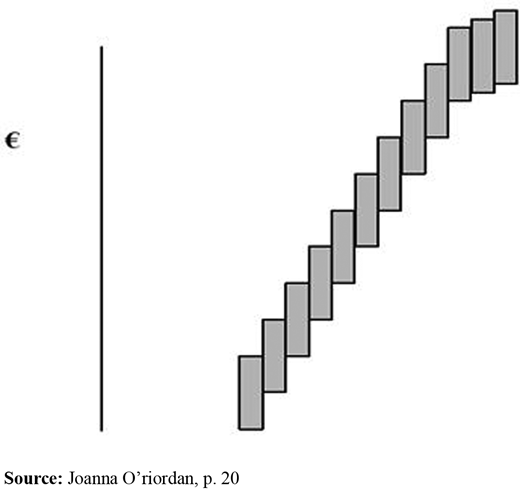
It comprises an arrangement of work grades into which employments of broadly comparable value are put. There may be eight or more grades and long-established structures, especially within the open division, may have as numerous as 18 or indeed more grades. The rate of wages is linked to each functional degree with the maximum and usually ranges between 20 and 50 per cent above the minimum.
Grades may be characterized by a bracket of work evaluation points so that any work for which the work evaluation score falls inside the points bracket for a grade would be allocated to that grade. Then again, grades may be characterized by review definitions or profiles that give the data required to coordinate employments set out under work request figure headings (explanatory coordinating). This data can be supplemented by reference to benchmark employments that have been as of now evaluated as part of the structure plan exercise.
This narrow hierarchy of grade structures provides a framework for administrations to ensure equal opportunities. On the other hand, it helps to determine career progression. For employees, they prefer this format because it provides the opportunity to increase wages through promotion (O’Riordan, 2008, p. 20).
The problem with narrow-graded structures is that they encourage “grade drift”, i.e. unjustified upgrading. This takes place because it is difficult to differentiate between successive grades even with the help of job evaluation. This may cause constant pressure to develop the level of the leadership, while the hierarchy can be broadly represented in a way that is no longer appropriate in the system of hierarchy reduction. The work team and processes are the basis of work in organizations and devices. This form leads the workers to abandon the side moves for the development opportunities and the advantages that they find in the promotion to higher grades (Figure 1).
6.2.2 Broad-banded structures.
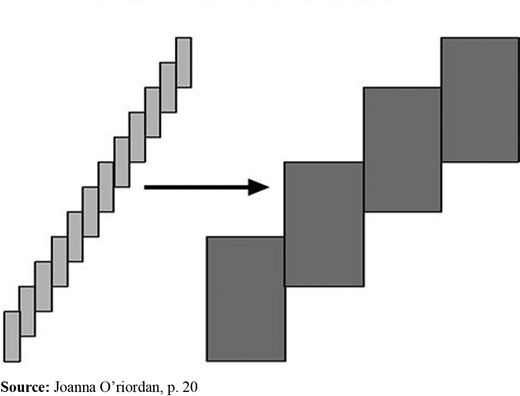
The broad-banded structure has six to nine grades, and it may have as many as four to five “bands”. The progression in these structures is linked to efficiency and performance, as well as the factors that influence monetary rewards.
For the rates of wage, this form differs from the previous one in determining the minimum and maximum wage, where the difference between them can be 100 per cent. Although this form does not restrict developing wages in each grade, it is necessary to examine the issues of equal pay (Figure 2).
6.2.3 Career family structures.
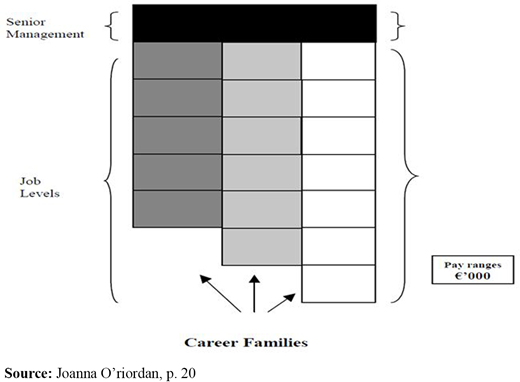
A career family structure is a single graded structure where each grade has been divided into job families (such as human resources, information technology, financial, support services […]). In this structure, occupations within the comparing levels over each of the career families are inside the same measurement range and, on the off chance that an explanatory work assessment conspire is utilized, this is characterized by the same range of scores. However, they vary according to the level of responsibility, competence, skills, and knowledge required for each grade.
It normally has six to eight levels defined by the activities carried out and/or by the knowledge and skills or competencies needed to perform these activities. Some job families may have more levels than others. Thus, it defines career paths “what people need to know and be able to do to advance their careers within some job families and develop career opportunities in other families.” Each family, in this structure, may have its own pay structure, taking into account the different levels of families. The level or degree of these structures may differ from family to another, due to the size of jobs, reflecting the characteristics and the role of each family. Moreover, the wage rates may vary among the same levels in different families, depending on the job evaluation analysis.
The structure, hence, is subdivided into symmetrical groups such as legal group, administrative group, financial group and IT group. Each group is considered a career family with gradual levels through which the employee moves and progress, and reflects the work’s needs of those families.
A good career progression is a positive feature of this system as in every family there is a known career path to progress to higher levels. As a result, employees must be aware that the competition and experience they need must be at the highest levels. Moreover, because jobs at the same levels as other families have the same size and the same pay level, it is possible to practice those occupations in other families and thereby promote opportunities for personal development (Figure 3).
6.2.4 Pay spines.
Like the narrow structure, they consist of a series of incremental “pay points” extending from the lowest to the highest paid jobs covered by the structure. Typically, pay spine increments are between 2.5 and 3 per cent. They may be standardized from the top to the bottom of the spine, or the increments may vary at different levels, sometimes widening towards the top. This difference may be due to career families.
This form is flexible as it links the development of wages to the service provided it does not focus on administrative provisions and for this reason, it is preferred by trade unions, and many employees and some managers.
However, it has some disadvantages, such as the fact that the wage is linked to the service, which means that the employees deserve the salary due to their presence and not the value of what they offer through their participation:
It is difficult to recycle the employees as many employees up to the highest career ladder.
In addition, access to the highest level of employment can lead to the frustration of employees as the increment is available only if they are promoted.
6.2.5 Broad-graded structures.
They are used to overcome or at least alleviate the grade drift problem endemic in narrow-graded structures. However, the increments can drift employees who expect to reach the maximum salary level. To offset this, it is possible to set controls such as (wages cannot be increased without achieving a certain level of efficiency).
Accordingly, there is no ideal framework that enables organizations to choose the progression and pay policies in the administrative systems. If the grades are numerous, there is a risk of grade drift as the employees’ progress easily in the career ladder. On the contrary, if the number of grades is very few, there is a risk of salary drift because of the lack of a structure of clusters where the highest point of a salary may reach 100 per cent more than the entry point (starting point).
Therefore, the progressive narrow structures have emerged, where the grading structure is of eight to ten grades, which reduces the problems of both narrow and broad structures.
However, what is most important of these grade structures is the specific definitions of the grades which makes it easy to differentiate between them. Moreover, the job evaluation system carefully ensures the best performance. In addition, the career progress and salary expectations must be informed to the staff explicitly.
The job grades and levels are analytical processes that determine the relative value of jobs in organizations as well as provide the basis for managing reward and skill programs. Through the levels of career grades, programs are delivered to employees, flexible and adaptable tools are introduced, career paths are connected, facilitating talent and skill transformation and providing competitive rewards. They also represent the basis for attracting and retaining skills and managing risks and costs.
Clearly, the Egyptian system, with its various administrative legislation that regulates the work of its administrative system (Starting from Law No. 210 of 1951 and through Law No. 46 of 1964, Law No. 58 of 1971, Law No. 47 of 1978, Law No. 18 of 2015, to finally the Civil Service Law No. 81 of 2016) follows the form of narrow structures.
The grade structures are not limited to the forms mentioned above, but there are many other forms of structures that can be used and referenced. Towers Watson has developed a form of career progression that can be a standard to be used to develop a job classification system.
Towers Watson’s systematic approach to job leveling helps organizations manage the opportunities and challenges of reward and talent program design and delivery (Watson, 2011, pp. 1-3), including:
aligning jobs located in multiple regions or across different lines of business;
creating a framework that integrates employees after a merger, acquisition or other structural change;
driving consistency, competitiveness, and efficiency among HR policies and practices; and
clarifying distinctions among levels to support career development.
According to Watson, job leveling is an analytical process that can determine the relative value of jobs in your organization. It provides a foundation for reward and talent management programs, including:
base pay;
short- and long-term incentives;
career management;
workforce planning;
succession planning; and
learning and development.
In combination, the conveyance of these programs through work leveling offers a flexible, versatile implies of communicating career ways, encouraging ability portability and conveying competitive rewards. Work leveling moreover addresses trade needs ranging from fascination, engagement and maintenance of key ability, to taken a toll and hazard management, to governance.
The key benefits of job leveling for your organization include:
a career framework that aligns with business needs and strategy;
a common language to describe career paths, job requirements and performance expectations;
linkages to organizational and job-family competencies;
consistent mapping of jobs to external market data;
contributes to cost-efficient talent and reward programs and delivery; and
helps ensure internal equity.
Inquire about shows that organizations that actualize all-inclusive steady work leveling are up to two and a half times as likely to report more successful ability and reward programs. These incorporate execution administrations, competency models, and administration evaluation and development.
The Towers Watson approach offers an extension of work leveling approaches, from built-up techniques to custom usage. Its GGS and Career Map work leveling apparatuses are not as it were more adaptable than conventional strategies but moreover easy to actualize, get it and oversee. They can be actualized separately or in pairs, and are:
transparent and objective;
easy to explain and administer, with limited bureaucracy or dependency on consultants;
able to accommodate dual career paths (individual contributor and managerial);
aligned with market data;
supportive of organizational change;
culturally neutral and applicable worldwide; and
supported by Web-based technology.
GGS is a job leveling tool for determining internal job levels based on an analysis of universally applicable factors proven to recognize differences in job size.
GGS accommodates organizations of all sizes and uses an organization’s size, complexity, and geographic breadth to assess the number of levels in its grading framework. It also ensures consistency in the development of a career framework that balances internal equity and external competitiveness:
The number of career grades in the individual career path is up to 17 that are classified as follows:
1-4 individual grade;
4-8 administrative grade;
8-12 professional grade; and
12-17 expert grade.
The number of career grades in the career path of the administration ranges from 8 to 24 grades that are classified as follows:
8-12 for supervisory scope;
12-17 for central administration;
17-22 for senior administration; and
22-24 for the first line of senior administration.
Towers Watson explains the Career Map framework clarifies the growth in jobs from one level to another based on responsibilities, scope, impact, required skills and knowledge. The Career Map is flexible, as it organizes jobs based on progressive levels of contribution, and presents opportunities for career pathing and targeted development.
It moreover gives technology-delivered modules that oversee all angles of talent and compensate program examination, plan and organization. The Career Outline may be executed with or without supporting technology.
7. Third: most important methods of job grading
Job grading is one of the most important factors of satisfaction and motivation to raise the performance level of the employee and affect his/her career. The most important methods of job grading are recruitment, promotion, transferring, assignment and secondment.
7.1 Recruitment
Clearly, the public sector has a number of civil service regulations, including a career-based system and a position-based system. Depending on either of them or a mixed system is reflected in the content of recruitment, promotion and contractual arrangements.
Career-based system recruits in accordance with the category and grade, which often starts with low categories to occupy a certain degree, not a certain position. Recruitment takes place early in the career and often uses competitive examinations and thereafter progression is managed by the organization. The administration has the right to place them in any grade or position, which means that the employee can be transferred from one department to another or from one unit to another.
The promotion system, therefore, depends on evaluating and grading that are more closely related to the person than the position. The employee shall be promoted to reach senior positions within the system. Moreover, people from outside the civil service are rarely recruited. So, this system is characterized by narrowing the possibilities of entering the service civil in the mid-career (OECD, 2003).
The position-based system appoints a staff member based on open competition. This system selects the best candidate among the contestants for a particular post, either outside the government apparatus or through internal promotion. It opens the contest to competitors from outside the organization to attract new skills and includes new elements, after studying each case separately.
The other option is to clearly define the positions according to laws, filling them by open competition for contestants from outside the organization, within the organization, or both. The recruitment process also focuses on the employee’s education, training, personal experience, career history, achievements, and even psychological state, since, recently the focus has been not only on the performance of senior government employees but also on the performance of junior employees who have leadership skills.
Most civil service systems currently combine the two former systems; hence, they have specific levels in the career sequence for recruiting staff. At the same time, there are certain positions filled by a contest open to qualified candidates regardless of grade (Al-Zubaidi et al., 2007, pp. 10-12).
7.2 Promotion
It means to move an employee to a higher-degree position that requires new responsibilities, skills, duties and authorities; in other words, it means moving the employee to a position with material and moral effects (Fatih, 2006, p. 16; Al-Anzi, 2012, p. 101). It is the path of any employee. It also reflects the upward vertical mobility of employees on the career ladder, while their horizontal movement across the departments of the organizational structure. There are two criteria for promoting:
Seniority criterion: This means that after serving a certain period in his/her position, a staff member has the right to be promoted to a higher position if he/she meets the requirements.
Efficiency criterion: This criterion takes into account the efficiency component of education, experience and competence in work regardless of the period the staff member has spent in the position.
Granting a promotion has benefits that can be summarized as follows:
Stimulate employees and encourage them to work with high efficiency and honest competition.
Keep human elements with high levels of efficiency.
Promotions are considered internal recruitment and this is less expensive and effortless to the organization.
Vertical promotions within the organization give greater scope and opportunities for supervision and follow-up by presidents.
7.3 Transferring
It means to transfer an employee from a position to another at the same level or at a higher level, which is considered in this case a promotion. The process of transferring has a set of rules, which are a vacant job that requires the same qualification of the transferred employee, and the absence of a worthy or qualified one to be promoted in the entity to be transferred to. It is not allowed to transfer the promoted employee from the job to another before the end of a certain period. Transferring, then, has the provisions and rules have to be taken into account.
It should be noted that not all the transferring falls within the career hierarchy. Only moving up is a kind of graduation, while disciplinary transferring or transferring at the same level does not fall within the career progression.
7.4 Assignment
It means to assign an employee to perform another job that is already vacant or to be a supervisor in his/her work or in another entity, besides his original job, or as a full-time job. The assignment of another job shall be in addition to the original job within the administrative entity either inside or outside the administration.
7.4.1 Inside administration.
The administrative supervisor shall clarify the need of the work to assign one of his employees to perform other functions of the same administration, specifying the name and salary of the employee, as well as the title and rank of the job to be assigned, whether vacant, clarifying the duration of the assignment. He/she also shall submit a memo to his direct supervisor and after the approval of this assignment, after confirming the conformity of the assignment terms, the decision will be issued.
7.4.2 Outside the administration: “within the administrative body”.
The assignment process begins with the request of the administrative supervisor who has the vacant post after coordinating with the administration of the employee who is required to be assigned. After approval, he/she sends to the Department of Human Resources to prepare the decision and to sign it from the authority holder.
7.4.3 Assignment of other works “outside the administrative body”.
After the administrative body approves the employee who is required to be assigned, the Department of Human Resources reviews the assignment terms and its reasons, and send to the administration of the employee to request approval. After receiving the approval, it prepares the decision and to sign it from the authority holder.
7.5 Secondment
The employee shall be discharged by the public official to perform another work of another entity, whether it is in the public sector (following the civil service system), or in the private sector (local, or overseas). Thus, the employee suspends his or her job and starts another job another administration, where he/she follows its conditions and receives its salary or full salary plus a certain percentage. On the other hand, the employee is still related to his/her original administration in terms of relations, seniority and promotions.
After the secondment is terminated before its expiry by the original administration, the other administration, or the employee himself, he/she returns to fill his original job if it is vacant or any other job of the same level. The secondment is made by a foreign government or an international organization. A secondment to a public sector requires following its own system. It, thus, differs from the assignment of another job, or the assignment of a job outside the workplace, as the assignment is only in the public sector that applies the civil service system.
Notably, the secondment differs from the mandate because the latter does not fall within the job grading of the employee who retains his/her original grade. The mandate shall temporarily assign to the employee another job outside the administration where he works while retaining his job grade.
8. Conclusion
After analysis, the study concludes that there is no ideal framework for all administrative systems to define the policies of grading and wages. Therefore, any grading system should honestly inform the employee of the details of the career progression and wages changes. The study also reviews the Towers Watson model, a model of job grading that is developed by one of the leading organizations in this field. The study also identified some methods and forms that could be considered as a means of career progression, including recruitment, promotion, transfer, assignment and secondment.
The study recommends to:
Link career structure to the nature of administrative work, instead of using one grading system to all administrative units in any country.
Link career grading to performance not seniority.
Define the objective of administrative unit before creating its job grading system.
Follow these steps, in addition to the criteria explicated above, to create a career structure:
grouping jobs into major categories based on the functions and characteristics of each job;
classifying jobs according to the tasks required of each job; and
sub-grading jobs according to the complexity and difficulty of the skills required for each job.
Points to be considered in the future:
While working on this research paper, the researcher concludes some points that can be studied in details in the future to provide effective models for administrative reforms:
Conducting a comparative study between the forms of career progression job grading in developed countries and their counterparts in developing countries in terms of the impact of scientific qualifications, methods of appointment, promotion and commissioning.
Study the relationship between the nature of the work of the administrative unit and the form of job grading.
Study the points of similarities and differences between the public and private sectors concerning the methods of job grading and determine how to take advantage of the positive points in each.
9. The addition provided by the study
The study analyzes the job grading and its most important criteria to explore the main forms of grading from an international perspective, and in the Egyptian case. Furthermore, it presents precise definitions of both career grade and job grading. It defines a career grade as the unit that organizes all jobs, which have the same level of difficulties and duties, but differ in their type of work. It has a segment of wages according to the financial link stipulated in the Civil Servants System. On the other hand, the study defines the job grading and explicates its objectives and criteria that positively influence the performance of both administrative systems and employees.
The study also analyses some literature on “job grading”, its objectives, its criteria and its main types, presenting an integrated framework that can be used to develop career-structure systems. Finally, the study identifies some methods that can be considered as a means of grading as there is no ideal framework in creating grading structure with concerning in the Egyptian case in grading system including recruitment, promotion, transferring, assignments and secondment.