


This study examines the nexus between entrepreneurship through small–medium enterprise (SME) business formation and the growth of the Nigerian economy. Furthermore, this paper seeks to explore the link between small enterprise development and econo.
The paper focused on secondary data for the period 1990–2016 for macro parameters including, registered small and medium scale enterprise, nominal gross domestic product, employment, total labor force and population. Forecasting technique was applied to obtain data for missing trends. Quantitative analytical techniques used include the dynamic method of the error correction model (ECM) and Johansen co-integration test for a long-run correlation.
The result shows an increasing number of SME formation which has also led to the growth of the economy. However, an increase in the amount of micro-small and medium scale enterprises did not contribute to the development of the economy more than existing businesses. The employment elasticity is positive and significant and shows that the contribution of entrepreneurship regarding employment is the most essential factor that advances economic growth and reduction of unemployment.
The paper examines how the persistent increase in small and medium enterprise formation improves the growth and development of the Nigerian economy, employing the ECM approach.
1. Introduction
Small–medium enterprise (SME) formation and venture start-ups always create excitement for economists, politicians, unemployed youths and consumers alike. Overcoming inertia to move from idea conceptualization to actual implementation in a tough clime like Nigeria or Sub Sahara Africa in Nigeria is a daunting task (Anyebe, 2017). On the global ease of doing business report, Nigeria has always fared badly, ranking 146 in 2019 and 131 in 2020 (World Bank, 2020) with only marginal improvement in recent years. The experience in the global innovation index (114 in 2019) (Cornell University, INSEAD and WIPO, 2019) is also in the same direction. Entrepreneurs who initiate start-ups are faced with a barrage of barriers including, registration, licensing, take-off capital, stiff competition, winning consumer affection and asymmetric information. While many informal SMEs abound and further undermine registered SMEs as they operate at a lower cost due to tax evasion and other levies (Aribaba et al., 2019), it is important to evaluate the formation of SMEs and economic growth in Nigeria.
SME formation is necessitated by a couple of drivers as follows: (1) necessity (Fairlie and Fossen, 2018), (2) Innovation (Visser, 2017; Adeosun and Shittu, 2021) and (3) opportunity (Aparicio et al., 2016). Necessity-driven entrepreneurs can be a result of unemployment or just the drive for survival. Opportunity-driven entrepreneurship is typically around a business idea to fill a need or gap, while innovation-driven is to improve on a process, market, service, or product or service (González-Pernía et al., 2015). Other SMEs have been a result of political brokered opportunities or genuine love and passion for businesses and create employment opportunities. Opportunity search and discovery, and opportunity exploitation are crucial elements of the entrepreneurial process (Kusa, 2019). Opportunities vary among individuals over time. The desire to explore opportunity by an entrepreneur depends on his innate skills, training and competitiveness of the environment.
SMEs vary by ownership. Ownership structure varies along with ownership concentration and ownership mix. Ownership concentration implies the owner takes a major risk, management of inflow and outflow to the business. In contrast, the ownership mix allows for a more relaxed management style, trusting others with key responsibilities (Obasan et al., 2016). While some are sole proprietorships, others are family-based, that is, couples, while others are partnerships consisting of friends or business associates (Peruzzi, 2017). It is interesting to note that some individuals or families have multiple businesses registered and run different areas of commerce.
SMEs are a veritable tool for economic growth and development. They play a key role in promoting prosperity by creating new jobs and increasing a region's economic prosperity (Maksimov et al., 2017). Due to the importance of small businesses, governments in developing and developed nations see them as a means of employment, innovation and wealth creation (Mills and McCarthy, 2016). Small business is important for the growth of products and services' productivity while it creates employment at a smaller financial cost, particularly in the rapidly developing service sector. More than half of the jobs in developing countries are created by SMEs, and they dominate the private sector space in the same economies (Kumar, 2017; Lorenz and Pommet, 2018). Poverty reduction and wealth creation in impoverished regions cannot merely rely on multinational enterprises or the central government for solutions. Still, they must depend on their entrepreneurship ability to innovate, plan and execute ideas leading to small businesses as a tool for wealth creation and poverty alleviation (Easterly and Reshef, 2014).
Entrepreneurs typically set up and manage SMEs. The revolution of entrepreneurship into a field of study and scope of human endeavor has in recent times enjoyed the attention of policymakers, researchers and academicians the world over. SMEs are crucial in many countries because they present people with the opportunity to be lifted from poverty (Hossain et al., 2018). Citizens with small finance, little or no education, and little or no experience can get some income via entrepreneurship (Baumol et al., 2007, p. 3). SME businesses are also crucial because they contribute to reducing inequalities by helping with wealth redistribution in the economy (Amorós et al., 2011). Also, entrepreneurship serves as a means of quick development of economies in developing and underdeveloped nations (Schumpeter, 1934; Clausen, 2006; Praag and Versloot, 2007).
Small businesses offer several benefits to an economy. In Nigeria, small businesses constituting 10 to 99 persons increased from a little above 15 million in 2010 to 36,994,578 in 2013, while large-scale industries constituting 100 persons and above pegged at over 2,000 in 2010 and increased to 4,670 in 2013 (SMEDAN, 2014). Small businesses account for 70% of industrial employment and about 50% of manufacturing output (Ogunmuyiwa and Okunleye, 2019). Previous nonempirical research has been conducted within Nigeria's framework to reflect the effect of entrepreneurship development and the rising level of unemployment and poverty, and the snail speed of growth in the economy (Abimbola and Agboola, 2011; Thaddeus, 2012; Salami, 2013). The necessity of entrepreneurship in eradicating poverty, creating employment and quickening advancement in the economy is widely believed. The various governments to have ruled Nigeria in more than thirty years have created regulations and activities focused on improving entrepreneurship using the growth of SMEs.
Despite the effort made by the government, the unemployment rate has remained high, rising from 6.4% in the first quarter of the year 2005 to 18.8% in the last quarter of the year 2017, with 7.9 million of the population of Nigerian youth aged 15–34 being unemployed (NBS, 2013). There are more than 100 million Nigerians living below US$1 daily, which is below the poverty line. The country’s population living in extreme poverty rose from 54.7% in 2004 to 60.9% in 2010 (NBS, 2011). Besides, the human development index (HDI) in Nigeria is still extremely low at 0.527, retaining her 2015 status and ranking 152 out of 188 countries – this is much lesser than the world weighted average of 0.7 (UNDP, 2016). The Global Entrepreneurship and Development Institute (GEDI) in 2018 ranked Nigeria 101 in the world ranking category and 8 in the regional category, with an overall score of 19.7%. Therefore this has an authoritative implication on the level of entrepreneurship development in the country.
The above assertions raise two critical questions: Is entrepreneurship via small and medium enterprise formation playing a vital role in economic growth in Nigeria as contended by Naude (2011). Is entrepreneurship in the country developing, given the largely dispersed number of SMEs? This paper, therefore, attempts to evaluate the connection between entrepreneurship development and economic growth using both the economic literature and empirical analysis. The article proceeds thus: the second section will present the conceptual and research discourse, the third section – the research methodology of empirical analysis – while data and results will be analyzed in section four; chapter five will then conclude the paper.
2. Literature review and theoretical discourse
2.1 Importance of small medium enterprises
For decades, small businesses have been creating employment opportunities for many people in an economy (Burns, 2016; Porter and Kramer, 2019). Lingering unemployment scenarios, which have become a global phenomenon, constitute a leading motivation for creating small businesses globally. Consequently, several small businesses are established either by choice or driven by necessity (Bushe, 2019). Either way, small businesses' existence provides job opportunities for the unemployed who are willing to earn a living legitimately. Small businesses also provide the employed with alternative sources of income, which eventually leads to more job opportunities. An emerging channel of job creation is in service outsourcing, which is also dominated by small businesses created to fulfill existing companies' unmet needs.
Global statistics acknowledge that small businesses are key providers of employment. For instance, in the United States of America (USA), small businesses accounted for 64% of new jobs created between 1993 and 2011 (Aribaba et al., 2019). Among the Organization for Economic Co-operation and Development (OECD) nations, small businesses account for 60–70% of jobs created annually (OECD, 2015). Among the emerging markets, 7 out of 10 new jobs are created by small businesses (World Bank, 2015; Page and Söderbom, 2015). The employment creation potentials of small businesses in Sub-Saharan Africa have also been acknowledged. In Kenya, Zambia, Ivory Coast, South Africa, Cameroon, etc. small businesses account for 38%, 37%, 33%, 21% and 19% of the new jobs created, respectively (World Bank, 2018). In Nigeria, the available statistics show that as of December 2017, small businesses provide about 3 million jobs (National Bureau of Statistic, 2019). These explain why the government, policymakers and other relevant stakeholders appreciate small businesses as a top priority for job creation within the economy.
Small businesses are fast becoming engines of innovation (De Massis et al., 2018). Unlike large companies with the necessary organizational resources to pursue research and development (R&D) and patented innovations, small businesses have unique ways of engaging in innovation activities. Given the changing technological environment, these businesses initiate innovative approaches to driving efficient and effective production and sale of their goods and services (Porter and Kramer, 2019). Similarly, the uncertainties that pervade economic environments push small business owners to explore other market opportunities, develop new products and seek new market openings for survival and enhanced performance (Dosi, 1988). Thus, the size, age and growth potential are necessary micro-economic variables supporting small businesses' innovation potentials globally (Hunjra et al., 2014).
In recent times, small businesses have increasingly become important knowledge transfer channels (Omotayo, 2015). Their ability to manage the knowledge transfer process plays an important role in their survival (Durst and Wilhelm, 2012, p. 646). The exchange of knowledge enables the successful onboarding and succession of new employees in small businesses. Newcomers feel welcome, and they have quick access to the information they need. At the same time, departing team members can be assured that their knowledge will remain within the business, accessible by their colleagues. Knowledge transfer also improves the employees' level of competency, especially those with a higher level of knowledge due to education, work experience, etc. (Oluyomibo, 2016). They are of particular importance to a small business as they facilitate other employees' growth, contributing to their wealth of knowledge, building capacity and improving overall performance (Massaro et al., 2016). Knowledge transfer has been found to improve innovation, decision-making, product knowledge and customer responsiveness (Aldrich and Yang, 2014).
2.2 Entrepreneurship and entrepreneurship development theories
Following the rise in interest in entrepreneurship by researchers and academic theorists, there now exists a wide range of entrepreneurial definitions and concepts. The general definition in many studies included the following vital variables such as risk-taking inventions and recognition and the maximization of favorable circumstances. These factors were used along with diverse forms of reiteration (Rusu et al., 2012).
Leibenstein (1968), in his X-efficiency theory, argues that when an input is not used effectively, the difference between the actual output and the maximum output attributable to that input is the measure of the degree of X-efficiency. The theory's key attributes are as follows: (1) It analyzes the role of an entrepreneur inefficiency. (2) It tells us why the growth rate is different in different countries. (3) This theory shows that a firm will achieve maximum efficiency when the firm minimizes cost. He explained that the types of entrepreneurship include routine entrepreneurship and innovational entrepreneurship. The roles entrepreneurs play include input completion and gap filling. They must be able to perceive (1) buying and selling opportunities in different markets, (2) the possibility of transforming input into output and (3) the profitable activities.
A development economist by the name Schumpeter (1934) considers entrepreneurship from the angle of provision of value while defining entrepreneurs as risk-taking innovators, required for quick advancement of the economy, via the application of “creative destruction,” which is a means that allows old ideas and technologies to be changed with current ones. Schumpeter (1934, 1942) argued that embedded in entrepreneurship is the prospect for enhancing the economy via the utilization of modern inventions and ideas that will push old industries out of business. In Schumpeter’s opinion, the utilization of modern ideas occurs in vast ways such as (1) the emergence of a new commodity, (2) the emergence of a new means of manufacturing, (3) the creation of a new market and (4) the restructuring of a business already in existence to fit the dynamics of technology.
Schumpeter (1934, 1942), however, considers an entrepreneur to be an advocate/change agent that changes the direction of the market from the equilibrium point. Drucker (1985) is of the view that an entrepreneur should not be seen in the light of an agent of change, but instead, as one that seeks changes, works on changes found and thoroughly explores opportunities. Drucker was also in agreement with Knight (1921), who considered entrepreneurship as the ability to ascertain and work with changes despite uncertainty and prevailing changes in the market. Stevenson and Jarillo (1990) explain entrepreneurship as how people pursue opportunities by themselves or within an organization. Shane and Venkataraman (2000) were of the firm opinion that the availability, characteristics and unearthing of opportunities form the basis of entrepreneurship.
To Leibenstein (1968), entrepreneurship is the process needed to establish and build an enterprise, while Gartner (1988), in simple words, defined entrepreneurship as making new enterprises. According to Martin and Osberg (2007), the outcome of the mixture of three elements leads to entrepreneurship: the setting wherein opportunities are formed, a set of innate skills required to recognize and utilize opportunities and the conversion of opportunities to enterprises. Baron and Henry (2010) stated that entrepreneurs are not limited to the recognition of possibilities. This is because their action generates a result that creates opportunities that hitherto did not exist.
Some empirical research indicated the intimate relationship of environmental conditions and the creation of entrepreneurship (Wilken, 1979; Thornton, 1999; Abimbola and Agboola, 2011). Thornton (1999) states the differences of the function of individuals possessing entrepreneurial attributes, categorized as supply-side view including functions of the social norms and the surrounding (demand view) in growing entrepreneurship. Wilken (1979) stressed government regulation and programs' relevance to establishing a favorable social and economic system necessary to develop entrepreneurship. Alvarez and Busenitz (2001) developed a material-centered concept of entrepreneurship that considers funds' availability as a sign of opportunity-focused entrepreneurs. Furthermore, Busenitz (2001) views resources as comprising the capacity to identify opportunities and coordinate and merge resources for production. Davidson and Honing (2003) mentioned in the Global Entrepreneurship Monitor (GEM) in 2012 that the ease of accessing resources could develop individuals' skills to recognize the merit in certain circumstances. Information gathered from the survey conducted by (GEM, 2012), Clausen (2006) shows the level of variation in materials that are linked to emerging entrepreneurship. The studies also revealed that people with certain human capital would possibly involve in entrepreneurship.
Naude (2011) argues that worldwide growth is getting to a threshold in which the role of entrepreneurship will be more pronounced. He gave three reasons to reach his conclusion. To start with are the Western-based economies that occurred between 1970 and 2000. This economic structure was reliant on big enterprises and mass production, which paved the way for an entrepreneurship-driven economy in which a smaller creative group conveniently produces goods and services. As provided by Naude (2011), the next adduced reason for development is the increasing growth that has recently been experienced by emerging nations such as Brazil, Russia, India and China, as a result of their acceptance of entrepreneurial revolution. Finally, is the less developed nations characterized by a reliance on donor agencies. Donor agencies, however, in the less developed nations are beginning to lean towards the growth of the private sector. The conclusion reached by Naude (2011) is the existence of entrepreneurship, which will allow for development and the availability of jobs of developed, new and less developed economies.
2.3 Entrepreneurship, innovation and economic growth
The establishment and administration of nascent enterprises, structured to achieve unusual and creative privileges to attain quick and return-yielding growth, define entrepreneurship Shane and Venkataraman (2000). According to Kanothi and Ngatia (2009), entrepreneurship is a merger of economic resources initiated by an indefinite opportunity for transient profit. Entrepreneurship also involves taking risk, creating and organizing factors of production to produce goods and services for members of a society (Kanothi and Ngatia, 2009). Entrepreneurship is also concerned with getting things done differently, creating innovative products and services, and organizing the process of creating and supplying products and services produced. Economic growth, however, occurs with a rise in the quality of manufactured products and services in a nation. It can be derived from the amount of increase in Gross Domestic Product (GDP). Economic advancement is ascertained in real terms or inflation-adjusted terms. In the economics parlance, “economic growth” or “economic growth theory” is an enhancement in the level of output or production due to an increase in total demand or production.
There is a general belief that for economic growth and development, entrepreneurship is of immense benefit. Over the past three decades, nations that have experienced a fall in the level of poverty are those that have adopted entrepreneurship (Naude, 2013). Stag inflation and high unemployment in the 1980s stirred an interest in supply-based economics and determinants of factors growth. The 1980s and 1990s also witnessed a greater focus on entrepreneurship. Knowledge of the functions performed to achieve economic advancement demands knowing essential components of the concept of entrepreneurship (Wennekers and Thurik, 1999).
Entrepreneurship and economic growth are separate concepts that are similar and positively linked. This relationship has been present in Schumpeter's previous findings. With a rise in the number of entrepreneurs, and with the needed skills and abilities to innovate or create, there will inevitably be a rise in economic growth. According to Schumpeter, the following are examples of innovative entrepreneurial activities: “(1) The creation of a nascent product – as already stated, a new good involves customers getting introduced to for the first time – or an existing good with improved quality. (2) The creation of a new production technique, i.e. a technique being tested for the first time in a production system. (3) The discovery of a new market- a new market hitherto has not been operated in before. (4) Finding a new location of resources supply or the supply of partly finished goods. (5) The establishment of a new organization within an industry (for example through fructification) or ending a monopoly position” (Schumpeter, 1934). The above-mentioned activities are how Schumpeterian entrepreneurs develop profit-making opportunities, increasing production.
There are so many studies of how entrepreneurship has enhanced economic growth. The reviews, discussions and debates are immense and create room for continuous innovation and rivalry development (Todtling and Wanzanbock, 2003). Evaluating entrepreneurial factors has been close to impossible to quantify. This makes it difficult to ascertain the contribution of entrepreneurship to the growth of the economy. Also, Carree and Roy (2002) stated that the idea of entrepreneurship is of many dimensions and is yet to get an adequate definition. Identifying the function of entrepreneurship in the event of growth in the economy demands a scope due to the existence of common parameters and connections (Bygrave and Minniti, 2000). It is essential to cite examples of common parameters. And they include creativity, competition from the existing and new firms, etc. Some other relevant entrepreneurial factors also apply in adding to the growth of the economy (Robbins et al., 2000). Furthermore, Acs (2006) and Ahiauzu (2010), concluded in their research that the correlation between entrepreneurship and the economy's growth is a positive one. Henderson (2007) regarded entrepreneurship as a topic increasingly getting attention as a fundamental economic growth tool. Combining available resources with creative ideas enables entrepreneurs to add value, commercialize new goods, invent new jobs and establish new firms. Findings from the GEM show that countries with an increased level of entrepreneurship reap the benefits through the economy's growth. Entrepreneurship is also considered to be the capacity and will of individuals, or a group belonging to an existing organization to sight and create nonexisting economic opportunities (new goods, new technique of production, new organizational system and newly discovered product market) as well as introduce freshly discovered schemes into the market even when faced with uncertainty and other forms of hindrances while profoundly considering variables such as location, utilization of resources and organization. Entrepreneurship, therefore, occupies a central place in the country's benefit. Entrepreneurship is of enormous importance in the process of creativity and innovation. The function of entrepreneurship in creating avenues for economic growth brings to bear several links. An understanding of entrepreneurs' features in innovating and shielding against rivalry is of importance to economic growth (Wennekers and Thurik, 1999).
In Figure 1, the conceptual link between entrepreneurship, which often reflects in the formation of SMEs, is shown, and the conditions in which they operate, their ability to operate in a competitive environment, are demonstrated Also, the crucial elements of entrepreneurship, both micro and macro levels, are highlighted. These interactions ultimately result in firm performance, personal wealth and aggregate national economic growth (Carree and Thurik, 2010).
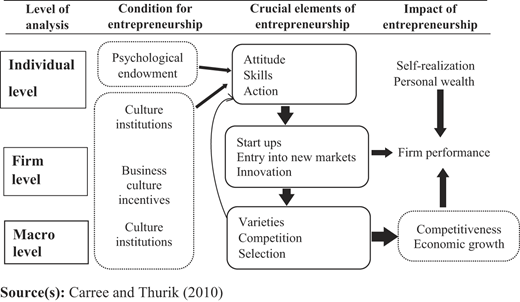
The conceptual structure connecting entrepreneurship, creativity and growth in the economy
The conceptual structure connecting entrepreneurship, creativity and growth in the economy
Naude (2013) was also in agreement with the capacity of entrepreneurship to enhance the economy and the creation of employment in developed, underdeveloped and emerging economies. Naude's finding is well backed by studies carried out by historians, managers and economists. The presence of many entrepreneurs certainly increases the level of goals and or aspirations in a country and increases opportunities while influencing people's ambition. The availability of entrepreneurs leads to job creation which diminishes unemployment and provides a significant source of happiness. Also, goods and services manufactured by entrepreneurs increase the level of happiness of customers.
3. Methodology
3.1 Model specification and source of data
In a bid to analyze entrepreneurship development and economic growth, data on annual GDP at the current price or nominal GDP is applied as an alternative to economic growth. Employment through entrepreneurial business (EMP) and the total number of registered micro–small and medium scale enterprises (TMSME) are the regressors for entrepreneurship development as contended by Schumpeter (1934) – the emergence of a new commodity, the emergence of a new means of manufacturing, the creation of a nascent market and the coordination of already operating enterprises to reply to the dynamism of technology. TLF and population (POP) are used as control variables to prevent multicollinearity. Time series data for the population (POP), the TLF and GDP were sourced from the World Development Indicator (WDI), while data on total micro–small and medium scale enterprises (MSME) and employment through entrepreneurial business (EMP) were taken from the National Bureau of Statistics (NBS) annual reports in conjunction with Small Medium Enterprises Development Agency of Nigeria (SMEDAN). Data were sparsely available for our analysis; Microsoft Excel 2016 package was used in forecasting the historical trends.
Hence, having outlined all variables for our empirical investigation, we at this moment specify the functional relationship that exists among our outlined variables as follows:
where,
The econometric form of the model is therefore given as
where,
are the parameters while is the stochastic error term representing all other variables not specified in the model.
3.2 Model estimation techniques
Many macroeconomic factors possess a unit root, thereby producing inaccurate results when ordinary least squares (OLS) is engaged in evaluating a model in the range of the variables (Acquah, 2017). A means of rectifying this issue is using OLS in the variation between the variables. This process, however, results in the displacement of information pertaining to the long run. Testing for co-integration and subsequently evaluating the error correction model (ECM) in situations where co-integration applies a generally approved method. The conclusion is reached by the Granger representation theorem of Engle and Granger.
The ECM, which was popularized by Engel and Granger involves the application of the error term in the trial above as equilibrium error (Salisu and Isah, 2017; Ahmad and Du, 2017). It involves the error term to link the short-run behavior of the GDPRt to its long-run value.
The error correction dynamic specification is of the general form
where,
Z is a vector of variables that co-integrate with the GDP annual growth rate, L is a general operator and ECMt−1 is the error correction term lagged by one period while is the error term. This can be expanded to include the vector of variables thus:
It should be noted that Δ denotes the first difference and the coefficient of the ECMt−1 provides an estimate of the speed of adjustment. The ECM was adopted due to the presence of unit root and mixed order of integration of not more than I(1).
3.3 Hypothesis
Hypothesis one
Employment through entrepreneurial business does not positively impacts GDP.
Employment through entrepreneurial business positively impacts GDP.
Hypothesis two
Small and medium scale enterprises do not positively impact GDP.
Small and medium scale enterprises positively impact GDP.
Hypothesis three
TLF does not impact GDP.
TLF impacts GDP.
H4. Hypothesis four
Population does not improve GDP.
Population improves GDP.
4. Results and discussion
4.1 Unit root test
Findings have established that a lot of time series quantities are unmovable or dynamic. Therefore, the use of dynamic quantities in the model will likely result in a false regression result that will be incapable of making an accurate prediction (Gujarati, 2003). Hence, our first step is to analyze the sequence of fusing the series, using the joint test for a unit root employing the Philip–Perron (PP) test for the individual unit root process. The general rule here is that if the PP quantity is higher than the critical values at the 5% level. Then, we conclude that the variable(s) has no unit root; in other words, the data are stationary.
Table 1 showed that all variables are fixed at initial variation. This is evident when making a comparison of test statistics (in absolute terms) of PP test statistics with the critical values (also in absolute terms) at 5% level of significance. This result shows the importance of undergoing a co-integration test to create long-run equilibrium because variables are not of the same order in terms of their stationarity.
Unit root test
| Variables | Philip–Perron statistics | 5% critical values | Order of integration | Remarks |
|---|---|---|---|---|
| GDP | /5.139445/ | /3.603202/ | I(1) | Significant |
| EMP | /5.502336/ | /3.603202/ | I(1) | Significant |
| TMSME | /3.297465/ | /3.603202/ | I(1) | Significant |
| TLF | /5.15366/ | /3.603202/ | I(1) | Significant |
| POP | /2.431217/ | /3.603202/ | I(1) | Significant |
Source(s): Researchers' computation using EViews and data from World Development Indicators (WDI) and National Bureau of Statistics (NBS)
4.2 Co-integration test
Creating a long-run equilibrium that exists among the selected variables for this study, the co-integration test will be estimated to determine whether the errors are co-integrated. This will be achieved by employing the Johansen co-integration test, which produces the likelihood ratio and maxeigenvalue to assert the validity of the long-run relationship at 5% level of significance. If the quantity of the trace statistics or the max eigenvalue is above the critical value, it can also be concluded that a long-run equilibrium correlation exists, else the residual is not co-integrated which means no long-run equilibrium between selected variables.
Table 2 shows the results for testing the presence of a long-run correlation between the quantities used for the study. The trace statistics and max-eigenvalue test indicated three co-integrating eqn(s) at the 0.05 level. This notes that a long-run correlation is present between the variables.
Johansen cointegration test
| Hypothesized no. of CE(s) | Trace statistic | Critical value 0.05 | Prob.** | Max eigen statistic | Critical value 0.05 | Prob |
|---|---|---|---|---|---|---|
| None* | 266.1652 | 95.75366 | 0.0000 | 116.4377 | 40.07757 | 0.0000* |
| At most 1* | 149.7276 | 69.81889 | 0.0000 | 66.57876 | 33.87687 | 0.0000* |
| At most 2* | 83.14880 | 47.85613 | 0.0000 | 49.04529 | 27.58434 | 0.0000* |
| At most 3 | 34.10351 | 29.79707 | 0.0150 | 22.63622 | 21.13162 | 0.0305** |
| At most 4 | 11.46729 | 15.49471 | 0.1843 | 11.46728 | 14.26460 | 0.1323 |
Source(s): Researchers' computation using EViews and data from WDI and NBS; * and ** represent significant at 1% and 5%, respectively; CE = Coefficients
4.3 Error correction model (ECM) regression result
As a result of the quantities being co-integrated, we computed our ECM, and the result obtained is presented in Table 3.
Error correction model (ECM) regression
| Dependent variable: D (GDP) | ||||
|---|---|---|---|---|
| Variables | Coefficient | Standard error | T- statistics | Prob |
| C | 4.46E+13 | 2.09E+13 | 2.138048 | 0.0612 |
| D (EMP) | 380248.5 | 150484.9 | 2.526822 | 0.0324** |
| D (TMSME) | 351228.4 | 556443.9 | 0.631202 | 0.5436 |
| D (TLF) | 8057357 | 14,316,007 | 0.562822 | 0.5873 |
| D (POP) | −15,893,488 | 9,379,968 | −1.694408 | 0.1244 |
| ECM (−1) | −0.521342 | 0.116840 | −4.462014 | 0.0016* |
| R- squared | 0.779538 | |||
| Adjusted R2 | 0.657059 | |||
| Durbin–Watson stat | 1.969400 | |||
| F-statistic | 6.364670 | |||
| Prob (F-statistic) | 0.008522* | |||
Source(s): Researchers' computation using EViews and data from WDI (2016); * and ** represent significant at 1% and 5%, respectively
A cursory look at the result revealed that only employment through entrepreneurial business (EMP) is statistically significant among our variables at 5% with a positive relationship with GDP. This connotes that a rise in entrepreneurial business yields higher GDP for the country. This means that when people are encouraged to venture into entrepreneurship business, whether through tax holidays to young entrepreneurs or access to financial credit from banks with the little interest rate, there's a tendency for the nation's GDP to increase and improve economic growth. Also, an increase in the amount of micro–small and medium-scale enterprises will all raise the GDP because of its positive coefficient due to the government's encouragement by laying out policies that will enhance entrepreneurship programs. However, from the statistics angle, it is considered negligible. This means that for the economy to grow, establishing more SMEs is not as outstanding as supporting the few innovative capacities. Furthermore, an increase in the TLF in the economy leads to improvement in economic growth because of its positive coefficient but lacks a tangible effect on the economy's growth. This implies that increases in the working age category in the country lead to an increase in the economy but lack any tangible impact on the economy's growth. However, an increase in population growth does not lead to an improvement in economic growth. This implies that the limited resources in Nigeria cannot be a taker for the rising population in the country. Besides, this reveals that Nigeria is the least developed nation among the OPEC nations because it has the largest population in Africa.
The coefficient of determination (R^2) of 0.79 indicates that 79% of the total variation in GDP is explained by our exogenous variables. Also, the Durbin Watson statistic of 1.97 shows that serial correlation is minimal, while the probability of F statistic of 0.009 – significant at 1% – indicates that a linear relationship exists among all the variables used. Lastly, the correctness of the ECM and its significance at 1% reveals that the variables adjust speedily to long-run dynamics.
5. Conclusion and recommendation
This study set out to understand the relationship between SME formation and the role they play in economic growth in Nigeria. The study also looked at how the development of these SMEs contributes to Nigerian economic development. Findings have revealed the significant entrepreneurship components, which comprise identifying, using and optimizing profitable opportunities available in businesses, are germane for economic growth. The three hypotheses tested indicated that employment through entrepreneurial business positively impacts economic growth with the p-value less than 0.05. Therefore, we reject the H0 in Hypothesis 1 and accept the alternative. The second hypothesis was tested to show whether SMEs impact on GDP has a p-value above 0.05. The third hypothesis on the TLF also indicated insignificance in economic growth. Furthermore, hypothesis four which tested the impact of population on GDP, also has a p-value above 0.05. Consequently, hypotheses two, three, and four H0 are accepted; therefore, the alternatives are rejected.
For small and medium businesses (SMEs) to thrive, entrepreneurship has to be well developed. In a manner that is sustainable and capable of resulting in economic enhancement for the country. This is because it translates into employment and wealth creation. However, regulation by the government and the condition of the business environment, especially factors that cannot be controlled, can ruin the ability of entrepreneurship to positively influence the growth and development of the nation.
Empirical evidence shows that increase in population growth does not lead to improvement in economic growth. However, an increase in the amount of micro–small and medium-scale enterprises raises the GDP. An increase in the number of working population contributes to the output of entrepreneurs. This agrees with an earlier study of (Naude, 2011; Oluyomibo, 2016). However, from our empirical analysis, it was revealed that while the annual increase in the total number of SMEs fosters economic growth, it is not indispensable; instead, aiding the existing businesses to innovate and develop better is what ought to be revealed that when businesses expand as a result of innovation, more employment is created, thus, lessening the gravity of unemployment. The study aligns with Leibenstein's (1968) X-efficiency theory; it focuses on the reason for differences in an individual country's growth rate.
A lot has been said about the increasing need to have qualified professionals or manpower for the economy to be pushed forward through SMEs and this can partially be achieved through universities and training institutions. Some institutions are doing great regarding this in the country but not to the extent of meeting market needs of qualified manpower as qualitative training provides experts with the right skills and qualification that will support the growth of SMEs. A standard curriculum that encompasses the starting of SMEs, co-ordination, management and continuation for SMEs to move from start-up to scale-up needs to be developed and used to train students in our training institutions as this will help to get them prepared for the phases of SME.
Therefore, to build capacity for the economy, the triple helix model can be adopted. It is recommended that the government provide support capable of augmenting innovation and widening its spheres. Greater attention should be paid to increase budgetary provision by increasing funding, provision of modern infrastructural facilities, that is, electricity, efficient transport framework, telecommunication, ease of doing business, reduction of regulatory bottlenecks, provision of tax incentives and access to exports. This will have a multiplier effect as most economy sectors are dominated by SMEs. The education sector curriculum should also be upgraded at all levels with entrepreneurial training. The National Youth Service Corps (NYSC) scheme should look deeply into entrepreneurial hubs with start-up grants for members to initiate their ventures. Management training that would include knowledge around systems, processes and structures should be made affordable and accessible to SME owners and employees by industry experts to develop the capacity to scale-up and enhance the survival rate of SMEs.
5.1 Limitation of the study
This study examined the impact of employment through entrepreneurship business, total micro–small and medium scale enterprises, TLF, and population on GDP. While only the impact of employment through entrepreneurship business was positive, others were negative. This study, however, did not examine the cause of the negative relationships. Given that a country with a high population like Nigeria ought to benefit from her high population, we propose that further study can unravel the root cause of the negative relationship between total micro–small and medium scale enterprises, TLF, and population and the Nigerian GDP.
We acknowledge everyone who have and will still contribute to the great success of this research work. We acknowledge Owolabi Kayode and Dr. Omolara Faboya's assistance toward this research paper.
Funding details: The authors received no direct funding for this research work.
Declaration of interest statement: The authors declare no conflict of interest.

