A key point in the internationalisation process of companies comes with the choice of international market. Following this choice, the results companies may thereby obtain help in measuring their level of international performance. This study aims to measure the impact of internationalisation processes in keeping with company market orientations (MOs) through measuring their effect on international performance.
The authors obtained the data from a questionnaire sent out by email to a total of 8,103 exporting companies and/or with interests in exporting (the study population) registered in the AICEP-Portugal Global database that provided the email addresses of the company representatives responsible for internationalisation. The authors received a total of 320 valid responses (sample).
The results display a positive MO effect both on internationalisation processes and on international performance. The authors also note the importance of studying the influence of strategic orientations on internationalization processes, motivated by the particular SME’s characteristics.
The authors aim to contribute to the study of the influence of the MO, both upstream and downstream, thus seeking to verify its impact on internationalization processes.
1. Introduction
According to Morgan-Thomas (2009), the internationalisation goals of small- and medium-sized enterprises (SMEs) need to take into account two competition-based pillars: the growing globalisation of markets (Coviello and Munro, 1997; Oviatt and McDougall, 1997; Jones, 1999; Chetty and Blankenburg Holm, 2000) and the speed of technological advances, especially in terms of the currently available scope for online transactions and exchanges (Karavdic and Gregory, 2005). Within this framework, understanding the motives for the success or failure of company internationalisation processes holds importance to both academics and management professionals (Morgan et al., 2004; Lages et al., 2008). Furthermore, the evolution in e-commerce has redefined the nature of international business for many SMEs (Karavdic and Gregory, 2005). In facilitating a direct connection between the company and a foreign client, these technologies provide the scope for accessing and serving external markets, impacting on the sheer numbers involved in greater volumes of export operations (Etemad and Wright, 1999). Whenever companies are contemplating internationalisation, attention focuses on the resources and the capacities deemed necessary to undertaking substantial operations in global and competitive environments. The tangible resources are easier to observe and imitate; however, the intangible resources are difficult to construct and manage over a short space of time and hence are the priority that companies seek to establish and maintain (Galbreath, 2005; Ahn and York, 2011). Furthermore, various researchers have, in recent years, approached the characteristics of the behaviours that enable SMEs to boost their internationalisation processes and their international performance despite an apparent lack of resources when compared with their much larger scale rivals (Oura et al., 2016; Lobo et al., 2018; Nakos et al., 2018). Amongst these characteristics, we encounter various essentially strategic orientations, such as the innovation capacity, the choice of the means of market entrance or the entrepreneurial orientation. However, other authors observe how market orientation (MO) reflects a crucial characteristic not only in internationalisation processes but also in the subsequent international performance levels (Cadogan et al., 2009; Frösén et al., 2016; Acosta et al., 2018). On the one hand, the literature identifies MO as a direct determinant of the international performances returned by both large firms and SMEs (Chung, 2012; Boso et al., 2013), even while the empirical evidence available on the SME sector still remains only shallow (Armario et al., 2009; Ripollés et al., 2012; Torres-Ortega and outros, 2015; Zhou et al., 2010). On the other hand, the constant search for business opportunities in new markets represents one means of corporate entrepreneurship for which various research projects have analysed the effect of MO on international performance (Escandón-Barbosa et al., 2016; Acosta et al., 2018; Nakos et al., 2018). According to Paul et al. (2017), much of the study of international entrepreneurship has focussed on international new ventures and Born Globals. Therefore, there is still scope for research on the factors determining the internationalisation of SMEs in general, without specifically focussing on companies with international focus from inception. According to Zhou et al. (2008), MO is one important firm-level resource and capability, and it is the extent to which a firm engages in generation, dissemination and responsiveness to market intelligence pertaining to current and future customer needs and wants, competitor strategies and actions and broad business environment (Morgan et al., 2009). A market-oriented firm proactively and systematically acquires and evaluates market intelligence concerning customers, competitors, government, technology and other environmental forces.
For all these reasons, a key aspect of company international strategies arises from the choice of strategy applied to approach the external market. These changes, as well as their impacts on the actual internationalisation strategies of companies, especially for SMEs, explain the need to study the impact of MO in terms of both developing internationalisation processes and achieving the international performance standards. The exploration of how these facets serve to influence this important relationship would certainly bring practical implications for the many SMEs that are increasingly embarking on expansion and correspondingly attempting to identify the best strategy for raising their performances. Hence, in our research here, we aim to contribute to studying the influence of MO both upstream and downstream, therefore striving to encapsulate its impact on internationalisation processes before then verifying its impact on international performance.
We have structured our study in the following fashion: following this introduction, Section 2 provides the literature review approaching the impact of MO on internationalisation processes before then turning to their impact on international performance and correspondingly basing our hypotheses on the existing literature on this research field. In Section 3, we detail the methodology and our results that enable the testing of our hypotheses in addition to finally setting out our respective conclusions.
2. Literature review
2.1 Market orientation and internationalisation processes
Narver et al. (1998) state that MO conveys how the objectives and the culture of a company focus on the creation of value for clients. This creation of value thus becomes an institutionalised culture. MOs are aware of the expectations and needs of clients, understanding and satisfying them and triggering sentiments and feelings (Kohli and Jaworski, 1990; Micheels and Gov, 2010). Thus, we may perceive the MO concept as arising from a long debate around the best means of implementing the marketing concept (Kohli and Jaworski, 1990). The business and management literature provides terms such as “client orientation” (Berthon et al., 2004) and “marketing orientation” (Payne, 1988; Gummesson, 1991). Shapiro (1988) concludes that these three concepts overlap with each other to such an extent that distinguishing between them is only ever difficult. We may summarise the MO construct as the gathering of information related to clients and the competition, disseminating it throughout the organisation and exploiting it to best satisfy the prevailing market needs (Day, 1990; Kohli and Jaworski, 1990; Narver and Slater, 1990; Shapiro, 1988; Ruokonen, 2008). MO therefore ensures a constant and proactive position as regards to meeting client needs while simultaneously emphasising the increasing usage and application of knowledge within the company, boosting innovation and new product performance (Olavarrieta and Friedman, 2008; Baker and Sinkula, 2007). There have been several attempts to apply the MO concept to SMEs (Blankson and Cheng, 2005; Pelham, 1997a, 1997b; Verhees and Meulenberg, 2004). One specific flow in the literature has focussed on MO in terms of internationalisation processes (Cadogan and Diamantopoulos, 1995; Cadogan et al., 2002) and about the challenges companies face within the context of such processes. Furthermore, some empirical studies on SMEs report evidence that recourse to information on international markets interrelates with successful internationalisation processes (Hart and Tzokas, 1999; Yeoh, 2000; Julien and Ramangalahy, 2003).
MO is particularly important in an international context. Foreign markets are much more complex than domestic ones. There are possible differences in many dimensions – technological, economic, political, cultural and social. This complexity increases the demand for creation, dissemination and market intelligence capabilities (Balodi, 2014; Hagen et al., 2017; Genc et al., 2019). Companies with MO compared to those without MO have a better understanding of the needs and wants of foreign customers, strategies and capabilities of competitors and external forces and can respond appropriately. In a timely manner to the requirements of a changing environment and thus enjoy a competitive advantage (Knight and Liesch, 2016; Acosta et al., 2018). Thus, MO is a valuable, rare, imperfectly imitable and non-replaceable capability and can generate sustainable competitive advantage (He and Wei, 2011; Papadas et al., 2019; Tho, 2019). Companies with MO can take advantage of these resources and capabilities to bridge cultural distance and select culturally distant markets in exchange for more market opportunities and better financial performances (Hakala, 2011; He and Wei, 2011; Deutscher et al., 2016; Mu et al., 2017; Acosta et al., 2018).
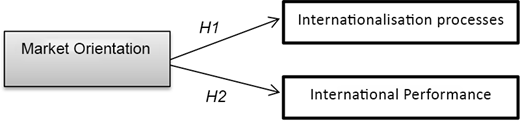
Thus, we may define our first research hypothesis as follows:
MO generates a positive impact on SME internationalisation processes.
2.2 Market orientation and international performance
MO holds particular relevance to international contexts (Zhou et al., 2008). International markets are far more complex than their domestic counterparts. There are feasible differences across many different facets – technology, the economy, politics, culture and society in general. This complexity heightens the need to generate market intelligence and ensure both its dissemination and the capacity to respond (Slater and Narver, 1998; Narver et al., 2000, 2004). When we compare companies without MO with those that do deploy this orientation, the latter better understand the needs and desires of their international clients. Furthermore, they are better able to grasp the strategies and capacities of their competitors and their external strengths and thus respond more appropriately to the demands of a changing environment through leveraging their competitive advantages (Ruokonen, 2008; Acosta et al., 2018). In summary, MOs are valuable, rare, imperfectly imitable and irreplaceable as well as being able to generate sustainable competitive advantages. Companies effectively deploying MOs may leverage their resources and capacities better to overcome cultural distances and select culturally distant markets in exchange for greater market opportunities and better economic returns (Ruokonen, 2008; He and Wei, 2011). Hence, MOs directly shape the international performance (He and Wei, 2011) with those companies attaining higher levels of MO tending to report higher levels of performance due to their characteristic intention of providing higher levels of value to clients on a continuous basis (Slater and Narver, 1998). Whenever these characteristics align with the international MO strategy, they inevitably influence the international performance (He and Wei, 2011). The strategic adjustment perspective of the resource-based view (Brouthers et al., 2008; Meyer et al., 2009) maintains that organisational success depends on the extent to which resources, strategies and the company structure interlink and mutually support each other. Therefore, companies that choose international markets based on their resource levels shall return better standards of performance than companies that do not do so (Combs and Ketchen, 1999; Brouthers et al., 2008). Furthermore, there is a range of empirical evidence confirming how MOs positively influence the international performances of companies (Chung, 2012; Escandón-Barbosa et al., 2016). MO is thus favourable and contributes towards the strategic performance of companies undergoing internationalisation processes (Armario et al., 2009; Boso et al., 2013; Acosta, 2018).
Based on this theoretical framework, we may define our second research hypothesis as follows:
The MO has a positive impact on the international performance of SMEs.
In Figure 1, we present our conceptual model.
3. Methodology
3.1 Data
We obtained the data from a questionnaire sent out by email to a total of 8,103 exporting companies and/or with interests in exporting (the study population) registered in the AICEP-Portugal Global database that provided the email addresses of the company representatives responsible for internationalisation. We received a total of 320 valid responses (sample). For international comparisons the source used is Eurostat (“Structural Business Statistics”). In this case, SMEs are classified in a simplified manner, taking into account only their number of employees: <10 – micro enterprise; <50 – small business; 50-250 – medium-sized company; <250 – SMEs.[1]
3.2 Variables
3.2.1 Dependent variable
3.2.1.1 Internationalisation process.
To measure the “Internationalisation Process” construct, we applied eight items on a Likert type scale (1= not at all important to 5= highly important). Exploratory factorial analysis (EFA) extracted three components with eigenvalues of greater than 1 and accounting for 65.8 per cent of the variation in the data with these results appropriate to the application of EFA (KMO = 0.62) (Table AI). For each dimension, we calculated the score corresponding to the average of the respective items.
3.2.1.2 International performance
To evaluate the international performances of firms, we applied the “company turnover” resulting from the internationalisation variable (per cent) (Ruigrok et al., 2007). This variable spanned the following categories: 1 – less than 10 per cent; 2 – between 10 and 25 per cent; 3 – between 25 and 50 per cent; 4 – between 50 and 75 per cent; 5 – over 75 per cent.
3.2.2 Independent variables
3.2.2.1 Control variables
The control variables applied in the analysis of each company were economic activity, length of time in business (in years), duration of internationalisation (in years) and company scale (number of employees).
3.2.2.2 Market orientation.
3.2.2.2.1 Domestic market related motivations
The construct conveying “Domestic market related motivations” contains four different items with Likert type scales evaluating the respective level of importance (1= not at all important to 5= highly important). EFA of these two items generated two factors, with two items apiece, explaining over 60 per cent of the variance in the data (68.0 per cent) and with eigenvalues in excess of 1 and an acceptable Kaiser–Meyer–Olkin (KMO) (0.68) (Table AII). For both of these factors, we calculated the score corresponding to the average of their two constituent items.
3.2.2.2.2 External market characteristics
To measure the construct depicting the level of importance of the “External market characteristics”, we applied six items via a Likert type scale (1= not at all important to 5= highly important). EFA extracted three components returning eigenvalues of over 1 and accounting for 73.8 per cent of the variability in the data and respectively made up of three, two and one items and returning statistically acceptable results (KMO = 0.65) (Table AII). For the first two factors, we calculated the score corresponding to the average for the items and with the final score corresponding to the score (1 to 5) attributed to each constituent item. Table I sets out a summary of the study variables.
3.3 Data analysis
Calculating the EFA took place according to the principle component method and, to determine the number of factors to retain, we deployed criteria based on values greater than those for the unit and with the factors returning a total explained variance in excess of 60 per cent having carried out VARIMAX rotation with the objective of facilitating the interpretation of the factorial solutions and the KMO criteria to evaluate whether the correlations existing among the variables enabled advancing with EFA (Hair et al., 2010).
Common method bias remains a critical methodological concern in many areas of empirical research arising from the use of self-reported questionnaires (Antonakis et al., 2010; Podsakoff et al., 2003; Siemsen et al., 2010). To evaluate the Common method bias, procedural and statistical methods were adopted to minimise and test this bias. In terms of procedures, respondents were guaranteed anonymity and confidentiality to reduce the disagreement of the assessment, and in statistical terms we performed the Harman factor test (Podsakoff et al., 2003). An exploratory factor analysis was used with all items belonging to the constructs Strategic Approach to Internationalisation, market characteristics and inhibiting factors. The results revealed the non-emergence of a single factor, nor the existence of a general factor that could explain most of the variations in these variables. The first factor represented only 10.7 per cent of the total variation, indicating that the potential existence of Common method bias does not affect model estimates.
We evaluated the reliability and consistency of the constructs and dimensions using Cronbach's alpha, which tends to vary between 0.84 and 0.95, indicating that the constructs and dimensions have high levels of reliability and internal consistency.
We estimated three multiple linear regression models for each factor to analyse the predictors of Internationalisation Processes with the calculation of four separate models (Model 1: independent variables – control variables; Model 2: independent variables –MO: motivations related to external market characteristics, market characteristics; independent variables – control variables, MO: motivations related to external market characteristics, Market characteristics). In this case, we correspondingly estimated the following econometric models:
In terms of the econometric modelling of the level of internationalisation, measured by the proportion of turnover resulting from international activities, we deployed an ordinal regression model given this variable was categorically ordered (less than 10 per cent, between 10 and 25 per cent, between 25 and 50 per cent, between 50 and 75 per cent and over 75 per cent).
In accordance with AIC, BIC and −2 LL, the most closely aligned method stems from the logistical distribution (Cameron and Trivedi, 2005). The ordinal logistical regression model assumes that the relationship between the explanatory variable and the ordinal categorical variable is categorically independent.
To evaluate the predictors of the level of internationalisation, we calculated three models (Model 4: independent variables – control variables; Model 5: independent variables – motivations related with internal market characteristics, external market characteristics, inhibitor factors, Strategic factors driving internationalisation; Model 6: independent variables – control variables, motivations related with external market characteristics, market characteristics, inhibitor factors, strategic factors driving internationalisation) and correspondingly estimating the following econometric models:
To estimate the diverse model parameters, we made recourse to minimum squared method with robust standard errors to eliminate any issues with heteroscedasticity. For every regression, we analysed the existence of variables with the potential for multicollinearity effects through the variance inflation factors (VIF), with these resulting ideally coming in below 5 (Hair et al., 2010).
3.4 Results and discussion
We here present the results stemming from the analysis of the data from 320 companies in two sections with the first detailing the characteristics of the sample and the second providing the results of the different econometric calculations.
3.4.1 Descriptive statistics.
The company sample primarily contained companies engaged in non-financial services (41.3 per cent) or Transformative Industry (37.5 per cent) activities with the sample in business and trading internationally for an average of 27.8 ± 22.9 years and 15.8 ± 12.0 years, respectively, 28.4 per cent had up to 9 employees, 13.4 per cent employed 250 or more, 24.4 per cent had levels of international turnover of less than 10 per cent and while 23.4 per cent invoiced 75 per cent or more internationally. Table II summarises and characterises our sample.
3.5 Econometric modelling
Table III sets out the descriptive statistics and the correlation coefficients for the variables calculated in the econometric models as well as by VIF and resulting in the observation that there were no effects from multicollinearity present (VIF < 5).
Table IV details the results from the different predictive models estimated for the four dimensions to internationalisation processes (a, b, c, d). Excluding Model 1a, all the other calculations significantly predict the internationalisation process (F test: p < 0.05).
As regards the control variables, we may observe that the longer the company has been in business, the significantly lower are its scores across the internationalisation process capacities dimension (Model 1 b: β = −0.01; p < 0.05; Model 3 b: β = −0.01; p < 0.05). Furthermore, companies employing less than ten members of staff return significantly higher scores than other companies in terms of the second internationalisation process dimension (Model 1 b: β = 0.24; p < 0.01; Model 3 b: β = 0.22; p < 0.01). This furthermore reflects how newer companies attribute greater importance to the capacities of their employees.
When approaching MO in terms of the internal market motivations dimension, we may report that the first dimension generates a statistically positive impact on the sociocultural proximity of the new market (Model 2a: β = 0.19; p < 0.01; Model 3a: β = 0.21; p < 0.01) dimension of internationalisation processes. Therefore, MO, at the level of internal market characteristics, returns a positive effect on the internationalisation processes of SMEs, especially in markets where there is a prevailing sociocultural proximity.
As regards the external market characteristics (Model 2d: β = 0.13; p < 0.05; Model 3d: β = 0.15; p < 0.05 and Model 2 b: β = 0.07; p < 0.05; Model 3 b: β = 0.07; p < 0.05), there is a statistically significant and positive effect on the sociocultural proximity of the new market (Model 2a: β = 0.14; p < 0.05; Model 3a: β = 0.12; p < 0.05), on the capacities (Model 2 b: β = 0.12; p < 0.01) and the resources (Model 3 b: β = 0.12; p < 0.01) dimensions of internationalisation processes. We may thus report that MO in terms of the characteristics of the external market returns a positive impact on all the different dimensions to SME internationalisation processes. Hence, we may confirm H1.
Hence, we correspondingly align with the diverse existing studies that report how MO provides a basis on which companies may construct their interactions with dynamic external markets. These orientations thus determine the respective internationalisation processes of the company (Knight and Cavusgil, 2004; Luo, et al., 2005; Liu et al., 2011). Therefore, a key strategic decision in the internationalisation process of any company derives from selecting the respective international market (Ellis, 2000; Ellis and Pecotich, 2001; Kumar et al., 1994; Papadopoulos et al.. 2002). Entering new markets, especially when external, involves a major commitment of resources – strategic, technical, management and financial. Due to the limitations inherent to such resources, companies have to take strategic decisions over just which market to enter and to allocate the appropriate resources (He and Wei, 2011). This only becomes feasible through adopting a MO.
Finally, the results for the predictive factors for international performance measured by international turnover (IT) (Table V) were the following.
We may thus observe how the control variables demonstrate that transformative industry companies (Model 4: OR = 3.13; p < 0.001; Model 6: OR = 3.47; p < 0.001) display a significantly greater likelihood of reporting higher levels of international turnover in comparison with companies engaged in other sectors of activity in conjunction with how greater lengths of internationalisation also significantly boost the propensity (Model 4: OR = 1.09; p < 0.001; Model 6: OR = 1.08; p < 0.001) to return higher levels of international turnover. We may therefore report that the sector of activity and the duration of internationalisation both impact on international performance.
On the contrary, the longer the length of time a company has been in business then there is a statistically lower likelihood (Model 4: OR = 0.97; p < 0.001; Model 6: OR = 0.97; p < 0.001) of reporting higher rates of international turnover. As already reported above, the length of time a company has been in business negatively influences the processes of internationalisation and immediately bears the consequence (as verified above) of lower levels of international performance.
As regards the internationalisation process capacities (Model 4: OR = 1.85; p < 0.001; Model 6: OR = 1.79; p < 0.01), this returns a statistically positive effect on international performance. We may thus report that the capacities of members of staff and the company provide positive influences on internationalisation processes and the consequent level of international performance. The higher the scores returned for the dimensions of MO or internal market related motivations (Model 5: OR = 1.48; p < 0.001; Model 6: OR = 1.51; p < 0.001), or external market characteristics (Model 4: OR = 1.72; p < 0.001), there is a significantly greater probability of reporting higher percentages of international turnover. As we have already considered above, the opportunities perceived in new markets represent drivers of international processes. Whenever associating this perception with the need for companies to diversify their clients and markets, they obtain higher international performance levels. Therefore, we may correspondingly support H2. This result also aligns with those authors who defend how MO has represented one of the core concepts to the strategic (Balodi, 2014; Hagen et al., 2017; Acosta et al., 2018) and marketing literatures (Boso et al., 2013; Escandón-Barbosa et al., 2016) over recent decades. MO relates to and is strictly postulated as an essential organisational capacity that contributes towards international performance (Knight and Cavusgil, 2004; Zhou et al., 2005; Hult and Ketchen, 2005; Gruber-Muecke and Hofer, 2015). To be market oriented, the transversal focus of a company has to encapsulate learning about and responding to client needs as well as engaging in competitive actions (Kumar et al., 2011). Without the motivation to serve clients better, companies are unlikely to expend major efforts on developing new products or seeking out new processes by which they might meet constantly changing client needs. Furthermore, MO establishes an important framework for business actions. Without a clear focus on client needs, companies are simply unable to return positive results (Luo et al., 2005; Mac and Evagelista, 2016; Acosta, 2018).
3.6 Implications and final considerations
Taking into account the role of orientations and strategic positioning within the internationalisation processes of SMEs, while Hagen et al. (2017) affirm that despite all of the results agreeing with the vision that the strategic positioning of companies is crucial to their sustained survival and prosperity in competitive domestic environments, there still remains only scant research on their role in determining internationalisation processes and the international performances returned by SMEs. Hence, and to make our contribution to this research field, our objective here precisely involved testing the effects of MOs on the internationalisation processes of SMEs and on their international performance levels in the same study. We may report that MOs generate a positive effect in both cases. Therefore, we also demonstrate the need to engage in further research into the configuration and understanding of the internationalisation strategies of SMEs. We may also confirm the importance of studying the influence of strategic orientations to internationalisation processes with the latter susceptible to influences from the particular characteristics of SMEs. In general terms, our conclusions provide support to the importance of MOs both to selecting international markets and to the consequent international performance.
Thus, it is fundamental that new studies focus on resources and capacities as the core theory for the strategic selection of markets. Such choices require the guidance and the influence of the market oriented philosophy and activities of the respective company. Market-oriented companies may be able to reduce transaction costs arising from entering culturally distant markets through reductions to information asymmetries and opportunistic behaviours as well as also managing to contain risks and uncertainties.
In verifying that MOs generate positive effects on internationalisation processes and international performance, we may also confirm the presence of synergies among these three dimensions.
When companies seek to internationalise, they need to consider their prevailing level of MO and the appropriateness of the alignment between this MO and the internationalisation process.
The results of our research provide some interesting implications for SME entrepreneurs and managers seeking to engage in internationalisation processes. From the point of view of owners and managers, we demonstrate the importance of fostering a culture within the firm oriented towards internationalisation. Hence, it is highly important for SMEs to adopt proactive stances as regards international visits and contacts with suppliers and clients in international markets. To this end, SMEs should develop their capacities to network with other organisations and relevant partners both in the internal market and in international markets. We are aware that this also represents a challenge to SMEs due to their resource limitations (human and technological resources) even though the lack of scale may also generate advantages as only requiring simpler and more agile infrastructures.
One limitation of this research stems from having only applied MO in the study of internationalisation processes and levels of international performance. Other strategic orientations are equally important, including entrepreneurial orientation, network orientation and, in culmination, the study of dynamic capacities. The impact of dynamic capacities on national and international performance levels takes on enormous importance, especially for SMEs. Hence, as future lines of research, we would call for broader and deeper reaching studies in terms of the diverse dynamic capacities and their impacts both on international processes and on the international performance of SMEs.
Note
The authors would like to thank to NECE – Research Unit in Business Sciences funded by the Multiannual Funding Programme of R&D Centres of FCT – Fundação para a Ciência e a Tecnologia, under the project (UID/GES/04630/2019).
Funding: This work is supported by FEDER funds from COMPETE 2020 and Portuguese funds – PORTUGAL 2020; Project IEcPBI – Interactive Ecosystem for Portuguese Business Internationalization – POCI-01-0145-FEDER-032139.