Exporters are increasingly using business-to-business (B2B) cross-border e-commerce (CBEC) through third-party platforms as a foreign market entry mode. B2B CBEC platforms resemble online trade shows and aim to facilitate the establishment of relationships between sellers and foreign buyers (e.g. distributors, importers and original equipment manufacturers) to promote repeated exchanges. However, how international buyer−seller relationships are established through such platforms remains unclear. This study aims to draw on the new open resource, linkage and integration (OLI) advantages theory to develop a model for exporters to successfully use CBEC platforms.
This study was based on a longitudinal analysis of five Italian firms from the food and beverage industry using Alibaba.com to establish relationships with foreign distributors and professional food service buyers. Grounded theory was used to analyze the data.
The analysis resulted in a model explaining how exporters engage in co-creation processes with CBEC platforms’ ecosystems to transform the generic new OLI advantages enabled by B2B CBEC platforms into firm-specific advantages that drive the establishment of relationships with international buyers.
The cases considered in this study are linked to the food and beverage industry. The buying and selling cycles vary from industry to industry, resulting in the need for varying balances between in-platform and out-of-platform buyer interactions.
The model developed in this study can be readily implemented by firms using CBEC platforms. The model indicates the need to approach CBEC platform use with appropriate expectations and after assessing organizational readiness. It also emphasizes the need for exporters to adopt proactive behaviors through engagement activities, continuous learning and self-adjustment.
To the best of the authors’ knowledge, this study is the first to develop a comprehensive model outlining how exporters can use B2B CBEC platforms to establish stable relationships with foreign buyers.
1. Introduction
A rapidly growing number of exporters are embracing cross-border e-commerce (CBEC) as a foreign market entry mode (Tolstoy et al., 2023). CBEC is a subsection of digital trade that includes the “international sale or purchase of a good or service, conducted over computer networks by methods specifically designed for the purpose of receiving or placing orders” [1] (International Monetary Fund, OECD, 2023, p. 14). CBEC through third-party platforms or marketplaces, such as Amazon and Alibaba.com in particular, is rapidly expanding (International Monetary Fund, OECD, 2023). Such platforms enable the emergence of service ecosystems and facilitate information, logistics and financial flows among participants, thereby enabling effective matching between global (potential) buyers and sellers, resulting in sales or purchases (Wang et al., 2020; Wu et al., 2022). The advantages enabled by such platforms suggest that exporters frequently use CBEC platforms as an alternative – or sometimes in addition – to their e-commerce websites (Cassia and Magno, 2022a). Moreover, artificial intelligence (AI) technologies (often directly integrated into CBEC platforms) promise to significantly enhance both the efficiency and effectiveness of exporters’ CBEC use (Dai et al., 2024).
Despite the frequency of CBEC use by firms, understanding of exporters’ CBEC performance remains limited, and most available studies have focused on business-to-consumer (B2C) CBEC, which relates to exporters’ use of their websites or third-party platforms to sell directly to consumers (Tolstoy et al., 2022). Although business-to-business (B2B) e-commerce accounts for approximately 80% of global e-commerce (United Nations Conference on Trade and Development, 2021, 2023), exporters’ use of B2B CBEC platforms has been largely overlooked in research (Ho and Chuang, 2023). In their recent literature review on firm internationalization using digital platforms, Da Rocha et al. (2024) highlighted that only a few studies have examined CBEC from the B2B perspective. Specifically, in their suggested research agenda for future studies, they emphasize the need to address the following research question; “How are international buyer-seller relationships established within [such] digital platforms?” (Da Rocha et al., 2024, p. 1003). Notably, the purposes and functioning mechanisms of B2B CBEC platforms significantly differ from those of B2C CBEC platforms (Tóth et al., 2022). While B2C marketplaces are primarily designed for immediate online discrete transactions (purchases/sales), B2B marketplaces also aim to facilitate the establishment of relationships between sellers and buyers (e.g. distributors, importers and original equipment manufacturers) to promote repeated exchanges. Hence, B2B CBEC platforms resemble online trade shows and are often used by exporters with a marketing-focused approach to generate awareness and establish new business relationships (Jean et al., 2024). These platforms enable sellers to find potential buyers, establish a dialogue to negotiate possible future exchanges and eventually complete repeated exchanges (Tóth et al., 2022).
Despite the growing number of exporters using B2B CBEC platforms, available knowledge on how exporters establish such relationships with international buyers using this entry mode remains limited (Da Rocha et al., 2024). The present study addresses this gap by adopting the lens of the new open resource, linkage and integration (OLI) advantages theory in the era of digital globalization (Luo, 2021). Specifically, we aim to assess how exporters engage in co-creation processes with the platforms’ ecosystems (Vargo and Lusch, 2016) to transform generic new OLI advantages enabled by B2B CBEC platforms into firm-specific advantages to establish relationships with international buyers. Therefore, the present study addresses this gap and poses the following research question:
How do exporters that use B2B CBEC platforms transform platform-enabled generic OLI advantages into firm-specific advantages through co-creation processes to establish new relationships with international buyers?
To answer this question, we conducted a longitudinal analysis of five exporters operating in the food and beverage industry that use Alibaba.com, arguably the most important B2B CBEC platform worldwide (International Monetary Fund, OECD, 2023; Tóth et al., 2022). The analyzed exporters used Alibaba.com for a period of at least two years to establish relationships with distributors and professional food service buyers.
This study’s findings enrich theoretical knowledge on the co-creation processes through which exporters transform generic new OLI advantages into firm-specific advantages to create relationships with international buyers (Eduardsen et al., 2023). The findings also provide exporters with actionable insights for approaching and using B2B CBEC platforms to establish valuable and long-term relationships with foreign buyers.
The remainder of this study is organized as follows. In Section 2, we introduce the background literature, which offers the lenses through which we approach the investigated phenomenon. We then describe the methods (Section 3), results (Section 4) and grounded model (Section 5). Finally, the implications (Section 6) and conclusions (Section 7) of this study are presented.
2. Background literature
2.1 Exporters’ use of cross-border e-commerce
Several recent studies have examined the potential benefits of exporters adopting CBEC as a foreign market entry mode (Elia et al., 2021; Witek-Hajduk et al., 2022). Research focusing on B2B CBEC indicates that this entry mode reduces searching, negotiation and enforcement costs, thereby saving money and time while simplifying the foreign market entry process (Qi et al., 2020). Moreover, B2B CBEC accelerates the process of trust creation and exchange among sellers and buyers (Qi et al., 2020; Wu et al., 2022). Specifically, B2B CBEC platforms support exporters by providing services that facilitate financial, logistics, information, commercial and design flows (Ho and Chuang, 2023).
However, empirical research indicates that not all firms engaging in CBEC have achieved positive performance outcomes, leading to a growing interest in understanding the antecedents of such performance. On this point, a study by Eduardsen et al. (2023) found that performance was negatively affected by CBEC barriers related to issues with products, technical aspects of e-commerce, financial resources, knowledge, skills to operate in foreign markets and limits on CBEC usage imposed by suppliers. In contrast, Goldman et al. (2021) reported that an exporter’s digital marketing tactics (e.g. search engine optimization) positively affect e-store performance in foreign markets. Researchers also noted that exporters’ foreign market orientation level is positively related to e-store performance, both directly and indirectly (through the number of digital marketing tactics used).
A few studies have started to provide richer explanations of how the use of CBEC influences exporters’ performance by enhancing certain processes and capabilities. Tolstoy et al. (2023) outlined that CBEC improved exporters’ international economic performance by activating insidership mechanisms (international networking and international marketing analytics) and providing access to critical resources and insights for market creation through effectuation. Tolstoy et al. (2022) found that online marketing capabilities indirectly improve the international performance of exporters using CBEC by supporting ambidexterity (i.e. integrating market-driven and market-driving behaviors). Drawing on existing B2B studies, Fan et al. (2023) argued that CBEC platforms empower small- and medium-sized exporters, with such empowerment positively influencing exporters’ strategic flexibility, which positively affects export performance. Nonetheless, knowledge of how CBEC use influences exporters’ performance by enhancing certain processes and capabilities remains limited. Specifically, existing studies have not examined how co-creation processes with the platforms’ ecosystems enable exporters to develop firm-specific advantages to establish new relationships with international buyers.
Another relevant limitation of existing studies on exporters’ CBEC use is that they have focused on short-term economic results without evaluating the outcomes in terms of valuable and long-lasting relationships with foreign buyers established through CBEC platforms. For example, Goldman et al. (2021) measured the turnover, conversion rate and number of returning customers in the preceding 12 months. In addition, Tolstoy et al. (2022) and Tolstoy et al. (2023) asked exporters to report whether their economic performance was superior or inferior to their competitors’ performance in the preceding two years. Moreover, Fan et al. (2023) only assessed exporters’ export volume, export profit growth rate, international market share and overseas customer satisfaction. Eduardsen et al. (2023) measured exporters’ CBEC performance based on online export turnover, export intensity and export revenue growth. Other studies have assessed CBEC performance by examining exporters’ decisions to exit CBEC platforms (Luo et al., 2022; Yan et al., 2023). These studies have noted that exporters discontinue their use of CBEC platforms due to online reputation issues stemming from customer reviews (Luo et al., 2022), the excessive speed of firm internationalization (Yan et al., 2023) and differences in institutional environments (Yan et al., 2023). However, existing studies have not examined the co-creation processes through which exporters transform B2B CBEC platform-enabled generic OLI advantages (Luo, 2021) into firm-specific advantages that drive the establishment of long-term relationships with international buyers. This issue is theoretically important since clarity is needed on how the long-term relational outcomes of exporters’ B2B CBEC use are influenced by their engagement in co-creation and learning processes with such platforms’ ecosystems to enhance firm-specific advantages.
2.2 New open resource, linkage and integration advantages and cross-border e-commerce platforms
Extant research on CBEC is based on theories such as the resource-based view (Cassia and Magno, 2022a; Elia et al., 2021), transaction cost theory (Qi et al., 2020; Wu et al., 2022) and organizational ambidexterity (Tolstoy et al., 2023; Tolstoy et al., 2022). While these theories provided solid theoretical foundations for research, this study argues that the current theories relating specifically to firm internationalization in the digital landscape can support a more in-depth exploration of the processes through which exporters’ use of B2B CBEC results in positive long-term relationships with foreign customers. Specifically, we use the lens of the new OLI advantages theory in the era of digital globalization (Luo, 2021), which integrates Dunning’s (1980, 1988, 2000) well-established eclectic or ownership, location, internalization (also known as OLI) paradigm. Luo’s (2021) arguments stem from an awareness of digitalization profoundly transforming international business and the explicit acknowledgment of the role of digital platforms in connecting with foreign customers. Following Luo’s conceptualization, by using CBEC platforms, exporters can benefit from three new OLI advantages:
Digitization-enabled open resource advantage (O), indicating that exporters can access resources and competencies through the platform and combine them with their proprietary knowledge to develop new competitive advantages. For example, exporters can adopt a data-driven approach to CBEC platforms to gain foreign market knowledge using a large volume of data including analytics, customer reviews and product views (Cassia and Magno, 2022b; Tolstoy et al., 2023).
Digitization-enabled linkage advantage (L), indicating that exporters can access the platform-based ecosystems of international actors (e.g. potential buyers and service providers), thereby reducing the cost of cooperation and facilitating knowledge-sharing. For example, Luo (2021, p. 4) noted the following: “E-commerce marketplaces such as Alibaba, Amazon, eBay, Flipkart, and Rakuten, for example, support millions of vendors, creating enough product variety and price competition to attract enormous global customer bases [and] give smaller enterprises exporting capabilities by providing them with payment infrastructure, logistics support, and international visibility”.
Digitization-enabled integration advantage (I), indicating that exporters can benefit from platform-enabled connectivity to improve their orchestration and synchronization of internal and external actors (e.g. subsidiaries, distributors, and logistics providers), thereby enhancing market responsiveness and customer satisfaction (Bhandari et al., 2023; Luo, 2021).
While the new OLI advantages theory is valuable for clarifying the general advantages that firms can obtain by using B2B CBEC platforms, it fails to explain how these general advantages can be transformed into firm-specific advantages (Bhandari et al., 2023). Therefore, while this framework offers a theoretical background to examine exporters’ use of B2B CBEC, it is not sufficient to explain how an exporter can transform platform-enabled generic advantages into firm-specific advantages. Therefore, filling this knowledge gap is essential to understand why B2B CBEC use results in remarkably different outcomes for different exporters in terms of the relationships established with foreign buyers.
3. Research methodology
3.1 Overview and research setting
Considering the limited knowledge of the co-creation processes through which exporters transform platform-enabled generic OLI advantages into firm-specific advantages to establish new relationships with international buyers on B2B CBEC platforms, we used a qualitative, exploratory research approach. Specifically, we used longitudinal case studies to collect data and combined theory with our data through an abductive approach (Dubois and Gadde, 2002, 2014; Eisenhardt, 1989). We used the Gioia methodology to acknowledge informant- and researcher-based perspectives and develop a grounded theory (Magnani and Gioia, 2023).
The research setting comprised Italian firms operating in the food and beverage industry that used a specific CBEC platform, Alibaba.com (Wu et al., 2022). Alibaba.com is a Chinese online marketplace that “connects Chinese and overseas suppliers to overseas wholesale buyers, who are typically trade agents, wholesalers, retailers, manufacturers, and SMEs [small- and medium-sized enterprises] engaged in the import and export business, and provides them with sourcing, online transaction, digital marketing, digital supply chain fulfillment, and financial services” (Alibaba Group Holding Limited, 2023, p. 39). In the most recent fiscal year (i.e. ending on March 31, 2024), Alibaba.com reported “230,000 paying members from China and around the world,” reaching “over 48 million buyers from over 190 countries” (Alibaba Group Holding Limited, 2024, p. 34). Alibaba.com was selected as the platform for this study because it is considered the most important B2B CBEC platform in the world (International Monetary Fund, OECD, 2023; Tóth et al., 2022).
Moreover, the functioning mechanisms of Alibaba.com made it appropriate for our study. In detail, by paying a subscription, sellers have access to the request for quotation (RFQ) mechanism, which enables them to receive RFQs from customers and proactively search for “buyers looking for products like yours on the [RFQ] market” (Alibaba.com, 2024). Alibaba.com has also introduced an additional mechanism for so-called “ready to ship” products, through which the platform works “like a B2C” e-commerce website where buyers can add goods to their cart and complete the purchase instantaneously without interacting with the sellers (Alibaba.com, 2021). However, this mechanism has only been made available to Italian (and other European) sellers for a few months, after the end of our data collection period. As illustrated during an official event co-organized by the Italian Trade Agency and Alibaba.com in 2022, the RFQ mechanism was the only one available to Italian sellers, which means that Alibaba.com functions “like a trade show” (Italian Trade Agency, 2022). In addition, “all the provided tools are designed to empower [the subscribing] business through the creation of long-lasting relationships” (Italian Trade Agency, 2023), which made this platform suitable for exploring how exporters use B2B CBEC platforms to establish long-lasting relationships with foreign customers.
Furthermore, Italy is an export-oriented country. According to the Organization for Economic Co-operation and Development (OECD, 2023), in 2020, Italian businesses (with 10 employees or more) using e-commerce to sell to customers in other countries accounted for 41.7% of all Italian companies making e-commerce sales (15.4% engaged in CBEC with European Union countries exclusively; 24.9% engaged in CBEC with European Union countries and the rest of the world; and 1.4% engaged in CBEC with the rest of the world only). Therefore, examining B2B CBEC platform usage by Italian firms can offer interesting insights. Finally, we selected the food and beverage industry because it is highly important to the overall Italian export industry and is registering rapid growth in CBEC use (Italian Trade Agency, 2021).
3.2 Data collection
We purposefully selected five firms that began using Alibaba.com in 2020 or 2021 and opted for a two-year subscription plan (the “most common” plan when using Alibaba.com). This decision enabled us to conduct a longitudinal analysis of the cases. These cases were identified based on preexisting contacts with their managers established by the researchers over the years through workshops and meetings. Caution was taken to avoid bias regarding data neutrality. Respondents were asked to express their opinions freely and were guaranteed anonymity. Multiple key informants for each firm were interviewed twice: first, when they were about to subscribe or had just subscribed to Alibaba.com (i.e. during 2020 or 2021), then for a second time, immediately before the expiration of their subscription (in 2022 or 2023) when they had to decide whether or not to renew. This approach enabled us to interview the same people at both the beginning and end/renewal of their subscription to Alibaba.com, thus providing a longitudinal view of each firm’s experience with the platform and with the creation of new relationships with international customers (i.e. distributors and professional food service buyers).
In the first round of interviews (October 2020–November 2021), the participants were asked to describe their firm. We then focused on gaining an understanding of the motivations, expectations and objectives that the firms aimed to achieve by using Alibaba.com. In the second round of interviews, conducted after two years (October 2022–November 2023), the analysis focused on the firms’ use of the platform, achieved objectives, satisfaction level and intention to renew their subscription.
We applied the long interview method (McCracken, 1988) and, for each firm, we interviewed the people responsible for decision making relating to Alibaba.com use and those who managed the daily use of this platform. Although most interviews were conducted face to face, Zoom and Microsoft Teams were used in several cases. The interviews lasted between 50 and 130 min and were recorded and transcribed. Table 1 offers an overview of the five cases and interviewees.
3.3 Data analysis
Data analysis was conducted using the Gioia methodology, which is well established in business studies (Magnani and Gioia, 2023). All authors separately coded the transcripts, after which the outcomes were compared and discussed. In case of disagreement, several iterations were conducted until an agreement was reached. Following the Gioia methodology (Gioia et al., 2013), we began by analyzing first-order concepts reflecting the informant-centered perspective expressed in the interviewees’ own words. We applied an inductive approach to identify concepts highlighting the co-creation processes through which CBEC platform use resulted in new relationships with foreign customers. Following established recommendations, fewer than 20 concepts emerged from the analysis (Magnani and Gioia, 2023). Appendix provides representative participant quotations for each first-order concept.
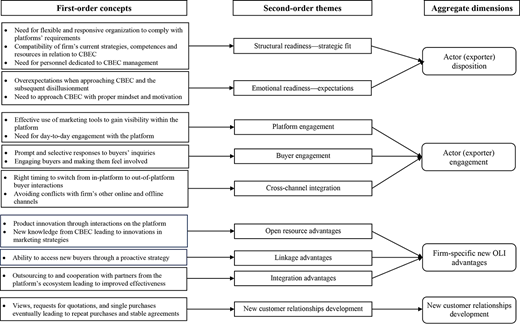
Next, using an abductive approach, we interpreted the informant-centered codes based on the existing literature to identify second-order theory-centered themes (Dubois and Gadde, 2014). This process of combining theory and empirical evidence highlighted nine second-order themes. Finally, the following four aggregate dimensions were obtained by merging second-order themes: actor (exporter) disposition; actor (exporter) engagement; firm-specific new OLI advantages; and new customer relationship development. Figure 1 illustrates the data structure. The following sections separately present our findings for each aggregate dimension. Drawing on the data structure, we developed a grounded theoretical model highlighting the dynamic processes through which B2B CBEC use results in new relationships with foreign customers at different stages of development.
4. Findings
4.1 Actor (exporter) disposition
Concerning the first aggregate dimension, “actor (exporter) disposition”, the interviewed firms agreed that their initial disposition to engage in the CBEC platform served a central role in their overall experience with CBEC and its outcomes. They all emphasized that CBEC demanded time, resources and competencies and that an organization must be structurally ready to engage in CBEC. Interestingly, the interviewees consistently reported cases in which they missed business opportunities because they were not sufficiently responsive to potential buyers’ RFQs. The sales manager of Case E reported that they:
Decided to leave Alibaba even if the performance had been positive […] the challenges faced in integrating the firm’s routines with the methodologies and timelines required by Alibaba created too much stress. Our procedures are not compatible with the need to ensure adequate responsiveness as requested by Alibaba’s standards […] significant difficulties emerged in platform management and coordination among the firm’s functions and subsidiaries.
Similarly, Case D missed several potential sales because its production capacity was too small to meet the volumes demanded by buyers. In addition, it lacked “knowledge concerning international sales, customs, logistics, currencies […] and legal understanding of product labeling regulations” (Case D, Entrepreneur). A specific concept emphasized by all informants was that the continuous management of the firm’s account on the platform required dedicated personnel and a significant amount of time. Concerning this point, an entrepreneur noted that the:
Main issue was the lack of employees with enough time to ensure the continuous monitoring and management of this channel [CBEC]. We couldn’t even explore all the free tools provided by the platform […] the workload for the sales manager was excessive […] precise and consistent platform management was not possible (Case D, Entrepreneur).
The disposition to engage in the CBEC platform encompassed firms’ structural and emotional readiness. Relatedly, informants highlighted their overexpectations when subscribing to the CBEC platform. In fact, due to their lack of experience with CBEC, they believed that “it would be much easier to find new customers […] and establish continuous supply relationships […] We have received only a few one-time sales” (Case B, Chief Executive Officer [CEO]). Thus, interviewees from some firms reported that their firm experienced dissatisfaction and disillusionment when they “did not achieve sales and profits [they] expected” (Case A, Sales Manager). Therefore, the firms were often emotionally unprepared to face the enduring efforts required to obtain tangible sales outcomes. Moreover, informants reported that emotional readiness required the commitment of the entire organization because embracing CBEC requires a new mindset and motivation from all departments and people. For example, the sales manager from Case E noted that he:
Must admit that we failed to convey the motivation for using Alibaba and proper involvement to our foreign sales offices. Our sales managers perceived cross-border e-commerce as an additional and unneeded burden […] they did not dedicate the necessary commitment and attention to managing the Alibaba sub-account assigned to their responsibility.
Therefore, the first aggregate dimension, actor (exporter) disposition, concerns the relevance of the firm’s structural and emotional readiness to use CBEC.
4.2 Actor (exporter) engagement
The second aggregate dimension, “actor (exporter) engagement”, concerns the day-to-day management of the firm’s engagement with the platform and (potential) buyers while integrating CBEC activities with those of other sales channels. The first second-order theme of this aggregate dimension relates to the firms’ engagement with platforms. All informants agreed that it was necessary to proactively use in-platform marketing tools to achieve sufficient visibility on the platform and stand out from competitors. The export manager of Case B argued that they “opted for both traditional keyword advertising and premium sponsored ads, which guaranteed use exclusivity on certain keywords […] We secured the top position in searches”. In addition, a strong consensus emerged about the outcomes as a function of day-to-day perseverance in monitoring and managing a firm’s presence on the platform. For example, the entrepreneur of Case A explained that during “some periods, we were overwhelmed by other commitments and priorities […] we overlooked it for entire weeks. This is probably a reason for our low sales”.
The second second-order theme of this aggregate dimension was buyer engagement. Concerning this theme, the informants agreed that firms should give personalized attention to potential buyers sending inquiries to the firm and be able to select attractive buyers to avoid potential fraud. All firms emphasized the need to be more responsive than their competitors in securing customers and improving their platform performance. For example, the export back-office manager of Case E reported the following:
As suggested by Alibaba, we tried to reply as fast as we could to buyers’ inquiries […] but it was not always possible, and the platform penalizes sellers who take more than 24 h to reply to potential buyers.
Moreover, it was considered necessary to proactively engage with buyers and make them feel involved. For example, the export manager of Case B reported that:
Alibaba allowed us to organize live streaming events during which we presented our products and answered real-time questions from interested buyers. We also proposed a virtual tour of our firm […] This was extremely effective in making buyers feel involved.
The third second-order theme highlighted the need for cross-channel integration. A highly important concept mentioned by multiple respondents concerned the need to understand when a relationship with a potential buyer was sufficiently mature to be managed outside the platform. Finding the right time to switch from in-platform to out-of-platform interactions with buyers was crucial for success. For example, the sales manager of Case C indicated that, at a certain point, it is necessary to move to face-to-face interactions because “you need to make them [the buyers] physically taste your product to close the deal”. However, switching to out-of-platform interactions too early can be detrimental, as noted by one informant:
Contrary to Alibaba’s suggestions, once we obtained contact with potential buyers, we preferred to handle it through our regular channels […] We sent them e-mails, but this approach intimidated and discouraged many potential buyers (Case E, Export Back-office Manager).
Finally, the informants agreed on the need to avoid conflicts between the CBEC and other existing sales channels. A clear example of this was provided by the sales manager of Case A, who argued that, sometimes, “buyers tried to bypass our exclusive distributors in their countries to pay lower prices. You have to be extremely careful. Otherwise, you create misunderstandings with your sales partners”. Therefore, the second aggregate dimension, actor (exporter) engagement, highlighted the need for continuous and effective engagement with the platform and each buyer sending inquiries, paying particular attention to avoiding cross-channel conflicts.
4.3 Firm-specific new open resource, linkage and integration advantages
The third aggregate dimension, “firm-specific new OLI advantages”, concerns transforming generic new OLI advantages into firm-specific advantages. The first second-order theme of this dimension, open resource advantages, relates to using the knowledge gained through interactions on the CBEC platform to innovate the firm’s product offerings. An interesting example was offered by the marketing manager of Case C, who stated that their firm:
Received an unforeseen number of requests for private labeling […] this was not part of our strategy. We reflected and decided to offer this new service to target a real need we found in the market […] by the way, now we produce and sell private label products for customers outside the platform.
In this case, interactions with potential buyers and the knowledge gained from engaging with the CBEC platform led to product innovation and multiple innovations in marketing strategies. Among the many examples reported by all informants, a representative case relating to pricing strategies was provided by the sales manager of Case C, who noted that on Alibaba:
You can set a price range for your product and then negotiate the final price with each buyer […] but, at the beginning, we did not know the most effective pricing strategy, and we started setting small price ranges. This created issues with buyers from some countries because they are used to having extensive negotiations on prices […] and issues with changes in exchange rates that left us with tiny margins.
Thus, all firms could transform the generic open resource advantage enabled by the CBEC platform into firm-specific advantages.
The second second-order theme of this dimension emphasized the transformation of a generic linkage advantage into a firm-specific advantage. CBEC platforms provide access to many potential buyers worldwide. However, firms must proactively transform this general advantage into a firm-specific advantage. The export back-office manager of Case E explained that when their firm began using Alibaba:
We had a passive way of establishing contacts. We published the product description and waited for inquiries from buyers […] Then we discovered the RFQ market, where buyers post their requests for quotation and, as sellers, we can provide our quotation. This was very interesting because the platform only allows up to 10 firms to provide their quotations […] you compete against a smaller number of competitors.
The third second-order theme of this aggregate dimension is related to firms transforming the generic integration advantages enabled by the platform into firm-specific integration advantages. Most participants reported that the CBEC platform provided them with access to the entire ecosystem of partners and their services to improve overall effectiveness. Such coordination extended well beyond outsourcing time-consuming platform management activities. An enlightening example was provided by the CEO of Case B, who reported that their firm:
Decided to participate in Alibaba’s Elite Partner Program, which allowed us to create relationships with many partners […] through this program, we started cooperating with a Chinese marketing agency specialized in the Alibaba platform, and they helped us to fine-tune and to enrich our offering for Chinese buyers.
Therefore, the third aggregate dimension, firm-specific new OLI advantages, illustrated how firms – albeit with different intensities – could transform generic new OLI advantages into firm-specific advantages.
4.4 New customer relationship development
The fourth aggregate dimension, “new customer relationships development”, concerns establishing buyer relationships and developing them through different development stages. All informants agreed that finding new buyers and creating long-lasting relationships with them was a primary motivation for using the CBEC platform. According to interviewees, creating these long-lasting relationships is a result of a sequence of intermediate steps. First, gaining visibility on the platform is necessary to address customer inquiries. For example, the export manager of Case B noted that their firm “achieved positive results in visibility […] about 2 million monthly views and almost 90 requests for quotations”. However, transforming RFQs into orders is not immediate: “It took a lot of time to transform this contact into an order […] much more time to establish a stable ongoing collaboration” (Case C, Marketing Manager). The most significant challenge highlighted by the participants was transforming single purchases into repeated purchases, thereby gaining customer loyalty. The firms only reached this goal in a few cases; specifically, the sales manager from Case A noted that a “contact that started on Alibaba subsequently led our firms physically meeting and them tasting our wines […] now we have a continuous collaboration agreement with this restaurant”. The sales manager from Case E noted that with “one customer in the USA, we have established an agreement to supply a container of goods […] every third month”. Therefore, the fourth aggregate dimension, new customer relationship development, clarified that connections facilitated by the CBEC platform can eventually transform into stable relationships.
5. Discussion
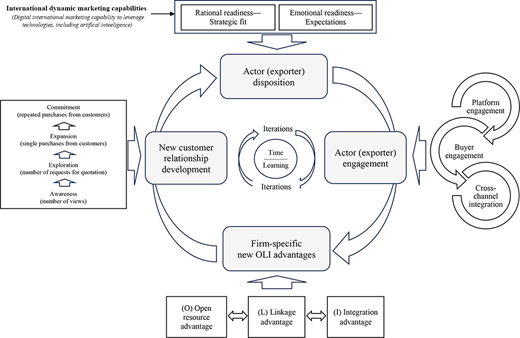
This study explored how exporters engage in co-creation processes to transform generic new OLI advantages enabled by B2B CBEC platforms into firm-specific advantages to establish relationships with international buyers. We developed a grounded model to move beyond the static perspective offered by the data structure to a dynamic representation of such processes (Magnani and Gioia, 2023). The model presented in Figure 2 highlights the relationships between the aggregate dimensions and themes emerging from the data structure.
This model is consistent with the new OLI advantages paradigm (Luo, 2021). It supports the argument that a firm’s new customer relationships established using B2B CBEC platforms depend on its ability to leverage the three advantages stemming from digital connectivity: open resources, linkage and integration advantages (Bhandari et al., 2023). In addition, our grounded model offers a more comprehensive explanation by highlighting how generic new OLI advantages are transformed into firm-specific ones, and subsequently into relationships at different stages of development.
Our model demonstrates that firm-specific new OLI advantages emerge from a firm’s engagement with a B2B CBEC platform, which includes both its disposition (or readiness) to engage and its actual engagement with buyers on the platform (and across channels). Therefore, the model is aligned with the theory of actor engagement (Ekman et al., 2021; Storbacka et al., 2016), which is rooted in service-dominant (S-D) logic. Actor engagement [exporter engagement in this study] “is conceptualized as both the disposition of actors to engage and the activity of engaging in an interactive process of resource integration within the institutional context provided by a service ecosystem [in this study, the B2B CBEC platform]” (Storbacka et al., 2016, p. 3009). Our findings strongly emphasize export disposition as an antecedent of export engagement on a B2B CBEC platform. The model is also aligned with the theory of international dynamic marketing capabilities (IDMCs), which are viewed as the “capabilities firms use to understand and fulfil foreign market customers’ expressed and latent needs better than its rivals” (Pfajfar et al., 2024a, p. 2). At the strategic level, IDMCs include both digital international marketing capability and dynamic internationalization capability, which are strictly consistent with our model. In fact, exporters must acquire digital international marketing capabilities to leverage available platform-enabled technologies (including AI features) to successfully manage relationships with foreign customers. Moreover, they also require dynamic internationalization capabilities for organizational learning through co-creation processes and for the dynamic renewal and transformation of their international marketing routines and capabilities, balancing exploration and exploitation (Pfajfar et al., 2024a, 2024b; Teece, 2014).
The analysis revealed that disposition comprises both rational and emotional components. The rational component corresponds to what Ekman et al. (2021) labeled “strategic fit” and encompasses the firm’s readiness to proactively engage in CBEC through a platform. Therefore, routines, decision-making processes and the entire organization must be aligned with the requirements of CBEC through the chosen platform(s). Simultaneously, the findings of this study emphasize the role of emotional readiness in approaching CBEC with an appropriate mindset and set of expectations. This emotional component corresponds to what Ekman et al. (2021) labeled as “experience” and concerns the need to be aware of the efforts and realistic outcomes that can be achieved through B2B CBEC platforms. Such emotional readiness is fundamental for avoiding overexpectations and subsequent disillusionment. The present study found that firm disposition or readiness levels for engaging with foreign customers through B2B CBEC platforms influenced actual engagement and its effects on the emergence of firm-specific new OLI advantages.
The findings also revealed that engagement entails an ongoing co-creation process with the platform and each individual (potential) foreign buyer. Thus, our model is consistent with S-D logic, which states that value emerges from co-creation through the service exchange, that is, the actors’ integration of specialized skills and knowledge (Vargo and Lusch, 2004). This integration process draws on the distinction between operand and operant resources. Operand resources are those upon which an act is performed (Vargo and Lusch, 2008), such as the multiple features offered by a CBEC platform to gain visibility and engage buyers. These resources must be triggered by operant resources, such as the knowledge and skills of exporters. A firm’s rational and emotional readiness influence its actual level of engagement in co-creation, encompassing both its quantity and quality (Ekman et al., 2021). Consequently, the firm’s efforts to apply its competencies and knowledge in co-creation with (and through) the platform influence its ability to transform the new OLI advantages enabled by digital connectivity into firm-specific advantages.
As highlighted by our grounded model (Figure 2), the emergence of firm-specific new OLI advantages and subsequent customer relationships is the result of continuous iterations and learning. Therefore, a firm can continuously update its disposition and actual engagement by learning over time. Our findings provide rich evidence suggesting that firms continuously adjust their readiness (e.g. by outsourcing platform management activities) and engagement (e.g. by optimizing their marketing investments to improve their visibility on the platform). These iterations lead to the creation of firm-specific advantages, including innovations in the firm’s products (open resource advantage), allowing more connections with potential customers (linkage advantage) and increasing efficiency and effectiveness through partnerships (integration advantage). Moreover, such iterations enable firms to advance (some of) the relationships through the following development stages outlined by theories of buyer–seller relationship processes (Dwyer et al., 1987; Oakley et al., 2021): awareness (i.e. number of views on the platform); exploration (i.e. number of RFQs); expansion (i.e. securing the first purchase from a customer); and commitment (i.e. obtaining relationship continuity through repeated purchases by customers).
Thus, our grounded model offers a contribution aligned with a combination of multiple theories (new OLI advantages, IDMCs, actor engagement theory, S-D logic and buyer–seller relationship theories) to explain the co-creation processes through which exporters transform generic new OLI advantages enabled by B2B CBEC platforms into firm-specific advantages to establish relationships with international buyers.
6. Implications
The results of this study have several theoretical and managerial implications. Regarding contributions to theory, the findings fill a gap in our understanding of the medium- to long-term outcomes of exporters using B2B CBEC platforms. This study enriches the research on B2B CBEC, which has tended to evaluate B2B CBEC outcomes by considering only immediate sales (Deng and Wang, 2016; Eduardsen et al., 2023; Goldman et al., 2021). As highlighted by our research, such evaluations do not consider that B2B CBEC platforms are often used to facilitate the creation of continuous relationships between exporters and foreign customers. Accordingly, our study demonstrates that establishing such relationships requires co-creation and learning processes to transform generic new OLI advantages into firm-specific advantages to establish relationships with international buyers. The findings also contribute to advancing research that has considered CBEC performance by addressing exits from platforms. Contrary to previous research, which related platform exit to issues with firm reputation (Yan et al., 2023), the present study offers a more comprehensive explanation of why firms abandon their subscriptions with CBEC platforms based on their low degrees of disposition and engagement.
Moreover, the findings of our study advance knowledge about the paradigm of new OLI advantages in the era of digital globalization (Bhandari et al., 2023; Luo, 2021). The analysis demonstrates how generic (new OLI) advantages can be transformed into firm-specific advantages through firm disposition and engagement. Our grounded model, rooted in the new OLI advantages and engagement theories, also theoretically substantiates Tolstoy et al.’s (2023, p. 40) intuition, according to which “e-commerce SMEs [small- and medium-sized enterprises], drawing upon insights about the behavioural patterns of foreign customers, gradually redefined the online customer experience in the firm’s most important offshore markets”. Hence, for firms engaging in B2B CBEC through platforms, valuable relationships with foreign buyers emerge over time through a continuous process of learning and adjustment, which gives rise to firm-specific new OLI advantages.
From a managerial perspective, the findings of this study suggest that exporters must adopt a strategic approach to leverage the potential of CBEC through platforms and achieve positive medium- to long-term customer relationship performance. Specifically, the results indicate the need to approach CBEC platforms with appropriate capabilities and expectations, and after assessing and ensuring organizational readiness. The results also emphasize the need for exporters to proactively manage their engagement activities, aiming for continuous learning and self-adjustment. In fact, the ability to learn from interactions with a platform’s ecosystem is fundamental to developing and continuously renewing firm-specific advantages. For example, such renewal can concern updates in the offering (e.g. the decision for firms with branded products to also satisfy the private labeling market) or in the optimization of in-platform marketing activities to increase visibility. Moreover, exporters must acquire and update their digital international marketing capabilities to leverage available technologies that enhance their use of CBEC platforms. Among such technologies, AI is gaining prominence and is increasingly integrated within CBEC platforms through tools that automate activities and support decisions. Exporters can use platform-provided chatbots to automate certain interactions with their potential buyers (e.g. to provide a prompt response to customers in countries with time zones that differ significantly from that of the importer). They can also use a platform’s features to easily update their firm’s online product catalog and tools that suggest the most effective reply to an RFQ from a specific buyer (segment). Exporters can also use many other AI tools that are available outside the CBEC platforms. However, while AI has the potential to enhance both the efficiency and effectiveness of CBEC management, our model emphasizes the need for exporters to first develop a strategic overall approach to CBEC and develop digital international marketing capabilities to properly integrate AI technologies to successfully manage relationships with foreign customers.
The findings of this study also offer insights for policymakers and trade promotion organizations. Concerning the need for policies and interventions to support CBEC (Ahi et al., 2023), the results suggest that existing economic incentives to foster exporters’ use of CBEC platforms are insufficient. The analysis emphasizes that, beyond financial incentives, trade promotion organizations should provide educational activities to make exporters aware of the actual organizational requirements, medium- to long-term orientation and daily engagement needed to successfully use B2B CBEC platforms.
7. Conclusions
The analysis performed in this study resulted in the creation of a comprehensive model outlining the processes of how exporters can use B2B CBEC platforms to establish stable relationships with foreign business customers. Specifically, the model highlights the relationships between exporter disposition and engagement with such platforms and how these factors can gradually lead to firm-specific new OLI advantages and long-lasting customer relationships.
Despite its value, this study has several limitations that should be acknowledged. First, we explored only the exporter’s perspective but not the perspectives of the platform or foreign customer. Notably, considering the views of all relevant actors involved in B2B CBEC ecosystems could provide a richer understanding of this context. Second, we considered only one platform, namely Alibaba.com. Although Alibaba.com is currently the largest B2B CBEC in the world, there is a need to acknowledge that each platform has its own mechanisms and features that influence the emergence of customer relationships. Therefore, future studies should expand this analysis to include additional B2B CBEC platforms. Moreover, only five cases were examined, which were identified through preexisting contacts of the researchers. Therefore, despite caution being taken to ensure data neutrality, a certain degree of bias cannot be ignored. In addition, the period of analysis (October 2020–November 2023) could have influenced some of the findings given that the COVID-19 pandemic could have affected the establishment of business relationships, particularly at the beginning of the observed period. Studying additional firms that have started using the platform more recently could also enrich the understanding of this phenomenon. Furthermore, the time span of this study covered two years, which may not be a sufficient amount of time to grasp more complex processes. Thus, future longitudinal studies should consider covering longer periods. As the integration between AI and CBEC progresses rapidly, future studies will also need to assess how exporters can best leverage AI to enhance their CBEC export strategies. Finally, all cases considered in this study were linked to the food and beverage industry. Although the benefits of choosing this industry were explained in the methods section, the potential drawbacks should also be considered. For example, the buying and sales cycles vary from industry to industry, which also requires different balances between in-platform and out-of-platform buyer interactions. Thus, future research should also examine cases from other industries.
Note
Digital trade is “all international trade that is digitally ordered and/or digitally delivered” (International Monetary Fund et al., 2023, p. 14).