Skip to article sections
Purpose

This paper aims to examine the influence of 3D knitted fabrics and multilayer nonwovens on the functionality of a two-layer laminate produced by dry lamination. The laminates produced are intended for use as car seat covers.

Design/methodology/approach

In the methodological part, the research focuses on mechanical properties, permeability properties and thermal conductivity.

Findings

It was found that 3D textiles significantly increase the bending rigidity, permeability to water vapour and air and thermal conductivity of the two-layer laminate. Conversely, 3D textiles improve strength under compressive load and reduce the delamination force.

Originality/value

Important findings of the research are that fibres and their orientation, the density of the yarns of the fabric and thus the number of contact points between the layers, as well as the distribution of the binder between the two layers, have a significant influence on the functionality of two-layer laminates.

Laminates often consist of multilayered textiles (nonwovens) and 3D textiles. Such laminates are easier to delaminate at the end of their useful life and cut with cutting rollers for further recycling. They are usually thermoplastic laminates, i.e. they can be regenerated into a new product (granules, binders, fibres, flat or 3D textiles) (Gruyter et al., 2023; Reis et al., 2022; Chang and Chang, 2021; Joshi and Butola, 2013; Lin et al., 2020).

When the two layers consist of multilayer nonwovens and 3D knitted fabrics, the laminate combines the unique advantages of both materials and creates a versatile and functional product (Sinmazçelik et al., 2011). On the other hand, multilayer nonwovens consist of several layers and are usually mechanically, chemically and thermally bonded. The mechanical process is the most sustainable. Multilayer nonwovens have better mechanical properties and a larger specific surface area. In addition to optimal mechanical properties, optimal permeability properties, insulation and absorbency can also be achieved (Russel et al., 2022).

Recently, 3D knitted fabrics have been increasingly used in laminates for engineering purposes (Renkens and Kyosev, 2022; Dabiryan and Jeddi, 2011; Turki et al., 2018; Li et al., 2015; Çinçik and Aslan, 2024).

Many researchers are focusing on multilayer nonwoven laminates and exploring ways to improve their functionalisation. An important finding is that the structure and arrangement of the layers, together with the type of adhesive used, play a crucial role in improving the overall performance of the laminate (Wang and Tang, 2023; Xiong et al., 2018; Shi et al., 2023; El-Ghoubary et al., 2023; Zhang et al., 2023; Chen et al., 2023).

Extensive research has been carried out on 3D mesh and 3D woven laminates, focusing on their mechanical properties and permeability. These studies aim to optimise factors such as tensile and compressive strength as well as air and liquid permeability, making 3D mesh laminates well suited for applications in areas such as sports equipment, medical devices and industrial filtration systems. Their ability to combine strength with breathability has made them a valuable material in these industries (Korkmaz et al., 2024; Li et al., 2022; Sinchuk et al., 2021; Krauledaitė et al., 2022; Sankauskaitė et al., 2020; Ravandi et al., 2022; Ionesi et al., 2021; Yu et al., 2023).

The researchers are investigating ways to improve the separation process to facilitate the recovery of high-quality fibres for reuse. They are also developing innovative techniques to ensure that recycled laminates retain sufficient mechanical properties, such as strength and durability, for various applications (Barnett and Ghossein, 2021; Arya et al., 2024).

Our research focuses on the comparison of 3D knitted fabrics (three-dimensional knitted fabrics) and multilayer nonwovens (nonwovens produced by applying multiple layers in a single layer). The technological process for producing 3D knitted fabrics is more expensive and more energy-intensive and requires a longer production time than for multilayer nonwovens.

The research focuses on the influence of individual layers of two-layer laminates for car seats, such as 3D knitted fabrics and multilayer nonwovens, on their functional properties. Important findings of the research are that fibres and their orientation, the density of the yarns of the fabric and thus the number of contact points between the layers, as well as the distribution of the binder between the two layers, have a significant influence on the functionality of two-layer laminates.

Four different two-layer laminates were produced as part of the study. The first sample consists of a 3D knitted fabric (vertical density of 20 rows per cm and horizontal density of 10 columns per cm) and a multilayer needled nonwoven with randomly orientated fibres (sample 1).

The second sample (sample 2) consists of the same 3D knitted fabric as the first sample and a woven fabric (warp density 32 threads/cm and weft density 10 threads/cm).

The third and fourth samples are a combination of a multilayer nonwoven made of polyester with isotropically orientated fibres and a cotton woven fabric (warp density 32 threads/cm and weft density 10 threads/cm). Sample 3 consists of a multilayer nonwoven and a woven fabric (warp density 32 threads/cm and weft density 10 threads/cm). Sample 4 consists of a multilayer nonwoven and a woven fabric (warp density 32 threads/cm and weft density 10 threads/cm). The density of polyester fibres is 1.40 g/cm3 (3D knitted fabrics and multilayer nonwoven of samples 1 and 2), while the density of cotton fibres is 1.52 g/cm3 (cotton fabrics of samples 2, 3 and 4).

The two-layer laminates are used in the automotive industry to reinforce car seat covers.

The lamination was carried out on a laboratory dry laminating machine (electromechanic Rugelj, Slovenia) with two square laminating plates with a working area of 50 cm x 50 cm using a dry process. The thermoplastic polyamide powder was used as a binder for dry lamination.

The lamination process was carried out at 145°C for 15 s under a pressure of 3 bars. To determine the significance of the influence of the selected layer in the laminate, i.e. 3D knitted fabrics (samples 1 and 2) and multilayer nonwovens (samples 3 and 4), a statistical ANOVA analysis was performed using IBM SPSS Statistics software. All measurements described in Section 2.2 were carried out under standard conditions (T = 20°C, H = 65%). In addition to identifying the samples for the study, Table 1 shows the composition of the raw material and the mass and thickness of the individual layers and laminates produced for the purposes of the study.

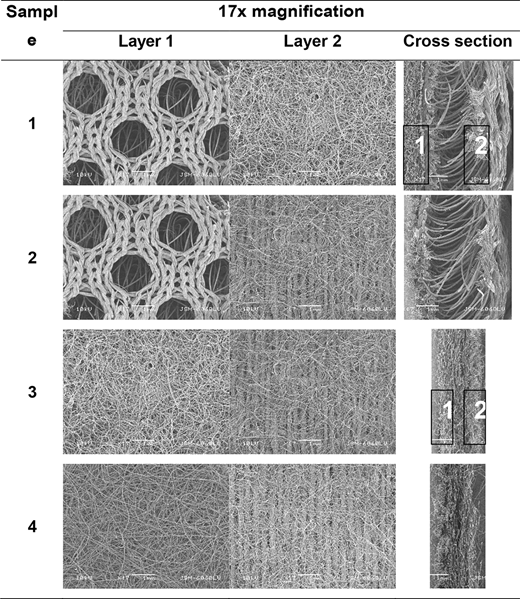
Figure 1 shows the samples at 17× magnification in the scanning electron microscope (SEM) JSM 6060 LV (JEOL, Japan).

2.2.1 Delamination force.

The delamination force was determined according to the DIN 54310 standard.

2.2.2 Bending rigidity.

The bending rigidity was determined in accordance with ISO 9073-7.

2.2.3 Water vapour permeability.

The water vapour permeability was determined in accordance with ASTM E96:E96M.

2.2.4 Air permeability.

Air permeability was measured in accordance with ISO 9237 using the AirTronic B device (Mesdan, Raffa, Italy). The air permeability was measured with an opening area of 20 cm2.

2.2.5 Thermal conductivity.

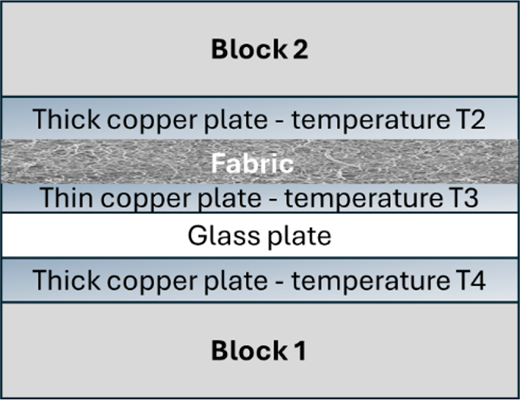
The thermal conductivity was measured using a device developed at the Faculty of Natural Sciences and Engineering; Department of Textiles, Graphic Arts and Design at the University of Ljubljana in accordance with DIN 52612. A reference woollen fabric with known thermal conductivity is used to calibrate the device. The device consists of three copper plates that are connected to an Almemo sensor (Ahlborn, Holzkirchen, Germany) for temperature measurement (Figure 2). The solid frame of the device has an insulating plate on the underside, on which a heating block 1 with a temperature of 60°C is placed. A thicker copper plate with a temperature of T4 is placed on this block. This is followed by a 4 mm thick glass reference plate, then a thinner copper plate with a temperature of T3, followed by a sample, again a thicker copper plate with a temperature of T2 and finally a cold block 2 with a temperature of 20°C. Two samples were prepared for each laminate to measure the thermal conductivity. The individual samples were placed between two copper plates and the temperature values were read after ten, 15 and twenty minutes. The thermal conductivity coefficient (λ) was calculated according to equation (1):

(1)

where: λn = Thermal conductivity of the reference glass plate (1.0319 W/mK); d = sample thickness in mm; dn = thickness of the reference glass plate (4 mm); T2 = temperature of the cooler thick measuring copper plate (°C); T3 = temperature of the medium thin measuring copper plate (°C); T4 = temperature of the warmer thick measuring copper plate (°C).

2.2.6 Breaking stress under compressive ball load.

The breaking stress under compressive load with a ball was carried out on the basis of the ASTM D3787 standard.

2.2.7 Abrasion resistance.

The test was performed using a Martindale M235 device (SDL International, London, UK) in which small round samples (approximately 38 mm in diameter) were placed in a sample holder with a standard foam behind it. The sample was abraded on a circular surface (with a diameter of approximately 100 mm) under load against a standard woollen fabric (ISO 12947-1) with a standard felt on the back. The abrasion movement followed a specific pattern, a Lissajous figure. The test samples were tested to the endpoint, i.e. until the laminate broke at a load of 12 kPa. During the analysis, we also monitored the mass loss until breakage on the front side of the laminate. The result is given as the number of cycles until the end point is reached.

2.2.8 Statistical analysis.

The research focuses on the influence of 3D textiles and multilayer nonwovens on the functionality of a two-layer laminate produced with dry lamination. The influence of the type of layer on the mechanical, thermal and absorption properties of the investigated samples was analysed using a one-way statistical analysis (ANOVA) (Taylor and Cihon, 2004).

The results of the delamination force (Table 2) show that sample 3 exhibited the strongest bond in the longitudinal direction, as the highest force was required for its delamination. In the transverse direction, however, it exhibited the lowest delamination force. This is due to the uneven distribution of the binder, the orientation of the fibres and the adhesion between the layers in each direction. Sample 3 consists of a multilayer nonwoven fabric made of polyester and cotton fabric and has a higher total mass per unit area than sample 4. This is the reason for a better distribution of the binder between the layers of sample 3 and consequently for a higher delamination force in the longitudinal direction. The second layer of sample 3 (cotton fabric) does not ensure an optimal distribution of the binder and thus an optimal number of contact points between the layers during lamination. The greater differences in the delamination force in both directions of sample 3 are due to the anisotropic arrangement of the fibres. A lower proportion of fibres in the first layer and a lower yarn density in the transverse direction significantly influence the decrease in the delamination force of laminates made of multilayer nonwoven and woven fabrics. In contrast, the multilayer nonwoven of sample 4 has more isotropically aligned fibres, which means that the binder is more evenly distributed between the fibres, resulting in a very small difference in the delamination force in the two directions (Table 2).

Sample 1, which consists of a 3D knitted fabric and a multilayer nonwoven fabric, provides more contact points between the fibres of the multilayer nonwoven fabric, the powdery binder and the 3D knitted fabric and consequently requires a higher force for delamination in the longitudinal direction than sample 2, which consists of a 3D knitted fabric and a cotton fabric. Due to the voids between the binding threads, the cotton fabric of sample 2 provides fewer contact points between the 3D knitted fabric and the cotton fabric, i.e. between the two layers in the laminate, which affects the lower force for delamination in the longitudinal direction. In sample 2, the voids of the fabric were filled with binder during lamination, as the binder softens during lamination, resulting in the delamination force of sample 2 being higher in the transverse direction, where the surface is more open in the weft direction due to the lower density, than sample 1, which has a multilayer nonwoven fabric instead of a woven fabric, where there are more connection points but fewer voids between the fibres.

The results show that the bending rigidity of all samples (Table 3) is higher in the longitudinal than in the transverse direction.

The bending rigidity of samples 1 and 2 is slightly higher than that of samples 3 and 4. Laminates consisting of 3D knitted fabrics have a higher mass, which is reflected in a higher bending rigidity. If the 3D knitted fabric is replaced by a multilayered nonwoven, the mass of the laminate decreases, which in turn means a lower bending rigidity, but the differences in bending rigidity between the tested samples are not statistically significant. Larger differences in bending rigidity can be observed in the transverse direction. In the transverse direction, there is generally a fibre content in multilayer nonwovens and a lower density of 3D knitted and woven fabrics, which in turn leads to a lower bending rigidity.

The results of the delamination force, at which individual layers must be delaminated, are influenced by the distribution of the binder, the number of voids between the binding threads in the fabric and the number of contact points between individual layers, in addition to the anisotropy of the samples. The results of the delamination force of the samples are not closely related to the results of the bending rigidity, where anisotropy is the only indicator of differences between the values of the samples in the two directions.

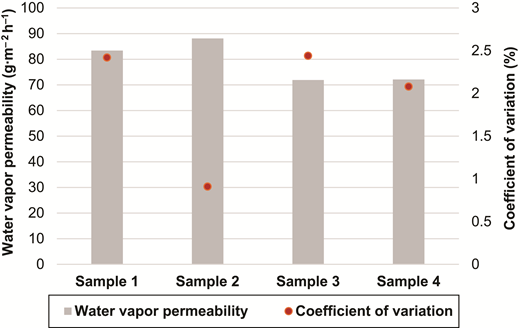
Samples 1 and 2 have the highest water vapour permeability (Figure 3). Sample 1 consists of a 3D knitted fabric and a multilayer nonwoven fabric, which have a more closed structure. For this reason, sample 1 has lower values than sample 2, which consists of a woven fabric.

Samples 3 and 4 consist of multilayer nonwoven fabric and a woven fabric. This is the reason for the significantly lower water vapour permeability compared to samples 1 and 2, which consist of 3D knitted fabrics.

The differences between the water vapour permeability values of the samples are greater between the group of 3D knitted fabrics (samples 1 and 2) and the group of multilayer nonwovens (samples 3 and 4), whereby the structure of the second layer in the laminate (woven or nonwoven) has no significant influence on the water vapour permeability. The reason for this is the free passage of water vapour, which in the case of laminates passes through the individual layer of the laminate and the binder layer. In the case of a laminate made of 3D knitted fabrics, which are more open or of multilayer nonwovens, which are more closed, there are no major differences in water vapour permeability between the samples. In the laminates, a single layer does not contribute significantly to the increase in water vapour permeability, although each layer has an open surface. The binder layer created during lamination has a greater influence. Therefore, the differences between the samples are not so great, although they are significant.

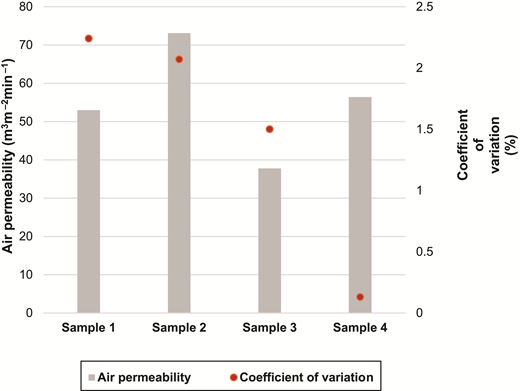
Sample 2, which consists of a 3D knitted fabric and a woven fabric, has the highest air permeability (Figure 4). Both layers of the sample have a very open structure compared to sample 1. Sample 1 consists of a 3D knitted fabric and a multilayer nonwoven fabric, which have a closer structure.

The multilayer nonwoven fabric causes a reduction in the openness of the surface, which leads to a significant reduction in the air permeability of sample 3 compared to samples 1 and 2, which consist of 3D knitted fabrics. Interesting air permeability results were obtained for sample 4, which consists of a multilayer nonwoven and a woven fabric and has a similar air permeability to sample 1. The reason for this is probably the lower mass of sample 4 compared to sample 1. Given the higher air permeability values of sample 4, which consists of a multilayer nonwoven and a woven fabric, the optimal combination of the individual layers of the laminate will be a major challenge for future research, as the combination in sample 4 can bring us closer to the air permeability values of 3D knitted fabrics, which is an important contribution in this field.

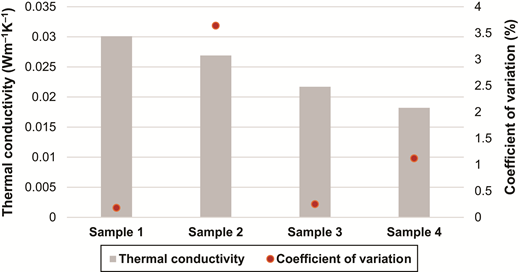
From the results of the thermal conductivity (Figure 5), it can be concluded that all samples have good insulating properties. Sample 1, which consists of a 3D knitted fabric and multilayer nonwoven fabric, has the highest thermal conductivity. This is followed by sample 2, which also consists of a 3D knitted fabric, with the second layer being a woven fabric. Samples 1 and 2 have the highest thermal conductivity due to their open structure, which has good permeability properties.

Samples 3 and 4, which are made of a multilayer nonwoven fabric, have a smaller surface area and thickness than samples 1 and 2, which consist of a 3D knitted fabric with a more open surface. However, samples 3 and 4 have a lower thermal conductivity than samples 1 and 2, as there are many empty spaces (micropores) between the fibres of the multilayer nonwoven fabric, in which air is trapped, which acts as a thermal insulator. This is also the reason for the lower thermal conductivity of samples 3 and 4 compared to samples 1 and 2.

The fact that multilayer nonwovens and laminates insulate well is very important from the point of view of sustainability, as less energy is needed to heat a car.

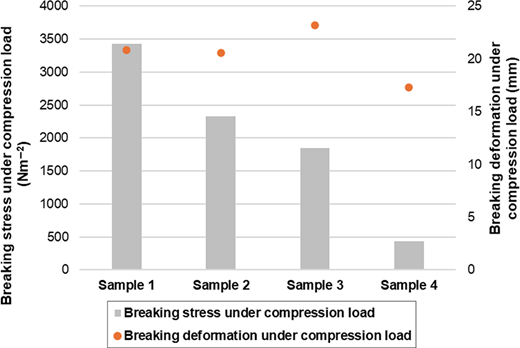
As expected, a laminate consisting of a 3D knitted fabric and a multilayer nonwoven fabric (sample 1) exhibits the highest breaking stress under compressive load (Figure 6). This is followed by sample 2, which consists of 3D knitted fabric and woven fabric, but is about 30% lower. It has been shown that the 3D knitted fabric in the laminate significantly extends the service life of such a laminate compared to laminates consisting of multilayer nonwoven and woven fabric (samples 3 and 4), where the values are half to five times lower. Samples 3 and 4 also have a much lower mass and thickness.

The results of deformation at break under spherical compression show that samples 1, 2 and 3 can achieve spherical compression stresses of more than 20 mm, with sample 4 performing the worst with the lowest value. Sample 4 consists of multilayer nonwoven and woven fabric but has the lowest thickness and mass compared to the other samples, which affects the lower value of deformation as well as the lowest value of breaking stress under spherical compression. A contribution in this area is the combination of the two layers of sample 3, which has the highest value of deformation under compression load. However, challenges remain, as 3D knitted fabrics exhibit higher compressive stress than multilayer nonwovens, except for sample 3, which most closely approaches these values.

Samples 1 and 2, which consist of 3D knitted fabrics, are the most durable, as no breakage occurred after 100,000 cycles (Table 4). The mass loss after 100,000 cycles is also lower for samples 1 and 2 than for samples 3 and 4, which consist of multilayer nonwoven and woven fabrics. Sample 2, which consists of 3D knitted fabric and woven fabric, shows a higher mass loss (0.026 g) than sample 1 (0.009 g). The reason for this could be the influence of the second layer, which consists of a woven fabric that, due to its lower density, has a slightly higher mass loss than multilayer nonwoven fabrics (sample 1).

A similar value of mass loss was also measured for samples 3 and 4. In both cases, the front side of the sample is a multilayer nonwoven fabric, while the back side is a lower-density woven fabric, resulting in a higher mass loss, as in this case the front side of the sample is more exposed to the load, resulting in a greater mass loss.

Samples 3 and 4 also break earlier than samples 1 and 2, with samples 3 and 4 breaking at 60,000 cycles, while samples 1 and 2 withstand up to 100,000 cycles.

The results show that the laminate consisting of 3D knitted fabrics and multilayer nonwoven fabrics has a significantly better durability than the other laminates tested.

The electron micrographs of the cross-section of samples 3 and 4 (Figure 1) show protruding fibres on the surface of the multilayer nonwoven fabric, compared to the cross-section of samples 1 and 2, where a stable 3D knitted structure is visible. During the rubbing process, the fibres are pulled out faster from the surface of the multilayer nonwoven and consequently samples 3 and 4 break faster (at 60,000 cycles) compared to samples 1 and 2, where no breakage occurs even at 100,000 cycles.

The results of the one-way ANOVA presented in Table 5 show that the type of layer has a statistically significant influence on the delamination force, water vapour and air permeability, thermal conductivity, breaking force under compressive load and abrasion resistance (p-value ≤ 0.05). In contrast, the type of layer has no significant influence on bending rigidity (p-value ≥ 0.05). In addition to the p-value, Table 5 also shows the number of measurements (count), the sum of all measurements (sum), the average value of the measurements (average) and the variance (variance). The fact that 3D knitted textiles or multilayer nonwovens have a statistically significant influence on almost all functional properties discussed in this paper represents a contribution to this topic. At the same time, it is a great challenge to improve the functional properties of multilayer nonwovens in two-layer laminates, which are more environmentally friendly than 3D knitted fabrics. In the future, the recycling of laminates, both 3D knitted textiles and multilayer textiles, will also play an important role.

The research focuses on the influence of 3D knitted fabrics and multilayer nonwovens on the functionality of a two-layer laminate produced with dry lamination and intended for seat covers in the automotive industry. The results of the present study show that 3D knitted fabrics in combination with multilayer nonwovens and woven fabrics in two-layer laminates increase the bending rigidity, thermal conductivity, compression strength under load with a ball and abrasion resistance.

The presence of 3D knitted fabrics in the laminate significantly reduces the delamination force, which is mainly due to the smooth 3D knitted fabrics made of multifilament yarn. This affects the poorer contact between the two layers during lamination.

An important contribution to science is the realisation that the anisotropy of the individual layers, which is related to the fibre orientation of multilayer nonwovens and the thread density of cotton fabrics, significantly influences the distribution of the binder between the fibres during lamination and thus the functional properties of the laminates.

The research has shown that multilayer nonwovens can replace 3D knitted fabrics in two-layer laminates and improve delamination strength, bending rigidity and insulation. In some cases, such as air permeability and water vapour permeability, these do not change drastically when 3D knitted fabrics are replaced by multilayer nonwovens in the laminate.

Multilayer nonwovens in laminates intended for car seat covers can be made also from recycled fibres from cut textile waste, are easier to recycle than 3D knitted fabrics and their production process is faster and therefore cheaper. The research results confirm that multilayer nonwovens can replace 3D knitted fabrics in two-layer laminates without significantly changing their functionality and are of crucial importance for the automotive industry as a user of such materials and represent an important source of information for research into the factors influencing the microstructure at the fibre level in multilayer nonwovens and understanding the structure of the individual layers of the laminate with the aim of improving its functional properties.
Arya
,
M.
,
Skrifvars
,
M.
and
Khalili
,
P.
(
2024
), “
Performance and life cycle assessment of composites reinforced with natural fibers and end-of-life textiles
”,
Journal of Composites Science
, Vol.
8
No.
6
, p.
196
, doi: .
Barnett
,
P.R.
and
Ghossein
,
H.K.
(
2021
), “
A review of recent developments in composites made of recycled carbon fiber textiles
”,
Textiles
, Vol.
1
No.
3
, pp.
433
-
465
, doi: .
Chang
,
C.W.
and
Chang
,
F.C.
(
2021
), “
Fracture characteristics and energy dissipation of textile bamboo fiber reinforced polymer
”,
Polymers
, Vol.
13
No.
4
, p.
634
, doi: .
Chen
,
C.
,
Legrand
,
X.
,
Hong
,
Y.
and
Wang
,
P.
(
2023
), “
Investigation and prediction of laminate quality and interlaminar mechanical performance of the tufted sandwich composites with different core structures
”,
Composite Structures
, Vol.
306
, p.
116594
, doi: .
Çinçik
,
E.
and
Aslan
,
E.
(
2024
), “
Assessing the sound and heat insulation characteristics of layered nonwoven composite structures composed of Meltblown and recycled thermo-bonded layers
”,
Polymers
, Vol.
16
No.
10
, p.
1391
, doi: .
Dabiryan
,
H.
and
Jeddi
,
A.A.A.
(
2011
), “
Analysis of warp knitted fabric structure. Part I: a 3D straight line model for warp knitted fabrics
”,
The Journal of The Textile Institute
, Vol.
102
No.
12
, pp.
1065
-
1074
, doi: .
El-Ghoubary
,
W.A.
,
El-Sayad
,
G.M.
,
El Gamal
,
F.A.
and
Abouzaid
,
H.A.K.
(
2023
), “
Development of breathable and liquid/wet bacterial penetration barrier composite laminated fabrics for surgical gown applications
”,
Journal of Industrial Textiles
, Vol.
53
, pp.
1
-
37
, doi: .
Gruyter
,
D.
(
2023
),
Smart and Functional Textiles
, (1st ed.)
Taylor and Francis Group
,
Oxfordshire
, p.
773
.
Ionesi
,
S.D.
,
Ciobanu
,
L.
,
Dumitras
,
C.
,
Avadanei
,
M.
,
Dulgheriu
,
I.
,
Ionescu
,
I.
and
Loghin
,
M.C.
(
2021
), “
FEM analysis of textile reinforced composite materials impact behavior
”,
Materials
, Vol.
14
No.
23
, p.
7380
, doi: .
Joshi
,
M.
and
Butola
,
B.S.
(
2013
),
Application Technologies for Coating, Lamination and Finishing of Technical Textiles
, (1st ed.)
Woodhead Publishing Series in Textiles
,
London
, pp.
355
-
411
.
Korkmaz
,
M.
(
2024
), “
In and off- axes mechanical properties of three-dimensional textile reinforced carbon composites
”,
Journal of Composite Materials
, Vol.
58
No.
4
, pp.
479
-
487
, doi: .
Krauledaitė
,
J.
,
Ancutiene
,
K.
,
Krauledas
,
S.
,
Urbelis
,
V.
and
Sacevičiene
,
V.
(
2022
), “
Research of 3D weft-knitted fabrics designed to protect against mechanical risks and suitable for contact with skin
”,
Journal of Industrial Textiles
, Vol.
51
No.
5_suppl
, pp.
7674S
-
7693S
, doi: .
Li
,
X.
,
Jiang
,
G.
,
Nie
,
X.
,
Ma
,
P.
and
Gao
,
Z.
(
2015
), “
Knitting technologies and tensile properties of a novel curved flat-knitted three-dimensional spacer fabrics
”,
Autex Research Journal
, Vol.
15
No.
3
, pp.
191
-
197
, doi: .
Li
,
Y.
,
Chen
,
X.
,
Zhou
,
J.
,
Liu
,
X.
,
Zhang
,
D.
,
Du
,
F.
,
He
,
W.
,
Jia
,
P.
and
Liu
,
H.
(
2022
), “
A review of high-velocity impact on fiber-reinforced textile composites: potential for aero engine applications
”,
International Journal of Mechanical System Dynamics
, Vol.
2
No.
1
, pp.
50
-
64
, doi: .
Lin
,
T.A.
,
Lin
,
J.-H.
,
Lin
,
T.R.
,
Lin
,
J.-Y.
,
Lin
,
M.-C.
and
Lou
,
C.-W.
(
2020
), “
Manufacturing techniques and property evaluations of sandwich-structured composite materials with electromagnetic shielding, flame retardance, and far-infrared emissivity
”,
Journal of Sandwich Structures and Materials
, Vol.
22
No.
6
, pp.
2075
-
2088
, doi: .
Ravandi
,
M.
,
Moradi
,
A.
,
Ahlquist
,
S.
and
Banu
,
M.
(
2022
), “
Numerical simulation of the mechanical behavior of a weft-knitted carbon fiber composite under tensile loading
”,
Polymers
, Vol.
14
No.
3
, p.
451
, doi: .
Reis
,
B.
,
Miguel
,
R.
,
Lucas
,
J.
,
Pereira
,
M.
,
Pinheiro
,
C.
,
Santos
,
G.
,
Carvalho
,
J.
,
Moreira da Silva
,
F.
and
Santos Silva
,
M.
(
2022
), “
Functional design of tri-laminated wool fabrics improving comfort properties
”,
Journal of Biomimetics, Biomaterials and Biomedical Engineering
, Vol.
57
, pp.
65
-
76
, doi: .
Renkens
,
W.
and
Kyosev
,
Y.
(
2022
), “
Geometry modelling of warp knitted fabrics with 3D form
”,
Textile Research Journal
, Vol.
81
No.
4
, pp.
437
-
443
, doi: .
Russel
,
S.J.
(
2022
),
Handbook of Nonwovens
, (1st ed.)
Woodhead Publishing Series in Textiles
,
London
, pp.
89
-
129
.
Sankauskaitė
,
A.
,
Rubežiene
,
V.
,
Kubiliene
,
D.
,
Abraitiene
,
A.
,
Baltušnikaite-Guzaitiene
,
J.
and
Dubinskaite
,
K.
(
2020
), “
Investigation of thermal behavior of 3d pet knits with different bioceramic additives
”,
Polymers
, Vol.
12
No.
6
, p.
1319
, doi: .
Shi
,
M.
,
Takahashi
,
S.
,
Takeno
,
A.
and
Nakai
,
A.
(
2023
), “
Nanofiber veil applied in toughness enhancement of thermoplastic carbon fiber composites
”,
Journal of Thermoplastic Composite Materials 2
, Vol.
36
No.
4
, pp.
631
-
1650
, doi: .
Sinchuk
,
Y.
,
Kibleur
,
P.
,
Aelterman
,
J.
,
Boone
,
M.N.
and
Van Paepegem
,
W.
(
2021
), “
Geometrical and deep learning approaches for instance segmentation of CFRP fiber bundles in textile composites
”,
Composite Structures
, Vol.
277
, p.
114626
, doi: .
Sinmazçelik
,
T.
,
Avcu
,
E.
,
Özgür Bora
,
M.
and
Çoban
,
O.
(
2011
), “
A review: fibre metal laminates, background, bonding types and applied test methods
”,
Materials and Design
, Vol.
32
No.
7
, pp.
3671
-
3685
, doi: doi: .
Taylor
,
J.K.
and
Cihon
,
C.
(
2004
),
Statistical Techniques for Data Analysis
,
CRC Press
,
UK
.
Turki
,
S.
,
Abdallah
,
S.B.
and
Abdessalem
,
S.B.
(
2018
), “
Development of composite materials reinforced with flat-knitted spacer fabrics
”,
The Journal of The Textile Institute
, Vol.
109
No.
10
, pp.
1315
-
1321
, doi: .
Wang
,
J.
and
Tang
,
X.
(
2023
), “
Investigation on the sound absorption of multilayered woven and nonwoven fabrics with different bonding conditions
”,
Polymer Composites
, Vol.
44
No.
1
, pp.
392
-
400
, doi: .
Xiong
,
X.
,
Yang
,
T.
,
Mishra
,
R.
,
Kanai
,
H.
and
Militky
,
J.
(
2018
), “
Thermal and compression characteristics of aerogel-encapsulated textiles
”,
Journal of Industrial Textiles
, Vol.
47
No.
8
, pp.
1998
-
2013
, doi: .
Yu
,
X.
,
Su
,
T.
,
Liang
,
X.
and
Cong
,
H.
(
2023
), “
Optimization the stab resistance and flexibility of ultra-high molecular weight polyethylene knitted structure fabric with response surface method
”,
Polymers
, Vol.
15
No.
23
, p.
4509
, doi: .
Zhang
,
Y.
,
Lin
,
J.-H.
,
Cheng
,
D.-H.
,
Li
,
X.
,
Wang
,
H.-Y.
,
Lu
,
Y.-H.
and
Lou
,
C.-W.
(
2023
), “
A study on tencel/LMPET–TPU/triclosan laminated membranes: Excellent water resistance and antimicrobial ability
”,
Membranes
, Vol.
13
No.
8
, p.
703
, doi: .
Published by Emerald Publishing Limited. This article is published under the Creative Commons Attribution (CC BY 4.0) license. Anyone may reproduce, distribute, translate and create derivative works of this article (for both commercial and non-commercial purposes), subject to full attribution to the original publication and authors. The full terms of this license may be seen at Link to the terms of the CC BY 4.0 licenceLink to the terms of the CC BY 4.0 licence.

Data & Figures

Figure 1.
A set of magnified fabric images showing four samples, each with two surface layers and one cross-section view.The figure presents four fabric samples at seventeen times magnification, arranged in rows. Each row shows layer one with its fibrous pattern, layer two with a denser fibre structure, and a cross-section image that displays the internal arrangement of fibres. Samples one and two show a more open structure in layer one, while samples three and four display tighter fibre networks across both layers. The cross-section images illustrate how fibres are stacked and bonded in each sample, with variations in thickness and density evident between samples.

Examination of the samples (SEM micrographs) at 17× magnification

Note(s): 1 – Layer 1; 2 – Layer 2

Figure 1.
A set of magnified fabric images showing four samples, each with two surface layers and one cross-section view.The figure presents four fabric samples at seventeen times magnification, arranged in rows. Each row shows layer one with its fibrous pattern, layer two with a denser fibre structure, and a cross-section image that displays the internal arrangement of fibres. Samples one and two show a more open structure in layer one, while samples three and four display tighter fibre networks across both layers. The cross-section images illustrate how fibres are stacked and bonded in each sample, with variations in thickness and density evident between samples.

Examination of the samples (SEM micrographs) at 17× magnification

Note(s): 1 – Layer 1; 2 – Layer 2

Close modal
Figure 2.
A layered thermal test setup showing fabric placed between copper and glass plates within two stacked blocks.The diagram shows a vertical stack of materials used in a thermal test. Block two is at the top, followed by a thick copper plate at temperature T2, then a layer of fabric, a thin copper plate at temperature T3, and a glass plate. Below the glass plate is another thick copper plate at temperature T4, resting on block one. The arrangement illustrates how the fabric layer is positioned between copper and glass plates to measure heat transfer through the material.

Principle of determining thermal conductivity on the device

Figure 2.
A layered thermal test setup showing fabric placed between copper and glass plates within two stacked blocks.The diagram shows a vertical stack of materials used in a thermal test. Block two is at the top, followed by a thick copper plate at temperature T2, then a layer of fabric, a thin copper plate at temperature T3, and a glass plate. Below the glass plate is another thick copper plate at temperature T4, resting on block one. The arrangement illustrates how the fabric layer is positioned between copper and glass plates to measure heat transfer through the material.

Principle of determining thermal conductivity on the device

Close modal
Figure 3.
A bar and point plot with four samples showing water vapour permeability on the left axis and coefficient of variation on the right axis.The plot presents four samples on the horizontal axis with water vapour permeability shown as vertical bars against the left axis in grams per square metre per hour and coefficient of variation shown as points against the right axis in percent. Sample 1 has permeability near 80 and variation near 2. Sample 2 has permeability near 90 and variation near 1. Sample 3 has permeability near 70 and variation near 2.5. Sample 4 has permeability near 75 and variation near 2. Both axes use evenly spaced grid lines.

Results of the water vapour permeability

Figure 3.
A bar and point plot with four samples showing water vapour permeability on the left axis and coefficient of variation on the right axis.The plot presents four samples on the horizontal axis with water vapour permeability shown as vertical bars against the left axis in grams per square metre per hour and coefficient of variation shown as points against the right axis in percent. Sample 1 has permeability near 80 and variation near 2. Sample 2 has permeability near 90 and variation near 1. Sample 3 has permeability near 70 and variation near 2.5. Sample 4 has permeability near 75 and variation near 2. Both axes use evenly spaced grid lines.

Results of the water vapour permeability

Close modal
Figure 4.
A bar and point plot with four samples showing air permeability on the left axis and coefficient of variation on the right axis.The plot shows four samples on the horizontal axis with air permeability represented by vertical bars against the left axis in cubic metres per square metre per minute and coefficient of variation marked by points against the right axis in percent. Sample 1 shows permeability near 50 and variation near 2. Sample 2 shows permeability near 75 and variation slightly above 2. Sample 3 shows permeability near 40 and variation near 1.5. Sample 4 shows permeability near 55 and variation near 0.5. Both axes include evenly spaced grid lines.

Results of air permeability

Figure 4.
A bar and point plot with four samples showing air permeability on the left axis and coefficient of variation on the right axis.The plot shows four samples on the horizontal axis with air permeability represented by vertical bars against the left axis in cubic metres per square metre per minute and coefficient of variation marked by points against the right axis in percent. Sample 1 shows permeability near 50 and variation near 2. Sample 2 shows permeability near 75 and variation slightly above 2. Sample 3 shows permeability near 40 and variation near 1.5. Sample 4 shows permeability near 55 and variation near 0.5. Both axes include evenly spaced grid lines.

Results of air permeability

Close modal
Figure 5.
A bar and point chart showing thermal conductivity and coefficient of variation for four samples with values decreasing across the samples.The chart plots thermal conductivity on the left vertical axis in watts per metre kelvin and coefficient of variation on the right vertical axis in percent for four samples. Sample 1 has thermal conductivity about 0.034 and coefficient of variation about 0.4. Sample 2 has thermal conductivity about 0.029 and coefficient of variation about 3.6. Sample 3 has thermal conductivity about 0.022 and coefficient of variation about 0.5. Sample 4 has thermal conductivity about 0.018 and coefficient of variation about 1.2.

The results of the thermal conductivity

Figure 5.
A bar and point chart showing thermal conductivity and coefficient of variation for four samples with values decreasing across the samples.The chart plots thermal conductivity on the left vertical axis in watts per metre kelvin and coefficient of variation on the right vertical axis in percent for four samples. Sample 1 has thermal conductivity about 0.034 and coefficient of variation about 0.4. Sample 2 has thermal conductivity about 0.029 and coefficient of variation about 3.6. Sample 3 has thermal conductivity about 0.022 and coefficient of variation about 0.5. Sample 4 has thermal conductivity about 0.018 and coefficient of variation about 1.2.

The results of the thermal conductivity

Close modal
Figure 6.
A bar and point chart showing breaking stress and breaking deformation under compression load for four samples with both measures decreasing.The chart plots breaking stress under compression load on the left vertical axis in newtons per square millimetre and breaking deformation on the right vertical axis in millimetres for four samples. Sample 1 has stress about 3600 and deformation about 22. Sample 2 has stress about 2600 and deformation about 20. Sample 3 has stress about 2100 and deformation about 17. Sample 4 has stress about 500 and deformation about 12.

Breaking stress and deformation under compression load

Figure 6.
A bar and point chart showing breaking stress and breaking deformation under compression load for four samples with both measures decreasing.The chart plots breaking stress under compression load on the left vertical axis in newtons per square millimetre and breaking deformation on the right vertical axis in millimetres for four samples. Sample 1 has stress about 3600 and deformation about 22. Sample 2 has stress about 2600 and deformation about 20. Sample 3 has stress about 2100 and deformation about 17. Sample 4 has stress about 500 and deformation about 12.

Breaking stress and deformation under compression load

Close modal
Table 1.

Presentation of lamination samples, their material composition and mechanical properties

Sample labelComposition of two-layers laminateMass of layers and laminate M (g/m2)Thickness of layers and laminate (mm)
Layer 1Layer 2
1Polyester 3D knitted fabricPolyester multilayered nonwoven (randomly oriented fibres)Layer 1: 309.87Layer 1:2.50
Layer 2: 154.84Layer 2:1.32
Laminate: 462.96Laminate: 3.75
2Polyester 3D knitted fabricCotton woven fabric (white)Layer 1: 309.87Layer 1:2.50
Layer 2: 103.17Layer 2:0.52
Laminate: 413.04Laminate: 2.94
3Polyester multilayered nonwoven (randomly oriented fibres)Cotton woven fabric (white)Layer 1: 154.84Layer 1:1.32
Layer 2: 103.17Layer 2:0.52
Laminate: 258.01Laminate: 1.72
4Polyester multilayered nonwoven (randomly oriented fibres)Cotton woven fabric (black)Layer 1:86.53Layer 1:0.93
Layer 2:87.53Layer 2:0.427
Laminate: 184.06Laminate: 1.24
Table 2.

Results of the delamination force

MeasurementDelimination force (N)
Sample 1Sample 2Sample 3Sample 4
Machine direction
15.5133.36457.53419.929
25.6863.72261.67726.207
35.5243.71471.00322.497
Average, x5.5743.60063.40522.878
Coeff. of var., CV (%)1.7385.67810.88013.796
Crossmachine direction
15.2175.5170.96627.156
24.6304.9871.06526.561
35.0875.7320.64323.902
Average, x4.9785.4120.89125.873
Coeff. of var., CV (%)6.1937.08524.7596.697
Table 3.

The results of the bending rigidity

MeasurementBending rigidity (μN·m)
Sample 1Sample 2Sample 3Sample 4
Machine direction
10.9570.5020.4371.113
21.1090.4450.4481.074
31.1910.5320.4730.980
41.5581.6941.3961.236
51.4921.5331.2731.436
61.2471.8661.5271.344
Average, x1.2591.0950.9261.197
Coeff. of var., CV (%)18.19661.04856.66514.456
Crossmachine direction
10.6760.3110.1590.290
20.5850.2700.1470.259
30.6570.2900.1420.245
40.6020.7010.1260.360
50.8630.7580.1590.307
60.8190.7380.1470.351
Average, x0.7010.5120.1470.302
Coeff. of var., CV (%)16.40847.4698.41815.518
Table 4.

The results of the abrasion resistance

Number of cyclesSample 1Sample 2Sample 3Sample 4
Mass (g)
00.5400.4410.3010.225
10,0000.5380.4310.2910.214
30,0000.5380.4280.2880.188
50,0000.5380.4230.2800.147
60,0000.5330.422Sample breakSample break
70,0000.5310.421
100,0000.5310.415
The difference in mass (g)0.0090.0260.0210.078
Table 5.

The results of one-way ANOVA

VariationSum of squaresDegrees of freedomMean squaresF-ratiop-valueF-critical
Delamination force
Between groups6928.732309.6160.41.7 · 10–74.07
Within groups115.2814.4
GroupsCountSumAverageVariance
Sample 1316.725.570.01
Sample 2310.803.600.04
Sample 33190.2163.4047.59
Sample 4368.6322.889.96
Bending rigidity
Between groups0.4030.130.660.593.10
Within groups4.00200.20
GroupsCountSumAverageVariance
Sample 167.551.260.05
Sample 266.571.100.45
Sample 365.520.920.27
Sample 467.181.200.03
WVT
Between groups805.13268.427.21.2 · 10–53.5
Within groups118.3129.9
GroupsCountSumAverageVariance
Sample 14333.6083.4016.33
Sample 24352.2088.052.43
Sample 34287.2071.8012.00
Sample 44288.2072.058.67
Air permeability
Between groups3775.9831258.7345.22.18 · 10–173.10
Within groups72.92203.6
GroupsCountSumAverageVariance
Sample 16317.8252.975.14
Sample 26438.4573.088.27
Sample 36226.6837.781.15
Sample 46338.4656.410.02
Thermal conductivity
Between groups0.00023.000.000136.820.00236.6
Within groups0.00004.000.0000
GroupsCountSumAverageVariance
Sample 120.060.032 · 10–8
Sample 220.050.036 · 10–6
Sample 320.040.022 · 10–8
Sample 420.030.022 · 10–7
Breaking force under compressive load
Between groups27,735,311.439,245,103.83225.35.1 · 10–273.09
Within groups57,328.7202866.4
GroupsCountSumAverageVariance
Sample 1620549.03424.82115.4
Sample 2613975.22329.2132.8
Sample 3611055.11842.57760.6
Sample 462590.5431.71456.7
Abrasion resistance
Between groups0.01123.00000.003711,172.00.000073.4903
Within groups0.000012.00000.0000
GroupsCountSumAverageVariance
Sample 140.0340.00853.3 · 10–7
Sample 240.1020.02553.3 · 10–7
Sample 340.0820.02053.3 · 10–7
Sample 440.310.07753.3 · 10–7

Supplements

References

Arya
,
M.
,
Skrifvars
,
M.
and
Khalili
,
P.
(
2024
), “
Performance and life cycle assessment of composites reinforced with natural fibers and end-of-life textiles
”,
Journal of Composites Science
, Vol.
8
No.
6
, p.
196
, doi: .
Barnett
,
P.R.
and
Ghossein
,
H.K.
(
2021
), “
A review of recent developments in composites made of recycled carbon fiber textiles
”,
Textiles
, Vol.
1
No.
3
, pp.
433
-
465
, doi: .
Chang
,
C.W.
and
Chang
,
F.C.
(
2021
), “
Fracture characteristics and energy dissipation of textile bamboo fiber reinforced polymer
”,
Polymers
, Vol.
13
No.
4
, p.
634
, doi: .
Chen
,
C.
,
Legrand
,
X.
,
Hong
,
Y.
and
Wang
,
P.
(
2023
), “
Investigation and prediction of laminate quality and interlaminar mechanical performance of the tufted sandwich composites with different core structures
”,
Composite Structures
, Vol.
306
, p.
116594
, doi: .
Çinçik
,
E.
and
Aslan
,
E.
(
2024
), “
Assessing the sound and heat insulation characteristics of layered nonwoven composite structures composed of Meltblown and recycled thermo-bonded layers
”,
Polymers
, Vol.
16
No.
10
, p.
1391
, doi: .
Dabiryan
,
H.
and
Jeddi
,
A.A.A.
(
2011
), “
Analysis of warp knitted fabric structure. Part I: a 3D straight line model for warp knitted fabrics
”,
The Journal of The Textile Institute
, Vol.
102
No.
12
, pp.
1065
-
1074
, doi: .
El-Ghoubary
,
W.A.
,
El-Sayad
,
G.M.
,
El Gamal
,
F.A.
and
Abouzaid
,
H.A.K.
(
2023
), “
Development of breathable and liquid/wet bacterial penetration barrier composite laminated fabrics for surgical gown applications
”,
Journal of Industrial Textiles
, Vol.
53
, pp.
1
-
37
, doi: .
Gruyter
,
D.
(
2023
),
Smart and Functional Textiles
, (1st ed.)
Taylor and Francis Group
,
Oxfordshire
, p.
773
.
Ionesi
,
S.D.
,
Ciobanu
,
L.
,
Dumitras
,
C.
,
Avadanei
,
M.
,
Dulgheriu
,
I.
,
Ionescu
,
I.
and
Loghin
,
M.C.
(
2021
), “
FEM analysis of textile reinforced composite materials impact behavior
”,
Materials
, Vol.
14
No.
23
, p.
7380
, doi: .
Joshi
,
M.
and
Butola
,
B.S.
(
2013
),
Application Technologies for Coating, Lamination and Finishing of Technical Textiles
, (1st ed.)
Woodhead Publishing Series in Textiles
,
London
, pp.
355
-
411
.
Korkmaz
,
M.
(
2024
), “
In and off- axes mechanical properties of three-dimensional textile reinforced carbon composites
”,
Journal of Composite Materials
, Vol.
58
No.
4
, pp.
479
-
487
, doi: .
Krauledaitė
,
J.
,
Ancutiene
,
K.
,
Krauledas
,
S.
,
Urbelis
,
V.
and
Sacevičiene
,
V.
(
2022
), “
Research of 3D weft-knitted fabrics designed to protect against mechanical risks and suitable for contact with skin
”,
Journal of Industrial Textiles
, Vol.
51
No.
5_suppl
, pp.
7674S
-
7693S
, doi: .
Li
,
X.
,
Jiang
,
G.
,
Nie
,
X.
,
Ma
,
P.
and
Gao
,
Z.
(
2015
), “
Knitting technologies and tensile properties of a novel curved flat-knitted three-dimensional spacer fabrics
”,
Autex Research Journal
, Vol.
15
No.
3
, pp.
191
-
197
, doi: .
Li
,
Y.
,
Chen
,
X.
,
Zhou
,
J.
,
Liu
,
X.
,
Zhang
,
D.
,
Du
,
F.
,
He
,
W.
,
Jia
,
P.
and
Liu
,
H.
(
2022
), “
A review of high-velocity impact on fiber-reinforced textile composites: potential for aero engine applications
”,
International Journal of Mechanical System Dynamics
, Vol.
2
No.
1
, pp.
50
-
64
, doi: .
Lin
,
T.A.
,
Lin
,
J.-H.
,
Lin
,
T.R.
,
Lin
,
J.-Y.
,
Lin
,
M.-C.
and
Lou
,
C.-W.
(
2020
), “
Manufacturing techniques and property evaluations of sandwich-structured composite materials with electromagnetic shielding, flame retardance, and far-infrared emissivity
”,
Journal of Sandwich Structures and Materials
, Vol.
22
No.
6
, pp.
2075
-
2088
, doi: .
Ravandi
,
M.
,
Moradi
,
A.
,
Ahlquist
,
S.
and
Banu
,
M.
(
2022
), “
Numerical simulation of the mechanical behavior of a weft-knitted carbon fiber composite under tensile loading
”,
Polymers
, Vol.
14
No.
3
, p.
451
, doi: .
Reis
,
B.
,
Miguel
,
R.
,
Lucas
,
J.
,
Pereira
,
M.
,
Pinheiro
,
C.
,
Santos
,
G.
,
Carvalho
,
J.
,
Moreira da Silva
,
F.
and
Santos Silva
,
M.
(
2022
), “
Functional design of tri-laminated wool fabrics improving comfort properties
”,
Journal of Biomimetics, Biomaterials and Biomedical Engineering
, Vol.
57
, pp.
65
-
76
, doi: .
Renkens
,
W.
and
Kyosev
,
Y.
(
2022
), “
Geometry modelling of warp knitted fabrics with 3D form
”,
Textile Research Journal
, Vol.
81
No.
4
, pp.
437
-
443
, doi: .
Russel
,
S.J.
(
2022
),
Handbook of Nonwovens
, (1st ed.)
Woodhead Publishing Series in Textiles
,
London
, pp.
89
-
129
.
Sankauskaitė
,
A.
,
Rubežiene
,
V.
,
Kubiliene
,
D.
,
Abraitiene
,
A.
,
Baltušnikaite-Guzaitiene
,
J.
and
Dubinskaite
,
K.
(
2020
), “
Investigation of thermal behavior of 3d pet knits with different bioceramic additives
”,
Polymers
, Vol.
12
No.
6
, p.
1319
, doi: .
Shi
,
M.
,
Takahashi
,
S.
,
Takeno
,
A.
and
Nakai
,
A.
(
2023
), “
Nanofiber veil applied in toughness enhancement of thermoplastic carbon fiber composites
”,
Journal of Thermoplastic Composite Materials 2
, Vol.
36
No.
4
, pp.
631
-
1650
, doi: .
Sinchuk
,
Y.
,
Kibleur
,
P.
,
Aelterman
,
J.
,
Boone
,
M.N.
and
Van Paepegem
,
W.
(
2021
), “
Geometrical and deep learning approaches for instance segmentation of CFRP fiber bundles in textile composites
”,
Composite Structures
, Vol.
277
, p.
114626
, doi: .
Sinmazçelik
,
T.
,
Avcu
,
E.
,
Özgür Bora
,
M.
and
Çoban
,
O.
(
2011
), “
A review: fibre metal laminates, background, bonding types and applied test methods
”,
Materials and Design
, Vol.
32
No.
7
, pp.
3671
-
3685
, doi: doi: .
Taylor
,
J.K.
and
Cihon
,
C.
(
2004
),
Statistical Techniques for Data Analysis
,
CRC Press
,
UK
.
Turki
,
S.
,
Abdallah
,
S.B.
and
Abdessalem
,
S.B.
(
2018
), “
Development of composite materials reinforced with flat-knitted spacer fabrics
”,
The Journal of The Textile Institute
, Vol.
109
No.
10
, pp.
1315
-
1321
, doi: .
Wang
,
J.
and
Tang
,
X.
(
2023
), “
Investigation on the sound absorption of multilayered woven and nonwoven fabrics with different bonding conditions
”,
Polymer Composites
, Vol.
44
No.
1
, pp.
392
-
400
, doi: .
Xiong
,
X.
,
Yang
,
T.
,
Mishra
,
R.
,
Kanai
,
H.
and
Militky
,
J.
(
2018
), “
Thermal and compression characteristics of aerogel-encapsulated textiles
”,
Journal of Industrial Textiles
, Vol.
47
No.
8
, pp.
1998
-
2013
, doi: .
Yu
,
X.
,
Su
,
T.
,
Liang
,
X.
and
Cong
,
H.
(
2023
), “
Optimization the stab resistance and flexibility of ultra-high molecular weight polyethylene knitted structure fabric with response surface method
”,
Polymers
, Vol.
15
No.
23
, p.
4509
, doi: .
Zhang
,
Y.
,
Lin
,
J.-H.
,
Cheng
,
D.-H.
,
Li
,
X.
,
Wang
,
H.-Y.
,
Lu
,
Y.-H.
and
Lou
,
C.-W.
(
2023
), “
A study on tencel/LMPET–TPU/triclosan laminated membranes: Excellent water resistance and antimicrobial ability
”,
Membranes
, Vol.
13
No.
8
, p.
703
, doi: .

Languages

or Create an Account

Close Modal
Close Modal