The textile and apparel (T&A) industry faces mounting pressure to accelerate its transition to sustainability. This study aims to systematically explore how technological domains drive, support and constrain sustainability outcomes within the T&A industry.
A systematic literature review was conducted, resulting in a final data set of 64 peer-reviewed articles published between 2020 and 2024. Each contribution was examined through the lens of the triple bottom line (TBL) framework to identify technologies’ impacts on profit, society and planet.
The review identifies eight core technologies, grouped into three categories: advanced digital technologies, applied technologies and process-oriented technologies. Common sustainability impacts of technologies are resource efficiency, waste reduction and traceability, while negative effects include high implementation costs, interoperability barriers and limited social acceptance. The synthesis reveals that environmental benefits dominate the literature, while social and economic aspects remain less explored. Artificial intelligence emerges as the most controversial, whereas blockchain shows a more convergent profile across the TBL dimensions despite adoption challenges.
This study provides a taxonomy linking textile-related technologies to the TBL framework, offering a consolidated view of how innovation shapes sustainability. It advances academic research on technology–sustainability linkages in the T&A and provides actionable insights for firms seeking to balance sustainability in their digital transformation.
1. Introduction
The textile and apparel (T&A) industry is increasingly under pressure from regulators, consumers and investors to reduce its environmental footprint and improve its social performance (Pedersen and Gwozdz, 2014). The industry consumes vast amounts of water and energy and relies heavily on toxic chemicals for fibre production, dyeing and finishing (Rahman et al., 2020a; Rahman et al., 2020b; Ribul et al., 2021). Currently, the T&A industry contributes to approximately 20% of industrial wastewater pollution worldwide, producing around 92 million tons of textile waste annually, with only a small segment being effectively recycled (Shirvanimoghaddam et al., 2020). Social challenges further intensify this scenario, as millions of workers are employed in regions characterised by low wages, poor working conditions and weak labour protections (Alam and Islam, 2021). These challenges have generated growing international attention and policy responses, as governments and institutions seek to reshape the industry through stricter environmental and social standards. In addition to the United Nations Sustainable Development Goals (SDGs) and the European Green Deal, other initiatives, such as the European Union Strategy for Sustainable and Circular Textiles and the Corporate Sustainability Reporting Directive (CSRD), are reshaping how textile manufacturers are expected to operate. To address these challenges, technological innovation is increasingly seen as a potential driver of change (Ejsmont et al., 2020). Emerging evidence from related industries, such as automotive and electronics, suggests that technologies can support circularity, transparency and operational resilience (Khan et al., 2025). In the T&A sector, studies have begun to explore these opportunities, for instance by examining digital design tools, sensor-based quality monitoring or smart supply chain platforms. However, despite this growing attention (Bertola and Teunissen, 2018; Chourasiya and Pandey, 2024), the extent to which these technologies deliver measurable sustainability benefits in textile contexts remains unclear: the available evidence remains fragmented and often limited to conceptual discussions and individual tools (Dal Forno et al., 2023).
Several literature reviews have addressed the relationship between technology and sustainability in the T&A industry (Dal Forno et al., 2023; De Felice et al., 2025; Tripathi et al., 2024), focusing on Industry 4.0 paradigms, circular economy strategies or specific technological domains. However, despite this growing body of work, existing reviews tend to adopt technology-centric or environmentally focused perspectives, offering limited integration across sustainability dimensions and across heterogeneous technology domains.
As a result, both academics and practitioners lack a clear understanding of how specific technologies contribute to sustainability. Therefore, this study addresses this gap by conducting a systematic literature review to analyse technologies in the T&A industry and their sustainability contributions, following the triple bottom line (TBL) framework (Elkington, 1997), which is adopted as a mapping tool to organise and represent how different technologies relate to environmental, social and economic sustainability outcomes. This approach enables the integration of technological perspectives and sustainability dimensions that have so far been examined in isolation or partially overlooked in prior reviews.
Accordingly, the research is guided by the following questions:
Which technologies have been investigated in the literature for their sustainability implications within the T&A industry?
How are these technologies linked to environmental, social and economic sustainability outcomes according to the TBL framework?
This paper presents an evidence-based taxonomy that classifies technologies and compares their sustainability profiles. The taxonomy is developed by systematically synthesising 64 peer-reviewed studies published between 2020 and 2024, reflecting the most recent state of research on technology-enabled sustainability in the T&A industry.
The work is structured as follows. Section 2 presents the theoretical background; Section 3 outlines the research methodology; Section 4 presents the results and a comparative overview of technology impacts on sustainability; finally, Section 5 discusses the main insights, limitations, future research directions, and implications of the study.
2. Theoretical background
The relationship between technology and sustainability in the T&A industry has evolved considerably over the past decade. Initially, technological innovation was primarily associated with process efficiency and cleaner production, reflecting the early stages of the sustainability debate in manufacturing (Rahman et al., 2020a). More recent studies have expanded this focus by examining digitalisation as a key driver of sustainable transformation. Concepts such as Industry 4.0 introduced an integrated vision in which cyber-physical systems, data analytics and automation are leveraged to reduce resource consumption, improve transparency and enhance traceability along global supply chains (Dal Forno et al., 2023). Accordingly, the research agenda has progressively incorporated new and rapidly advancing technologies, including artificial intelligence (AI) and blockchain, increasingly investigated for their potential to support circularity, waste reduction and data-driven decision-making (De Felice et al., 2025). This evolution reflects a broader theoretical shift in the sustainability debate, from viewing technology as a source of operational efficiency to understanding it as an enabler of socio-technical transitions. As research on sustainability in the T&A industry has expanded, several literature reviews have attempted to clarify the role of technology in supporting this transition. Early contributions mainly focused on the tools traditionally associated with Industry 4.0, such as the internet of things (IoT), cloud computing, big data analytics, augmented and virtual reality and additive manufacturing, emphasising their potential to improve resource efficiency and operational transparency (Dal Forno et al., 2023). More recent reviews have shifted attention towards specific emerging technologies, highlighting new automated applications for waste reduction, circular supply chains and digital traceability (De Felice et al., 2025). Other contributions examined process-oriented and material innovations. Irfan et al. (2020) conducted a bibliometric analysis of wastewater treatment technologies, while Tripathi et al. (2024) reviewed recycling and biotechnological solutions that promote cleaner production but rarely consider economic feasibility or adoption barriers. Recently, Chourasiya and Pandey (2024) have explored the adoption of emerging technologies within the textile industry, emphasising managerial readiness and innovation drivers, but they do not discuss the specific sustainability impacts of each technology.
This growing body of reviews confirms that academic attention toward technology-enabled sustainability in the T&A industry remains technology-oriented rather than integrative, addressing a specific innovation or impact dimension. The analysis emphasised operational and environmental performance improvements while social outcomes remained peripheral. This fragmentation underscores the need for a novel synthesis capable of mapping technologies in relation to sustainability outcomes. To this end, the present study uses the TBL framework (Elkington, 1997) as an integrative analytical lens. By systematically comparing how technologies contribute, positively or negatively, to profit, society and planet, this review aims to build a coherent and comparative understanding of technology-enabled sustainability in the T&A industry, consolidating evidence and supporting practical decision-making.
3. Research methodology
A systematic literature review approach was considered appropriate to ensure both coverage and comparability of results across sustainability dimensions. The method follows established guidelines for conducting a transparent and replicable review of the academic literature (Tranfield et al., 2003). The analysis was carried out through the following steps: material collection and selection; descriptive and content analysis.
3.1 Material collection
Academic articles were collected using the Scopus database, one of the most comprehensive and widely recognised bibliographic platforms for peer-reviewed literature. Scopus was selected because it allows a clear and reproducible focus on peer-reviewed journal articles and review papers (De Felice et al., 2025), an important feature, given the aim of the review, which requires consolidated and empirically grounded evidence.
A tailored search query was developed to identify studies explicitly addressing the intersection between technology and sustainability in T&A contexts. The query combined sectoral, technological and sustainability-related keywords in the title, abstract and keywords fields to maximise inclusiveness while maintaining analytical focus.
To ensure recency and relevance, we restricted the search to the years 2020–2024. This time window was selected to capture recent advances in digitalisation and sustainability-oriented innovation in the T&A industry, as well as the increasing availability of empirical studies examining the sustainability implications of technologies. In addition, this period reflects the growing influence of major sustainability policy frameworks, such as the European Green Deal and the EU Strategy for Sustainable and Circular Textiles, which have accelerated regulatory pressure, transparency requirements and technological adoption aimed at improving environmental and social performance across textile value chains. Table 1 summarises the research criteria adopted in the review.
3.2 Material selection
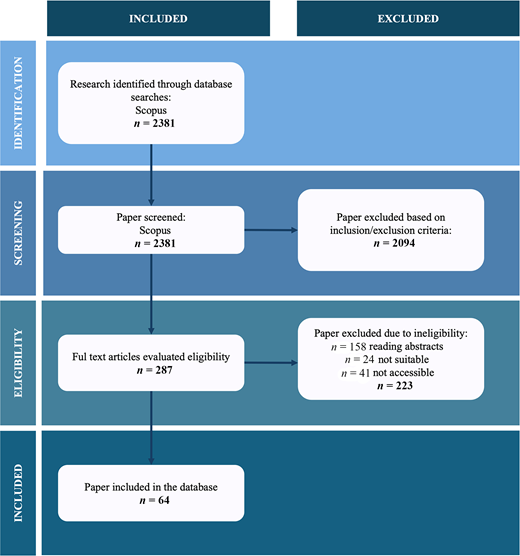
The screening and selection of articles followed the Preferred Reporting Items for Systematic Reviews and Meta-Analyses (PRISMA) framework, which provides a structured approach for identifying, screening and evaluating relevant literature in a transparent and replicable manner (Moher et al., 2009). As shown in Figure 1, the initial query returned a broad sample of documents.
By applying the inclusion criteria, resulting from the application of automatic database filters in Scopus, including language, document type, subject areas and the selected time window, the remaining sample was 287 articles. These documents were then screened based on title, abstract and keywords to verify their explicit relevance. During this phase, exclusion criteria were applied, and additional 223 articles were excluded due to a lack of explicit connection between technology and sustainability (n = 158), topic not relevant or off-sector (n = 24) and full text unavailable (n = 41). All steps related to the application of inclusion and exclusion criteria are summarised in Table A1 in Appendix, to enhance transparency of the selection process. Following this multi-stage process, 64 peer-reviewed articles met all inclusion criteria and were retained for full-text analysis (see Table A2 in Appendix).
3.3 Descriptive analysis
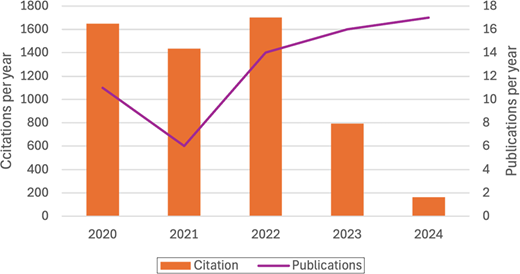
The descriptive analysis contextualises the reviewed body of literature by mapping its temporal, methodological and bibliometric characteristics. This phase provides a preliminary overview of the research landscape before engaging in in-depth qualitative synthesis. Firstly, a temporal analysis examined publication and citation trends between 2020 and 2024. As demonstrated in Figure 2, publication volumes increased steadily, while citations grew more moderately, indicating an emerging but rapidly developing field.
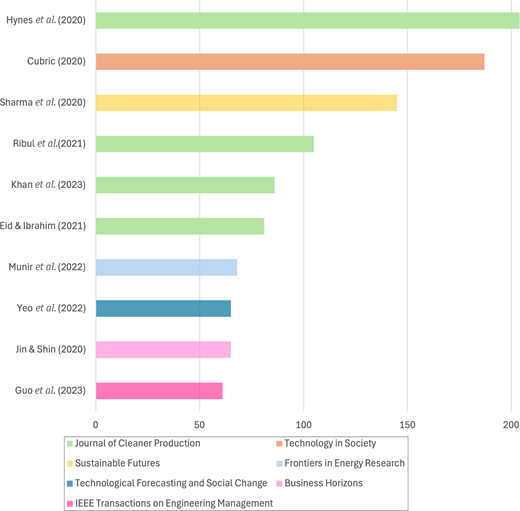
To explore the intellectual structure of the field, a citation analysis was conducted on the sample. Figure 3 visualises the most cited authors in the data set, with each colour indicating the journal of publication.
The results reveal a strong influence of articles published in the Journal of Cleaner Production, which accounts for most top-cited contributions (Eid and Ibrahim, 2021; Hynes et al., 2020; Ribul et al., 2021). This reflects the journal’s central role in advancing interdisciplinary research at the intersection of environmental sustainability, industrial innovation and manufacturing practices. The most cited article is by Hynes et al. (2020), addressing sustainable innovation systems in manufacturing, followed by Cubric (2020), who explores digital technology adoption for sustainability transitions. Other significant contributions include Sharma et al. (2020), focusing on strategic sustainability integration, and Ribul et al. (2021), who examine circular design and digital transparency in the textile sector.
3.4 Content analysis
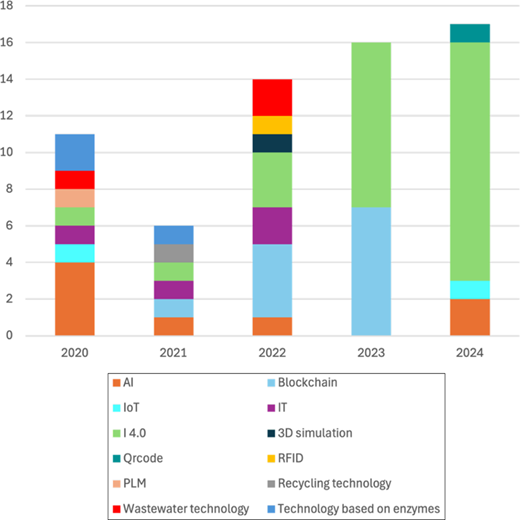
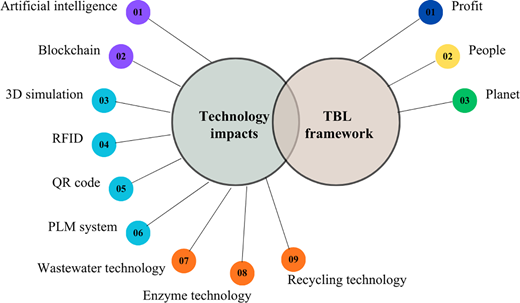
The content analysis reveals a wide range of technologies investigated in relation to sustainability outcomes in the T&A industry. Current literature concentrates on a wide range of technologies, as shown in Table 2 and exhibits a high degree of technological diversity, in Figure 4.
In the early phase (2020–2021), the research landscape was highly fragmented, reflecting an exploratory stage in which scholars tested a broad range of technological solutions with direct environmental implications. Most studies focused on wastewater systems (Abbas et al., 2020; Agarwal and Singh, 2022), enzyme-based and bio-technological processes (Eid and Ibrahim, 2021; Rahman et al., 2020a; Rahman et al., 2020b) and recycling innovations (Ribul et al., 2021). These works share a strong orientation towards measurable ecological outcomes, such as pollution reduction, water reuse and energy optimisation, mirroring the influence of the European Green Deal and the initial policy emphasis on cleaner production and resource efficiency. From 2022 onwards, the scientific focus progressively consolidated around digital and systemic approaches. This shift coincides with the expansion of Industry 4.0 architectures and information-technology infrastructures, which integrate multiple digital enablers into coherent platforms for traceability, monitoring and process optimisation (Ali et al., 2024; Hmamed et al., 2024; Khan et al., 2023; Wong and Ngai, 2023). Within these frameworks, AI and blockchain gained significant momentum. AI evolved from a supporting tool for demand forecasting and process optimisation to a transversal technology enabling resource efficiency and predictive management across the supply chain (Jin and Shin, 2020; Rafi-Ul-Shan et al., 2024; Singh, 2024). Conversely, blockchain emerged as a trust-enabling infrastructure that strengthens transparency, traceability and ethical sourcing within global value chains (Guo et al., 2023; Jain et al., 2022; Shou and Domenech, 2022), though studies continue to highlight barriers linked to cost, interoperability and data governance (Chen, 2023; Cuc, 2023; Siddik et al., 2023). Alongside these digital domains, technologies such as product lifecycle management (PLM) systems, 3D simulation tools, RFID and QR codes, maintained a stable presence in the literature. These solutions operate as operational enablers that connect sustainability objectives to everyday industrial practice, facilitating eco-design, inventory control and consumer transparency (Conlon, 2020; Kutschera and Crowell, 2024; Nayak et al., 2022).
This temporal analysis revealed a clear distinction between technologies that gained momentum more recently and technologies that maintained a stable presence throughout the entire timeframe. Accordingly, technologies were interpreted in terms of how they are framed in the literature, distinguishing between advanced and transformative (AI, blockchain), versus applied and consolidated technologies (3D simulation tools, PLM systems, RFID, QR codes, wastewater treatment, enzymes technology, recycling technology, information technologies and Industry 4.0 technologies). Within the consolidated technologies, the analysis further revealed a distinct and relatively homogeneous subset of technologies predominantly discussed in relation to chemical and recycling processes. This additional distinction led to the definition of the following three technology groups:
Advanced digital technologies (AI and blockchain) include data-driven and connective systems that enhance decision-making, traceability and automation across production and supply chain processes.
Applied technologies (3D simulation tools, PLM systems, RFID, QR codes, information technologies and Industry 4.0 technologies) encompass mature solutions already integrated into industrial operations to improve design efficiency, product traceability and consumer transparency.
Process-oriented technologies (wastewater treatment, enzyme technology and recycling technology) intervene directly on material and resource flows, targeting the environmental dimension of sustainability through pollution control, waste recovery and cleaner production.
To reduce subjectivity, category assignments were cross-checked by the authors and discussed until consensus was reached (Patton, 1999).
4. Results
4.1 Linking technologies to their sustainability impacts
The concept of sustainability has evolved to encompass the balance between economic, environmental and social dimensions. Within this perspective, the TBL framework (Elkington, 1997) has become a widely adopted analytical lens for evaluating organisational performance across the three pillars of sustainability. Economic sustainability typically refers to financial efficiency and cost optimisation (Cruz and Wakolbinger, 2008); environmental sustainability to waste minimisation, energy efficiency and emission reduction; and social sustainability to the broader impact of industrial transformation on workers and communities (Sartal et al., 2020). By integrating these three aspects, industries can pursue long-term sustainability, contributing positively to people and the planet. Accordingly, the authors associated the T&A technological impacts with the TBL framework (see Figure 5).
Importantly, information technologies and Industry 4.0 technologies were excluded from the impact comparison, as both terms represent integrated frameworks or bundles of enabling technologies.
The coding of sustainability impacts was executed by identifying explicit statements in the reviewed articles referring to environmental, social or economic outcomes associated with a given technology.
For instance, statements linking RFID adoption to improved inventory accuracy, real-time information availability and enhanced traceability were coded as positive economic and social impacts, while references to waste reduction and improved resource efficiency enabled by better stock coordination were coded as positive environmental impacts (Nayak et al., 2022). Similarly, AI-related concerns regarding job displacement, skills gaps and lack of trust were coded as negative social impacts (Cubric, 2020). In the case of process-oriented technologies, statements referring to reduced water consumption and chemical use in enzyme-based finishing processes were coded as positive environmental impacts (Eid and Ibrahim, 2021).
The process to validate results followed a triangulation process: two authors independently reviewed the full texts to identify statements on sustainability impacts, and the results were then jointly discussed with a third author to ensure methodological rigour, define the coding outcomes in terms of unified labels and minimise interpretative bias (Patton, 1999).
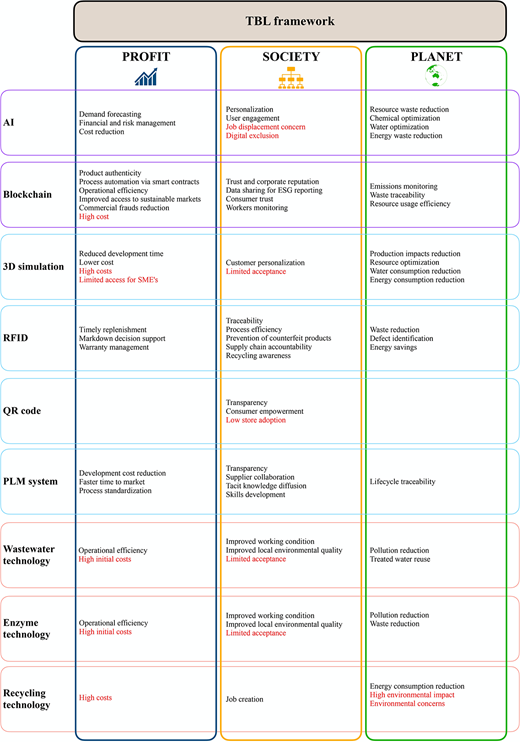
As shown in Figure 6, the structure clearly displays evidence linking each technology to its positive impacts, marked by black and negative impacts, marked by red, following the TBL framework.
4.1.1 Advanced digital technologies.
AI is one of the most heavily studied technologies, with applications across multiple stages of the textile value chain, from product design and manufacturing to retail and consumer engagement. The impacts differ greatly across the three sustainability dimensions. The economic effects of AI systems stem from their ability to process large amounts of data and predict demand trends accurately. This ability helps reduce overproduction, inventory costs and unsold stock. By optimising production planning and logistics, AI enhances operational efficiency and supports decision-making under uncertainty (Jin and Shin, 2020; Singh, 2024; Ujjawal et al., 2024). Such mechanisms translate into cost reduction and improved profitability along the supply chain. The social dimension remains the most ambivalent. On the one hand, AI fosters personalisation and user engagement, enhancing customer experience and promoting a shift towards demand-driven, customised production (Yeo et al., 2022). On the other hand, several studies warn about job displacement concerns and digital exclusion (Cubric, 2020; Sharma et al., 2020). For planet behaviour, AI effects derive from predictive and adaptive control systems capable of identifying inefficiencies and regulating the consumption of energy, water and chemical inputs during manufacturing (Rafi-Ul-Shan et al., 2024). Regarding blockchain, its adoption primarily responds to systemic challenges related to transparency, traceability, data reliability and inter-organisational trust in supply chains. From an economic perspective, the main impacts concern product authenticity, process automation via smart contracts and operational efficiency. Through the exclusion of intermediaries and the automation of verification processes, blockchain reduces transaction costs and administrative delays (Munir et al., 2022). Nevertheless, several barriers persist, including high implementation costs and interoperability issues, which limit large-scale adoption, especially among small and medium enterprises (SMEs) (Chen, 2023; Cuc, 2023). For society, as a distributed ledger, it enables secure, immutable and decentralised recording of transactions and product data, thereby addressing key risks such as counterfeiting, labour exploitation and greenwashing, especially relevant in the T&A industry (Chen, 2023; Jain et al., 2022; Shou and Domenech, 2022). Blockchain also allows for transparent auditing and the verification of ethical and safe working conditions along the supply chain (Chen, 2023), even if its effectiveness depends on data accuracy and governance mechanisms (Hauschild and Coll, 2023; Shah et al., 2023). For the planet, studies emphasise its role in circular economy fashion models by enabling transparent tracking of materials, facilitating recycling processes and improving compliance with environmental standards (Shou and Domenech, 2022). The integration of blockchain with lifecycle assessment frameworks allows more accurate and verifiable environmental reporting, improving accountability in carbon management and sustainable sourcing (Munir et al., 2022; Shou and Domenech, 2022).
4.1.2 Applied technologies.
Technologies that have already been applied to sustainable fashion are part of a broader transformation of the entire fashion ecosystem. These technologies intervene at strategic stages of the value chain, from product design and virtual prototyping to user experience and supply chain planning. In the realm of design and manufacturing, 3D simulation platforms have emerged as a decisive tool for professionals. CLO3D, a prominent example, facilitates the creation and testing of virtual garments and fabrics, thereby streamlining digital sampling and virtual production processes. This technological advancement significantly reduces the reliance on physical prototypes, paving the way for enhanced efficiency and precision in the design industry. This tool leads to reduced development time and lower production costs by accelerating design iterations and minimising material waste in the early phases of product development. However, the literature also reports high initial costs and limited accessibility for SMEs as major barriers to adoption (Choi, 2022). 3D simulation contributes to customer personalisation and enhances consumer experience by supporting virtual try-on applications and co-design interfaces. Nevertheless, limited social acceptance persists due to the gap between digital and physical product representation and the need for new digital design skills (Choi, 2022). On the environmental side, by replacing physical sampling with digital modelling, 3D simulation tools reduce waste, fabric consumption and the environmental footprint associated with prototyping and logistics.
Technologies such as RFID and QR codes have seen a marked increase in adoption within the T&A industry, as it seeks to address the persistent challenges posed by the opacity of fashion supply chains. RFID systems are predominantly applied in manufacturing and logistics, where they enable the continuous tracking of materials and products, improving inventory control, supporting timely replenishment and reducing markdowns and warranty-related costs (Nayak et al., 2022). These mechanisms enhance operational efficiency and lower the financial risks associated with overproduction or mismanagement of stock, thus reinforcing economic sustainability (Irfan et al., 2020). Moreover, RFID also facilitates recycling and circular strategies by enabling accurate identification of materials and garments at the end of their lifecycle, reducing waste and improving recovery efficiency. QR Codes, by contrast, are mostly used at the consumer interface, serving as a bridge between production transparency and market communication. They allow users to access digital content that conveys information on product composition, origin and sustainability certifications, fostering more responsible purchasing behaviour (Kutschera and Crowell, 2024). From a social standpoint, both technologies contribute to strengthening supply chain accountability and consumer empowerment. PLM systems now play a central role in aligning design, production and supply chain functions in the T&A industry (Conlon, 2020). Furthermore, they contribute to the reduction of development costs, accelerate time to market and standardise processes by integrating product data across all lifecycle stages, thereby enhancing quality and efficiency. Nonetheless, the full potential of PLM systems is constrained by factors including cultural resistance, inadequate training and an overly technical focus. From an ecological perspective, these systems facilitate lifecycle traceability, thereby promoting eco-design, material monitoring and closed-loop recycling (Conlon, 2020).
4.1.3 Processes-oriented technologies.
The last group of technologies includes process-oriented innovations that intervene directly in the material and operational stages of textile production. Wastewater treatment technologies address one of the textile sector’s most critical challenges, the intensive use and contamination of water. Advanced systems such as membrane bioreactor (MBR), electrochemical coagulation (EC) and mixed bed bio reactor (MBBR) enable pollution control and treated water reuse, significantly decreasing freshwater demand and effluent toxicity (Agarwal and Singh, 2022). Abbas et al. (2020) further demonstrate the environmental benefits of managing water, energy and materials as interconnected flows. Economically, these systems improve operational efficiency but remain limited by high capital costs and restricted accessibility for smaller firms (Zhou et al., 2022). Enzyme-based and biotechnological technologies represent a second and rapidly evolving field. By substituting chemical treatments in pre-treatment, dyeing and finishing with enzymatic or bio-based processes, these technologies reduce energy use, CO2 emissions and chemical waste, while enhancing worker safety and public health (Eid and Ibrahim, 2021; Rahman et al., 2020a). However, their adoption is still constrained by high initial investment and technical know-how requirements. Environmentally, enzyme-based methods align with the principles of green chemistry and circular production, offering cleaner and more regenerative processing options (Rahman et al., 2020b). Lastly, recycling technologies intervene at the end of the product lifecycle, supporting material recovery through mechanical, chemical and bio-based recycling processes and reducing dependence on virgin fibres (Ribul et al., 2021). Beyond their strong environmental contribution, they still face financial, technical and regulatory barriers that hinder full-scale implementation (Zhou et al., 2022).
4.2 Comparison and discussion
The comparative analysis of the technologies reveals an uneven distribution of sustainability impacts across the TBL dimensions. Findings show that the environmental dimension remains the most positively represented, as most studies emphasise measurable benefits such as waste reduction, energy optimisation and pollution control. Environmental sustainability clearly emerges as the most consistently addressed dimension. This pattern reflects the intrinsic environmental intensity of textile production, historically characterised by resource-intensive processes, chemical use and waste generation. Process-oriented technologies intervene directly in these material flows and therefore generate the most immediate and measurable ecological benefits. By contrast, applied and advanced digital technologies tend to produce indirect environmental gains, primarily through optimisation, coordination and reduction of inefficiencies. While their ecological contribution is significant, it is mediated by organisational integration and data quality rather than by direct material transformation. A key trade-off emerges across the comparison: environmental gains tend to increase with technological complexity, while traceability and controllability become more dependent on data quality, integration and organisational capabilities, raising governance complexity.
The economic and social pillars present a more ambivalent picture. From an economic perspective, the implementation of applied technologies confers several immediate operational advantages, including the reduction of development time, the enhancement of inventory management and the acceleration of time-to-market. These benefits are especially pertinent within an industry marked by brief lifecycles and volatile demand. The implementation of advanced digital technologies holds the potential for a comprehensive transformation through automation and data-driven integration. However, the distribution of these benefits is found to be inequitable due to the high costs associated with implementation, interoperability issues and infrastructure requirements. These factors impose constraints on SMEs to a greater extent than on other entities, resulting in an imbalanced distribution of opportunities and resources. Process-oriented technologies, although environmentally effective, are often capital-intensive and technically demanding, limiting economic accessibility and potentially reinforcing asymmetries across global textile value chains. Consequently, a structural economic tension exists: technologies that promise higher sustainability gains often require greater upfront investment and organisational capacity. This potential reinforces existing inequalities within global textile value chains.
Lastly, social sustainability remains the least resolved dimension. Advanced digital technologies exhibit the strongest tensions, as automation and data analytics raise concerns about job displacement, skills obsolescence and digital exclusion in labour-intensive contexts. Applied technologies may support accountability through transparency and traceability, but improvements in labour conditions depend on governance arrangements and the ability to translate information into action (worker safety, wages, working hours). Process-oriented technologies can indirectly enhance occupational health and safety by reducing exposure to hazardous chemicals and unsafe working environments, yet these outcomes are rarely foregrounded. This comparative reading reveals a critical gap: social sustainability remains the least integrated and most fragile dimension of technological innovation in the T&A industry, despite the sector’s high labour intensity and well-documented social risks.
5. Conclusion
The study conducted a systematic literature review of 64 peer-reviewed documents, following the PRISMA framework and combining descriptive and content analyses to map the field’s intellectual structure and synthesise empirical evidence. The descriptive analysis revealed a rapidly expanding yet fragmented research landscape, while the content analysis identified eight core technologies grouped into three categories:
advanced digital technologies;
applied technologies; and
process-oriented technologies.
The final synthesis compared the positive and negative impacts of each technology through the TBL framework, resulting in a comparative overview of sustainability impacts.
The findings show that the environmental dimension dominates the literature, with technologies mainly investigated for their positive contributions to waste reduction, energy optimisation and pollution control. Conversely, the economic and social pillars reveal more ambivalent and sometimes conflicting effects, reflecting the trade-offs associated with implementation costs, organisational readiness, workforce transformation and digital inclusion. AI emerges as the most controversial technology, while blockchain displays the most convergent profile across the TBL dimensions. 3D simulation tools stand out for their divergent impacts; by contrast, RFID and PLM systems appear more mature and promising, offering tangible benefits for process efficiency, traceability and lifecycle management, with relatively contained social and economic drawbacks. Lastly, both wastewater treatment and enzyme-based solutions exhibit a similar pattern: they deliver clear environmental benefits while raising social and economic trade-offs. Recycling technologies, paradoxically, pose additional concerns, not only in terms of economic feasibility and implementation barriers, but also regarding their own environmental footprint, as the processes involved can entail significant energy consumption and residual waste generation.
The comparative analysis indicates that no single technology group delivers balanced sustainability outcomes across environmental, economic and social dimensions. Instead, each group exhibits distinct strengths and structural trade-offs. Advanced digital technologies offer systemic transformation potential but introduce profound social and governance challenges. These tensions suggest that sustainability in the T&A industry cannot be achieved through isolated technological solutions. Applied technologies support incremental, operational sustainability, but are limited by adoption barriers and uneven organisational readiness. Process-oriented technologies excel in environmental performance but face economic and scalability constraints. Instead, sustainability in the T&A industry requires a coordinated and context-sensitive combination of technologies supported by complementary policies, workforce training and governance mechanisms that explicitly address labour conditions, worker safety and social equity. Without such integration, technological innovation risks prioritising environmental and economic efficiency at the expense of social sustainability, particularly in labour-intensive segments of global textile value chains.
Despite its contributions, the study has some limitations. The reliance on a single bibliographic database, Scopus, may have led to the exclusion of some relevant works indexed elsewhere. Furthermore, the focus on the 2020–2024 time window, chosen to capture the most recent phase of digital acceleration and regulatory transition in the T&A industry, restricts longitudinal comparison with earlier technological developments. Moreover, the search strategy and the other selection criteria may have excluded relevant works, and the relatively limited sample size may affect the generalisability of the findings. Lastly, we acknowledge that the qualitative synthesis introduces potential subjectivity.
5.1 Future research directions
Building on the findings, several promising directions for future research can be identified within the T&A industry literature. A first direction concerns the empirical validation of results through interviews with practitioners and stakeholders across the textile value chain.
Secondly, future studies should examine how AI adoption influences employment structures, skill dynamics and inclusivity in T&A manufacturing and retail environments. Further research should also investigate governance mechanisms, interoperability challenges and cost structures that condition blockchain adoption. Moreover, despite their environmental rationale, recycling solutions in the T&A industry raise unresolved questions concerning their real ecological footprint, scalability and energy demand. Lastly, more focused research is needed to assess the social implications of specific technologies, given that this dimension is still largely overlooked in the existing literature.
5.2 Implications of the study
From a theoretical perspective, the study advances existing research by moving beyond technology-specific analyses and providing an integrative synthesis that highlights asymmetric sustainability profiles, recurring trade-offs and tensions across environmental, social and economic dimensions. It draws attention to the persistent underrepresentation of social sustainability outcomes and to the uneven consideration of economic feasibility and adoption constraints in current research. These insights open relevant avenues for future studies aimed at developing more balanced and context-sensitive analyses of technology-enabled sustainability.
From a managerial perspective, the findings offer practitioners a structured reference to support technology-related decision-making in sustainability transitions. The study helps managers align technology choices with specific sustainability priorities, such as pollution reduction, efficiency improvement, traceability or labour risk mitigation, by clarifying how different technology groups are associated with distinct sustainability outcomes and implementation challenges. The findings also enable practitioners to anticipate trade-offs prior to adoption. Advanced digital technologies promise transformative potential but require significant financial, technical and organisational capabilities. For instance, the implementation of AI in the T&A industry necessitates robust data infrastructures and the capacity for cross-functional integration, rendering it particularly well-suited for medium-to-large textile firms with vertically integrated operations. This is due to the necessity of coordinating activities across the spinning, weaving and finishing stages. Blockchain solutions have been shown to enhance the traceability of raw materials and chemical inputs. These solutions are particularly advantageous for export-oriented firms that operate within globally regulated supply chains. Applied technologies, instead, provide more accessible and incremental benefits. 3D simulation tools and PLM systems offer more immediate operational improvements in design, sampling and product development stages, where reducing physical prototypes and coordinating collections can generate measurable cost and material savings. These technologies may therefore represent a more accessible entry point for SME textile manufacturers. Lastly, process-oriented technologies offer strong environmental gains but often require high investment. Wastewater treatment systems and enzyme-based finishing processes deliver direct environmental benefits in water-intensive and chemically intensive production phases, particularly dyeing and finishing. However, their capital-intensive nature and technical complexity may constrain adoption among smaller upstream textile producers unless supported by financial incentives or regulatory pressure. Lastly, the evidence suggests that technological innovation alone is insufficient to guarantee social sustainability within the T&A industry. Efficiency gains may coexist with risks related to job displacement, skills gaps and power imbalances, requiring managers to complement technological investments with training initiatives, governance mechanisms and stakeholder engagement to improve working conditions and worker safety.