This paper conceptualizes the persistent deficiencies of business law education in MBA, undergraduate business, and management programs as a responsible management education (RME) problem. It develops a framework for aligning business law instruction with the Principles for Responsible Management Education (PRME).
The paper synthesizes scholarship on business law pedagogy, RME and PRME, the hidden curriculum, and integrative ethics-responsibility-sustainability (ERS) competence. From this literature, the paper identifies four theoretical traditions: experiential learning theory, situated cognition, the manager-as-legal-strategist paradigm, and responsible management competence and practical wisdom. These traditions are then combined into a framework in which each tradition addresses limitations of the others.
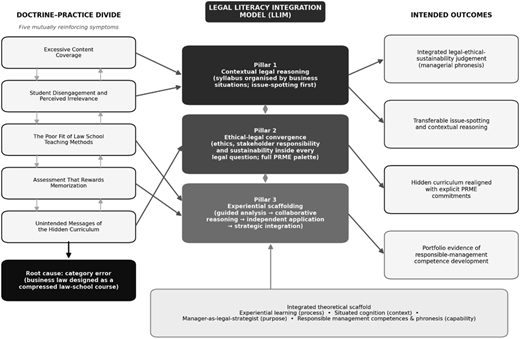
The doctrine-practice divide is better understood as a category error than as a resource problem. Business law courses are often designed as compressed law-school courses rather than as applied reasoning courses for future managers. This design produces a hidden curriculum that conflicts with the explicit PRME commitments of many business schools. The paper further argues that five recurring symptoms – excessive content coverage, student disengagement and perceived irrelevance, poor fit between law-school methods and business classrooms, memorization-oriented assessment, and hidden-curriculum effects – operate as a mutually reinforcing system. The Legal Literacy Integration Model (LLIM) is proposed as a three-pillar framework organized around contextual legal reasoning, ethical-legal convergence, and experiential scaffolding. A venture-launch module illustrates the model, and the paper specifies boundary conditions, including contexts in which sustained doctrinal grounding remains appropriate.
As a conceptual contribution, LLIM is an analytical framework rather than an empirical claim. Its propositions require comparative learning-outcome studies, longitudinal tracking of graduates, and cross-cultural research on implementation, especially in Global South contexts.
LLIM offers curriculum designers, faculty developers, and accreditation bodies a coherent design logic for embedding ethics, stakeholder responsibility, and sustainability into business law without adding courses or hours. It also identifies the hidden curriculum risks that conventional doctrinal teaching poses to RME goals.
Embedding PRME-aligned legal literacy in management education contributes to the United Nations Sustainable Development Goals (SDGs) by preparing graduates who can address the legal, ethical, and sustainability dimensions of managerial decisions and protect the public affected by organizational conduct.
The paper positions recurring deficiencies in business law education as deficiencies in responsible management education and integrates legal pedagogy, hidden-curriculum analysis, and ERS competence development into a single course-design framework. Its contribution lies in diagnosing the interaction among these problems and linking their remediation to PRME commitments. The paper also proposes a research agenda at the intersection of legal literacy, PRME, and managerial practical wisdom.
Introduction
Many MBA students and undergraduate business students complete required business law courses without acquiring legal knowledge that they can apply in managerial practice. The problem is not the marginality of business law. Scholars have repeatedly argued that legal knowledge is essential for effective management (Siedel, 2000; Babu, 2016; O'Brien et al., 2018; Lowenstein, 2013; Yeargain and Tanner, 1990). The problem lies in the dominant instructional design: business law is commonly taught in a form that fits neither legal education nor business education, leaving the course suspended between two disciplinary logics.
The literature identifies a consistent set of concerns (Lim et al., 2026). Instructors face difficult trade-offs between breadth and depth within the single course most programs allocate to the subject (Kuzenski, 2023; Lampe, 2006; Butler and Madhloom, 2016). Students perceive the material as intimidating, unfamiliar, and disconnected from their career aspirations (Hemarathne, 2025; Khan, 2021). Traditional lecture-based pedagogy, adopted directly from law school models, underperforms when transplanted into business classrooms composed of students who do not intend to become lawyers (Douglas, 2012; Cameron and Dickfos, 2015). Assessment methods default to examinations that measure memorization of rules rather than the capacity to recognize and reason through legal issues in managerial contexts (Loafman, 2023). Efforts to incorporate ethics and interdisciplinary perspectives, although widely endorsed in principle, remain inconsistent and superficial in execution (Babu, 2016; Bagley et al., 2019; Cavico and Mujtaba, 2018).
Taken separately, these concerns can appear to be discrete instructional problems. The literature has often treated them in that way, examining one intervention, classroom, or course design at a time. Taken together, they indicate a more fundamental failure of course purpose and structure. Business law is one of the few areas of the business curriculum in which students engage directly with the relationship among organizations, legal rules, and public obligations. Weakness in this course therefore affects more than course-level learning outcomes; it also weakens the institution's claim about the kind of graduate it prepares.
Two scope clarifications are necessary at the outset. First, this paper engages PRME in its broad sense: the full set of principles to which signatory schools commit, revised in 2023 from six to seven: Purpose, Values, Teach, Research, Partner, Practice, and Share. It does not limit PRME to a single strand of the initiative, such as the Impactful Five (i5) pedagogical framework (Sen, 2025; Ibrahim and Storey, 2025). Where the paper draws on pedagogy developed under the i5 banner, particularly its emphasis on meaningful, actively engaging, and socially interactive learning, it treats that work as one resource among several rather than as the organizing frame (Ibrahim and Storey, 2025). Second, although the empirical literature reviewed below concentrates on MBA and undergraduate business law teaching, the argument is not degree-specific; the framework is intended for business and management programs generally, a point developed in the conclusion.
The guiding research question is as follows: how can business law education in business and management programs be redesigned to address the doctrine-practice divide while giving operational substance to the PRME commitments formally adopted by many accredited business schools?
The paper addresses this question by proposing the Legal Literacy Integration Model (LLIM), a conceptual framework that defines business law education around the legal reasoning required of responsible managers. LLIM rests on three mutually reinforcing pillars: contextual legal reasoning, ethical-legal convergence, and experiential scaffolding. The second pillar carries PRME's central commitments by treating ethics, stakeholder responsibility, and sustainability as integral to legal analysis rather than as supplemental topics. Together, the pillars conceptualize the business law course as a form of applied reasoning education aligned with the broader RME mission of business schools.
The doctrine–practice divide as the central problem
Although the literature on business law education identifies multiple challenges, most can be traced to a single structural tension: doctrinal coverage competes with practical application for limited instructional time. This section argues that the tension is conceptual as well as allocative, because it reflects assumptions about the purpose of business law courses. The same tension also produces a hidden curriculum that conflicts with RME commitments. The section concludes by showing that the problems identified in the literature interact as a self-reinforcing system, which helps explain their resistance to incremental reform (Lim et al., 2026).
Excessive content coverage
Kuzenski (2023), in an exploratory study of undergraduate business law textbooks, found that the volume of material instructors feel obligated to cover is a primary source of pedagogical difficulty. When a single three-credit course must span contracts, torts, agency, employment law, intellectual property, business organizations, and regulatory compliance, instructors commonly move through topics at a pace that prevents deep understanding. Lampe (2006) made the same observation earlier, calling for a new paradigm that would prioritize fewer topics treated in greater depth. Butler and Madhloom (2016) confirmed the pattern in the UK context, noting that business students were overwhelmed not only by the difficulty of legal concepts but also by the volume and pace of instruction. A consistent casualty of this coverage pressure is the time available for ethics, stakeholder analysis, and sustainability, which are typically the first elements removed when doctrinal material exceeds the available time (Saunders et al., 2022; Cavico and Mujtaba, 2018).
Student disengagement and perceived irrelevance
Business students' perception of law courses as difficult, dry, and irrelevant has been documented across national contexts (Khan, 2021; Hemarathne, 2025; Douglas, 2012). Khan (2021), in a study of business students' perspectives on legal education in Pakistan, found that students viewed law courses as disconnected from the managerial skills developed elsewhere in the curriculum. Hemarathne (2025), in a study of Sri Lankan management undergraduates, reported similar findings: students struggled with legal terminology and did not perceive a clear relationship between legal content and their professional futures.
These findings should not be interpreted as evidence of weak student motivation. They are more plausibly interpreted as responses to a course design that asks business students to learn law in a manner modeled on legal education, despite the absence of the professional context that makes such learning meaningful for law students (Douglas, 2012; Reems, 2021). When legal doctrine is taught as free-standing content, separated from the business decisions in which it becomes operative, students have reason to perceive a disconnection. Decontextualized knowledge is difficult for learners to connect to professional identity and to retrieve in later practice (Brown et al., 1989; Lave and Wenger, 1991; Hajian, 2019). From an RME perspective, the cost is greater: students who disengage from business law may also disengage from one of the curriculum's most direct sites for examining the legal foundations of stakeholder, environmental, and human rights obligations (Høgdal et al., 2019; Olanya et al., 2023).
The poor fit of laws school teaching methods
The dominant pedagogical approach in business law courses remains the lecture, supplemented by textbook readings and examinations (Douglas, 2012; Cameron and Dickfos, 2015). The approach can function effectively in law schools, where students are self-selected for interest in legal reasoning, the case method provides a form of active engagement, and multiple semesters allow ideas to mature. In business programs, this transplanted approach performs less well. Douglas (2012) demonstrated that problem-based learning significantly outperformed lectures in engaging business students with legal material. McDonald et al. (2022) showed that active learning strategies built around realistic business scenarios improved both engagement and the development of critical workforce skills. Reems (2021) argued for humanizing the teaching of business law through pedagogies that center student experience rather than doctrinal coverage.
The evidence favors pedagogies organized around problem-solving and authentic scenarios. Adoption nevertheless remains uneven. Zhao (2024), for example, documented institutional silos and insufficient faculty development as barriers in the Chinese university context. The more basic question is why the lecture-centered default remains so durable. This paper argues that the underlying conception of the course has remained largely unchanged. Instructors may experiment with delivery methods, but if the course is still conceived as legal doctrine to be covered, the coverage imperative reasserts itself and displaces the pedagogies most strongly supported by research (Kuzenski, 2023; Lampe, 2006), including those aligned with experiential RME (Baden and Parkes, 2013; Salinas-Navarro et al., 2022; Martins et al., 2023; Ibrahim and Storey, 2025).
Assessment that rewards memorization
Loafman (2023) provided a pointed critique of the dominance of traditional examinations in business law assessment, arguing that such instruments privilege memorization and recall over the applied reasoning skills that constitute the actual learning objective. Putman (2025) demonstrated that business simulations could serve as both a learning activity and an assessment mechanism, capturing students' ability to navigate legal issues in the flow of business decision-making. McDonald et al. (2022) and Reems (2021) similarly advocated for assessment methods, including case studies, role-playing exercises, and reflective writing, that capture a richer picture of student learning.
Examination-centered assessment persists because it is aligned with doctrine-centered instruction. Constructive alignment theory predicts that assessment will gravitate toward the knowledge and skills made visible by the course design (Biggs, 1996). If a course is organized around doctrinal topics, assessment will tend to measure doctrinal knowledge. Changing assessment without changing the underlying conception of the course creates misalignment between instruction and evaluation (Biggs, 1996; Loafman, 2023). The assessment problem is therefore downstream of the same conceptual problem that produces disengagement and pedagogical mismatch.
Unintended messages of the hidden curriculum
Read alongside the RME literature, the preceding symptoms indicate more than a pedagogical inconvenience. Blasco (2012), Høgdal et al. (2019), and Smith et al. (2023) show that the implicit messages students absorb about institutional values, often described as the hidden curriculum, can conflict with the formal curriculum's explicit commitments to ethics and sustainability. When business law is delivered as a rapid survey of statutory rules, with ethics relegated to a closing module and sustainability mentioned only briefly, the implicit message is clear: legal compliance is a technical specialty, separate from the moral substance of management, and properly handled by lawyers rather than managers. Fougère and Solitander (2023) show that RME content can be absorbed into a neoliberal frame that individualizes responsibility while leaving institutional patterns intact. Olanya et al. (2023) document a related pattern in students' lived experience: the gap between responsible-leadership rhetoric and classroom signals can undermine students' confidence in management education.
A discrete unit on business ethics cannot resolve the hidden-curriculum problem. The hidden curriculum is produced by course structure, allocation of time and attention, assessment practices, and the framing of legal questions. A business law course that treats every problem as a doctrinal puzzle signals that managers have limited responsibility for integrated legal, ethical, and sustainability judgment. That signal conflicts with the message PRME signatory schools claim to send (Sen, 2025).
Interactions of the symptoms
The five symptoms described above are frequently studied in isolation and addressed through discrete interventions. This fragmentation helps explain their persistence. The symptoms are interdependent. Excessive content coverage encourages lecture-based delivery because lecture is the fastest method for moving through an expansive syllabus (Kuzenski, 2023; Lampe, 2006). Lecture delivery makes examinations the default assessment instrument because assessment tends to follow what instruction makes visible (Biggs, 1996; Loafman, 2023). Examination-driven memorization removes managerial context from the material, producing the disengagement and perceived irrelevance documented by Khan (2021) and Hemarathne (2025). A course experienced as an unfamiliar technical requirement then transmits the hidden-curriculum message that legal and ethical judgment belongs primarily to specialists rather than managers (Blasco, 2012; Høgdal et al., 2019). The resulting disengagement can appear to justify tightly controlled doctrinal delivery, which reinforces excessive coverage and increases the perceived risk of pedagogical experimentation (Douglas, 2012; Zhao, 2024).
This systemic account helps explain why isolated remedies have produced uneven results. An applied assessment added to a doctrinal lecture course creates misalignment rather than coherence (Biggs, 1996). A problem-based module within a coverage-driven syllabus may be experienced as a departure from the central course content. An ethics week added to a rule-memorization course can reinforce the signal that ethics is detachable from legal reasoning (Blasco, 2012; Jonson et al., 2015). If the symptoms share a common root, course redesign must address that root rather than add further isolated techniques. The framework developed below is therefore presented as a design logic for course reconstruction.
Theoretical foundations
If the doctrine-practice divide reflects a conceptual error rather than a resource constraint, an alternative conception of business law education is required. This section draws on four theoretical traditions to establish the foundation for the Legal Literacy Integration Model. It then integrates those traditions into a single scaffold, attending to both their complementarities and their tensions.
Experiential learning theory
Kolb's (1984) experiential learning theory, which posits that learning is most effective when it cycles through concrete experience, reflective observation, abstract conceptualization, and active experimentation, provides a well-established basis for rethinking business law pedagogy. Douglas (2012) and McDonald et al. (2022) explicitly drew on experiential principles in designing their interventions, and a parallel stream within RME has shown that experiential and simulation-based methods improve applied skills, theoretical understanding, and engagement with sustainability content (Baden and Parkes, 2013; Leal-Rodríguez and Albort-Morant, 2019; Salinas-Navarro et al., 2022; Cathcart et al., 2010; Ibrahim and Storey, 2025). The implication for business law education extends beyond the addition of exercises to a lecture course. If learning begins with concrete experience, the organizing unit of a business law course should be a business situation, such as launching a product, hiring employees, or negotiating a deal, in which multiple legal issues arise simultaneously. It should not be an isolated legal topic such as contracts, torts, or agency. This structure reflects the way legal issues arise in managerial practice and should therefore inform their presentation in the curriculum. Experiential learning theory is also subject to criticism: it has been charged with underspecifying what the experience should be an experience of and with resting on a contested empirical base (Kayes, 2002). The framework developed below treats this critique as consequential rather than treating the theory as self-sufficient; as argued later, the responsible management competence literature supplies the content specification that experiential learning theory alone lacks.
Situated cognition
The theory of situated cognition (Lave and Wenger, 1991; Brown et al., 1989) holds that knowledge is inseparable from the context in which it is learned and applied. Knowledge acquired in abstract, decontextualized form transfers poorly to novel situations. The principle explains why business students who can recite the elements of a valid contract on an examination may fail to recognize a contractual issue when it arises in a case study or, more critically, in their professional lives. Khan (2021) and Hemarathne (2025) both reported exactly this pattern: students could reproduce legal rules but could not deploy them in unfamiliar contexts. This failure of transfer from decontextualized instruction is well documented across educational settings: knowledge encoded in abstract conditions does not reliably activate when the situational cues of professional practice differ from those of the examination room (Law, 1994, 1998; Hajian, 2019; Halpern and Hakel, 2003).
Situated cognition suggests that legal knowledge for managers must be learned in managerial contexts if it is to be retrievable and usable in those contexts. This does not require abandoning legal principles. It requires embedding them within the decision environments where they matter. The qualification is necessary because strong versions of situativity have themselves been challenged: Anderson et al. (1996) marshal evidence that abstract instruction can transfer well and that some competencies are learned more efficiently outside their context of use. The position taken here is deliberately moderate. The pedagogical implication is that abstraction should follow experience rather than precede it. Students should first encounter the legal problem as a business issue, reason through its dimensions, and only then receive the doctrinal framework that names and organizes what they have already begun to understand. This sequencing preserves the benefits of explicit principles while anchoring them in contextual encoding (Halpern and Hakel, 2003; Johnson et al., 2014).
The manager-as-legal-strategist paradigm
Siedel (2000, 2017) has been the most sustained advocate for repositioning business law as a strategic management competency rather than a technical subject. His six-forces model treats the legal environment as one of the competitive forces shaping business strategy, alongside the five forces in Porter's framework. Bagley et al. (2019) extended this logic, arguing for a systems-based approach that integrates law, strategy, and sustainability into a unified framework for developing business school graduates who can think across disciplinary boundaries.
The manager-as-legal-strategist paradigm defines the learning objective. The aim is to develop managers who can use legal reasoning in decision-making, risk management, and value creation. This reframing has implications for course design, pedagogy, and assessment. It is also consistent with the RME premise that responsible managers must understand legal context as part of their stakeholder and sustainability responsibilities (Bagley et al., 2019; Siedel, 2017; Enarsson et al., 2021).
Responsible management competence and practical wisdom
Experiential learning theory addresses instructional process. Situated cognition explains the significance of context. The manager-as-legal-strategist paradigm identifies the purpose of business law in management education. A fourth tradition, the literature on responsible management competence and practical wisdom (RMC-PW), specifies the capabilities required of responsible managers and is central to the RME framing advanced in this paper.
Laasch et al. (2022), in an integrative review of three decades of RME scholarship, propose an interdisciplinary responsible management competence framework that draws together personal (being and becoming), behavioral (acting and interacting), and intellectual (knowing and thinking) dimensions of ethics, responsibility, and sustainability (ERS) competence. The three dimensions are interdependent: a manager who knows the rules but lacks the disposition to apply them, or who has the right values but cannot read the context, will not behave responsibly under pressure. Audebrand and Pepin (2022) reach a complementary conclusion in their axiological analysis of PRME: because PRME's principles, six at the time of their analysis and seven since the 2023 revision (Sen, 2025), are stated abstractly, they only become operational when courses are organized around concrete values such as justice, sustainability, and stakeholder responsibility. Saunders et al. (2022) provide empirical evidence that students' own values and ethical ideologies shape how seriously they engage with social-responsibility content, which means that pedagogy must work on disposition as well as on knowledge.
The character and virtue tradition adds a further layer. Nguyen and Crossan (2021) argue that ethical decision-making in management requires not only rule-knowledge but a character infrastructure capable of recognizing and acting on what the situation demands. Kristjánsson (2021) develops the Aristotelian concept of phronesis, practical wisdom, as the capacity to deliberate well about what to do in particular cases. Small and Lew (2019) connect mindfulness to moral responsibility and, through it, to moral intent in decision-making. Jurkiewicz (2014) reinforces this point from the pedagogy side, arguing that ethical competence cannot be transmitted through instruction alone but must be developed through pedagogical encounters that confront learners with morally complex situations demanding real judgment. Across these accounts, responsible managerial judgment appears as a blend of contextual perception, ethical reasoning, and acquired disposition. Legal competence, narrowly construed as familiarity with rules, is necessary but plainly insufficient.
The implication for business law education is direct. An RME-aligned course cannot stop at teaching legal rules. It must develop students' capacity to recognize legal, ethical, and sustainability dimensions in managerial situations, reason across those dimensions, and make defensible judgments under uncertainty.
Toward an integrated theoretical framework
The four traditions perform distinct functions in the argument. Experiential learning theory explains instructional process: students learn through cycles of experience and reflection, although critics argue that the theory does not specify clearly enough what the experience should contain and rests on disputed evidence (Kayes, 2002). Situated cognition explains instructional placement: knowledge is more likely to transfer when it is learned in contexts resembling later use, although strong versions of the theory understate the value of explicit abstraction (Anderson et al., 1996). The manager-as-legal-strategist paradigm explains course purpose: managers require legal reasoning as part of strategic decision-making, although that literature gives less attention to moral formation or pedagogy (Siedel, 2017; Bagley et al., 2019). The RMC-PW literature identifies the target capability: judgment that integrates ethics, responsibility, and sustainability, although it rarely specifies how a law course should teach that capability (Laasch et al., 2022; Kristjánsson, 2021).
The model depends on the reciprocal correction among these traditions. It retains doctrinal abstraction but changes its sequence: students first encounter the problem in context and then use doctrine to identify and organize what they have observed (Halpern and Hakel, 2003; Johnson et al., 2014). It also gives experiential learning a specific content focus. The relevant experience is a situation in which legal, ethical, and sustainability considerations interact and require judgment (Laasch et al., 2022; Jurkiewicz, 2014). The strategist literature supplies the managerial purpose, while RME supplies the value commitments that the strategist literature often leaves implicit. These connections produce the three pillars developed below: contextual legal reasoning, ethical-legal convergence, and experiential scaffolding.
The legal literacy integration model (LLIM)
Drawing on these theoretical foundations, this paper proposes the Legal Literacy Integration Model as a framework for reconceiving business law education in business and management programs. LLIM is organized around three interconnected pillars, each of which addresses a dimension of the doctrine-practice divide and operationalizes PRME values within the constraints of a single course. The pillars are simultaneous design principles rather than sequential stages. They should inform syllabus structure, class sessions, learning activities, and assessment.
The model corresponds to the five symptoms identified above. Contextual legal reasoning addresses excessive coverage and perceived irrelevance by making the business decision, rather than the doctrinal category, the primary unit of course design. Ethical-legal convergence addresses the hidden curriculum by making ethics, stakeholder responsibility, and sustainability recurring components of each scenario. Experiential scaffolding addresses pedagogy and assessment by replacing the lecture-and-examination pairing with staged activities that teach and evaluate applied reasoning. Because the symptoms interact, the pillars must also operate together. Figure 1 summarizes the model, its diagnostic starting point, theoretical basis, and intended outcomes.
Pillar 1: contextual legal reasoning
The first pillar replaces doctrinal coverage as the organizing principle of the course with contextual legal reasoning: the capacity to identify, analyze, and respond to legal issues as they arise in business decision-making. Under this pillar, the syllabus is organized by business contexts rather than legal topics. Instead of a week on contracts followed by a week on torts, for example, the course might begin with a unit on launching a venture, which would surface questions of entity formation, supplier contracts, intellectual property protection, and regulatory compliance within one integrated scenario. This design limits excessive coverage by introducing doctrine in the context of decision-making. It also addresses perceived irrelevance because students encounter law in situations resembling the professional problems they expect to face.
The reorganization does not mean that less law is taught. It means that the law is encountered in the way managers actually encounter it: embedded in situations, intertwined with other considerations, and requiring judgment about which legal dimensions are most salient. Lampe (2006) called for exactly this kind of paradigm shift, though the field has been slow to implement it. Butler and Madhloom (2016) offered a partial model with their framework for teaching company law through structured business scenarios rather than isolated doctrinal lectures. LLIM generalizes the approach across the full scope of the business law curriculum.
A central feature of contextual legal reasoning is the treatment of issue-spotting, the capacity to recognize when a business situation has legal dimensions, as a primary skill rather than as a byproduct of doctrinal knowledge. Siedel (2017) argued that issue-spotting is the most valuable legal competency for business leaders and is more consequential than the ability to recite rules. Bazerman (2014) reaches a related conclusion in the managerial cognition literature: the capacity to notice legally or ethically relevant features of a situation before they become crises is among the most consequential skills a leader can develop. Reardon and Gauss (2018) show that structured scenario exercises, in which students identify legal issues embedded in realistic business situations before doctrinal instruction, can develop this noticing capacity in legal environment courses. Under LLIM, each class session begins with a realistic business scenario, and students first identify the legal issues it presents. Doctrinal instruction then follows as the tool for addressing issues already recognized by students.
Pillar 2: ethical-legal convergence
The second pillar addresses ethics integration by rejecting the treatment of ethics as a separate module or addendum. In LLIM, ethical reasoning and legal reasoning are treated as convergent modes of analysis. Legal issues commonly have ethical dimensions, and ethical dilemmas often have legal consequences. Cavico and Mujtaba (2018) criticized the separation of law and ethics in business school education, arguing that it weakens both domains. Pazey and Cole (2015), in a different professional education context, found that embedding an explicit ethical framework directly into a law course for future leaders produced measurable gains in students' capacity to address situations in which legal rules and ethical obligations diverged. In an LLIM-designed course, each scenario requires ethical and sustainability analysis, so those concerns are not added after legal analysis is complete.
The ethics carried by this pillar is broad. It includes deontological and consequentialist reasoning, stakeholder responsibility, environmental and social sustainability, and the practical wisdom needed to weigh them in concrete cases (Audebrand and Pepin, 2022; Laasch et al., 2022; Bagley et al., 2019; Nguyen and Crossan, 2021). Babu (2016) observed that the intersection of law and business raises distinctive ethical questions that neither discipline addresses well in isolation. Bagley et al. (2019) went further, arguing that integrating law, strategy, and sustainability requires a systems-based approach that crosses traditional disciplinary boundaries. LLIM turns that claim into a course-design rule: each major scenario should contain legal, ethical, and sustainability tensions, and students should be expected to analyze them together.
This claim differs from the dominant organization of business school curricula, where ethics is commonly taught as a stand-alone course or dispersed across courses through learning objectives that may lack deep integration (Jonson et al., 2015; Setó-Pamies and Papaoikonomou, 2016; Doh and Tashman, 2014; Painter-Morland et al., 2016). The comparative evidence on stand-alone and integrated ethics teaching is mixed rather than uniformly favorable to integration; Jonson et al. (2015) found broadly similar outcomes on some measures. The argument advanced here is therefore narrower: business law is a particularly suitable site for ethical-legal-sustainability convergence because its subject matter regularly produces situations in which legal compliance and ethical responsibility diverge. These include cases that are lawful but ethically problematic, unlawful but arguably justifiable, or technically compliant yet environmentally or socially unsustainable. Such tensions are central to managerial judgment and to the development of phronesis (Kristjánsson, 2021; Small and Lew, 2019). The second pillar therefore aligns the explicit curriculum with PRME commitments and addresses the hidden-curriculum gap documented in RME scholarship (Høgdal et al., 2019; Smith et al., 2023).
Pillar 3: experiential scaffolding
The third pillar addresses pedagogy and assessment through experiential scaffolding: a structured progression from guided to autonomous application of legal reasoning in increasingly complex business contexts. It treats the poor fit of law-school teaching methods and memorization-focused assessment as linked forms of instructional misalignment. Drawing on Vygotsky's (1978) zone of proximal development and its application in professional education, LLIM proposes that students move through four stages of scaffolded experience. This concrete-before-abstract sequence is consistent with instructional design research showing that learners who encounter situated examples before formal principles develop more flexible and transferable understanding than learners who receive principles first (Johnson et al., 2014).
In the first stage (guided analysis), students work through pre-structured scenarios with explicit prompts that direct attention to legal, ethical, and sustainability dimensions. In the second stage (collaborative reasoning), students work in teams on more open-ended scenarios without explicit prompts, practicing issue-spotting and integrated reasoning with peer support. In the third stage (independent application), students tackle novel scenarios individually, demonstrating their ability to transfer integrated reasoning to unfamiliar contexts. In the fourth stage (strategic integration), students engage in complex simulations, akin to the business simulation model Putman (2025) described, where legal-ethical-sustainability reasoning must be integrated with financial, strategic, and operational decision-making in real time. The progression mirrors the structure of practice-based legal education that Li et al. (2025) describe as transformative for students' professional identity and civic responsibility, and it parallels experiential approaches to sustainability in supply-chain education (Salinas-Navarro et al., 2022).
This progression functions as both pedagogical architecture and assessment framework. Each stage produces assessable artifacts, including analyses, recommendations, simulation decisions, and reflective journals. These artifacts can be evaluated for legal reasoning, ethical sensitivity, sustainability awareness, and practical judgment. The structure responds to Loafman's (2023) call for inclusive assessment alternatives and to McDonald et al.'s (2022) argument for active learning assessments. The scaffolding also prepares students for later simulations by developing the competencies those simulations assess.
A worked example: the venture-launch module
A four-week venture-launch unit illustrates the model. The module is positioned at the beginning of a thirteen-week course and follows two recent graduates preparing to launch a plant-based food venture with a proprietary recipe, an emerging supplier relationship, and a planned marketing campaign.
In week one, students receive the founders' situation as a two-page memorandum and, before the introduction of formal doctrine, identify potential legal risks and the founders' obligations to affected parties beyond minimum legal compliance. Guided prompts (Stage 1: guided analysis) direct attention to entity choice, the absence of a founders' agreement, protection of the recipe and brand, food-labeling regulation, and the supplier relationship. Doctrinal instruction then follows the issue list generated by the class. In week two, contract and agency doctrine are taught through the supplier negotiation: teams redraft key clauses and confront the module's sustainability tension, namely that the lowest-cost supplier has opaque labor practices in its upstream chain. This design incorporates supply-chain due diligence and stakeholder analysis into material that would conventionally be taught as contracts doctrine (Stage 2: collaborative reasoning). In week three, intellectual property and consumer-protection regulation are introduced through the marketing plan, which is designed to be lawful yet arguably misleading. This exercise illustrates Pillar 2 by requiring students to analyze a situation in which the legal and ethical answers diverge. In week four, each student writes an advisory memorandum to the founders that integrates the legal, ethical, and sustainability dimensions into a single recommendation, accompanied by a short reflective note on how the student's analysis changed across the module (Stage 3: independent application). The memorandum is assessed with a rubric covering issue recognition, doctrinal accuracy, stakeholder breadth, quality of ethical reasoning, sustainability awareness, and the defensibility of the final recommendation. The module's threads then resurface in an end-of-course capstone simulation (Stage 4: strategic integration).
The example has two implications. First, it covers much of the same doctrinal territory as a conventional four-week sequence on business organizations, contracts, agency, intellectual property, and consumer-protection regulation. The difference lies in sequence and context, rather than in reduced legal content. Second, each stage produces assessable work, so assessment is embedded in the instructional design rather than appended at the end of the module.
Boundary conditions and trade-offs
LLIM is a normative design argument, and its limits should be stated explicitly. It does not claim that integrated, context-first instruction is superior in all circumstances, for all learners, or for all learning objectives. Four boundary conditions qualify the model. First, where precise rule knowledge is itself the occupational requirement, as in compliance-intensive tracks preparing students for banking regulation, securities, or health-sector roles, sustained doctrinal grounding retains priority. In such contexts, LLIM's scenario spine should be supplemented with dedicated doctrinal depth modules. Second, programs preparing students for quasi-legal occupations, including compliance, contract management, and human resource management, may face legitimate coverage obligations fixed by accreditation or professional bodies. Third, novices with little business experience may initially need more direct instruction than a discovery-oriented interpretation of the model would suggest. This point is consistent with the model because the first scaffolding stage is deliberately guided, but it cautions against compressing or skipping that stage and reflects evidence that unguided problem-solving serves novices poorly (Anderson et al., 1996; Hajian, 2019). Fourth, the model presumes instructors who can facilitate open-ended discussion of ethical and sustainability tensions. Where that capacity is absent and cannot be developed, a well-executed conventional course may outperform a poorly implemented integrated course.
The model also entails trade-offs. A course organized around depth and transfer will reduce coverage of some topics in conventional syllabi. Scenario development requires faculty time before implementation. Portfolio assessment may be less reliable across markers than standardized examinations unless programs invest in rubric calibration and sample double-marking. Student experience may vary more across instructors. Existing evidence for integrated designs is promising (Douglas, 2012; McDonald et al., 2022; Putman, 2025), but much of it derives from single-course studies. LLIM should therefore be treated as a testable framework rather than as an established empirical finding.
Addressing structural constraints
Curriculum reform must be evaluated against the constraints under which programs operate. Three objections are particularly likely: the single-course constraint, faculty preparedness, and diverse or large cohorts.
The single-course constraint
The most immediate objection is that LLIM's emphasis on depth, context, and scaffolded progression requires more time than a single course can provide. The concern is credible because most programs offer only one required business law course (Kuzenski, 2023; Boren, 1993; Hiller, 1985; Buchanan, 1983; Miller and Crain, 2011; Dunfee et al., 1980). LLIM, however, does not require additional content. It reorganizes existing content around different design principles. A thirteen-week course, for example, can be organized around three four-week integrated modules, such as launching a venture; scaling and employing; and crisis, dispute, and accountability, with an orientation week and a capstone simulation week. The venture-launch module described above addresses business organizations, contracts, agency, intellectual property, and consumer regulation. A scaling module can address employment law, financing, and data protection. A crisis module can address torts, dispute resolution, and regulatory enforcement. A scenario-based course can therefore cover much of the same doctrinal territory as a topic-by-topic lecture course while developing more transferable reasoning skills. Evidence from prior studies suggests that integrated scenarios may support retention because contextual encoding aids later retrieval (Douglas, 2012; McDonald et al., 2022; Halpern and Hakel, 2003; Levin-Banchik, 2018; Rivière et al., 2019; Johnson et al., 2013).
Faculty preparedness
Zhao (2024) documented that faculty often lack the training and institutional support required to adopt new pedagogies, and the broader RME literature reports similar barriers in relation to responsibility and sustainability content (Shah et al., 2022; Ndubuka and Rey-Marmonier, 2019; Abdelgaffar, 2021). LLIM requires instructors to work differently: as facilitators of scenario-based reasoning and as guides to ethical and sustainability analysis as well as legal analysis. A feasible institutional package would include a pre-semester scenario-writing workshop, a departmental or cross-institutional scenario library, one co-taught session per module with a strategy, ethics, or sustainability colleague, and a mid-semester peer observation focused on facilitation. Research on professional learning supports this work-anchored design: mid-career professionals develop new capabilities most readily when development is embedded in their own work context rather than delivered as generic content (Olsson and Josefsson, 2026). The same logic applies to law faculty developing as facilitators. Collaborative scenario development is also consistent with stepwise RME implementation models (Malarski and Berte, 2023) and interdisciplinary teaming in RME (Martins et al., 2023). The principal barrier is not only skill acquisition, but also the absence of a coherent rationale for replacing the familiar doctrinal model. LLIM supplies that rationale.
Diverse and large cohorts
Teaching business law to culturally and linguistically diverse students in large lecture settings presents documented challenges (“Teaching business law,” 2014). LLIM's collaborative reasoning stage can address this concern because small-group scenario work allows students with different cultural frames to contribute distinct perspectives on legal, ethical, and sustainability issues. In large cohorts, the model can be implemented through standing teams of four to six students with rotating roles, including issue-spotter, counsel, stakeholder advocate, and decision-maker. Team analyses can be submitted through the learning management system, teaching assistants can be trained as facilitators, and plenary debriefs can compare the reasoning of selected teams. In this design, cohort diversity becomes a pedagogical resource because business decisions are commonly made in teams facing ambiguous legal and ethical conditions.
Implications for practice and research
curriculum design
LLIM suggests that curriculum designers should begin by identifying the business decision contexts most relevant to students' likely career trajectories and then work backward to the legal, ethical, and sustainability content those contexts require. This sequence reverses the traditional approach, which begins with a list of legal topics and moves toward application. Programs adopting LLIM may find that some conventionally covered topics, such as detailed rules of evidence or extensive procedural law, can receive less attention, while other topics, such as technology strategy, cross-border regulatory risk, supply-chain due diligence, climate-related disclosure, and data protection, warrant greater emphasis. Relevant decision contexts include climate-related disclosure regimes such as the EU Corporate Sustainability Reporting Directive, supply-chain due diligence statutes in European and other jurisdictions, and data protection frameworks. The development of AI governance frameworks adds urgency to this reprioritization, since AI deployment raises legal and ethical questions that require integrated reasoning (Ferrell et al., 2024). Shannon (2025), for example, showed how integrating housing policy into the business law curriculum can enrich both legal understanding and social awareness, which is consistent with LLIM's context-driven design. For PRME signatory schools, LLIM offers a concrete mechanism for meeting commitments in a course where integration has often been weak (Eustachio et al., 2024; Sen, 2025).
Faculty development
Institutions adopting LLIM would need faculty development that helps business law instructors move from doctrinal expertise toward facilitation of integrated applied reasoning (Huang et al., 2024; Rooney and Cuganesan, 2015; Hopkins, 2011). Promising arrangements include co-teaching with management, strategy, or sustainability faculty (Martins et al., 2023), shared scenario libraries, and communities of practice that develop and refine materials over time (Malarski and Berte, 2023). The package described above, consisting of a pre-semester scenario-writing workshop, a shared scenario library, one co-taught session per module, and structured peer observation, is modest relative to the cost of ineffective redesign. It also treats instructors as work-integrated learners whose development is linked to their own teaching context (Olsson and Josefsson, 2026). Endeshaw (2002) raised questions about methodology in teaching law to business students more than two decades ago. The field still lacks a systematic approach to preparing instructors for this teaching context, and the integration of RME content makes that gap more consequential. Groundwater-Smith and Mockler (2009) observe that professional learning stalls when practitioners operate in compliance-oriented institutional cultures that reward coverage over inquiry. Business law instruction, structured around doctrinal syllabi and examination accountability, can reproduce that dynamic unless faculty development addresses it explicitly.
Assessment reform
Under LLIM, the dominant assessment method shifts from examinations to portfolio-based evaluation of student reasoning across the four scaffolding stages. This shift need not eliminate examinations. A well-designed examination can assess issue-spotting and doctrinal application under time constraints. The examination becomes one component of a broader assessment architecture that includes scenario analyses, simulation performance, reflective writing, and peer evaluation of collaborative reasoning. The worked example above illustrates the rubric dimensions such an architecture requires: issue recognition, doctrinal accuracy, stakeholder breadth, ethical reasoning, sustainability awareness, and defensibility of the final recommendation. Because portfolio assessment carries reliability risks, adopting programs should allocate resources for rubric calibration and double-marking of sample artifacts. O'Brien et al. (2018) argued that benchmarking and accreditation goals support the value of a core business law course. LLIM's multi-method assessment approach provides richer evidence of student learning for accreditation purposes than examination-only evaluation and aligns with PRME reporting expectations that schools demonstrate development of responsible-management competencies (Eustachio et al., 2024).
Hidden curriculum realignment
LLIM also changes the implicit messages conveyed by the course. A traditional doctrinal course can signal that law is a technical specialty separate from managerial responsibility. An LLIM-designed course conveys a different message through its structure: scenarios contain legal, ethical, and sustainability tensions; assessments reward integrated reasoning; and classroom exchanges treat legal judgment as part of management rather than as an automatic referral to counsel. Blasco (2012), Høgdal et al. (2019), and Smith et al. (2023) emphasize that hidden-curriculum reform occurs where students receive institutional signals, including course delivery, faculty-student interaction, and assessment design, rather than through mission statements alone. LLIM operates at those sites.
Future research
LLIM is a conceptual framework, and its claims require empirical testing. The boundary conditions stated above indicate where its propositions could fail. Several research directions follow. First, comparative studies should measure learning outcomes, including knowledge retention, transfer, and professional application, for students taught through scenario-based, context-driven designs and students taught through traditional topic-by-topic approaches. Parallel sections of the same course at the same institution, one redesigned along LLIM lines and one conventional, with common final assessment items and a delayed retention test, would provide a feasible quasi-experimental design. Second, longitudinal research should examine whether LLIM-trained graduates demonstrate stronger integrated reasoning in professional contexts. Third, hidden-curriculum research within business law should test whether courses redesigned along LLIM principles affect students' perceptions of what their school values, extending the broader work of Olanya et al. (2023) and Høgdal et al. (2019). Fourth, cross-cultural research should examine how LLIM principles translate across legal systems and educational cultures, particularly in Global South contexts where Hemarathne (2025), Khan (2021), and Li et al. (2025) have documented distinctive challenges and opportunities. Fifth, faculty-transition research should examine how instructors experience the shift from doctrinal to integrated teaching and should inform faculty development programs for PRME signatory and non-signatory schools. Sixth, research should test the boundary conditions directly by comparing integrated and doctrinally weighted designs in compliance-intensive tracks.
Conclusion
Business and management programs exhibit well-documented deficiencies in business law instruction. The field has lacked a conceptual framework that explains the persistence of these deficiencies, their interconnections, and their relationship to the RME mission adopted by many accredited schools. This paper argues that the central problem is a doctrine-practice divide produced by a category error: business law courses are often structured as condensed law-school courses rather than as applied reasoning education for responsible managers. The symptoms of this error mutually reinforce one another, helping to explain their persistence despite two decades of incremental reform.
The Legal Literacy Integration Model offers a structured alternative. It organizes instruction around contextual legal reasoning, integrates ethics, stakeholder responsibility, and sustainability into legal analysis, and moves students from guided analysis to strategic integration. LLIM gives business law courses a design rationale tied to managerial responsibility and PRME commitments. The model does not require new courses, additional credit hours, or exceptional instructors. It requires a clearer account of the purpose of business law education, including its boundary conditions and trade-offs.
Although the argument was developed with MBA and undergraduate business law education in mind, the model is applicable wherever non-lawyers receive legal education within a management curriculum. Relevant settings include undergraduate business degrees, specialized master's programs, doctoral training in management, and executive education, especially for mid-career learners who need professional development connected to their work settings. The venture-launch module described above would require adaptation for a supply-chain master's cohort or an executive audience, but the design principles of contextual primacy, continuous convergence, and scaffolded autonomy would remain consistent.
Managers who cannot identify, analyze, and address legal issues expose their organizations, stakeholders, and affected communities to avoidable risk. Business law courses have long been justified on that basis. From an RME perspective, the justification is stronger: legal literacy is one domain in which responsible management education can become embedded in habitual managerial judgment. LLIM provides a framework for examining that commitment in the classroom.