This study aims to examine how students in a UK business school perceive Principles for Responsible Management Education (PRME)-related curriculum and pedagogical experiences, and how these perceptions inform an understanding of PRME implementation.
Using survey data from 95 students in a UK business school, the study investigates PRME curriculum recognition, responsible business values and expectations for further integration. Correlation analysis, independent-samples t-tests and one-way analysis of variance (ANOVA) were used to examine relationships and differences by gender and stage of study.
Students reported that sustainability, ethics and responsibility were present within the curriculum, but also desired greater depth, visibility and integration. Strong relationships were identified among preferences for curriculum integration, case-based learning, practitioner engagement, experiential learning and critical analysis. No significant gender differences were identified, but significant year-of-study differences suggest that PRME recognition and expectations may vary across the student journey. The findings indicate a PRME perception–expectation gap between formal curriculum presence and students' desire for more explicit and pedagogically meaningful engagement.
Business schools should ensure that responsible management education is visible to students, integrated across the curriculum and reinforced through applied, context-sensitive and practice-oriented pedagogies.
The paper develops a Student-Centred PRME Perception–Expectation Framework linked to the PRME Principles. The framework extends student voice and PRME implementation debates by distinguishing between curriculum presence, student recognition and perceived pedagogical sufficiency.
Introduction
Higher education institutions and Business schools are under growing pressure to respond credibly to environmental, social and ethical challenges. The sustainability agenda, the United Nations Sustainable Development Goals, and increasing scrutiny of corporate responsibility have contributed to expectations that universities should do more than reproduce conventional managerial logics (Cortese, 2003; United Nations, 2020; Haertle et al., 2017). Business schools are therefore expected not only to teach sustainability and responsibility, but also to educate future managers capable of addressing complex societal challenges and contributing to more sustainable futures (Young and Nagpal, 2013; Bento et al., 2022).
Within this context, the Principles for Responsible Management Education (PRME) have become a prominent global framework for embedding sustainability, ethics and responsibility within management education. PRME encourages institutions to align teaching, research and engagement with broader social and environmental goals, while demonstrating progress through institutional change, reflection and reporting (PRME, 2021; Haertle et al., 2017). In this paper, PRME-related content refers to curriculum content, pedagogical practices and learning activities that reflect the seven PRME Principles: Purpose, Values, Teach, Research, Partner, Practice and Share (PRME, 2023). In student-facing terms, this includes learning concerned with sustainability, ethics, social responsibility, responsible leadership, stakeholder accountability, applied engagement and critical reflection.
Despite widespread commitment to PRME, implementation remains uneven and difficult to operationalise consistently across institutions. John (2025) highlights that sustainable education remains a work in progress across many institutions, while Sen (2025) suggests that PRME adoption is often characterised by varied interpretations, differing levels of curriculum integration and challenges in translating institutional commitment into meaningful educational practice. This raises an important question: how do students perceive the extent to which responsible management education has been embedded within their programmes and courses?
This question is particularly relevant given the growing influence of Generation Z learners. Generation Z is commonly described as the cohort born between the mid-1990s and early 2010s, shaped by digital technologies, economic uncertainty and social justice movements (Seemiller and Grace, 2017). Contemporary students are often described as attentive to sustainability, climate change and ethical conduct, although recent work cautions against assuming uniform values or learning preferences across this cohort (Cone, 2019; Prayag et al., 2025; Radzi et al., 2025; Rylance-Graham and Ismail, 2026). Student interest in sustainability and responsible management education should therefore be examined empirically rather than assumed to be universal.
The literature on PRME and responsible management education has generally focused on institutions, faculty, accreditation and policy frameworks rather than on students as central stakeholders in curriculum implementation (Bento et al., 2022; Cooper et al., 2014; Young and Nagpal, 2013). Yet student voice research argues that students hold legitimate and distinctive perspectives on teaching, curriculum and educational experience, and that these perspectives can enhance educational quality and institutional responsiveness (Cook-Sather, 2007; Flutter and Rudduck, 2004; Robinson and Taylor, 2007). In the context of responsible management education, this suggests that PRME implementation should not be judged solely through curriculum audits, module documentation or institutional reports, but also through how learners recognise, interpret and value what they experience.
This paper explores student perceptions of PRME within a UK Business school. It makes three contributions to the responsible management education literature. First, it foregrounds student voice as an evaluative lens through which PRME implementation can be understood. Second, it develops a Student-Centred PRME Perception–Expectation Framework and introduces the concept of a PRME perception–expectation gap. This concept explains how students may recognise responsible management education as present within their learning experience while simultaneously judging it to be insufficiently visible, coherent or pedagogically meaningful. Third, it provides empirical evidence concerning the pedagogical approaches students associate with meaningful responsible management education, including curriculum integration, case-based learning, practitioner engagement, experiential learning and critical analysis.
The following research question guides the study:
Do students perceive PRME-related education to be embedded and important within management curricula, and to what extent are these perceptions shaped by gender and stage of study?
Given the single-institution context, the study does not seek to make population-level claims about all business students or all PRME signatory schools. Instead, it uses one UK Business school as an exploratory case through which to examine how student perceptions may reveal tensions between PRME curriculum presence and perceived sufficiency. The broader contribution lies in developing a student-centred conceptual lens that can be tested and refined in future responsible management education research.
Literature review
Responsible management education, PRME, and business schools
Responsible management education (RME) sits at the intersection of sustainability, ethics, and management learning. Building on traditions associated with education for sustainable development, critical management education, and business ethics, RME seeks to challenge narrow assumptions about the purpose of management education and to place social and environmental responsibility more firmly at the centre of Business school activity (McKeown et al., 2002; Venkataraman, 2009; Fleming and Oswick, 2014). PRME provides one of the most visible institutional vehicles for this work by encouraging schools to align their educational mission with responsible leadership, ethical values, and the Sustainable Development Goals (PRME, 2021; Haertle et al., 2017).
The seven PRME Principles provide a useful structure for understanding what counts as PRME-related content within management education. Purpose concerns the role of responsible management education in fostering inclusive prosperity and thriving ecosystems; Values places organisational responsibility and accountability to society and the planet at the core of management education; and Teach focuses directly on curriculum and pedagogy by integrating responsible management concepts and practices into learning environments. Research, Partner, Practice and Share extend this agenda by linking responsible management education to knowledge generation, external engagement, institutional conduct and collective learning. For students, PRME-related content is most likely to be encountered through the principles of Purpose, Values and Teach, but may also be experienced through practitioner engagement, placements, institutional examples and opportunities for critical reflection (PRME, 2023).
The literature has examined multiple dimensions of PRME implementation. Some studies focus on institutional rationales, governance, or the organisational challenges of embedding sustainability within Business schools (Cooper et al., 2014; Bento et al., 2022). Others examine curriculum innovation and the use of pedagogies such as case studies, experiential learning, and cross-disciplinary integration (Young and Nagpal, 2013; Dickson et al., 2013; Wersun et al., 2020). These studies demonstrate that responsible management education is not merely an additional topic area but often requires deeper curricular and cultural change. However, despite this growing body of work, much RME scholarship remains institution-facing rather than learner-facing.
Conceptually, the responsible management agenda is also linked to wider debates on the responsibility of business itself. Earlier views that the primary responsibility of business is profit maximisation have increasingly been challenged by stakeholder, sustainability and triple-bottom-line perspectives (Friedman, 2007; Elkington, 1999; Laasch and Conaway, 2015). For Business schools, this shift has important educational implications: if conceptions of responsible business are changing, then management education must equip students to understand and engage with these broader expectations.
Student voice and learner experience in higher education
Student voice scholarship argues that students are not passive recipients of education but knowledgeable participants whose perspectives can contribute meaningfully to curriculum development, teaching enhancement, and institutional change (Flutter and Rudduck, 2004; Cook-Sather, 2007; Robinson and Taylor, 2007). In higher education, student voice has often been associated with quality enhancement, participation, and the idea that students possess unique insight into how curriculum and pedagogy are experienced in practice (Maunder et al., 2013; Wilkinson and Wilkinson, 2020).
At the same time, the student voice literature also warns against reducing learners to consumers or limiting their role to superficial feedback. More transformative accounts emphasise dialogue, partnership, and the co-construction of curricula and learning environments (Cook-Sather, 2015; Fielding, 2004). These debates are directly relevant to responsible management education because RME seeks not only to transfer knowledge about sustainability and ethics but also to shape values, critical reflection, and future-oriented capabilities. Understanding how students perceive those efforts is therefore central to evaluating whether implementation is experienced as authentic, visible, and educationally meaningful.
Despite this relevance, student perspectives remain less visible in PRME research than institutional and faculty perspectives (Russo et al., 2023). Where students do appear, they are often treated as beneficiaries of redesigned curriculum rather than as stakeholders whose perceptions might reveal implementation gaps or hidden assumptions in educational practice (Clements et al., 2014; Chen and Hoshower, 2010). This constitutes an important gap relative to the PRME literature and provides a strong rationale for the present study.
Gender, stage of study, and expectations of responsible management education
Earlier studies in CSR and PRME-related education suggest that gender and age may shape how students respond to questions of responsibility, ethics, and sustainability. Rashid and Ibrahim (2002) found greater support among female respondents for socially responsible organisational behaviour, while Haski-Leventhal et al. (2017) examined the role of gender and age in business students' values, CSR attitudes, and responsible management education. Such work has been valuable in identifying potential differences in learner attitudes, but it has largely been conducted outside the UK context and has not focused specifically on current business students' perceptions of PRME implementation in UK business education (Eustachio et al., 2024).
Similarly, stage of study may matter because students encounter curriculum differently across their educational journey. Haski-Leventhal et al. (2017) emphasised the importance of understanding where students are in their degree journey, while broader higher education research suggests that educational stage can shape learner perception, belonging, and curriculum engagement (Jackman et al., 2019). The existing literature says little about whether such differences influence student perceptions of PRME implementation specifically within business education in the UK.
Overall, the literature establishes a strong case for examining not simply whether PRME is present in curricula, but how students perceive that presence, evaluate its sufficiency and express different expectations according to gender or stage of study. Student voice provides a means of examining these questions and informs the conceptual framing of the present study.
Theoretical and conceptual framework: the PRME perception–expectation gap
The literature on PRME and responsible management education has established the importance of embedding sustainability, ethics, and social responsibility into Business school mission, vision and curricula (Cortese, 2003; McKeown et al., 2002; PRME, 2021). However, a recurring emphasis on institutional strategy, curriculum frameworks, and faculty-led implementation means that less is known about how students experience that embedding in practice (Bento et al., 2022; Cooper et al., 2014; Dickinson et al., 2020). A student-centred perspective suggests that curriculum presence or institutional commitment alone is insufficient; what matters is whether learners perceive that content as coherent, visible, and educationally meaningful (Cook-Sather, 2007; Chen and Hoshower, 2010). This is particularly relevant to PRME as the ultimate goals of PRME is to “transform curriculum development to empower students, educators, and institution” (PRME, 2023).
Building on this premise, this paper introduces the concept of a PRME perception–expectation gap. This refers to the disjuncture between students' recognition that PRME-related themes are present within curricula and their simultaneous expectation that such themes should be more deeply embedded, more explicitly signposted, and more consistently enacted through pedagogy. The concept shifts attention away from a binary question of whether PRME is present or absent, and towards the quality, visibility, and perceived sufficiency of implementation from the learner perspective (Young and Nagpal, 2013; Bain, 2020; Zundans-Fraser and Bain, 2016).
The PRME perception–expectation gap is defined as the student experience misalignment between recognised curriculum presence and perceived pedagogical sufficiency. It occurs when students identify responsible management education within their programme but consider its delivery insufficiently visible, coherent, integrated or connected to practice. This distinction is important because curriculum presence alone does not guarantee that students experience responsible management education as meaningful or adequate.
The PRME perception–expectation gap should be distinguished from the established value–action gap. The value–action gap concerns discrepancies between expressed sustainability expectations or values and intended or actual behaviour, with evidence suggesting that its magnitude may vary according to student involvement and national context (Grunwald et al., 2025). By contrast, the perception–expectation gap concerns the relationship between students' recognition of PRME-related curriculum presence and their judgement of its pedagogical sufficiency. This distinction positions the proposed framework at the level of learner experience and curriculum implementation rather than individual sustainable behaviour.
In this framework, pedagogical expectations are not limited to traditional classroom case discussion. They include broader applied and contextual approaches through which students can connect responsible management concepts to live organisational, regional and stakeholder challenges.
The concept extends existing literature in three ways. First, it extends student voice research by positioning students not only as respondents or sources of feedback, but as evaluators of curriculum implementation. Second, it extends curriculum implementation debates by distinguishing between what is formally embedded in the curriculum, what students recognise, and what students judge to be sufficient. Third, it extends PRME scholarship by shifting attention from institutional adoption, curriculum mapping and reporting towards learners' experiences of PRME visibility, coherence and pedagogical meaning. The PRME perception–expectation gap therefore identifies a specific form of implementation misalignment within responsible management education.
A student-centred view of PRME implementation therefore requires alignment across three dimensions: institutional commitment and delivery, pedagogical practice, and student perception. Where these dimensions are aligned, responsible management education is likely to be experienced as authentic and impactful. Where they are misaligned, students may acknowledge that sustainability and responsibility are present while also regarding them as fragmented, underdeveloped, or insufficiently integrated into their learning journey (Cortese, 2003; Knight, 2002; Wersun et al., 2020).
Student-centred PRME perception–expectation framework
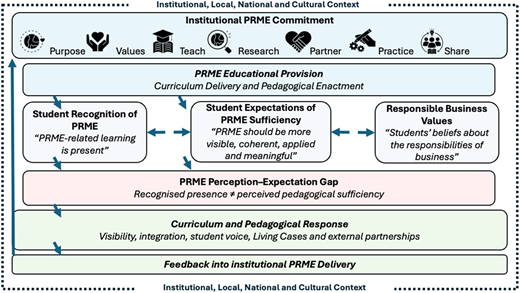
The study proposes a Student-Centred PRME Perception–Expectation Framework (Figure 1). The framework is informed by student voice theory and is developed from the empirical dimensions examined in the study. Within the framework, “PRME-related content” is not treated as a generic synonym for sustainability or ethics. Rather, it refers to student-facing curriculum and pedagogical experiences through which the PRME Principles are recognised, interpreted and evaluated by learners. The framework examines how institutional PRME commitment is translated through curriculum delivery and pedagogical enactment, and subsequently recognised and evaluated by students. Students' responsible business values provide an interpretive lens through which they assess the presence and perceived sufficiency of PRME-related learning.
The framework proposes that institutional PRME commitment is translated into student experience through educational provision, encompassing curriculum delivery and pedagogical enactment. Students then evaluate this provision in two related ways: whether they recognise PRME-related learning as present and whether it meets their expectations for visible, coherent, applied and meaningful engagement. Where recognised curriculum presence does not meet perceived pedagogical expectations, a PRME perception–expectation gap emerges. Students' responsible business values provide an additional interpretive lens for understanding these evaluations.
Accordingly, the framework suggests that effective PRME implementation requires alignment between institutional provision, student values and pedagogical experience. Where students recognise responsible management education but continue to express strong expectations for further integration, a perception–expectation gap emerges. Understanding this gap is important because it provides insight into how responsible management education is experienced by learners and highlights potential opportunities for curriculum enhancement.
In this study, the framework is developed from an exploratory institutional case. The framework is not presented as a universal model of PRME implementation, but as a student-centred conceptual lens for examining how learners evaluate the relationship between recognised curriculum presence and perceived pedagogical sufficiency. Its broader relevance therefore requires further empirical testing across different Business school contexts.
The arrows represent a proposed implementation and evaluation pathway rather than empirically established causal relationships. The framework is presented as a context-sensitive conceptual lens that requires further testing across institutional, national and cultural settings. The framework is situated within a wider local, national and cultural context. This recognises that the translation and evaluation of PRME may vary according to institutional PRME maturity, regulation, cultural values, stakeholder expectations and the perceived relevance of sustainability to business and career outcomes.
Methodology
The study adopted a questionnaire-based design informed by the literature on PRME, RME, CSR education, and student voice. The intention was to capture students' perceptions of the importance of responsible management education, their understanding of where such content appears in the curriculum, and the kinds of pedagogical practices they considered most valuable. The research design was deductive in the sense that it drew on existing scales and conceptual assumptions from the literature, while also incorporating opportunities for open-text responses meaning that students could elaborate their views in their own words (Gray, 2014).
The three composite scales were designed to capture student-facing dimensions of the PRME Principles. The PRME curriculum recognition scale focused on whether students recognised content aligned with Purpose, Values and Teach within their programmes. The responsible business values scale reflected students' orientation towards the Values principle, particularly responsibility and accountability to society and the planet, and included items adapted from Rashid and Ibrahim (2002) and Haski-Leventhal et al. (2017). The PRME pedagogical expectations scale captured students' preferences for stronger enactment of the Teach principle, while also connecting to Partner, Practice and Share through items relating to practitioner engagement, placements, recruiter education and critical reflection (PRME, 2020; Wersun et al., 2020).
Gender and stage of study were included as contextual variables because previous research suggested that both could shape student responses to responsible management and curriculum design (Rashid and Ibrahim, 2002; Haski-Leventhal et al., 2017; Jackman et al., 2019). The questionnaire also included open-text boxes after the responsible business values and PRME pedagogical expectations sections, allowing students to elaborate on their responses (Harland and Holey, 2011). Thirteen usable comments were received, 12 of which addressed business responsibility. Given the limited volume of qualitative data, the comments are used only as illustrative evidence to contextualise the quantitative findings and are not treated as a standalone qualitative dataset.
Materials and methods
The survey was distributed via Qualtrics through the University's online learning portal. This route was selected because it enabled the survey to be made available to the full eligible student population while avoiding reliance on in-class attendance. It also ensured that participation was limited to students with active enrolment at the point of data collection. Students on a break in study, leave of absence, suspension, or otherwise inactive status were therefore excluded from the sampling frame. Email and portal-based communication were used because institutional communication studies indicate that email remains a preferred channel for university information (Gilani, 2024). Table 1 provide a profile of the overall sample.
The sampling frame comprised 667 students within the Business school. A total of 141 students responded, representing an initial response rate of 21%. Forty-three incomplete responses were removed from the dataset, including responses where participants had not progressed sufficiently through the questionnaire to provide usable data for the main analysis. This left a final usable sample of 95 respondents, approximately 15% of the student population.
The final sample comprised 55 male respondents and 40 female respondents. Participants were also asked to indicate their stage of study, ranging from First Year/Level 4 through to PhD/Level 8. The highest proportion of responses came from Third Year/Level 6 students, who accounted for 42% of the sample. In line with the School's PRME membership and Sharing Information on Progress report, PRME is embedded across all levels of study, although not necessarily within every individual module. Stage of study was therefore included as a contextual variable because students at different stages may have had different levels of exposure to PRME-related content.
While the final sample is modest, the purpose was not to make population-level claims about all business students, but to examine patterns of perception within a specific institutional context and to develop insight into student experiences of PRME implementation (Iqbal et al., 2026). Nevertheless, the response rate is recognised as a constraint on the analysis and is addressed further in the limitations section. Response rates in student survey research are widely recognised as variable and can be affected by student engagement, survey fatigue and non-response bias (Baruch and Holtom, 2008; Nulty, 2008; Umbach and Porter, 2002). The aim of the study is to generalise to theory in context, “abstracting similarities across comparable people, contexts, and eras” as opposed to population (Drisko, 2025, p. 103). As such, the findings are best understood as exploratory and context-specific, offering insight into student perceptions within one UK PRME-engaged Business school rather than statistically representative evidence of PRME implementation across the sector.
The questionnaire data were analysed quantitatively using descriptive statistics, reliability testing and correlational analysis. Cronbach's alpha was used to assess the internal consistency of the three composite scales. The scales returned alpha values of 0.72, 0.74 and 0.907 respectively, indicating acceptable to very strong reliability for the purposes of this study (Cronbach, 1951; McHugh, 2012). Means and standard deviations were calculated for relevant items, and relationships between scale items, gender and stage of study were explored through Pearson's correlation analysis.
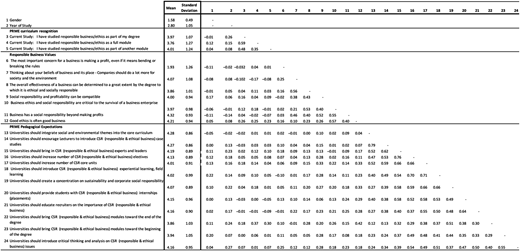
Independent-samples t-tests were conducted to examine whether gender differences existed across the three composite scales: PRME curriculum recognition, responsible business values and PRME pedagogical expectations. Gender was used as the grouping variable, while the three scale scores were entered as dependent variables. Levene's test was used to assess equality of variances, and statistical significance was assessed at the p < 0.05 level. One-way ANOVA was conducted to examine whether responses differed by year and stage of study across the three composite scales. Tukey HSD and Games-Howell post-hoc comparisons were used where appropriate. Figure 2 provides an overall breakdown of the data, including overall means, standard deviations, and inter-correlations between scale items.
Results
The analysis examined students' perceptions of responsible management education across three composite scales within a single UK-based Business school. The first scale, PRME curriculum recognition, measured the extent to which students perceived responsible business, ethics and sustainability-related content as already present within their degree. The second scale, Responsible business values, measured students' views on the relationship between ethics, social responsibility, sustainability and business purpose. The third scale, PRME pedagogical expectations, measured students' preferences for further integration of responsible management education through curriculum embedding, case-based learning, practitioner input, experiential learning, placements and critical analysis.
Across the individual items, mean scores suggest that students generally recognised responsible management education as present within the curriculum. Mean scores for studying responsible business/ethics as part of the degree, as a full module, and as part of another module ranged from M = 3.76 to M = 4.01, equivalent to approximately 75%–80% of the maximum scale score. Students also expressed strong support for further PRME-related curriculum development. The highest-rated items were integrating social and environmental themes into the core curriculum, M = 4.36, SD = 0.771, equivalent to 87% of the maximum scale score; encouraging lecturers to introduce responsible business case studies, M = 4.33, SD = 0.764, equivalent to 87%; bringing in CSR/responsible business experts and leaders, M = 4.25, SD = 0.612, equivalent to 85%; and introducing critical thinking and analysis on CSR/responsible business issues, M = 4.25, SD = 0.838, equivalent to 85%.
Pearson's correlation analysis was conducted to examine relationships between demographic variables, students' perceptions of existing responsible management education, responsible business values, and preferences for further PRME-related curriculum development. Given the size of the correlation matrix, the results are discussed in relation to the main conceptual areas of the study rather than each individual association.
The first pattern relates to students' recognition of responsible management education within the curriculum. The three items measuring perceived exposure to responsible business and ethics were positively and significantly related. Students who indicated that they had studied responsible business/ethics as part of their degree were also more likely to indicate that they had studied it as a full module, r = 0.590, p < 0.01, and as part of another module, r = 0.478, p < 0.01. The relationship between studying responsible business/ethics as a full module and as part of another module was also significant, though more moderate, r = 0.350, p < 0.01. These associations indicate that students' perceptions of PRME-related curriculum presence were relatively consistent across different forms of curriculum exposure.
These three scales correspond to the student-facing dimensions of the PRME Principles. PRME curriculum recognition captures whether students perceive the principles, particularly Purpose, Values and Teach, as present in their learning. Responsible business values reflect students' engagement with the Values principle. PRME pedagogical expectations capture how students believe the Teach principle should be more explicitly enacted through curriculum integration, case-based learning, practitioner engagement, experiential learning and critical analysis.
A second pattern concerns students' responsible business values. Several items relating to ethics, social responsibility and business purpose were positively associated. The belief that companies should do more for society and the environment was significantly related to the view that the ethical and socially responsible character of a business contributes to its overall effectiveness, r = 0.565, p < 0.01. The view that business ethics and social responsibility are critical to the survival of a business was associated with the belief that businesses have social responsibilities beyond making profits, r = 0.551, p < 0.01, and with the view that good ethics is often good business, r = 0.567, p < 0.01. These findings suggest that students tended to connect ethics, social responsibility, business effectiveness and long-term business viability.
While limited in number, the open-text comments provide illustrative support for the quantitative findings. Respondents emphasised the importance of ethical conduct, sustainability and corporate responsibility, while also recognising the practical challenges associated with implementation. One respondent noted that “business need to accept responsibility and lead change,” while another argued that “businesses should be more sustainable and ethical rather than using it as a marketing technique.” Several students viewed social responsibility as an increasingly important expectation of business, with one suggesting that “in the future, I believe more and more people will hold businesses accountable for their practices in relation to sustainability.” At the same time, some students recognised limits to corporate responsibility, arguing that “business cannot be responsible for everything, governments need to regulate to make it a level playing field.” These comments are not presented as independent qualitative findings, but as illustrative evidence that helps contextualise the broader quantitative pattern.
The strongest and most consistent associations were found among the pedagogical preference items. Support for Universities integrating social and environmental themes into the core curriculum was strongly associated with support for lecturers introducing responsible business case studies, r = 0.793, p < 0.01. Support for bringing in CSR/responsible business experts and leaders was also strongly associated with support for increasing elective provision in this area, r = 0.758, p < 0.01. In addition, support for increasing core CSR/responsible business units was strongly associated with support for experiential learning, r = 0.712, p < 0.01. These relationships suggest that students' preferences were not limited to isolated curriculum additions but formed a broader pattern of support for applied and integrated PRME-related learning.
One open-text comment also provides a useful illustration of how exposure to responsible management education may shape student perceptions. One student stated: “I have studied this topic as a full module for the first time this year and I have changed my own views about how important this is.” Given the limited qualitative dataset, this comment is used illustratively rather than as evidence of a broader qualitative theme.
The survey asked whether Universities should introduce critical thinking and analysis on CSR/responsible business issues. This item correlated significantly with several other pedagogical preference items, including bringing CSR/responsible business modules towards the beginning of the degree, r = 0.547, p < 0.01, increasing core CSR/responsible business units, r = 0.537, p < 0.01, introducing experiential learning, r = 0.511, p < 0.01, educating recruiters on the importance of CSR/responsible business, r = 0.498, p < 0.01, increasing elective provision, r = 0.487, p < 0.01, providing CSR/responsible business internships or placements, r = 0.474, p < 0.01, and bringing CSR/responsible business modules towards the end of the degree, r = 0.398, p < 0.01. This indicates that students who valued critical thinking and analysis also tended to support a broader and more developmental model of PRME integration.
Overall, the correlation analysis shows three main empirical patterns: students recognised responsible management education as present within the curriculum; students demonstrated a broadly responsible business values orientation; and the strongest associations clustered around expectations for further pedagogical development. These results provide the empirical basis for the later discussion of a PRME perception–expectation gap. These patterns provide empirical support for the distinction between recognising responsible management education as present and judging it to be sufficiently integrated, visible and pedagogically meaningful.
Gender differences
Independent-samples t-tests were conducted to examine whether gender differences existed across the three composite scales. No statistically significant gender differences were identified for PRME curriculum recognition, t(93) = −0.680, p = 0.498; Responsible business values, t(93) = 0.431, p = 0.667; or PRME pedagogical expectations, t(93) = −1.167, p = 0.246.
These results indicate that students' perceptions of existing responsible management education, their responsible business values, and their expectations for further PRME integration were broadly consistent across gender groups.
Year-of-study differences
One-way ANOVA was conducted to examine whether responses differed by year of study across the three composite scales. Statistically significant differences were identified for all three scales. For PRME curriculum recognition, the effect of year of study was significant, F(4, 90) = 3.887, p = 0.006. For Responsible business values, the effect was also significant, F(4, 90) = 2.632, p = 0.039. For PRME pedagogical expectations, the effect was significant, F(4, 90) = 4.082, p = 0.004.
Effect size estimates indicated that year of study explained approximately 14.7% of the variance in PRME curriculum recognition, 10.5% of the variance in responsible business values, and 15.4% of the variance in PRME pedagogical expectations.
Post-hoc comparisons were conducted to identify where these differences occurred. For PRME curriculum recognition, Course/Year 3 students scored significantly higher than Course/Year 1 students, mean difference = 1.063, p = 0.004 using Tukey HSD, and p = 0.016 using Games-Howell. For PRME pedagogical expectations, Course/Year 3 students scored significantly higher than Course/Year 2 students, mean difference = 0.577, p = 0.003 using Tukey HSD, and p = 0.035 using Games-Howell. For Responsible business values, Tukey HSD indicated a significant difference between Course/Year 3 and Course/Year 4, mean difference = 0.485, p = 0.047; however, this comparison was not significant using Games-Howell, p = 0.099, and should therefore be interpreted cautiously.
Taken together, the ANOVA results suggest that year of study was associated with differences in students' recognition of PRME-related curriculum content, responsible business values and pedagogical expectations. In particular, Course/Year 3 appears to be an important point in the student journey, with students in this group reporting higher scores on PRME curriculum recognition and PRME pedagogical expectations than some earlier-year groups. This may indicate that recognition of PRME-related teaching is greater among students at later stages of study, although the cross-sectional design limits claims about change over time. This finding is consistent with the school's claim that PRME is embedded across all levels of study, while also suggesting that students' recognition and expectations vary by stage of study.
Discussion
The findings contribute to responsible management education in three main ways: by demonstrating that students recognise PRME-related content within the curriculum; by identifying a PRME perception–expectation gap between curriculum presence and perceived sufficiency; and by highlighting the pedagogical approaches students associate with meaningful responsible management education.
These findings should be interpreted in light of the study's exploratory, single-institution design. The empirical results provide insight into how students in one UK Business school perceive PRME-related curriculum presence, responsible business values and pedagogical expectations. They do not establish generalisable patterns across all PRME signatory institutions or countries. However, the findings do offer a useful basis for theorising how student voice can reveal tensions between institutional provision, curriculum recognition and perceived pedagogical sufficiency.
First, they demonstrate that students recognise responsible management education as an established component of their degree experience. The relatively high scores across the PRME curriculum recognition items suggest that sustainability, ethics and responsibility are already visible within the curriculum to a meaningful extent. This is an important finding because much of the literature has focused on institutional barriers, implementation challenges and incomplete adoption of responsible management education, whereas the student perspective presented here suggests that embedding has, at least in part, been achieved in context (PRME, 2021; Bento et al., 2022; Young and Nagpal, 2013).
The findings also demonstrate that the presence of responsible management education does not eliminate demand for further integration. Students recognised that sustainability and responsibility were already present in their education, while simultaneously expressing strong support for deeper curriculum integration, greater use of case studies, practitioner engagement, experiential learning and critical analysis. This pattern is reflected in the strong correlations among the pedagogical preference items, particularly the relationships between curriculum integration and case-based learning, practitioner engagement and experiential learning. These findings suggest that students are not seeking isolated additions to the curriculum, but rather a coherent and connected approach to responsible management education (John, 2025).
The findings also reinforce the importance of coherence between institutional commitment, curriculum delivery and student experience. Alfirević et al. (2023) found that RME exposure was most effective when accompanied by students' perceptions of a socially responsible institutional orientation, suggesting that teaching content alone may be insufficient. Similarly, the present findings indicate that formal curriculum presence does not guarantee perceived pedagogical sufficiency. Students may recognise RME content while continuing to expect greater visibility, integration and connection to practice. The relatively positive findings should also be interpreted cautiously, and in context, as previous cross-national research has identified differences in business students' sustainability expectations, intentions and value–action gaps across national contexts (Grunwald et al., 2025).
This provides empirical support for what this paper defines as the PRME perception–expectation gap. Students recognise that responsible management education is present within their learning experience, yet continue to expect greater visibility, coherence and pedagogical engagement. The concept extends existing concerns within the RME literature regarding implementation challenges and offers a student-centred perspective on how PRME may be experienced. Recent literature has also highlighted the importance of curriculum experience and the hidden curriculum in shaping students' understanding of responsible management education, suggesting that formal curriculum provision alone may not determine how responsible management is experienced by learners (Sen, 2025). The findings of the present study support this view, indicating that curriculum presence and perceived sufficiency are not necessarily synonymous.
The theoretical value of the PRME perception–expectation gap lies in its distinction between recognition and sufficiency. Existing PRME literature has established the difficulties of translating institutional commitment into curriculum practice, but such discussions often focus on institutions, faculty, accreditation or reporting. This study suggests that implementation should also be theorised at the level of student experience. Students may recognise responsible management education within their programmes while simultaneously judging it to be insufficiently visible, integrated or practice-oriented. The perception–expectation gap is therefore not simply another label for incomplete implementation; it identifies a student-experience dimension of implementation in which formal curriculum presence does not guarantee perceived pedagogical adequacy.
Second, the findings provide insight into students' responsible business values. Students expressed strong agreement that business should contribute positively to society and the environment, that ethics contributes to organisational effectiveness, and that social responsibility extends beyond profit-making. Qualitative comments reinforced these patterns, with respondents arguing that businesses should “accept responsibility and lead change” and that organisations should be “more sustainable and ethical rather than using it as a marketing technique.” At the same time, students demonstrated an awareness of the complexities of responsibility in practice, recognising the role of regulation and the tensions that can exist between commercial activity and sustainability objectives. This suggests that students' views extend beyond simple expressions of support for responsibility and include a more nuanced understanding of contemporary responsible business challenges.
Third, the findings identify a learner-informed hierarchy of pedagogical priorities. Students were most supportive of integrating social and environmental themes throughout the curriculum, encouraging lecturers to adopt responsible business case studies and involving practitioners with sustainability expertise. However, these findings should not be interpreted as support for traditional case-based learning alone. Rather, they suggest a broader preference for applied, contextual and practice-oriented pedagogy. Case-based learning remains valuable, but it should be understood as one point on a wider pedagogical continuum that includes project-based learning, Living Cases and live organisational challenges. Such approaches may be particularly valuable in responsible management education because sustainability and responsibility issues are context-dependent and shaped by regulation, culture, stakeholder expectations and local business ecosystems.
The strong association between critical thinking and multiple pedagogical preference items is particularly noteworthy. Students who favoured critical engagement with responsible business issues were also more likely to support curriculum integration, experiential learning, placements and practitioner engagement. This suggests that students view responsible management education not simply as additional content, but as a distinctive mode of learning that combines theory, reflection and practice. These results reinforce previous arguments that effective RME depends upon transformative and experiential pedagogies rather than the inclusion of sustainability topics alone (Young and Nagpal, 2013; Dickson et al., 2013; Wersun et al., 2020; Sen, 2025).
The findings also have implications for the evaluation of PRME implementation. If institutions rely primarily on curriculum mapping, module descriptors or PRME reporting mechanisms, they may overestimate the extent to which responsible management education is experienced as meaningful by students. The results suggest that implementation should be assessed not only in terms of what institutions provide, but also through how learners recognise, interpret and value that provision. Student voice therefore represents an important evaluative dimension of PRME implementation rather than a supplementary perspective (Cook-Sather, 2015; Robinson and Taylor, 2007; Chen and Hoshower, 2010).
The demographic findings provide further insight. Consistent with the t-test results, no statistically significant gender differences were identified across the three composite scales. This is noteworthy because earlier studies suggested that female students may demonstrate stronger support for corporate social responsibility and sustainability-related initiatives. These findings do not support a strongly gendered pattern within this sample and suggest that support for responsible business and sustainability may be broadly shared among the students surveyed (Rashid and Ibrahim, 2002; Haski-Leventhal et al., 2017; Wersun et al., 2020).
In contrast, year of study was associated with significant differences across all three composite scales. Students in Course/Year 3 reported significantly higher levels of PRME curriculum recognition than students in Course/Year 1, while also demonstrating stronger pedagogical expectations than students in Course/Year 2. These findings suggest that the PRME perception–expectation gap is not static but may develop across the student journey. Greater exposure to responsible management education may be associated with higher recognition of PRME-related content while simultaneously raising expectations regarding its visibility, relevance and practical application.
Rather than reducing demand, greater engagement with responsible management education appears to reinforce students' expectations of how it should be taught. This strengthens the pedagogical case for longitudinal and scaffolded curriculum design in which sustainability, ethics and responsibility are revisited throughout the degree experience rather than introduced at isolated points (Haski-Leventhal et al., 2017; Jackman et al., 2019; Bain, 2020).
These findings should also be interpreted in relation to the specific institutional and national context of the study. The relatively positive student perceptions reported here may be influenced by the School's positive PRME engagement, the visibility of responsible management education within the curriculum, and the extent to which students had encountered sustainability, ethics and responsibility across their programme. The findings should therefore not be read as evidence that all business students prioritise sustainability or perceive responsible management education as central to business value. Rather, they suggest that within this institutional context, students recognised PRME-related provision and expressed expectations for deeper integration. Student perceptions of sustainability and responsible management education may differ across national, cultural and institutional settings, particularly where sustainability is less strongly associated with employability, business relevance or career differentiation.
Taken together, the findings support the proposed Student-Centred PRME Perception–Expectation Framework. Students recognised responsible management education within the curriculum, demonstrated broadly responsible business values, and expressed strong expectations for further pedagogical development. The broader implication is therefore not that student demand for sustainability-focused education is universally high, but that student voice can reveal how PRME implementation is interpreted within a particular institutional and cultural context.
The strongest patterns within the correlation analysis were found among the pedagogical enhancement items, suggesting that students seek a coherent and applied model of responsible management education that integrates curriculum content, practitioner engagement, experiential learning and critical reflection. Effective PRME implementation therefore depends upon alignment between institutional commitment, educational provision and student experience. Institutional commitment must be translated through curriculum delivery and pedagogical enactment in ways that students recognise as visible, coherent, applied and meaningful. The challenge for Business schools is not simply to include sustainability and responsibility within the curriculum, but to design learning experiences through which students recognise responsible management education as a meaningful and central component of their development as future managers and leaders.
Implications for responsible management education
While the findings are drawn from one UK Business school and should not be generalised uncritically, they raise broader questions for PRME-engaged institutions about how responsible management education is made visible, coherent and meaningful to students. While contemporary case studies remain valuable, the findings suggest that responsible management education should increasingly move towards more immersive and context-specific forms of experiential learning, including project-based learning, Living Cases, practitioner-led challenges, simulations, placements and live organisational or community-based projects. These approaches can help students engage with the complexity of responsible management in practice, where sustainability challenges are shaped by sectoral conditions, stakeholder expectations, regulatory environments and cultural contexts.
Students generally recognised the presence of sustainability, ethics and responsibility within their degree programmes, yet simultaneously expressed strong support for further curriculum integration, case-based learning, practitioner engagement, experiential learning and critical analysis. This finding supports previous research suggesting that the success of RME is shaped not only by curriculum content but also by the ways in which responsible management principles are enacted and experienced through pedagogy (Young and Nagpal, 2013; Dickson et al., 2013; Wersun et al., 2020).
The results indicate that responsible management education is most valued when it is embedded across the student learning journey rather than delivered through isolated modules. This aligns with calls for the integration of sustainability and responsibility throughout Business school curricula, enabling students to repeatedly engage with these themes in different disciplinary and practical contexts (Cortese, 2003; PRME, 2021; Haertle et al., 2017). The significant differences identified by year of study further suggest that students' understanding and expectations evolve over time, reinforcing the importance of scaffolded and longitudinal curriculum design.
The strong relationships observed between curriculum integration, case studies, practitioner engagement, experiential learning and critical thinking suggest that students view responsible management education as a connected educational experience rather than as a series of discrete interventions. Business schools should therefore consider pedagogical approaches that integrate theory, practice and reflection. While contemporary case studies remain useful for developing analysis and discussion, the findings suggest that responsible management education should move beyond reliance on predefined cases alone. Project-based learning, live organisational projects and “Living Cases” may provide richer opportunities for students to engage with real sustainability and responsibility challenges in context. Such approaches can connect students with organisations, communities and stakeholders, allowing them to examine how responsible management is shaped by local regulation, culture, institutional conditions and business ecosystems. This is especially important in PRME implementation because responsible management challenges are rarely universal or context-free. Students therefore need opportunities to work with situated problems where ethical, environmental and social responsibilities are negotiated in practice (Young and Nagpal, 2013; Dickson et al., 2013; Bain, 2020).
The findings also highlight the importance of incorporating student voice into the evaluation of PRME implementation. While curriculum audits, accreditation processes and institutional reporting provide evidence of formal commitment to PRME, they reveal comparatively little about how such initiatives are experienced by students. Consistent with student voice literature, learner perceptions should therefore be viewed as an important source of evidence in curriculum review and enhancement processes in relation to PRME (Cook-Sather, 2007, 2015; Flutter and Rudduck, 2004; Robinson and Taylor, 2007). Student feedback can provide valuable insight into the visibility, coherence and educational impact of responsible management initiatives.
For practice, the perception–expectation gap suggests that Business schools should evaluate PRME implementation not only by curriculum coverage, but also by whether students experience responsible management education as visible, coherent and pedagogically meaningful.
These findings should be interpreted in light of the study's exploratory, single-institution design. The empirical results provide insight into how students in one UK Business school perceive PRME-related curriculum presence, responsible business values and pedagogical expectations. They do not establish generalisable patterns across all PRME signatory institutions. However, the findings offer a basis for theorising how student voice can reveal tensions between institutional provision, curriculum recognition and perceived pedagogical sufficiency. The broader implication is therefore conceptual rather than statistical: the PRME perception–expectation gap provides a lens for examining whether formally embedded responsible management education is experienced by students as visible, coherent and meaningful.
A further implication concerns external partnership. Closer engagement between business schools, PRME Chapters, PRME UK and Ireland Local Networks, Working Groups and signatory organisations could provide students with access to real-world sustainability challenges and help them understand how organisations address sustainable transformation in practice.
Finally, the findings suggest that effective PRME implementation depends upon alignment between multiple factors, including institutional commitment, curriculum design, pedagogical practice and student experience. Where responsible management education is formally embedded but insufficiently recognised as meaningful or coherent by students, a perception–expectation gap has the potential to emerge. Addressing this gap requires Business schools to move beyond demonstrating curriculum coverage towards ensuring that responsible management education is experienced as relevant, applied and central to students' development as future managers and leaders (PRME, 2021; Bento et al., 2022; Wersun et al., 2020).
PRME principles
This study contributes to the seven PRME Principles: Purpose, Values, Teach, Research, Partner, Practice and Share (PRME, 2021, 2023; Haertle et al., 2017). The findings speak most directly to Teach, Purpose and Values, as students recognised responsible management education within the curriculum, expressed responsible business values and identified preferred pedagogical approaches for deeper integration. Students' support for curriculum integration, case-based learning, practitioner engagement, experiential learning and critical analysis aligns with calls for more applied and embedded RME pedagogy (Young and Nagpal, 2013; Dickson et al., 2013; Wersun et al., 2020). The study also connects to Partner through support for industry engagement, to Practice through expectations that institutions model responsible values, and to Share by using student voice as evidence for PRME evaluation and curriculum enhancement (Cook-Sather, 2015; PRME, 2021; Bento et al., 2022). While Research is not directly measured, the paper contributes empirical insight into how PRME implementation is perceived by learners.
Conclusion
This paper examined how students in a UK Business school perceive the presence and importance of responsible management education within their curricula. The findings show that students recognise PRME-related themes in their learning, suggesting that responsible management has been embedded to a meaningful degree. At the same time, students continue to call for stronger integration, more visible case-based teaching, and greater engagement with practitioners. This apparent contradiction is important rather than problematic. It reveals what this paper terms a PRME perception–expectation gap: a disjuncture between the existence of responsible management education and students' desire for deeper, clearer, and more pedagogically engaging implementation (PRME, 2020; Young and Nagpal, 2013; Wersun et al., 2020).
These findings suggest that the effectiveness of responsible management education depends not only on its formal inclusion within the curriculum, but also on the extent to which students recognise it as visible, coherent and meaningful.
The study contributes to the responsible management education literature in three ways. First, it places student voice at the centre of debates on PRME implementation (Cook-Sather, 2007, 2015). Second, it develops the PRME perception–expectation gap as a conceptual lens for understanding why formal curriculum presence may not translate into perceived sufficiency. The concept contributes to PRME literature by theorising a student-experience dimension of implementation, in which students may recognise responsible management education as present while still expecting greater visibility, coherence and pedagogical integration. Third, it offers practical guidance for educators and Business schools by highlighting the forms of pedagogy students value most (Dickson et al., 2013; Knight, 2002).
These findings suggest that PRME implementation should be judged not only by institutional commitments or curriculum documentation, but also by how students experience, interpret, and value responsible management education. For Business schools, the challenge is not simply to include sustainability and responsibility in the curriculum, but to embed them in ways that students can clearly recognise as central to their educational and professional development. Future research could explore this perception–expectation gap across institutions, disciplinary contexts, and cultural settings to test its wider relevance within responsible management education (Bento et al., 2022; PRME, 2021; Wersun et al., 2020).
Limitations and future research
The study is limited by its focus on a single, UK-based Business school, meaning the findings should not be generalised uncritically to all institutional contexts. The final usable sample was also modest. Although the use of the University's online learning portal ensured that only students with active enrolment could complete the questionnaire, participation was voluntary and may therefore have introduced self-selection bias. Students with stronger views on sustainability, ethics or responsible management education may have been more likely to respond, while students less engaged with their studies or with the online learning portal may be underrepresented.
The response rate reflects wider challenges associated with questionnaire-based research in higher education, where participation can be affected by student engagement, survey fatigue and non-response bias (Baruch and Holtom, 2008; Nulty, 2008; Umbach and Porter, 2002). Future studies could strengthen participation through multi-channel distribution or follow-up reminders and incentives where ethically and institutionally appropriate. Although sustainability education also merits investigation in further, primary and secondary education, these settings fall outside the scope of the present study (John, 2025). However, in this study, the chosen distribution method was appropriate because it enabled access to the eligible student population while maintaining the exclusion criteria relating to active enrolment.
A further limitation relates to institutional, cultural, local and national context. The findings were generated within one UK Business school with an existing PRME orientation, and students' relatively positive perceptions may reflect this specific national context. Student attitudes towards sustainability and responsible management education may differ in settings where sustainability is less visible in the curriculum, less strongly connected to perceived business value, or less clearly associated with employability and career differentiation. Future research should therefore examine the PRME perception–expectation gap across different national, cultural and institutional contexts, including institutions with varying levels of PRME engagement and different labour-market expectations.
Future research should test the PRME perception–expectation gap across multiple institutions and with larger samples to examine whether the pattern identified in this study reflects a broader feature of PRME implementation or is specific to the institutional context examined here. Comparative research across PRME signatory and non-signatory schools may be especially useful in identifying whether the perception–expectation gap reflects a broader challenge in responsible management education implementation or is shaped by local institutional factors. The study also focuses primarily on students' perceptions of institutional provision and does not examine students' own sustainability-related behaviours or responsibilities. Future research could therefore explore how students understand their own role in responsible management education, including the extent to which they see themselves as active contributors to sustainable development.
Future-oriented RME pedagogy should prioritise opportunities for direct student participation. Cross-national evidence suggests that gaps between sustainability expectations and intended action may be smaller where students can engage through research, projects and other concrete activities (Grunwald et al., 2025). This supports the use of project-based learning, Living Cases, placements and campus or community sustainability projects alongside conventional case-based learning.
Comparative research could also examine whether students' perceptions of responsible management education are shaped by national development, cultural values, institutional PRME maturity and the perceived relationship between sustainability and future business value.