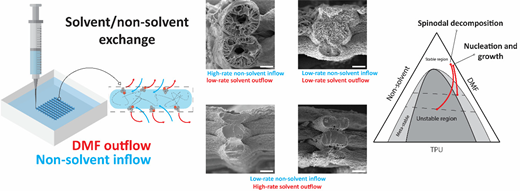
Porous structures are crucial for wound dressings, but conventional 3D printing techniques often struggle to produce them effectively. This study aims to develop a one-step 3D printing method to fabricate polyurethane wound dressings with tunable pore architectures, addressing the limitations of traditional approaches. Surface roughness and porosity can be controlled in the present method, leading to a potential influence on cell behavior that promotes wound healing.
A novel immersion precipitation 3D printing (ip-3D printing) technique was used, leveraging solvent/non-solvent exchange to control porosity. Four solvent/non-solvent systems were tested to evaluate their effects on pore morphology, printability and biological performance. The resulting structures were characterized using scanning electron microscopy, mechanical testing, water uptake analysis and water vapor transmission rate (WVTR) measurements. In vitro biocompatibility was assessed via live/dead assays, MTS assays and cellular morphology analysis.
Non-solvent type and printing conditions significantly influenced pore structure, with exchange rate mechanisms (nucleation and growth, or spinodal decomposition) dictating pore morphology (dense, foam-like or fingerlike). WVTR measurements confirmed microstructure-dependent permeability. In vitro studies demonstrated excellent biocompatibility, with cellular behavior strongly linked to pore architecture.
This work introduces the application of one-step ip-3D printing method for foam-like polyurethane wound dressings for the first time, enabling precise control over pore size and surface morphology without post-processing. By linking solvent/non-solvent dynamics to cellular response, it offers a scalable platform for designing customized wound dressings with enhanced performance.
1. Introduction
Wound dressings play a vital role in the healing process by providing a protective barrier, absorbing excess moisture and promoting a moist environment conducive to tissue regeneration (Ha et al., 2023; Hedayatyanfard et al., 2019). Appropriate wound dressings help to prevent infection, minimize scarring and expedite healing, ultimately improving patient outcomes (Li et al., 2023; Xu et al., 2024). Polyurethane has emerged as a versatile material for wound dressing applications due to its desirable properties (Morales-González et al., 2022). It offers excellent biocompatibility, mechanical strength and permeability to oxygen and water vapor, making it suitable for various wound types (Bužarovska et al., 2019; Chen et al., 2023b; Song et al., 2017). Polyurethane-based wound dressings can be fabricated into different forms, including films (Lee et al., 2016), foams (Chen et al., 2023a) and nanofibrous mats (Unnithan et al., 2012), each with specific advantages. These dressings can effectively absorb exudate, provide a moist healing environment and promote cell growth, ultimately aiding in wound closure and reducing the risk of infection (Almasian et al., 2020; Khodabakhshi et al., 2019; Xu et al., 2016).
An essential parameter in evaluating the effectiveness of a wound dressing lies in its porosity (Khodabakhshi et al., 2019; Seyedsalehi et al., 2024). When a wound dressing possesses optimal porosity, it can adequately maintain the necessary moisture levels within the wound, preventing its dehydration (Field and Kerstein, 1994). Consequently, this fosters an expedited wound healing process (Xu et al., 2016). Conversely, if a wound dressing lacks a porous structure, it hinders the passage of water and gases as well as the absorption of moisture (Li et al., 2017). This hindrance results in the accumulation of wound exudate in the same area, potentially leading to infections and other complications (Lei et al., 2016; Liu et al., 2013). Using porous dressings is one strategy to mitigate the risk of wound infections. As a result of the porosity of the wound dressing, wound exudate can be absorbed more effectively and porous dressings can exchange water vapor with the environment as well (Alizadehgiashi et al., 2021; Khodabakhshi et al., 2019).
There are different techniques for the fabrication of porous wound dressings (Dehghani and Annabi, 2011; Jungprasertchai et al., 2022). Among them, additive manufacturing (AM) enables the fabrication of samples with custom-designed dimensions (Alvarez-Lorenzo et al., 2024; Kumar and Sharma, 2021), extrinsic porosity and interconnected channels (Chen et al., 2017; Salehabadi and Mirzadeh, 2024), facilitating the creation of tailored structures for wound dressing applications (Shafiee et al., 2021). Applying the most common AM methods, including stereolithography, fused deposition modeling and direct ink writing, results in the printed structures exhibiting smooth surfaces and dense microstructures (Cano-Vicent et al., 2021; Drummer et al., 2012; Fiocco et al., 2017; Guo et al., 2014; Kaviani-Samani et al., 2020; Lakkala et al., 2023; Wickramasinghe et al., 2020). The smoothness of these surfaces can reduce the adhesion between the sample’s layers, potentially leading to a reduction in mechanical properties. In addition, most of the AM methods can produce only extrinsic porous samples with dense microstructures, while the intrinsic porosity is more favorable for controlling the water vapor permeability (Alizadehgiashi et al., 2021). The creation of surface morphology and intrinsic porosity in 3D-printed samples using these conventional AM methods often necessitates multi-steps such as the use of sacrificial materials like polyvinyl alcohol or salts (Cooperstein et al., 2015; Kashyap et al., 2018; Mu et al., 2017; Sears et al., 2016; Sušec et al., 2013).
In recent years, immersion precipitation 3D printing (ip-3DP) has emerged as a promising technique using non-solvent induced phase separation (NIPS) to solidify polymer solutions and create 3D printed structures. Despite its versatility in fabricating various parts, ip-3DP has not garnered significant attention. Limited research has explored this method (Karyappa et al., 2019), which is often less desirable for those seeking high mechanical properties for structural applications due to the inherent porosity that typically forms. Karyappa et al. (2019) used this method for 3D-printing of acrylonitrile butadiene styrene (ABS). They changed the concentration of polymer solution (ABS in acetone) to change the internal morphologies of the 3D printed structures, ranging from complete porous microstructures (with pore sizes ranging from 1 to 20 μm) to dense nonporous microstructures (Karyappa et al., 2019). While a major drawback of ip-3DP technique is the formation of pores that can weaken 3D-printed parts and limit the structural application of this AM method, it can be translated into a benefit for biomedical applications like wound dressings and tissue engineering as the presence of pores and rough surfaces promotes cellular attachment and proliferation.
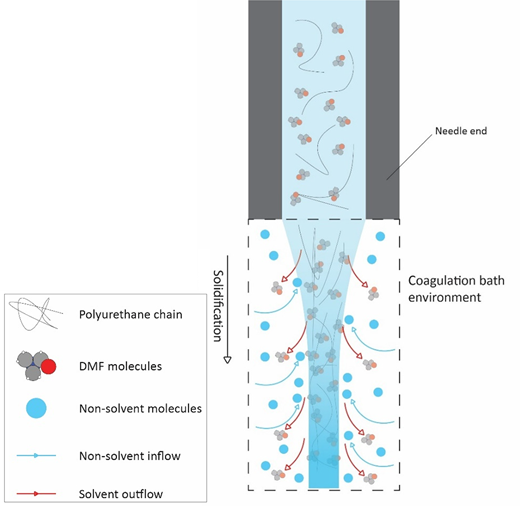
In ip-3DP, the porosity of the final product is strongly tied to the exchange rate between the solvent and non-solvent, with the rate of this process being heavily influenced by the system’s kinetics and thermodynamics (Karyappa et al., 2019). The process of immersion precipitation involves the exchange of solvent and non-solvent, leading to phase separation and the formation of distinct polymer-rich and polymer-lean phases (Duk Kim et al., 1999). There are two primary mechanisms for this phase separation: nucleation and growth and spinodal decomposition. The former involves the formation and growth of nuclei, creating small pores and a foam-like structure. The latter occurs when the solution enters the spinodal region, resulting in concentration fluctuations and the emergence of fingerlike pores (Kahrs and Schwellenbach, 2020). The final morphology depends on the kinetics of solvent-non-solvent exchange. The sedimentation rate and solubility of the solvent and non-solvent together also influence the morphology of the pores (Guillen et al., 2011). By understanding these factors, it is possible to control the pore size and structure, which is crucial for various applications especially the biomedical applications such as wound dressings and tissue engineering. In the supplementary material the theoretical background of the pore formation in ip-3DP and ternary diagram are explained more elaborately (Figure S1 in Supplementary material).
This study introduces a novel approach using ip-3DP to fabricate wound dressings with precisely controlled porous structures in a single-step process. By seamlessly integrating the NIPS method with 3D printing technology (Figure 1), ip-3DP enables the design of intricate wound dressing architectures while creating porosity with tailored percentage, type, size and morphology of both intrinsic and extrinsic pores. The size and geometry of the resultant pores are critically dependent on the solvent/non-solvent exchange rate, which directly dictates the final morphology of the structure. Optimizing this rate allows for the fine-tuning of wound dressing properties, thereby enhancing their suitability for various clinical applications. To investigate this, four groups of polyurethane samples were fabricated using different solvent/non-solvent systems with varying exchange rates, enabling systematic control over the resulting porous topographies and their biological performance.
2. Experimental section
2.1 Materials
Medical grade polyether-based thermoplastic polyurethane (TPU) (Coimgroup 9060), Dimethylformamide (DMF) (Neutron) and ethanol (Pars Alcohol, absolute ethyl alcohol 99.6%) were used to prepare polyurethane ink.
2.2 Preparation of polyurethane ink
TPU granules and DMF solvent were used to prepare the DMF/TPU solutions with a concentration of 12% w/w at 300 RPM and 25°C, stirred until the solution achieved complete homogeneity. All the prepared samples are presented in Table 1. To prepare the shifted Ethanol/DMF/TPU ink, 25% w/w ethanol is added to the TPU/DMF solution to reach the ethanol/DMF ratio of 1/4. The vial was then placed on the stirrer under the previous conditions until the solution was entirely homogeneous.
2.3. 3D printing process
An extrusion-based 3D printer (Chalic-B3) was used for the printing process. For printing, the homogeneous solution was loaded into a syringe (Ava Lowerlock syringe 3 mL) and inserted into the 3D printer. Before each print, the vertical (Z) axis was calibrated according to the needle’s length and its distance from the container’s bottom. Once the device was designed and calibrated, the 3D printing process was initiated. Four series of samples were printed according to Table 1, denoted as water/DMF/TPU (WDT), delayed ethanol/DMF/TPU (D-EDT), ethanol/DMF/TPU (EDT) and shifted ethanol/DMF/TPU (S-EDT). For the WDT sample, distilled water was poured into the coagulation container and the sample was printed in the water. In the D-EDT sample, besides ethanol as a non-solvent, the coagulation bath also contained 20% v/v DMF solvent. The EDT sample was printed in pure ethanol. In the S-EDT sample, a DMF/TPU solution containing 25% w/w ethanol was used and printed into ethanol as a non-solvent.
SOLIDWORKS software was used to design cubic samples in “.stl” format. Subsequently, the resulting .stl file was imported into a slicer software to generate the structure layer by layer in “.gcode” format. For this purpose, we used the Simplify3D software to configure various parameters, including printing speed, the number of layers, the percentage of external porosity and other relevant specifications, to optimize the printing process. When printing polyurethane solutions, several key parameters play a crucial role in achieving optimal results, which will be discussed below.
2.4 Printing parameters
Printing needle: A needle with a specific gauge and length should be selected to ensure uniform printing of polyurethane ink. Therefore, a gauge-24 (inner diameter = 0.310 mm) was selected for printing. The needle length was adjusted to 10 mm to reduce the shear stress applied to the polymeric solution during printing.
Layer height: To promote strong adhesion between layers, the layer height should be adjusted to ensure that the strands of the new layer slightly compress the previous layer. This compression enhances layer-to-layer adhesion, as shown in supplementary material Figure S2. Experimentally, adjusting layer height to one-third of the needle’s inner diameter will provide adequate adhesion between layers.
Syringe pressure control: The syringe used in the printer is connected to a stepper motor that controls the pressure on the syringe, which impacts the ink output rate. The force applied to the syringe piston is regulated by the extrusion multiplier (EM) parameter that has been determined in the Simplify3D software. An EM value of 1 corresponds to the default calculated output rate. If EM is less than 1, the material’s output rate is reduced proportionally. Experimentally for polyurethane printing, EM values ranging from 0.04 to 0.15 are typically used. The relation between EM and ink flow rate is shown in Figure S3 in Supplementary material and equation (S1).
Printing speed: The printer’s speed is another crucial parameter. Faster printing speeds result in a narrower strand, whereas slower speeds produce a wider strand. This parameter affects the quality and accuracy of the printed structure. Uniform strands can be obtained by setting the speed to 100 mm/min when EM = 0.1. All the adjusted parameters in the software are shown in Table 2.
Sample drying: After printing, the samples were placed in the non-solvent for 24 h so that the exchange of solvent and non-solvent could be completed.
2.5 Morphological study
To examine the morphology of the top surface, cross-section and bottom surface of the printed samples, we used scanning electron microscopy (SEM) photography (Vegall by Tescan). The samples, measuring 20 × 20 mm2 with a thickness of 0.4 mm, were printed in four different series. Subsequently, they were left on tissue paper in the laboratory environment for 24 h to dry. To prepare the samples for SEM imaging, the samples were fractured in liquid nitrogen and sputter-coated with gold.
2.6 Water uptake test
The printed samples measuring 20 × 20 mm2 with a thickness of 0.4 mm were dried under the conditions mentioned earlier and then submerged in distilled water. After 24 h, the samples were removed from the water, the excess water drops were removed carefully with a paper filter without putting pressure on the sample and then weighed to measure the amount of water absorbed.
2.7 Water vapor transmission rate (WVTR) test
We conducted the water vapor transmission rate test on samples with 10%, 20%, 30%, 40%, 50%, 60% and 100% filling. These samples were printed in dimensions of 32 × 32 mm2 with a thickness of 0.4 mm, according to the specified filling percentages. Samples were placed on top of vials while sealed vials containing distilled water, and their initial weights were recorded. After 24 h, the weights of the vials were measured again. The difference in weight represents the amount of water vapor that passed through the samples. Then, water vapor transmission rate (WVTR) can be calculated by equation (1) where Wi, Wf and A are the initial weight, the final weight after 24 h and the cross-section of vials.
2.8 Tensile test
Samples were printed with dimensions of 10 × 50 mm2 and a thickness of 0.4 mm. The tensile tests were conducted using a Universal Testing Machine (Santam Machine) with a test speed of 10 mm/min, gage length of 20 mm and a load of 60 N.
2.9 Cloud point test
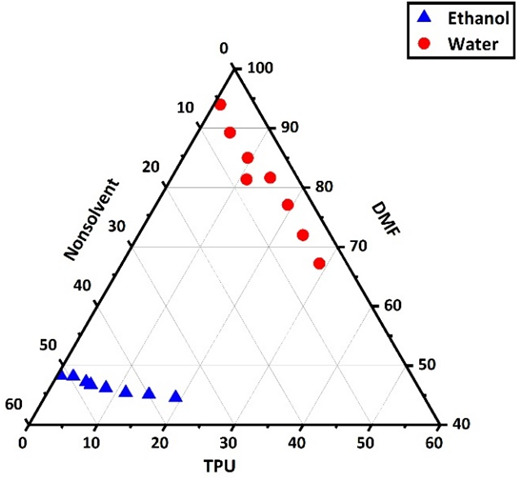
Polyurethane solutions with various concentrations were prepared. The titration with the non-solvent was started while stirring at a low speed. After adding a few drops of non-solvent, the solution was given some time to obtain its homogeneity and then the titration was started again. This process was continued until the solution became cloudy. At this point the addition of the non-solvent was stopped and the total amount of added non-solvent was recorded. The obtained composition percentage (polymer/solvent/non-solvent) for different concentrations of polymer in the cloud point was plotted on a triangular graph, and by connecting these points, the binodal line for the system was determined. This process was repeated using water as a non-solvent to plot a triangular diagram.
2.10 In vitro studies
2.10.1 Cell culture and passaging
This study used human foreskin fibroblast (HFF – Code No: RSCB0561) cells for live/dead assay and MTS assay and human dermal fibroblasts (HDF) for cell morphology assay obtained from Royan Cell Bank Services. An ethics committee approved their use, and informed consent for research was obtained.
The cells were cultured in a specific medium (DMEM/F12) supplemented with 10% fetal bovine serum (FBS, Gibco), 1% L-glutamine (Gibco), non-essential amino acid (Gibco) and penicillin/streptomycin (Gibco) in T-75 flask tissue culture. They were grown in flasks and maintained in a controlled environment (37°C, 5% CO2, 95% air). The medium was refreshed every three days. Once confluent, the cells were harvested, treated with 0.05% trypsin/EDTA (Gibco) for detachment and re-plated in a fresh medium for further experiments. Only cells between passages four and six were used.
2.10.2 Metabolic activity measurement
Samples were sterilized and transferred to well plates. A specific number of cells (2 × 10⁴ cells/cm2) were seeded onto the samples and cultured in a medium suitable for proliferation. The medium was changed every other day. To assess cell viability cultured on the samples, an MTS (Promega, G5421) assay was performed according to the manufacturer’s instructions. Briefly, cells were seeded on the samples at a set density and the medium was replaced daily. On designated days (1, 4 and, 7), the samples were transferred to new wells, treated with MTS solution and incubated for a set time. The optical density of the solution was measured at 490 nm wavelength using a plate reader. This experiment was run in triplicate for accuracy.
2.10.3 Live/dead assay
A commercially available LIVE/DEAD Kit (cat. No. L3224, ThermoFisher Scientific) was used to evaluate cell viability after 1, 4 and 7 days of culture. The samples were washed, and a staining solution containing 2 μM calcein AM and 4 μM ethidium homodimer-1 was added. Following incubation, the samples were rewashed and observed under a fluorescence microscope. Live cells appeared green, while dead cells were stained red. Images of cells were captured using a fluorescent microscope (Olympus, BX51) with an Olympus DP72 digital camera that was mounted on the microscope.
2.10.4 Cell morphology assessment
SEM was used to study the shape and features of cells grown on the 3D-printed structures. After 24 h, the cell-laden samples were collected, washed to remove loosely attached cells and then fixed with a 4% glutaraldehyde solution overnight. The samples were dehydrated through a series of increasing alcohol concentrations and finally dried under a vacuum. The dried samples were then coated with gold and examined by SEM.
3. Result and discussion
3.1 Morphological study of cross-section
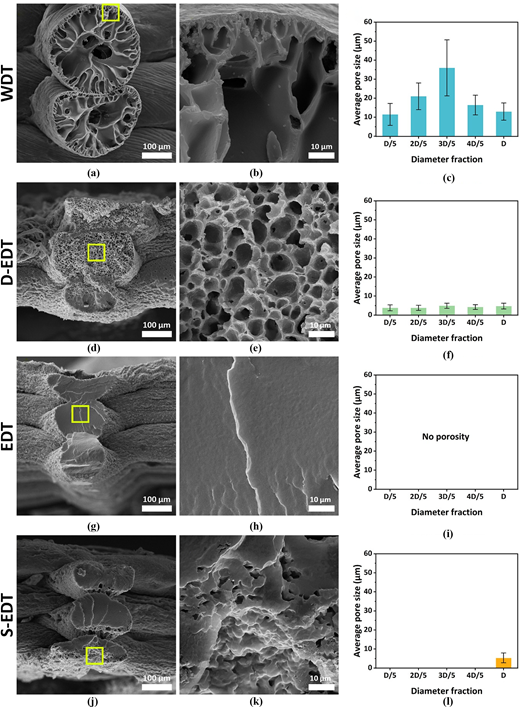
Our morphological investigation using SEM has revealed vast differences in the structures of printed samples produced through the ip-3DP process (Supplementary Video S1, S2). Final printed structures are also shown in Figure S4 in Supplementary material. Figure 2 depicts cross-section SEM images of four groups of samples with distinct structures obtained through different non-solvents. Figure 2(a) and (b), showcases the cross-section of the WDT sample, printed using polyurethane ink in pure water as the non-solvent (Supplementary Video S3). This sample exhibits a fingerlike structure, with a gradient pore size (a dense single layer on the surface, and large pores in the center of strands). Figure 2(c) illustrates anisotropic changes in the size of the pores as a function of strand diameter fraction. For WDT sample, when moving from left to right along the strand, the pore size increases from small to large, and then decreases again near the surface Figure 2(d) and (e), presents the cross-section of the D-EDT sample, which was printed in ethanol containing 20% v/v DMF solvent (Supplementary Video S4). The resulting structure resembles a foam-like structure, characterized by a relatively dense upper layer and uniform porosity in its depth. Importantly, the adhesion between the printed layers is strong, and the layers are connected seamlessly. As moving across the diameter of the strands, the pore sizes remain consistent. A comparison of the pore size for D-EDT samples is shown in Figure 2(f). Due to nucleation and growth phase separation and slow sedimentation rate, isotropic porosities are distributed uniformly throughout the sample cross-section. Figure 2(g) and (i), displays the cross-section of the EDT sample, printed with polyurethane ink in a coagulation container containing pure ethanol (Supplementary Video S5). The surface structure exhibits a very thin porous layer on the surface, but the center of the strand is entirely dense and the printed layers are well-integrated. Figure 2(j-l), illustrates the cross-section of the S-EDT sample, printed with polyurethane ink containing 25% w/w non-solvent in pure ethanol (Supplementary Video S6). This sample presents a relatively dense cross-section and a moderately porous surface. However, the adhesion between the printed layers is weak. Figure 2(l) shows a structure that is non-uniformly printed and has a small amount of porosity near the surface of the strands. Comparing the videos S1–S6 (in Supplementary material) shows the different rates of solidification for other samples. It is clear from these findings that non-solvents significantly influence the porosity features such as pore size, morphology and porosity distribution within the printed strands.
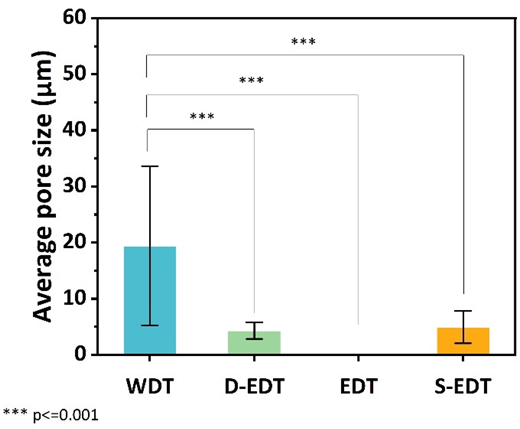
The average pore size in the strand’s cross-section for all samples is shown in Figure 3. The mean size for WDT is 20 µm, and this can vary from a short size near the surface to a larger size at the center of the strands. This parameter is much lower for the D-EDT sample at around 5 µm and nearly 0 for EDT. As S-EDT has some porosity in the cross-section, it is nearly 7 µm. The p-values indicate that the WDT sample, which had water as the non-solvent, exhibits significantly different pore sizes compared to other samples. This diagram proves that by changing the non-solvent, we can change the size of the porosities and the phase separation mechanism.
3.2 Cloud point
The cloud point test provides thermodynamic understanding into the miscibility of the system, which predicts the phase separation behavior that directly influences the membrane morphology. To understand the reason behind the influence of the non-solvent on the morphology, the phase diagram of polymer/solvent/non-solvent for the two systems of polyurethane/DMF/water and polyurethane/DMF/ethanol was plotted according to the cloud point test at 25°C. Non-solvent was gradually added to the solution until a milky color developed in the ink. This method is widely reported in literature and provides sufficient accuracy for creating ternary phase diagrams in polymer/solvent/non-solvent systems (Duk Kim et al., 1999). As shown in Figure 4, in the triangular diagram, the area below the binodal curve represents the two-phase region, where the homogeneous solution divides into two phases. Outside the curve is the single-phase region, where the sample remains clear. Since water dissolves more readily in DMF than in ethanol, polyurethane precipitates more rapidly. This suggests that water is a stronger non-solvent for polyurethane and DMF solutions than ethanol. Consequently, the two-phase region of the sample is much larger when water is used as a non-solvent. Changing the non-solvent alters the interaction parameters in the ternary system, which shifts the cloud point and the size of the two-phase region. The cloud point curves act as a reference for future studies, guiding solvent/non-solvent selection and phase separation in the design of polyurethane membranes.
3.3 Morphological study of top section
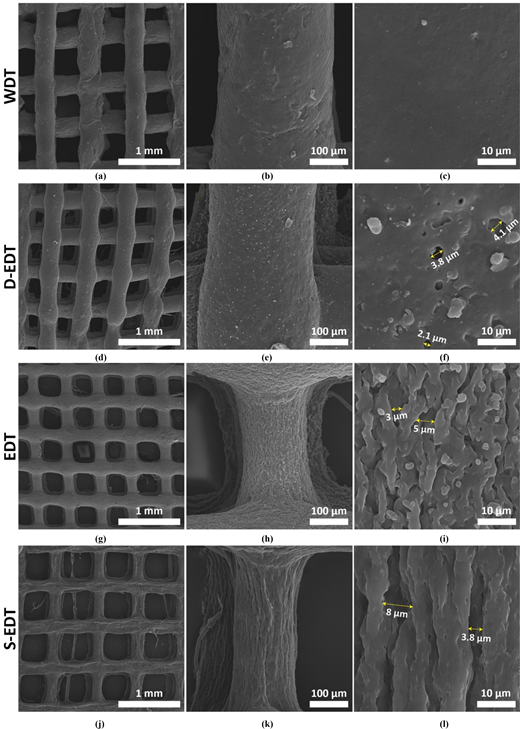
To study the effect of solvent/non-solvent exchange on the surface morphology of the 3D-printed structures, SEM images of the top surface of four different printed groups of samples are presented in Figure 5. The top surface of the WDT sample appears smooth and non-porous. The diameter of the printed strand closely matches that of the printing needle, measuring approximately 310 µm. There is uniformity in the changes in sample diameter along the printer’s movement direction [Figure 5(a)–(c)].
Due to sedimentation and delayed precipitation, the D-EDT sample exhibits very small pores on its surface. The final structure has experienced shrinkage, resulting in a smaller diameter compared to the needle size. There are noticeable changes in sample diameter along the printer’s movement direction, mainly due to the structure’s shrinkage resulting from the slow entry of the non-solvent inflow [Figure 5(d)–(f)]. The EDT sample displays the formation of some small rough structures on the surface of the 3D-printed strands. These structures can improve cellular attachment and spreading if needed (Mirzadeh and Bagheri, 2007). In addition, strong contraction has led to the complete closure of pores in the cross-section. Considerable changes in sample diameter along the printer’s movement direction can be observed, primarily due to the fast solvent outflow and slow non-solvent inflow rates [Figure 5(g)–(i)]. The S-EDT sample, like the EDT sample, exhibits surface roughness, although it is not uniformly printed compared to the other samples. This sample has also experienced contraction due to the fast solvent outflow and slow non-solvent inflow rates. Nevertheless, the shrinkage observed in the S-EDT sample is less than that in the EDT sample. This difference is attributed to the S-EDT sample’s higher settling speed, a result of having some non-solvent in its ink, ultimately reducing shrinkage compared to the EDT sample [Figure 5(j)–(l)]. The type of porosity and its size is described in Table 3. As D-EDT, EDT and S-EDT shrinkage in all directions in the same way, their contractions will be isotropic. The bottom section of SEM micrographs is shown in Figure S5 in Supplementary material.
3.4 Printing fidelity and diameter distribution
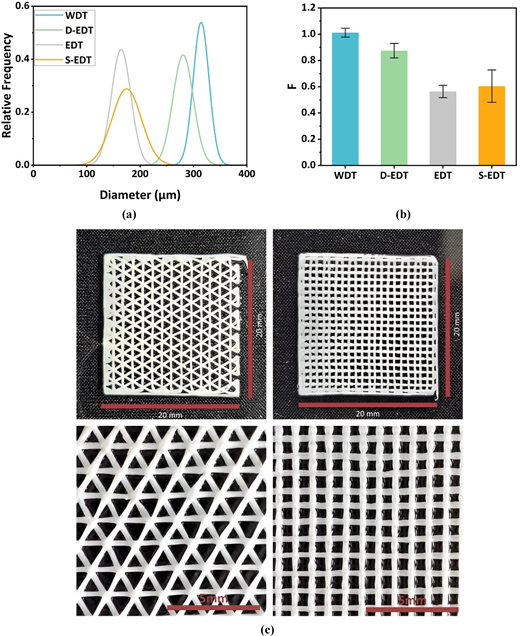
The diameter distribution diagram of the printed strands and printability parameter for each sample are presented in Figure 6. Figure 6(a) depicts all four groups of printed sample diameter distributions. In WDT samples, the peak of the curve falls within the range of 310–330 µm. This indicates that the printed strands in water have minimal diameter fluctuations. The coagulation process is rapid in this case, and the strands do not shrink significantly due to the type of spinodal phase separation. In contrast, the D-EDT sample experiences contraction, attributed to the nucleation and growth phase separation mechanisms. The peak of the curve is positioned at lower values compared to the diameter of the needle. Both the EDT and S-EDT samples exhibit the most significant shrinkage compared to the previous two samples. This intense contraction is due to the phase separation type, where the rate of solvent leaving the structure surpasses the rate of non-solvent entry, causing a strong contraction.
Figure 6(b) demonstrates printing fidelity for printed structures. The fidelity parameters are the ratio of experimental to preset diameter of samples, which can be calculated through equation (2) where Da is the actual and Dd is the designed diameter of strands. When F > 1, there is a positive deviation in the diameter of the printed strand compared to the standard value of the design. F < 1 indicates a shrinkage in the dimeter of the strands, while F = 1 indicates that the diameter of the printed strand is by preset values.
The value of F will be less than 1 when the mass flow rate is low or the printing speed is high. In this scenario, the material will be stretched and oriented during the printing process, resulting in a higher resolution. However, excessively increasing the speed or reducing the mass flow rate can cause the material to rupture and result in a discontinuous structure. As long as the material is consistently and accurately printed with high resolution, we consider it a “fine print”. Increasing the flow rate and decreasing the speed leads to an increase in the F parameter. In this case, the strand is not stretched regularly and is spread in place during printing, which ultimately increases the practical diameter compared to the design. Finally, this issue causes a significant fluctuation in diameter distribution and we report the printed structure as “poor print”. According to Figure 5(c), the structures were printed with nozzle speed and EM equal to 100 mm/min and 0.1, respectively [Figure 6(c)]. Although F < 1, structures have high resolution, but printing at the same speed and EM = 0.4 can lead to a non-uniform structure (Figure S6 in Supplementary material).
3.5 Water uptake
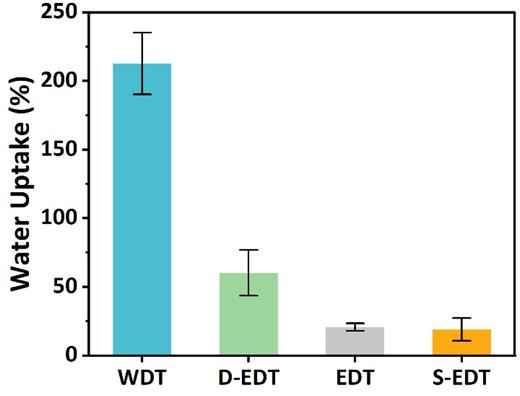
Water uptake diagram is shown in Figure 7. Due to its fingerlike pores, water can easily infiltrate between the pores, resulting in the WDT sample absorbing more than 200% of its weight in water. The sponge-like pores in the D-EDT sample allow less water to enter its structure, resulting in a lower water absorption compared to the WDT sample. The EDT and S-EDT samples absorb significantly less water due to the absence of porosity in their structures, and finally, these two samples absorb the least amount of water out of all the printed samples.
3.6 Water vapor transmission rate
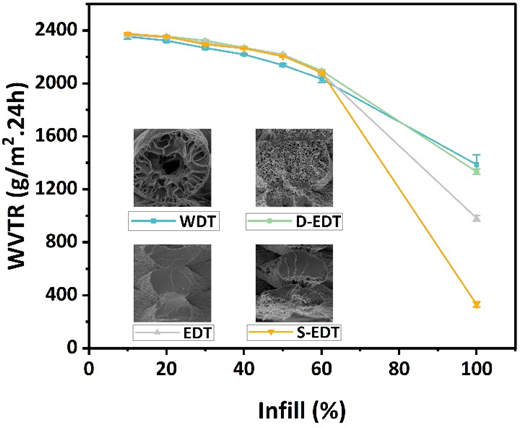
Figure 8 illustrates the impact of varying infill percentage on the WVTR for four groups of samples. Notably, the WVTR at 10% infill is consistent across all samples. However, as the infill percentage increases, the WDT sample exhibits a distinct trend compared to the others. At 100% infill, WDT and D-EDT samples show higher WVTR values compared to EDT and S-EDT. This behavior can be explained by the spinodal phase separation mechanism. The rapid phase change in WDT during printing leads to a strand diameter close to the needle diameter, resulting in lower WVTR at lower infill percentages. However, at 100% infill, some strand overlaps can happen. This overlap increases the thickness of the printed structure which in turn can result in the higher resistance to water vapor transmission rate. Conversely, the D-EDT sample forms foam-like pores during printing, allowing for easier water vapor passage. In addition, D-EDT strands have shrinkages during printing, resulting in a smaller diameter and higher initial WVTR compared to WDT at the same infill percentage. This trend holds for the EDT and S-EDT series as well. Interestingly, at 100% infill, the presence of these pores leads to a lower WVTR in D-EDT compared to WDT. Finally, the minimal porosity of EDT and S-EDT samples translates to the lowest overall WVTR. Printed structure for WVTR is shown in Figure S4 in Supplementary material.
Controlling WVTR is crucial for wound dressing applications. While large macroscopic pores facilitate high WVTR, they also increase the risk of bacterial infections. Therefore, materials with intrinsic pores offer a more suitable approach. This study demonstrates that ip-3DP allows for tailoring the porosity and, consequently, WVTR. By manipulating the infill percentage and phase separation behavior, we can tailor wound dressings with desired vapor transmission properties via intrinsic porosity rather than the extrinsic ones. Thus, the 3D-printed samples with intrinsic porosities (WDT and D-EDT) can be more suitable for wound dressing applications in WVTR point of view. Since the WVTR of ip-3D printed porous polyurethane (with fingerlike porosities) falls within the reported range of 2,000–3,000 g m–2 24 h–1 in the literature, it is suitable for wound dressing applications (Alizadehgiashi et al., 2021; Xu et al., 2016).
3.7 Mechanical properties
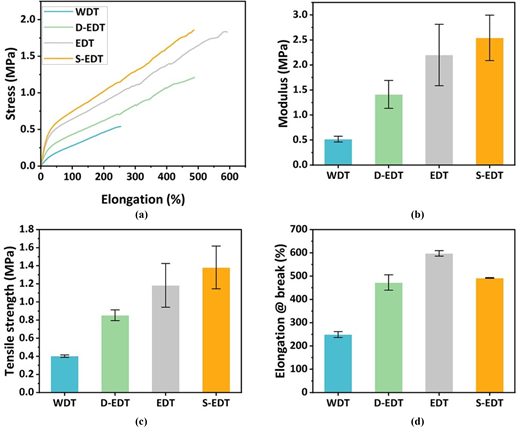
Figure 9 shows the mechanical properties of the four different groups of samples evaluated using the tensile test. In Figure 9(a), as a result of the fingerlike pores in the WDT sample, the mechanical properties are significantly reduced. Its modulus is sharply reduced due to its extensive porosity. Furthermore, the rapid solidification of the bottom layer during printing prevents proper adhesion between upper and bottom layers, which further diminishes mechanical properties. The D-EDT sample on the other hand shows improved mechanical properties compared to the WDT sample. In addition, smaller porosity contributes to increased tensile strength. Besides, slower coagulation during printing allows new layers to be integrated more efficiently with the underlying layers, enhancing interlayer adhesion and tensile strength. EDT sample exhibits higher strength than WDT and D-EDT samples. Due to the complete adhesion between layers and the lack of porosity within the structure, the structure exhibits a remarkable increase in modulus and tensile strength. The tensile modulus of the S-EDT sample is higher than that of the EDT sample. However, due to the presence of non-solvent in the print ink, the phase separation mechanism tends toward spinodal decomposition, resulting in a diminished elongation in compare with EDT sample. Figure 9(b)–(c) illustrates the modulus and tensile strength values of four groups of samples, respectively. Figure 9(d) provides specific values for elongation at break for all samples. It clearly shows that EDT and S-EDT samples have much higher mechanical properties than WDT and D-EDT samples. The optimal elastic modulus and strength should balance between providing adequate support and protection while allowing for movement and conformability to the wound site. The suitable tensile strength for wound dressing applications ranges from 0.32 to 5.26 MPa and the appropriate elongation ranges from 180 to 434%. Consequently, the mechanical properties of all the samples in this study are suitable for such applications (Khodabakhshi et al., 2019; Lee et al., 2016).
3.8 Metabolic activity
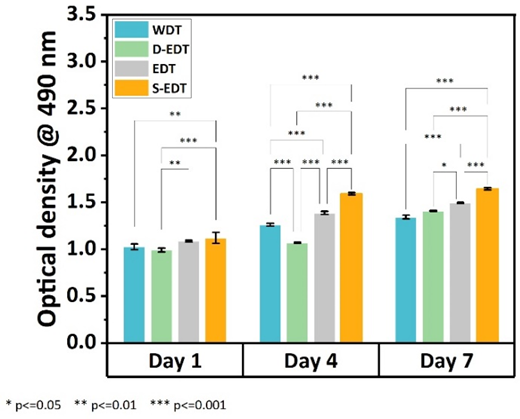
The metabolic activity of HDF-green fluorescent positive (GFP)+ cells cultured on samples was evaluated using an MTS assay on days 1, 4 and 7 (Figure 10). On day 1, WDT and D-EDT samples exhibited slightly lower metabolic activity compared to the other samples. This suggests that cell attachment and proliferation were initially lower on these materials. The difference in metabolic activity between day 1 and day 7 was more pronounced for EDT and S-EDT samples compared to the others. This indicates that cells on EDT and S-EDT samples exhibited a larger increase in activity over the culture period, suggesting that these materials may be more favorable for cell growth and proliferation.
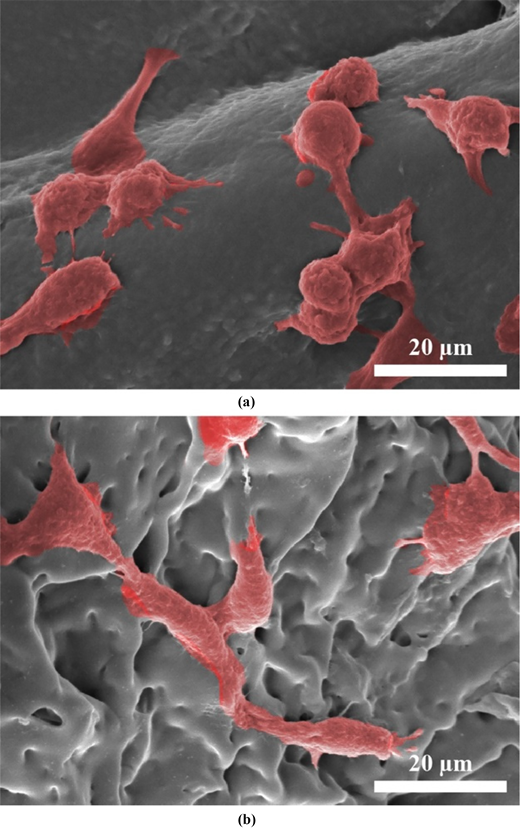
As discussed, Figure 5 demonstrates the variation in surface morphology of the 3D-printed samples depending on the solvent used. WDT samples printed in water exhibited the smoothest surface, while D-EDT samples were slightly rough. EDT and S-EDT samples displayed the roughest surfaces. These observations were further corroborated by the metabolic activity results, suggesting a correlation between surface roughness and cell attachment/proliferation. Rougher surfaces provided greater support for cell attachment, proliferation and spreading.
This correlation between surface morphology and cell behavior is crucial for tailoring materials to specific wound healing applications. It is important to note that the optimal properties of a wound dressing, including cell attachment, can vary depending on the specific type of wound, stage of healing and intended function of the dressing. Temporary wound dressings require minimal cell attachment (easy to remove) (Unnithan et al., 2016), while regeneration and permanent wound dressings benefit from enhanced cell attachment and proliferation (Rodrigues et al., 2019). Since the polyurethane used in this study is not biodegradable, the focus was on developing temporary wound dressings with reduced cell attachment to make them easier to remove and less traumatic to the wound site. Therefore, the smoother surface of WDT samples is preferable.
3.9 Live/dead assay
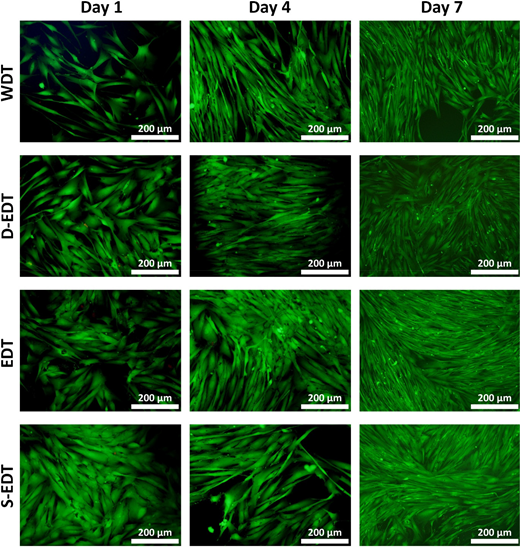
A live/dead assay was performed to assess cell viability on the samples. The low number of red fluorescent dead cells observed across all samples indicates minimal cytotoxicity associated with the samples (Figure 11). This is consistent with the metabolic activity data (Figure 10), suggesting that none of the ip-3D printed samples exhibited cytotoxicity. It is worth mentioning that all samples were submerged in pure ethanol for 24 h after printing to ensure complete removal of residual solvent. For in vitro studies, the samples were subsequently sterilized using 70% ethanol followed by UV light. These procedures ensured the absence of toxic solvents in the samples, as further confirmed by the live/dead assay.
3.10 Cell morphology
SEM images in Figure 12 further corroborate the influence of surface topography on cell morphology. The images depict HDF cells on WDT and EDT samples, showcasing a clear difference in cell spreading. Cells on the rougher EDT surface exhibit a more spread-out morphology compared to those on the smoother WDT surface. This observation aligns with the findings from the metabolic activity assay (Figure 10) and the live/dead assay (Figure 11). These results suggest that formed morphologies on the surface of samples may promote cell adhesion and encourage a more spread-out morphology, potentially leading to enhanced cell growth and proliferation (Mirzadeh and Bagheri, 2007).
Overall, the combined data from the metabolic activity assay, live/dead assay and SEM imaging (Figures 10–12) strongly suggest that ip-3D printing with varying solvent/non-solvent systems can be a versatile method for developing wound dressings with tailored properties. By manipulating the surface topography of the 3D-printed structures, this technique can control cell behavior and potentially optimize wound healing outcomes. This finding highlights the potential of ip-3D printing technology for creating advanced biomaterials for various biomedical applications. In addition, it can be concluded that for temporary wound dressings where reduced cell adhesion and spreading is favorable, the samples printed in water as a nonsolvent demonstrate better performance.
4. Conclusion
In this study, the ip-3D printing method was used as a versatile method to fabricate 3D-printed porous wound dressings with tailored topography and intrinsic porous structures. Comparing the cloud point test results and SEM images, showed the effect of solvent/non-solvent exchange rate on the microstructure of the 3D-printed polyurethanes. The phase separation mechanism of polyurethane ink varies depending on the type of non-solvent and the conditions of the polyurethane ink. Spinodal decomposition occurs if the composition path falls within the two-phase region. If it falls within the meta-stable region, the nucleation and growth mechanisms become dominant. A change in the direction of the composition path can be achieved by the addition of solvent to the coagulation bath or by the addition of non-solvent to the polyurethane ink. Finally, the microstructure of 3D-printed samples can vary from dense to foam-like to fingerlike. Based on the phase separation mechanism, the top surface of the sample can have different morphologies, which will ultimately affect the behavior of the cell growth on the printed structure. Pore size and topology have a significant effect on water uptake and WVTR. The water uptake and WVTR of dense structures and foam-like pores are lower, while the highest amount is found in fingerlike pores. In addition, the number, size and distribution of pores affect the mechanical properties of the samples. Mechanical properties of all groups of samples were in the acceptable range for wound dressing. WDT samples have the lowest tensile modulus and strength while S-EDT samples have the highest ones. According to results of the metabolic activity assay, cell morphology study and live/dead assay, the samples are nontoxic. In addition, these findings demonstrate a potential link between surface topography and cell attachment/proliferation, highlighting the importance of considering surface design for optimizing wound healing applications.
Overall, this research demonstrates the versatility of ip-3D printing for developing advanced wound dressings with tunable properties. By manipulating the phase separation process, we can control surface roughness and porosity and potentially influence cell behavior to promote wound healing. The successful application of ip-3D printing in this study paves the way for its exploration in other biomedical fields and various functionalities, especially in tissue engineering applications where porosity and surface roughness play a crucial role. In future works, functional elements, such as antimicrobial agents or growth factors, could be incorporated into the wound dressing for enhanced therapeutic effects.
Acknowledgements
The authors acknowledge the use of AI tools, such as ChatGPT and Gemini, for linguistic editing of the manuscript.
References
Supplementary material
The supplementary material for this article can be found online.