


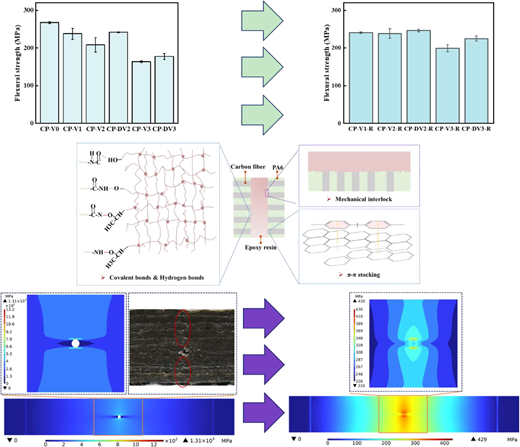
In additive manufacturing of fiber-reinforced composites, fused deposition modeling (FDM) has been widely adopted due to its low complexity and high flexibility. However, the formation of void defects during the process severely limits the mechanical performance of printed components. This study aims to systematically investigate the influence of void orientation, size, and distribution on the mechanical properties of 3D-printed carbon fiber/PA6 composites, and to explore an epoxy resin repair strategy for performance enhancement.
In this study, short carbon fiber/polyamide 6 (SCF/PA6) and continuous carbon fiber/polyamide 6 (CCF/PA6) composites were used, and different types of void defects were designed to investigate the influence of void orientation, size and distribution patterns on mechanical properties.
The results demonstrate that when void defects are oriented differently, composites containing voids in the Z-direction exhibit the lowest strength, reaching 83.6 MPa. Regarding defect size and distribution, the failure of fiber-reinforced composites is governed by stress–strain interactions, where both competitive and synergistic mechanisms coexist.
Furthermore, this work proposes an epoxy resin repair strategy, which enhances the mechanical performance of composites through combined physical and chemical interactions.


