The study aims to analyze the relationship between seismic damage to various railway infrastructures and seismic intensity through historical seismic damage investigations of conventional railways, thereby addressing the issues of a lack of focus in post-earthquake inspections and prolonged train service restoration times after seismic events.
Post-earthquake railway inspection data were collected from 6 historical earthquakes in Xinjiang and 4 in the Sichuan-Yunnan region through field surveys and data research. Longitude and latitude coordinates of damaged sections were calculated according to their kilometer markers (K marks) and visualized on maps. The approximate seismic intensity at each damage site was estimated using intensity attenuation relationships or instrumental intensity data from adjacent stations, and empirical patterns of seismic damage modes were summarized.
Through investigations of historical seismic data and actual railway damage in Xinjiang and the Sichuan-Yunnan region, results indicate that in areas with seismic intensity greater than Level V (I > V), main structural damage to conventional railway infrastructure occurs. This includes cracking of bridge piers and abutments, differential settlement at bridge ends, track distortion, fracture of tunnel portals, and edge collapse, all of which disrupt train operations. In contrast, in areas with seismic intensity of Level V or below (I = V), no records indicate that earthquakes caused main structural damage to conventional railway infrastructure. Only damage to ancillary facilities was observed, such as concrete spalling from girders, cracking of transverse diaphragms, damaged protective cones, deformed limiters, and cracks in subgrade slopes—none of which affect train passage.
Based on investigations into the post-earthquake infrastructure conditions of conventional-speed railways in earthquake-prone regions of China such as Xinjiang, Sichuan and Yunnan after 10 historical earthquakes, this study analyzed the correlation between seismic damage and corresponding seismic intensities using instrumental intensity data from surrounding seismic stations and intensity attenuation laws. A conclusion was drawn that train operation remains unaffected in areas with seismic intensity no higher than V (I = V). For the first time, this research established a correlation between post-earthquake damage to conventional-speed railways and seismic intensity, and identified the safety threshold at seismic intensity V. The findings enable railway personnel to conduct targeted post-earthquake inspections, significantly reduce inspection workload, and alleviate the pressure on post-earthquake operation recovery.
1. Introduction
Earthquakes are among the most destructive natural disasters for railway transportation. Seismic events can directly damage railway infrastructure, leading to major operational accidents such as train derailments and overturning (Sun, Xuan, Jiang, Wang, & Song, 2023; Zhang, 2014). China's total railway operational mileage exceeds 140,000 kilometers, of which approximately 100,000 kilometers are conventional railways distributed extensively across the country (Jiang et al., 2019; China Railway Corporation, 2018; Yang, Sun, & Wei, 2025). For post-earthquake emergency response, railway authorities currently rely on documents such as the “Regulations for Emergency Seismic Response of Conventional Railway Infrastructure” and the “Railway Earthquake Emergency Plan,” which stipulate procedures for speed restrictions, line inspections, and emergency measures following earthquakes (China Railway Corporation, 2018). Based on practical emergency handling experience, railway administrations typically suspend operations immediately after a seismic event and conduct comprehensive line inspections. Trains are gradually resumed only after manual verification of track and equipment conditions.
In practice, due to conservative safety considerations, post-earthquake inspections often lack focus and exceed necessary ranges. The restoration of train services after earthquakes is prolonged, typically requiring 2–4 hours even for non-destructive seismic events to complete inspections and resume operations. Consequently, post-earthquake inspection work imposes significant demands on manpower and resources, substantially impacting railway transportation.
Recent studies show that seismic damage is strongly intensity-dependent, although motion characteristics and structural conditions also affect fragility and failure probability (Li, 2025; Li, 2026a, b; Li et al., 2025; Li & Xu, 2026). This trend is consistent with recent railway findings from the Science and Technology Research and Development Program Project of China State Railway Group Co., Ltd. (N2022G019), which indicate clear safety-intensity thresholds for railway bridges and tunnels. For conventional-speed simply supported railway bridges, the safety intensity threshold is generally intensity VI for structures designed to the 2009 code, but may decrease to intensity V for older structures designed to the 1977 or 1987 codes. For tunnels, the corresponding safety intensity threshold is intensity VI, beyond which structural damage may begin to develop.
As a seismically active country, particularly in regions like Xinjiang and Sichuan-Yunnan, China possesses unique advantages for investigating seismic damage to conventional railways. By analyzing damage patterns across various infrastructure types—using waveform records from near-epicenter stations (Zhu, Sun, Li, Yao, & Song, 2024a; Zhu et al., 2024b), measured instrumental intensity data (Bai, Huang, & Zhang, 2015), and empirical intensity attenuation formulas (Sun, Wang, & Zhou, 2022; Hu, 2017)—this study establishes correlations between seismic intensity and infrastructure damage. This approach aims to identify safe intensity thresholds for post-earthquake train operations, facilitating graded and zoned inspection strategies to alleviate restoration pressures.
Regarding criteria for determining operational feasibility, management rules such as the “Rules for Maintenance of Conventional Railway Bridges and Tunnels” and the “Regulations for Emergency Seismic Response of Conventional Railway Infrastructure” require assessing whether seismic damage affects main structural components and compromises track geometry parameters. Investigations of 6 earthquakes in Xinjiang and 4 in the Sichuan-Yunnan region indicate that Intensity V (I=V) serves as the critical threshold for train operational safety. This finding enables railway authorities to implement targeted inspection protocols based on seismic intensity zones, effectively avoiding excessive inspection ranges and low operational restoration efficiency.
2. Correlation method between seismic intensity and damage
The seismic intensity attenuation relationship is an empirical formula that establishes the relationship between intensity, magnitude, and distance. In the standard for the fifth-generation seismic ground motion parameter zoning map (GB18306-2015), the compilers developed a seismic ground motion attenuation relationship model suitable for China (as shown in Equation (1) (Yu, Li, & Xiao, 2013)), based on a large number of domestic and foreign strong motion records, research results such as the American NGA (Next Generation Attenuation), and China’s regional observation data and actual conditions.
Where is the seismic intensity, , , , are regression coefficients, is the surface wave magnitude, and is the epicentral distance.
In the standard, China is generally divided into four major regions according to seismic zones: the Eastern Strong Earthquake Region, the Moderate-Strong Earthquake Region, the Xinjiang Region, and the Qinghai-Tibet Region, each corresponding to different regression coefficients, as shown in Table 1.
In this study, the location of the seismic source area is determined based on the three elements of the seismic source where the earthquake occurred. According to the magnitude of the earthquake and I=IV, V, VI, VII, VIII respectively, the range of the circle with R as the radius is obtained, which corresponds to the influence range of intensity IV ∼ VIII degrees. Longitude and latitude coordinates are calculated according to the approximate locations (K marks) of railway damaged points and displayed on a map. Then the approximate seismic intensity at the damaged points is deduced based on the intensity attenuation relationship or nearby instrumental seismic intensity, so as to establish the correlation.
The seismic intensity attenuation relationship is derived empirically based on a certain sample size, and the estimated results may have certain deviations from the actual measured values. However, since the vast majority of areas in China are not densely equipped with seismic stations, estimating the post-earthquake intensity in any region of China based on the seismic intensity attenuation relationship is a common practice in the industry at present. If there is a better attenuation relationship that conforms to local characteristics in a specific region, it can be cited separately, which will not be repeated here.
3. Earthquake damage investigation
China's vast territory is highly seismically active. According to incomplete statistics, from ancient times to 2024, over 70,000 seismic events have occurred within China and its surrounding regions (Zhu et al., 2025; Liu, Sun, Li, Zhou, & Song, 2024). Since the founding of the People's Republic of China, railway construction has undergone rapid expansion, with a dense network of conventional railways connecting cities across the nation. This extensive infrastructure exhibits significant temporal and spatial overlap with seismically active zones.
3.1 Xinjiang region
According to the National Earthquake Network seismic catalog, the Xinjiang region experienced 1,961 recorded earthquakes over the past decade. Statistical analysis of seismic distribution reveals that epicenters were primarily concentrated in: (1) the vicinity of Kashgar City, (2) Pishan County, Hotan Prefecture, (3) the Jinghe County area, Bortala Mongol Autonomous Prefecture, (4) the Xinhe County region, Aksu Prefecture, and (5) southern Minfeng County, Hotan Prefecture. This study selected six historically significant earthquakes in Xinjiang with documented railway damage for field investigations and data research. Post-earthquake inspection reports, work summaries, and disaster loss records from relevant departments (including railway maintenance units) were collected. Utilizing waveform records from seismic stations near epicenters (provided by earthquake administrations), measured instrumental intensity data, Peak Ground Acceleration (PGA) parameters, and empirical intensity attenuation formulas, statistical analysis was conducted on the damage patterns of typical railway lines in Xinjiang under different seismic intensities.
M6.6 Earthquake in Bayingolin Mongol Autonomous Prefecture
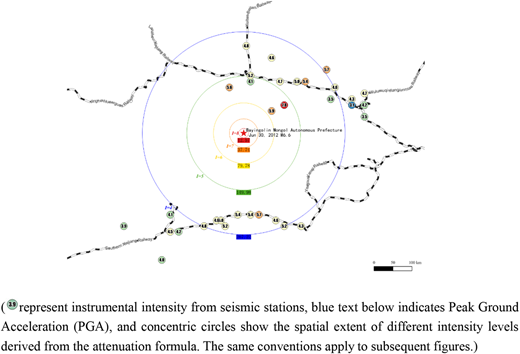
At 05:07 on June 30, 2012, a magnitude 6.6 earthquake struck the border region between Xinyuan County (Ili Kazakh Autonomous Prefecture) and Hejing County (Bayingolin Mongol Autonomous Prefecture). According to statistical records, infrastructure along several railways in Xinjiang sustained varying degrees of damage. The positional relationship between the seismic intensity distribution map and the railway lines is illustrated in Figure 1, and the primary seismic damage conditions and corresponding estimated seismic intensities are listed in Table 2.
Based on measured instrumental intensity and calculated intensity from attenuation formulas, the maximum seismic intensity affecting railway lines during this event did not exceed Intensity VI, with most areas experiencing Intensity V. Corresponding impacts included subgrade cracking and damage to bridge limiters.
M7.3 Earthquake in Yutian County, Hotan Prefecture
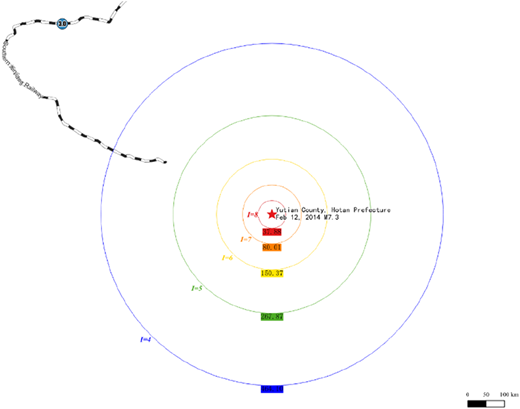
At 17:19 on February 12, 2014, a magnitude 7.3 earthquake struck Yutian County in Hotan Prefecture, Xinjiang. Strong shaking was felt in Hotan Prefecture, Kashgar Prefecture, Bohu County, Kuqa County, and Luntai County. The event significantly impacted a major railway in southern Xinjiang, affecting a 1,284-km section between Luntai and Hotan. The positional relationship between the seismic intensity distribution map and the railway lines is illustrated in Figure 2, and the primary seismic damage conditions and corresponding estimated seismic intensities are listed in Table 3.
Based on measured instrumental intensity and calculated intensity from attenuation formulas, the maximum seismic intensity affecting railway lines during this event did not exceed Intensity V, with most structural damage concentrated in Intensity V zones. Corresponding impacts included: longitudinal cracks and subsidence of subgrade slopes with varying severity, alterations in track geometry; damage to ancillary facilities such as bridge/culvert protective cones and diversion embankments; failure of seismic protection devices on bridges; concrete spalling from girders and cracking in transverse diaphragms; and ballast loss observed even in Intensity IV zones. These findings demonstrate how intensity-based damage patterns can inform targeted post-earthquake inspection strategies.
M6.5 Earthquake in Pishan County, Hotan Prefecture
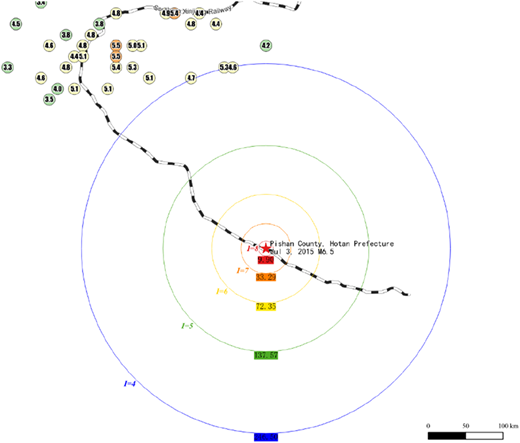
At 09:07 on July 3, 2015, a magnitude 6.5 earthquake occurred in Pishan County, Hotan Prefecture, Xinjiang. With its epicenter located near Pishan Station on the Southern Xinjiang Railway, the event caused varying degrees of damage to the section between Yijianfang and Hotan. The positional relationship between the seismic intensity distribution map and the railway lines is illustrated in Figure 3, and the primary seismic damage conditions and corresponding estimated seismic intensities are listed in Table 4.
Based on measured instrumental intensity and calculated intensity from attenuation formulas, the maximum seismic intensity near railway lines during this event reached Intensity VIII, with damage predominantly concentrated in Intensity V-VIII zones. The seismic impacts caused differential settlement of subgrade slopes, lateral displacement and shearing of bridge bearings, as well as cracking and failure of bridges, culverts, and ancillary facilities. These damage patterns demonstrate the correlation between seismic intensity levels and infrastructure vulnerability, providing critical data for optimizing post-earthquake inspection protocols and reinforcement strategies.
M6.6 Earthquake in Jinghe County, Bortala Mongol Autonomous Prefecture
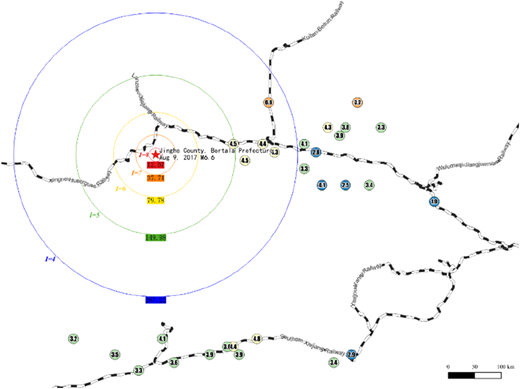
At 07:42 on August 9, 2017, a magnitude 6.6 earthquake struck Jinghe County, Bortala Mongol Autonomous Prefecture, Xinjiang. Strong shaking was felt in the Kuituan Railway Maintenance Section, with noticeable tremors recorded in the Ürümqi, High-Speed Railway, Aksu, and Korla Maintenance Sections. Affected lines included the several main railways in northern and southern Xinjiang as well as some branch lines. The positional relationship between the seismic intensity distribution map and the railway lines is illustrated in Figure 4, and the primary seismic damage conditions and corresponding estimated seismic intensities are listed in Table 5.
Based on measured instrumental intensity and calculated intensity from attenuation formulas, the maximum seismic intensity near the railway lines during this event reached Intensity VIII, with the most severe damage concentrated in Intensity VII-VIII zones. This resulted in significant deterioration of track geometry, cracking and failure of bridge protective cones and pier/beam restraint devices, fracture of tunnel portal structures, as well as broken catenary support poles and severed contact wires.
M6.4 earthquake in Jiashi County, Kashgar Prefecture
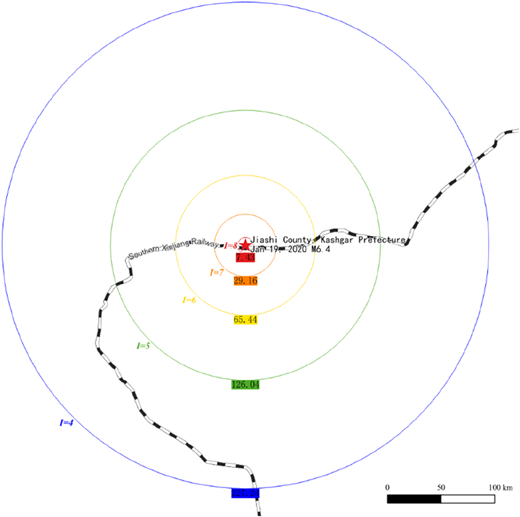
At 21:27 on January 19, 2020, a magnitude 6.4 earthquake struck Jiashi County, Kashgar Prefecture, Xinjiang. With its epicenter approximately 2.2 km from a major railway in southern Xinjiang, strong tremors were felt at all stations between Aksu Station, Kona Station, and Shache Station along the line. The positional relationship between the seismic intensity distribution map and the railway lines is illustrated in Figure 5, and the primary seismic damage conditions and corresponding estimated seismic intensities are listed in Table 6.
Based on the calculations of measured instrumental intensity and intensity derived from the attenuation formula, it is known that the seismic intensity at the closest points of various railway lines during this earthquake reached Grade VIII. Most severely damaged areas were concentrated in Intensity VI-VIII zones. The damages mainly included: displacement of bridge girders and bearings; uneven settlement, heaving of railway tracks; scattering of ballast, ballast shortage in the track bed; settlement, heaving, cracking, and step displacement of subgrades; structural cracks in bridge piers and abutments; damage to bridge protection cones; severe cracking of station buildings; and collapse of enclosing walls.
M5.8 earthquake at the Border of Artux City and Jiashi County, Xinjiang
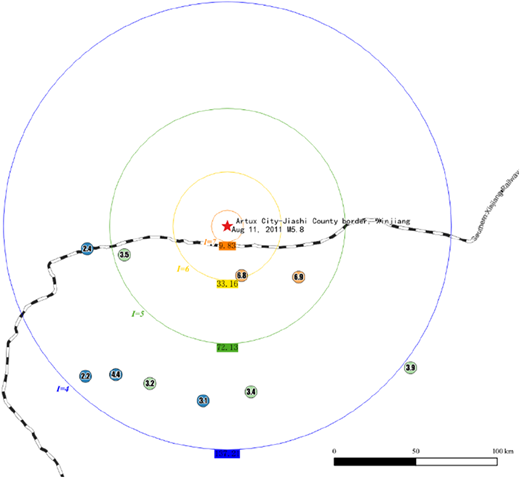
At 18:06 on August 11, 2011, a magnitude 5.8 earthquake occurred at the border of Artux City and Jiashi County, Xinjiang. The earthquake affected the track and bridge equipment between Wudaoban and Bapanmo on a major railway in southern Xinjiang. The positional relationship between the seismic intensity distribution map and the railway lines is illustrated in Figure 6, and the primary seismic damage conditions and corresponding estimated seismic intensities are listed in Table 7.
According to calculated intensity from attenuation formulas, the maximum seismic intensity near the railway lines during this event reached Intensity VII, with the most severe damage concentrated in Intensity VI-VII zones. The impacts on the Southern Xinjiang Railway included track alignment deviations, subgrade settlement, lateral displacement of beams, bridge deck arching, and other structural deformations.
3.2 Sichuan-Yunnan region
Consistent with the research methodology adopted in the Xinjiang region, major historical earthquakes that caused documented railway damage within the jurisdictions of China Railway Chengdu Group Co., Ltd. and China Railway Kunming Group Co., Ltd. were selected for this analysis. Post-earthquake inspection reports, disaster loss records, and other official documents from railway management departments were collected. By integrating seismic station waveform records, instrumental intensity measurements, Peak Ground Acceleration (PGA) data, and empirical intensity attenuation formulas, a unified statistical analysis of railway damage characteristics under different seismic intensity levels was conducted.
Based on the analytical framework, four representative earthquake events in the Sichuan-Yunnan region were investigated. The core information of these events and the corresponding railway damage conditions are summarized in Table 8.
4. Results of historical seismic damage analysis
Through the investigation of historical earthquake data and actual railway seismic damage in the Xinjiang Uygur Autonomous Region and the Sichuan-Yunnan Region, the following patterns are identified (see Table 9):
Based on historical earthquake data, in areas where the seismic intensity is greater than Grade V (), there is structural damage to the main body of conventional-speed railway infrastructure. This leads to damages such as cracks in bridge piers and abutments, uneven settlement at both ends of bridges, track distortion, fractures at tunnel portals, and edge collapse, which affect train operation.
In contrast, in areas where the seismic intensity is less than or equal to Grade V (), there is no record of any seismic-induced structural damage to the main body of conventional-speed railway infrastructure. Only damage to auxiliary facilities occurs, such as spalling of beam bodies, cracks in diaphragms, damage to protective cones, deformation of stoppers, and cracks in subgrade slopes. Such damages do not affect train operation.
5. Conclusion
Given that post-earthquake inspection of conventional-speed railway infrastructure involves heavy workload and low efficiency in resuming operation, this study determines the longitude and latitude coordinates of railway damage sites based on seismic damage investigation data of conventional-speed railway infrastructure in Xinjiang, Sichuan and Yunnan regions of China. Combined with instrumental intensity data from surrounding seismic stations and the law of seismic intensity attenuation, the correlation between damage conditions and corresponding seismic intensity is analyzed. A conclusion is drawn that in areas with seismic intensity no higher than V (I ≤ V) based on historical earthquake data, only ancillary facilities suffer damage, which will not affect train operation. This conclusion helps railway staff narrow down the post-earthquake inspection scope by levels and regions on the premise of ensuring safety, thus alleviating the pressure on post-earthquake operation recovery.