

This paper discusses the evolution of sustainability reporting and the role of the Global Reporting Initiative (GRI) in relation to the social and environmental accounting (SEA) literature calling for a revolution in the standardization of sustainability reporting and the inherent complexities. This paper focuses on the future role of GRI in light of the changes resulting from harmonization supported by the International Sustainability Standards Board and the European Financial Reporting Advisory Group’s draft European Sustainability Reporting Directive.
Building on Bourdieu (1983, 1992) and SEA studies, the authors adopt a critical and qualitative approach to theorize power dynamics in the sustainability reporting field. After identifying the main issues arising from the complexity of the sustainability reporting standards and practices according to SEA scholars, the authors connect them with Bourdieu’s (1992, 1983) field theory to discuss the future role of GRI.
The findings suggest two distinct but intertwined roles that GRI could play in the future, namely, power related and theoretical/technical, aimed at engendering revolutionary rather than evolutionary changes in sustainability reporting.
This study offers practical implications for GRI to strengthen its future role in sustainability reporting standardization.
The limited time available to mitigate the disastrous consequences of non-sustainable business on society and the environment calls for urgently addressing the complexities of sustainability accounting to foster a positive impact on society and the environment.
The authors’ reflections reclaim the SEA literature as central to identifying sustainability complexity and Bourdieu’s (1983, 1992) notions of power as key to understanding the role of GRI in the sustainability field. Furthermore, this paper emphasizes the intersection of different critical concepts, including power, complexity, value, capital and materiality.
1. Introduction
This article offers some critical reflections on the (r)evolution of sustainability reporting and the role of the Global Reporting Initiative (GRI) (Milne et al., 2009; Milne and Gray, 2013; Boiral, 2013). Inspired by social and environmental accounting (SEA) studies (Gray and Milne, 2002), our considerations are based on the notions of field and power according to Bourdieu’s (1983, 1992, 1993) praxeology.
The topic of sustainability is particularly relevant given a number of recent changes, such as the launch of the International Sustainability Standards Board (ISSB) (IFRS Foundation, 2020, 2021a, 2021b, 2022) and the European Financial Reporting Advisory Group’s (EFRAG) set of standards that will be adopted by firms within the European Union (EU) boundaries due to the directive which the EU enacted.
The complexities related to the development of sustainability reporting can only be fully recognized and understood by retracing the roots of the social accounting project (Gray et al., 1996, 1997) which had strong environmental concerns at its heart (Gray and Bebbington, 2000; Gray, 2008). The pioneers of sustainability studies called for an accounting revolution (Gray, 2002) capable of broadening the scope from mere financial accounting to including sustainability instances (Gray and Milne, 2015; Buhr et al., 2014). In defining how nonfinancial sustainability reporting should be designed, the dream of scholars actively promoting this profound change in accounting (Gray et al., 2009; Gray, 2010a, 2010b) encountered several obstacles and complexities (Bebbington and Gray, 2001; Mook et al., 2007) that have yet to be fully considered in the debate on the future of GRI and the sustainability field. This lack of recognition in studies pointing out the difficulties in designing sustainability reporting is to some extent surprising given the need for “a detailed and complex analysis of the organization’s interactions with ecological systems, resources, habitats and societies” (Gray and Milne, 2002, p. 69; Buhr et al., 2014). Ensuring sustainability through accounting implies addressing the complexities arising from the interaction of economic, social and environmental issues. The Oxford English Dictionary defines complexity as “a number of dissimilar parts intricately related.” These intricately related parts can be understood in their interrelations and reassemblage. Numerous scholars in different disciplines have studied the issue of complexity and ways of dealing with it (Fateman, 1992; Barnsley, 2014; Heylighen et al., 2007). Managing complexity means recognizing the different components of a phenomenon and arriving at a certain degree of simplification that simultaneously allows maintaining the interrelations among the various parts that make the phenomenon complex and to manage them. The simplification process requires time and solutions capable of neither flattening complexity by rhetorically referring to its reduction (de Villiers et al., 2022) nor ignoring or not recognizing some of the issues by obscuring differences and nuances that stem from the multiple interconnections of the phenomenon.
The complexity inherent in extending reporting to include the impacts of sustainability has resulted in a plethora of ideas on how to standardize reporting documents with international and local flavors (Gray, 2002, 2010a). GRI has played a crucial role in addressing the problem of guiding practitioners toward a more standardized approach to sustainability reporting, becoming a central reference (Adams and Abhayawansa, 2022).
Nevertheless, the role of GRI is challenged by a new scenario that could significantly change its future (Giner and Luque-Vílchez, 2022; Luque-Vílchez et al., 2021), namely, new and growing sustainability projects aimed at impacting the global level. Therefore, new power dynamics among different actors are developing and will arguably influence and shape the future of sustainability reporting. A process of harmonization and convergence similar to the financial accounting field, but likely over a shorter period of time, is occurring (Giner and Luque-Vílchez, 2022; Howitt, 2022). Scholars are questioning the opportunities of the new era of harmonization in sustainability reporting resulting from the new equilibrium of power in the field (Abela, 2022; Adams and Cho, 2020; Adams and Abhayawansa, 2022; Giner and Luque-Vílchez, 2022). In an interview, Eric Hespenheide (Chairman of the GRI Board of Directors) expressed a certain degree of optimism but also concern, “We have an overarching concern that International Financial Reporting Standards (IFRS) is using sustainability standards and reporting in a narrow sense compared to GRI” (Wadsworth, 2022).
Considering the lack of studies on the power dynamics in the field of sustainability and the need to address the underestimated complexities identified by SEA scholars, our paper proposes a reflection on the future role of GRI to address the question:
How might power dynamics be identified and managed to enable GRI to face the key complexities of the sustainability reporting field?
To answer this question, we adopt an interpretive-theoretical stance (Abela, 2022) to discuss the future of GRI using the constructs of power and hierarchy elaborated in Bourdieu’s (1983, 1992) field theory and consider the need to manage the critical complexities that SEA scholars have identified in the sustainability field.
Our main contribution draws on field theory to examine the inherent power dynamics among different actors in the sustainability reporting field and how GRI might leverage its power in the future. Our theoretical approach illuminates some key issues that GRI might face in maintaining a dominant position in the sustainability field and enabling a revolution aimed at addressing planetary social and environmental issues. In particular, we show that GRI could not only leverage specific competencies to face complex sustainability issues but also strengthen its power in the field and in alliances with other actors playing a major role therein. In addition, we systematize parts of the critical stance of the SEA literature at the service of the development of sustainability reporting standards, helping practiotioners not to ignore key issues that scholars have identified in decades of study.
Finally, our paper has practical implications for standard setters that should consider how the equilibrium of power within the sustainability reporting field could be modified to benefit from GRI competencies and establish fruitful alliances among the different actors in the field.
The remainder of the paper is organized as follows. We first illustrate our methodology (Section 2). Then, we introduce field theory to explain the position of GRI in the sustainability field, and the critical stance of SEA and sustainability accounting and management studies to discuss key complexities in the sustainability domain (Section 3). Thereafter, we theorize the role of GRI in this domain guided by Bourdieusian praxeology (Section 4). Finally, we conclude by distinguishing between flattening and addressing the complexities that an accounting revolution implies (Section 5).
2. Methodology
In this paper, we adopt an interpretive approach (Abela, 2022) and propose a theoretical stance at the intersection of field theory (Bourdieu, 1983, 1992) and the sustainability reporting complexity identified by SEA scholars, focusing on the concept of hierarchy.
The starting point of our work is the thought of Bourdieu (1983, 1992) on the dynamics that create a hierarchy of power in a field: we use these lenses to analyze the sustainability reporting field.
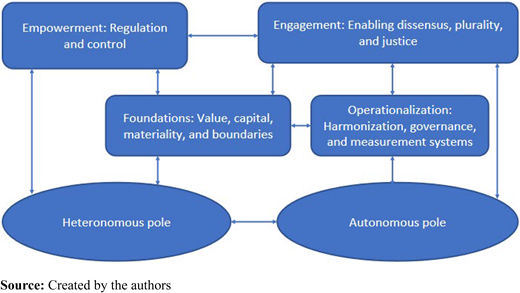
Then, we analyze some recent contributions (Abela, 2022; Abhayawansa, 2022; Adams and Abhayawansa, 2022; Adams and Mueller, 2022; de Villiers et al., 2022; Costa et al., 2022; Giner and Luque-Vílchez, 2022) to the debate on the evolution of the sustainability reporting field. The content of these studies has been coded (O’Dwyer, 2004), and as a result, some emerging complexities in the sustainability field have been identified. Hence, the following four main categories have been isolated:
empowerment: Regulation and control (de Villiers et al., 2022);
engagement: Enabling dissensus, plurality and justice (Abela, 2022; Adams and Mueller, 2022; Costa et al., 2022);
foundations: Notions of value, capital, materiality and boundary (Abela, 2022; Abhayawansa, 2022; Adams et al., 2021; Adams and Mueller, 2022; de Villiers et al., 2022; Giner and Luque-Vílchez, 2022; Jørgensen et al., 2022); and
operationalizations: Harmonization, governance and measurement systems (Adams and Abhayawansa, 2022; Costa et al., 2022).
Then, we also link the identified categories to longstanding debates in SEA studies. Reviewing the SEA literature for each of the four categories allows for summarizing the building blocks of the related debates.
Finally, our theoretical discussion on the future of the GRI interrelates the four key complexities in the sustainability field with two main categories (autonomous and heteronomous) determining the hierarchy of power in the Bourdieusian construct (Bourdieu, 1983, 1992). In sum, we develop a theory of power dynamics in the sustainability reporting field to discuss how GRI might face the complexities at the core of this field.
3. Theoretical background and relevant literature
3.1 Theoretical insights: hierarchy and power in the sustainability field
Scholars have investigated changes in sustainability reporting through the lenses of institutional theory (Larrinaga and Bebbington, 2021), mobilizing the notion of isomorphism to explain the diffusion of the GRI approach. Furthermore, legitimacy theory (de Villiers et al., 2022) has been applied in these studies highlighting that the legitimacy of GRI is the result of experience and competence in supporting organizations in recognizing material issues and improving sustainability performance and reporting quality (Chen et al., 2015).
We argue that field theory in the Bourdieusian elaboration (Bourdieu, 1983; Mangez and Liénard, 2015) can add another flavor to the study of changes occurring in the realm of sustainability to understand the future role that GRI might play therein.
In line with Bourdieu’s praxeology, fields are “relatively autonomous social spaces [that] constitute around a particular activity, which have been constructed historically through struggles and power relation” (Mangez and Liénard, 2015, p. 184). In this paper, we refer to sustainability as a field in which several actors, among which GRI, compete and assume different hierarchical positions that depend on power relations (Bourdieu, 1983). Indeed, many scholars and practitioners consider GRI as one of the more (if not the most) authoritative in the field of sustainability, long playing a leading role (de Villiers et al., 2022).
In the Bourdieusian perspective, actors occupy different positions that reflect the hierarchies established in each field (Mounier, 2001). What places GRI in a hierarchical position in the sustainability field is the specific experience developed and refined over time (Adams and Mueller, 2022). Furthermore, the GRI competencies are linked explicitly to sustainability and related values; this means that the position that it occupies, in Bourdieusian terminology, stems from autonomous hierarchy, namely, from coherent values, at the foundation of that field (Hilgers and Mangez, 2014). In each field, two categories of hierarchies compete:
the autonomous, allowing the actors to occupy a position by virtue of values grounded in the values of the field; and
the heteronomous, allowing the actors to occupy a position by virtue of other principles of hierarchy.
The heteronomous hierarchy descends from “outside” the specific values of the field, often linked to economic and political powers (Bourdieu, 1983). The sustainability field is also influenced by the heteronomous principles of hierarchy descending from other fields that are in some ways related to sustainability but based on other values, such as financial reporting principles and financial notions of value. Going further, Bourdieu (1983, 1992) defined the “meta-field” of power that is overarching, influencing every field and where two opposite poles compete, namely, the economic and cultural (Vandenberghe, 1999; Bourdieu, 1983, 1992; Albu et al., 2022).
Thus, in the field of sustainability, the autonomous values of the field that establish the hierarchy among actors positing GRI in an authoritative position are challenged by the influence of the field of power, which sets the rules based on the ownership of economic versus cultural stocks of capital (Bourdieu, 1983). The autonomous versus heteronomous hierarchies in the field, together with the features of the field of power as defined by Bourdieu, may help explain how the ISSB entered the sustainability field attempting to occupy a hierarchical position (Adams and Mueller, 2022). In this regard, Abela (2022) suggests that the ISSB is a power holder by virtue of values that in Bourdieusian language can be defined as heteronomous with respect to the sustainability field, because they are related to financial accounting and the idea of capitalism. Under the Bourdieusian lens, ISSB’s entry in the sustainability field might be attributable to the interplay between economic and cultural capital. To understand why the ISSB holds strong power related to economic capital requires recalling that it stems from the International Accounting Standards Board (IASB), a pivotal actor in the field of economics shaping the definition of capital and profit. Furthermore, many actors interested in the sustainability field are large listed companies adopting IFRS. Finally, the IASB has shown its ability to exercise strong political power to the point of making its principles mandatory in several countries.
Finally, Bourdieu introduced the idea that alliances among actors can be another key element of enabling dominance in the field (Bourdieu, 1988). Alliances often occur among actors with a common background, or in Bourdieusian terms, a common habitus (Bourdieu, 1988).
We argue that to enable a revolution, the actors in the sustainability field must manage some key and complex issues, leveraging autonomous values in respect of the field (descending knowledge and expertise), to gain power in the field. Furthermore, alliances among different actors in the field may allow to gain power from heteronomous sources of hierarchy.
The next section illustrates some fundamental complexities identified by SEA scholars in the sustainability field.
3.2 Social and environmental accounting studies and complexity in sustainability reporting
A detailed reading of recent contributions in the realm of the development of sustainability reporting (Abela, 2022; Abhayawansa, 2022; Adams and Abhayawansa, 2022; Adams and Mueller, 2022; de Villiers et al., 2022; Costa et al., 2022; Giner and Luque-Vílchez, 2022) and the categorization of the emerging issues in this literature have led to identifying the following complexities in longstanding debates in SEA studies.
3.3 Empowerment: regulation and control
A warhorse of advocates criticizing the status quo of sustainability reporting is the need for regulatory enforcement (Tilling and Tilt, 2010). The voluntary nature of nonfinancial disclosure, together with limited regulatory enforcement characterizing the development of SEA for years, is seen as the main limitation that has not allowed SEA to reach its potential (Chen and Roberts, 2010; de Villiers and Van Staden, 2011). Regulations can force organizations to make changes to address sustainability issues, but often remaining vague, similarly to voluntary disclosure, leaving sustainability report preparers room to adopt impression management strategies (Milne and Patten, 2002; Cho and Patten, 2007; Merkl-Davies and Brennan, 2007, 2011; Beelitz and Merkl-Davies, 2012; Cho et al., 2015). Efforts to strengthen regulations seem to have entered a new era in which laws and government regulations are considered essential and constantly evolving (Gallhofer and Haslam, 1997; Chauvey et al., 2015; Pizzi et al., 2020). In this scenario, the European Commission issued a directive in 2014, but its effectiveness was highly questioned (Luque-Vilchez and Larrinaga, 2016), leading to new legislation emphasizing elements not previously addressed (Schönherr et al., 2021; Howitt, 2022).
In addition, among the legal standards invoked by scholars, one concerns the control and assurance processes that call for professionals and practitioners trained in SEA issues (de Villiers et al., 2022; O’Dwyer et al., 2011; Cho et al., 2014; Walker, 2016; Michelon et al., 2019; Larrinaga et al., 2020; Bebbington and Larrinaga, 2022). Scholars have pointed out that the sustainability assurance process is deficient and governed by people with no background in sustainability (O’Dwyer and Owen, 2005). This has allowed accountants and the Big 4 to dominate the sustainability reporting assurance process (Thompson et al., 2022). As a result of this assurance process conducted by people with a financial accounting but scarce sustainability background, sustainability reporting became “financialized,” losing the complexities linked to the interrelations among the economic, social, and environmental impacts (Deegan et al., 2006; Mock et al., 2013). The challenge for regulators will be to not merely skim the surface of complexity in empowering norms, but provide sound assurance (de Villiers et al., 2022).
3.4 Engagement: enabling dissensus, plurality and justice
Although the discourse on the role of regulation has been historically prominent, perhaps the main topic discussed in recent decades in the SEA academic debate is the need to engage stakeholders in the sustainability reporting process (Owen, 2008; Unerman, 2010; Rinaldi et al., 2014; La Torre et al., 2018). The idea of engaging stakeholders in sustainability accounting and reporting means moving away from the shareholder-centered approach that dominates financial accounting, embracing the idea that sustainability disclosure should involve the whole of society (Burchell et al., 1985; Gray, 1994; Gray et al., 1996; Cooper et al., 2011; Bellucci et al., 2018; Adams and Cho, 2020; Alawattage et al., 2021).
Nevertheless, SEA studies show that organizational practices have failed to give voice to marginalized stakeholders, engaging only those stakeholder groups that are given higher priority (Boesso and Kumar, 2009).
Considering the limited achievements in engaging stakeholders, the critical position of SEA has highlighted the urgent need to give voice to less powerful stakeholders and enable dissensus, plurality and diversity as the main challenges that SEA must address to play a transformative role (Brown and Tregidga, 2017).
In this study, we emphasize the development of dialogic versus monologic forms of accounting and accountability (Bebbington et al., 2007; Brown and Dillard, 2015; Flower, 2015; Dillard and Vinnari, 2017, 2019; Vitolla et al., 2019a, 2019b). Scholars supporting dialogic accounting recall evidence of failures to engage and protect less powerful stakeholders, pointing out that the traditional top-down (monologic) approach to disclosure allows only the more powerful stakeholders (investors) to retrieve information from accounting systems, generating so-called disclosure sclerosis (Brown and Dillard, 2015). Under the top-down approach (disclosure for disclosure’s sake), disclosure proliferates without offering any real benefits to stakeholders other than investors, with little concern for accountability (Dillard and Vinnari, 2019). Therefore, critical dialogic accounting (Brown and Dillard, 2015; Vinnari and Dillard, 2016) takes as its starting point the interests and responsibilities of a variety of entities (human and nonhuman), following the notion of agonistic pluralism (Mouffe, 2005).
In particular, this growing body of research highlights the urgency of developing accounting and accountability with the inclusion of marginalized stakeholders and inequalities (Schönherr et al., 2021).
The crucial political significance attributed to the top-down approach is an important addendum to the monologic versus dialogic accounting debate. In political terms, the monologic approach results in the implicit acceptance of the simplistic neoliberal assumption that all other stakeholders’ information needs are met by satisfying shareholders’ information needs (Abela, 2022; Dillard and Vinnari, 2017). Monologic accounting and accountability focused on a single (mono) narrative are dominated by positivism and capitalist perspectives (Abela, 2022; Brown and Dillard, 2015; Andrew and Baker, 2021). Furthermore, the myth of profit maximization has translated into a monologic and mono-variable measurement system that reduces the organizational goal to maximizing financial profit. This measure is too simplistic and flattens the complexities of sustainability by introducing errors of judgment in assessing the organizational achievements.
In contrast, dialogic accounting and accountability through ongoing dialogue among different stakeholders allows a plurality of subjects to engage in accounting and accountability (Manetti et al., 2021).
Other, often opposing, interests must be taken seriously to promote responsibility, trustworthiness, democracy and pluralism (Dillard and Vinnari, 2019). The dialogic versus monologic debate does not see consensus and dissensus as dichotomous, but both necessary to developing democratic accounting and disclosure processes (Mouffe, 2005), evidencing another key SEA topic, namely, justice (McKernan and MacLullich, 2004).
That accounting can act as a positive and transformative force in society (Gallhofer and Haslam, 2019), capable of capturing social changes and contributing to the realization of justice in a broad sense, has been widely debated in the literature (Walker, 2016; Parker and Kohlmeyer, 2005; McKernan and MacLullich, 2004). In the specific field of environmental justice, Reynolds and Ciplet (2023) draw on environmental justice theory to propose a framework for transformative accounting that requires cumulative accountability and counter-hegemonic practices of embedded accountability. In this regard, McKernan and MacLullich (2004) challenge the eminently normative origin of accounting, encouraging a movement toward communicative ethics (making room for the dialectic of love and justice), instead of an authority-driven force.
Furthermore, Gray et al. (2017) deploy accounting as a social injustice mechanism, whereas Brown and Tregidga (2017) stress the role of dissensus in addressing social injustices and ecological unsustainability, since SEA (as currently configured) is unlikely to satisfy the revolution.
Building on the thoughts of scholars who see the complexity of sustainability as linked to social justice and the dialogic approach, some critical theoretical and technical issues at the heart of the foundations of the discipline must be addressed.
3.5 Foundations: value, capital, materiality and boundaries
The notions of value and capital constitute technical and theoretical concepts in the accounting and SEA literature. In financial accounting, the notion of capital has a direct relationship with the notion of value (Abela, 2022; Nobes, 2015). The relationship between these concepts also exists in sustainability accounting and reporting. As with the notion of capital, all the facets of sustainability add further complexity to the notion of value.
Defining a new notion of capital and value that includes sustainability deeply changes the traditional financial accounting conceptualizations (Gray, 1994; Lamberton, 2005; Nicholls, 2020; Morrison et al., 2022).
SEA scholars offer notions of value and capital that transcend mere financial definitions and relate to the concept of sustainably (Gray, 2002, 2006). Retracing the history of sustainability accounting, Lamberton (2005) emphasizes the role that Gray (1994) attributes to the concept of capital maintenance based on the need to maintain the stock of natural capital for future generations. Capital maintenance refers primarily to natural capital, but additional concepts of capital explored in the realm of SEA studies include social, relational and cultural capital (de Villiers et al., 2022; Malsch et al., 2011). Notably, while different forms of capital have been considered in the conceptualizations of the integrated reporting framework (Adams et al., 2016), criticisms have been leveled at this framework, some related to the definition of capital, remaining too vague and interconnected rather than integrated in a single vision and reporting technique (Pesci and Girardi, 2021).
Recently, Nicholls (2020) proposed a different conception of value and the integration of financial and nonfinancial items, recalling the SEA tradition (Bebbington and Gray, 2001; Brown and Frame, 2005; Mook et al., 2007). Nicholls (2020) points out that to enable a revolution through integrated forms of accounting, nonfinancial items must be incorporated in the double-entry system to impact the decision-making process.
Nevertheless, another complexity linked to value creation is the type of value generated and for whom this value is effectively created (Sukhari and De Villiers, 2019; Farneti et al., 2019; Bourguignon, 2005; van Bommel et al., 2023).
In traditional financial accounting, the concept of value is primarily related to shareholder interests and the notion of capitalism (Abela, 2022). Adopting a sustainability approach requires broadening the perspective and the conception of value that often encounters problems in terms of measurability (Vakkuri and Johanson, 2020).
These considerations are closely related to an important antecedent concerning technical issues in determining capital and value, namely, materiality, a theoretical concept that permeates accounting. Materiality is not easy to operationalize, given its dependence on the judgment of the preparers (Bernstein, 1967; Brennan and Gray, 2005; O’Dwyer and Unerman, 2020). In particular, the concept of materiality is critical in deciding which items should be included in the reports, their financial impact and how to evaluate them.
Even if sustainability reporting should include a wide variety of impacts (beyond financial) and a plurality of stakeholders (Lai et al., 2017; Puroila and Mäkelä, 2019), the traditional financial perspective on materiality focuses on financial information for investors to enhance their returns (Khan et al., 2016; Grewal et al., 2021). Therefore, a new perspective of materiality is needed (Adams et al., 2021; Abhayawansa, 2022) that takes into account the needs of investors, all stakeholders and society at large (Adams et al., 2021). In this regard, materiality perspectives can be summarized (Howitt, 2022) as the outside-in perspective that considers how sustainability affects the performance, position and development of business organizations; the inside-out perspective focused on how business organizations impact people and the environment. Considering the complex interconnections between business and the environment in the sustainability domain, the two perspectives should be integrated and all material items considered (Jørgensen et al., 2022; Abhayawansa, 2022). In this vein, following a comprehensive literature review, Abhayawansa (2022) proposes a definition of “single” materiality able to overcome financial materiality, as well as resolving some relevant issues arising from a double materiality model. In Abhayawansa’s (2022) opinion, by embracing both perspectives (financial and sustainability), the adoption of single materiality might help in resolving potential redundancies arising from distinguishing two concepts that in some cases overlap.
Another key complexity related to the definition of capital and value when an organization drafts its sustainability report is the technical problem of setting the boundaries of the report itself (Thomson and Bebbington, 2013). Although defining the boundaries is crucial, as it delineates the subject matters to disclose in the sustainability report, GRI’s (2016) proposal for defining the boundaries has received limited attention. As Giner and Luque-Vílchez (2022) note, standard-setting institutions have only vaguely defined the boundaries of sustainability reports, likely due to their complexity (Gray, 2006; Pesci and Andrei, 2011; Antonini and Larrinaga, 2017; Antonini et al., 2020).
Boundary setting can also be understood as a theoretical issue that entails identifying the interconnection between the organizational boundary and the planetary boundaries (Antonini and Larrinaga, 2017). According to Werbach (2004), binary thinking based on top-down governance and precise boundaries between “humans” and “the environment” should be replaced by a more comprehensive framework focused on interconnectedness. The failure to articulate the big picture precludes the opportunity to address complex issues, such as climate change and social justice, diverting attention to the “effects rather than causes” (Orr, 2005, p. 993). In light of these considerations, reporting institutions should go beyond the typical financial reporting boundary represented by financial control and thus pursue sustainability control (Antonini and Larrinaga, 2017).
3.6 Operationalization: harmonization, governance and measurement systems
A complexity that encapsulates the technical and theoretical criticalities in drafting sustainability reports is the governance issue. In particular, organizations are not a uniform locus where the impact can be judged and measured without considering how the governance model operates (Gray, 2010b; Contrafatto, 2014). Looking at organizations as uniform entities in terms of size and governance models can produce the illusion of having the ability to compare all statements and results, thus flattening the practical need to deal with complexity by following the myth of hypothetical comparability and the harmonization of measurement systems (Adams and Abhayawansa, 2022). The object of harmonization and comparison must be clearly identified to avoid oversimplification that results in merely flattening the differences among organizations (Costa et al., 2022). In this regard, considering the growing role of hybrid organizations in both the business world and the academic literature, addressing the issue of the plurality of governance models is essential (Argento et al., 2019; Contrafatto et al., 2019; Grossi et al., 2022; Grossi and Thomasson, 2015; Vakkuri et al., 2021). In the realm of hybrid organizations, the myth of a “golden standard” approach to measuring the impacts encompassing all possible organizational forms seems to be superseded by more tailored approaches highlighting that complexities need not necessarily be flattened and treated uniformly (Costa and Pesci, 2016).
Therefore, the main technical and theoretical complexity in standardizing sustainability accounting can be seen in the interdependencies that arise when considering the economic, social and environmental impacts, as they could lead to nonlinear measurement models (Espinosa and Porter, 2011; Espinosa et al., 2008; Milne and Gray, 2013). In this sense, tailored approaches to sustainability disclosure may be more valuable than standardized top-down approaches (Espinosa and Walker, 2017).
In conclusion, the need to study and implement measurement models that consider interconnected variables in the sustainability approach should be emphasized. This latter consideration implies accepting the idea that sustainability is a concept that requires a multidisciplinary approach more oriented toward biology and sociology (Bebbington et al., 2019).
Given the need to address the aforementioned complexities, the next section considers how Bourdieu’s (1983, 1992) ideas on power dynamics that establish hierarchies in the field can illuminate GRI’s role in the sustainability field. In sum, the following section develops a theory devoted specifically to the power dynamics in the sustainability reporting field and offers some ideas on the GRI’s future based on this theory.
4. Theorizing the future of Global Reporting Initiative: addressing complexity by leveraging the heteronomous and autonomous hierarchization principles
In this section, we discuss how GRI should address the concerns of SEA scholars by further developing its role in the sustainability field through power dynamics, leveraging the heteronomous and autonomous hierarchization principles and alliances (Bourdieu, 1983, 1992) (Figure 1).
4.1 Power and heteronomous principles of hierarchization and Global Reporting Initiative in the sustainability field
The recent increase in actors in the sustainability field, such as EFRAG with the Corporate Sustainability Reporting Directive and the IFRS Foundation with ISSB, inevitably lead GRI to confront the heteronomous principles of hierarchization related to the field of power (Bourdieu, 1983, 1992).
In the power field logic, where the economic pole dominates the cultural pole (Mangez and Liénard, 2015; Albu et al., 2022), heteronomous values influence the struggle to dominate the sustainability field.
The first heteronomous forces that GRI must face are those currently stimulating increased law enforcement (Giner and Luque-Vílchez, 2022; Larrinaga et al., 2020; Tilling and Tilt, 2010), including the sustainability reporting control and assurance system (Abela, 2022; Bebbington and Larrinaga, 2022; Cho et al., 2014; de Villiers et al., 2022; Larrinaga et al., 2020).
With respect to law enforcement and related policy choices, ISSB, as an expression of the IFRS Foundation, boasts a tradition of ties with political actors and the economic capital of the business world (Abela, 2022). The power field logic establishing positions of dominance through economic capital is evidenced by ISSB’s attempt to establish its heteronomous values for defining the users of sustainability information, stating on its website, “International investors with global investment portfolios are increasingly calling for high quality, transparent, reliable and comparable reporting by companies on climate and other environmental, social and governance (ESG) matters [1].” Thus, in this declaration, the ISSB confirms that its intention is merely to deliver sustainability-related disclosure standards that “provide investors and other capital market participants with information about companies’ sustainability-related risks and opportunities to help them make informed decisions.” These explicit declarations show the persistence of a straightforward monologic approach to new sustainability reporting projects (Brown, 2009), limited to merely translating the financial standard’s approach to sustainability reporting (Abela, 2022). This attitude highlights the urgency for GRI to leverage autonomous forces in the direction of promoting diversity and the inclusion of different stakeholders (Brown and Dillard, 2015), ensuring justice by providing accounting information (Walker, 2016; Parker and Kohlmeyer, 2005; McKernan and MacLullich, 2004). The environmental justice theory and principles could inspire GRI to reduce inequalities by adopting a dialogic approach that includes stakeholder needs (Reynolds and Ciplet, 2023; Manetti et al., 2021).
Nevertheless, GRI is heading in a number of parallel, contiguous but not overlapping directions, which could also leverage heteronomous hierarchization principles. For example, to empower its role at the political-economic level, in mid-2022 GRI opened an office in Brussels, which according to GRI:
[…] will act as a hub for stakeholder engagement, including with the European Commission and Parliament, multinational companies, EU-focused business and environmental organizations, and civil society groups. It opens at a key stage in the progress of the Corporate Sustainability Reporting Directive.
In addition, GRI exploits its alliance with the EU, which could also be construed as pressure on, and institutional legitimization of, the ISSB. This was indirectly highlighted by ISSB when the Chair declared:
The ISSB is committed to creating a global baseline of reporting standards that meets the needs of investors. Our collaboration with GRI will bring clarity to the market on how our two sets of standards can interact to provide a comprehensive and seamless suite of reporting standards that meets the needs of broader stakeholders while streamlining the process for companies [2].
Under the Bourdieusian lens, GRI seems to recognize that the autonomous hierarchy in the sustainability field, which has long established its dominance, must now be assisted by heteronomous forces, highlighting the need for alliances with diverse actors (Bourdieu, 1983, 1992). For example, an alliance with the EU through EFRAG can strengthen the role of GRI, as evidenced by their strong collaboration since 2021 [3]. However, this alliance entailing different actors with different roles should be carefully handled because it can nurture coordination challenges and specific internal power dynamics.
In other words, while it is clear that justice (both social and environmental) has not been achieved to date and a substantial revolution through sustainability has not yet materialized, the role of GRI must necessarily also develop via heteronomous nuances and strong alliances with actors holding power in related fields.
Moreover, the role of the autonomous hierarchization principle that has long made GRI dominant in the field of sustainability needs to be further exploited to enable its expertise to develop coherent foundations and operationalize them. Indeed, sustainability requires sharing a new framework (Adams and Abhayawansa, 2022) based on a sustainability culture (Howitt, 2022) and autonomous values.
4.2 Autonomous principle of hierarchization and Global Reporting Initiative in the sustainability field
The autonomous principle of hierarchization is grounded in key concepts at the heart of sustainability, and in this respect, GRI has developed knowledge and high-level competencies (Giner and Luque-Vílchez, 2022; de Villiers et al., 2022; Dillard and Vinnari, 2017; Andrew and Baker, 2021).
These theoretical and technical competencies should be the starting point of addressing the issues related to the foundations of the sustainability concept and SEA scholarly concerns regarding the capital, value, materiality and boundary notions (Abela, 2022; Gray, 1994, 2002; Mook et al., 2007; Nicholls, 2020).
ISSB neglects the value that organizations create for stakeholders, merely linking value creation to the interests of the enterprise, its shareholders and lenders (Flower, 2015; Vitolla et al., 2019a, 2019b). This definition of value, aimed at satisfying the information needs of providers of financial capital, marginalizes other stakeholders who might be damaged by the organization’s activities (Abela, 2022; Sukhari and de Villiers, 2019; Farneti et al., 2019). Therefore, if the theoretical definition and measure of value refer only to those who provide financial capital, the need for justice is again called into question. GRI’s theoretical and technical competencies should bring a broader conceptualization of the notion of value to the harmonization process that is likely to take place soon.
Moreover, GRI could use its experience by developing measurement tools to operationalize this notion of stakeholder value (Larrinaga and Bebbington, 2021). Some SEA experiences should be given additional consideration by GRI to draw inspiration and evaluate possible alternatives in developing measures of value (Mook et al., 2007). For example, an interesting source of inspiration could be Nicholls’ (2020) proposal regarding changing the meaning of assets and liabilities (and hence revenues and costs), whereby the values that emerge also change: if liabilities are recognized only if they meet the accounting standard requirements, the negative externalities that do not affect the enterprise are not accounting liabilities (Nicholls, 2020). Indeed, redefining the notion of value implies redefining the underpinned notion of capital, currently based mainly on a capitalistic paradigm (Abela, 2022; Gray, 1994; Lamberton, 2005). This redefinition should be ambitious and aimed at including different forms of capital in the sustainability accounting standard (de Villiers et al., 2022; Malsch et al., 2011). In this regard, GRI must spread the technical culture of measuring the interconnected financial and nonfinancial values (Larrinaga and Bebbington, 2021).
The assessment of materiality is crucial in determining the magnitude of what is measured and reported in sustainability reporting systems. Indeed, materiality must be defined both in theoretical and technical terms. GRI can offer its experience in developing the materiality concept, as it has adopted the double-materiality perspective defined and applied in different sectors and industries (Adams et al., 2021; GRI, 2016, 2020; Howitt, 2022; Jørgensen et al., 2022). By adopting the GRI approach to materiality, the complexity of tracking the impacts of different facets of sustainability begins to translate into practice. However, this notion could be further refined to address the issues raised by SEA scholars who suggest aligning the various definitions (de Villiers et al., 2022) or adopting the “single” materiality concept (Abhayawansa, 2022).
Another foundation of sustainability that GRI has addressed in technical and theoretical terms but could be enriched further is the definition of sustainability reporting boundaries (Pesci and Andrei, 2011). In this regard, further efforts should be made to adopt the theoretical concept of planetary boundaries and resolve the related technical issues (Antonini and Larrinaga, 2017; Giner and Luque-Vílchez, 2022). GRI could promote the importance of considering the issue of boundaries and broaden the concept to include the effects of organizational actions on planetary sustainability.
This latter point is related to the need to incorporate interdisciplinary competencies in the sustainability measurements systems and standard-setter architectures that allow developing multi-dimensional measures (Bebbington et al., 2019).
Finally, GRI’s theoretical competencies could be at the service of developing measures that are consistent with the context in which they are to be implemented, considering the existence of hybrid organizations and forms of participatory governance that are widespread in different settings (Costa et al., 2022; Vakkuri and Johanson, 2020). In this vein, Journeault et al. (2021) and Hazelton et al. (2022) emphasize that the GRI standards were formulated in the context of developed economies, particularly Western countries. Multicultural issues, often related to the existence of non-capitalistic hybrid organizations, should also be subject to careful consideration in future GRI endeavors addressing complexity.
In sum, GRI’s theoretical competencies should be geared toward recognizing the complexity of the sustainability foundations, defining and measuring their core components (Schönherr et al., 2021). GRI technical experience could help in assessing coherent measurement systems, avoiding the risk of flattening the multiple complexities to be addressed. This means that the position occupied by GRI by virtue of its autonomous hierarchy in the field must necessarily be strengthened and aimed at addressing the complexities not yet fully considered in the sustainability field.
5. Conclusions: flattening versus addressing complexity
In this study, we identify the power dynamics in the sustainability field by adopting the Bourdieusian lens on how power develops. We propose a theoretical view based on power dynamics to understand how GRI might face and manage the key complexities of the sustainability reporting field.
In particular, in the sustainability reporting field, changes have occurred in an evolutionary form, namely, changing the scenario over a long period without achieving a substantial revolution (Malsch and Gendron, 2013). We suggest that without dedicating attention to some of the critical complexities identified in the SEA literature, future changes in the sustainability reporting field may continue to be too slow, evolve only cosmetically (Cho et al., 2015; Michelon et al., 2016; Higgins et al., 2020) or reshape the field toward the dominance of mere heteronomous values.
Impetus for change in the sustainability field is needed to address the complexities related to environmental and societal needs in revolutionary terms (Buhr et al., 2014; Cooper and Sherer, 1984; Morgan, 1988; Dillard, 1991; Cousins and Sikka, 1993; Chua, 1996; Bebbington, 1997; Gray, 2002; Adams, 2004), and GRI might play a key role in this revolution by leveraging its competencies that represent autonomous values in the sustainability reporting field and alliances to manage heteronomous forces in the field.
Drawing on field theory (Bourdieu, 1983, 1992), SEA and the sustainability literature, we contribute to the literature on sustainability reporting changes (Abela, 2022; Abhayawansa, 2022; Adams and Mueller, 2022; Adams et al., 2021; Costa et al., 2022; de Villiers et al., 2022; Giner and Luque-Vílchez, 2022; Jørgensen et al., 2022) by identifying some fundamental issues that affect GRI’s power to determine a substantial revolution (Malsch and Gendron, 2013).
In particular, SEA scholars have identified some key complexities of the inclusion of sustainability instances in accounting that we summarize in four main categories: empowerment, engagement, foundations and operationalizations.
These complexities are not separate but interrelated and must be addressed by GRI through identifying the associated challenges of power and hierarchization.
In our theory development, we argue that GRI must address the complexity of sustainability reporting by developing its power and relations with heteronomous actors, building alliances with them (Bourdieu, 1983, 1992). The power role is at the core of GRI’s future. Indeed, enabling dissensus, plurality and justice is inconceivable if occupying an ancillary position limited to providing technical advice on disclosure. We call for an influential role of GRI, able to accommodate the dramatic urgency for change in view of the complexities of sustainability for the benefit of society, which per force foresees strengthening alliances with other actors in the field.
In the meantime, GRI should autonomously leverage its value-based role with respect to the sustainability field. Defining the role of standards in ensuring justice requires the use of theoretical foundational concepts (Reynolds and Ciplet, 2023), while defining the capital and reporting boundaries requires a theory of what an organization is (de Villiers et al., 2022; Malsch et al., 2011; Vakkuri and Johanson, 2020; Antonini and Larrinaga, 2017). GRI should enforce the autonomous principle of hierarchization in the sustainability field by empowering the sustainability culture and proposing additional technical tools to solve practical problems. Returning to the foundational concepts of sustainability, including the notions of value, materiality, capital and boundaries, is a challenge for each actor in the sustainability field, as it entails (re)considering how and where financial accounting and sustainability merge and overlap and how and where they differ. GRI’s technical competencies may become an important reference point for the future of the sustainability field precisely because they stem from autonomous principles in the field and can assist the development of new foundational concepts coherent with the values of the field.
Our argument revolves around whether complexity should be flattened or addressed. The current evolution of the sustainability framework and regulations is not designed to deal with complexity, but to flatten it (de Villiers et al., 2022). The business and economic world is developing in complex and multifaceted ways, while the interrelations with social and environmental issues are increasing (Espinosa and Porter, 2011; Bebbington et al., 2019), and the approaches adopted thus far appear too simplistic (Adams and Abhayawansa, 2022). Sustainability standard setters support the harmonization and comparability myths (Adams and Abhayawansa, 2022), and even if needed to avoid the use of standards as camouflage instruments that can be manipulated without any possibility of comparison (Cho et al., 2015; Michelon et al., 2016), they may in some cases flatten the complexities by not recognizing the plurality and diversity of society and organizations (Abela, 2022; Costa et al., 2022). Given that the sustainability reporting standardization scenario seems to be at a turning point, it is crucial to avoid the risk that such reporting makes no difference to society, except for organizations that in providing additional external information increase their costs using an impression management tool (Higgins et al., 2020; Moneva et al., 2006).
Furthermore, the standardization of sustainability reporting has been developing for years, but the evolutionary nature of the process does not allow achieving the revolution at the heart of SEA studies (Gray, 2002, 2006, 2008). Without recalling the dream to benefit society through a sustainability revolution in its fullest nuance (see the four criticalities identified by SEA scholars), the development of new sustainability accounting and reporting standards is losing its deeper meaning. Sustainability reporting standards and practices must assume a revolutionary force. Indeed, evolutionary changes have occurred, but there is little time for our planet to confront the climate change and sustainability issues, and a substantial revolution is urgent (Malsch and Gendron, 2013; Bebbington et al., 2019). GRI’s role can be achieved through the development of a more autonomous hierarchy in the field of sustainability, where the technical and theoretical underpinnings of sustainability can be further clarified and operationalized, and through strong empowerment through alliances with other actors in the field that can promote strong policy action. Thus, our study has meaningful implications for GRI and other actors in the sustainability field because it reveals how power dynamics could be handled in the field of sustainability reporting.
In sum, GRI is compelled to answer the call for positive impact. However, for sustainability reporting and accounting to have such an impact on society requires seriously considering the significant issues raised by SEA and sustainability scholars. Only by addressing the complexity issues can we avoid the risk that Giuseppe Tomasi di Lampedusa described in Il Gattopardo, namely, “change everything in order not to change anything.”
Nevertheless, we acknowledge some limitations in the definition of complexities in current SEA studies and changes in the sustainability field, which would benefit from further investigation and/or a different systematization. Furthermore, future research could investigate how and whether GRI’s power, alliances, theoretical and technical roles could be enabled and developed by adopting a practical approach and focusing on specific complexities. Finally, a power-dynamic analysis of the future developments in the sustainability field might illuminate why and if a change in reporting practices might occur in evolutionary versus revolutionary terms.

