This study addresses the critical imperative of quantifying building information modeling (bimalliance) benefits by augmenting existing methodologies, with a focus on monetization. Engaging industry practitioners, the research develops a comprehensive framework through an exhaustive literature review and a survey in the Swedish construction industry, incorporating insights from 128 respondents.
The framework, validated by industry experts, systematically assesses tangible BIM benefits against associated costs. It introduces a novel method in construction, addressing the lack of a unified approach. The resulting framework facilitates nuanced feasibility determinations by systematically evaluating BIM benefits against costs.
Despite its acknowledged limitations, the framework effectively captures a comprehensive range of costs and benefits, providing a more accurate and detailed estimation of BIM’s impact on project outcomes.
With practical implications, the framework enhances BIM understanding and application, contributing to effective project management throughout the construction supply chain lifecycle. Moreover, it aims to improve efficacy within the architecture, engineering, construction and operations industry.
The study empowers organizations and decision-makers with a bespoke tool for evaluating BIM feasibility, contributing to decision-making through a clarified numerical representation.
Introduction
Assessing the financial performance of Building Information Modeling (BIM) stands out as a pivotal undertaking, particularly at the project’s finalization (Apeesada et al., 2021). Given that the adoption of BIM necessitates a substantial investment, decision-makers are tasked with validating whether the monetary returns derived from its application surpass the associated costs (Jasiński, 2020). Presently, the economic evaluation of BIM is underway within various large corporations and by industry analysts, each employing their unique methodologies (PWC, 2018). However, a notable debate persists regarding the feasibility of BIM (Munir et al., 2019). This ongoing discourse underscores the complexity of gauging BIM’s economic value and emphasizes the need for a comprehensive understanding of its monetary implications, providing decision-makers with the necessary insights to ascertain the technology’s viability in relation to financial outcomes (Hosseini et al., 2018).
Nonetheless, the accurate translation of BIM effects into numerical values encounters several limitations (McGraw-Hill, 2012; PWC, 2018). The measurement of BIM effects relies on a multitude of assumptions when compared to scenarios where BIM is not implemented (Barlish and Sullivan, 2012). Consequently, numerous prior studies have assigned numerical values to BIM benefits in their respective case projects; however, these studies often fall short in providing intricate details regarding the specific assumptions and calculation processes employed (McGraw-Hill, 2012; PWC, 2018). The resultant wide range of BIM benefits values reported in these cases raises concerns about the reliability of BIM applications and fosters a negative perception of their effectiveness (Lee and Lee, 2020). This discrepancy emphasizes the need for a more transparent and standardized approach to evaluating and reporting the quantitative impact of BIM to enhance the credibility and understanding of its financial implications (Gharaibeh et al., 2024).
A comprehensive understanding of the business benefits associated with BIM is instrumental in aiding organizations to make informed decisions regarding the adoption of BIM technology and its effective implementation (Apeesada et al., 2022). This understanding empowers organizations to assess the potential Return on Investment (ROI) and weigh the benefits against the costs by delineating specific advantages that BIM can offer, including cost savings, enhanced productivity, and error reduction (Abdelbary et al., 2020; Chou and Pei-Yu, 2017). Moreover, a nuanced understanding of BIM’s business benefits facilitates the formulation of a well-defined implementation strategy, allowing organizations to maximize the utility of BIM (Guoqian et al., 2021). Importantly, better BIM implementation not only enhances current practices but also opens avenues for more advanced applications, including robotics, artificial intelligence (AI), and digital twin technologies, propelling organizations toward cutting-edge advancements in the construction industry (Aktürk and Irlayıcı Çakmak, 2024; Heng and Zhe, 2022; Stas and Abrishami, 2024; Walid et al., 2023).
This study addresses the need to quantify BIM benefits, acknowledging the lack of established methodologies. Building on previous efforts, it aims to create a comprehensive framework by engaging industry practitioners. The goal is to empower organizations and decision-makers with a tool for evaluating BIM feasibility in their specific contexts. The research involves an extensive literature review to identify relevant metrics, followed by a survey to validate and enhance these metrics based on industry insights. The subsequent proposal of quantification methods and equations will undergo validation by construction industry experts, leading to the development of a robust BIM benefits quantification framework.
Research methods and techniques
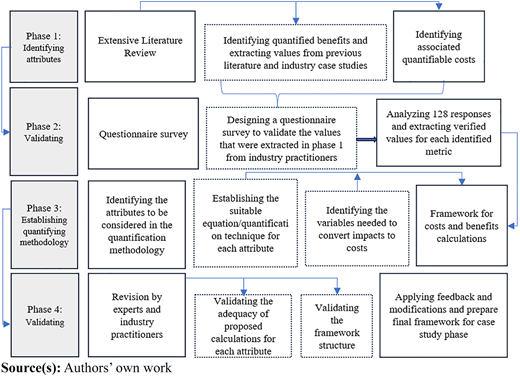
This study aims to establish a systematic methodology for quantifying the benefits of BIM in construction projects, addressing gaps in prior research. The research will follow a sequential approach, starting with a comprehensive literature review. A survey within the Swedish construction industry will validate gathered insights. The culmination will be the formulation of metrics and calculations within a comprehensive framework, evaluating tangible BIM benefits while considering associated costs. The framework’s validity will be determined through assessment by a panel of industry experts, ensuring the sufficiency of the formulated calculations and providing a basis for feasibility determinations. The research methodology is illustrated in Figure 1.
Phase 1: attributes identification
The initial phase of the methodology aimed to identify quantifiable indicators representing tangible benefits of BIM. These indicators, linked to measurable outcomes and assigned specific values, were derived from a literature review, including industry reports and case studies. This review served to compile identified attributes and associated quantified values. The literature also addressed costs linked to BIM investment. To establish precise values, a questionnaire was developed with each attribute corresponding to a distinct question, presented as an ordinal Likert scale. Industry practitioners validated metric values based on their experiences and project data.
The literature review included relevant publications from the past two decades, focusing on diverse assessment methodologies. Limiting the publication date to the past two decades ensured the inclusion of contemporary economic methodologies. Only English-language journal articles were considered, and Endnote software facilitated article refinement and duplicate removal. A content analysis using NVivo software identified research patterns, highlighted gaps, and suggested future directions. The final literature review comprised 75 research articles, with a standardized data extraction form capturing quantitative and qualitative details such as title, year, source, method, attribute, project phase, and reported results type.
Phase 2: questionnaire survey
The survey served the dual purpose of validating the values extracted from prior research and addressing the lack of studies specific to the Swedish construction industry. This alignment ensured that international figures and values were adapted to suit the unique characteristics of the Swedish construction market. Considering the diverse and expansive nature of the Swedish construction sector, the questionnaire survey method was chosen as the most effective approach for gathering insights from a wide range of industry practitioners. This approach aligns closely with the research objectives by enabling a comprehensive and in-depth exploration of professionals’ perspectives on the percentages and values associated with BIM benefits in the construction field.
A detailed questionnaire was carefully developed and refined using a professional survey design platform, employing a web-based format for efficient distribution and response collection. The online survey method was essential in enhancing the precision and reliability of the responses. This was achieved by using mandatory questions to ensure a response for each question, thereby minimizing the occurrence of incomplete or missing data. The questionnaire included sections to gather demographic information from the sample and to assess perceived benefits using a set of 12 predefined items sourced from previous literature. For each item in the survey, participants were provided with a range of ordinal values and were asked to select the interval that most accurately reflected the impact of each benefit on their project’s cost, based on their project-specific data. Furthermore, the collected data were systematically analyzed to understand the trends and variations in the perceived benefits of BIM across different segments of the industry.
Sampling
The survey aimed to encompass diverse stakeholders in the Swedish construction industry, including clients, consultants, designers, manufacturers, suppliers, contractors, facility managers, and building operators. Utilizing purposive and convenience sampling, the survey was electronically distributed through a web-based platform. Initial recipients, totaling 204, were chosen based on predefined criteria, emphasizing individuals with BIM experience in the Swedish construction industry. Encouragement was provided for recipients to extend the survey within their networks. Additionally, a digital survey link was publicly shared through professional networks associated with the Swedish construction industry. As a result, we received a total of 128 completed surveys after conducting an initial quality check to ensure the responses were both complete and accurate. Given the diverse distribution methods employed, calculating an exact response rate posed challenges; however, it is noteworthy that response rates ranging from 10% to 12% are not uncommon in research related to construction management (Bing et al., 2005).
Phase 3: establishing quantification methodology
Each quantifiable benefit required a distinct approach to convert its tangible impact into costs, necessitating an analysis of each attribute to determine the most suitable quantification method. The equations for each attribute encompassed numerous variables, some of which were specific to each case and needed to be filled based on project data, while variables related to the value of the BIM benefit were assumed based on the metrics gathered from the survey, which confirmed previous research findings.
Once the appropriate equation for each attribute was determined, all the inputs were integrated into the comprehensive framework, essentially aggregating all benefits, and subtracting costs, while also considering project-specific factors.
Phase 4: validating the framework
Following the development of the framework for quantifying BIM benefits, it was essential to validate the established equations and techniques utilized for each attribute. The framework was subjected to validation by presenting it to a panel of industry practitioners. For each attribute, a discussion was conducted, and feedback and considerations raised by the panel were carefully incorporated into the final version of the framework.
Literature review
The primary focus of this literature review was to compile and critically evaluate the quantified benefits of BIM from previous studies. Several methods have been proposed for assessing the economic impact and investment value of BIM. One widely suggested method is the Return on Investment (ROI) approach (Apeesada et al., 2022; Lee and Lee, 2020). This methodology quantifies the profit, gains, and losses resulting from an investment in BIM, represented as a percentage of the invested amount and adjusted for contributions and withdrawals (Sompolgrunk et al., 2023). While ROI provides a straightforward and easy-to-understand metric, its application in BIM assessment is often limited by the difficulty in capturing all relevant financial flows and accurately attributing them to BIM adoption. As such, several studies argue that ROI might oversimplify the complexities associated with BIM, and therefore, caution should be exercised when relying solely on this metric for decision-making (Ardani et al., 2022; Qian, 2012).
Another commonly used approach is the Cost-Benefit Analysis (CBA), which evaluates the economic feasibility of adopting BIM technology in the construction industry (Weisheng et al., 2014). The use of CBA in the context of BIM allows for a more comprehensive assessment by comparing the costs—such as hardware and software acquisition, employee training, and workflow modifications—with the potential benefits, including enhanced collaboration, reduced rework, and improved project outcomes (Chahrour et al., 2020). However, the accuracy of CBA is contingent upon the ability to quantify both tangible and intangible benefits and costs. Studies by Barlish and Sullivan, (2012) and Zakeri et al. (2023) have highlighted the methodological challenges of including intangible benefits, such as improved collaboration and decision-making, which are often subjective and harder to measure. Moreover, the effectiveness of CBA is limited by the variability of cost and benefit data across different contexts and project types, which hinders the generalization of results.
Although both ROI and CBA provide valuable insights into the economic viability of BIM, they are not without limitations. A key critique emerging from recent studies is that these methods often lack standardized procedures, leading to inconsistencies in their application and results (Barlish and Sullivan, 2012). Additionally, many studies offer incomplete descriptions of their methodologies, making it challenging to assess their accuracy and reliability (Ardani et al., 2022). Consequently, while ROI and CBA remain prevalent, there is a need for more comprehensive, context-sensitive, and standardized methodologies that can better accommodate the diverse range of benefits and challenges associated with BIM adoption.
To attain a comprehensive understanding of prior research endeavors, the literature review categorized the selected sources based on various dimensions, including their relation to the project lifecycle and the impact of BIM on different stakeholders. Some studies encompassed the entire project lifecycle (Walasek and Barszcz, 2017) while others specifically analyzed distinct phases, such as examining BIM benefits for consultants (Chahrour et al., 2020), facility managers (Weiwei et al., 2018), asset owner (Munir et al., 2019) and manufacturers (He et al., 2021).
The literature review identified a notable research trend, with a significant focus on quantifying specific BIM benefits, often associated with distinct functions or project phases. Predominantly, research concentrated on the design stage, exploring the impacts of design optimization, error reduction and clash detection (Abdelbary et al., 2020; Chou and Pei-Yu, 2017; Porwal et al., 2020), and stakeholder coordination (Xian-yong et al., 2019). Approximately 24% of the articles emphasized the integration of design and construction, delving into topics like quantifying change order costs (Myungdo and Ung-Kyun, 2020; Poirier et al., 2015) and assessing how BIM enhances opportunities for prefabrication and offsite construction (Barkokébas et al., 2021; Poirier et al., 2015). Post-construction effects of BIM were examined in 12% of the analyzed articles, evaluating the investment value for operators and facility managers (Mohammed et al., 2022; Wang et al., 2013). Additionally, a substantial number of studies addressed sustainability and optimized energy consumption during building operations. Table 1 compiles quantified attributes extracted from the literature review, categorized based on the measured benefits.
Classification of benefits
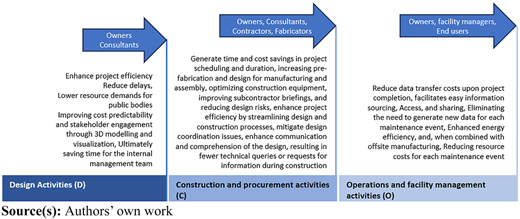
Previous research endeavors focused on quantifying BIM benefits, revealing diverse advantages throughout a project’s lifecycle. To streamline calculations, a dual classification system was adopted in this study. The initial categorization considered both the beneficiary stakeholder and the project phase. This aimed to efficiently allocate quantified benefits and clarify the impact on specific stakeholders. Subsequently, a detailed classification based on the nature of the impact was implemented. For instance, time-saving benefits in the design phase were grouped as “efficiency savings.” This classification enhanced the framework’s user-friendliness by reducing user input. Figure 2 illustrates benefit grouping across project phases and identifies key stakeholders experiencing these benefits.
Likelihood
Prior studies have highlighted the connection between the degree of development and the realized benefits of implementing BIM (PWC, 2018; UnitedBIM, 2022). While BIM experts and researchers aim for full BIM implementation, some argue that complete adoption is not necessary to reap anticipated benefits, and even partial utilization can significantly impact project performance (Dainty et al., 2017). Nevertheless, evidence suggests that the higher the adoption level and sophistication of the BIM model, the greater the applications and, consequently, the perceived benefits (Eadie et al., 2013). In line with this notion, this research introduces the term “likelihood” to express the probability of a given case experiencing the quantified benefit. This likelihood is determined by linking the level of BIM implementation in the company or project with the potential to realize the intended effect.
Benefits quantification methodology
The formulation of equations aimed to quantify benefits as cost savings, leveraging established mathematical relationships among key project success factors like cost, time, and quality, validated in prior research. Productivity improvements, for example, reduce time and resource needs, leading to cost savings across direct and indirect expenditures. Similarly, time-related benefits yield cost savings across various factors. Each benefit calculation underwent thorough individual examination. Attributes identified required two types of variables: metrics converting assumed BIM benefits into cost values (validated through research and questionnaires), and case-specific variables (project-specific figures). Table 2 details attributes and metrics for each calculation.
Formulation of equations
An equation was developed for each attribute to capture the monetary value associated with the presumed benefit. These equations were constructed based on prior research and established quantification methods commonly used in the construction industry Table 3. Lists the developed equations and the explanation of the variables for each attribute.
Assumed BIM investment associated costs (I)
The costs associated with BIM investment and implementation are systematically quantified and integrated into the overall BIM benefits assessment methodology. These costs are generally consistent across various BIM environments and include expenses such as establishing a common data environment (CDE), BIM management costs, expenses related to BIM training, Employer Information Requirement, Organization Information Requirements (OIRs), the cost of updating facilities management systems as required by the procuring authority, and the expenses incurred in maintaining the BIM model.
Verification of assumed metrics
The formulated equations for each item incorporate two types of variables crucial for quantifying the impact of BIM. The first type involves case-related variables, specific to the project or company, tailoring results to the context under study. The second type includes metrics from prior research and industry case analyses, where BIM benefits were quantified to a certain confidence level. These variables were collected, evaluated, and validated through the questionnaire survey in this research. Table 4 displays the extracted metrics from the survey data analysis. Participants selected the most accurate estimate of the BIM effect based on their experiences and projects, ensuring alignment with previous research for accurate estimations. The answer with the higher frequency was considered for each item.
Likelihood assumption
As discussed previously in various research literature, the perception of BIM effects is closely linked to the level of implementation. Therefore, it is crucial to calibrate the equations in alignment with the level of BIM implementation in the case under study. To achieve this, an initial qualitative assessment of the company is conducted to estimate its level of BIM utilization within its processes. The assessment results position the company on a scale of likelihood to perceive benefits, signifying that a higher level of advancement in BIM corresponds to a greater likelihood of reaping benefits.
In simple mathematical terms, the overall equation for the assessment methodology, incorporating all costs and benefits and calibrated using the qualitative assessment, can be expressed as follows:
Where is the likelihood coefficient, which is expressed as a percentage determined by the user based on the qualitative assessment for each case, D, C, and O values are as per Table 3. And represents the summation of benefits in the design, construction and operations, while I is the summation of investment costs also as per Table 3.
Validation of framework
The quantification methodology framework and the established equations underwent a continuous validation process with industry practitioners to ensure their adequacy for measuring the targeted impact and practicality in real-world scenarios.
Expert Selection and Participation: Experts were selected based on their extensive experience in the construction industry and familiarity with digital tools like BIM. Three company representatives participated in an initial workshop where a thorough review of the framework and equations was conducted. The framework was subsequently tested with two additional company representatives.
Validation Criteria: The validation focused on three key criteria: (1) the adequacy of the equations for capturing the intended impact, (2) the clarity of the methodology, and (3) the feasibility for users to obtain the necessary values for each variable.
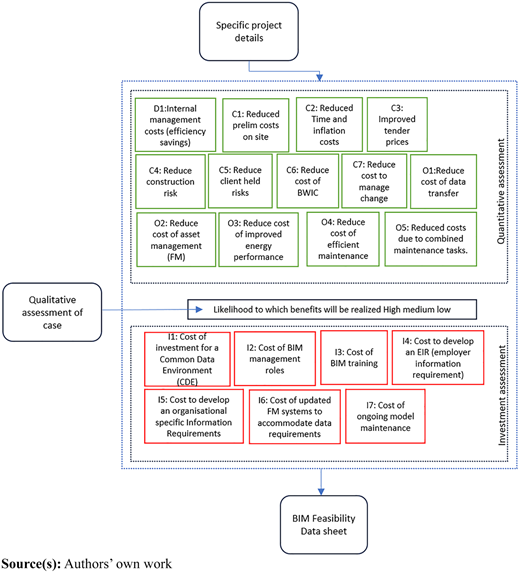
Validation Process and Results: During the workshop, the experts provided valuable feedback on these aspects, and adjustments were made accordingly. In the testing phase, the representatives confirmed that the framework was clear and that they were able to obtain the required information to use it effectively. A final revision of the equations was conducted, incorporating the comments from both the workshop and testing phases to enhance clarity and applicability. Figure 3 presents the quantification assessment framework.
Discussion
In its final form, the framework is designed to conduct a cost-versus-benefits analysis of BIM implementation and generate a comprehensive conclusion regarding the feasibility of BIM for a specific establishment or project. The feasibility concept is rooted in the belief that the investment cost of BIM may not be fully offset by the benefits in certain cases. Therefore, the framework aims to provide an exploratory data sheet that distributes the costs and benefits throughout the project’s supply chain.
It is crucial for industry practitioners and decision-makers to recognize that the benefits of BIM are not all immediate. BIM can be considered a long-term investment, with some benefits, such as energy efficiency and facilitating building operations, being realized over an extended period. While certain benefits, like error reduction and efficiency improvements, can be immediate, decision-makers may exhibit hesitancy to invest in BIM due to a focus on short-term gains. This reluctance is influenced by the nature of the construction project supply chain, which typically involves multiple partners with varying perspectives on innovation and business development.
In parallel to the distribution of benefits, the costs associated with BIM investment are also spread across the project lifecycle, with a tendency for a larger portion of costs to be concentrated in the initial stages of the project. Consequently, the decision to implement BIM should ideally be made by clients and consultants during the early stages of the construction project. This early engagement allows subsequent stakeholders to participate in model development and the broader BIM environment.
The framework introduced in this study fills a significant research gap by providing a unified approach to quantify BIM benefits. A thorough literature review exposes the absence of consensus on a standardized methodology for accurately assessing the genuine investment value of BIM. Further scrutiny of previous research underscores a limited understanding of BIM’s economic impact, with general assertions prevailing in academic and industry sources. Existing methodologies may not be structured to aid industrial organizations in evaluating the perceived value of BIM aligned with their specific operational contexts. The literature review reveals diverse methodologies often concentrating on specific attributes, cases, or projects, emphasizing the necessity for a comprehensive cost-benefit model capable of measuring BIM’s return on investment throughout the entire construction supply chain lifecycle.
The framework exhibits several limitations, including the challenge of incorporating intangible benefits such as adaptability to changes, knowledge transfer, and regulatory compliance. Despite the difficulty in quantifying these advantages, their impact is discernible within organizations. Concurrently, the framework fails to address intangible costs, particularly considering their substantial variation across projects and dependence on organizational capabilities. For instance, the cost of developing a BIM model to advanced levels may be more significant for certain companies than others. Nonetheless, the utilization of BIM not only enhances project efficiency but also confers a competitive advantage to construction industry organizations through the stimulation of innovation, cost reduction, and the overall enhancement of project quality and sustainability.
Notwithstanding its inherent limitations, the framework is perceived to comprehensively encompass the costs and benefits pertinent to the specific case under consideration, offering a precise estimation of the overall expected effects of implementing Building Information Modeling (bimalliance). This analytical approach promises decision-makers a clearer numerical depiction, facilitating a more informed decision-making process. The resulting data sheet, derived from this quantification methodology, will position the examined case within a BIM feasibility context. Moreover, it will analyze the anticipated distribution of costs and benefits across the project lifecycle, thereby assisting companies in anticipating and strategically planning for the timing and impact of these effects.
Conclusion
This research delves into the complexities of Building Information Modeling (BIM), acknowledging its inherent limitations while highlighting its substantial potential through the introduction of a novel framework for quantifying the financial impact of BIM at the project level. Despite the challenges in quantifying intangible elements, the proposed framework provides a practical analytical tool that enables decision-makers to develop a detailed, numerical understanding of the anticipated effects of BIM implementation in specific contexts. The resulting data sheet, a concrete output of this methodology, serves as a strategic asset for organizations, helping them assess their position along a BIM feasibility spectrum. Moreover, the framework supports the analysis of projected costs and benefits throughout the project lifecycle, offering insights that empower stakeholders—including project managers, owners, and construction teams—to strategically plan for the timing and magnitude of BIM’s impact.
As BIM continues to reshape the construction industry, this study makes a significant contribution to both practical and theoretical domains. For practitioners and project stakeholders, it provides a systematic approach to assessing the feasibility and financial implications of BIM adoption, thereby supporting informed decision-making in real-world scenarios. For academics, it enriches the body of knowledge with a robust framework for BIM quantification, bridging the gap between theory and application in the construction sector.
To maximize the practicality and applicability of this research, it is crucial to rigorously test the proposed framework through multiple case studies across diverse project types and organizational settings. These case studies will not only validate the framework but also serve as a foundation for refining the model iteratively, based on empirical evidence and evolving industry practices. Empirical testing is essential to uncover any potential gaps that may only emerge in real-world contexts, allowing for targeted improvements to the framework.
Furthermore, results from these case studies will generate invaluable data, providing insights into the current industry landscape regarding the application and value accrued from BIM. These insights will help identify emerging trends that shape future BIM strategies, thereby informing both of industry practices and academic discourse. Expanding the scope of testing to include different geographical and regulatory environments will further enhance the framework’s robustness and adaptability, contributing to the ongoing advancement of methodologies and practices in BIM implementation and management. Ultimately, this research aims to benefit both project stakeholders and the broader field of knowledge, fostering a more informed, strategic approach to the adoption and management of BIM technologies.