Value management (VM) has the capability to enhance a project's functions at minimum lifecycle cost; however, limited creativity, subjectivity in decision-making and inadequate digitalisation (digitisation phase) have limited its success. This paper aims to address the research gap by integrating Life Cycle Cost Analysis (LCCA), TRIZ (Inventive Problem-Solving) and the Analytic Hierarchy Process (AHP) within a low-code platform (Microsoft Power Apps) to enhance rigour, transparency and sustainability.
The method was executed using a six-step VM job plan and tested on the Warners Bridge case study located in Queensland, Australia. Nine design alternatives were created from TRIZ. AHP was used to methodically calculate the weights of criteria and to calculate and compare lifecycle costs using a 100-year LCCA.
The results indicated that the developed framework enables logical screening and ranking of infrastructure alternatives by coupling multiple-criteria decision-making (MCDM) with lifecycle costing (LCC). It is observed that simultaneously evaluating functional performance, sustainability and economics within a single decision framework yields less cost-driven and more value-based outcomes. The application of RII (Relative Importance Index), AHP and LCCA enables logical screening of feasible alternatives and sound ranking, whilst clearly identifying opportunities for advanced materials systems to enhance whole-of-life performance. The framework has the potential to improve the objectivity, transparency and repeatability of infrastructure-related decisions.
The framework and tool provide infrastructure sector stakeholders with a how-to guide for incorporating sustainability principles into VM decision-making.
The current study applies TRIZ contradiction analysis to the VM creativity phase of infrastructure projects. Further, a unique methodology that fuses AHP-weighted evaluation with LCCA-based value indexing is presented to enable transparent, repeatable decision-making through a low-code digital platform.
1. Introduction
Globally, infrastructure stakeholders face a growing imperative to maximise output from limited inputs, compelling them to enhance the longevity and value of their existing assets while simultaneously meeting escalating demands for ecological consciousness, robustness, efficient resource deployment and prudent fiscal oversight (Ainamo et al., 2010). From bridges and transportation networks to flood levees and energy systems, infrastructure assets must meet a growing array of targets across capital and whole-of-life costs, durability and constructability, maintainability, carbon emissions and other sustainability metrics (Mousa et al., 2022). These pressures are not unique to Australian infrastructure; decision-makers in the built environment face similar challenges regarding asset optimisation and sustainability worldwide. Early design-phase decisions have far-reaching impacts across the economy, environment and society; and there is growing international demand for decision-making processes which support the integrated, transparent and evidence-based assessment of cost, performance and sustainability trade-offs.
Value management (VM) is a systematic methodology for improving function, reducing unnecessary cost and maximising whole-of-life project performance (Kineber et al., 2022a). While VM is widely used in practice, it is still largely applied in an ad hoc manner, relying predominantly on paper-based processes, workshop activities and professional opinion (Gabr et al., 2024). Current practice can produce helpful outputs but generally lacks analytical rigour, consistency and auditability, particularly when applied to complex infrastructure projects which must factor in large volumes of technical, economic and environmental information. Modern reviews of VM have therefore called for “digital-enabled” approaches which support evidence-based assessment, multidisciplinary engagement and lifecycle optimisation across each phase of the VM job plan (Gohar, 2025).
Digital technology has the potential to overcome several known barriers to VM implementation, including limited stakeholder engagement, inadequate functional analysis and conflict resolution, insufficient information and model availability and poor integration of cost, risk, sustainability and lifecycle performance information (Kineber et al., 2024). While technologies like building information modelling (BIM), cloud computing and automated analysis have transformed data availability and workflows across much of the construction industry, there has been limited uptake of technologies applied to end-to-end VM. Individual tools exist to digitise information management, cost estimating, sustainability assessment, multi-criteria decision-making (MCDM), and more; however, no existing tool successfully integrates all VM phases into a fully auditable, seamless decision-support framework. The continued reliance on spreadsheets, meeting presentations and standalone software, therefore, limits repeatability and weakens stakeholder confidence in VM outcomes.
Recent research efforts have aimed to supplement VM with companion methods for enhancing individual phases of the job plan. Approaches like the analytic hierarchy process (AHP) have been applied to introduce objective MCDM to VM, allowing criteria to be weighted and alternatives to be ranked. Life-cycle cost analysis (LCCA) similarly aims to promote economic optimisation by considering longer-term cost drivers instead of minimum initial expenditure. TRIZ has been applied as a creativity method to help participants identify and solve technical contradictions, proposing innovation-based alternatives that systematically overcome weaknesses identified in traditional brainstorming exercises (Asyraf et al., 2020; Chang et al., 2023). While useful for supporting specific phases of job plans, these techniques have generally not been integrated into a cohesive end-to-end framework or low-code solution for routine industry applications.
Limited examples of digitised VM implementations include Group Decision Support Systems (GDSS), which have been found to facilitate stakeholder participation and information capture but primarily focus on briefing development rather than structured alternative appraisal (Luo et al., 2011). Infrastructure-specific applications have further enabled life-cycle assessment and value-based decision-making (Mousakhani et al., 2017). However, no studies were found to integrate all aspects of the VM job plan – including FAST-based function analysis, TRIZ creativity, AHP-informed MCDM, LCCA and automated Value Index (VI) assessment – within a single low-code/no-code framework. This gap in accessible tools capable of supporting end-to-end VM represents the motivating problem for this research.
This research, therefore, presents a novel and fully digitised VM framework that seamlessly integrates FAST-based function analysis, TRIZ-driven creativity, weighted AHP-based MCDM, LCCA and VI assessment within an easy-to-use low-code platform. The key novelty of this research lies not in designing new analytical methods but in integrating existing methods into an end-to-end decision-support workflow, thereby elevating the transparency, consistency, auditability and confidence in VM outcomes. While the case study presented in this research is centred on the Warner Bridge upgrade in Queensland, Australia, the methodologies and digital tools developed here are intended to be transferable to infrastructure and construction projects of all types, across all organisational contexts and within any suitable digital platform.
To fulfil this aim, this research is shaped by the following research question: How can TRIZ, AHP and LCCA be incorporated into a digital Value Management framework to improve the rigour, transparency and sustainability outcomes of infrastructure decision-making? Specifically, this research will: (1) Detail the integration of TRIZ contradiction analysis into the creativity phase of VM to support the development of innovation-based alternatives; (2) Detail the implementation of weighted AHP multi-criteria analysis and LCCA-informed VI calculations to enhance option evaluation; and (3) Apply this updated job plan to digitise VM within a low-code platform, supporting repeatable and auditable decisions. Each of these objectives builds on the others to develop a novel VM framework with immediate real-world application – and the potential to support better, more sustainable decision-making across the global infrastructure industry.
The remainder of this paper is organised as follows. Section 2 offers research background. Section 3 defines the research aim and objectives. Section 4 explains the research design and methodology. Section 5 explains the case study application and results. Section 6 discusses the findings. Section 7 explains the research's theoretical implications and practical implications. Section 8 presents limitations. Section 9 concludes this paper.
2. Research background
Decision-makers in the infrastructure space are now expected to provide bridges that deliver long-term value through sustainability, resilience and whole-of-life optimisation. This comes against a backdrop of concerns about durability, maintenance and material performance. As a result, bridge projects are assessed on more than their capital cost and increasingly need to consider factors such as life-cycle performance, constructability, environmental impact and compatibility with asset management strategies (Meharie et al., 2019). VM has thus become a central concept in infrastructure decision-making frameworks, with substantial research emerging on its effective application (Kelly et al., 2014). While VM is widely accepted as a decision-making method internationally, in practice, it has historically been difficult to implement effectively in large, complex engineering projects.
2.1 Limitations of conventional value management in infrastructure
Traditional VM workshops, for example, have remained primarily dependent on subjective human judgement, verbal deliberations and paper-based data collection (Pearson, 2020; Rosengart et al., 2023). The variability observed in VM results, specifically their susceptibility to the facilitator's knowledge, the stakeholders involved, and the data available, frequently brings into question the consistency of the process. Infrastructure decisions are further characterised by high complexity, in which decisions are typically multi-criteria (technical, financial, social, environmental, etc.) and the relationship between cost, performance and risk is not directly proportional but requires sophisticated analytical support (Berawi et al., 2014). Many pragmatic VM solutions demonstrate restricted potential to produce truly creative options. They are hampered by time constraints, cognitive biases and a lack of systematic processes to overcome functional contradictions. The result is that many VM studies converge on variations of the original concept without producing a more valuable alternative. Scholars have also highlighted that methodological improvements could enhance the creative, analytical and evaluative power of VM in practice (Gouda Mohamed et al., 2024). VM techniques have traditionally been used to enhance construction project cost by weighing functions and performance against cost (Mousa et al., 2022). The researchers limit their evaluation phase to deterministic or cost comparisons. Unfortunately, infrastructure decisions require multi-criteria comparisons, including difficult-to-compare factors such as structural performance, sustainability, constructability, maintainability and risk. Limited use of formalised multi-criteria decision-making techniques, such as AHP, has led to a weaker analytical structure and greater subjectivity in final decisions. The Function Analysis System Technique (FAST), for example, deconstructs project objectives into specific, measurable and achievable functions, which form the basis for reviewing innovation potential and determining value (Shahhosseini et al., 2018). Luo et al. (2011) have shown that GDSS-based VM can enhance collaboration and capture decisions. GDSS-based VMs have been shown to improve collaboration and the traceability of decisions, but these solutions are limited in functionality, focusing on briefing and scope definition rather than rigorous evaluation of alternative engineering solutions. However, the focus of such tools is briefing and scope definition rather than appraising alternative engineering solutions. Digital VM platforms are thus underused for options appraisal and selection of materials systems, especially in bridge asset management. Mousakhani et al. (2017) conducted a VM-based study on roadway alignments. VM was shown to achieve cost reductions while maintaining functionality, though FAST and economic comparison were used instead of structured creativity and multi-criteria ranking. This shortcoming limits the use of traditional VM in multi-dimensional infrastructure decision-making, including performance, sustainability, constructability, maintainability and risk.
Therefore, the subjective element within VM frequently yields fluctuating and challenging-to-replicate results. Additionally, existing VM methodologies do not reflect the reality of infrastructure decision-making, which often must consider multiple, sometimes conflicting criteria (long-term asset performance vs. short-term costs, sustainability vs. constructability vs. risk) when evaluating different solutions. Structured approaches to support MCDM are lacking, as is consideration of life-cycle economics. While there are nascent examples of digital tools supporting VM, it has yet to leverage developments such as BIM, mobile devices or AI. Tools such as GDSS tend to support information sharing and workshop setups rather than offering decision-analytical capabilities to compare alternative solutions. There is therefore a clear gap in the development of fully integrated digital VM processes which embody creativity, objective evaluation and defensible decision-making support.
Review papers on VM tend to present examples of applications and areas of savings, showing improvements in functionality, but without a deeper discussion of issues with current approaches or their limitations. Current practices of VM continue to rely on facilitation skills and participants' expertise, with few attempts to reduce bias and subjectivity. Current budgeting and cost management efforts frequently stumble on inconsistent estimation techniques and a lack of analytical integration. This results in low visibility of decision-making rationale, thereby limiting the ability to achieve repeatable or defensible decisions. While many projects adopt VM workshops to generate ideas, practitioners may lack the skills to implement formal evaluation methods or optimisation schemes when managing trade-offs among multiple criteria, e.g. sustainability, constructability and lifecycle performance.
2.2 Digital transformation and the need for integrated VM frameworks
The construction industry is undergoing one of the fastest rates of digital transformation, with BIM, AI-driven analytics and cloud-based platforms being leveraged more broadly (Baihaqi et al., 2024). Research literature often focuses on the benefits afforded by these technologies. Their implementation within construction has tended to be siloed; adopting tools specific to a discipline such as visualisation/design or data management, rather than platforms built around decision-making. In comparison, VM have not kept pace with this digitalisation. While a significant number of industry-specific VM tools now exist, most have a narrow focus, address only parts of the VM process (cost modelling, risk assessment, multi-criteria decision analysis, etc.) or function in isolation from other tools (Lavi and Reich, 2024). This fragmentation of tools and methods necessitates a seamless VM workflow to reduce information silos and fragmented decision-making.
In recent years, researchers have begun to propose integrated digital VM frameworks that combine functional analysis, lifecycle cost, sustainability metrics, multi-criteria decision analysis, etc. (SAVE, 2008). Integrated digital systems, compared to isolated point solutions, have the potential to improve transparency, decrease human error and increase repeatability of results, thereby instilling greater trust in project governance. However, studies remain limited on how to integrate advanced decision-support capabilities, such as LCCA, multi-criteria evaluation and TRIZ, into modern VM practice.
2.3 Advanced decision tools supporting modern VM practice
LCCA is a common approach to ensure value is considered when making decisions and is often closely linked with VM (Sharaf et al., 2020). The most popular and verified LCCA method is Present Worth (PW). PW is frequently utilised for infrastructure projects when conducting economic comparisons over the lengthy asset life cycle (Kineber et al., 2022a, b). The multi-criteria weighting involved the AHP. AHP enables structured pairwise comparison for performance, constructability, risk and sustainability criteria (Uddin, 2013). TRIZ, on the other hand, is a practical decision-making framework that stimulates creative thinking and promotes innovation in engineered systems (Setti et al., 2021). TRIZ is based on general principles for solving engineering problems and overcomes many of the challenges associated with brainstorming (Chou, 2021). Despite its potential, TRIZ is rarely used, even in infrastructure contexts and is seldom linked to VM activities. A major challenge is the lack of easily applied digital systems that demonstrate how TRIZ can be connected to the downstream options evaluation and selection phase (Güler, 2025).
2.4 Evolving research gap
Construction and infrastructure projects are often complex and highly uncertain as several technical, managerial and operational variables are closely interrelated. The project outcomes are seldom affected by a single criterion. Project performance variables, including bill of quantities (BQ), completeness of drawings/specifications, construction progress, materials procurement/order management, value of placed work (VOP), scheduling, safety and others, play a vital role in construction projects (Kebriyaii et al., 2025). Incomplete quantities or drawings/specifications may result in variations that lead to cost and time overruns, rework and quality non-compliance, which may diminish whole-of-life asset value (Mazaheri et al., 2025). Existing literature indicates that inaccurate quantities and incomplete drawings contribute significantly to design growth/change-orders, while inadequate schedules and procurement plans cause inefficient workflows, leading to increased direct costs (materials/resources) and indirect costs (programmes). Poor safety performance can also result in social loss and liability while adversely affecting productivity, insurance premiums and programme overruns (Mazaheri et al., 2025).
Infrastructure projects are also long-lived and decisions made during the planning and design stages strongly influence asset performance, maintenance and sustainability-related outcomes. Existing engineering practices rarely provide opportunities to assess the collective impact of technical, cost, operational, safety and environmental criteria individually, which can significantly affect constructability, cost, project performance and adherence to specification requirements (Mousa et al., 2022). The literature underscores the importance of both quantitative variables (e.g. BQ, VOP, schedule and life-cycle cost) and qualitative variables (e.g. safety, maintainability, constructability and user acceptance). Without structured techniques to determine the criteria variables, weights and the level of importance that decision-makers assign to each variable, selections would be highly subjective and less likely to provide an accurate cost estimate and to select alternatives that satisfy specification requirements.
The review of the literature found three main limitations in infrastructure VM: (1) lack of method integration for innovation development, (2) inadequate multi-criteria use to objectively rank options and (3) digital platforms with limited use for analytical and sustainability-focused decision support, instead focusing on information management. To fulfil the identified research gaps, this study proposes and demonstrates the use of an integrated, low-code digital VM framework that leverages TRIZ, AHP, LCCA and VI evaluation in Power Apps to provide an accessible, auditable and end-to-end analytical decision support system for bridge projects (Baihaqi et al., 2023). Microsoft Power Apps appear to be an ideal foundation for building custom VM tools that can be more easily scaled, maintained and integrated with existing systems, and that offer strong capabilities for automating workflows without specialist programming skills (Okudan et al., 2025). Therefore, there is a gap for a custom digital VM platform that meets the stated requirements and has been tested in a real-world infrastructure project.
Literature reviews also do not identify gaps in bridging creativity tools and systematic evaluation methods or in bridging creativity tools and digitised decision-support tools. To fill this gap, this study aims to develop and demonstrate an integrated and digitised approach that embeds TRIZ and systematisation of creative ideation, AHP for managing multi-criteria decision-making and life-cycle costing assessment within a low-code development platform. Table 1 presents an overview of existing VM studies compared against the requirements defined in Sections 2.1 to 2.3. As shown in Table 1, no study combines TRIZ, AHP, LCCA and a digital platform within a single VM framework for infrastructure projects.
To address the above issue, this research investigates the possibility of digitising VM by firstly determining and assigning weights to criteria and sub-criteria identified from the literature review and complemented by expert interviews. Variables included in this study were cost, construction schedule, material design, safety and specification, as they were common factors influencing asset value during delivery. The VM process guided framework development, embedding these variables into a single analytical environment, thereby allowing the researcher to quantify and evaluate each alternative against different criteria while controlling costs. This research develops and tests an integrated VM decision-support framework implemented as a customised digital tool on the Power Apps platform (Laaksonen, 2024). In addition, this framework is operationalised and validated through a real infrastructure case study (Warners Bridge upgrade) (GHD, 2021). The platform brings together the entire VM lifecycle, from information capture and functional analysis through TRIZ, AHP, lifecycle costing and VI scoring, into a single system. This is a powerful demonstration of how digitised VM can drive more analytical rigour, deeper stakeholder involvement and more sustainable infrastructure decision-making.
2.5 Research significance
This study holds value for clients because its organised, open approach to decision-making builds confidence that selected infrastructure solutions will deliver superior long-term value, moving beyond mere initial cost savings. Governments and industry increasingly demand that asset owners justify their investments in terms of sustainability, durability, cost-effectiveness, risk and serviceability outcomes (Kebriyaii et al., 2025). Using functional analysis and lifecycle cost modelling, alongside established multi-criteria decision-making and VI techniques, within a single digitised environment will allow clients to compare alternatives objectively, record decisions made and explicitly align procurement outcomes with organisational and project objectives (carbon reduction, circularity, whole-life performance, etc.). All underpinned by improved governance, auditability and accountability processes – vital considerations when delivering publicly funded infrastructure.
The Contractor will find this framework invaluable for more efficient project planning, as it enables early consideration of constructability, scheduling, procurement and safety and maintenance factors for any given alternative, helping to select options that reduce project complexity, minimise rework, maximise material efficiency and present lower operational and maintenance risks. This reduces the manual input required by typical VM exercises, as many of the related calculations can be automated within a single platform that links typically disparate data sets.
The core desire on both sides is to select the optimal value solutions, yet their understandings of what constitutes optimal value may not align. Individually, they are looking to mitigate risks, maximise resource utilisation and optimise commercial outcomes. By adopting this common evidence-based framework to evaluate all alternatives against established criteria, the client and contractor can work towards a shared definition of value that meets project and company-wide objectives. Everyone can agree on the targets (increased asset value, decreased carbon footprint, X% whole-life savings, etc.) and how they will be measured against each alternative. Successful projects that meet stakeholders' expectations are delivered on time and on budget, with reduced disputes and improved commercial outcomes. Assets that deliver greater economic, environmental and social value throughout their entire life cycle.
3. Research aim and objective
The goal is to develop a comprehensive, digitised VM framework for projects.
The study objectives are;
To recognise gaps with traditional VM applications on infrastructure projects.
To embed TRIZ for systematic innovation in the VM process.
To embed AHP to support MCDA and objective comparison of alternatives.
To embed lifecycle costing and VI assessment.
To curate a low-code digital solution to enable end-to-end VM workflow.
To test the framework using an example bridge case study.
4. Research design and methods
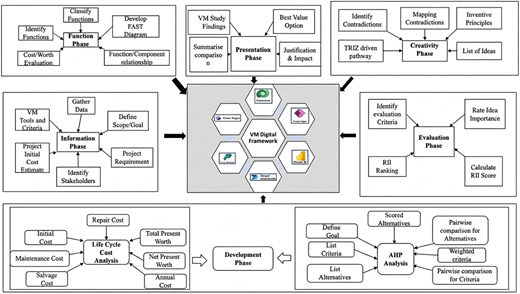
This research involved conducting a VM study to both develop and validate the proposed digitised framework. A qualitative case study methodology was employed for several reasons. Case studies allow for an in-depth investigation of contemporary problems situated within their real-life contexts and have also been adopted elsewhere for the development and evaluation of frameworks for VM processes in engineering and management (Li et al., 2021). The Warners Bridge upgrade project, located in Queensland, Australia, was used as the case study. Australia was chosen because infrastructure procurement generally focuses on value for money, sustainability, whole-of-life asset management and transparent governance; this focus is particularly evident in publicly funded transport infrastructure projects. Furthermore, the Warners Bridge upgrade project information was publicly available, providing sufficient documentation and data richness to test-case the proposed framework. The results presented in this paper use Warners Bridge as a case study example only. The framework and job plan processes are applicable to other infrastructure assets, across organisational contexts and digitisation platforms. The VM job plan followed the six phases of Information (Plan), Function, Creativity, Evaluation, Development and Presentation (Li et al., 2021). Figure 1 illustrates the methodology adopted for this study, while Figure 2 provides an overview of the proposed digital tool. Prior to conducting the VM workshop, publicly available project information was sourced and reviewed. Information included drawings and documents detailing the reference design bill of quantities and costs, hydrology report, geotechnical report, community feedback, council plans check and constraints. Workshop participants were briefed on the compiled information, which defined the baseline design and ensured that all stakeholders had an aligned understanding of the project's objectives, technical systems and commercial constraints.
The VM study was undertaken in a four-person expert workshop. Domain experts included professionals with significant knowledge and experience in bridge engineering, infrastructure asset design, cost estimation and construction and project delivery. For the purposes of this study, experts were selected based on their specialised knowledge of the infrastructure context and processes, in line with standard VM practice. VM workshops do not seek statistical representation via sample sizes; rather, participants are selected for their knowledge about the study (SAVE, 2008). Experts reviewed the reference design and project scope (Information), clarified functions and opportunities for value improvement (Function) and conceived alternative bridge systems (Creativity). FAST diagrams were developed during the Function phase to validate a bridge's functions and define the relationships between functions and physical solutions, including structural systems and material types. TRIZ contradiction analysis was used in the Creativity phase to guide experts through trade-off decisions and develop alternatives free from technical compromise.
Criteria and subcriteria were informed by literature and circularity principles, then adapted by experts during the workshop to capture project priorities. Criteria considered included cost, structural performance, constructability, sustainability, maintainability and risk. Stakeholder acceptance of each alternative was first evaluated using RII to screen out inferior alternatives. Alternatives that met or scored relatively close to the acceptable range were progressed through the AHP process. AHP was used to quantify judgments and develop weighted criteria to rank-order alternatives. This allowed experts to transparently and logically break down complex decisions into a series of pairwise comparisons. Ranking was conducted using the weighted criteria developed through AHP to ensure decisions aligned with overall project priorities. LCCA was used to estimate the project's whole-of-life cost, including initial construction and future maintenance costs. Functional performance and cost metrics were combined to calculate VI scores.
Microsoft Power Platform was used to digitise each phase of the VM. All mathematical models embedded into the low-code platform PowerVM. PowerVM stores data, automatically calculates functions and metrics and presents results in a shareable and auditable format. The use of PowerVM streamlined workshop activities and improved consistency by reducing manual calculations. Figure 3 provides an overview of the PowerVM interface. Figures 4-12 provide webpage snapshots and study outputs for each phase of the job plan.
Workshop data were interpreted using thematic analysis. Workshop dialogue, comments and researcher observations were reviewed and coded to identify themes (Braun and Clarke, 2006). Themes identified during the workshop included common decision-making practices and perceptions of the existing VM process and are used to support findings discussed in the results (Ahmed et al., 2025). Thematic analysis supplements the quantitative metrics reported in this study to triangulate findings and minimise bias introduced by experts' scoring and weighting assessments.
The expert panel was small, and scoring and weighting processes are influenced by individual judgment. Future research could examine the impact of panel size and expert experience on RII and AHP outcomes. Expert assumptions also informed LCCA calculations and estimates of future maintenance and costs. Transparent and repeatable processes were used to mitigate limitations where possible. The FAST and TRIZ structured decision-making, standardised measures were used to calculate RII and AHP scores and sensitivity analysis was used to present likely ranges of outcomes for LCCA and VI calculations.
4.1 Preworkshop activities
The pre-workshop investigation of the design status, alongside cost analysis and technical documentation, enabled stakeholders to develop a shared understanding of the project's limitations and goals, thereby aligning their expectations. This pre-workshop information allowed the VM facilitator and team to review the current design thinking, rationale, constraints and opportunities before developing alternatives.
4.2 Value management team
The VM process for the Warners Bridge upgrade was carried out by a four-person multidisciplinary team. This team was made up of two seasoned EPC structural engineers and one civil engineer from the Australian steel manufacturing industry, bringing diverse experience and knowledge in structural systems, constructability and material performance and durability. All team members were involved in the functional analysis, cost–benefit analysis and the development of alternatives (Luo et al., 2011). The participants' identities and employers have been withheld for reasons of commercial confidentiality. Each participant was provided with a briefing pack which described the scope of the project and the VM process.
4.3 Value job plan
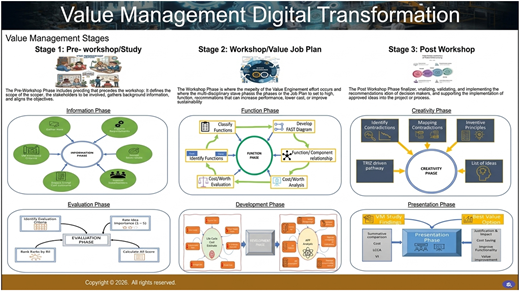
The VM Job Plan defines the pre-workshop, workshop and post-workshop activities characteristic of VM, especially as they relate to functional analysis. The workshop phase is further divided into six stages (Rajaram et al., 2022). At one time, VM studies were conducted over several weeks; others were compressed into three-to five-day workshops for construction projects. It is usually not possible to find a block of time to complete all workshop tasks, so VM studies may be broken into several parts to keep the study moving forward with team members present.
Essential elements of this proposed framework are based on the six-phase VM job plan categories: Information, Function, Creativity, Evaluation, Development and Presentation (Figure 1). These activities provide a logical structure to guide decision-making through solution definition to chosen solution validation (Kineber et al., 2022b).
Suitable project information is gathered during the Information phase (drawings, cost estimates, specifications, geotechnical reports, environmental studies, etc.). Performance during this stage can be validated by confirming the completeness of the dataset used to feed into the analysis. Ensuring correct input information leads to quality results from the latter stages of decision-making.
Key project functions are defined during the Function phase. Structured FAST analysis translates project requirements into functions (Kineber et al., 2022b). The performance of this stage will be validated by the framework's ability to connect structural/material alternatives to the bridge's required functions.
Potential alternatives are defined and documented during the Creativity phase. TRIZ contradiction analysis will be used to generate additional alternatives beyond traditional brainstorming exercises. Validation of performance during this phase can be measured by comparing the total quantity of different technically feasible design options with that of the reference solution.
Evaluation of alternatives is achieved through RII scoring (Kineber et al., 2022b). Chosen alternatives undergo further analysis during the Development phase. AHP, LCCA and VI allow for objective comparison of alternatives across multiple categories. Consistency ratios (AHP), similar rankings between comparisons and triangulation with actual output results can validate the performance of this phase. Lifecycle costing and constructability are considered to further develop the shortlisted alternatives (Kineber et al., 2022b). Successful performance during this phase can be validated by the natural elimination of alternatives and movement toward solutions with higher VI scores and better whole-of-life costs (Kineber et al., 2022b).
Compilation of results occurs during the Presentation phase. All relevant information is viewable and traceable within the platform, providing adequate support for the final decision. Validated performance during this phase can be demonstrated by a clear definition of decision outputs (e.g., the chosen alternative) and the auditability of the decision pathway, allowing stakeholders to understand how and why the selected alternative was chosen. Validated performance at each stage of the job plan can be supported by integrating established methods (FAST, TRIZ, AHP and LCCA) into the digitised platform, enabling users to confirm consistency ratios, compare analytical results and understand the relationships among input information, analysis activities and decision outputs.
5. Digital value management tool
Microsoft Power Platform is a collection of low-code development tools that can support efficiency, collaboration and decision-making in VM (Mousakhani et al., 2017). Power Apps, Power Pages, Power BI and Power Automate are used to digitise various aspects of VM, such as the collection of structured information, the automation of workflows, the real-time visualisation of data and secure stakeholder engagement (Laaksonen, 2024; Mousakhani et al., 2017). When integrated, these low-code tools address administrative burden, transparency and speed/rigour of VM outcomes.
Power Apps supports low-code, data-powered value management applications. Power Pages allows secure external access to dashboards, stakeholder feedback and evaluation (Heller, 2023). Power BI provides dynamic, real-time analytics for lifecycle cost and performance evaluation. Power Automate allows for integrated workflows, data synchronisation and event-driven alerts throughout the VM process (Mousakhani et al., 2017).
Power Platform can provide an integrated digital environment that supports agility, governance requirements and collaborative decision-making. Alignment with existing enterprise systems, streamlining of data analysis and low-code democratisation of app development are features that align well with the needs of contemporary VM practice and the digital transformation of infrastructure delivery (Okudan et al., 2025). PowerVM, the customised tool developed during this study, leverages these capabilities to provide a phase-based, structured digital interface for conducting VM (Figure 2). The tool supports user navigation through each phase of the VM methodology, with project selection, phase overviews and dedicated modules featuring guided forms and automated functions to execute specific activities. Figure 2 provides an overview of the PowerVM tool home screen.
5.1 Information phase
This stage involves collecting project information, such as cost estimates, design data, scope and project requirements, drawings, bill of materials and related studies (e.g. environmental impact assessments and design calculations) (Kineber et al., 2022a, b). The client can outline their requirements, expectations and project goals in detail during this phase. Therefore, the project description, VM scope and criteria for this case study are outlined here.
5.1.1 Case study project description
The Warners Bridge project (GHD, 2021) aims to replace the current timber bridge with a new single-span crossing that will support both road traffic and seasonal sugar cane tramways crossing Warner Road in Mackay, Australia. The existing bridge has a limited load capacity of 10 tonnes and faces several safety, durability and hydraulic issues. The preferred option is a 21 m single-span prestressed concrete (PSC) deck, positioned downstream of the existing alignment, to improve road geometry and provide functional separation between the road and rail. The selected alternative incorporates seven PSC deck units, asphalt surfacing, steel-pile foundations and improved drainage. Hydrologic/hydraulic studies have been performed to verify design velocities and flood behaviour, while geotechnical studies have verified the presence of deep alluvial soils and the need for driven steel piles. Service relocations and rock scour protection are included in this option. The offset alignment allows construction to take place with minimum traffic management requirements, providing a safe, more resilient and long-term reliable solution for the people of Douglas Shire.
5.1.2 VM scope and criteria
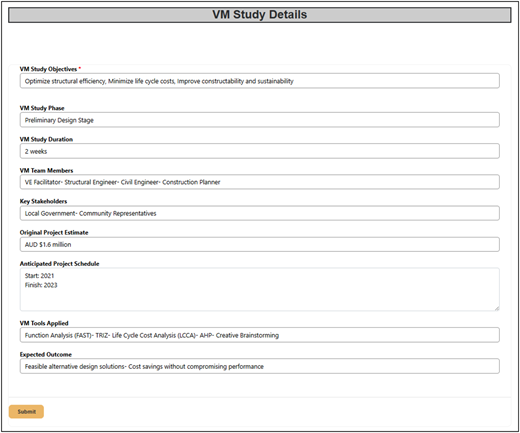
The objective of this VM study is to identify options to improve constructability, economy, durability and ease of maintenance for the Warners Bridge upgrade without compromising the required environmental outcomes and design criteria. Options are limited to superstructure, substructure, foundations, coatings and protection. The criteria and scope used during this VM study to ensure the Warners Bridge ecosystem is minimally affected were to select a long-lasting structure with sustainable materials and to minimise maintenance by selecting low-maintenance options. Figure 3 presents details of the VM study, including its objectives, duration, stakeholders, VM tools used and expected outcomes.
5.1.3 Project cost estimate
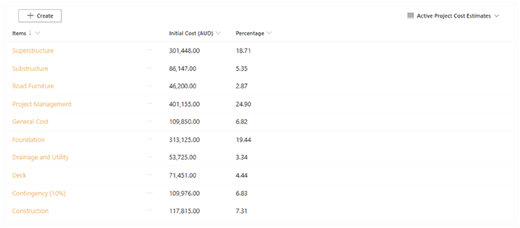
The Warners Bridge project cost estimate requires a detailed identification of all significant bridge components and their respective investment costs. Figure 4 shows the cost estimate screen in the PowerVM tool. The user inputs an estimated cost for each major component of the bridge system. The program automatically calculates the percentage value for each component relative to the total estimated cost. In this case, the highest costs are for the foundations, superstructure, deck and road furniture components.
5.1.4 VM study assessment criteria – circularity matrix
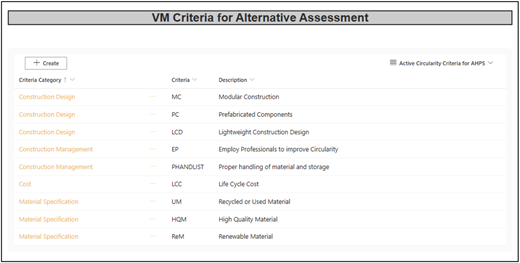
Circular economy (CE) principles are essential for promoting the sustainability of infrastructure assets (Tseng et al., 2024). However, most VM applications in practice still primarily focus on cost, time and performance parameters, with minimal or no consideration of material circularity and end-of-life impacts (Amarasinghe et al., 2024). In that sense, circularity criteria were developed to assess design alternatives based on design and financial merit, as well as their long-term potential to enhance resource efficiency – a crucial factor for material-heavy projects like bridges. These criteria were chosen for their ability to foster resource efficiency, facilitate design for disassembly, enhance durability, recyclability, adaptability and reduce environmental impact – thereby enabling a balanced approach between short-term delivery needs and long-term sustainability goals. In the Warners Bridge example, the selected criteria were integrated into PowerVM to guide the scoring, weighting and automated aggregation of results. Figure 5 shows the PowerVM section for the VM study assessment criteria.
The resulting framework supports transparent evaluation of the CE performance of the alternatives while improving decision-making by facilitating a shift in infrastructure asset selection away from linear “build–use–demolish” models and toward CE-compatible “design–use–recover” systems. PowerVM contributes to that transition by promoting an evidence-based digital workflow that supports the economic, environmental and functional evaluation of infrastructure projects.
5.1.5 Information phase summary
Summary for the information phase shows completed and pending tasks. This allows the team to see what remains to be done before moving forward. PowerVM accomplishes this by using colour coding for easy status identification.
5.2 Function phase
The functional phase aims to achieve mutual understanding of the project requirements. It consists of (1) defining major and minor functions of the bridge, (2) eliminating wasteful tasks and (3) ideating novel ideas (Kineber et al., 2022a, b). By utilising FAST, the VM-team deconstructs the bridge according to the functions it needs to fulfil rather than its physical structure, thereby generating more value by providing better solutions at lower cost (Luo et al., 2011). Relationships among different functions can be easily visualised using FAST diagrams, helping stakeholders recognise higher-value alternatives (Kassa, 2016).
5.2.1 Function Analysis System Technique
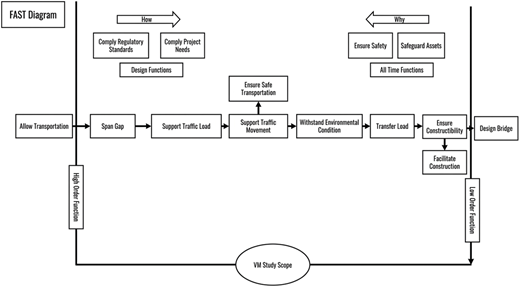
Function Analysis System Technique (FAST) is Value Management's primary tool, developed into its formalised format in the 1960s. It allows for the logical structuring and linking of all project functions (Rajaram et al., 2022). It is commonly used in civil infrastructure and transportation projects, as these typically involve multiple objectives, such as cost and constructability, while balancing environmental impact and durability over the project's lifecycle to achieve optimal asset performance (Kassa, 2016). Bridges serve as an example of these types of projects. FAST organises these functions into a hierarchy of high-level/basic, secondary, supporting and all-time functions. All functions are written in a verb–noun format to avoid implying a solution. The functions are connected by pieces of logic formulated by asking “why” (to the left) and “how” (to the right). By applying logic to the relationships between functions, teams can follow the chain of purposes, examine needs and define options for innovation. For Warners Bridge, the overall function was defined as “allowed transportation” with a basic function of “span gap.” Several secondary functions were defined, including supporting loads, allowing movement, transferring forces and resisting environmental loads. These defined further requirements of the project, such as having minimal resistance to gravity loads and traffic and maximum strength in these areas. Support functions, such as selecting material, geometry and connections, connected the PURPOSE to the MEANS and ALL TIME functions, such as safety and durability, were defined. Requirements based on regulatory needs and project needs were also included. PowerVM captured all identified functions and FAST diagrams were automatically generated in Power BI, as shown in Figure 6. The digital workflow ensured completeness, enhanced multidisciplinary understanding and revealed opportunities to improve value beyond just cost savings.
5.2.2 Cost Worth Analysis
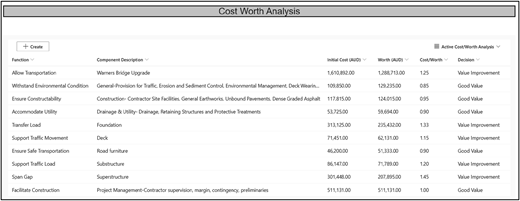
Cost–Worth Analysis (CWA) describes a one-to-one relationship between functions and cost breakdowns, providing clear value judgments. PowerVM software's cost-worth component captures the costs and worth for each function and component, from which the software determines cost–worth ratios, along with functions where cost exceeds worth, for consideration of value improvement through redesign or substitution (Figure 7). Functions and their corresponding components were defined for the Warners Bridge case from FAST outputs. Individual costs were allocated to cost breakdowns, which were then compared with their direct contribution to the bridge's performance. Automated determination of cost–worth ratios for each function is provided, with values less than 1.0 considered to be performing well and those above 1.0 as candidates for value improvement.
5.2.3 Function phase summary
The Function Phase – Summary lists the functions completed, including those identified using FAST, such as high-order, basic and secondary functions. Those functions that still need to be finished are shown, including linking functions to parts of the project and determining worth values (Kineber et al., 2022a, b). Tracking the status is important to ensure all functions are fully developed before moving into the creativity and evaluation stages.
5.3 Creativity phase
The creativity stage generates new and improved alternatives by evaluating ideas against project functions and requirements. To move beyond traditional and intuition-led brainstorming, TRIZ is introduced to systematically resolve technical contradictions and support creative idea generation (Delgado-Maciel, 2025). This enhances VM, enabling innovative, sustainable and value-adding design options.
5.3.1 Identify primary contractions
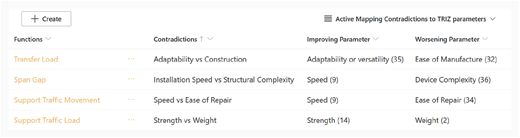
The VM study benefits from recording primary contradictions, which reveal important technical trade-offs. The contradictions identified for Warners Bridge, for example, concerned the FAST-created functions: adaptability vs. construction, speed vs. repair, strength vs. weight and so on. These documented contradictions guide TRIZ-based idea generation during the creativity phase (Karendał, 2018).
5.3.2 Mapping Contradictions to TRIZ parameters
Primary contradictions drive TRIZ inventive parameters during the Creativity Phase. Each had an improving or worsening parameter, for example, Adaptability/Versatility versus Ease of Manufacture and Strength versus Weight. VM tool entries influence solution development towards balanced, value-creating design decisions (Figure 8).
5.3.3 TRIZ inventive principles
TRIZ contradiction analysis helped identify major technical contradictions in which enhancing one parameter caused the deterioration of another (Chang et al., 2023). Applied to the Warners Bridge problem, five main contradictions were identified based on functions; for example, increasing load capacity also increases self-weight and cost. The TRIZ contradiction matrix was consulted to identify relevant inventive principles (such as segmentation and mechanical substitution). The ideas for alternatives, like FRP and geopolymer concrete systems, were supported by TRIZ. All contradictions involving improving and worsening parameters and their associated inventive principles are shown in Figure 9.
5.3.4 TRIZ inventive principles to generate ideas
TRIZ inventive principles and the contradiction matrix were employed to resolve the primary contradictions (Chang et al., 2023). The contradiction matrix of improving and worsening parameters was utilised to identify relevant principles shown on the TRIZ Inventive Principle tab. Each contradiction is mapped to relevant inventive principles for use in the design phase.
5.3.5 TRIZ-driven creativity pathway
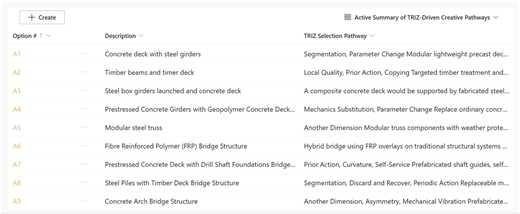
The nine TRIZ inventive principles were transformed into nine individual bridge design options for the Warners Bridge replacement project. Each alternative resolved the focused contradictions with different materials, structural systems or construction methods. For instance, A4 utilised geopolymer concrete to decrease embodied carbon, while A7 used Fibre-Reinforced Polymer (FRP) systems, which leverage the principle of composite materials. Overall, these nine options established a thorough and systematic design space for exploration. Figure 10 summarises the TRIZ-inspired alternatives.
5.4 Evaluation phase
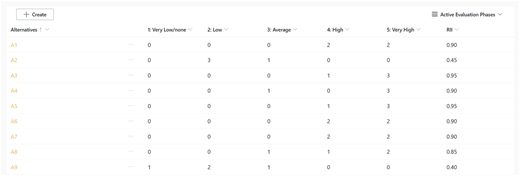
Alternatives received during the Creativity Phase are screened during the Evaluation Phase. Each alternative will be analysed to ensure it is feasible, cost-effective and of value. Qualitative and quantitative methods are used to rank these options against the set criteria. Criteria often include cost, performance, durability, sustainability and constructability. The Relative Importance Index (RII) is used to calculate a ranking score based on stakeholder input. By utilising Likert Scale data and calculation of RII, value management provides an objective, data-led decision-making process (Kineber et al., 2022a, b). The higher the ranking, the higher the option ranks amongst the criteria. An option is kept if its RII ≥0.8 (Kineber et al., 2022a, b). This indicates that the solution has considerable stakeholder support and is logical. By setting a high threshold for continuation into the next phase, time and resources can be dedicated to the most value-maximising alternatives. In the Warners Bridge study, Alternatives A2 and A9 scored below 0.8, leading to their elimination from further development. Using RII guarantees an impartial, efficient and performance-oriented evaluation in VM, especially for infrastructure projects. This quantitative approach prioritises options that optimise cost, function and risk reduction, thereby improving the overall effectiveness of the VM process (Gouda Mohamed et al., 2024). Figure 11 displays the PowerVM section for the evaluation phase.
5.5 Development phase
The Development Phase refines the final solution by selecting one of the shortlisted bridge designs. LCCA calculates the present values for all cost categories using the fully automated and error-proof VM tool. Technical and economic parameters are assessed with AHP (Akhrouf and Derghoum, 2023). These scores are combined with the cost values through the VI method. The design alternative with the highest VI is selected. The entire workflow is documented in PowerVM for full transparency and traceability.
5.5.1 Initial cost estimate for each alternative
A consistent method was used to estimate construction costs for all options considered for the Warners Bridge upgrade, based on a standard single-span length of 21 m and a deck width of 6 m. The bridge design geometry is based on GHD design (GHD, 2021) and standard Austroads/TMR dimensions. Estimates of quantities for all key materials, such as steel, concrete, timber and composites, were prepared for each option. Unit rates for different components were determined using TMR and local benchmarks (Department of Transport and Main Roads, 2024). Preliminaries, supervision, contingency and contractor margin were kept consistent across all options, allowing easy comparison of capital costs. The options assessed were A1 – Concrete deck, steel girders; A3 – Steel box girders, cast-in-place concrete deck; A4 – Prestressed concrete girders, geopolymer concrete deck; A5 – Modular steel truss; A6 - Fibre reinforced polymer bridge; A7 – Prestressed concrete deck, drilled shafts; and A8 – Steel piles, timber deck. The options vary in structural system, materials, constructability, durability and sustainability. Nonetheless, all options were designed to standardised spans, deck width and substructure arrangements, allowing costs and performance to be compared consistently.
5.5.2 Total life cycle cost estimate of each alternative
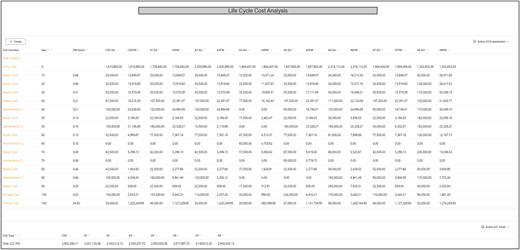
The LCCA for all Warners Bridge alternatives was performed using the Net Present Worth method over a 100-year design life, including construction, maintenance, upgrades and salvage costs (Kineber et al., 2022a, b; Luo et al., 2011). Inflation, discount rates and maintenance cycle assumptions are set at 2.5%, 4% and 15 years for timber and 30 years for concrete, respectively (Shahhosseini et al., 2018). The FRP/timber and concrete/steel replacements were assumed to be 100% and 50% included in the LCCA, respectively. Major upgrades considered include deck replacement, additional corrosion protection and regular inspections every 24 months. A summary of the LCCA results for all alternatives is provided in Figure 12.
5.5.3 Multi-criteria decision analysis – AHP (Analytic Hierarchy Process)
The AHP is a multi-criteria method that ranks alternatives by structuring decision criteria and sub-criteria and deriving weighted scores through pairwise comparisons (Mohapatra et al., 2024). Implemented in the VM tool, AHP enables multiple participants to collaboratively assign weights to criteria and score all alternatives consistently. The tool automatically synthesises results and provides clear, organised rankings for all bridge design options (Mousa et al., 2022). Figure 13 shows the weighted criteria and alternative scores obtained using the AHP tool (Source: Link to the website), which is integrated into PowerVM.
5.5.4 Ranking and value estimation of each alternative
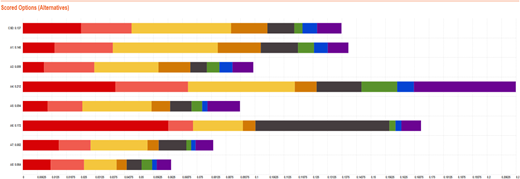
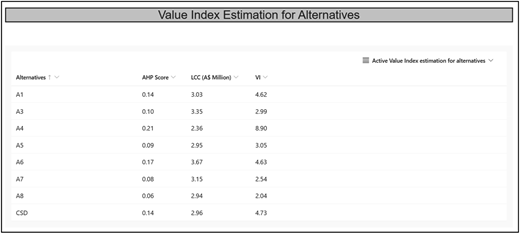
The VI method calculates a performance-to-cost index by combining AHP-weighted scores with lifecycle cost estimates. VI values were calculated automatically in PowerVM, ensuring accuracy and transparency (Kineber et al., 2022a, b). Option 4 resulted in the highest VI score of 8.9 (reference option was 4.73) and was determined to be the most economically beneficial and balanced solution for this project (Figure 14).
5.6 Presentation phase
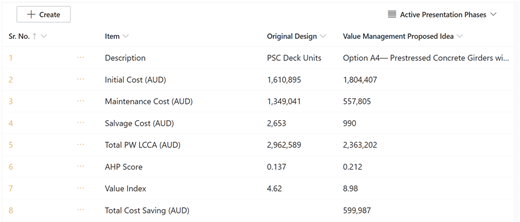
The Presentation Phase clearly demonstrates the VM results to the project stakeholders using PowerVM. Shortlisted options were then plotted against the case study (Figure 14). Notice that although the selected option has a higher initial cost by 10.7%, it has a lower lifecycle cost. LCCA is important and should not be trumped by initial cost alone. Option A8 is one of the lowest-cost options, but it offers a low VI. This shows that just picking a low-cost option is not enough. Option A4 (geopolymer concrete deck option) scored the highest VI of 8.98 due to its ability to provide adequate lifecycle savings along with added value (Figure 15).
6. Findings and discussion
The primary purpose of implementing the digitised VM framework on the example bridge upgrade job was to demonstrate how all phases of the VM job plan can be supported through a transparent, repeatable and structured multi-criteria decision-making process. Results of the case study have shown that by executing FAST, TRIZ, AHP, LCCA and VI modelling within the same digital VM environment, all nine bridge alternatives were logically assessed against the criteria of cost, sustainability, constructability and whole-of-life performance. Once more, it was found that higher capital alternatives that outperformed others from a sustainability and durability perspective also received higher overall VI scores. Therefore, this study again supports existing literature that deterministic cost-minimisation frameworks often struggle to account for whole-of-life value during infrastructure project delivery.
6.1 Validating identified research gap and contribution contextualisation
To summarise existing VM literature, three major shortcomings can be described. One, previous VM studies apply commonly known tools in siloed phases without integration across creativity, evaluation and costing (Gillier et al., 2015; Mousa and Albasyouni, 2021). Two, workshops and professional judgement predominate during evaluation and decision-making, which can limit repeatability and structured analysis. Third, current digitised VM offerings (GDSS- and BIM-linked) primarily focus on information management rather than decision intelligence across the entire VM job plan (Luo et al., 2011). This study has implemented all the FAST, TRIZ, AHP and LCCA worksheets in PowerVM, demonstrating that digitised VM frameworks can unify information and support decision intelligence across all phases of VM.
6.2 Validating TRIZ benefits to VM creativity
A second benefit of structured creativity, discussed in the literature, is the ability to produce higher-quality outputs. TRIZ allowed for technical trade-offs to be expressed as engineering contradictions, e.g. higher strength comes at the expense of sustainability. Expressing these trade-offs as quantified contradictions throughout the ideation process guided the team to propose nine fundamentally different structural alternatives. Of particular interest is alternative A4 – the geopolymer concrete deck alternative. A4 was created as a direct result of solving the contradiction between high strength and low embodied carbon. Alternative A4 would be nearly impossible to think of without using TRIZ to guide decision-making. Therefore, this proves that structured creativity can increase not only the quantity of VM alternatives but also their quality.
6.3 Validating MCDM via the AHP technique
The main benefit of applying AHP in multi-criteria decision-making was the creation of a logical and transparent weighting scheme for ranking alternatives. Where traditional VM decision-making would rely on consensus based on subjective opinions, the pairwise comparison format enabled clear weightings to be applied to sustainability criteria, cost information, constructability aspects and performance elements. The team found that the rank order of alternatives using AHP differed from that of the overall VI scores calculated using LCCA. This demonstrates that expert judgement can be quantified in decision models to produce a robust final ranking.
6.4 Validating sustainability linkage to whole-of-life costing
The benefit of integrating lifecycle cost early in the VM job plan was demonstrated by LCCA results. Over the 100-year analysis period, alternative A4 demonstrated approximately 20.2% cost savings compared to the current dock state. This supports a large body of infrastructure literature that defines durable, low-maintenance alternative materials and structural systems as a method of providing better long-term value. As with the integration of sustainability criteria during the AHP process, credit was given to alternatives that excelled in areas such as material efficiency, recyclability, durability and reduced environmental impact.
6.5 Validating contribution of digital execution
Perhaps one of the biggest opportunities to improve current VM practice lies in digital integration across all stages of the job plan. Instead of requiring manual data export and import between spreadsheets, a system like PowerVM automates all calculations, reducing human input and transcription errors. Additionally, since every action inside the Power Platform is logged by default, every step of the decision-support workflow is easily auditable. Providing a fully digital thread from inputs through analysis to outputs improves the transparency of decision-support calculations compared to standalone models that may or may not exist in Excel. Finally, low-code logic implemented within PowerVM makes this proof of concept more useable for industry practitioners. To the author's knowledge, this study is the first to successfully integrate TRIZ, AHP and LCCA into a fully digitised VM framework.
6.6 Implications of findings
Taken together, these results illustrate that the lowest initial-cost alternatives do not always provide the best value to stakeholders when whole-of-life considerations are included in decision-making. Alignment among TRIZ exercise alternatives, AHP ranking and LCCA analysis demonstrates that integrating the components of creativity, decision analysis and life-cycle costing yields more informed final decisions. This work helps build on the fragmented use of tools by demonstrating how all components of the VM job plan can be unified into a single digitised decision-support ecosystem.
7. Research implications
The following outlines the theoretical and practical implications of this study.
7.1 Theoretical implications
Enhancing VM theory by integrating the VM job plan with TRIZ contradiction analysis: This research advances existing VM theory and the literature by formally integrating TRIZ contradiction analysis into the VM job plan. This research formalises the creativity phase of the VM job plan to address recognised limitations in the VM literature regarding the quality and defensibility of ideas generated during VM workshops. Ideas generation is no longer reliant on experience or workshop facilitation.
Developing VM scoring theory by utilising Multi-criteria Decision Analysis (AHP): Formalising the use of the AHP contributes to VM theory on scoring and evaluating ideas by providing transparency in decision-making through a mathematically based methodology. Rather than selecting scores in a somewhat subjective manner, this research leverages well-established MCDM theory to make VM decisions more defensible.
Validating Life-Cycle Costing (LCC) with Functional Performance: LCCA incorporated with the VI to validate low-cost suggestions with good functional performance and vice versa. Building on recent VM research that questions the value of cost optimisation as the sole focus of many VM studies, this research enables true whole-of-life value trade studies.
Advancing research into digital VM practice: This research translates the VM job plan theory into a digitised workflow using a low-code platform. Research into digital VM has lacked real-world case studies demonstrating the effectiveness of digitising VM without bespoke software development.
7.2 Practical implications
At a practical level, this research makes numerous contributions to infrastructure decision-makers, VM facilitators and asset owners.
Firstly, the resulting PowerVM platform is readily applicable to stakeholders who wish to establish a repeatable, documented digital process space for conducting VM studies using the six-phase job plan. This will reduce the required manual input, increase traceability and make VM between decision cycles more repeatable.
Secondly, by adopting TRIZ, VM facilitators have access to a repeatable framework for running creative sessions. Typical creativity workshops involve some measure of groupthink, bias from time constraints and rely on the experience of individuals within the workshop. TRIZ allows users to understand and resolve technical contradictions using a structured approach to improving the quality and novelty of alternatives.
Finally, findings from the case study indicate that alternative material and structural system options (e.g. geopolymer concrete; fibre-reinforced polymer (FRP) systems) can provide better whole-of-life value, even if they incur larger capital cost penalties. This further emphasises the real-world need to move procurement and design evaluations away from lowest price-focused decision-making and towards optimising lifecycle value.
8. Research limitations and future research
Framework Validation: This was completed on a single bridge in Australia. The generalisability to other asset types and jurisdictions can be further tested by validating across multiple case studies in different infrastructure sectors.
Size of Expert Panel: Four experts were used, which is standard for VM workshops; however, this limits the statistical robustness (generalisability) of the AHP weightings produced. Parallel workshops with different expert panels can be used to investigate the sensitivity of output to panel members.
The LCCA relies on assumptions about the discount rate, deterioration rates and maintenance intervals over the 100-year analysis period. Sensitivity to these variables can be quantified with a probabilistic LCCA based on Monte Carlo simulation in future research.
The Power Apps platform is reliant on Microsoft products. Investigating open-source alternatives and BIM integration to automate the information phase is recommended in future research.
9. Conclusion
A smart, sustainable VM framework that combined TRIZ, AHP and LCCA was created and validated within a low-code digital platform and applied to the Warners Bridge replacement project. Key outcomes of this research are:
Nine structurally different alternatives were created from five TRIZ-derived technical contradictions during the enhanced creativity stage. This demonstrates that structured innovation techniques can replace ad hoc brainstorming during VM practice.
Alternative A4 (geopolymer concrete deck with steel girders) achieved an 88% improvement in value over the reference design, with a VI of 8.9, compared to 4.73 for the business-as-usual alternative.
An estimated 20.2% lifecycle cost savings over 100 years were found through LCCA of the preferred alternative, confirming that more sustainable material systems can provide better whole-of-life economic value.
This study proved that the entire six-phase VM process can be embedded within the Power Apps digital platform, allowing non-specialist VM practitioners to access rigorous VM.
The theoretical and practical implications of this research are that VM theory can be supported by a replicable, smart, sustainable framework and tool for use by road authorities, bridge engineers and VM facilitators to conduct transparent, auditable and analytically rigorous value studies.