This research examines the human factors that influence construction professionals' engagement and motivation to participate in BIM-based continuing professional development (CPD). As digitalization reshapes architecture, engineering and construction (AEC) practices, understanding participation in CPD is essential for supporting industry-wide competence development.
A qualitative multi-method design combined participatory workshops with an open-ended survey. Data were analyzed using thematic analysis.
Engagement and motivation were shaped by interconnected pedagogical, organizational and individual factors. Collaboration, interdisciplinary interaction and authentic practice-centered learning supported engagement, while flexible and modular delivery formats aligned with professionals' need for autonomy. Diverse digital and BIM-related backgrounds shaped participants' learning needs and preferences for BIM-based CPD, highlighting the importance of flexible and adaptable learning pathways.
This study extends research on motivation and engagement in CPD into the underexplored context of BIM-based learning in the AEC sector. While broadly consistent with workplace learning literature, the findings suggest that BIM-based CPD is distinguished by the importance of role-specific project relevance, interdisciplinary interaction and learners' diverse digital and BIM-related backgrounds. The study provides empirically grounded insights for designing BIM-based CPD.
1. Introduction
The architecture, engineering and construction (AEC) sector is undergoing a profound transformation shaped by technological, environmental and societal pressures. Sustainability requirements, demographic change, evolving regulation and rapid digitalization are reshaping how the built environment is designed, delivered and managed (Alaloul et al., 2020; Krueger et al., 2020; Moshood et al., 2024; Shabha et al., 2023). Digital tools such as Building Information Modeling (BIM), digital twins, robotics, advanced analytics and AI are increasingly central to these changes, affecting how information is produced, coordinated and used across the project lifecycle. Continuing professional development (CPD) is therefore essential for sustaining professional growth, organizational innovation and workforce adaptability. In the AEC sector, CPD is particularly important because digital construction capabilities increasingly shape employability, career progression and participation in complex interdisciplinary projects (Sivaraja et al., 2025).
As BIM has become central to the AEC sector's digital transformation, its role has expanded far beyond its early conception as an enhancement of 2D CAD. Although information has always been at the core of BIM, early development efforts concentrated primarily on modeling tools. It soon became clear, however, that technology alone would not deliver the expected improvements in project outcomes; the key was in managing information effectively across the entire lifecycle, supported by new processes, policies and collaborative practices (Jaskula et al., 2025). This shift positioned BIM as a foundation for a broader ecosystem of digital applications, including tools for communication, coordination, visualization, analysis, simulation, virtual reality and data capture, storage and analytics, and linked it to emerging technologies such as robotics, digital fabrication and autonomous or unmanned operations. Correspondingly, BIM education has developed from raising awareness of BIM and its implications, to skill-focused training and ultimately to BIM-based learning environments where a Building Information Model functions as an integrated platform for analysis and collaboration (Underwood et al., 2013). Research on BIM education has grown steadily since the early 2000s, with a notable increase in publications from around 2007 onwards (Barison and Santos, 2010; Puolitaival and Kestle, 2018), reflecting the expanding scope and complexity of BIM-related competences required in contemporary practice.
Although BIM education research is substantial, detailed examinations of CPD remain limited. In particular, the engagement and motivational factors influencing professionals' participation in BIM-based CPD remain underexplored.
2. Literature review
2.1 Continuing professional development
2.1.1 Professional development terminology
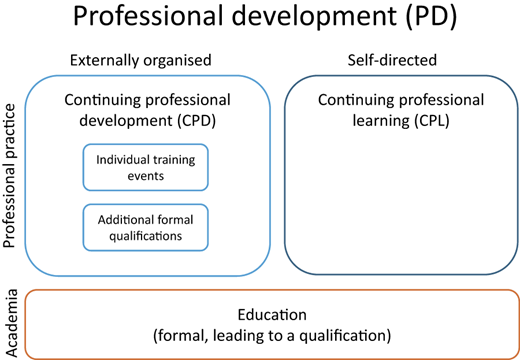
The terms education, training, professional development (PD), continuing professional development (CPD) and continuing professional learning (CPL) are interconnected concepts, which contribute to professional growth. There are differences in focus, scope and nature, and these are not necessarily always agreed on and sometimes the terms are used interchangeably. Different industries also conceptualize CPD in different ways.
Figure 1 describes how the terminology and their connections are understood in this research. This figure is a simplified example as individuals may have very different PD paths. PD can be seen as a continuous process and a lifelong journey involving various learning forms to acquire professional competences and adapt to changes, especially in technology-driven environments, improving professional knowledge and effectiveness (Jeeva et al., 2024). The foundation of one's PD is typically in education, where a formal qualification is awarded. Education provides theoretical foundation and fosters reflective habits necessary for lifelong learning (Dorfman-Furman, 2024). CPD is most often regarded as a subset of PD. CPD involves various organized training activities, which one attends after the qualification has been awarded. It may also include additional formal qualifications during one's professional career. Training focuses on skill acquisition offering a structured, targeted process aimed at acquiring specific skills for immediate workplace application. Training can range from short workshops to multi-day learning sessions. Training is an integral component of CPD; however, these two concepts are sometimes used interchangeably (Anderson, 2007; Bouix, 2013). In addition to CPD, PD includes also a self-directed aspect. This is most often called continuing professional learning (CPL). In CPL ongoing learning and adaptation to new technologies and challenges is emphasized, often involving technology-mediated and informal learning (Roth and Moencks, 2021). CPL could also be called continuous professional learning due to its continuous nature, with learning happening not just by active informal learning but also through practicing one's profession, learning-by-doing. Research on workplace learning suggests that a substantial share of CPL is informal and situated, emerging through problem solving and collaboration in real work settings (Eraut, 2004; Decius, 2025). Adult professional learning literature highlights self-direction and the need for immediate relevance and applicability (Loeng, 2020), which are particularly relevant for CPL and often also inform CPD choices.
2.1.2 Continuing professional development in the AEC industry
When searching for literature regarding CPD in the construction industry, there are very few papers, where CPD or CPL is at the core of the paper. Some of the early literature is from the early 1980s’. MacDowell (1981) explored the ways in which industry groups, professional groups and tertiary institutions can assist in providing continuing education for construction engineers. In-house training in engineering consultation firms has been investigated by Martin (1988). Fisher et al. (2005) goal was to improve an organization's core competence in construction project management with the help of a formalized education and training model. Wall and Ahmed (2008) developed a framework for education providers to deliver blended lifelong learning in the construction industry and within that looked at the facilitators' role in motivation. Toor and Ofori (2008) developed a conceptual model of potential collaborative relationships, and specific roles for the universities, the industry, professional bodies and government in lifelong PD. Madter et al. (2012) explored CPD practices for construction engineers. There are also papers, which are bridging the gap between academia and industry by improving higher education curricula (Sacks and Pikas, 2013). In many papers CPD has been a conclusion, a possible solution, when discussing lack of competences or barriers and challenges that the industry faces. These discussions do not go deeply into CPD.
2.2 BIM education
BIM education has become an established and rapidly evolving research area, reflecting the central role of BIM in the digital transformation of the AEC sector. Across this expanding literature, BIM education is commonly conceptualized as progressing from BIM-aware to BIM-focused and ultimately to BIM-based learning. In BIM-aware approaches, learners develop conceptual understanding of BIM; in BIM-focused approaches, they acquire task-specific skills and in BIM-based approaches, BIM functions as an integrated environment for interdisciplinary collaboration, problem-solving and applied competence development (Underwood et al., 2013). Studies adopting this latter perspective often emphasize the value of real project data, collaborative tasks and multi-disciplinary teamwork, aligning BIM education with broader learning theories such as experiential learning and project-based learning.
A significant amount of research has explored the competences needed for BIM-enabled practice, ranging from modeling and information-management skills to communication and coordination competences (Sacks and Pikas, 2013; Succar and Sher, 2013). Alongside competence frameworks, numerous studies have documented course-level interventions in higher education settings across disciplines. These include applications within construction project management (Peterson et al., 2011), structural analysis, construction sequencing and safety (Clevenger et al., 2012) and more specialized topics such as project cash flow modeling (Olowa et al., 2021). At a broader educational scale, several authors have proposed curriculum-level integrations of BIM to ensure coherent learning pathways (Ghosh et al., 2015; Puolitaival and Forsythe, 2016).
Technological developments have further diversified BIM education. Research has examined the use of virtual and augmented reality, serious games and simulation-based environments to support interactive, immersive and experiential learning (Ahmed, 2020; Morganti et al., 2023; Teizer et al., 2020). These technologies are often positioned as pedagogical tools for enhancing authenticity, collaboration and engagement. These attributes are considered essential for preparing professionals for data-driven project environments.
Most BIM education research has concentrated on curriculum design, course development, competences or technological enhancement. Collectively this literature provides a well-established understanding of how BIM-related competences can be framed and supported through higher education courses, curriculum integration and technology-enhanced learning approaches. However, considerably less attention has been given to CPD contexts, where learning takes place within organizational settings and under different motivational conditions than those found in higher education. Accordingly, what remains unclear in BIM-based CPD for practicing professionals is what drives willingness to engage in and sustain participation over time. In particular, research rarely examines how delivery formats, workplace relevance, role-specific learning needs or organizational conditions shape engagement and motivation in the AEC context.
2.3 Engagement and motivation factors
Motivation has been defined as “the processes that account for an individual's intensity, direction and persistence of effort towards attaining a goal”, where intensity describes the value of the effort, and how it needs direction and persistence to achieve organizational and personal goals. A commonly held view is that one cannot simply or forcibly motivate people, instead a motivational work culture and environment is needed first and foremost that will encourage individuals/employees to feel motivated about working toward their own and the organization's goals. Another view is that different people are motivated by different things, such as job satisfaction, money, flexible work conditions, training schemes and or/incentives (Robbins et al., 2021, p. 164).
2.3.1 Early theories of motivation
Early theories of motivation such as Maslow's Hierarchy of needs (physiological, safety, social, esteem and self-actualization), and Herzberg's Two factor theory (motivators and hygiene factors) have been referred to, and often still are by organizational managers. Herzberg suggested that a productive work environment and job satisfaction is influenced by motivators such as recognition, responsibility, personal growth and achievement opportunities, as well as hygiene factors such as salary, working conditions, fair and clear company policies and positive collegial relationships (Robbins et al., 2021, pp. 164–165,167). Researchers have not found empirical substantiation to validate Maslow's theory, and Herzberg's theory has not been supported given several detractors all related to the choices of methodology process, reliability and assumptions. Whilst being regarded as seminal works, they are now just regarded as the foundations for more contemporary motivational theories.
2.3.2 Contemporary theories of motivation
Contemporary theories of motivation such as Goal-setting, Expectancy, Self-determination and Self-efficacy theories of motivation, are currently viewed as representing valid viewpoints regarding employee and organizational motivational approaches.
The Goal-setting theory suggests that setting specific goals and challenges, and receiving externally generated feedback, leads to higher performance amongst employees/individuals and the organization as a result. To quote from Robbins et al. (2021, p. 169), “The specificity of a goal, and especially a difficult goal, seems to act as a personal stimulus”, and “difficult goals lead us to discover strategies to perform the task(s) more effectively”. Creating self-generated reflective feedback appears to be a strong motivator for individuals/employees.
Victor Vroom's Expectancy theory is currently one of the most accepted motivational theories in organizational practice, suggesting employees tend to put in more effort when they think it will result in a good personal performance appraisal, subsequent organizational increase in salary or promotion rewards that fit with the employee's goals. Employees' expectations might not be matched or in sync though with the organization's performance expectations appraisal and reward system(s) (Robbins et al., 2021, p. 176).
The Self-determination theory (SDT) suggests that people are motivated by three psychological needs: autonomy, competence and relatedness. Preference is to have control over their choices and actions, not feeling obligated to undertake tasks and goals set by others, feeling capable and competent in their own abilities and wanting to feel connected and supported by others. To design CPD programs that support these personal needs, requires offering a variety of differing learning options and formats that suit differing learning styles, encourages collaboration, peer learning and recognition of progress and achievements (Bandhu et al., 2024; Robbins et al., 2021, p. 167). An example is when people are paid (i.e. extrinsic rewards) for work, and it might feel more like something they have to do, rather than what they want to do, when following their intrinsic desire to excel and influence the goals to be met, irrespective of the monetary awards.
The Self-efficacy theory suggests that people are motivated by personal belief and confidence in their own abilities to perform a task or goal. This influences choices, efforts perseverance and resilience in the face of challenges (Bandhu et al., 2024; Robbins et al., 2021, p. 170). For organizations to support and encourage self-efficacy, employees need realistic learning tasks that match their current skill level(s) and at the same time challenges them to upskill/improve.
Motivational factors shaping CPD engagement in the AEC context can help explain the human dimensions of digital skills development. These factors can then be interpreted using motivational and social learning theories, with implications for how organizations design and implement CPD.
2.4 The research gap
Although CPD is broadly recognized as essential in the AEC sector, existing research has mainly concentrated on identifying skill needs and designing curricula in higher education context. Much less is known about the human factors that influence whether AEC professionals choose to engage in CPD or feel motivated to continue learning. Studies rarely explore how practitioners perceive the relevance of learning opportunities, how different delivery formats affect participation or which practical and organizational conditions support or hinder sustained engagement.
BIM education literature has expanded, covering competence frameworks, course designs and technological innovations. However, most of this work focuses on higher education contexts or on technical and pedagogical aspects of BIM. Research that examines BIM-related learning from the perspective of practicing professionals, who work under real project pressures and organizational constraints, remains limited. As a result, little is known about what motivates professionals to participate in BIM-based CPD or about the barriers or challenges that prevent learning in practice. While related research in domains such as healthcare and other professional sectors provides relevant insights into motivation and CPD, differences in project-based work structures, fragmented organizational settings and digitally mediated collaboration mean that these findings may not transfer directly to BIM-based CPD in the AEC context.
Motivation theories such as Goal-setting, Expectancy, Self-determination and Self-efficacy provide useful perspectives for understanding learning behavior, yet they have only been minimally applied to CPD in the AEC sector to date. While BIM education research has produced substantial insights on competences, course design and technology-enhanced learning, it remains unclear how these insights translate into BIM-based CPD for industry professionals working under real project pressures and organizational constraints. This study therefore investigates the factors that shape construction professionals' engagement and motivation to participate in BIM-based CPD. The research is guided by the question: “What factors influence construction professionals' engagement and motivation to participate in BIM-based continuing professional development?”
3. Methods
3.1 Data collection
Given the limited prior empirical research on engagement and motivation in BIM-based CPD, this study adopts a qualitative multi-method research design to generate contextually grounded insights into how such factors are articulated by practitioners. The approach combines two stakeholder workshops and an open-ended survey to capture both collectively negotiated perspectives and individually expressed views across different organizational contexts.
A total of 56 workshop participants and 72 survey responses were included in the study.
Workshop 1 in Tallinn, Estonia, was organized using the “World café” method, which is widely used in organizational change and development processes (Löhr et al., 2020). The method is strongly participatory and inclusive, and it encourages dialogue and cross-pollination between the participants (Fouché and Light, 2011). Seven steps were followed in the execution:
“Clarify the context,
Create a hospitable environment,
Explore questions that matter,
Encourage everyone's contribution,
Cross-pollinate and connect diverse perspectives,
Listen together for patterns, insights and deeper questions,
Harvest and share collective discoveries” (Schieffer et al., 2004, pp. 3–4).
In Workshop 1 there were 29 participants, representing educational institutions (both staff and students), training organizations, industry and government. Most of the participants were from Estonia, three educational institute staff were from Finland and three also from Italy.
In the Workshop 2 in Bologna, Italy, there were 27 participants representing educational institutions (both staff and students), training organizations, industry and government. Most of the participants were from Italy, three educational institute staff were from Estonia and similarly three from Finland. Instead of the World café method, data was collected in this workshop via individual questionnaires and group work. The questions discussed in Workshop 2 differed from the questions in Workshop 1 in Tallinn (Table 1). Participants in both workshops generally represented a high level of BIM expertise, although a small number of participants, mainly students, had more moderate levels of BIM experience.
In addition to the workshops, a wider survey data collection was implemented to verify and complement the findings from the workshops. A questionnaire was sent out to 139 construction industry, public organization and educational institution representatives in Estonia, Finland and Italy. MS Forms was used to collect the data. After one reminder round, a response rate of 52% was achieved. The survey was sent to a range of organizations, including construction companies (29%), consultancy firms (28%), educational institutes (22%), public organizations (9%), technology providers (8%), research institutes (3%) and real estate/facility management organizations (1%). Majority of the organizations were large with more than 250 employees representing relatively typical organizations within the field with medium to high BIM maturity. The survey targeted primarily senior- and middle-management and specialist roles within their organizations.
Industry and public organization representatives formed the largest group of participants with 45 responses. There were 20 responses from educational institution representatives and seven represented both groups. Although the participants came from three different countries: Estonia, Finland and Italy, this was not used as a demographic criterion in the questionnaire. The questionnaire had one demographic question about the nature of the organization that the respondent worked at and five open-ended questions as follows:
The main beneficiaries of BIM-based education and training in your organization would be which professionals or professions (if you are an industry or public sector representative), or which degree programs or training courses (if you are an educational institute representative)
What type of digital models would be needed for your educational and training needs?
What would engage and motivate you to participate in BIM-based education?
What kind of BIM-based course or educational module would create wide interest and enthusiasm?
What would you like to see happening next to realize the benefits of BIM-based education?
3.2 Data analysis
The analysis followed Braun and Clarke's (2012) six-step thematic analysis process:
Familiarizing yourself with the data
Generating initial codes
Searching for themes
Reviewing potential themes
Defining and naming themes
Producing the report
Because the two workshops differed substantially in focus, questions and interaction formats, the datasets were organized and analyzed separately. In particular, the Workshop 1 dataset addressed a broader set of issues related to BIM-based learning, while Workshop 2 and the survey focused more directly on engagement and motivation in BIM-based CPD. The survey responses were more extensive and were therefore imported into ATLAS.ti to support data management. Once the analyses of the individual datasets were completed, themes were compared across datasets.
Given the limited number of project researchers, one researcher conducted all coding while other team members administered data collection. This separation helped protect participant anonymity. Reflexivity was addressed through project team discussions during theme development, where emerging codes and interpretations were discussed and refined among researchers. A hybrid coding approach was used, combining inductive identification of themes with sensitizing concepts related to engagement and motivation.
For both workshops, written responses and notes were entered into spreadsheets and then analyzed. Quotations relevant to engagement, motivation and broader aspects of BIM-based CPD were highlighted. Given the differences between the workshop questions, the data for each workshop was analyzed separately. For both workshops, codes emerged from the data and remained closely aligned with the themes reported in the Results section, where Workshop 1 themes are presented in section 4.1.
As Workshop 2 and the survey were guided by closely aligned questions, Workshop 2 code set was used as a starting coding framework for the survey data. Workshop 2 codes included collaboration, role or project stage specific functions, work requirements, holistic, practical, software-specific, low-cost access to software and beyond BIM. The code set was applied and further refined during the analysis of the survey data, with some changes to existing codes and new codes added when required. For the survey, the analysis progressed from initial codes adopted from the Workshop 2 to refined codes and further to four themes: roles, delivery method, focus of CPD and explicit motivational factors. These themes were used to structure the reporting of findings in section 4.2. The themes functioned as higher-level groupings of related codes rather than as fully discrete analytical compartments. For example, role- and task-specific codes contributed to the “roles” theme; pedagogical and format-related codes contributed to “delivery method” and technology-, data- and use case-related codes to the “focus of continuing professional development”. Explicit drivers of participation, such as perceived benefits, relevance to work, organizational support and management commitment, were grouped under “motivational factors”. In practice, most survey responses could be coded using the Workshop 2 code set, with the survey primarily providing richer and more detailed examples within these themes. Themes were reviewed by returning to the original data to ensure they were supported by the data.
Because the datasets were produced through different questions and interaction formats, they may reflect different types of viewpoints (e.g., collaboratively discussed perspectives in workshops versus individually articulated survey responses). The datasets were therefore treated as complementary, and cross-dataset comparisons were made with caution, with greater weight given to themes supported by more than one dataset. Given the exploratory qualitative design, formal saturation was not systematically assessed. However, recurring themes were identified consistently across datasets.
4. Results
Because the datasets were generated using different questions, scopes and interaction formats (see chapter 3), the results are presented here in two parts. The Workshop 1 dataset addressed a broader range of issues related to BIM-based learning and resulted in a distinct set of themes (Table 2); these findings are therefore reported separately in 4.1. By contrast, Workshop 2 and the open-ended survey were guided by closely aligned questions focusing on engagement and motivation in BIM-based CPD, leading to largely overlapping codes and themes (Table 2). These findings are therefore reported together in 4.2.
4.1 Workshop 1 in Tallinn
Workshop 1 in Tallinn looked at BIM-based education from the point of view of industry, technology, learners and teaching. Themes of interest related to motivation and engagement that emerged from the workshop were:
Enabling collaboration
Real-life experience
Flexibility
Open format
Facilitator competence
Learners' background knowledge and existing attitudes
Collaboration emerged as one of the key motivators for engagement. Items under this theme emphasized knowledge sharing, interdisciplinary course design bringing “diverse groups of experts” together and mixed groups learning from each other. Participants also consistently associated authentic, real-world exposure with higher engagement. Under the “real-life experience” theme there were quotations such as “use of real project data,” “practice” and explicit mentions of “real life experiences”. Under the “flexibility” theme there was customized learning, scalability and ability to use either online or face-to-face learning. With flexibility came also challenges both for the facilitators and for the learners. These included unknown technology infrastructure, and facilitator availability and competence. Availability of good facilitators and use of industry experts appeared as motivators that can unlock collaboration and support authentic tasks. The educational model was seen as cost effective and accessible due to the open access and freeware use, and, in some cases, also due to the remote access (online and no need to travel). Quotations such as “Freedom to learn (no need to travel, no time constraint)”, “cost-effectiveness of online provision”, “customized learning”, “flexible platform” and “open formats for better interoperability” were included. There were also some concerns such as “open (access) tools are not necessarily the ones used in industry”, which can on the other hand erode motivation if learners perceive tools as nonstandard. Learners' background and previous knowledge and digital competences of learners raised concerns especially in terms of uneven competences and how this could be considered when designing and delivering collaborative learning modules. Attitudinal barriers for motivation were also recognized including quotations such as “existing culture(s)”, “lack of time/will” and the need to “unlearn existing practices”.
4.2 Workshop 2 in Bologna and the survey
Themes related to roles, delivery methods and the focus of CPD were identified from the Bologna workshop data as engagement and motivational factors. In addition, explicit motivational factors were mentioned. The same coding framework was then used as an initial code set for the survey analysis because the survey questions were closely aligned with those used in Workshop 2 (Bologna). The results are presented here by theme. The statements below are reported as descriptive summaries of what was mentioned in the data and are not intended as inferential or statistical evidence.
4.2.1 Roles
The first question of the workshop identified roles that benefit from BIM-based education. Many participants considered BIM-based education to be suitable for all professionals in the AEC industry. In the Bologna workshop individual questionnaires, engineers and technicians were mentioned most often (78% of coded role-mentions), followed by architects (63%), project managers (33%) and site managers (30%). In the survey, project managers were the most frequently mentioned role (40% of coded role-mentions), followed by site managers/engineers, foremen, architects, engineers and BIM specialists (20% each). Designers (not specifying the design discipline), construction workers, procurement specialists and developers were also mentioned eight or more times each (>11% of coded role-mentions). Site workers were mentioned twice and facilities management was mentioned once. BIM coordinator, firemen, safety coordinator and building permit authorities came up in the group discussion in the Bologna workshop, but not through the individual responses. There was no direct correlation between the participant demographics and the roles identified.
4.2.2 Delivery method
The analysis of both the Bologna workshop and the survey responses revealed a strong emphasis on delivery methods that prioritize practical, flexible and modular approaches to BIM-based education. Among the 72 survey participants, 29 provided one or more comments about delivery preferences (some participants provided multiple points in a single response). Practical or reality-based learning was the most frequently mentioned delivery preference, with participants consistently referring to learning-by-doing, project-based studies and exercises embedded within authentic work environments. Independent learning and short modules were also prominent, with participants highlighting the importance of self-paced study, open-access digital materials and modular course structures that support flexible progression. Online learning and personalization, tailoring content to specific roles or project contexts, were identified as dual priorities, reflecting the need for robust digital delivery and relevance to individual professional needs. Collaboration between academia and industry, as well as interdisciplinary cooperation, were highlighted as essential for effective training delivery. Open-source and free applications were seen as valuable by some due to accessibility. However, concerns were also raised regarding industry applicability.
Several understandable variations emerged between the demographic groups. Industry and public-sector participants favored practical, flexible and context-sensitive learning. Educational institution representatives emphasized the structural integration of BIM into degree programs to ensure progression of PD from higher education to practice.
4.2.3 Focus of continuing professional development
In the survey, BIM-based education was recognized as applicable across a range of BIM use cases. Construction management (including time, cost, safety and quality management) represented the most frequently mentioned application (44% of survey participants). Other areas included design information analysis (16%), as-built/record modeling and inventory modeling (14%) and coordination tasks (7%). Many respondents also referred to the need for customized training to address diverse role- and task-based requirements (35% of survey participants).
Technological advancements, such as data management, data classification, databases, linked data and machine readability, were identified as critical, with preferences for open interfaces like IFC. Beyond technical skills, BIM-based education was also seen to enhance organizational capabilities and deepen understanding of conceptual and managerial aspects.
Looking ahead, participants expressed varied expectations for the future of BIM education, including changes in contracts, industry guidelines and regulatory frameworks. The integration of virtual and augmented reality, as well as artificial intelligence, was seen as indicative of the evolving landscape of BIM education.
4.2.4 Explicit motivational factors
Engagement with BIM-based training was driven by several motivational factors. The most evident was the tangible benefit to participants' own work, with many mentioning improvements in efficiency in general and in specific tasks such as quantity take-off, planning and project management as key reasons for pursuing CPD. Benefits to own work were mentioned by 41 participants out of 72 survey participants. The practical advantages of BIM were repeatedly linked to increased motivation, reinforcing the direct relationship between perceived benefit and engagement.
BIM was widely recognized as a mandatory competence within the construction sector, reflecting evolving professional standards and regulatory requirements (10 survey participants). Proficiency in BIM was seen as essential for contemporary practice. Efficient data management emerged as another important motivator, with participants viewing BIM as a critical tool for integrating and leveraging information across real estate and construction processes.
The opportunity to engage in simulation-based learning, incorporating real-world scenarios and practical exercises, was valued for meaningful understanding and skill development. Other factors, such as the quality of training materials and trainers, visibility and promotion of training opportunities and the prospect of certification, also played roles in motivating participation though less frequently. Some respondents expressed interest in expanding their digital competences beyond BIM, including related technologies like VR, AR and AI, suggesting that broader digital literacy is an emerging motivator.
5. Discussion
The discussion interprets the themes identified in chapter 4 through established theories of motivation and social learning, focusing on how these mechanisms are expressed within BIM-based CPD rather than restating the empirical findings.
5.1 Collaboration and social learning
Collaboration emerged as a central mechanism for engagement in BIM-based CPD. This aligns with research that presents BIM not merely as a digital toolset but as a collaborative methodology supporting interdisciplinary communication and shared ownership of project outputs (Jaskula et al., 2025; MacDonald and Mills, 2013).
The findings also reflect what Communities of practice (CoP) concept describes: people learn effectively when they work together on shared tasks over time and take part in a joint professional activity (Wenger, 1998). The preference among participants for interdisciplinary problem-solving and communication with outside experts reflects CoP characteristics. In other words, professionals are motivated not only by what they learn but by who they learn with, and how this collective context strengthens the meaningfulness of BIM-related CPD.
5.2 Authentic, practice-centered learning
Authentic, practice-centered learning helps explain why participants valued real project data, role-based tasks and practical exercises. Workplace learning research conceptualizes learning as situated in professional practice rather than decontextualized instruction (Eraut, 2004). This also aligns with the Expectancy theory, as realistic tasks can increase both perceived usefulness and confidence in successful performance (Robbins et al., 2021, p. 176).
Authenticity also connects to Goal-setting theory, as project-based tasks, simulations and learning-by-doing provide specific goals and feedback that can support effort and persistence (Robbins et al., 2021, p. 169). In BIM-based CPD, such approaches may therefore strengthen perceived relevance, self-efficacy and sustained engagement.
5.3 Format of the delivery and role of facilitation
Flexible delivery formats, self-paced modules, short courses, role-specific pathways and online access, were valued by participants. The emphasis on flexible, modular and self-paced learning aligns with adult education research that highlights self-direction and immediate relevance as key conditions for engagement in professional learning (Loeng, 2020). These also support autonomy, a core need in Self-determination theory that enhances intrinsic motivation (Bandhu et al., 2024), when learners feel that they can choose how, when and at what pace to learn.
Facilitator competence also influenced engagement. Competent trainers and industry experts can strengthen the perceived relevance of learning, whereas insufficient expertise or availability may reduce motivation. This underlines the need to connect flexible delivery with credible, practice-based support.
5.4 Learner background and existing attitudes
Participants entering BIM-based CPD with diverse professional roles, prior experiences and digital/BIM-related backgrounds, results in differing learning needs and expectations. From an Expectancy theory perspective, learning opportunities that align with participants' existing knowledge, professional responsibilities and perceived relevance may strengthen confidence and engagement, whereas poorly aligned learning experiences may reduce motivation (Robbins et al., 2021, p. 176). This highlights the importance of flexible learning pathways, varied entry points and opportunities for role-specific learning.
Attitudinal barriers, organizational cultures, lack of time or interest, resistance to change and concerns about relevance were found to significantly shape motivation (Egan et al., 2004). This reflects workplace learning research showing that the realization of informal learning potential depends strongly on organizational conditions, resources and support structures (Decius, 2025).
6. Conclusions
This study provides empirically grounded insights into engagement and motivation in BIM-based CPD, a topic that has received limited attention within the AEC domain. While the identified engagement and motivation factors broadly align with established workplace learning and motivation theories, the findings suggest that BIM-based CPD possesses characteristics that are not fully captured by generic professional learning literature. In particular, engagement was closely linked to role-specific project tasks, interdisciplinary interaction and differences in participants' digital and BIM-related backgrounds. Together, these findings suggest that BIM-based CPD is not simply another form of professional training; rather, motivation is shaped by the interaction of interdisciplinary collaboration, role-specific project contexts and diverse learning needs associated with different professional and digital backgrounds.
The results indicate that engagement and motivation in BIM-based CPD are shaped by a combination of pedagogical, organizational and individual factors. In particular, collaboration, authentic practice-centered learning and flexible delivery formats appear to support perceived relevance, autonomy and self-efficacy, whereas limitations in facilitation and organizational constraints may hinder participation. These findings reinforce the importance of considering both learning design and contextual conditions when examining PD in digitally evolving work environments.
By linking theoretical perspectives to observable features of BIM-based CPD, the study contributes a contextually informed perspective that may support both interpretation of current practices and the design of future CPD initiatives. Rather than introducing new theoretical constructs, the study illustrates how established frameworks, including Communities of Practice, Expectancy theory, Self-efficacy theory and Self-determination theory, can be used to interpret engagement and motivation in this specific setting.
As a qualitative multi-method study, the findings are contextually grounded and intended to support analytical rather than statistical generalization. The inclusion of participants from Estonia, Finland and Italy provides a degree of contextual variation. However, the results should be interpreted with consideration of differences in institutional, organizational and cultural conditions across settings. Although the study focuses on BIM-based CPD, similar dynamics may be relevant in other domains where digitalization, project-based organizations and interdisciplinary collaboration are shared realities.
Future research could further examine how different actors, such as higher education institutions, professional bodies, construction organizations and individual practitioners, collectively shape CPD practices. Additional work is also needed to understand how professionals navigate digital competence development across formal and informal learning contexts over time.
Ethics statement
This study did not involve the collection of personal, sensitive or health-related data, nor any procedures that could cause harm to participants. Information about the research was provided to the participants before consent, participation was fully voluntary and no identifying information was recorded. According to the policies of the institutions involved in the data collection and data analysis, research of this nature does not require formal ethics review board approval. Therefore, no ethics clearance was sought. The data were handled in line with GDPR requirements.
This paper is an extended version of our previous work, which was presented at the International Conference on Digital Frontiers in Buildings and Infrastructure (DFBI 2025), held in Delft, Netherlands. The authors acknowledge the support and feedback from the conference chairs, Prof. Farzad Rahimian and Assoc. Prof. Mohammad Fotouhi, along with their team, throughout the peer review process of DFBI 2025 and during the conference, which helped improve our submissions.