


This paper aims to explore the role of social and cultural sustainability in shaping smart urban development in the Arab Region, focusing on three cities, i.e. Sharjah Sustainable City (UAE), Lusail Smart City (Qatar) and SEKEM (Egypt). The research looks into how cultural aspects are integrated into the United Nations 2030 sustainable development goals (SDGs) and their relationship in the achievement of SDGs and sustainable city pillars.
By following a mainly qualitative research approach and methodology of interviewing experts about the cities and carrying out an intensive literature review and case studies, this research analyzes the key cultural elements essential for the evolution of smart and/or sustainable cities. It highlights the importance of preserving cultural heritage, enhancing social cohesion and promoting inclusivity, all within the framework of the established sustainability standards.
By following a detailed approach to case studies and rigorous research methods, this study provides valuable insights for architects, urban planners, policymakers and researchers. The research highlighted the importance of engaging the communities and local population in the urban planning processes to ensure that the voices of potential residents are heard and that development projects meet the needs of the local population. The research also concluded that the formation of a social and sustainability index is crucial in the Arab Region.
The study’s utilization of secondary data and expert interviews may introduce biases, hence constraining the extent of analysis. Moreover, the concentration on a restricted set of towns may not adequately depict the variety of urban growth throughout the Arab region. Future studies would be enhanced by expanding their scope to include a wider range of case studies and utilizing mixed approaches to gain a more nuanced comprehension of sustainable strategies.
The findings offer a foundation for thoughtful and sustainable urban planning in Arab cities. The research emphasizes the vital connection between cultural preservation and sustainability goals and the importance of the inclusion of cultural dimensions in sustainability frameworks to create more inclusive and resilient smart cities.
The study illustrates that incorporating cultural values into urban planning promotes social cohesiveness and inclusivity, hence enhancing the sustainability and resilience of communities. This method guarantees that urban development is both ecologically sustainable and culturally considerate, promoting the conservation of local identities and customs.
This study deepens the understanding of how cultural preservation and sustainability intersect in urban development. It provides important insights that can guide the development of smart cities, particularly in the Arab region, by ensuring that cultural values are integral to sustainable urban growth.
1. Introduction
1.1 Sustainable cities
The term sustainable city became popular in 1987 (Roy, 2009), denoting the relationship between economic, social and environmental sustainability aspects from a combination of indicators of each of these components (Ahvenniemi et al., 2017). As a knowledge-based city, a sustainable city must demonstrate efficiency in all aspects, with energy efficiency being crucial to prevent unnecessary energy waste. Energy efficiency involves using less energy by enhancing system efficiency to provide the same product output (Sodiq et al., 2019). Sustainable buildings must meet standards for human and environmental health, cultural heritage, social equity and social infrastructure (Sodiq et al., 2019). Characteristics of sustainable cities include sustainable transport, self-dependency, use of sustainable energy, low carbon dioxide emissions, energy efficiency and eco-friendly construction. This approach, to some extent, is even applied on smaller scales of cities, such as the universities where sustainability is a key factor in sustainable education (Mushtaha et al., 2022).
Developing a sustainable city is challenging due to location-specific needs and available resources (Sodiq et al., 2019). Efforts often emphasize technical solutions and impacts within city boundaries, overlooking broader sustainable urban development challenges. Cities rely on external resources and hinterlands for sustainability (Sodiq et al., 2019); together, these two practices result in identifying only parts of the challenges and solutions related to sustainable urban development (Sodiq et al., 2019). The main reason for this is that few (if any) cities are self-sufficient. For its citizens’ lives, the city depends on a hinterland, from which resources are taken and to which pollutants and waste are disseminated (Sodiq et al., 2019). Culture and sustainable development are intertwined through contributions to the 5 Ps: safeguarding cultural assets, promoting inclusion, protecting natural heritage, enhancing cultural resilience, supporting creative livelihoods, fostering social cohesion, transparent governance and reducing global cultural inequities (UNESCO, 2018).
In this research’s scope, the chosen countries of the MENA (Middle East North Africa) include Egypt, which is located in the Northern Africa region and Qatar and the United Arab Emirates (UAE), which are located in the Gulf countries in the Western Asia region. All these countries are covered by the Leadership in Energy and Environmental Design (LEED) certification but also have their own local rating systems, such as Al Sa’afat and Estidama in the UAE, which are inspired by multiple rating systems, including the LEED.
1.2 Smart cities
The concept of Smart Cities can be traced back to at least the Smart Growth Movement of the late 1990s; smart cities are an emerging concept that can be viewed as the successor to information cities, digital cities and sustainable cities (Yigitcanlar, 2006). Smart is understood as a feature rather than a sign of performance. This means that the opposite of “smart” is not “dumb” but rather Uses advanced information and communication technology in its operations (Höjer and Wangel, 2014).
According to Kirimtat et al. (2020) and Khan et al. (2017), a smart city must include various components, including a smart economy, environment, mobility, people, lifestyle and governance. Because it establishes technology to be implemented in favor of systems and services for people, the idea of a smart city goes beyond the concepts of information cities, digital cities and intelligent cities (Lăzăroiu and Roscia, 2012; Lee et al., 2014; De Jong et al., 2015).
The growing interest in smart cities is driven by factors such as urban population growth, climate change, resource scarcity, globalization and increased competition (Angelidou, 2015; Angelidou et al., 2017). The evaluation of a smart city should consider past experiences in environmentally friendly and livable cities, focusing on sustainability, quality of life and technological composition (Marsal-Llacuna et al., 2015). Lazaroiu and Roscia (2012) describe a smart city as an interconnected, sustainable, comfortable, attractive and secure technological community. In practice, smart cities use data for traffic management, energy consumption, security and optimizing municipal services (Harrison et al., 2010; Tahmasseby, 2022; Sharifi et al., 2024)
Caragliu et al. (2011) conceptualized smart cities with key characteristics such as enhanced administrative and economic efficiency via networked infrastructures, business-oriented urban development, social inclusion in public services, the importance of high-tech and creative industries, the role of social and relational capital and a focus on social and environmental sustainability (Trindade et al., 2017). On the other hand, Nam and Pardo (2011) divided smart cities into three dimensions: technology (hardware and software infrastructures), population (creativity, diversity and education) and institutions (governance and policy) (Trindade et al., 2017).
1.3 Smart and sustainable cities
There is a weak connection between sustainable cities and smart cities as approaches and landscapes, respectively, with the proven role of advanced Information and Communications Technology (ICT) (Alkhalifa, 2024). Coupled with the vast potential of big data technology and its various applications, sustainable cities can be supported, enhancing and optimizing their performance under what is labeled “smart, sustainable cities.” In this aspect, there has recently been a conscious push for sustainable cities to become smart and thus more sustainable by embracing what big data technology and its novel applications offer to reach the optimal level of sustainability (Bibri and Krogstie, 2019).
According to Carrillo et al. (2014) and Kondepudi et al. (2014), there are four attributes of smart and sustainable cities: (1) Sustainability, (2) Quality of life, (3) Urban aspects and (4) Intelligence. These attributes are analyzed under four main themes: (1) Society, (2) Economy, (3) Environment and (4) Governance (Carrillo et al., 2014; Kondepudi et al., 2014). Therefore, cities need to offer improved and customizable services for people (Angelidou, 2015). According to Dhingra and Chattopadhyay (2016), a smart and sustainable city has goals to be achieved in an adaptable, reliable, scalable, accessible and resilient way, such as:
Improve the quality of life of its citizens.
Ensure economic growth with better employment opportunities.
Improve the well-being of its citizens by ensuring access to social and community services.
Form an environmentally responsible and sustainable approach to development.
Warrant efficient service delivery of essential services and infrastructure, such as public transportation, water supply and drainage, telecommunication and other utilities.
Ability to address climate change and environmental issues
Issue an effective regulatory and local governance mechanism, ensuring equitable policies.
Smart City concepts often focus solely on the ICT use phase, neglecting other lifecycle phases affecting people’s quality of life (Höjer and Wangel, 2014; Rachedi et al., 2021). Responsible smart city development supports SDGs, particularly SDGs 11, 12, 7 and 6 (Sharifi et al., 2024). The core areas for a smart, sustainable city include quality of life, infrastructure, ICT, society, environment, governance, economics and transportation (Rachedi et al., 2021).
This research attempts to fill gaps in previous studies by integrating additional region-specific studies and those critical evaluations addressing cultural sustainability within the Arab region, such as Salama et al. (2016), offer a timely appraisal of the way that knowledge economics may shape sustainable urbanism in Doha in showing interrelations of governance, spatial development and cultural preservation.
The research emphasizes the importance of context-specific planning strategies that account for the unique socio-cultural dynamics of Gulf cities. Similarly, Dessouky and Wheeler (2022) examine how sustainable communities, such as Dubai’s Sustainable City, are framed in popular media, revealing a focus on vibrancy, innovation and ecological features while often neglecting social equity and inclusivity.
These are examples of challenges in balancing the dimensions of culture with sustainability goals in urban planning. More importantly, Dessouky et al. (2023) criticize the market-driven sustainable neighborhoods by listing such controversies related to branding, governance and resident behavior that are directly relevant in the context of urban planning for the Arab region.
1.4 Sustainable development goals
In 2015, the UN published the 2030 Agenda for Sustainable Development Goals (SDG), urging all the UN member states to work together to achieve a more just world. This agenda is organized around 17 major Sustainable Development Goals, the SDGs. It is an action plan in favor of people, planet and prosperity for all world countries, regardless of their level of development and to strengthen universal peace and access to justice. The resolution adopted by the General Assembly about SDGs recognizes that today’s world challenge is poverty eradication and the planet’s healing and environmental protection (Vila et al., 2021).
Vallance et al. (2011) highlighted the deep connection between the social aspect and other dimensions of sustainability, emphasizing that achieving development requires a balanced integration with biophysical goals. This perspective also recognizes the fundamental interdependence between human needs and the environment, which is central to the United Nations’ 17 SDGs and their associated indicators. Most of the SDGs highlight that human well-being is the heart of social sustainability, such as the specific SDGs of good health and wellbeing (SDG3), gender equality (SDG5), decent work and economic growth (SDG8) and reducing inequalities (SDG10) (Vallance et al., 2011).
1.4.1 Thematic indicators for culture
The UNESCO thematic indicators for Culture in the 2030 Agenda, shown in Figure 3, is a framework of thematic indicators used to measure and monitor the progress of culture’s enabling contribution to the national and local implementation of the Goals and Targets of the 2030 Agenda for SDG (UNESCO World Heritage Centre, 2019; UNESCO thematic indicators for culture in the 2030 Agenda, 2023).
 The flowchart begins with Materials and Methods, focusing on Research Methodology. It then progresses to the Literature Review, which includes the Evolution of Cultural Indicators, Definitions, and Principles and Objectives. The Analytical Study section involves Setting Cultural Indicators, Interviewing Experts, and Measuring the Compliance of Cultural Indicators with UN's SDGs. This leads to the Comparative Case Study Middle East, featuring Qualitative Data Analysis through three case studies: Sharjah Sustainable City in UAE, SEKEM in Egypt, and Lusail Smart City in Qatar. The process concludes with Results and Discussion, examining the Applicability and Potentials of Cultural Indicators at Different Built Environment Scales, followed by Conclusion and Recommendation.
Methodology map diagram
The flowchart begins with Materials and Methods, focusing on Research Methodology. It then progresses to the Literature Review, which includes the Evolution of Cultural Indicators, Definitions, and Principles and Objectives. The Analytical Study section involves Setting Cultural Indicators, Interviewing Experts, and Measuring the Compliance of Cultural Indicators with UN's SDGs. This leads to the Comparative Case Study Middle East, featuring Qualitative Data Analysis through three case studies: Sharjah Sustainable City in UAE, SEKEM in Egypt, and Lusail Smart City in Qatar. The process concludes with Results and Discussion, examining the Applicability and Potentials of Cultural Indicators at Different Built Environment Scales, followed by Conclusion and Recommendation.Methodology map diagram
The thematic cultural indicators framework includes indicators that are grouped into four thematic dimensions corresponding to the three pillars of sustainable development (the economic, the social and the environmental) in addition to a fourth dimension related to education, knowledge and skills in cultural fields. The framework also responds to the 5 Ps of the 2030 Agenda (People, Planet, Prosperity, Peace and Partnerships), where peace is fully transversal and supported by the fundamental focus on promoting cultural diversity. Gender equality is mainstreamed throughout the framework by ensuring that as much sex-disaggregated data as possible is collected across each dimension (UNESCO World Heritage Centre, 2019).
The initiative aims to make culture a visible contribution to sustainable development and provide evidence-based results to inform policies and actions. Hence, this framework is designed to assess both the role of culture as a sector of activity and the transversal contribution of culture across different SDGs and policy areas (UNESCO World Heritage Centre, 2019). In addition, it aims to support and complement the global indicators agreed upon within the 2030 Agenda (Figure 1) and foster linkages between different Goals and Targets (UNESCO World Heritage Centre, 2019).
 The illustration is divided into four main categories: Environment and Resilience, Prosperity and Livelihoods, Knowledge and Skills, and Inclusion and Participation. Each category lists specific thematic indicators related to culture and sustainable development. Environment and Resilience includes indicators such as expenditure on heritage, sustainable management of heritage, climate adaptation and resilience, cultural facilities, and open space for culture. Prosperity and Livelihoods includes indicators like culture in GDP, cultural employment, cultural businesses, household expenditure, trade in cultural goods and services, public finance for culture, and governance of culture. Knowledge and Skills includes education for sustainable development, cultural knowledge, multilingual education, cultural and artistic education, and cultural training. Each category is associated with specific sustainable development goals and targets.
Thematic indicators for culture
The illustration is divided into four main categories: Environment and Resilience, Prosperity and Livelihoods, Knowledge and Skills, and Inclusion and Participation. Each category lists specific thematic indicators related to culture and sustainable development. Environment and Resilience includes indicators such as expenditure on heritage, sustainable management of heritage, climate adaptation and resilience, cultural facilities, and open space for culture. Prosperity and Livelihoods includes indicators like culture in GDP, cultural employment, cultural businesses, household expenditure, trade in cultural goods and services, public finance for culture, and governance of culture. Knowledge and Skills includes education for sustainable development, cultural knowledge, multilingual education, cultural and artistic education, and cultural training. Each category is associated with specific sustainable development goals and targets.Thematic indicators for culture
Rather than monitoring the contribution of culture to each relevant SDG Target and globally accepted indicator, the UNESCO Culture:2030 Indicators consider the contribution of culture across several of the Goals and Targets, intending to link them together. The framework allows data aggregation across different Goals and Targets around transversal themes in line with UNESCO’s programs, activities and policies (UNESCO World Heritage Centre, 2019). (see Figure 2)
 A sequence of six colored hexagons, each containing text. The hexagons are arranged horizontally and have different colors. The text inside the hexagons reads: Make culture visible, Provide a thematic overview, Build messages and advocacy, Inform national and local policies and actions, Understand trends and build knowledge, Monitor global progress of culture in the SDGs.
Aims of the UNESCO culture’s 2030 indicators framework
A sequence of six colored hexagons, each containing text. The hexagons are arranged horizontally and have different colors. The text inside the hexagons reads: Make culture visible, Provide a thematic overview, Build messages and advocacy, Inform national and local policies and actions, Understand trends and build knowledge, Monitor global progress of culture in the SDGs.Aims of the UNESCO culture’s 2030 indicators framework
1.4.2 Sustainable development goals and cultural and social sustainability
A relatively limited amount of research addresses social sustainability, unlike comparatively, the work on related concepts in this field, like social capital, social cohesion, social inclusion and social exclusion.
UNESCO has recently defined 22 thematic indicators that aid in the measurement and monitoring of the progress of culture in the implementation of national and local SDGs (Petti et al., 2020; UNESCO World Heritage Centre, 2019). The relationship between the value created by culture and the implementation of SDGs is now a frequent research topic (Štreimikienė et al., 2019).
Culture is clearly mentioned within the 2030 Agenda framework regarding education (SDG 4), sustainable cities (SDG 11), food security (SDG 2), environment (SDG 13), economic growth (SDG 8), sustainable consumption and production patterns (SDG 12) and peaceful and inclusive societies (SDG 17) (Erlewein, 2017; Štreimikienė et al., 2019; Wiktor-Mach, 2018). Furthermore, SDG 17 encourages inclusive alliances in sectors such as culture that are not otherwise reflected in the 2030 Agenda (Luque Gallegos, 2015). The support given to culture within this agenda is unparalleled and unprecedented within international agendas on development, as culture is now made one of the main objectives (Erlewein, 2017).
The role of culture in sustainable development varies with different interpretations of culture, from tangible and intangible human achievements to symbolic patterns, norms and rules of human communities (Dessein et al., 2015; Soini and Birkeland, 2014).
The first interpretation of culture refers to a set of shared values, beliefs and norms through which people perceive, interpret or respond to actions and environments. In this sense, culture acts as a facilitator of or barrier to development by affecting human perceptions, actions and achievements concerning sustainability (Douglas, 2002; Kingston, 1983; Nielsen and Reenberg, 2010). The second interpretation has a more functional orientation and denotes culture practice through cultural production, consumption and participation. In this definition, culture plays a role as a driver and enabler of development since the cultural and creative industries that produce cultural goods and services can generate growth, income and employment (Throsby, 2017).
1.5 Social impact assessment factor in LEED
In 2012, the U.S. Green Building Council (USGBC) revised its Strategic Plan to include a focus on Promoting Social Equity as a key guiding principle. This new direction is in line with USGBC’s core belief that sustainability encompasses a balance of social, economic and environmental factors. It reflects the concept of sustainable development as defined in the 1987 Brundtland Report, which emphasizes fulfilling basic needs for all and providing everyone with opportunities to improve their quality of life (U.S. Green Building Council, n.d.).
The LEED promotes socially responsible practices through its Social Equity Pilot Credits, developed by the LEED Social Equity Working Group. The pilot credits are designed to address social equity from the perspective of everyone touched or impacted by a building. Social equity within the community credit encourages a project team to address identified needs and disparities in the community surrounding the project. It outlines a process of engagement with communities and allows certification through established frameworks such as the Social Economic Environmental Design (SEED) Evaluator (U.S. Green Building Council, 2023). These credits are focused on identifying and addressing community needs and disparities, promoting equitable practices among owners, architects, engineers and contractors and assessing the supply chain, particularly concerning human rights violations (Okamoto, 2021).
The criteria for social sustainability in LEED include a range of practices aimed at promoting equity, community engagement and well-being. Projects seeking LEED certification are encouraged to actively engage with and benefit the local community, a concept rooted in Social Equity within the community criterion. This benefit involves addressing local needs and disparities, including completing aspects of the SEED Network evaluation or forming partnerships with community service or advocacy groups (Okamoto, 2021; Desiderio et al., 2022).
Moreover, ethical and responsible supply chain management is a critical aspect, focusing on evaluating suppliers for their labor practices and the environmental impact of materials (Desiderio et al., 2022). Another important aspect is the accessible and universal design of projects, ensuring spaces are useable by a wide range of individuals, including those with disabilities. In addition, the health and well-being of occupants should be prioritized through considerations for indoor air quality and design features promoting physical and mental health (Okamoto, 2021; Desiderio et al., 2022).
The SEED criteria also extend to the provision of community services and amenities that benefit the local populace. Engaging various stakeholders in the project, including the local community and project team, ensures that diverse needs and expectations are met. Lastly, educational and awareness programs related to sustainability and environmental conservation are also encouraged to contribute to a population with a broader understanding and adoption of sustainable practices (Okamoto, 2021).
2. Materials and methods
This article applies a qualitative approach considering three cities in the Arab Region: Sharjah Sustainable City (UAE), SEKEM (Egypt) and Lusail Smart City (Qatar). The overall methods are shown in Figure 3 and explained as follows:
Both desk research and expert interviews are used for data collection, as they are analytical approaches to examining urban governance and sustainability strategies, according to Dessouky et al. (2023) and Salama et al. (2016). The originality of this study is elaborated as a combination of different methods to comparatively explore cultural sustainability in different cities in the MENA region.
Further research is warranted to increase the strength of data collection through triangulation with other methods, such as carrying out focus groups with representatives from city planners, citizens and policymakers, bearing in mind different views on cultural sustainability (Dessouky and Wheeler, 2022).
2.1 Desk research
Desk research, or secondary research, is a method that includes investigating and collecting data from existing documents and previous studies to validate or corroborate findings (Goundar, 2012). It is an economical approach to acquiring essential information from various sources, laying the foundation for the subsequent research phase.
Desk research and revision of the literature review were carried out on the topic of social sustainability, sustainable cities, smart cities, sustainable and smart cities and the cultural and thematic indicators and their corresponding SDGs. Books, official reports, journal articles, newspapers and official websites were used to collect the information.
2.2 Expert interviews
In order to understand more about the cities functioning, a qualitative method of interview was conducted with experts from the three chosen cities for the case study to gather their opinions (Meuser and Nagel, 2009). A total of three experts (one key individual from each city) were interviewed, targeting their views on the application of social sustainability in those cities and the level of achievement of the thematic cultural indicators. The interviewed experts belong to the architectural field in the respective locations.
The interview process was flexible, either a face-to-face or an online meeting session, as per the experts’ availability and preference. The experts were selected based on their excellent knowledge of sustainable cities and sustainability in their respective countries.
2.3 Case studies in MENA selection criteria
Since there are insufficient case studies on sustainable and smart cities in the MENA region, the following sustainable cities were chosen as case studies based on their cultural and social sustainability adaptation. The chosen MENA countries share the same main religion (Islam) and language (Arabic) and have similar cultures and beliefs. Egypt is in the Northern Africa region, while Qatar and the UAE are in the Gulf region in the Western Asia region. Due to their regionally different locations, they come from different civilizations, resulting in different overall traditions and socio-cultural factors. Each of the mentioned countries also has different future visions in different aspects and follows different rating systems.
Previous researchers considered different case studies in the region; for example, the case of Dubai’s Sustainable City represents one of the most exciting examples of sustainable urbanism led by the private sector in terms of innovative on-site solar production, urban farming and pedestrianized streets (Dessouky et al., 2023). The sustainable city shows how integrating governance, innovation and branding may help overcome some of the most pressing issues related to sustainable urbanism, behavior and equity controversies while underlining the complexities of balancing market demand and sustainability goals.
Considering Doha’s development, Salama et al. (2016) show in great detail how independence between knowledge and economic urban qualities can provide insights into how spatial governance in the Gulf shapes the possibilities of economic diversification and urban livability. Similarly, media framing sustainable communities as vibrant, innovative, ecological and resilient (but omitting elements connected to equity and inclusiveness) opens another window to how communication strategies match broader sustainability goals (Dessouky and Wheeler, 2022).
These region-specific views enrich the argument of the article and lay a base for further research on the integration of cultural, environmental and social dimensions in Gulf urbanism.
2.3.1 Sharjah Sustainable City, UAE
After their Dubai Sustainable City proved to be successful, Diamond Developer, along with Shurooq developers, launched another Sustainable City in Sharjah, known as Sharjah Sustainable City (SSC) (Jung and Awad, 2023; Ibrahim, 2020). SSC is a walkable sustainable city with areas divided between residential and commercial zones.
SSC aims to create a sustainable community that is aligned with the United Nations SDGs. It has smart houses and relies 100% on solar power and water and waste recycling, and it is the first net zero community in Sharjah (Ibrahim, 2020; AlGhoul et al., 2023; Sharjah Sustainable City, 2024; Sharjah Sustainable City, 2023c). In addition to this, this City concept also encourages walkability and the use of Clean transportation mobility methods (AlGhoul et al., 2023). Like Dubai’s Sustainable City, Sharjah Sustainable City obeys the three pillars of sustainability. Under the social sustainability umbrella, the city offers schools, gyms, health clinics and other community programs (Ibrahim, 2020).
Sharjah Sustainable City also follows the following three of five UN-habitat principles for achieving sustainable neighborhoods, as it is being constructed by the same developer as Dubai Sustainable City (Ibrahim, 2020):
For Principle 1 (Adequate space for streets and an efficient street network), Sharjah Smart City Shall successfully implement it as the city is designed to have pedestrian-friendly walkways and the street area is 30%.
Principle 4 (Social mix) is likely to be implemented as the unit prices have different price ranges, including the prices being more affordable and the floor areas being more compared to Dubai’s Sustainable City.
Principle 5 (Limited land-use specialization) is successfully applied as the single-use block amount is expected to be 40%, like Dubai Sustainable City (see Figure 4, Figure 5 and Figure 6).
 An aerial view of Sharjah Sustainable City master plan. The layout features a grid of residential blocks with green spaces and walkways. Key points of interest are marked with numbered orange circles. Point 1 is located near a cluster of buildings at the bottom right, Point 2 is near the center of the layout, Point 3 is at the top center, Point 4 is at the top right, Point 5 is at the middle left, Point 6 is at the bottom right near a large green area, Point 7 is at the top left, Point 8 is at the bottom left, and Point 9 is also at the bottom left but slightly above Point 8.
Sharjah sustainable city master plan
An aerial view of Sharjah Sustainable City master plan. The layout features a grid of residential blocks with green spaces and walkways. Key points of interest are marked with numbered orange circles. Point 1 is located near a cluster of buildings at the bottom right, Point 2 is near the center of the layout, Point 3 is at the top center, Point 4 is at the top right, Point 5 is at the middle left, Point 6 is at the bottom right near a large green area, Point 7 is at the top left, Point 8 is at the bottom left, and Point 9 is also at the bottom left but slightly above Point 8.Sharjah sustainable city master plan
 The left side of the image features a map with highlighted roads and locations, including Metropolis University for Sustainability and El Sekem Group, with a red circle marking a specific area. The right side shows an aerial view of the SEKEM site, displaying buildings, green spaces, and a swimming pool.
SEKEM site
The left side of the image features a map with highlighted roads and locations, including Metropolis University for Sustainability and El Sekem Group, with a red circle marking a specific area. The right side shows an aerial view of the SEKEM site, displaying buildings, green spaces, and a swimming pool.SEKEM site
 A detailed map of Sharjah Sustainable City, illustrating different districts and land use designations. The map includes a legend with various colors representing different types of land use, such as residential areas, commercial zones, public facilities, and recreational spaces. Key labeled locations include the Medical and Education District, Golf District, Stadium Precinct, and Detain Island. The map also shows roads, pedestrian pathways, and green spaces. The layout indicates a mix of residential, commercial, and public areas, adhering to principles of sustainable urban planning.
Lusail smart city masterplan
A detailed map of Sharjah Sustainable City, illustrating different districts and land use designations. The map includes a legend with various colors representing different types of land use, such as residential areas, commercial zones, public facilities, and recreational spaces. Key labeled locations include the Medical and Education District, Golf District, Stadium Precinct, and Detain Island. The map also shows roads, pedestrian pathways, and green spaces. The layout indicates a mix of residential, commercial, and public areas, adhering to principles of sustainable urban planning.Lusail smart city masterplan
2.3.2 Lusail Smart City, Qatar
Extending over an area of 38 Sq km, this urban development of 4 exclusive islands and 19 multipurpose residential, mixed-use, entertainment and commercial districts is designed to become a known example of the natural and cultural qualities of Qatar (Global District Energy Climate Awards, 2023; Lusail City, n.d.).
Developed by Lusail Real Estate Development Company (LREDC) on behalf of the state-owned Qatari Diar real estate company, the vision of this development is to improve the lifestyles of Qatari Citizens and Residents as well as promote the development of businesses by implementing services based on sustainability and efficiency (Global District Energy Climate Awards, 2023; Lusail City, n.d.). The vision of the city is based on the Qatar National Vision 2030, approved in 2014 and looks at the Human Development, Social Development, Economic Development and Environmental Development of the communities (Ellath, 2022; Tahmasseby, 2022).
This waterfront City development is set to accommodate 200,000 residents, 170,000 employees and 80,000 visitors, with its population aimed to reach up to 450,000 people (Tahmasseby, 2022; Lusail City, n.d.; Lusail City: Qatar’s Future City, n.d.; The Peninsula, 2020). The city has one of the stadiums (Lusail Stadium) that hosted the FIFA 2022 World Cup, in addition in 2018, Lusail City was planned to be home to 200 towers, 27 hotels with different stars ratings for visitors and 37 schools (The Peninsula, 2020; Emirates24/7, 2016).
In order to achieve the goals of being a smart development, the City pillars look into the following aspects (Tahmasseby, 2022):
Smart operation
Smart people
Smart economy
Smart environment
Smart governance
Smart living
Smart construction
Smart mobility
Lusail was the first development to adopt the Global Sustainability Assessment System (GSAS), a performance-based rating for green infrastructure. Currently, every building in Lusail boasts a minimum GSAS rating of two stars. This achievement reflects the city’s commitment to various sustainability targets, including efficient energy consumption, water conservation, use of locally sourced materials, recycling, maintaining high-quality outdoor environments and effective management and operations (Lusail City: Qatar’s Future City, n.d.).
Lusail is expected to become a model sustainable city, integrating people, nature and infrastructure through a tech-powered environment. The city’s masterplan focuses on districts and neighborhoods, ensuring all civic facilities are within easy reach, reducing travel distances. An integrated ICT infrastructure featuring city-wide Wi-Fi and a fiber optic network supports Lusail’s goal of enhancing lives and empowering businesses with efficient, sustainable services. The future-forward amenities include e-education, e-health, automated weather forecasts and smart cards. In addition, businesses are able to benefit from smart access, control and cloud-based services, while buildings are equipped for full automation of homes and offices (Lusail City: Qatar’s Future City, n.d.).
2.3.3 SEKEM, Egypt
SEKEM is an Egyptian initiative created in 1977 in the Egyptian desert by Dr Ibrahim Abouleish, which turned 70 hectares of desert located 60 km northeast of Cairo into a showcase example of sustainable agriculture and a healthy ecosystem. Abouleish’s vision was to meet the contemporary challenges by achieving sustainable development where each human being may develop his capabilities, where humanity coexists in social forms that represent human rights and where all economic activities integrate with ecological and ethical values. For 30 years, SEKEM village expanded to include successful commercial business ventures as well as cultural and social institutions, including a kindergarten and elementary school, a medical center, several workshops and vocational organizations, an amphitheater and a residential complex that houses the Abouleish family and some of SEKEM’s employees (Ibrahim and Ahmed, 2022).
The SEKEM vision can be expressed in the Sustainability Flower, which implies development in the four spheres of life – economic, cultural, societal and ecological life (Abouleish, 2021). SEKEM’s approach to sustainable development combines four aspects of life: the economy, society, culture and ecology, all of which are independent and interconnected. It has developed 16 goals that emerged from these 4 pillars to realize Abouleish’s vision of sustainable development. SEKEM established several institutions to manage each sector, including the SEKEM Development Foundation (SDF) for cultural life, the SEKEM Holding for economic life, the Egyptian Biodynamic Association (EBDA), SEKEM Agriculture for ecological aspects and the SEKEM Future Council for social life (Abouleish, 2021).
In 2018, the larger SEKEM community formulated its SEKEM Vision Goals for Egypt 2057 (SVGs) and its related mission for SEKEM. These goals create a visionary path that leads to social innovation and societal transformation to address today’s local and global challenges (Abouleish, 2018).
While working on achieving its vision and mission, SEKEM addressed the 17 United Nations’ SDGs. They found it necessary to create their own set of goals with a higher emphasis on our cultural life. Nevertheless, they took inspiration and guidance from the SDGs wherever possible and created a link between SEKEM’s 16 Vision Goals and the 17 UN SDGs presented in SEKEM SVGs sustainable development flower, which shows the four main pillars and their 16 goals incorporated with the relevant institutions (Abouleish, 2021, 2022).
3. Findings: SDGs and cultural indicators applications
Creating a method to assess sustainability involves several stages. A crucial step is setting benchmarks for each indicator. As an alternative to fixed benchmarks, one can use comparative methods like benchmarking to evaluate different systems or track changes over time, as suggested by Binder et al. (2010) and Deytieux et al. (2016) identified four key phases in the assessment process: (1) defining the objectives, (2) describing and outlining the system, (3) choosing criteria and indicators and calculating or measuring each one and (4) the final evaluation, using either thresholds or reference values to assess the performance of the system.
3.1 Sharjah Sustainable City, UAE
3.1.1 Social and cultural sustainability
SSC official website and WAM states that what makes SSC socially sustainable includes the gyms, cycling and jogging tracks, parks and kids’ playgrounds, educational programs and events, a kindergarten, social activities and events, swimming pools, health clinics and a mosque and prayer rooms (Sharjah Sustainable City, 2023b; AlGhoul et al., 2023).
The city has also helped in decentralization. It developed a unique, diverse neighborhood that has created its own identity that caters to the needs of people and the environment, hence aiding in the reduction of the congestion in the emirate’s urban centers. The city also puts efforts into educating its residents and visitors about the importance of sustainability (Sharjah Sustainable City, 2023a; AlGhoul et al., 2023).
The city’s goal has been to make an eco-conscious community that values sustainable living, which can be achieved by sharing knowledge and building capacities; a chain reaction of positive change that never stops is expected from the residents as SSC aims to make their residents as ambassadors of sustainable living, promoting green living, especially in MENA, which is vulnerable to climate change (Sharjah Sustainable City, 2023a; Sharjah Sustainable City: AlGhoul et al., 2023).
3.1.2 Cultural indicators achieving SDGs
Social and Cultural sustainability and SDGs are closely linked (Zheng et al., 2021). Sharjah Sustainable City exhibits the social sustainability pillar in its operation and design by embracing the concept of “living locally” in a fully integrated and vibrant community, offering a unique and sustainable lifestyle and quality urban spaces (Bandyopadhyay, 2023).
Additionally, to support food security efforts, the city is home to indoor farming facilities and partially solar-powered greenhouses called biodomes that annually produce about 10,000 kg of chemical-free leafy greens and vegetables, which is expected to increase to 15,000 kg in the future (Sharjah Sustainable City, 2023a).
It was also seen through the literature review conducted in this research as well as from the interview with the experts of SSC that there are environmental, social and cultural activities in the city’s hub. These activities increase the social cohesion of the community and ensure the members of the community are constantly included and educated about sustainable lifestyle approaches, along with multiple leisure activities and events for major known national and international events.
This aspect is particularly evident in how the SSC addresses several SDGs that directly impact social well-being and community development. The following table lists the SDGs and how they are achieved in SSC, as shown in Table 1.
Cultural indicators followed in the city and the corresponding SDGs achieved
| Cultural indicator | SDG achieved | Initiatives done to achieve it |
|---|---|---|
| Environment and Resilience | SDG 6: Clean water and sanitation |
|
| Environment and Resilience; Prosperity and Livelihoods; Inclusion and Participation | SDG 11: Sustainable cities and communities |
|
| Environment and Resilience; Knowledge and Skills | SDG 12: Responsible consumption and production |
|
| Environment and Resilience; Knowledge and Skills | SDG 13: Climate action |
|
| Environment and Resilience | SDG 15: Life on land |
|
Source(s): Table 1 created by authors
3.2 Lusail Smart City, Qatar
3.2.1 Social and cultural sustainability
Two sub-pillars fall under smart people. The first sub-pillar is the smart lifestyle, which includes the integration of e-services in education and health, as well as the usage of service portals and smart cards. The second sub-pillar is the safety and security initiatives like Video Surveillance, Marina Security and management, Access control, fire detection and fighting integrated Solutions and public address (AlAli et al., 2023; Adalbi et al., 2022).
The second pillar is the smart community, which includes stakeholder engagement for a people-centered approach. The foundation of the smart innovation roadmap lies in fostering a strong and engaged smart community. Collaboration among government, private sector, SMEs/startups, academic institutions and communities ensures a people-centered approach to smart, sustainable cities. Addressing the needs and aspirations of the community through a participatory development process results in greater inclusivity and collective contributions towards the city’s sustainability (Adalbi et al., 2022).
The third pillar relating to social sustainability is smart governance, which aligns with the city vision and the national strategies and SDGs. Smart governance plays a crucial role in driving the development of smart, sustainable cities. This pillar focuses on establishing a smart, sustainable city vision that aligns with the country’s national strategy and is connected to the United Nations’ 17 SDGs. By integrating the SDGs into the city’s vision, decision-makers prioritize sustainability and address global challenges such as climate change and social equity. Creating a smart city index based on the strategy allows for continuous evaluation and accountability (AlAli et al., 2023; Adalbi et al., 2022).
The fourth pillar is Smart Living, which looks at the quality of life. The environmental infrastructure in the Lusail smart city has been built around the provision of delivering water, electricity and waste management in a sustainable manner. The quality of life is naturally expected to improve as a result as educational institutes and workplaces become more adaptive and provide a more affluent daily experience; with pain points being addressed in a smart manner, the living culture of smart cities is expected to become more harmonious in relation to the people (AlAli et al., 2023; Adalbi et al., 2022).
Moreover, regarding social development, the city aims to enhance the cohesion of family structures between citizens and maintain social protection in terms of the rights and incomes of the people in the city. Another aspect that addresses the cultural identity of the community is that the city aims to preserve the Arab and Islamic identity of the residents and the area, as well as form a secure community that is built based on justice and equality for everyone (AlAli et al., 2023; Adalbi et al., 2022).
3.2.2 Cultural indicators achieving SDGs
Lusail City showcases social sustainability through its focus on health, well-being, inclusivity, community engagement and safety. Extensive cycling and pedestrian paths, green spaces, inclusive infrastructure, advanced security and collaborative development foster social interaction, accessibility and a strong sense of community, enhancing residents’ quality of life and mental health. Table 2 highlights the initiatives done in Lusail Smart City to achieve each of the cultural indicators (Lusail City: Qatar’s Future City, n.d.).
Cultural indicators followed in the city and the corresponding SDGs achieved
| Cultural indicator | SDG achieved | Initiatives done to achieve it |
|---|---|---|
| Environment and Resilience | SDG 6: Clean water and sanitation |
|
| Environment and Resilience; Knowledge and Skills; Inclusion and Participation | SDG 9: Industry, innovation and infrastructure |
|
| Environment and Resilience; Prosperity and Livelihoods; Inclusion and Participation | SDG 11: Sustainable cities and communities |
|
| Environment and Resilience; Knowledge and Skills | SDG 12: Responsible consumption and production |
|
| Environment and Resilience; Knowledge and Skills | SDG 13: Climate action |
|
| Environment and Resilience | SDG 14: Life below water |
|
| Environment and Resilience | SDG 15: Life on land |
|
Source(s): Table 2 created by authors
3.3 SEKEM-Egypt
3.3.1 Social and cultural sustainability
The architectural design of the SEKEM community majorly impacts the social well-being and daily life of those in it by catering to the residents’ physical, social and cultural needs. Open spaces and communal areas are strategically designed to be accessible, inviting and functional, promoting regular social interactions essential for community cohesion. The educational facilities of Heliopolis University for Sustainable Development are situated close to living and agricultural areas, integrating the student’s learning process with practical application and encouraging interactions among students, educators and professionals.
Additionally, community spaces host cultural events that celebrate diversity and heritage, creating a strong cultural identity and a sense of belonging among members. The SEKEM initiative focuses on human and community development; hence, the SEKEM Development Foundation (SDF) was founded in 1984 to enhance the lives of its employees and the local community while raising cultural and social awareness. To fulfill its mission, the SDF established various institutions (Kirby and El-Kaffass, 2021; Papageorgiou, 2013; Von Kimakowitz et al., 2011; Abouleish and Abouleish, 2008).
The SEKEM Kindergarten, founded in 1985, serves employees’ children and the surrounding community. The SEKEM School, launched in 1989, offers a creative learning approach emphasizing social, cultural and intellectual development along with aesthetic and art courses. The professional training center, which started in 1997, provides a three-year curriculum that emphasizes hands-on learning in fields like industrial mechanics, carpentry, textile production and agricultural machinery. Since 2006, about 1,000 students have graduated from this center.
The SEKEM Environmental Scientific Center offers interactive science classes on environmental themes. In 2012, SEKEM established Heliopolis University, a not-for-profit institution specializing in sustainable development in fields such as medicine, agriculture, arts, economics and engineering, also providing knowledge transfer opportunities to farmers and the community.
Employee engagement is enhanced through the art department and personal development training. SEKEM promotes equality through daily meeting circles where employees discuss accomplishments, symbolizing unity and equity. Staff benefits include discounted education expenses for their children, free courses for illiterate employees and a Special Education Program launched in 1989 to equip students with special needs with fundamental skills (Hatem, 2006; Abouleish and Abouleish, 2008).
3.3.2 Cultural indicators achieving SDGs
SEKEM’s initiatives align with various SDGs and SVGs. Table 3 highlights the initiatives done by SEKEM to achieve each of the cultural indicators (Abouleish, 2021; Abouleish, 2022; SEKEM Agency, 2022).
Cultural indicators followed in the city and the corresponding SDGs achieved
| Cultural indicator | SDG achieved | Initiatives done to achieve it |
|---|---|---|
| Environment and Resilience | SDG 2: Zero hunger |
|
| Knowledge and Skills | SDG 4: Quality education |
|
| Environment and Resilience | SDG 6: Clean water and sanitation |
|
| Prosperity and Livelihoods; Knowledge and Skills | SDG 8: Decent work and economic growth |
|
| Environment and Resilience; Knowledge and Skills; Inclusion and Participation | SDG 9: Industry, innovation and infrastructure |
|
| Prosperity and Livelihoods; Inclusion and Participation | SDG 10: Reduced inequalities |
|
| Environment and Resilience; Prosperity and Livelihoods; Inclusion and Participation | SDG 11: Sustainable cities and communities |
|
| Environment and Resilience; Knowledge and Skills | SDG 12: Responsible consumption and production |
|
| Environment and Resilience; Knowledge and Skills | SDG 13: Climate action |
|
| Environment and Resilience | SDG 14: Life below water |
|
| Environment and Resilience | SDG 15: Life on land |
|
| Environment and Resilience; Inclusion and Participation | SDG 16: Peace, justice and strong institutions |
|
Source(s): Table 3 created by authors
4. Discussion
The interviews with experts and literature studies highlighted how SEKEM in Egypt addresses several SDGs and cultural and thematic indicators through its much simpler design when compared to the other cities mentioned in this research. In addition, it has a much more comprehensive approach to sustainable development than other cities. SEKEM promotes economic empowerment and poverty reduction (SDG 1) by creating job opportunities and providing vocational training. Its agricultural practices prioritize food security and sustainable farming (SDG 2), ensuring access to nutritious food. SEKEM enhances health outcomes (SDG 3) by prioritizing access to healthcare services and holistic wellness programs. Education initiatives (SDG 4) provide quality education for all, including vocational training and lifelong learning opportunities. Gender equality (SDG 5) is promoted through equal employment opportunities and leadership development programs (Abouleish, 2021; Abouleish, 2022; SEKEM Agency, 2022).
By creating employment opportunities and fostering entrepreneurship, SEKEM would then support the aim of achieving sustainable economic growth and decent work (SDG 8). In addition, the Sustainable urban planning principles (SDG 11) are emphasized in SEKEM’s design, which emphasizes the use of green infrastructure and cultural heritage preservation in the masterplan. The achievement of such approaches integrated the social, economic and environmental dimensions to create a thriving and resilient community (Abouleish, 2021; Abouleish, 2022; SEKEM Agency, 2022).
As for SSC, it was noted that modernizing architecture often sidelines cultural and traditional designs, posing significant challenges to preserving cultural identities globally. Hence, sustainable urban planning emerged as a crucial strategy to address this issue; SSC adopted this approach and blended modern-day advancements with cultural heritage preservation techniques by implementing and integrating traditional elements in the design. SSC’s design aligns with multiple SDGs and Thematic Cultural Indicators, emphasizing SDG 7 (Affordable and Clean Energy), SDG 11 (Sustainable Cities and Communities), SDG 12 (Responsible Consumption and Production), SDG 13 (Climate Action), SDG 15 (Life on Land) and SDG 17 (Partnerships for the Goals) (Bandyopadhyay, 2023; Sharjah Sustainable City, 2023a).
SSC design was a response to the demand for modern architecture, driven by evolving buyer preferences and technological advancements, and the aim of such designs should not overshadow the importance of cultural values. SSC’s villas feature courtyards and sikkas and respect the local traditions while providing modern amenities and the required environmentally sustainable design elements such as passive design and sunshades. This ensured that the residents’ privacy was reflected by the cultural values and met modern living standards and environmental sustainability (Bandyopadhyay, 2023; Sharjah Sustainable City, 2023b).
SSC design acknowledges natural landscape and biodiversity preservation, which is critical to the region’s cultural identity. By maintaining the desert vegetation and water bodies and safeguarding local flora and fauna, the ecosystem’s sustainability is supported. This approach ensures that urban development does not disrupt the natural environment, which is integral to the cultural heritage of the region (Sharjah Sustainable City, 2023b).
Another social aspect that was addressed by the design was that modern lifestyles often reduce community interaction. SSC countered this by prioritizing community engagement through year-round programs, cultural events, workshops and educational initiatives. These efforts help residents connect with the country’s heritage and enhance their cultural pride, creating an inclusive community where diverse cultures are appreciated (Sharjah Sustainable City, 2023b; AlGhoul et al., 2023).
To be considered somewhat of a smart city and improve the residents’ quality of life, SSC adopted smart home technologies and data collection tools to monitor energy and water consumption, waste management and recycling. The integration of the Green Future Project Energy Management and Carbon Footprint Software enabled real-time environmental monitoring and ESG reporting, ensuring continuous improvement in sustainability efforts (Sharjah Sustainable City, 2023a).
Finally, it was concluded that SSC’s design does align with multiple SDGs and cultural thematic indicators by emphasizing the use of clean energy, sustainable urbanization, responsible consumption, climate action, life on land and partnerships for the goals. These principles guide the city’s development, ensuring a comprehensive approach to sustainability that benefits the environment, economy and society.
On the other hand, in the interview with one of the experts regarding Lusail Smart City, the responses indicated that Lusail City’s development did not explicitly follow any SDGs. This opinion heavily contrasted with the information and data collected from online secondary data. The city was designed as a contemporary, smart urban environment, prioritizing modern living standards over the preservation of local heritage or cultural elements. Unlike other parts of Doha, such as Msheireb and Katara, where efforts to balance modernity with cultural preservation are evident, Lusail lacks integration of traditional cultural values crucial for social cohesion and cultural identity.
Lusail City is described as a neoliberal development by the expert interviewed from Qatar, where social and cultural sustainability were not primary concerns. This focus on economic growth and urban expansion led to creating an urban environment that prioritizes efficiency and modernization at the expense of community and cultural values. From the expert interviewee’s point of view, the absence of the thematic culture indicators considerations in Lusail’s planning and development signifies a missed opportunity for comprehensive sustainability, which includes environmental protection, social equity and economic viability.
Despite these gaps, there are several ways Lusail City could improve its alignment with the SDGs in future development phases. For example, incorporating SDG 11, which focuses on creating inclusive, safe and resilient communities, could involve developing affordable housing, improving public transportation and creating green spaces that encourage social interaction and well-being. Social and cultural sustainability can be enhanced by integrating cultural elements into the urban fabric, designing community centers that celebrate local heritage, incorporating traditional architectural styles in the designs and organizing cultural and social events that enhance social cohesion. It was concluded that Lusail Smart City was more on the advanced technicality and technology spectrum than on the social sustainability spectrum. However, Kirimtat et al. (2020) and Khan et al. (2017) argued that a smart city should encompass various components such as economy, environment, mobility, people, lifestyle and governance, integrating technology to enhance the systems and services in all sustainability pillars for its residents.
Engaging the community in urban planning processes is essential for all other upcoming projects to ensure that the voices of potential residents are heard and that development projects meet the needs and aspirations of the local population. While Lusail City currently does not follow the thematic cultural indicators majorly in comparison to the other two sustainable cities (Table 4) mentioned, incorporating these social and cultural sustainability goals into its future development can transform it into a more inclusive, resilient and sustainable urban environment.
Comparative analysis of three chosen case studies alignment with the cultural thematic indicators
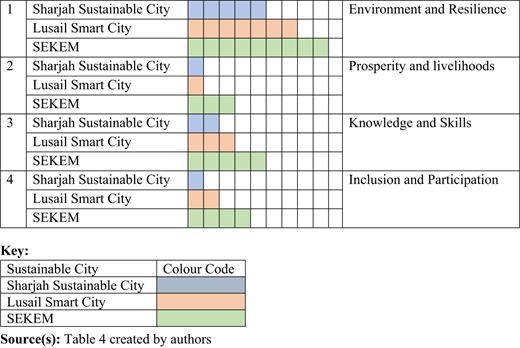 |
Table 4 illustrates a comparative analysis of how the three chosen case studies of Sharjah Sustainable City (SSC), Lusail Smart City and SEKEM, address the SDGs within specific thematic cultural indicators based on the conducted interviews and the thorough literature reviewing process of the case studies. These indicators are categorized into four main areas: Environment and Resilience, Prosperity and Livelihoods, Knowledge and Skills and Inclusion and Participation.
Environment and Resilience: This dimension, focusing on environmental sustainability and resilience, shows that SSC had multiple SDGs linked to this thematic area, as represented by five filled boxes. This is likely due to SSC’s design, which emphasizes the integration of green infrastructure and natural landscape preservation, clearly reflecting its commitment to environmental sustainability. Lusail Smart City has seven filled boxes, showing a strong alignment with the achievement of environmental sustainability aligned themes, which, as discussed earlier, was the superior motive behind its design, which focuses on creating a modern, sustainable urban environment. However, SEKEM leads this category with nine filled boxes, demonstrating an exceptional commitment to environmental sustainability through its sustainable agricultural practices and an extensive approach and methods to achieving high sustainability.
Prosperity and Livelihoods: In the Prosperity and Livelihoods category, both SSC and Lusail Smart City have one filled box each, indicating a limited focus on economic empowerment and livelihood opportunities in comparison to other sustainability goals. On the other hand, SEKEM has three filled boxes in this category, reflecting a stronger emphasis on economic empowerment, poverty reduction and job creation through sustainable practices. This fact indicates that SEKEM places a higher priority on integrating economic sustainability with broader social goals than SSC and Lusail.
Knowledge and Skills: The Knowledge and Skills dimension sees Lusail Smart City with three filled boxes, reflecting a moderate commitment to education, skills development and lifelong learning. Sharjah Sustainable City has two filled boxes in this category, indicating a somewhat lesser focus, although still significant. SEKEM stands out with five filled boxes, showcasing its strong alignment with education and skills development, which is a critical component of its sustainable development strategy, as seen in all its educational initiatives, especially in universities that have curriculums related to architectural and urban development (Sukkar et al., 2024).
Inclusion and Participation: Regarding Inclusion and Participation, Lusail Smart City has two filled boxes, indicating some focus on social inclusion and community engagement, though with room for improvement. Sharjah Sustainable City has one filled box, showing a more limited emphasis on these aspects. SEKEM, with four filled boxes, leads in this category, reflecting its extensive efforts to promote gender equality, social inclusion and active community participation.
Overall, SEKEM has demonstrated the most comprehensive approach to sustainability, particularly in environmental sustainability and knowledge development, with strong performances across all categories. Sharjah Sustainable City also shows a solid commitment, particularly in environmental sustainability, though it lags slightly in other areas, such as social inclusion. Lusail Smart City, while leading in environmental sustainability and showing strong efforts in knowledge and skills, reveals gaps in areas like prosperity and livelihoods and social inclusion, highlighting areas for further development. This analysis finalizes the article’s objective to compare how different cities in the Arab region incorporate cultural dimensions of sustainability into their urban development strategies.
Such research would close the gap between theory and practice by putting forward a framework for incorporating cultural dimensions in sustainability strategies – a concept under-explored in most global urban contexts. For instance, while tensions between modernization and cultural preservation are strikingly visible in the Arab region, similar tensions abound in many of the fastest-growing cities across Asia and Africa (Dessouky et al., 2023).
The case studies by SEKEM and SSC provide hands-on approaches toward embedding cultural heritage within sustainable urban planning and offer transferrable lessons for cities looking to reconcile local identity with global sustainability goals. Addressing such challenges using qualitative analysis, this research provides actionable insights that go beyond the Arab region into resonance with broader international frameworks like the United Nations’ Sustainable Development Goals (SDG 11). Such findings will highlight the urgent need to create contextually planned practices, which will close a growing void currently existing between theory and best practices in urban design for a global audience.
5. Conclusion
This article highlighted the importance of integrating cultural dimensions into the sustainability frameworks of smart cities in the Arab region. SEKEM and SSC serve as exemplary models, demonstrating that urban development can achieve sustainability while preserving cultural heritage and fostering social cohesion. Lusail, on the other hand, highlights the risks of overlooking these aspects in favor of modernization. As cities in the Arab region continue to evolve, the lessons from this research advocate for a balanced approach that marries modernity with cultural preservation, ensuring that urban development is not only sustainable but also culturally and socially inclusive.
This study relied heavily on secondary data sources and expert interviews, which may have introduced biases in the outcomes, which could be considered a limitation of the research, particularly in interpreting and comparing sustainability efforts across different cities. Also, the availability and depth of data varied significantly between the case studies, which might have influenced the comprehensiveness of the analysis. Additionally, the study focused primarily on a limited number of cities within the Arab region, which may not fully capture the diversity of approaches to cultural dimensions of sustainability across other cities in the region or globally. The indicators used to assess the integration of SDGs were also based on a set framework, which may not account for all nuances and contextual factors influencing urban sustainability. Finally, the dynamic and evolving nature of urban development means that the findings represent a snapshot in time, potentially overlooking ongoing or future initiatives that could alter the sustainability landscape in these cities.
By expanding the scope to include a broader range of cities within and beyond the Arab region, potential future studies could provide a more comprehensive understanding of how cultural dimensions of sustainability are being integrated globally. Another possibility is to incorporate a mixed-methods approach by joining the quantitative with qualitative insights from people in those cities via focus groups or ethnographic studies, which will offer this study a richer texture. It could be an argument to practically support decision-making on the ground when addressing cultural sustainability within city planning. A longer-term research design would help capture dynamic changes in cultural sustainability practices and might provide better insights into long-term effects. The proposed future decisions of the research are intended to follow the findings of the present study.

