In the context of bilateral bargaining, we deal with issue linkage by developing a two-issue cooperative bargaining model. In contrast to the traditional Nash bargaining literature, the axioms we propose focus on the role of the disagreement points. We characterize a new solution that we call the Linked Disagreement Points (LDP) solution, which explicitly links the players’ bargaining powers on each issue. We then weaken our axioms in turn, and a family of bargaining rules stands out: the Equal Net Ratio Solutions. These solutions point to Pareto-efficient outcomes such that the relative gains for players are equal across issues. We discuss our results in light of international trade and environmental negotiations, which are often put on the bargaining table in a linked fashion.
INTRODUCTION
Many bargaining situations involve multiple issues at once. For instance, international trade and environmental negotiations have often been put on the bargaining table in a linked fashion. From Montreal in 1987, through Kyoto (1997) and Cartagena (2003), to Copenhagen in 2009 international environmental agreements have been negotiated with the lurking spectre of Pareto-inferior trade (dis)agreements like the WTO. Stylized facts suggest that countries’ negotiation powers over each specific issue (trade or environment) play an important role in shaping the overall outcome of international negotiations because they act as threat points (Harrison and Rutström, 1991).
We develop a two-player, two-issue cooperative bargaining framework to capture the idea of concessions exchange between issues. Contrasting with previous axiomatic works on multi-issue bargaining, we do not normalize disagreement points to zero but instead emphasize their roles in the bargaining process. To do so, we allow for all disagreement point configurations, but normalize the feasible sets to being linear. Although seemingly restrictive, this normalization allows one to focus on the role of the disagreement points in determining how to split the surplus of a negotiation between the players, which is at the heart of any bargaining process. Under transferable utility, this surplus can be interpreted as that obtained from a Pareto efficient outcome identified through joint bargaining.
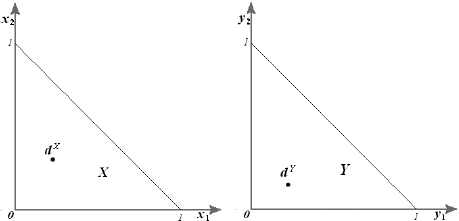
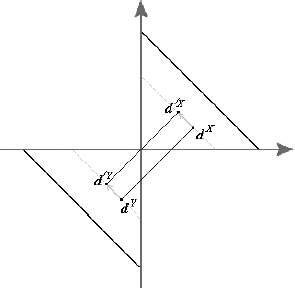
Formally, we normalize the feasible sets of each issue, X and Y, to be bargaining “cakes” of size one but allow the disagreement points to vary (Figure 1). When considering simultaneous bargaining over both issues we link the two bargaining problems by considering the relative bargaining power of the players over each issue.
We propose two specific axioms to deal with issue linkages. A first axiom, No Concession for Equal Relative Bargaining Power (or No Concession, for short), formalizes the linkage between issues by asking that if the agents’ relative bargaining powers are identical across issues, this relationship alone should drive the final outcome. As such, it specifies to what extent the issues should be treated separately. The second axiom, Invariance, is stronger and states that total payoffs should not be altered by a reallocation of each agent’s bargaining power across issues. In other words, by focusing on the combined bargaining powers of the agents’ it specifies to what extent the two issues can be treated as a single one.
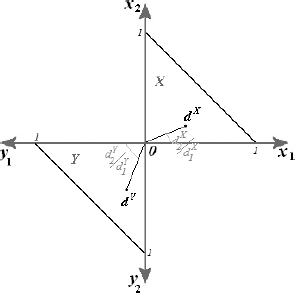
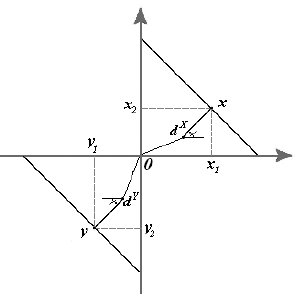
These two axioms together characterize a family of solutions that are variants of what we call the Linked Disagreement Points (LDP) solution (Theorem 1). Graphically, the LDP solution links the disagreement points of each issues in the mirrored utility space and selects the intersection of that line with the Pareto frontiers of each issue’s bargaining set (Figure 2).
Next, we drop one axiom at a time and explore the type of solutions the other allows. The Invariance axiom appears to be the more prescriptive of the two, as it alone leads to a representation result (Theorem 2). By contrast, the No Concession axiom requires additional properties to arrive at a tractable class of solutions. In particular, combining it with other mild axioms leads to a family of solutions, which we call Equal Net Ratio Solutions. These solutions point to Pareto-efficient outcomes such that the relative gains for players are equal across issues (Theorem 3). The LDP solution belongs to this family of solutions, but not the Nash bargaining solution as it violates No Concession and thus fails to satisfactorily convey issue linkage.
The paper unfolds as follows. Section 2 discusses our theoretical contribution in light of the related literature. Section 3 presents the two-issue bilateral bargaining model and the characterization of the LDP solution. In Section 4, we explore the consequences of weakening the two main axioms in turn. Section 5 offers a discussion on issue linkage building on our theoretical results, and Section 6 concludes.
RELATED LITERATURE
The bargaining literature is made up of two main strands: one follows a non-cooperative approach à la Rubinstein (1982) while the other follows a cooperative or axiomatic approach à la Nash (1950). Our work belongs to the latter. Most of the theoretical work on multiple-issue bargaining uses two-player models and generalizes existing solutions from single-issue cooperative bargaining. This is done by proposing new axioms that generalize or replace the classical ones found in the literature on single-issue bargaining. When agents’ preferences are represented by a utility function it is assumed that utilities are additive across issues. Ponsatí and Watson (1997) generalize the Nash solution and the symmetric utilitarian solution. Peters (1986) generalizes Kalai’s (1977) extended family of proportional solutions and Harsanyi and Selten’s (1972) extended family of non-symmetric Nash solutions. Another approach has been more recently proposed by Mármol and Ponsatí (2008) and uses maximin and leximin preferences when information about preference is limited or when those preferences do not admit a utility representation. This work follows Bossert et al. (1996) and Bossert and Peters (2001) by modeling the global bargaining problem as the Cartesian product of classical (single issue) bargaining problems.
These works follow the typical practice of normalizing the disagreement points to zero, thus remaining silent regarding the role played by disagreement points. Meanwhile, stylized facts suggest that disagreement points are pivotal in negotiations because they constitute a basis for the exchange of concessions. For instance, trade wars and trade negotiations in the pre-NAFTA context were driven by the parties’ disagreement points. In this context, Harrison and Rutström (1991) compute the non-cooperative Nash equilibrium of the trade protection game between the United States and Europe and evaluate welfare relative to it. The Nash equilibrium can then serve as a “natural measure of nation’s bargaining strength when entering into international trade negotiations, [where] this bargaining strength is based on relative gains and losses in a credible disagreement outcome, which [they] interpret as the disagreement outcome” (p. 421). This bargaining mechanism was also observed within the genetically modified organisms dispute in the years 2003-2006, which pitted the United States of America, Canada and Argentina on one side and the European Union on the other and was settled in favor of the former group, where negotiation power over trade favored the winners.1
Cooperative bargaining problems invite three possible families of axioms. First, there are axioms that are related to changes in the bargaining set, where the focus is on bargaining situations under variable bargaining trophies. These appear in Peters (1985, 1986), and Ponsatí and Watson (1997) among others, where disagreement points are normalized to zero. Second, there are axioms related to changes in the population on which the literature has been mostly silent because bilateral bargaining is usually assumed.2 Finally, axioms related to changes in the disagreement points have so far not been considered under multiple-issue bargaining. Here, we explore the relevance of these disagreement points in bargaining situations under fixed bargaining trophies. The focus is on the pure contribution of these points to bargaining solutions where the bargaining sets are not allowed to vary during the negotiation rounds, in contrast to the traditional Nash bargaining framework.3 More specifically, we propose axioms related to issue linkages when the disagreement points are taken into consideration. This constitutes a main contribution of our model.4
Finally, one should note the distinction between separate and linked Pareto efficiency. Classical axioms that are applied to single-issue problems are based on the idea of separate or local Pareto efficiency, where it is enough for the solution to be on the Pareto frontier of each set to be efficient. In a more general context, Peters (1985) and Ponsatí and Watson (1997) discuss the idea of global efficiency in the context of multi-issue bargaining. They argue that efficiency demands that no possible gains from cooperation are lost, which means that each local solution must belong to Pareto frontier of the sum of the local sets. Given our context where the issue bargaining set is a simplex, any solution located on the Pareto frontiers of both sets maximizes the sum of players’ utilities across issues and is thus also globally Pareto efficient.
THE MODEL
Two agents, i = 1,2, which we interpret to be countries or populations, bargain simultaneously over two issues, X and Y. Successful bargaining consists in dividing a total payoff of 1 for each issue between the two agents. Failure to achieve an agreement in both issues results in agents falling back to their disagreement payoffs in both issues; we denote (resp. ) agent i’s payoff on issue X (resp. issue Y). We impose and , and denote . The profile vector constitutes a linked bargaining problem (or bargaining problem). We denote by the class of linked bargaining problems. In Section 4.2, we shall allow for the possibility of achieving an agreement in several steps rather than in a single round. This requires defining an intermediate problem, where the payoff to be divided in issue X (resp. Y) is (resp. ). A triple (d; is an intermediate linked bargaining problem (or intermediate problem) if and .
A linked bargaining solution (or solution), maps each bargaining problem (or intermediate problem) to a payoff vector, such that and . When dealing with a genuine bargaining problem (), we simply write instead of . We interpret and to be the agents’ relative bargaining powers over issues X and Y, respectively. For instance, if is very small (close to zero) and is large, then player 1 has a strong advantage over issue X but player 2 has a better bargaining power over issue Y (See Figure 3). Our analysis makes extensive use of the interpretations of the relative bargaining powers as slopes in the utility space. We shall work under the convention that division by zero equals infinity, and represents the slope of a vertical line in the utility space. Lastly, we use the following shorthand notation: ; in particular, and are the overall payoffs of agent 1 and agent 2, respectively.5
We introduce two properties that we deem desirable in a solution to a linked bargaining problem. The first axiom captures the idea of concessions exchange by linking the two issues. In particular, it asks that no concessions be made if the agents’ relative bargaining powers are equal across issues: it is this common ratio of powers that should govern the bargaining outcome in both issues. In other words, if both issues “agree” on the relative strengths of the bargainers, the final outcome should respect this overall relative strength.
Axiom 1 “No Concession for Equal Relative Bargaining Pomer (No Concession)”
Next, we require that the agents’ total payoff be independent of how they choose to allocate their bargaining power across issues.
Axiom 2 “Payoff Invariance with respect to Bargaining Pomer Reallocation Across Issues (Invariance)” , such thatand,
fori = 1,2, where.
Note that Invariance can be viewed as having both strategic and normative content. From a strategic viewpoint, it ensures that agents cannot manipulate the solution by reallocating their bargaining efforts across issues. That is, in an ex ante game where agents could revisit their prior investments toward building bargaining power for each issue, none would find an interest in doing so. From a normative standpoint, Invariance ensures that the solution is not partial toward one issue over the other. Indeed, it asks that disagreement utility play an equivalent role on each issue, just like agreement utility on each issue has equal weight in each agent’s total (agreement) payoff.
These two axioms are not only focused on the role of the disagreement points on each issue, they also convey the notion of linkage, which is the fundamental distinction between the linked bargaining problem and the traditional Nash bargaining problem. We now further illustrate this distinction by showing how linkage would be ignored if one attempted to treat the linked bargaining problem as a single-issue bargaining problem. More specifically, one may be tempted to combine the two issues as follows: the disagreement utility levels of the players would be and , respectively, and the size of the cake to be divided would be 2. The reader can easily check that applying, say, the Nash bargaining solution to this (single-issue) problem yields the following total payoffs for each agent:
The many points in giving rise to the above total payoffs are of the form:
with for all . In particular, taking amounts to applying the Nash bargaining solution to each issue independently. Hence, the Nash bargaining solution entirely ignores the linkage between both issues. In fact, the Nash bargaining solution, whether applied to the joint (single-issue) problem or to each issue independently, violates No Concession.6
Taken together, the No Concession and Invariance axioms characterize a family of solutions related to what we call the “Linked Disagreement Points solution” (or LDP solution), which we define as follows:
This solution takes its name from the fact that it “links” the disagreement vectors of each issue. This can be seen graphically in Figure 4.
Theorem 1A solution satisfies No Concession and Invariance if and only if it is a payoffequivalent variant of the LDP solution:
withsuch thatandwhenever.
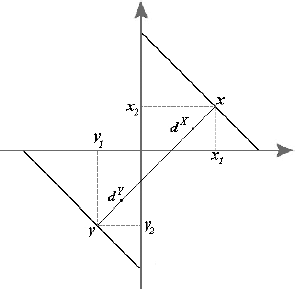
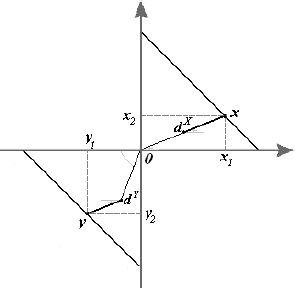
Proof: The reader can check that such a solution satisfies No Concession and Invariance. Conversely, consider a solution satisfying both axioms. By Invariance, the total payoff of each agent only depends on each agent’s overall bargaining power, . Now consider an alternative profile, , such that with and (See Figure 5).
Note that . By No Concession, and . Invariance yields and . Thus, the solution can be written as in Expression (1) with No Concession ensuring that whenever .
RELAXING THE AXIOMS
According to Theorem 1, the No Concession and Invariance axioms together dictate how total payoff is determined. To gain further understanding of the interplay between these two axioms, we now present what solutions are permitted when dropping either the No Concession or the Invariance axiom.
Dropping the No Concession Axiom
The role of the No Concession axiom in the proof of Theorem 1 was to pin down the total payoff that the solution must assign to each agent. Hence, requiring Invariance alone characterizes a class of solutions assigning a total payoff that only depends on each agent’s overall bargaining power.
Theorem 2A solution satisfies Invariance if and only if there exist a functionsuch that, for all :
where.
Proof: This follows directly from the Invariance axiom.
Many solutions satisfy Invariance, including the well-known Nash bargaining solution. However, because the Invariance axiom is only concerned with aggregate bargaining power, it provides little indication on how to link the bargaining issues, X and Y. Quite to the contrary, Invariance dictates to what extent the issues can be treated as a single one. Hence, the No Concession axiom is a crucial one to explore issue linkage. In what follows, we replace the Invariance axiom by weaker ones and explore the type of solutions afforded by the No Concession axiom.
Dropping Invariance
The Invariance axiom has strong implications for the nature of the solution and we wish to explore the possibilities that dropping the Invariance axiom affords. Clearly, the No Concession axiom allows for too many solutions to be of interest by itself, so we shall combine it with other mild axioms.
Keeping with the spirit of impartiality, we argue that a solution should not behave differently across issues. More precisely once bargaining power has been taken into account - via the agents’ issue-wise disagreement points - the solution treats both agents and issues symmetrically.
Axiom 3 “Issue neutrality”,
This axiom is an axiom of neutrality vis-a-vis the issues. For example, if , the solution confers an a priori advantage to player 1 over player 2 in issue Y, which can be viewed as undesirable. Therefore, this condition must hold at equality to ensure neutrality with respect to issues once bargaining powers are accounted for.
Next, we ask that a solution be consistent: achieving an agreement in several steps rather than in a single round should not affect the outcome.
Axiom 4 “Composition” for any intermediate problem.
The next requirement is one of smoothness, which ensures that the solution be not wildly sensitive to changes in the bargaining powers:
Axiom 5 “Smoothness” f is continuously differentiable in d.
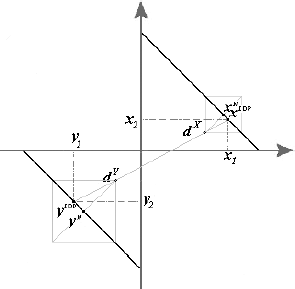
Requiring Axioms 3-5 in addition to No Concession yields a family of bargaining solutions, which we call Equal Net Ratio Solutions. Graphically, these solutions map to points on the Pareto frontiers that lie on two rays of equal slope from their respective disagreement point (See Figure 6).
Theorem 3A solution satisfies No Concession and Axioms 3-5 if and only if it is an Equal Net Ratio Solution; i.e., if and only if
is a continuously differentiable function such that:
- (i)
for all ,
- (ii)
for all 7where,
- (iii)
if .
The value a(d) can be interpreted as the relative gains of agent 2 over agent 1 on issue X and, according to proviso (i), on issue Y as well.
Proof: The reader can readily check sufficiency. Regarding necessity, items (i) and (iii) follow directly from Issue Neutrality and No Concession, respectively, but the proof of proviso (ii) requires several steps. Let be a bargaining solution satisfying No Concession and Axioms 3 through 5. Let and denote .
Claim 1For all8the following holds:
- (a)
;
- (b)
and,
- (c)
.
Let and let . We first prove point (a). By Composition, because the coordinates of the latter term already sum up to 1. By Issue Neutrality, is collinear to , which together with the fact that and the fact that and are collinear implies that and are collinear.9 Lastly, the fact that the coordinates of sum up to implies that . Finally, by the Composition axiom, , yielding the result.
Note that, by assumption on and . It follows that the rays () and are positively sloped, implying . By Smoothness, the mapping is continuously differentiable.
An analogous argument leads to . Finally applying (a) to the latter expression leads to , proving point (c).
Claim 2For alland all, the following holds:
- (a)
;
- (b)
; and
- (c)
.
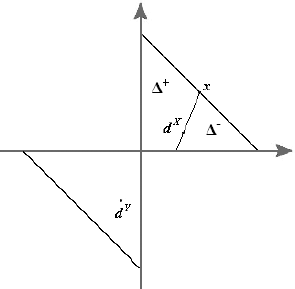
We first prove statement (a). Let . The line divides into two convex regions, and such that . (See Figure 7).
Let and suppose (the case not covered by Claim 1). We shall show that is stable on each of the subsets and .10 Indeed, suppose there exists such that . For any denote . By Continuity of in . Yet, by Composition, it must be that for any . Otherwise, there would exist some , for which Claim 1 would imply and, by Composition, we would have , contradicting the fact that . Finally, because for any , the convexity of implies that , where is the closure operator, implying that , a contradiction.
Statement (b) is proved in a similar fashion as statement (a), and (c) is obtained by combining (a) and (b), as was done for Claim 1.
Remark 1It follows from the proof of Theorem 3 that dropping No Concession yields a similar theorem, only without proviso (iii). Note, however, that this result is of limited conceptual interest for our purposes because No Concession is the only axiom that explicitly addresses the issue of concessions exchange and, therefore, of issue linkage.
Monotonicity
Theorem 3 provides the general structure of linked bargaining solutions satisfying No Concession and Axioms 3 through 5. In addition, one may find it desirable that the improvement of an agent’s bargaining power in either issue should not hurt her overall payoff:
Axiom 6“Monotonicity” For all,
where.
Corollary 1A solution satisfies No Concession and Axioms 3-6 if and only if it is an Equal Net Ratio Solution such that:
where.
Proof: We show the first inequality. Let satisfy Axioms 1-5. Let , and such that . Denote ) and . By definition of and . Adding both equalities yields . The same operation applied to the original bargaining problem yields . Subtracting the latter equality from the previous one yields . Using the fact that leads to:
Taking the limit toward leads to:
It follows from this last expression that imposing monotonicity amounts to requiring , as was to be proven. The other inequalities are proven similarly.
DISCUSSION
Even with the additional requirement of Monotonicity, the class of Equal Net Ratio Solutions is still relatively large. An interesting subclass of solutions is one where issues have a constant relative influence over each other. For instance, if issue X is deemed twice as important as issue Y, we may find it desirable for the solution to reflect this fact and require that the relative bargaining powers in issue X bear twice as much influence as issue Y on the overall bargaining outcome. Formally, this amounts to having the solution’s “net ratio,” , be a convex combination of the relative bargaining powers in each issue: there exists such that,
As it turns out, the only solutions satisfying Expression (2) are the two extreme solutions where the bargaining powers in one issue dictate the overall bargaining gains. For instance, “Issue- X dictatorship” allocates bargaining gains according to the relative bargaining powers over issue X (i.e., ) only. In other words, the bargaining power over issue Y does not matter (See Figure 8).
Proposition 1An equal net ratio solution satisfies Expression (2) if and only if it is the Issue-X dictatorship solutionor the Issue- Ydictatorship solution.
Proof: Consider such a solution, , let such that and . Write . Consider and write . By proviso (ii) of Theorem 3, , which implies that , where the second equality follows from the fact that . Therefore, by Expression (2), . Hence, . Therefore, either or , with the latter case occurring only if , by construction, which, in turn, implies .
The LDP solution, which is characterized by Invariance and No Concession as per Theorem 1, could be seen as a refinement where the gains on each issue depend on the absolute bargaining powers of each agents: , which amounts to defining the convex combination as . Graphically, and as was discussed earlier, this solution links both disagreement points, and , and locates the solution outcome on the Pareto frontier of each bargaining set (see Figure 2). Thus, the LDP solution could be seen as a balanced compromise solution since it combines the bargaining powers over both issues.
It is noteworthy that the degrees of freedom granted by the class of monotonic equal net ratio solutions is “horizontal,” in the sense that linkage is not a question of how strongly the two issues are linked, but a question of how much weight is given to the relative bargaining powers in each issue. In particular, a solution treating both issues separately would not belong to the class. This can be seen with the (single issue) Nash bargaining solution, for instance, which would correspond to at all profiles, thus violating No Concession as was demonstrated ealier. In other words, “no linkage” is not a special case of linkage. In fact, single-issue and multiple-issue bargaining problems are two very different problems. The decision to link issues is a binary one and not a matter of degree: one cannot speak of issues being “strongly linked” or “weakly linked.” What is a matter of degree, however, is to what extent the relative bargaining powers in one issue influence the outcome in the other, which is precisely what we have explored. Whether that influence is significant or not, the issues remain linked nonetheless.11
CONCLUDING REMARKS
Stylized facts suggest that in international law, issues pertaining to commerce and environment are usually dealt with in a conflicting manner. This has been a trend since 1972 when the United Nations Environment Program (UNEP) was established. That year was the year of the United Nations’ conference on the environment held in Stockholm, and is now seen as a turning point in international environmental awareness. The conflicting nature of international environmental law stems from the fact that trade and environmental concerns carry trade-offs. The GATT (WTO after 1995) is in general against unilateral discriminatory measures, as per Article Twenty. However, if these measures are required by an international environmental agreement (IEA) then the issue becomes more problematic because simultaneous negotiations are needed. Interestingly, the single-issue dictatorship solutions seems to reflect the way simultaneous bilateral bargaining over trade and environment has been taking place. In this example, if environmental measures are not in conflict with WTO’s Article Twenty then solutions in the spirit of the trade dictatorship solution seems to have been adopted, requiring bargaining gains to be allocated according to the relative bargaining powers over the trade issue only. The 1991 GATT tuna case pitting Mexico versus United States of America, and the 2001 WTO Shrimp case pitting the United States of America versus Malaysia, Philippines, Pakistan and India are illustrations of such solutions. In those cases, the older treaty - i.e., the GATT/WTO - took precedence.
Otherwise, a balanced compromise solution (in the spirit of our LDP solution) between both issues will determine the final outcome as was the case with the Genetically Modified Organisms (GMOs) conflict in 2003 between the United States of America, Canada, Argentina on the one hand and the EU on the other.12 During this conflict, an IEA - the Cartagena protocol on bio-safety - was used to challenge WTO rules. Here, there was precedence of the more precise treaty, that is, the Cartagena protocol. Yet, this precedence is not absolute because the older treaty, which is on trade, still has jurisdiction.
Lately, an aviation emissions dispute pitted the EU against non-EU countries. Because aviation emissions had recently been included in the European Emission Trading Scheme (ETS), non-EU airlines operating international routes would also have had to comply with the ETS. In response, non-EU countries considered retaliatory measures invoking trade sanctions and called upon the European Court of Justice for a ruling. The ruling was delivered in December 2011 in favor of the EU forcing non-EU based airlines to abide by the ETS. As in the Cartagena dispute, given its desirable properties for the bargaining countries, a balanced compromise solution seems to have been adopted.13
The normalization of bargaining sets proved essential in gaining a comprehensive understanding on the role of disagreement point in multi-issue bargaining and in isolating the pivotal role of concession exchange. Nonetheless, we believe that being able to handle bargaining sets of general shape is an important goal that future research should aim for. Allowing for the Pareto frontiers to be of different slopes is a likely first step in that direction.14 This route will introduce another layer of heterogeneity among players, in addition to the heterogeneity in bargaining powers we have introduced. Finally, an alternative setting would be to extend the bilateral case to an n-player bargaining situation, which is otherwise prohibitive in the traditional setting with non-normalized sets. This path may allow for the definition of axioms related to population in addition to those related to the disagreement points already defined in our framework.
For further information consult the WTO’s dispute database. http://www.wto.org/english/tratop_e/dispu_e/dispu_subjects_index_e.htm.
See Thomson and Lensberg (1989) for single-issue models with n agents.
The envisioned bargaining problems are cases where players know and cannot change the bargaining set. Of course, this does not preclude negotiations in steps toward the final sharing of the pre-fixed set. This point is discussed further in the model section.
Nonetheless, it should be noted that Thomson (1987, 1994) and Chun and Thomson (1990, 1992) introduce axioms related to the disagreement point but for single-issue bargaining only.
The assumption of transferable utility is consistent with the fact that, in practice, the welfare of populations and countries is commonly evaluated in monetary terms, as is for instance the case in cost-benefit analyses.
The reader can easily check that only when .
(dY, y) denotes the line passing through dY and y.
[dY, y]denotes the line segment connecting dY to y.
Vector notation follows the usual convention: for all .
A function h is stable on a subset A of its domain if .
In particular, it would be inappropriate to invoke a limit argument and expect the theory of multiple-issue bargaining to meet the classical theory of single-issue bargaining when, say, “linkage approaches zero.”
For more information about the aviation emissions case in the EU see the July 2011 Newsletter of the International Center for Climate Governance.
We thank an anonymous referee for the suggestion.