


Production of a renewable substitute to fossil fuels is modeled as causing the cost of this backstop technology to fall over time in proportion to the scale of the substitute production and how long it has been in use. The unit cost of resource extraction is assumed to rise as the stock is depleted, so learning by doing will increase the reserves permanently left in the ground. The green paradox can nevertheless be present, in the sense that the resource extraction path can initially lie above what it would be in the absence of a parallel production of renewable energy. In a monopolistic market, the resource monopolist's optimal price path is twophased, even with inelastic demand. In the limit-pricing phase, the price is falling, due to the progressive learning by doing effect, and the extraction path is rising.
Introduction
About 10 years ago, Hans-Werner Sinn wrote about the green paradox (Sinn, 2008, 2012). Renewable energy projects will lower the price for energy and increase the demand for it, which could increase the demand for fossil fuels and increase carbon dioxide emissions and the associated climate problems. This is the green paradox.
In Sinn's model, this is all-important. Sinn is skeptical about whether there will ever be a backstop technology that will choke all demand for fossil fuels and gives the rhetorical example of whether the Chinese or American air force will ever run their fighter jets on hydrogen.1 The absence of a fully effective backstop implies that all fossil fuel resources will ultimately be extracted (Van der Ploeg and Withagen, 2012), but over a long time horizon. Meanwhile, the near-term extraction and carbon dioxide emissions will increase. But, as shown by Gerlagh (2011), if the extraction cost of fossil fuels rises as the remaining reserves dwindle, lower cost of the backstop will increase the reserves that are not worthwhile to extract and the Green Paradox will disappear, except in the sense that extraction will go up in the near term.
Several papers on the green paradox have since been published. A recent one, giving a good review of the literature, is Wang and Zhao (2018). Some of these papers find that the green paradox is particularly likely to happen in a monopolistic market (Van der Meijden et al., 2018; Wang and Zhao, 2018). It may also happen in competitive markets; Grafton et al. (2012) found that the appearance of the green paradox in a competitive market depends on the shape of the demand function (linear or nonlinear), the marginal cost function of the substitute technology, and the unit cost of the resource extraction (zero or positive constant). They also found that the green paradox could appear in monopolistic markets.
None of the aforementioned papers investigates how learning by doing might affect the green paradox. They allow for subsidization of renewable energy, but there is no progressive decline over time in the cost of this technology due to learning by doing or economies of scale. Yet such effects have been conspicuous in recent years; the cost of solar panels and wind turbines have fallen substantially due to learning by doing in production and possibly also economies of scale. A paper that explicitly addresses learning by doing in the renewable energy sector and the green paradox is Nachtigall and Rübbelke (2016). They use a two-period model, in order to obtain analytical solutions, and analyze in detail the effects of the slope of the marginal cost curve for fossil fuels, whereas this paper uses a continuous-time model and focuses on the price elasticity of demand.
A paper by Jaakkola (2019) is closely related to this one and analyzes a game between an oil exporting cartel (OPEC) and oil importers where the latter can impose an import tax or engage in research and development to make a renewable substitute more competitive, pushing the imported oil out of the market in due course. But there is no payoff to the research and development until it is suddenly put to good use. In this paper, by contrast, the renewable energy is subsidized up to a certain volume, setting in train a cost-reducing process through learning by doing. When the cost of the renewable energy has fallen and the cost of fossil fuels risen to make both equal, renewable energy will expand to fully replace fossil fuels. Subsidization of renewable energy can thus be defended as a tool of climate policy on two grounds; immediately replacing some fossil fuels and making some reserves uneconomical.
There are other papers which touch upon the effect of learning by doing on the green paradox, even if the main emphasis is on other subjects. One such is by Chakravorty et al. (2011) where the main emphasis is on integrated assessment models and thoroughly analyzes market structure, as determined by the number of firms. They are concerned about emissions of greenhouse gasses and so touch upon the green paradox, but do not consider elasticity of demand, which is a main theme in this paper. They also assume a constant cost per unit of fossil fuels, which implies that the cost-reducing effects of learning by doing will not have any effect on total extraction, only on its time profile. Turning fossil fuel deposits into "stranded assets" could, however, be the most important effect of learning by doing in the renewable energy sector. Rezai and van der Ploeg (2017) also discuss learning by doing in the green energy sector in the context of integrated assessment models; their main emphasis is on subsidies to green energy as a second-best tool in climate policy.
In this paper, we shall look into the implications of learning by doing for the green paradox and in particular whether it would be neutralized or reversed as a result of learning by doing. We will do so in a conventional resource extraction model where there is an effective backstop technology which chokes off all demand and the unit cost of extraction rises as the remaining stock of the resource falls. The backstop technology assumption is popular and reasonable, but not unassailable, as the above reference to Sinn makes clear (see also Gerlagh, 2011). The assumption of rising unit costs over time as the resource stock is depleted seems eminently reasonable.2 It is well known that resource deposits are never totally depleted, because further depletion becomes uneconomical at a certain point due to rising costs. This particular cut-off point clearly depends on the price; a higher price makes it worthwhile to continue extraction a little longer. It is also well known that the deposits of fossil fuels vary enormously in terms of unit cost across the world and that, in the imperfect markets of the contemporary world, deposits of widely different unit cost levels are exploited simultaneously. Discoveries of large and low cost deposits are, however, becoming increasingly rare, so sooner or later, if not already, the unit cost will begin to rise as the remaining resource stock dwindles.
With a rising unit cost of resource extraction, developing alternative technologies for energy production and the associated learning by doing has a powerful effect. The greater the scale of the renewable energy and the longer it remains in action, the more the cost of the backstop technology is lowered. As a consequence, more of the resource stock will be left in the ground, reducing the total emissions of carbon dioxide that will occur over the entire time horizon. The green paradox could still occur, as extraction may increase in the near term. We focus in particular on whether or not this will happen and find that the green paradox need not occur, neither when markets are competitive nor under monopoly. While not doing away with the green paradox entirely, learning by doing in combination with an effective backstop technology and rising unit costs as the resource stock is depleted makes it less likely and it definitely results in more resources left in the ground.
A Model of Learning by Doing
Suppose there is a backstop technology that initially puts a ceiling on the price for a non-renewable resource. Now introduce production of a perfect substitute at a constant flow rate . Over time, the cost of this substitute will decline at a rate of , where is a scale factor reflecting the learning by doing productivity of the substitute, so that, at time , the cost of this backstop technology will be
Rather than being ready at hand at time , the early introduction of the substitute technology will reduce its cost and thereby the backstop price at time , the more the earlier the backstop technology is introduced. A more realistic approach would be to introduce the backstop technology gradually rather than once and for all, but would require a more complicated modeling without necessarily adding any insights. The substitute product is sold at the same price as the resource, with the difference between its cost and the market price being covered by subsidies as needed until time . We do not address the question of optimal subsidies; our concern is merely how the production of the substitute will affect the extraction path of the resource and if there is a production volume that would neutralize the green paradox.
Since the early introduction of the backstop technology would reduce the backstop price, it would tilt the price path downwards and potentially increase the demand for the non-renewable resource. But more is involved. The production of the substitute competes with the non-renewable resource at each point in time. Therefore, even if the demand for the services of the non-renewable resource and its perfect substitute will increase at all time points, the extraction of the nonrenewable resource could nevertheless fall, because it is competing with the backstop technology.3 This would contradict the green paradox. If this were true, we would get a double dividend from using the backstop technology prematurely as it were; it would reduce the backstop price and cause more of the resource stock to be left in the ground, provided its unit cost rises as the stock is depleted, and reduce the extraction of the resource in time periods before it is finally abandoned.
Important parameters for how the production of the substitute will affect the extraction of the resource are the length of the time period to exhaustion and the elasticity of demand for the energy provided by the resource and the backstop technology. Let and consider a demand function with a constant elasticity, . The price at any time will depend on through its effect on the backstop price. Differentiating, we get
Since , because an increase in the use of the backstop technology will lower the backstop price, the left-hand side of this is positive. The change in resource extraction () could, however, be negative. The likelihood of this increases the lower is, that is, the less elastic the demand is. More precise answers can only be attained by numerical models, to which we now turn. The numbers we put on parameters in the model serve no other purpose than to obtain qualitative answers.
Competitive Markets
The solution for a competitive market with perfect foresight can be obtained by maximizing the present value of the resource extraction under the relevant resource constraints and given that resource owners have no individual control over the price. The Hamiltonian for this problem is
where and are the price and quantity extracted of the non-renewable resource. It is assumed that the unit cost of resource extraction rises as the stock is depleted. From the necessary conditions for maximum, and , we obtain
There are two terminal conditions. First, at the end point of production , the price catches up with the cost of the backstop technology at time :
where is given by Eq. (1). Second, at that time point, the unit cost has risen to a level equal to the price. We use the following unit cost function:
where is a constant. Hence, the stock of the resource left unexploited is
The problem is solved backwards. Terminal conditions (5) and (7) determine the price and stock level at the end of the time horizon, and we can then use (4) to back-calculate , with being determined by the initial resource stock, .
Figure 1 shows extraction and price paths for a competitive market with a constant elasticity demand function, for three different price elasticities. The objective is to find out whether using an alternative technology in parallel with the non-renewable resource would reduce the extraction of the resource at all points in time prior to its final abandonment. Along the reference paths in all three cases there is no use of the alternative technology () The uppermost two panels show a case where the production with the alternative technology is very extensive and leads to an early abandonment of the resource. Yet the extraction path is well above the reference path with no use of the alternative technology. In that sense the green paradox can be said to prevail, but for most of the time within the reference time horizon there is no extraction of the resource at all, since the extensive use of the alternative technology has increased the abandonment level of the resource sixfold, from 10 to 60 . It is not possible to construct a case where practicing the alternative technology pushes the extraction path below the reference path (the one without the use of this technology).
Things turn out differently with a less elastic demand function. As already explained (see Eq. (2)), the less elastic demand is, the more likely is it that using the alternative technology would lead to a slower extraction of the resource. The two panels in the middle () show the case of a unitary elasticity. A more moderate use of the alternative technology now pushes the extraction path below what it would be in the absence of using this technology. This effect is still more prevalent in the lowest two panels (), where the elasticity of demand is only 0.5 . Here, a use rate of the alternative technology that is only one-tenth of the first case nevertheless produces an extraction path below the reference path with no use of the alternative. So, in these latter two cases of inelastic or unitary elastic demand, the use of the alternative technology can be said to yield a double dividend; more of the resource is left in the ground because further extraction is rendered uneconomical, and the extraction rate at all time points is lowered.
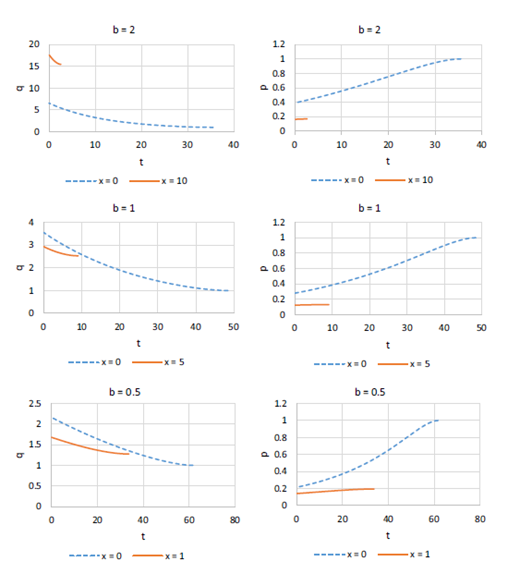
Price and extraction paths in a competitive market, with different demand elasticities (b). Other parameters are , and
Price and extraction paths in a competitive market, with different demand elasticities (b). Other parameters are , and
That a higher elasticity of demand increases the likelihood of the green paradox when markets are competitive is to be expected. A given production of renewable energy will displace the price path downwards (cf. the discussion of Eq. (2)] above). This will increase the demand for energy, the more so the higher the price elasticity. With a given production of renewable energy, more of the increased demand will be satisfied by fossil fuels the higher is the price elasticity.
Monopoly
How does this pan out in the case where the market is not competitive but dominated by an effective cartel? We focus on the clear-cut case of pure monopoly. There are two phases of the price path to consider (Hoel, 1978). First, the monopolist might want to charge a price just below the limit set by the costs of the alternative technology; as a practical matter we put these two equals. Second, for some of the extraction period the monopolist might want to charge a lower price in order to increase sales. For this phase the intertemporally optimal price and extraction paths can be found by maximizing the present value of profits, similar to the competitive case, but now taking into account that the monopolist has full control of the price. The Hamiltonian of this problem is
with the necessary conditions
and
Eqs. (9) and (10) lead to an equation determining the change in marginal revenue over time (note that ):
We can use (11) to back-calculate the marginal revenue from the time point when the monopolist begins to charge the backstop price. The length of the two price and extraction phases is determined by what division of the initially available economic reserves between the two phases of the price and extraction paths will maximize the monopolist's present value of profits.
The price and extraction paths are shown in Figure 2. In the reference case of no production with the alternative technology the monopolist will practice limit pricing from the beginning if the elasticity of demand is unity or less. With more elastic demand, the price and extraction paths have two phases, limit pricing and a price rising over time as determined by the optimal rise in marginal revenue (from Eq. (11)) and the constant elasticity demand equation (see Eq. (2)).
Production with the alternative technology and learning by doing leads to two-phased price and extraction paths in all cases, but the limit pricing path is downward-sloping, because the production cost of the alternative technology falls over time. The upward-sloping price path catches up with the production cost of the alternative technology at the time point when this phase ends, but after that the price will have to fall in tandem with the production cost of the alternative technology. This effect is also present in Jaakkola's model even if no production takes place in that case (Jaakkola, 2019).
In the case of elastic demand the extraction path with the alternative technology is initially below the extraction path without it. This happens despite the fact that the price is lower than without using the alternative technology, but the production volume of the latter is more than enough to cancel out the effect of a larger demand. This happens even if the production with the alternative technology is rather moderate. One could say that the green paradox is absent here, as the extraction rate is slowed down to begin with, but after the downward-sloping limit price path is reached, the extraction will increase compared with what it would be without the alternative technology. On the other hand, the total extraction is greatly reduced and its time horizon shortened correspondingly; in the case at hand (uppermost panels of Figure 2) the time of extraction is reduced from to and the resource stock left in the ground () increased from 10 to 21 . It is worthwhile noting that, in a competitive market with the same elasticity of demand, the green paradox, in the sense of more extraction initially, cannot be reversed, no matter what scale of the substitute technology is tried.
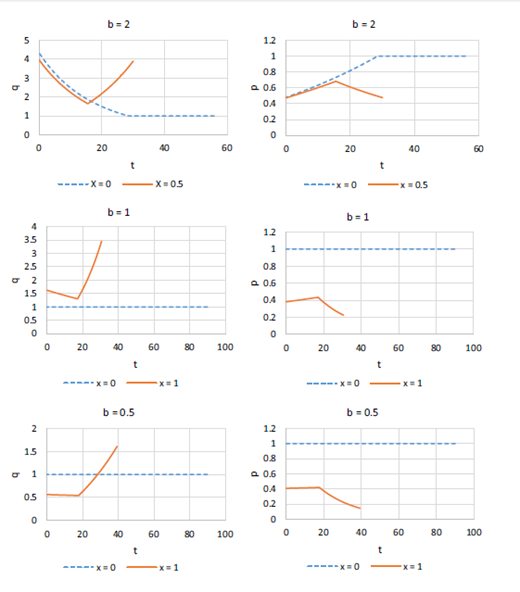
Price and extraction paths under monopoly, for different demand elasticities (b). Other parameters as in Figure 1.
Price and extraction paths under monopoly, for different demand elasticities (b). Other parameters as in Figure 1.
In the two cases with inelastic or unitary elastic demand the price path changes from limit pricing throughout to a two-phased path where the price is initially increasing. Clearly, the threat of a backstop price falling over time induces the monopolist to lower his price and sell more initially to avoid the deleterious effects of more and more of his resource stock becoming worthless as time passes. But this does not necessarily mean that the monopolist's extraction path is higher at all times than it would otherwise be; this indeed happens in the unit elasticity case (middle panel of Figure 2), but with a lower elasticity (; lowest panel in Figure 2) about three quarters of the extraction path is below the one without the alternative technology. Note that in both of these cases the volume of alternative technology production is the same and recall the earlier argument that the absence of the green paradox is more likely the less elastic the demand is (see Eq. (2)). In both these cases the stock left in the ground increases substantially, from 10 in the absence of the alternative technology to versus .
The production of the alternative energy in parallel with the monopolist's non-renewable energy makes the demand facing the monopolist elastic. This is true for the entire production period with , but only for the first part of the production period when . In both cases the price path is upward-sloping at first, but hits the (downward-sloping) backstop price path while the elasticity of demand is still greater than one. Price elasticity is not in this case a sufficient criterion for when and whether the monopolist's price path hits the backstop price path.
Conclusion
We have shown that learning by doing effects of using an alternative technology could in many cases eliminate the green paradox. We contend that learning by doing is realistic; in recent years the production costs of wind turbines and solar panels have declined substantially as a consequence of producing these things and taking them into use. For how long such effects will last can be debated; if such learning by doing effects last indefinitely the consequences can be dramatic, as recently illustrated by Squires and Vestergaard (2018) in the fisheries context.
That aside, one may wonder whether the importance of the green paradox may have been overplayed. What it is all about is the time path of extraction, not the total amount of resources left in the ground.
If the deleterious effects of carbon dioxide emissions are as dramatic as some people believe and irreversible, it would seem of second order importance when exactly this happens. The green paradox says that it will happen sooner rather than later, but if all resources available are to be extracted, it will happen in any case, unless a method is found to remove carbon dioxide emissions from burning fossil fuels. Nevertheless, on a very long time scale the time path of emissions could be important; technologies for carbon capture and storage could become feasible on a large scale, and with slower emissions more of carbon dioxide could be permanently taken out of circulation by natural processes.4
With a backstop technology setting an effective upper limit to the price that can be charged for a resource, the most important effect of learning by doing is to progressively lower this price ceiling and render an increasing amount of reserves in the ground uneconomical. Even if this backstop feature is a popular characteristic of resource extraction models, some economists question the validity of this assumption, as discussed in the Introduction with reference to Sinn. If the backstop technology is not fully effective, all available reserves will be extracted anyway, irrespective of learning by doing effects. This would greatly diminish the importance of learning by doing; its major effect is through rendering an increased volume of reserves uneconomical, but in the absence of that effect, learning by doing would only affect the time path of extraction and this in an ambiguous way, depending on the elasticity of demand for energy.
References
The quote is from Sinn (2012, p. 207). For backstop technologies, see also Chapter 4 (Sinn, 2012).
Not all authors take this approach, but Van der Ploeg and Withagen (2012) and Grafton et al. (2012) are among those who do.
Grafton et al. (2012) identified these two opposite effects of increasing production of the substitute technology, referring to them as the direct and indirect effect.
See Sinn (2012, p. 156).

