Despite the growing recognition of customer engagement in academia and industry, its application in participant sports remains significantly underdeveloped, especially when contrasted against the extensive attention dedicated to spectator sports. To address this gap, this study explores the antecedents, dimensions, and outcomes of customer engagement in participant sports.
Partial least squares structural equation modeling (PLS-SEM) was conducted on online survey responses from 327 physical and virtual marathon participants.
Findings reveal that (1) challenge, enjoyment, mastery, socialization, status, weight, health and fitness, as well as mental wellbeing serve as key motivators driving customer engagement in participant sports, and that (2) engagement during participation is cognitive, emotional, and behavioral, with (3) word-of-mouth and re-participation intention emerging as resultant outcomes.
Organizers of participant sports (e.g. marathon events) should leverage the identified motivational factors in their marketing initiatives and strive to create an environment conducive to heightened cognitive, emotional, and behavioral engagement in order to nurture loyalty among customers of participant sports. Specifically, organizers who emphasize enjoyment, personal growth, and wellbeing can foster deeper customer loyalty while delivering substantial societal benefits, as these initiatives promote physical activity and community interaction, support public health, strengthen community bonds, and enhance social integration, thereby advancing both organizational success and societal wellbeing.
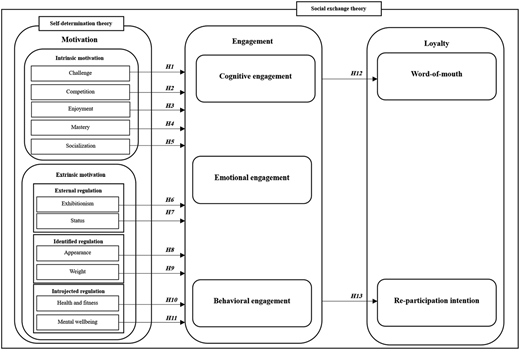
Novelty of study lies in conceptualizing customer engagement in participant sports by highlighting the instrumental role of intrinsic and extrinsic (external regulation, identified regulation, and introjected regulation) motivation in fostering engagement (cognitive, emotional, behavioral) and the consequential impact of such engagement on loyalty (word-of-mouth and re-participation), as grounded in self-determination theory and social exchange theory.
1. Introduction
Customer engagement emerged as a subject of academic discourse around 2006 and ascended to prominence by 2010 (Lim et al., 2022). As a strategic asset for organizations, customer engagement has been gaining traction among both researchers and practitioners (Behnam et al., 2021; Srivastava and Sivaramakrishnan, 2022). In fact, since 2010, the Marketing Science Institute (MSI) has identified customer engagement as a research priority, and over 3,500 scholarly documents have been published on the subject as per a Scopus search for “customer engagement” in the “article title, abstract, and keywords” on January 1, 2025. Noteworthily, establishing strong customer relationships is key to enhancing loyalty (Kumar and Utkarsh, 2023; Zaheer, 2019), and the escalating prominence of customer engagement can be attributed to the positive outcomes it engenders, such as enhanced relationship quality (Behnam et al., 2021), amplified word-of-mouth (Halaszovich and Nel, 2017; Kanje et al., 2019), and increased repeat purchases (Pansari and Kumar, 2017; Wirtz et al., 2013).
The literature provides multiple conceptualizations of engagement in marketing and sports (Table 1). As defined by Bowden (2009) and Vivek et al. (2012), customer engagement is not a one-time event but an ongoing process initiated by either the organization or the customer, where an individual actively interacts with an organization’s activities or offerings. This process cultivates loyalty among new customers, propelling repeat purchase behaviors. Moreover, customer engagement invites customers to contribute both directly and indirectly beyond purchases, aligning with the notion that the customer is a co-creator of value (Brodie et al., 2011; Harmeling et al., 2017; Hasan et al., 2024; Pansari and Kumar, 2017). There are three recognized dimensions of engagement: cognitive, emotional, and behavioral (Dwivedi, 2015; Hollebeek, 2011a; Lim et al., 2022; Patterson et al., 2006). In digital and virtual spaces, customer engagement unfolds through social media and online brand communities, where individuals engage with others regarding a brand and employ brand-related cues such as hashtags (Bastrygina and Lim, 2023; Bastrygina et al., 2024; Dessart, 2017; Lim and Rasul, 2022; Stathopoulou et al., 2017; Wirtz et al., 2013). However, despite the growing interest in customer engagement, its role within participant sports remains underdeveloped, raising two significant issues.
On the one hand, customer engagement in sports has typically revolved around spectator sports, which is about watching and supporting teams or individual athletes, and thus differs from participant sports, which is about physically taking part in the activity. Indeed, the difference between these two sports is critical, as engagement involving spectator sports often centers on fans, who may pay (e.g. cable television) or not pay (e.g. free coverage) to watch an event, whereas engagement involving participant sports focuses on individuals who usually pay to join the activity (e.g. marathons), and is therefore captured through the notion of customer engagement (Lim et al., 2022). Such a focus on spectators rather than participants poses a significant issue because it overlooks how paying participants engage and what strategies can best foster their ongoing involvement and loyalty.
On the other hand, prior research on motivations for participating in charity-affiliated sporting events (Bennett et al., 2007), exercise (Markland and Ingledew, 1997), physical activity (Zach et al., 2013), and recreational sports (Clough et al., 1989) have not considered participants as customers, leaving a gap in explaining customer engagement in participant sports. Recognizing participants as customers is crucial because it emphasizes their dual role as both consumers of the event experience and contributors to its financial sustainability, thereby shaping engagement approaches and marketing strategies (Lim et al., 2022). Although Temerak and Winklhofer’s (2023) seminal work on participant engagement in running events made progress, it examined only three antecedents—i.e. appearance, perceived similarity, and suitable behavior—which limits understanding of the full range of motivations driving engagement.
Collectively, these issues imply that failing to capture the distinct nature of customer engagement in participant sports risks diluting theoretical clarity and practical guidance for organizers. Addressing these issues is necessary to avoid suboptimal strategies that fail to capitalize on the motivations of paying participants, and is important for fueling sustained loyalty, revenue, and overall growth in participant sports. This focus is also highly relevant, given the resurgence in participant sports like marathons—exemplified by the New York City Marathon’s record-setting 55,646 finishers in November 2024 (Reuters, 2024)—and urgent, given that participant sports like marathons remain relatively inelastic for which people are willing to pay substantial fees, wherein the larger the race, the higher the cost (Page, 2025), thereby making it vital to understand customer engagement in participant sports.
In response to these challenges, this study aims to advance understanding by identifying and investigating a comprehensive set of antecedents, dimensions, and outcomes of customer engagement in participant sports. Theoretically, this study draws on self-determination theory (Deci and Ryan, 1985), which illuminates the motivational factors at play, and social exchange theory (Thibaut and Kelley, 1959), which sheds light on the linkages between the antecedents, dimensions, and outcomes of customer engagement in participant sports. Methodologically, this study employs an online survey to transcend geographical boundaries and capture insights from participants worldwide. Practically, this study focuses on both physical and virtual marathons as illustrative cases, thereby reflecting the evolving landscape of participant sports and offering actionable guidance for organizers.
The expected contributions of this study are manifold. On the theoretical front, this study enhances understanding of customer engagement in participant sports by shedding light on underexplored antecedents, defining engagement dimensions, and revealing relevant outcomes. These insights, in turn, could open up new avenues and form the basis for further research in this area. On the practical front, understanding the antecedents to and outcomes of customer engagement could equip organizers of participant sports with insights to devise effective marketing strategies to encourage continued participation and nurture sustained engagement. Moreover, by defining the dimensions of customer engagement, this study also provides a framework to measure and monitor customer engagement, and thus, guiding efforts to enhance customer experience and promote greater loyalty in participant sports. Therefore, this study is poised to advance both the theoretical understanding and the practical application of customer engagement in participant sports.
2. Conceptual foundation
The concept of customer engagement encompasses both a subject and an object, with customers acting as the subject and organizations, brands, and other customers serving as the objects with which they interact (Brodie et al., 2025; Dwivedi, 2015; Hollebeek, 2011a, b; Lim et al., 2022; Mollen and Wilson, 2010; Patterson et al., 2006; Van Doorn et al., 2010). Customer engagement extends across three dimensions: affective/emotional, cognitive/mental, and behavioral/physical (Lim et al., 2022).
Affective or emotional engagement is characterized by fervor, dedication, and enthusiastic involvement (Hollebeek, 2011a; Patterson et al., 2006; Vivek et al., 2014). This dimension implies an emotional investment by the customer in their interaction with the engagement object, marked by passionate responses when utilizing the organization’s products or services, or interacting with its staff. Customers may experience a sense of belonging and pride, with participant sports engendering positive, joyful, and exciting feelings (Temerak and Winklhofer, 2023). Within the context of participant sports, we define affective or emotional engagement as the application of emotional resources during sports participation.
Cognitive or mental engagement is depicted by absorption, immersion, and conscious attention (Hollebeek, 2011a; Patterson et al., 2006; Vivek et al., 2014), indicating a mental commitment during interaction with the engagement object. This dimension involves being fully engrossed and focused, particularly evident in sports, where participants tend to think deeply about the sport, strive to learn more, and reflect on their experiences (Temerak and Winklhofer, 2023). Within the context of participant sports, we define cognitive or mental engagement as the expenditure of mental resources during sports participation.
Behavioral or physical engagement is characterized by vigor and activation (Hollebeek, 2011a; Patterson et al., 2006), implying the deployment of physical resources during interaction with the engagement object. This includes the expenditure of energy, effort, and time, as well as engaging in discussions related to sports participation. In sports, such engagement may manifest as comparisons with other outdoor activities or participation in events organized by the sports entity (Temerak and Winklhofer, 2023). Within the context of participant sports, we define behavioral or physical engagement as the utilization of physical resources during sports participation.
Given this discussion, we propose that customer engagement in participant sports constitutes the emotional, mental, and physical resources that sports participants invest, wherein these resources are activated by their motivation to participate in the sport, which yield desirable outcomes for sports organizers and marketers, such as word-of-mouth endorsements and re-participation intentions.
3. Theoretical foundation
3.1 Social exchange theory
This study employs social exchange theory as a theoretical lens to elucidate customer engagement in participant sports. At its core, social exchange theory postulates that people choose to engage in social exchanges based on a rational analysis of potential benefits and costs (Thibaut and Kelley, 1959), thereby indicating that “social exchange comprises actions contingent on the rewarding reactions of others, which over time provide for mutually and rewarding transactions and relationships” (Cropanzano and Mitchell, 2005, p. 890). Building on this, customer exchange literature implies that customers accrue myriad benefits from their reciprocal relationships with firms (Verleye, 2015). In this study, we explore how these benefits manifest within the specific context of participant sports, thereby illuminating the diverse motivations that underpin customer engagement.
3.2 Self-determination theory
A key antecedent of customer engagement in participant sports, as posited in this study, is motivation. Customer engagement arises from an inherent motivation to partake in an activity (Ben-Eliyahu et al., 2018). In the context of sports, motivation is defined as the “reasons that individuals offer for their participation” (Curry and Weiss, 1989, p. 258).
The self-determination theory serves as a valuable lens through which to explore motivation in sports. Self-determination is “a quality of human functioning that involves the experience of choice, or in other words, the experience of an internally perceived locus of causality” (Deci and Ryan, 1985, p. 39). In essence, self-determination suggests that individuals possess the capacity to make decisions, contrasting with scenarios where external forces dictate actions (Lim and Weissmann, 2023). Noteworthily, according to self-determination theory, motivation falls into three distinct categories (Ryan and Deci, 2019).
The first type of motivation is intrinsic motivation, which is an innate desire to enhance skills, embrace challenges, and engage in new experiences without external pressures or rewards (Ryan and Deci, 2000a). An example is an individual participating because they enjoy the sport.
The second type of motivation is extrinsic motivation, which involves partaking in an activity to realize a separable outcome (Ryan and Deci, 2000b, c). Extrinsic motivation sub-divides into four categories: external regulation, identified regulation, introjected regulation, and integrated regulation. External regulation sees individuals engaging in an activity to fulfil an external demand or gain an external reward (Ryan and Deci, 2000b). An example is when one participates in sports due to the status associated with participation. Identified regulation emerges when a behavior, although not immediately rewarding, is considered valuable and personally important (Ryan and Deci, 2000a, b, c). An example is when one participates in sports to improve their appearance. Introjected regulation is driven by internal pressures to avoid anxiety or guilt or to bolster one’s ego (Ryan and Deci, 2000b, c). An example is when one participates in sports to bolster their health. Lastly, integrated regulation occurs when identified regulations align with an individual’s needs and values (Ryan and Deci, 2000c). An example is one who views themselves as a fit person participates in sports because it is consistent with their fitness goals.
The third and final type of motivation is amotivation, where an individual’s actions lack the ability and intent to anticipate their consequences (Pelletier et al., 1999; Ryan and Deci, 2000b). As such, their actions, devoid of purpose, seem to be dictated by uncontrollable forces (Deci and Ryan, 1985).
Both social exchange theory and self-determination theory are utilized in this study. While self-determination theory explains the underlying motivational forces that drive engagement, social exchange theory provides an overarching lens grounded in reward systems. Social exchange theory maintains that individuals engage in exchanges due to an expectation of rewards (Cropanzano and Mitchell, 2005), whereas self-determination theory posits that individuals are motivated to engage in activities to fulfil their psychological needs (Ryan and Deci, 2000c). Sport participants and sporting organizations operate under different motivations yet both benefit from these exchanges. For example, participants pay a fee and derive social benefits from their participation, whereas organizations receive revenue and are motivated to enhance loyalty. The following section will explore the various motivations for sports participation.
4. Hypothesis development
4.1 Challenge
Challenge is defined as undertaking a difficult activity to achieve success (Recours et al., 2004). Participants challenge themselves on physical and mental planes (Kerr, 2021; Lamont and Kennelly, 2012), or strive for improved timings (Lynch and Dibben, 2016). Accordingly, we advance the following hypotheses:
Challenge has a positive effect on cognitive engagement (H1a), emotional engagement (H1b), and behavioral engagement (H1c) in participant sports.
4.2 Competition
Competition infers a contest where a victor is designated among participants (Zhou et al., 2020). However, competition is not solely about outperforming others, as participants also strive to surpass their personal milestones (Parra-Camacho et al., 2019; Vallerand and Losier, 1999). As a result, we articulate the following hypotheses:
Competition has a positive effect on cognitive engagement (H2a), emotional engagement (H2b), and behavioral engagement (H2c) in participant sports.
4.3 Enjoyment
Enjoyment is often associated with a sense of satisfaction (Lamont and Kennelly, 2012). Motivations for participation extend from deriving pleasure and happiness (Mina, 2019) to cultivating an interest in sports (Ryan et al., 1997). Based on this, we establish the following hypotheses:
Enjoyment has a positive effect on cognitive engagement (H3a), emotional engagement (H3b), and behavioral engagement (H3c) in participant sports.
4.4 Mastery
Mastery involves the pursuit of self-established objectives without reliance on comparative benchmarks set by others (Zhou et al., 2020). Mastery also encapsulates the drive to acquire and develop new skills (Allman et al., 2009; Toktas, 2021). Considering the motivational impetus that mastery provides for engagement in sports, we formulate the following hypotheses:
Mastery has a positive effect on cognitive engagement (H4a), emotional engagement (H4b), and behavioral engagement (H4c) in participant sports.
4.5 Socialization
Socialization is defined as the process by which individuals engage in interactions and build relationships—both social and professional—through sports (Anaza, 2017; Jones et al., 2006).
Individuals participate in sports not only to spend time with friends (Jones et al., 2006) but also to forge new connections and expand their professional networks (Anaza, 2017; Koronios et al., 2020; Lawler et al., 2021; Pluhar et al., 2019). Consequently, we introduce the following hypotheses:
Socialization has a positive effect on cognitive engagement (H5a), emotional engagement (H5b), and behavioral engagement (H5c) in participant sports.
4.6 Exhibitionism
Exhibitionism represents the drive to display one’s prowess or dominance (Recours et al., 2004) This motivation also extends to the desire to present oneself favorably, particularly in front of friends and acquaintances (Bennett et al., 2007; Koronios and Kriemadis, 2018). Considering this, we offer the following hypotheses:
Exhibitionism has a positive effect on cognitive engagement (H6a), emotional engagement (H6b), and behavioral engagement (H6c) in participant sports.
4.7 Status
Status is defined as the desire to enhance one’s standing and be recognized by others (Clough et al., 1989; Mina, 2019). This desire motivates individuals to seek validation by striving to feel important (Clough et al., 1989) and to elevate their reputation within their social circles through sports participation (Mina, 2019). They can, in turn, gain popularity and assert influence over others (Buonamano et al., 1995; Clough et al., 1989). Drawing from these insights, we posit the following hypotheses:
Status has a positive effect on cognitive engagement (H7a), emotional engagement (H7b), and behavioral engagement (H7c) in participant sports.
4.8 Appearance
Appearance is defined as the pursuit of enhancing one’s physical attractiveness through visible changes, often times through sports participation (Oliveira-Brochado et al., 2017). Some desire to achieve a youthful look or develop a more athletic or attractive physique through sports (Diehl et al., 2018; Koivula, 1999; Ryan et al., 1997). In light of these insights, we present the following hypotheses:
Appearance has a positive effect on cognitive engagement (H8a), emotional engagement (H8b), and behavioral engagement (H8c) in participant sports.
4.9 Weight
Weight is defined as the concern with managing body mass to achieve or maintain a desired physical state, which often motivates individuals to participate in sports (Markland and Ingledew, 1997). Notably, participation in sports helps in burning calories, promoting weight loss, and sustaining a healthy weight (Markland and Ingledew, 1997; Pluhar et al., 2019). In view of this understanding, we propose the following hypotheses:
Weight has a positive effect on cognitive engagement (H9a), emotional engagement (H9b), and behavioral engagement (H9c) in participant sports.
4.10 Health and fitness
Health and fitness is defined as the pursuit of physical wellbeing through regular physical activity targeted at maintaining or enhancing bodily functions (Bennett et al., 2007). The positive contribution of sports participation to health is well documented (Shawver, 2020), encompassing improved cardiovascular function, weight loss, and weight management (Chiu et al., 2016; Jepson et al., 2012). Moreover, engaging in sports enables individuals to assess and maintain their fitness levels (Mishra et al., 2022; Parra-Camacho et al., 2019; Rundio and Buning, 2021). On this basis, we put forth the following hypotheses:
Health and fitness has a positive effect on cognitive engagement (H10a), emotional engagement (H10b), and behavioral engagement (H10c) in participant sports.
4.11 Mental wellbeing
Mental wellbeing is defined as the state of emotional and psychological health, characterized by the ability to cope with stress and stay resilient. The pursuit of enhanced mental wellbeing motivates sports participation (Koronios et al., 2018), as engaging in physical activity often serves as a coping mechanism to alleviate stress (Markland and Ingledew, 1997) and provide a welcome escape from daily pressures (Rintaugu et al., 2020). Therefore, we put forth the following hypotheses:
Mental wellbeing has a positive effect on cognitive engagement (H11a), emotional engagement (H11b), and behavioral engagement (H11c) in participant sports.
4.12 Loyalty
Loyalty is defined as the sustained commitment and advocacy that customers demonstrate toward a brand or product over time (Tuguinay et al., 2022). In the context of customer engagement, loyalty manifests in two ways: attitudinal and behavioral (Rauyruen and Miller, 2007).
Attitudinal loyalty emerges when customers form a psychological bond with a provider, leading to advocate for the provider through word-of-mouth (Rauyruen and Miller, 2007). Prior studies suggest that word-of-mouth is an outcome of cognitive, emotional, and behavioral engagement (Kanje et al., 2019; Lim et al., 2022; Lim and Rasul, 2022). Customers who form an emotional bond (emotional engagement) with a company often engage in word-of-mouth behavior (Liu and Zhao, 2015; Sashi, 2012). Similarly, behaviorally engaged customers seek further engagement opportunities, such as advocating for the company (Kanje et al., 2019; Liu and Zhao, 2015). However, in context of participant sports, early evidence shows that only emotional engagement was found to promote word-of-mouth, but not cognitive and behavioral engagement (Temerak and Winklhofer, 2023). This prompts the need for research and reconciliation, resulting in the formulation of the following hypotheses:
Cognitive engagement (H12a), emotional engagement (H12b), and behavioral engagement (H12c) have a positive effect on word-of-mouth in participant sports.
Behavioral loyalty, the other type of loyalty, arises when a customer maintains a relationship with an organization through repeat purchases (Bowden, 2009; Rauyruen and Miller, 2007). Customer engagement is designed to foster these long-term relationships by influencing repurchasing intentions (Megatari, 2021; Sashi, 2012). In this context, repurchase intention emerges as a key outcome of customer engagement (Lim et al., 2022; Molinillo et al., 2020; Phang et al., 2021), with engaged customers tending to repurchase and invest more time interacting with the organization (Pansari and Kumar, 2017; So et al., 2016). In participant sports, repurchase intention manifests as re-participation intention, reflecting participants’ motivation to engage in future sports activities (Chao-Sen, 2018; Kim, 2008). This leads to the formation of the following hypotheses:
Cognitive engagement (H13a), emotional engagement (H13b), and behavioral engagement (H13c) have a positive effect on re-participation intention in participant sports.
Figure 1 illustrates the hypothesized linkages among motivation (intrinsic: challenge, competition, enjoyment, mastery, and socialization; extrinsic motivation by external regulation: exhibitionism and status; extrinsic motivation by identified regulation: appearance and weight; and extrinsic motivation by introjected regulation: health and fitness as well as mental wellbeing), engagement (cognitive, emotional, and behavioral), and loyalty (word-of-mouth and re-participation intention).
5. Methodology
5.1 Instrumentation
A questionnaire containing items to measure the constructs in the study were adapted from existing studies. A seven-point Likert scale was used, ranging from “1” (strongly disagree) to “7” (strongly agree). Statements pertaining to health and fitness, mastery, and status were preceded by “Marathons …” whereas statements related to appearance, challenge, competition, enjoyment, exhibitionism, mental wellbeing, socialization, and weight started with “I participate in marathons because I/it/to …” No preceding words were utilized for engagement and loyalty items. The questionnaire underwent a pretest with engagement and sport experts to establish content validity and a pilot study with participants of marathons to establish face validity (Lim, 2024, 2025). The experts and pilot study participants recommended a few changes to the wording of the instruments and the design of the survey before administration it to the main sample, thereby strengthening both content and face validity.
5.2 Sampling
A purposive sampling approach (Lim, 2025; Rahi, 2017; Shelley and Horner, 2021) was adopted to select a focal sport—and the participants of that sport—that would serve as a suitable context for an investigation on customer engagement in participant sports. Marathons were selected as the focal sport, leveraging their popularity and including both in-person and virtual formats. In-person marathons involve participants gathering at a specific location and time, whereas virtual marathons allow participants to engage individually at their chosen location within a defined timeframe (Perun, 2022). Virtual marathons expanded the participant pool given the temporary suspension of in-person marathons due to COVID-19 pandemic lockdown regulations.
Data were collected through an online survey, disseminated via English-speaking Facebook marathon groups in multiple countries such as Australia, India, Kenya, Malaysia, New Zealand, Singapore, South Africa, the United Kingdom, the United States, and Zimbabwe, among others. In turn, this approach enabled the study to improve its generalizability by accommodating participants from around the world, and thus, mitigate potential bias from collecting responses only from a single or few selected country.
Eligibility was limited to individuals aged 18 years and older—a pragmatic decision grounded in their legal capacity to provide consent as adults. The initial sample size was 390, however, 327 valid responses were retained after excluding disqualified respondents and those with excessive missing data.
Demographically, the sample comprised 55.4% females and 43.7% males. Age-wise, 30.6% of respondents were 45–54 years old, followed by 26.6% in the 35–44 bracket, and 16.5% between 25 and 34. In terms of education, 45.6% held postgraduate degrees, 37% had undergraduate degrees, and 12.5% possessed certificates or diplomas. Participants had engaged in various marathon distances: 59.9% last participated in a full marathon, 22.3% in a half marathon, and 8.3% in an ultra-marathon. The majority (79.8%) last participated in an in-person marathon, with the remaining 20.2% having engaged in a virtual marathon. Participants were drawn from an array of marathons worldwide, including the Boston Marathon, London Marathon, Tata Mumbai Marathon, New York Marathon, Two Oceans Marathon, Victoria Falls Marathon, Standard Chartered Marathon Singapore, and more (Table 2).
5.3 Analysis
To analyze the data, we ran partial least squares structural equation modeling (PLS-SEM) in the SmartPLS software. PLS-SEM was chosen over co-variance-based structural equation modeling (CB-SEM) because it effectively tests theoretical relationships within complex structural models comprising multi-item constructs, is ideally suited for exploratory research without requiring normally distributed data, and is robust to small sample sizes, non-normality, and measurement error, thereby enhancing predictive accuracy and offering a flexible analytical approach (Hair et al., 2014, 2017; Lim, 2025; Manley et al., 2021).
The analysis via PLS-SEM involves three critical steps. Firstly, to address common method bias, we applied single factor test and Kock’s (2015) full collinearity test. The second step involved evaluating the measurement model, focusing on convergent and discriminant validity, as well as internal consistency or reliability (Hair et al., 2011; Lim, 2025). The final step entailed assessing the model’s predictive power by examining the coefficient of determination (R2), the predictive relevance (Q2), and the direction, magnitude, and statistical significance of the path coefficients (Hair et al., 2014; Manley et al., 2021).
6. Results
6.1 Preliminary assessment
Apart from using procedural remedies such as randomized item presentation and voluntary survey participation with no right or wrong answers to mitigate common method bias (CMB) (Lim, 2025), we engage in statistical checks by conducting Harman’s (1976) single factor test, grounded in two assumptions identified by Podsakoff and Organ (1986): CMB typically manifests as a single dominant factor, and this factor accounts for the majority of the covariance among variables. Our results showed that one factor accounted for 30.496% of the variance, which is below the maximum threshold of 50%, suggesting that CMB is not a significant concern in this study. Moreover, we performed a collinearity test using the variance inflation factor (VIF), which indicated that all indicators were below the recommended threshold of 3.3 (Kock and Lynn, 2012), thereby further confirming the absence of CMB.
6.2 Measurement model assessment
As part of measurement model assessment (Tables 3 and 4), we examined factor loading (λ), average variance extracted (AVE), Cronbach’s alpha (α), composite reliability (CR), and heterotrait-monotrait (HTMT) ratio of correlations. The λ values generally exceeded 0.708, with the exception of three indicators (i.e. BEH5 = 0.662, COG4 = 0.512, and MAS4 = 0.633), which were retained because of their substantive significance (owing to their conceptual importance), and given that all constructs’ AVE surpassed 0.50, convergent validity is therefore reasonably taken as established (Hair et al., 2011; Lim, 2025). Both α and CR values were above 0.70 for all constructs, thereby demonstrating internal consistency or reliability (Hair et al., 2011; Lim, 2025). The HTMT values were below the 0.85 threshold (Henseler et al., 2015), thus indicating discriminant validity.
6.3 Structural model assessment
6.3.1 Explained variance (R2) and predictive relevance (Q2)
R2 values reveal a substantial degree of explained variance in the engagement and loyalty constructs within our model (R2 < 0.19 = very weak; 0.19 ≤ R2 < 0.33 = weak; 0.33 ≤ R2 < 0.67 = moderate; R2 ≥ 0.67 = substantial; Chin, 1998). Specifically, cognitive engagement demonstrated an R2 value of 0.544, emotional engagement 0.571, and behavioral engagement 0.503. These figures indicate a moderate influence of the underlying factors on these forms of engagement. In the loyalty constructs, word-of-mouth had an R2 of 0.405, and re-participation intention 0.364, suggesting also a moderate and significant explanation of variance by the predictors in our model.
Regarding Q2 values, which assess the model’s predictive relevance, all endogenous variables showed positive outcomes: emotional engagement (0.534), cognitive engagement (0.505), behavioral engagement (0.463), word-of-mouth (0.336), and re-participation intention (0.234). These values, being above zero, affirm the model’s predictive power (Hair et al., 2014). This underscores the model’s effectiveness in not only explaining but also predicting the relationships among constructs.
The hypothesized model integrates a diverse range of motivational factors—including challenge, competition, enjoyment, mastery, socialization, exhibitionism, status, appearance, weight, health and fitness, as well as mental wellbeing—and effectively links them to three types of engagement (cognitive, emotional, and behavioral) and loyalty dimensions (word-of-mouth and re-participation intention). The moderate R2 values for engagement and loyalty constructs indicate adequate explanatory power of the motivational factors on these outcomes. The positive Q2 values further strengthen the model’s capability to predict the influence of these motivational factors on engagement and loyalty.
6.3.2 Hypothesis testing
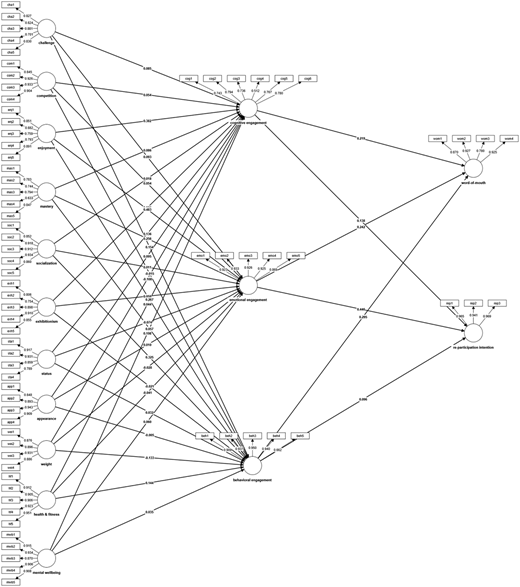
The direction(+, –), magnitude (β), statistical significance (p, t), and effect size (f2) of the path coefficients in the structural model are presented in Figure 2 and Table 5.
Challenge, while not associated with cognitive (β = 0.085, p = 0.098 > 0.05, t = 1.653 < 1.96 f2 = 0.011 < 0.02) and emotional engagement (β = 0.093, p = 0.062 > 0.05, t = 1.866 < 1.96, f2 = 0.013 < 0.02), shows a significant relationship with behavioral engagement (β = 0.154, p = 0.008 < 0.01, t = 2.671 > 2.576, f2 = 0.032 > 0.02 = small effect), supporting H1c but not H1a and H1b.
Competition does not exhibit a positive relationship with cognitive (β = 0.054, p = 0.263 > 0.05, t = 1.118 < 1.96, f2 = 0.005 < 0.02), emotional (β = 0.054, p = 0.212 > 0.05, t = 1.248 < 1.96, f2 = 0.006 < 0.02), or behavioral engagement (β = −0.015, p = 0.745 > 0.05, f2 = 0.000 < 0.02), leading to the rejection of H2a-c.
Enjoyment markedly influences cognitive (β = 0.382, p = 0.000 < 0.001, t = 7.084 > 2.576 f2 = 0.140 ≈0.15 = medium effect), emotional (β = 0.483, p = 0.000 < 0.001, t = 7.806 > 2.576 f2 = 0.239 > 0.15 = medium effect), and behavioral (β = 0.267, p = 0.000 < 0.001, t = 4.182 > 2.576 f2 = 0.063 > 0.02 = small effect) engagement, affirming H3a-c.
Mastery is significantly associated with emotional engagement (β = 0.256, p = 0.000 < 0.001, t = 3.680 > 2.576, f2 = 0.057 > 0.02 = small effect), supporting H4b, but shows no association with cognitive (β = 0.086, p = 0.224 > 0.05, t = 1.216 < 1.96, f2 = 0.006 < 0.02) or behavioral engagement (β = 0.057, p = 0.397 > 0.05, t = 0.847 < 1.96 f2 = 0.002 < 0.02), thus not supporting H4a and H4c.
Socialization, while not associated with cognitive (β = 0.018, p = 0.720 > 0.05, t = 0.359 < 1.96, f2 = 0.001 < 0.02) and emotional engagement (β = 0.011, p = 0.817 > 0.05, t = 0.231 < 1.96 f2 = 0.000 < 0.02), is significantly related to behavioral engagement (β = 0.325, p = 0.000 < 0.001, t = 5.507 > 2.576, f2 = 0.149 ≈0.15 = medium effect), thus supporting H5c but not H5a and H5b.
Exhibitionism does not demonstrate an association with cognitive (β = 0.036, p = 0.573 > 0.05, t = 0.564 < 1.96, f2 = 0.001 < 0.02), emotional (β = 0.059, p = 0.321 > 0.05, t = 0.992 < 1.96 f2 = 0.004 < 0.02), or behavioral engagement (β = −0.021, p = 0.706 > 0.05, t = 0.377 < 1.96 f2 = 0.000 < 0.02), leading to the rejection of H6a-c.
Status is positively associated with cognitive engagement (β = 0.136, p = 0.032 < 0.05, t = 2.142 > 1.96 f2 = 0.018 ≈0.02 = small effect), affirming H7a, but shows no significant relationship with emotional (β = −0.074, p = 0.184 > 0.05, t = 1.328 < 1.96, f2 = 0.006 < 0.02) and behavioral engagement (β = 0.032, p = 0.585 > 0.05, t = 0.546 < 1.96, f2 = 0.001 < 0.02), thus not supporting H7b and H7c.
Appearance does not show a significant association with cognitive (β = 0.095, p = 0.108 > 0.05, t = 1.610 < 1.96, f2 = 0.010 < 0.02), emotional (β = 0.010, p = 0.844 > 0.05, t = 0.196 < 1.96 f2 = 0.000 < 0.02), or behavioral engagement (β = −0.005, p = 0.923 > 0.05, t = 0.097 < 1.96 f2 = 0.000 < 0.02), leading to the rejection of H8a-c.
Weight is not positively related to cognitive (β = −0.108, p = 0.081 > 0.05, t = 1.744 < 1.96, f2 = 0.013 < 0.02) and emotional engagement (β = −0.028, p = 0.596 > 0.05, t = 0.530 < 1.96, f2 = 0.001 < 0.02), but is significantly associated with behavioral engagement (β = −0.133, p = 0.016 < 0.05, t = 2.405 > 1.96, f2 = 0.019 ≈0.02 = small effect), supporting H9c but not H9a and H9b.
Health and fitness motivations are not associated with cognitive (β = 0.044, p = 0.445 > 0.05, t = 0.763 < 1.96 f2 = 0.002 < 0.02) or emotional engagement (β = −0.041, p = 0.558 > 0.05, t = 0.585 < 1.96 f2 = 0.002 < 0.02), but are positively related to behavioral engagement (β = 0.144, p = 0.025 < 0.05, t = 2.242 > 1.96 f2 = 0.016 ≈0.02 = small effect), affirming H10c while refuting H10a and H10b.
Mental wellbeing is positively associated with cognitive engagement (β = 0.198, p = 0.001 < 0.01, t = 3.453 > 2.576, f2 = 0.049 > 0.02 = small effect), supporting H11a, but it does not exhibit a positive relationship with emotional (β = 0.060, p = 0.219 > 0.05, t = 1.228 < 1.96, f2 = 0.005 < 0.02) or behavioral engagement (β = 0.035, p = 0.511 > 0.05, t = 0.657 < 1.96 f2 = 0.001 < 0.02), thus not supporting H11b and H11c.
All forms of engagement—cognitive (β = 0.219, p = 0.000 < 0.001, t = 4.440 > 2.576 f2 = 0.051 > 0.02 = small effect), emotional (β = 0.242, p = 0.000 < 0.001, t = 4.211 > 2.576, f2 = 0.050 > 0.02 = small effect), and behavioral (β = 0.295, p = 0.000 < 0.001, t = 5.329 > 2.576, f2 = 0.087 > 0.02 = small effect)—show a significant association with word-of-mouth, validating hypotheses H12a-c. Conversely, while cognitive (β = 0.138, p = 0.023 < 0.05, t = 2.277 > 1.96, f2 = 0.019 ≈0.02 = small effect) and emotional engagement (β = 0.446, p = 0.000 < 0.001, t = 6.330 > 2.576, f2 = 0.161 > 0.15 = medium effect) are significantly associated with re-participation intention, supporting H13a and H13b, behavioral engagement (β = 0.096, p = 0.177 > 0.05, t = 1.349 < 1.96, f2 = 0.009 < 0.02) does not show a similar association, leading to the rejection of H13c.
7. Discussion and conclusion
Consistent with past research on the motivating role of challenge in driving participation (Zhou et al., 2020), findings indicate that challenge fosters behavioral engagement—but not cognitive or emotional engagement—in participant sports. This suggests that individuals primarily translate challenging goals into tangible actions and interpersonal interactions, such as exchanging ideas and sharing experiences with fellow participants. In other words, when participants strive to meet personal targets, their engagement manifests more clearly through observable behaviors rather than internal reflections or emotional responses.
Contrary to earlier assertions that competition motivates participation (Recours et al., 2004), findings reveal that competition does not significantly influence cognitive, emotional, or behavioral engagement in participant sports. This suggests that participants may not view competing against others as a central driver of engagement, possibly because their focus is on personal achievement and other intrinsic rewards rather than on outperforming peers.
Consistent with Lamont and Kennelly (2012), findings show that enjoyment serves as a key driver by significantly enhancing cognitive, emotional, and behavioral engagement in participant sports. This implies that when participants derive pleasure from their experience, they not only process the event more thoughtfully but also form a deeper emotional connection and engage more actively with the activity, reinforcing a comprehensive model of customer engagement in participant sports.
Consistent with Allman et al. (2009), findings suggest that while mastery—a motivational drive to improve personal skills—significantly enhances emotional engagement in participant sports, it does not appear to influence cognitive or behavioral engagement. This suggests that the pursuit of skill improvement primarily elicits an enthusiastic and passionate emotional response, rather than affecting participants’ mental processing or observable actions during sports participation.
Consistent with Jones et al. (2006), findings indicate that socialization significantly enhances behavioral engagement in participant sports, as participants actively interact and exchange ideas with one another; however, socialization does not appear to influence cognitive or emotional engagement, indicating that the social component of participation primarily drives observable actions rather than internal thought processes or affective responses.
Contrary to past research (Recours et al., 2004), findings reveal that exhibitionism does not drive cognitive, emotional, or behavioral engagement in participant sports. This suggests that the desire to showcase one’s abilities does not translate into meaningful engagement, likely because many participants prefer focusing on the activity rather than being observed by others.
Consistent with Clough et al. (1989), findings show that status serves as a motivational factor in participant sports by primarily enhancing cognitive engagement. This indicates that the recognition and esteem garnered through participation reinforce self-appraisal and identity, but these status-driven aspects do not significantly evoke emotional responses or translate into observable behavioral actions.
Contrary to expectation, appearance does not significantly influence any dimension of customer engagement in participant sports, suggesting that its motivational value may diminish with age (Larsen et al., 2021), and thus, may not serve as a driver of participation (Clough et al., 1989).
Consistent with Markland and Ingledew (1997), findings indicate that weight concerns do not significantly influence cognitive or emotional engagement in participant sports; however, they are significantly associated with behavioral engagement. This suggests that motivations related to weight management specifically drive observable actions—such as discussing strategies for weight loss or maintenance—rather than affecting internal cognitive or affective processes.
Consistent with prior research emphasizing health and fitness as key drivers for sports participation (Bennett et al., 2007; Mishra et al., 2022), findings reveal that while health and fitness motivations do not significantly influence cognitive or emotional engagement, they do positively drive behavioral engagement. This suggests that concerns about physical wellbeing primarily translate into concrete actions—such as increased participation intensity—rather than altering internal thought processes or affective responses.
Consistent with the notion that mental wellbeing motivates participation in sports (Koronios et al., 2018), findings show that while mental wellbeing enhances cognitive engagement—prompting participants to reflect and strategize about their involvement—it does not significantly influence their emotional or behavioral engagement, suggesting that the pursuit of mental health benefits primarily drives internal processing rather than affective responses or observable actions during sports participation.
Our findings indicate that all forms of engagement—cognitive, emotional, and behavioral—positively contribute to word-of-mouth in participant sports, suggesting that a comprehensive engagement strategy drives customer advocacy. This contrasts with previous research, which highlighted emotional engagement as the sole predictor (Temerak and Winklhofer, 2023), and aligns with studies showing that when customers are cognitively involved, emotionally attached, and actively engaged, they are more inclined to promote the event through word-of-mouth (Kanje et al., 2019; Liu and Zhao, 2015).
Our findings further reveal that cognitive and emotional engagement significantly drive participants’ intentions to re-engage in future events, highlighting the importance of mental investment and emotional attachment in sustaining long-term involvement in participant sports. In contrast, behavioral engagement, although influential in fostering advocacy, does not appear to translate into a commitment to re-participate, suggesting that observable actions during the event are less critical for future engagement (Chao-Sen, 2018; Kim, 2008).
These findings collectively offer important insights through the lens of self-determination theory (Deci and Ryan, 1985) and social exchange theory (Thibaut and Kelley, 1959). Self-determination theory (Deci and Ryan, 1985) suggests that individuals are driven by both intrinsic motivations (e.g. challenge, enjoyment, mastery, socialization) and extrinsic motivations (e.g. status, weight, health and fitness, mental wellbeing), but the extent to which these motivations translate into cognitive, emotional, or behavioral engagement varies. For instance, enjoyment, an intrinsically driven factor, strongly fuels all three dimensions of engagement, while competition, an extrinsic driver locked at surpassing others, shows no influence. Similarly, although status boosts cognitive engagement, it does not lead to notable emotional or behavioral outcomes. These patterns imply that when motivations are more self-directed and aligned with personal growth or enjoyment, they are more apt to generate richer engagement experiences.
Meanwhile, social exchange theory (Thibaut and Kelley, 1959) underscores the reciprocal relationship between participants and sporting organizations. Participants enter the exchange when their self-determined motivations—whether intrinsic or extrinsic—are fulfilled by the event. This exchange then manifests in varying forms of engagement, which in turn yield valuable outcomes for sporting organizations. For example, stronger behavioral engagement from factors like challenge or socialization often translates into real-time interactions and discussions, whereas cognitive and emotional engagement are more likely to inspire loyalty over the long run, as seen in increased word-of-mouth and re-participation intentions. Taken together, these findings highlight how aligning events with participants’ motivations can foster a mutually beneficial exchange: participants receive value in the form of personal development and enjoyment, and organizations benefit through higher advocacy and sustained commitment.
7.1 Theoretical contributions
This study extends the theoretical generalizability of its guiding frameworks by revealing a wider range of motivational drivers and their distinct impacts on engagement dimensions, fostering greater loyalty behaviors.
First and foremost, the application of social exchange theory (Thibaut and Kelley, 1959) in participant sports extends its applicability beyond traditional consumer settings (Cropanzano and Mitchell, 2005), wherein our study demonstrates how the exchange of value in sports participation, driven by a variety of motivational factors, fosters different types of engagement, leading to loyalty behaviors.
Furthermore, the incorporation of self-determination theory (Deci and Ryan, 1985) to elucidate the motivational underpinnings of engagement in sports (Ryan and Deci, 2000a, b, c), including both intrinsic (e.g. challenge, enjoyment, mastery, socialization) and extrinsic (e.g. status, weight, health and fitness, mental wellbeing) motivational factors, provides a detailed understanding of how different motivational dimensions interact to shape customer engagement in participant sports.
Moreover, the empirical validation of the model illustrates the specific pathways through which various forms of motivation influence various types of engagement and result in loyalty behaviors, thereby providing a clearer understanding of which motivational factors are most effective in fostering customer engagement in participant sports.
Last but not least, the study contributes to a deeper understanding of how cognitive, emotional, and behavioral engagements function as distinct pathways in the loyalty formation process—a distinction that enhances theoretical understanding of engagement types in predicting specific loyalty outcomes.
7.2 Managerial implications
Competition emerges as a comparatively weak motivator for participant sports, suggesting that event organizers should pivot their marketing from emphasizing contest-based rivalry to highlighting enjoyment as a core value. Findings indicate that enjoyment meaningfully boosts cognitive, emotional, and behavioral engagement, implying that creating fun, immersive experiences is central to sustained customer involvement in participant sports. For instance, race promotions could feature entertaining on-site activities, interactive social media content, and celebratory post-race gatherings that showcase the event as a lively, enjoyable occasion rather than a race to outdo others.
A focus on personal growth also appears vital. Both challenge and mastery motivations prompt participants to pursue self-improvement and skill development, although each has different engagement impacts. Whereas challenge translates mostly into tangible, outward-facing actions, mastery heightens emotional involvement. This suggests that event marketers can help participants set personalized goals (e.g. specific pace targets or skill-based milestones) and acknowledge their incremental progress during the event. Organizers might also offer expert coaching sessions, skill-building workshops, or virtual training programs to reinforce participants’ sense of personal growth, thereby elevating enthusiasm and willingness to invest effort.
A similar shift toward wellbeing—encompassing health and fitness, weight, and mental wellbeing—can strengthen behavioral and, in some cases, cognitive engagement. A notable implication is that participants primarily transform these motives into concrete actions (e.g. attending training camps, tracking calories, sharing wellness tips). Market communications should highlight practical resources for achieving better health and stress relief, such as mental wellness programs, nutritional advice, and virtual support groups. Showcasing the event’s capacity to fulfill these wellbeing needs can thus support organizers in fostering deeper participant commitment and facilitate ongoing dialogue around healthy lifestyles.
Importantly, shaping long-term loyalty requires careful alignment of engagement strategies with distinct aspects of cognition, emotion, and behavior. While all three engagement dimensions spur positive word-of-mouth, only cognitive and emotional engagement predict re-participation. This implies that event planners should cultivate reflective and affective attachments—through inspiring event narratives, personalized follow-ups, or loyalty incentives—so that participants not only talk about the event but also commit to returning. Status motives, meanwhile, elevate cognitive engagement; thus, recognition initiatives (such as finisher tiers or exclusive commemorative items) can spark reflection and reinforce identity, though such tactics alone may not guarantee repeated attendance. Rather, strategically weaving together enjoyment, personal growth, and wellbeing can shape a more holistic event experience—one that caters to diverse participant motivations while nurturing advocacy and sustained participation.
7.3 Limitations and future directions
This study, while contributing significantly to the literature on customer engagement and participant sports, has certain limitations that open avenues for future research.
Firstly, although this study focused exclusively on English-speaking marathoners and individual-based sports, its findings may extend to other individual endurance sports—such as English and non-English speaking base jumping, cycling, and triathlon (Koronios et al., 2016, Koronios and Kriemadis, 2018, Koronios et al., 2018, 2020)—as well as team-based sports like basketball, football, rugby, and relay races. Future research should therefore recruit a more diverse sample, going beyond purposive sampling (e.g. cluster sampling, stratified sampling; Lim, 2025), that includes participants from various linguistic backgrounds and team sports contexts, which in turn creates room to incorporate new perspectives, such as those involving emotional resonance and social identity, thereby enhancing the generalizability of existing findings while generating new insights on customer engagement in participant sports.
Secondly, unlike some past studies (e.g. Naumann et al., 2019; Rahman et al., 2022), this research did not examine negative aspects of customer engagement and their outcomes. Future studies should address this gap by exploring negative customer engagement in participant sport. Understanding both positive and negative engagement is crucial for developing comprehensive engagement strategies in sports settings.
Thirdly, although this study expanded the antecedents of customer engagement in participant sports from past research, it did not delve into some motivations such as sport tourism. Future research could explore the differing motivations, engagement levels, and subsequent outcomes between local and international marathon participants. This would contribute to a finer-grained understanding of how various motivational factors impact customer engagement and loyalty in sports, particularly in the context of global sports events.
Data availability statement: Data can be made available upon reasonable request.