The United Nations’ Sustainable Development Goals is calling for action from all stakeholders to address the rapid decline in social and environmental conditions. Sport organizations have responded by implementing various sustainability initiatives. However, for these goals to be achieved, employee engagement is crucial. The purpose of this study is to examine how sport employees perceive their organization’s social and environmental sustainability practices, and how these perceptions influence their attitudes and behavioral intentions toward sustainability at work.
A structural equation model was used to test the relationships among sport employees’ perception of their organization’s sustainability behaviors, attitudes toward environmental and social sustainability and sustainability behavior intention. The researchers recruited 249 managerial sport employees from athletic departments of Division I institutions.
Results indicate that sport employees’ perceptions of their organization’s social and environmental sustainability influenced their sustainability attitudes, leading to higher sustainability behavior intentions.
This study contributes to the field of sport management by enhancing our understanding of factors that influence sustainability behaviors among sport employees. By identifying key predictors, this research highlights the importance of sport organizations’ activities as critical drivers of employee sustainability behaviors at work. Furthermore, the study extends the Theory of Reasoned Action by examining perception’s influence on their attitudes.
The increasing global decline in social and environmental conditions has captured the urgent attention of the international community, prompting the United Nations to establish the Sustainable Development Goals (SDGs) as a strategic framework for ensuring a sustainable future (Rezapouraghdam et al., 2019; United Nations, 2015). These comprehensive goals call for collaborative action from all societal stakeholders, including businesses, which have positive organizational outcomes to do so, such as sales growth, lower financial volatility and higher organizational survival rates (Schramade, 2017). While organizations have realized successes on this front, the success of such efforts relies on employee engagement with these initiatives. Without employee buy-in, implementing sustainability initiatives becomes a daunting challenge (Yuriev et al., 2018) and threatens the success and authenticity of these initiatives, which makes the organization open to increased risks (e.g. greenwashing, sport washing; Grix et al., 2023; Miller, 2017).
Current management literature has primarily concentrated on the organizational-level strategies for implementing sustainability, often overlooking the critical role of individual employees to support and engage in sustainable behaviors (de Lange et al., 2012; Fenwick, 2007). Understanding how employees perceive and contribute to corporate sustainability efforts is important to examine to ensure the success, by way of internal support, for sustainability initiatives (e.g. corporate social responsibility). Internal branding has an important role in shaping employee awareness of organizational sustainability performance (Biedenbach and Manzhynski, 2016). They found that employees with strong brand commitment were more likely to align with and champion sustainability initiatives within their organization.
Incentive mechanisms enhance employee participation in these efforts. For example, Merriman et al. (2016) found that attaching financial performance objectives to sustainability goals increased employee engagement with environmental initiatives. Within sport, employees are often viewed as catalysts for promoting sustainability behaviors among fans and other stakeholders. As a result, exploring strategies to engage sport employees is essential to ensure the success of these efforts and the potential to influence other positive organizational outcomes.
To this end, the purpose of this study is to investigate how sport employees perceive their organization’s social and environmental sustainability practices, focusing on sport events, environmental sustainability and employee-related sustainability efforts. Using the Theory of Reasoned Actions (TRA; Ajzen and Fishbein, 1977), a well-established framework for analyzing sustainable behavioral intentions, our study aims to understand the influences on sustainable behaviors within the workplace. By integrating aspects such as subjective norms, and attitudes, the study seeks to provide valuable insights into promoting sustainable practices within sport organizations (Coleman et al., 2011; Liu et al., 2017; Mi et al., 2018; Untaru et al., 2016; Suri, 2011; Oja et al., 2019).
Literature review
Sustainable behaviors at work
In the last 50 years, organizations have responded to the need to implement social and environmental sustainability initiatives benchmarked by SDGs (Bansal, 2005). In achieving these goals, organizations have emphasized their performance within social equity and ecological preservation (Badri Ahmadi et al., 2017). This has led sustainability research to explore why and how these organizations adopt sustainable practices (Chams and García-Blandón, 2019). In addition to exploring the top-down approach, scholars have shifted to better understand the role of employees in implementing sustainable initiatives (Lamm et al., 2015). Researchers recognized that as they spend most of their day at work, employees’ contributions are highly effective in achieving sustainable goals within their organization (Rezapouraghdam et al., 2019). Furthermore, employees can become internal drivers for their organization to implement agendas by developing and championing these initiatives (Lamm et al., 2015). However, as employees’ participation in these initiatives is not a requirement of their organization (Ramus and Killmer, 2007), it would be helpful to investigate factors that result in their involvement with such organizational activities. For example, employees’ perception of their organization’s support toward environmental sustainability positively influenced their job satisfaction and organizational citizenship behaviors toward the environment (Lamm et al., 2015).
Sport organizations have implemented environmental sustainability initiatives through the design of their facilities and by raising awareness among consumers (Inoue and Kent, 2012; McCullough et al., 2016). However, most of the sustainability research in sport management has followed this trend by exploring sport organizations' involvement and sport consumers’ environmental sustainability behaviors at events (for a review, see Cury et al., 2023). For example, Trail and McCullough (2021) found that sport participants’ attitudes and behavior toward sustainability were influenced by their satisfaction with the initiative’s communication. However, as sport employees work in unique conditions (e.g. stressful environments, long work hours and low wages; Hazzaa et al., 2022), additional research is needed to understand how environmental and social sustainability initiatives can create a healthy and safe working environment. As a result, TRA is utilized in this study, which provides a framework to understand factors that lead to employees’ environmental and social sustainability behaviors.
Theory of Reasoned Action
The TRA, developed by Ajzen and Fishbein (1977), proposes that an individual’s actions are primarily guided by their behavioral intentions. These intentions are, in turn, influenced by two key factors: attitudes and subjective norms. Attitudes refer to an individual’s internal evaluations and feelings towards performing a particular behavior, while subjective norms involve the external social pressures or influences perceived by the individual. Although attitudes are personal, they can be shaped by external factors, emphasizing the interplay between internal dispositions and external social influences.
In this study, we focus on the interconnectedness between attitudes and subjective norms, rather than viewing their impacts on intentions in isolation. This approach is supported by research indicating that attitudes and subjective norms often intersect and influence each other, especially in contexts involving ethical or moral decision-making (Tarkiainen and Sundqvist, 2005).
While an extension of TRA, known as the Theory of Planned Behavior (TPB), is frequently used to account for perceived behavioral control – essentially, an individual’s perception of their ability to perform a behavior (Ajzen, 1985; Madden et al., 1992) – this study does not incorporate this aspect. Our focus is solely on the attitudes and subjective norms related to sport employees' intentions towards sustainable behaviors, without considering the element of behavioral control. This decision aligns with the context of corporate social responsibility (CSR) initiatives, which are typically supported by employers, potentially mitigating barriers to employee engagement. Therefore, TRA provides an appropriate framework for examining these influences in the context of sport employees and sustainability intentions.
Attitudes toward environmental sustainability
Attitude can be the degree of favor or disfavor that an individual possesses toward an entity (Eagly and Chaiken, 1993; Trail and McCullough, 2021) and is influenced by an individual’s social identification (Bartels and Hoogendam, 2011). Attitudes are formed through positive and negative interactions and experiences. Attitudes are influenced by external factors that resonate and become internalized as attitudes. For example, when a person strongly identifies with a group, they align with that group’s norms and values that result in positive attitudes within and of the group (Ajzen and Fishbein, 1977). The collective values (e.g. corporate social responsibility, competitiveness in the workplace, etc.) shape the group’s attitudes and influence individual’s attitude to shape normed behaviors (Trail and McCullough, 2021). By way of example when upper management collectively held positive attitudes toward the environment, they were more likely to implement environmental management practices in their organization (Roxas and Coetzer, 2012).
In the sport context, attitudes toward environmental sustainability have been emphasized in sport fan s (Cayolla et al., 2023; Greenhalgh and Drayer, 2020; Harrison et al., 2022), but less so examined among internal stakeholders (e.g. employees; Casper et al., 2012; Daddi et al., 2025; Todaro et al., 2023). However, the impact of sport fan’s attitudes on their behaviors may be associated with the organizational support for such initiatives (for a discussion see, Trail and McCullough, 2021). For example, McCullough and Cunningham (2011) discovered that although sport spectators had high attitudes toward recycling there was not a significant relationship to influence recycling intentions because of a lack of environmental commitment on behalf of the sport organization. Trail and McCullough (2020) found that participants in community-run attitudes toward environmental sustainability campaigns predicted sustainable behavioral intentions among a sporting event that supported environmental efforts. Following these results among external stakeholders, we surmise that internal stakeholders (i.e. employees) are worth exploring because the organizational commitment to sustainability initiatives (e.g. social, environmental) requires internal buy-in to have a more broader influence on external sustainable outcomes. We explore this further in the current study to offer additional information to the literature and provide clarity on the relationship between employees’ environmental sustainability attitudes and behaviors (i.e. reducing carbon footprint and recycling).
Sport event environmental sustainability
Our subjective norms are shaped by what we believe those closest to us think we should do and what we observe them doing, which ultimately influences our behaviors (Ajzen, 2012). However, in the workplace, these norms are often developed through the practices implemented by the organization, which then guide everyone’s behavior and transform into the norm (Balasubramanian and Balaji, 2021). As a result, the construct of sport event environmental sustainability was developed to account for the environmental practices that sport organizations are exhibiting during sporting events such as reducing carbon footprint and recycling. Subjective norms represent the pressure that individuals experience from social norms to engage in a desired behavior (McCullough and Cunningham, 2011), which is consistent with findings that sport fans were more likely to engage in environmental behaviors when influenced by social norms (McCullough, 2013).
Environmental sustainability behaviors in a sport context have primarily been studied regarding fans and participants (Casper et al., 2020; Kellison and Mondello, 2012). Casper et al. (2020) found that the higher college basketball fans perceived the benefits of recycling the more positive perception they had of their athletic department’s sustainability efforts. They also found that when organizations participated in sustainability initiatives, it increased the goodwill perception of their fans (Casper et al., 2020; Kellison and Mondello, 2012). In the context of sport organizations, it is also imperative to consider sport employees’ unique features such as sport employee identification and pride (Swanson and Kent, 2017). Especially for sport employees in administrative roles, their job tasks are closely related to the mission and values of the sport organizations, which may shape how they perceive sustainability efforts. Although fans and sport employees might possess different motivations, these findings suggest that overall perceptions can be influenced by positive attitudes towards sustainability efforts, which might extend to sport employees as well. To further extend TRA, we believe that social norms are not isolated from an individual’s attitude but instead influence on the relationship. As a result, the following hypothesis was developed:
Sport employees’ perception of sport event environmental sustainability will positively influence attitudes toward environmental sustainability.
Attitudes toward social sustainability
Social sustainability is one of the three dimensions of sustainability (i.e. economic, social and environmental) and emphasizes the basic needs and equity of individuals and society (Rajak and Vinodh, 2015). Social sustainability can range from employee’s quality of life (e.g. health and psychological well-being), to providing equitable opportunities and employee’s feeling of belonging (Sadick and Kamardeen, 2020). As social sustainability has a vast spectrum, this study focuses on various elements along the range to capture their social sustainability such as social issues (i.e. gender equality), job security, professional development and safety norms. Research shows that employees' attitudes toward social sustainability can be shaped through education, which provides them with relevant knowledge (Huq and Stevenson, 2020). Awareness also plays a role, as it makes employees conscious of sustainability issues. Additionally, their position within the organization can influence their attitudes; for example, managers who hold power are directly involved in implementing social sustainability initiatives (Huq and Stevenson, 2020). Furthermore, when employees experience these attitudes, it positively influences work motivation, reduced absenteeism, lower turnover rates and higher performance (Rahman et al., 2016). The attitudes toward sustainability in the sport management literature have largely focused on environmental sustainability with limited studies regarding social sustainability. These studies highlighted consumer attitudes (Reis and Higham, 2009; Walker and Heere, 2011) and team dynamics (Vveinhardt et al., 2019).
Employee related sustainability
Employee-related sustainability was conceptualized to encompass social sustainability that is experienced within the organization especially, gender equality, job security, safety training and development. Kucharska and Kowalczyk (2019) discovered that an employee’s position within the organization influenced their perception of their CSR practice. The higher the employee’s position, the more positive they perceived CSR practices. However, employees’ positive perceptions are not limited to their satisfaction with social sustainability activities. These perceptions overflow into positive views of additional areas such as leadership and the organization’s performance (Lee et al., 2013).
Organizational culture has been found to play a significant role in organizations' involvement in social sustainability (Schönborn et al., 2019). As a result, organizations display these values by considering social sustainability when developing strategies, policies and management systems (Schönborn et al., 2019). Organizations benefit from their involvement in sustainability on meso- and micro-levels. Researchers found that by integrating social sustainability, communications collaborations with stakeholders are enhanced and new revenue streams are established which increase profits (Schönborn et al., 2019). On a micro level, their employees exhibited higher job satisfaction, a sense of belonging, and found their work meaningful (Glavas, 2016).
In the sport context, social sustainability research has focused on sport tourism (Sánchez-Sáez et al., 2020; Taks, 2013) and perceptions of CSR (Hazzaa et al., 2022). Hazzaa et al. (2022) found that when nonprofit sport employees held positive perceptions of their organization’s CSR activities, it influenced their psychological capital, which in turn led to positive outcomes on the individual level (i.e. job engagement, job satisfaction, organizational citizenship behaviors). Adversely, Vveinhardt et al. (2019) found that harassment within a team context negatively influenced the social sustainability behaviors of players (i.e. safety and welfare). Based on the theoretical foundations of TRA and empirical research, we propose the following:
Sport employees who have positive perceptions of employee-related sustainability will have a positive relationship with their attitude toward social sustainability.
Sustainability behavior intention
Attitudes and social norms are all aspects that have been found to positively relate to an individual’s sustainability behavior intentions (McCullough and Cunningham, 2011). Behavioral intentions are those actions that individuals plan to engage. This leads to defining sustainability behavior intentions as the intention to engage in environmentally and socially sustainable behaviors. When individuals engage in sustainability behaviors, they are more likely to participate in an organization’s sustainability campaigns (Norton et al., 2017). Social science researchers have consistently found that behavioral intentions are the best predictor of actual behaviors (Conner and Norman, 2022; De Cannière et al., 2009; Webb and Sheeran, 2006).
Within sport, there is a limited emphasis on a holistic view of sustainability behavior intentions. Many of these studies largely explore environmental sustainability intentions of sport consumers (McCullough and Trail, 2021; Trail and McCullough, 2021). As more sport organizations increase their involvement in various sustainability efforts (e.g. social and environmental), studying sport employees can provide new insights. The TRA is based on the premise that an individual’s attitudes and subjective norms predict intentions to perform a behavior, which then predict their actual behavior (Ajzen and Fishbein, 1977). This leads us to develop the following hypotheses:
Sport employees having positive attitudes toward environmental sustainability will have higher sustainability behavior intentions.
Sport employees having positive attitudes toward social sustainability will have higher sustainability behavior intentions.
Method and results
Procedures and participants
We developed an online survey on the Qualtrics platform to examine the employee’s sustainability perception, attitudes toward sustainability and sustainability behavior intention. Once the study was approved by the Institutional Review Board, data were collected from employees of Division I institutions in the United States. The participants were recruited by a convenient sampling procedure in which qualified sport employees were contacted through email addresses displayed on their institution’s website. The researchers’ initial email to participants included the purpose and significance of the research, the timeframe of the survey and a hyperlink to the online Qualtrics survey that required consent to complete.
In total, 481 sport employees opened the survey; however, only 249 (51.7%) were valid and used in the analysis. The sample contained 142 females (57%), 102 males (41%), 2 nonbinary (8%) and 3 (1.2%) who preferred not to disclose which 197 (79.1%) identified as White, 21 (8.4%) Black, 14 (5.6%) Hispanic, 6 (2.4%) Multiracial, 7 (3.1%) Asian 6 (2.4%) and 2 (0.8%) identified as other. The average age was 35.61 (SD = 11.15), with a range of 21–71 years old and worked for their athletic department for an average of 6.97 years. The participants worked in an array of managerial departments, such as marketing, ticketing, administration, compliance and communications.
Survey instrument
The questionnaire measured six latent variables, in which items were modified to better fit the sport industry. All items utilized a five-point Likert scale (1 = strongly disagree to 5 = strongly agree). The survey included four items to measure sport event environmental sustainability (Casper et al., 2014). Modified example items are “My athletic department encourages fans to be more active with recycling at sporting events” (α = 0.75). Four items were utilized that measured employee-related sustainability (Balasubramanian and Balaji, 2021), including the following: “My athletic department supports the professional development of their staff” (α = 0.97). Five items measured attitudes toward environmental sustainability (Trail and McCullough, 2020, 2021) with a sample item such as “I like to encourage people to recycle in the workplace” (α = 0.87). Four items measured attitudes toward social sustainability (Trail and McCullough, 2020, 2021), a sample item included “I like to support gender equality in the workplace” (α = 0.91). Four items measured sustainability behavior intentions at work (McCullough and Trail, 2023), “In my day-to-day job, I would increase my environmentally sustainable behaviors if my sport organization asked me to” ” (α = 0.91).
As the data from this study were self-reported, we have implemented several procedural remedies to address common method bias as recommended by Podsakoff et al. (2003). In the designing of our questionnaire, the items were organized in a random order which helps reduce the respondent’s ability to use their previous answers for upcoming questions. Additionally, page breaks were implemented between the construct’s measurements to provide temporal separation. In the introduction of the study, we informed the respondents about the measures taken to protect their privacy to reduce evaluation apprehension. Lastly, to mitigate the potential effects of common method bias, a single-factor model was conducted statistically.
Data analysis
There were several steps included in our data analysis. First, the correlations among the variables were calculated to ensure that the values were not greater than 0.85 (Kline, 2005). Next, a full measurement model was completed through a confirmatory factor analysis using Mplus (version 8.1). During this process, we evaluated the global fit indices, which included the comparative fit index (CFI), Tucker–Lewis Index (TLI) and root mean square error of approximation (RMSEA). The CFI and TLI were above 0.93, and the RMSEA was below 0.08, indicating an acceptable model fit (Hair et al., 2018). To assess reliability and convergent validity, we used composite reliability (CR) and average variance extracted (AVE), followed by squared inter-construct correlation (SIC) to evaluate discriminant validity (Fornell and Larcker, 1981). Following the testing of the full measurement model, we tested hypotheses using structural equation modeling with Mplus (version 8.1).
Measurement models
In testing the initial full measurement model, two items were eliminated (i.e. one item of sport event environmental sustainability; one item of attitudes toward environmental sustainability) due to low factor loadings (i.e. <0.5). Additionally, these two items were removed because they measured factors that were narrow in context (i.e. tailgating materials and specific transportation) and not central to the study’s theoretical framework. Furthermore, these unique questions did not consistently align with the survey items measuring perceptions, attitudes and behavioral intentions, thus affecting the construct validity. The modified model displayed an acceptable model fit (2 = 226.14, df = 142, p < 0.001, CFI = 0.96, TLI = 0.95, RMSEA = 0.05). The factor loading for each item was greater than the 0.50 requirement (Hair et al., 2018). All CR values and AVE values met the cutoff thresholds of 0.7 and 0.5 with a range of 0.80–0.89 and 0.5–0.67, respectively (Table 1). To further provide support for discriminant validity for the measurement model, a comparison of SIC values to AVE values was completed for the respective latent constructs. The results showed that AVE values were greater than SIC values for each construct which supported discriminant validity in the measurement model (Fornell and Larcker, 1981). In assessing the potential impact of common method bias within our data, we loaded all measurement items onto a single latent construct (Podsakoff et al., 2003). The results for the model fit were poor, suggesting that common method bias was not an issue (df = 153, CFI = 0.422, TLI = 0.355 and RMSEA = 0.173).
Hypotheses testing
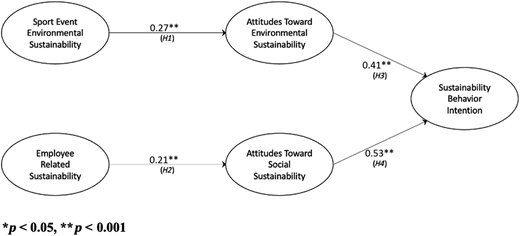
A structural equation model was used to examine the five research hypotheses (Figure 1). The results provided an acceptable fit for the model (2 = 194.52, df = 146, p < 0.001, CFI = 0.98, TLI = 0.97, RMSEA = 0.03). Next, the individual standardized path coefficients were calculated among the variables. The path from sport event environmental sustainability to attitudes toward environmental sustainability (0.27, SE = 0.07, p < 0.001) was positive and statistically significant, supporting H1. The path from employee-related sustainability to attitudes toward social sustainability was also positive and significant (0.21, SE = 0.06, p < 0.001), supporting H2. The paths from attitudes toward environmental sustainability (0.41, SE = 0.04, p < 0.001) and attitudes toward social sustainability (0.53, SE = 0.05, p < 0.001) to sustainability behavior intention were positive and significant, supporting H3 and H4.
Discussion
The purpose of this study was to explore the antecedents that lead to sport employees’ intention to partake in sustainable behaviors at work. This study provided favorable results in ways that sport organizations can assist their employees to be sustainable. Our results showed that H1 was significant in the relationship between sport event environmental sustainability and attitudes toward environmental sustainability. The relationship in H2 was also significant between employee-related sustainability and attitudes toward social sustainability. These results are consistent with prior research by Tarkiainen and Sundqvist (2005), which found that social norms influenced consumers' attitudes toward purchasing organic food.
Our results also support our earlier claim that attitudes and subjective norms influence each other within the TRA. Our findings support the fact that subjective norms are not always isolated but can influence an individual’s attitudes. After developing TRA, Fishbein and Ajzen (1975) acknowledged that subjective norms and attitudes could influence each other, and we are able to support this claim within an organizational context. Thus, the social context that forms subjective norms can in turn influence an individual’s attitudes. The significance of these findings provided evidence in the sport context that there is a connection between the two variables. As a result, sport managers should be considerate of their actions toward environmental and social sustainability because the subjective norms within the organization can influence their employees’ attitudes. This is an important consideration as it relates to organizational outcomes and employee well-being. For example, employees with positive attitudes are more productive and partake in collaborative efforts in the workplace (Gregory et al., 2009).
We found that the relationship between attitude toward environmental sustainability and behavior intention supports H3. We also found the relationship between attitudes toward social sustainability and sustainability behavior intention to significantly support H4. These results support previous studies that found positive attitudes regarding sustainability to predict intentions (Trail and McCullough, 2020, 2021). Based on the TRA (Ajzen and Fishbein, 1977), an individual’s belief (i.e. attitudes, perception) strongly indicates their behavior. In sport management, scholars have utilized the TRA to predict the behavior of sport consumers in various contexts (Breslin et al., 2019; Burak et al., 2013; Yim and Byon, 2021). In the current research setting, we explored how the TRA can be utilized to predict behaviors in the context of sport employees, as found in this study. Additionally, this finding is promising for sport managers who are seeking ways to engage their employees in sustainable behavior. As these behaviors are not required, sport managers now have insight into potential actions that could encourage desired behaviors in their employees.
Theoretical contributions
The results of this study offer ample theoretical advancements within sport management. First, our findings provided a broader understanding of the factors that influence the sustainability behaviors of sport employees beyond employee perceptions in previous studies (e.g. Casper et al., 2012; Babiak and Trendafilova, 2011; Todaro et al., 2023). Similarly, the outcomes of studies involving sport employees have focused on psychological aspects and retaining them within the organization (Kim et al., 2019; Oja et al., 2022; Pack et al., 2007; Taylor et al., 2022). However, sport management research emphasizes non-organizational performance outcomes of sport employees and the behaviors that lead to them. Paek et al. (2022) examined elements that assisted sport employees in exhibiting creative behaviors in the workplace. They found that sport employees' emotional intelligence and job engagement were significant drivers of creative behaviors. We contribute to the literature by focusing on the impact of the work environment on sport employees, such as their perception of their organization, and how it ultimately influences their behaviors. We further broaden the contribution to the literature concerning sustainability by highlighting the role of sport employees in sustainable initiatives within their organization. This initial study measures the sport employees’ sustainability behaviors at work and explores predictors that lead to such behaviors.
Secondly, we advanced the understanding of how to involve sport employees in sustainability activities. Past research has overlooked the contributions of sport employees by emphasizing fans and organizational leadership (Casper et al., 2020; McCullough and Cunningham, 2011; Trail and McCullough, 2021). We provided additional insight to other stakeholders of sport organizations, which can assist them in achieving their sustainability goals. Sport employees are multipliers (i.e. champions) for sustainability in their organizations and can deepen their commitment (McCullough et al., 2018). Additionally, we assessed social and environmental sustainability behaviors that advance the sport management literature. Previous sustainability studies in sport have concentrated on environmental sustainability (Casper et al., 2020; McCullough, 2013; Trail and McCullough, 2020) or social sustainability and sport teams (Vveinhardt et al., 2019) or spectators (McCullough and Trail, 2021).
Third, we examine the interrelationships between constructs within the TRA which were suggested by Fishbein and Ajzen (1975) by demonstrating the influence of attitudes and perceptions. This theory frequently explores attitudes and perceptions as isolated variables disregarding interaction. Previous studies have utilized the connection between norms and attitudes to improve the explanatory power of an individual’s behavior (Chang, 1998; Tarkiainen and Sundqvist, 2005). Our results found that sport employees' attitudes toward sustainability influenced their view on their organization’s sustainability behavior, ultimately impacting their behavioral intentions. Thus, we provide a foundation for future research to explore the interaction of these concepts and how they can lead to behaviors in other areas of sport especially as we consider the influence of the social context, or workplace in this study, on individual’s subjective norms and attitude formation.
Practical implications
The results of this study provide beneficial implications for practitioners in the field of sport management. This work can assist leaders in sport organizations in their pursuit to encourage their employees to engage in sustainability activities at work. Sport managers should reflect on their efforts, as sport employees’ perceptions play a critical role in shaping their behavior. This can be accomplished by developing initiatives that are present throughout their organization and not limited to the gameday experience. For example, if a sport organization places recycling and composting bins in the stadium, it should also support similar programs for its employees in their office spaces. This consistency can encourage their employees to exhibit behaviors and develop champions for sustainability in their organization. Additionally, sport employees are observant of the actions of their organizations which we found can contribute to their behaviors. Matching programs from an internal and external perspective can encourage deeper buy-in from all stakeholder groups and help advance these programs in the future (McCullough et al., 2018).
Limitations and future directions
The focus on college administration sport employees for participants is a limitation of this study. While sustainability efforts are sprouting in these athletic departments, the attention is still in its infancy stage and yet to mature throughout many Divisions in the NCAA (Pelcher et al., 2021). As a result, sport employees may have limited exposure to their athletic departments’ actions toward sustainability. Yet, this factor provides an insightful opportunity for future studies to examine additional leagues (i.e. professional, international and nonprofit). Other sectors within the sport organization have emphasized sustainability efforts and established sustainability efforts within their organizations. This could be accomplished by completing an individual case study to better understand how sustainability efforts are prioritized throughout the organization. Additionally, our sample was predominantly white (approximately 80%), which may have influenced research participants’ perceptions and attitudes toward environmental sustainability within the current research model. Although this racial composition may reflect the broader demographic profile of sport employees, it nonetheless limits the generalizability of the findings. For future research, it would be meaningful to consider more diverse populations by utilizing purposive sampling to better capture the viewpoints of underrepresented groups.
As leadership in sport organizations develop various initiatives to improve efficacy in the workplace, it highlights the importance of seeking alternative approaches to engage the workforce. This study suggests a critical aspect of employees’ attitudes and their impact on their behaviors. As a result, future studies can examine additional workplace behaviors such as organizational pride, organizational citizenship behavior and innovative work behaviors. Furthermore, although behavioral intentions are strong predictors of actual behavior, they are limited in explaining the majority of variance in behavior (Conner and Norman, 2022). This presents an opportunity for future studies to gather data on the actual sustainability behaviors of sport employees. Additionally, future research could examine the organizational outcomes from multiple sustainability perspectives in a longitudinal study to exhibit the long-term impacts and fluctuations of employees’ responses and influences of initiatives throughout the year (i.e. pre-season, during-season, off-season).
Conclusion
Amid the United Nations' encouragement of organizations to implement sustainability practices, employee engagement is key to achieving their goals. We created and tested a hypothesized model to expand the understanding of sport employees’ sustainability behaviors in collegiate athletics departments. Sport event environmental sustainability and employee-related sustainability initiatives were predictors of attitudes toward environmental sustainability and social sustainability respectability. From there, these factors improved sport employees’ intention to partake in sustainable behavior at work. This study’s result creates an understanding of how to improve sport employees’ attitudes and how to support their involvement in sustainability initiatives.