This study examines how the relationship between uncertainty and performance varies across levels of organizational status. Specifically, it analyzes how status conditions the relationship between two distinct sources of uncertainty – firm-specific uncertainty arising from a firm's own production processes and partner-specific uncertainty originating from key external partners – and organizational performance.
The study draws on an unbalanced panel of Formula One constructors competing between 1993 and 1999. Using detailed race-level data, the analysis employs high-dimensional fixed-effects regression models to examine how status interacts with firm- and partner-specific uncertainty. Additional event-history analyses provide suggestive evidence regarding the underlying mechanisms of search behavior and access to resource quality.
The results indicate that status plays a dual role in the relationship between uncertainty and performance. High-status firms exhibit lower performance than low-status firms under conditions of firm-specific uncertainty, consistent with reduced problemistic search and weaker development of integration capabilities. In contrast, high-status firms exhibit higher performance under conditions of partner-specific uncertainty, consistent with exchange partners being more selective in their favor during such periods.
This study contributes to the literature by distinguishing between firm- and partner-specific uncertainty and demonstrating that organizational status differentially moderates their relationship with performance. By integrating behavioral theory of the firm with status-based theories of markets, the paper offers a more nuanced understanding of how organizations respond to uncertainty in competitive environments.
Introduction
The last few years have witnessed the resurgence of a central tenet of strategy and organizational theory: uncertainty (Alvarez et al., 2018; Bettis and Blettner, 2020). In general terms, uncertainty can be defined as decision-makers’ lack of knowledge about the possible outcomes of their decisions and their probabilities (Knight, 1921). Among the different aspects in which such uncertainty can play a role, a particularly relevant one is a poor understanding of the relationships of cause and effect in a firm's activities (Lippman and Rumelt, 1982). The presence of such uncertainty, especially in complex systems (Simon and Cilliers, 2005), is one of the main factors that makes it difficult, if not impossible, to identify a firm's determinant of performance (Lippman and Rumelt, 1982). This is because “Uncertainty in the creation of new production functions is most likely to come about because there is ambiguity as to what the factors of production actually are and as how they interact” (Rumelt, 1997, p 136). From this perspective, uncertainty regarding the new production function can be decomposed into two. The first concerns how the sources of production interact, and the second concerns the factors of production that must interact. Insofar as firms obtain their factors of production from suppliers that also face the same uncertainty about the creation of a new production function, a focal firm will face two distinct types of uncertainty. The first is firm-specific and reflects a firm's ambiguity about how to transform its inputs into outputs. The second is partner-specific and reflects the supplier's ambiguity on how to transform its inputs into outputs. Given that uncertainty makes it more difficult to identify the determinants of performance, firms seek to avoid it (Cyert and March, 1963) by, for instance, accumulating experience that helps them better understand cause-effect relationships in firms' activities (Argote and Epple, 1990). Along this line, research on the behavioral theory of the firm has shown that firms exposed to negative performance feedback engage in problemistic search that might lead to learning and, consequently, to a better understanding of such cause-effect relationships in firms' activities (Greve, 2003; Argote and Greve, 2007). Nevertheless, it has been argued that isolating mechanisms can make a firm's competitive position more stable and defensible (Rumelt, 1997), thereby making firms more or less sensitive to the need for uncertainty reduction.
One possible source of isolation is a firm's position in a status hierarchy (Podolny, 1993). Since Merton's (1968) early work on the Matthew effect, showing that higher-status scientists enjoy greater recognition and rewards for a given level of quality of their work, research on status-based models of markets has focused on the benefits accruing to high-status firms (for a review, see Piazza and Castellucci, 2014). Among these benefits, high-status firms enjoy greater access to information and resources, as well as priority in selecting exchange partners (Podolny, 2005; Sauder et al., 2012; Prato et al., 2024). These advantages, however, can be considered a double-edged sword. If, on the one hand, they isolate firms from competition, on the other hand, such isolation might prevent firms from learning (Barnett and Hansen, 1996; Barnett and Pontikes, 2008).
In this manuscript, I argue that, because of their greater access to information and resources, high-status firms are more likely to receive higher-quality production factors from external partners. Because the overall quality of a product depends on both the quality of production factors and a firm's ability to integrate them (Sanchez and Mahoney, 1996), firms with access to superior resources may experience less negative performance feedback and may consequently engage in less problemistic search. As a result, high-status firms may be less likely to develop capabilities for integrating and transforming inputs into outputs effectively. Accordingly, the relationship between firm-specific uncertainty and performance is expected to become more negative as firm status increases.
On the other hand, high-status firms are more likely to secure higher-quality partners or more favorable conditions from partners facing similar levels of partner-specific uncertainty than their lower-status counterparts. As a result, the relationship between partner-specific uncertainty and performance is expected to become more positive as firm status increases.
Using a sample of Formula One constructors and their engine suppliers, I test and find support for these two hypotheses. In this setting, the theoretical constructs correspond to observable features of the production process. Firm-specific uncertainty arises from new car designs that require constructors to integrate interdependent components under imperfect knowledge. Partner-specific uncertainty stems from externally supplied engines, whose performance and fit with the focal car are not fully known ex ante. Finally, status reflects a constructor's relative market standing and is associated with differences in access to resources and relationships with suppliers. This setting therefore provides an appropriate context for examining how the relationship between these two sources of uncertainty and performance varies across firms occupying different positions in the status hierarchy.
Theory and hypotheses
Since the seminal work of Cyert and March (1963), which treats uncertainty avoidance as a core element of the behavioral theory of the firm, research has generally assumed that organizations act to control uncertainty. Under uncertainty, decision makers do not know either the outcomes of their decisions or the probabilities of those outcomes occurring when a decision is made (Knight, 1921). Accordingly, firms seek to avoid uncertainty because it makes it difficult, or even impossible, to determine the factors that produce performance (Lippman and Rumelt, 1982).
Research on learning curves (Lieberman, 1987; Argote and Epple, 1990), on adaptation (Barnett et al., 1994; Gavetti and Levinthal, 2000) and on performance feedback (Greve, 2003) shows that as firms accumulate experience on a technology and learn by collecting and interpreting information, both outcomes and their probabilities become better defined. As uncertainty is reduced, the determinants of performance become clearer. Uncertainty thus impairs a firm's ability to identify the drivers of its performance, but experience and learning can mitigate this effect.
To better understand the link between uncertainty and performance, we must specify which types of uncertainty are at stake and how firms experience them (Argote, 1982). Rumelt (1997) explains differences in rates of return among firms in the same industry as arising from resource heterogeneity that firms endogenously create under uncertain production functions. This uncertainty arises “because there is ambiguity as to what the factors of production actually are and as how they interact” (Rumelt, 1997, p. 135). A firm's ability to extract rents thus depends on uncertainty regarding both its factors of production and their interactions – including uncertainty surrounding resource suppliers and the integration of their inputs.
In a product's overall production process, the first step is to develop a product architecture by “applying existing knowledge and creating new knowledge about components and their interactions” (Sanchez and Mahoney, 1996, p. 68). Insofar as knowledge of components and interactions may be inadequate, firms may face uncertainty about how to both create components and integrate them effectively. Learning by experimentation may reduce this uncertainty and improve productivity and product architecture (Henderson and Clark, 1990; Baldwin and Clark, 2006). After the architecture is defined, uncertainty may also affect manufacturing. There may be ambiguity about how to convert inputs into outputs due to the complexity and interdependence of components (Rumelt, 1997). Products are typically complex systems assembled from interdependent components, often sourced from external partners. Therefore, final performance depends on two capabilities: acquiring high-quality components from suppliers and integrating them effectively (Sanchez and Mahoney, 1996; Simon and Cilliers, 2005).
Accordingly, a focal firm faces two sets of uncertainty. The first is its own uncertainty about how best to convert inputs into outputs and integrate them into the final product. The second is the supplier's uncertainty about how best to convert its inputs into outputs, thereby providing components of varying quality. Experimentation may reduce uncertainty in both conversion processes (Fiol and Lyles, 1985; Argote and Miron-Spektor, 2011). I refer to uncertainty in the focal firm's own conversion process as firm-specific uncertainty, and to uncertainty in suppliers' conversion processes as partner-specific uncertainty. The core question of this manuscript is whether the relationship between these two forms of uncertainty and performance varies across firms occupying different positions in a status hierarchy.
Uncertainty is central in status-based theories of markets. Podolny (2001) distinguishes between altercentric and egocentric uncertainty. Altercentric uncertainty is the uncertainty that potential exchange partners, consumers or suppliers have about the quality of the focal firm's offerings. Status primarily serves as a market signal under conditions of such uncertainty; if quality were fully observable, partners could simply choose the best product and status would be irrelevant (Podolny, 1993). Under altercentric uncertainty, status hierarchies form (Podolny, 1993), tend to crystallize (Podolny, 2005) and confer benefits on firms perceived as at the top of this hierarchy (for a review, see Sauder et al., 2012; Piazza and Castellucci, 2014). Among the different benefits associated with a high-status position, insofar as status is transferred through association (Podolny and Phillips, 1996), high-status firms have first choice of exchange partners, as such partners seek association with high-status firms to benefit from status transfer.
Egocentric uncertainty, by contrast, is “a focal actor's uncertainty regarding the best way to convert a set of inputs to an output desired by a potential exchange partner” (Podolny, 2001, p. 33). It concerns how firms allocate resources to identify and exploit market opportunities, such as an automobile manufacturer's uncertainty about supplier relationships and production choices.
Both firm-specific and partner-specific uncertainty are forms of egocentric uncertainty: the former concerns the focal firm's own conversion of inputs into outputs, and the latter concerns the supplier's conversion. This manuscript focuses on these two types of egocentric uncertainty, while assuming the presence of altercentric uncertainty to explain how status differences shape competitive positions and, in turn, condition the relationship between these uncertainties and performance.
Firm-specific uncertainty
Although firm-specific uncertainty can arise from internal (e.g. Konrad and Pfeffer, 1990; Haunschild, 1994; Henisz and Delios, 2001) or external (e.g. Williamson, 1981; Palmer, 1983) sources, its defining characteristic is that it is uniquely experienced by the firm. Firm-specific uncertainty stems from an imperfect understanding of the structure and direction of cause-effect relations underlying core internal processes of production (Cohen et al., 1972). Organizations may vary in their understanding of their production processes and technologies, thereby being uncertain about how best to use their technology, people and materials (Cyert and March, 1963).
The analytical issue of concern is whether the relationship between firm-specific uncertainty and performance varies across firms occupying different positions within a status hierarchy. Status-based models of market competition rest on the observation that potential exchange partners prefer to affiliate with high-status actors rather than low-status ones (Podolny, 1993; Gould, 2002), thereby granting high-status firms enhanced access to information and resources, and better positioning them to evaluate the quality of potential partners (Huber, 1991; Rao, 1998; Stuart et al., 1999; Rao et al., 2001). Superior access to resources also grants high-status actors a larger pool of potential partners from which to choose than lower-status actors (Greve et al., 2014). As a result, high-status firms should be better able to act on any additional information they might have by selecting higher-quality partners (Benjamin and Podolny, 1999). Because both the quantity and quality of resources exchanged directly affect the quality of the final products (Barney, 1991; Moran and Ghoshal, 1999), high-status firms, ceteris paribus, tend to manufacture higher-quality products (Simcoe and Waguespack, 2011).
Yet final product quality also depends on firms' ability to integrate these resources (Rumelt, 1997). Insofar as there is uncertainty about the cause-effect relationship in converting inputs into outputs, integrating resources from external suppliers may not enable a firm to produce the best possible product. Experimentation and learning may enable firms to develop the knowledge necessary to reduce such uncertainty (Fiol and Lyles, 1985; Argote and Miron-Spektor, 2011). The behavioral theory of the firm (Cyert and March, 1963) suggests that firms are problemistic searchers that engage in search behavior when confronted by adverse stimuli (Greve, 2003), and satisficers that search for alternatives until performance reaches a satisfactory level (Winter, 2000). They extend their search locus in response to environmental feedback: the less adverse the feedback, the more local the search. Firms begin by examining alternatives near the current solution; if performance remains unsatisfactory, they move to more distant alternatives (Barnett and Sorenson, 2002). More generally, when a product that integrates available resources provides negative performance feedback, firms seek new ways to integrate those resources, beginning with alternatives that are not distant from the current solution. If local alternatives are still unsatisfactory, the search for alternative ways to integrate the resources will move farther from the original until a satisfactory solution is found. As the search moves away from the original solution, the likelihood of finding a global optimum rather than a local one increases (Levinthal, 1997), thereby increasing the probability that a firm will identify a superior way to integrate available resources.
All else equal, because products manufactured with higher-quality resources are of higher quality, high-status firms are likely to encounter fewer problems and less adverse feedback from the environment than their low-status counterparts. Consequently, they may engage in fewer and less extensive search processes into how to integrate their inputs into outputs. Castellucci and Podolny (2017) showed that high-status firms are generally worse at integrating resources obtained from their exchange partners than their lower-status counterparts. As firm-specific uncertainty increases, firms may become less effective at integrating resources into a final product. Yet by using higher-quality resources, high-status firms will, on average, produce higher-quality final products, not because they have greater integrative capacity but because they have greater access to superior resources. By achieving satisfactory product performance more often, they are more likely to trigger fewer – and mainly local – search processes and are therefore less likely to develop strong capabilities for integrating resources from external suppliers.
Conversely, by building their products on lower-quality resources, low-status firms are more likely to face more frequent and adverse performance problems, triggering increasingly distant searches that help them learn to better convert inputs into outputs. Because performance depends on both the quality of the resources used and the ability to integrate them (Rumelt, 1997), reduced ability to integrate external components into the final product negatively affects performance (Marino et al., 2015). Following this line of thought, it is possible to hypothesize:
The relationship between firm-specific uncertainty and performance will become more negative as firm status increases.
Partner-specific uncertainty
Partners in competitive markets have incentives to reduce their own uncertainty to provide reliable products and avoid losing business. The key question is whether partners are more inclined to act in favor of high-status firms than low-status ones. Prior work suggests that partner firms “proffer generous financial terms and/or access to promising development-stage technologies to entice a high-status firm into an exchange relation” (Stuart, 1998, p. 675) and that discounted offers are more likely to be accepted by entrepreneurial start-ups when they come from reputable venture capitalists (Hsu, 2004). Empirically, Castellucci and Ertug (2010) show that high-status firms are more likely than low-status firms to obtain greater effort from an exchange partner. Taken together, these findings suggest that actors with high prestige, good reputation or high-status are more likely to receive greater partner effort to reduce partner-specific uncertainty.
Given that status hierarchies develop by observing both a firm's past demonstrations of quality and the status of its affiliates (Podolny and Phillips, 1996; Rindova et al., 2006), patterns of affiliations convey status (Stuart, 2000) by acting as endorsements of partner quality (Stuart et al., 1999). Interrupting a relationship with a high-status firm entails a loss of endorsement, so partners are more motivated to reduce uncertainty in favor of a high-status firm than a low-status one.
Two observations follow. First, as partners reduce uncertainty surrounding their core production processes, all connected firms could, in principle, benefit. However, partners may selectively act on this knowledge, favoring only high-status firms. Unless what is exchanged is standardized or modular (Ethiraj and Levinthal, 2004a, b; Pil and Cohen, 2006), each resource must be specifically integrated into the focal firm's product and less-than-optimal integration reduces system performance (Simon and Cilliers, 2005). Thus, even if reduced uncertainty could benefit all firms, partners may use it to tailor resources primarily to high-status firms. Second, this argument applies not only when the focal firm is higher in status than its partner, but also when both are high-status. As the status differential between a focal firm and its exchange partner increases, partners are more likely to attend to the needs of the higher-status focal firm (Castellucci and Ertug, 2010), strengthening incentives in favor of the high-status focal firm. Nevertheless, Thye (2000) shows experimentally that high-status actors are both more actively sought after and enjoy more favorable exchange conditions not only when partners are lower status but also when they are of equal status. Even high-status partners thus prefer high-status focal firms over low-status ones. This may reflect not only perceptions of higher quality (Thye, 2000), but also a rational concern that high-status partners can be damaged if a high-status focal firm drops them in favor of a competitor. Along these lines, Baum and colleagues (2005) argue that high-status firms may discontinue their preferred high-status partners in favor of unknown ones when they underperform on market or status outcomes, and Guler (2007) shows that high-status firms, facing less normative pressure to maintain relationships, are more likely than low-status firms to terminate exchanges. High-status firms may therefore be more sensitive to their partners' performance and exert greater pressure on them, knowing they can be more easily replaced. Such replacement entails not only a loss of business but also a negative signal that the partner no longer possesses the requisite quality to be associated with another high-status firm. Since status is transferred through affiliations (Podolny and Phillips, 1996), the disruption of an affiliation with a high-status focal firm can damage the partner's status. Thus, even high-status partners have incentives to selectively act in favor of high-status firms to maintain the endorsement these relationships confer. As partners selectively act for high-status firms in reducing uncertainty, I hypothesize:
The relationship between partner-specific uncertainty and performance will become more positive as firm status increases.
Research design and methods
These two hypotheses are examined by analyzing whether the relationships between firm-specific and partner-specific uncertainty and performance vary across firms occupying different positions in the status hierarchy for all Formula One Constructors (as firms in this industry are formally known) that competed between 1993 and 1999. Since the inaugural race in 1950, Formula One (F1) has been governed by the Fédération Internationale de l’Automobile (FIA), which sets the technical and sporting regulations – the “formula” – that all constructors and cars must satisfy to compete. Each F1 World Championship season comprises a series of Grands Prix in which every constructor enters two cars. Points earned by these cars count toward both the Drivers' and Constructors' Championships.
Several characteristics of F1 make it especially appropriate for testing the proposed hypotheses. First, F1 is an intensely competitive environment in which constructors strive for the highest possible standing in each race and across each racing season (Aversa et al., 2015). The context also provides precise measures of performance across constructors: all cars compete on the same tracks under identical conditions, subject to the same regulations and within a uniform points system, so performance outcomes are transparent and directly comparable.
Second, acts of deference (Podolny, 1993) and the associated status dynamics are salient features of the industry. High-status constructors attract greater attention from external partners seeking affiliation and routinely secure more lucrative sponsorship agreements. They are also rated higher in quality by industry experts, even after controlling for performance (Castellucci and Ertug, 2010). In this setting, status hierarchies may originate from historical performance differences, yet they tend to persist. Consequently, even when a lower-status constructor attains on-track performance equivalent to that of a higher-status rival, the higher-status constructor is more likely to attract superior sponsorships, enjoy greater access to resources and exchange partners and continue to be perceived as delivering higher-quality outputs. These enduring positional disparities closely mirror the distinctions between high- and low-status scientists described in Merton's (1968) articulation of the Matthew Effect, as well as the market-level dynamics identified by Podolny (2005).
Third, unlike many other forms of motorsport – such as NASCAR, where firms typically assemble cars from components leased or purchased from a small set of suppliers – only firms that design, construct and race their own chassis are eligible to compete in F1. Competitive pressures compel constructors to redesign their cars frequently and each redesign introduces uncertainty regarding how the newly designed model will perform under actual racing conditions. Although constructors must design and manufacture their chassis, they may outsource other components. It is common to purchase engines from external suppliers that provide engines to multiple constructors. While thousands of components influence performance, the engine is arguably the most consequential, as it directly affects weight distribution, speed, handling and competitive outcomes. Engine suppliers also engage in periodic redesigns, generating uncertainty about how new engines will perform on the racetrack.
Fourth, the 1993–1999 period provides an ideal empirical setting because it captures a coherent technological regime in F1 while incorporating significant exogenous variation in design constraints. Before this period, the 1989 mandate banning turbocharged engines represented a major technological transition, establishing a stable baseline for naturally aspirated engine development. Throughout the sample window, key regulatory changes – most notably the 1994 prohibition on driver electronic aids and the 1998 revisions to car design and tire specifications – brought about discrete, system-wide disruptions to established design routines (see Judde et al., 2013). These interventions were associated with higher levels of technological uncertainty by altering how constructors integrate components and how suppliers adapt their technologies, thereby affecting both firm- and partner-specific uncertainties. Importantly, despite these disruptions, the overall competitive structure remained stable, ensuring meaningful comparability across seasons and the interpretability of the analysis.
The general-level hypotheses are translated into the empirical context as follows. In F1, both sources of uncertainty are tied to the introduction of new designs and decline as experience accumulates over time. Firm-specific uncertainty pertains to the constructor and arises when a new chassis is introduced, as the constructor has limited knowledge of how to integrate multiple interdependent components into a racing car. As the constructor gains experience with the design, this uncertainty decreases. Partner-specific uncertainty pertains to the engine supplier and is highest when a new engine design is introduced. This uncertainty declines as the engine supplier gains experience with the design and as integration with the constructor's chassis improves. Partner-specific uncertainty is therefore captured by the time elapsed since the introduction of a new engine design. Both measures of uncertainty are rescaled so that higher values indicate greater uncertainty. Within this framework, Hypothesis 1 predicts that the relationship between the rescaled measure of time since the introduction of a new chassis design and performance becomes more negative as status increases, while Hypothesis 2 predicts that the relationship between the rescaled measure of time since the introduction of a new engine design and performance becomes more positive as status increases.
During the period covered by this study, 16 races were held each year, except in 1995 and 1997, when 17 races took place. The number of competing constructors varied: 13 in 1993; 14 in 1994 and 1995; 11 in 1996, 1998 and 1999; and 12 in 1997, with each constructor entering two cars per race. Constructors that manufactured their own engines (e.g. Ferrari) were excluded from the sample, as the focal firm–supplier relationship cannot be examined in such cases.
The resulting dataset constitutes an unbalanced panel comprising 1,115 constructor-race observations across 114 races and 22 constructors. Data were collected from Autocourse, Who Works in Formula One and the official F1 Website (formula1.com).
Dependent variable
Firm performance. The dependent variable is the final performance of a constructor in a race, measured as the average position of its two cars, as reported by the official FIA report. If a car did not finish, it is assigned the ranking of the last-listed car plus 1. Because better positions correspond to smaller numbers, I transformed this measure by subtracting the average constructor rank from the highest possible average rank in each race. Larger values thus indicate higher performance, simplifying the interpretation of the coefficients.
Independent variables
Firm-specific uncertainty. The introduction of a new F1 racecar begins with a design stage that leverages existing and emerging design concepts within FIA regulations, resulting in a specific design. Operating across racetracks with differing speeds, corners and weather characteristics, constructors aim to optimally integrate components. Regardless of the amount of technology used to both design it and virtually simulate its behavior, there is always a “discrepancy between the” newly designed “car's predicted performance (…) and its behavior on the track” (formula1.com, 2007a). Innovative concepts, necessary to be competitive, “by nature cannot be immediately under control” (formula1.com, 2007b). Newly designed cars, therefore, tend to perform worse at introduction than improved prior models. Over time, through testing and racing, constructors accumulate knowledge of the new car's behavior, which reduces this uncertainty. Consequently, the uncertainty about how best to integrate the different components in a new car design is expected to be higher at introduction and to decline over time as the constructor learns its true behavior on the racetrack. Accordingly, firm-specific uncertainty is measured as the number of days since the introduction of a new car design.
Each constructor uses a specific chassis code for a new design, followed by additional codes for evolutions. For example, Williams introduced the FW16 chassis in the first race of 1994 and the FW16/B in the ninth race. This evolution is not counted as a new design. A new design is recorded only when the chassis code changes (e.g. FW17). In the sample, there are 100 new car designs. To ease interpretation, I divided the number of days since introduction by the maximum observed value and subtracted it from 1. The variable ranges from 0 (lowest uncertainty) to 1 (highest uncertainty). In interaction with the status variable, firm-specific uncertainty is used to test hypothesis H1.
Partner-specific uncertainty. Engine suppliers follow a similar development process. Although they aim for reliability and high performance, new engines also exhibit uncertain behavior on track. While the engine supplier gathers information to reduce uncertainty, it also acts on that information to optimize the engine for the car's needs where it is installed. Given that there is always a degree of adaptation of the engine to the car in which it is installed (formula1.com, 2005), engine suppliers might act on the additional information to optimize the adaptation of the engine only for high-status constructors. This is where advantages associated with high-status firms may emerge relative to their lower-status counterparts.
Partner-specific uncertainty is measured as the number of days since the introduction of a new engine design. Each engine design has a specific code, with additional codes for evolutions. For instance, Tyrrell used the Yamaha OX10 A in 1993 and the modified OX10 C in 1995; this evolution is not counted as a new design. A new design is recorded when the engine code changes (e.g. OX11 A in 1996). There are 85 new engine designs in the sample. For ease of interpretation, I divided the number of days since introduction by the maximum observed value and subtracted the result from 1, so the resulting variable ranges from 0 (lowest uncertainty) to 1 (highest uncertainty). In interaction with the status variable, partner-specific uncertainty is used to test hypothesis H2.
Status. Status-based market research shows that higher-status actors receive greater rewards for a given level of performance (Piazza and Castellucci, 2014; Prato et al., 2024), as in Merton's (1968) work on Nobel laureates, who are granted more credit for their co-authored work or in Podolny's (1993) study of investment banks. By analogy, at a given performance level, high-status F1 constructors should receive greater media attention. Following Castellucci and Ertug (2010) and Shen et al. (2014), I construct a residualized status measure. I first count the number of Factiva articles published in each year of the sample (starting from 1992) in which the constructor's name appears, and either the header or lead paragraph contains “Formula One.” I then regress these counts, in yearly cross-sections, on the total points scored. Status is measured by the residuals from these regressions, standardized annually (mean 0, standard deviation 1) and lagged by one year. The correlation between status at t and t−1 is 0.54 (p < 0.000), indicating persistence in status ordering even when performance is observable. This variable, interacted with firm- and partner-specific uncertainty, is used to test both hypotheses H1 and H2.
As reported by Castellucci and Ertug (2010), this status measure does not directly gauge deference (Podolny, 1993; Benjamin and Podolny, 1999), legacy (Washington and Zajac, 2005) or evaluations by external stakeholders (Phillips and Zuckerman, 2001) but captures a manifestation of these constructs. Nevertheless, this measure was used because it has been validated in prior research (Castellucci and Ertug, 2010; Shen et al., 2014; Castellucci and Podolny, 2017).
Table 1 illustrates the distinction between performance and status for 1996: for example, Benetton ranked third in points but last in status, while McLaren ranked first in status despite finishing fourth in points, having scored fewer points than Benetton.
Because the status measure is based on media attention, a potential concern is that it may reflect episodic, team-specific events – such as high-profile accidents, driver changes or exceptional performances – that generate temporary spikes in coverage and in the status measure. To address this issue, it is important to note that the status measure is constructed using cross-sectional regressions estimated separately for each year, capturing variation in media attention relative to other constructors within the same season, net of performance. As a result, common year-specific shocks are accounted for within each cross-section. To further ensure that the results are not driven by extreme observations that may reflect such episodic shocks, I tested the hypotheses by re-estimating the models after winsorizing the status measure at both the 1st–99th and 5th–95th percentiles within the estimation sample. The results remain substantively unchanged across specifications, indicating that the findings are not driven by short-term media fluctuations but instead capture more systematic differences in status across constructors.
Control variables
As control variables, I include the lagged constructor performance during the previous race (Lagged Firm Performance). Moreover, I include Partner quality, measured as the average championship points scored by all constructors using the supplier in the previous season, and Collaboration, an indicator equal to 1 if there is a contractual relationship under which the supplier develops or provides top-specification engines for the focal constructor while providing off-the-shelf engines to others. I also control for Partner status, measured as the mean status of the constructors supplied by the partner in the previous season (Stuart et al., 1999; Castellucci and Ertug, 2010), and for the Number of firms supplied, measured as the number of constructors receiving engines from the supplier in the current season. I also control for the driver's contribution to performance. Because all constructors race with two cars, driver-level variables are averaged across the constructors' drivers; I thus control for Driver age, measured in years.
To estimate how status and technical uncertainty jointly shape constructor performance, I employ a high-dimensional fixed-effects regression model using reghdfe in Stata 19. The model absorbs year × round, firm and engine-supplier fixed effects to control for unobserved heterogeneity at these levels, ensuring identification from within-constructor variation across races and uncertainty conditions. Including the lagged dependent variable in this framework captures performance dynamics while maintaining identification of the status–uncertainty relationships. I use robust standard errors to account for remaining unobserved heterogeneity (Baetschmann et al., 2011). Accordingly, the empirical estimates should be interpreted as conditional associations consistent with the proposed theoretical mechanisms rather than definitive causal effects.
Results
Table 2 reports descriptive statistics and the correlation matrix for the study variables. Although multicollinearity should not be a concern, I checked the Variance Inflation Factor after centering the two uncertainty variables on their means (Cronbach, 1987). The maximum value was 2.95, and the mean was 1.59, well below the recommended value of 10 (Fox, 1991; Kennedy, 1998). Because the results were identical across models using centered and uncentered variables, I report only results for the full sample with uncentered variables.
In Table 3, Models 1–5 present regression results with race ranking as the performance measure, including fixed effects. Model 1 is the baseline model, including only the control variables. It is worth noting the positive and significant coefficients for Collaboration (p < 0.05), Number of firms supplied (p < 0.05) and Driver age (p < 0.05). Model 2 adds the independent variables, namely firm-specific and partner-specific uncertainty and status. Although the main effects are not statistically significant, this pattern suggests that the relationships between status, uncertainty and performance may be conditional rather than additive, a possibility assessed by including interaction terms in the next specification.
Model 3 adds to Model 2 the interaction between firm-specific uncertainty and status whose coefficient is negative and statistically significant (p < 0.05), supporting Hypothesis 1. This result indicates that the relationship between firm-specific uncertainty and performance becomes more negative for high-status constructors than for low-status constructors. Model 4 adds to Model 2 the interaction between status and partner-specific uncertainty. The coefficient on this interaction is positive and statistically significant (p < 0.05), supporting Hypothesis 2. This finding suggests that the relationship between partner-specific uncertainty and performance becomes more positive for high-status constructors than for low-status constructors. Model 5 is the full model that adds both interaction terms to Model 2. The interaction between status and firm-specific uncertainty remains negative and significant (p < 0.01), and the interaction between status and partner-specific uncertainty remains positive and significant (p < 0.01). These results, supporting both hypotheses H1 and H2, indicate that the relationship between uncertainty and performance differs systematically across constructors depending on both the source of uncertainty and their position in the status hierarchy.
Table 3 also includes Models 6 and 7 as a robustness assessment, estimating the full specification using the average grid position from qualifying rather than the average final race position and the average best speed obtained in qualifying, respectively. Qualifying performance reflects underlying constructor capability while being less exposed to idiosyncratic race shocks such as collisions, mechanical failures or safety-car interventions. Although final race results remain the ultimate indicator of competitive success, qualifying outcomes serve as a cleaner benchmark. The results from Models 6 and 7 closely align with those from Model 5: the key interaction terms remain significant and in the theorized direction, supporting the robustness of the observed status–uncertainty relationships across performance measures.
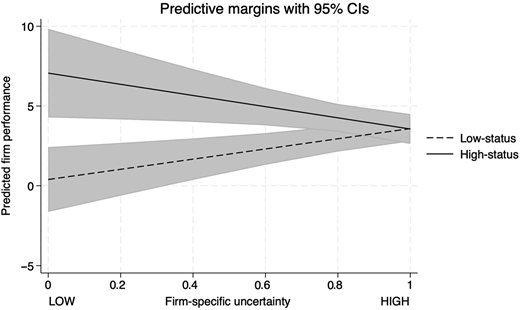
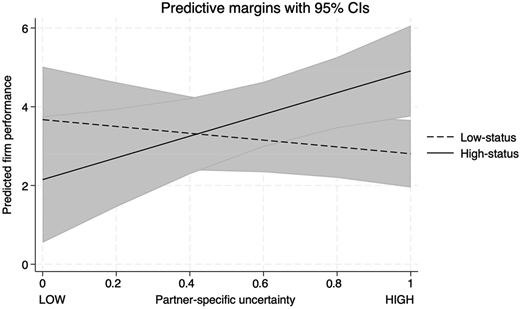
To further assess the substantive implications of the results, I computed marginal effects for both sources of uncertainty at different levels of firm status using the coefficients of Model 5. Specifically, I estimated predicted performance for low-status firms (one standard deviation below the mean) and high-status firms (one standard deviation above the mean) across the observed range of both firm-specific and partner-specific uncertainty. The predicted effects are presented in Figures 1 and 2.
Figure 1 shows how firm-specific uncertainty affects high- and low-status firms differently. High-status firms perform best when uncertainty is minimal, with a predicted performance of about 7.08, but their performance declines steadily as uncertainty increases, falling to roughly 3.55 at the maximum level. Low-status firms show the opposite pattern, with predicted performance increasing from about 0.38 at minimal uncertainty to 3.58 at the highest level. As a result, the performance gap between high- and low-status firms narrows substantially and effectively disappears at high levels of firm-specific uncertainty, consistent with the argument that high-status firms may be less effective at adapting to firm-specific uncertainty.
Figure 2 presents the corresponding analysis for partner-specific uncertainty. As uncertainty increases, predicted performance declines for low-status firms, from approximately 3.67 to 2.81, while it increases for high-status firms, from roughly 2.14 to 4.91. This pattern indicates that the relationship between partner-specific uncertainty and performance differs across status levels, with it becoming more positive for high-status firms than for low-status firms. Although the confidence intervals overlap across part of the range, indicating that differences in predicted performance at specific levels of uncertainty are not always statistically distinguishable, formal tests of marginal effects show that the effect of partner-specific uncertainty is positive and statistically significant for high-status firms (β = 2.76, p < 0.05) but not for low-status firms (β = −0.87, n.s.). Importantly, the difference in slopes across status levels is statistically significant (Δ = 3.62, p < 0.01), indicating that the relationship between partner-specific uncertainty and performance is significantly more positive for high-status firms. Accordingly, Figure 2 should be interpreted as illustrating differences in slopes rather than a clear separation in performance levels.
Additional analyses
Two mechanisms suggested in the theory need to be empirically explored: (1) high-status firms are worse at developing capabilities to integrate their resources because they search less; (2) high-status firms have, on average, access to better resources. I tested these mechanisms using two sets of models, each employing event history analysis (Tuma and Hannan, 1984) to estimate the hazard rate for either chassis modifications or engine failures. Given that both are repeated events, I modeled the event histories as conditional risk-set models (Prentice et al., 1981). For chassis modification, each observation is a constructor, and the duration of the spells extends from the introduction of a new car design to the introduction of a car modification (25 such events, coded by the FIA) or to the data-censoring time. For engine failures, each observation is a constructor, and the spell duration extends from the introduction of a new engine design to the retirement of a car from a race due to engine failure or to the data-censoring time. At the end of each race, the FIA reports the reason for a car's non-finish, thereby enabling the coding of events related to engine failures (198 in the sample). I used a piecewise exponential specification, assuming baseline rates are constant within the racing season but can vary over time. Each spell was split at every race to allow for time-varying covariates. As covariates, I included Lagged constructor average rank performance (not reversed), Partner quality, Driver quality (sum of championship points scored by the driver in the previous season), Partner status, Constructor status and the indicator variable New engine modification, taking the value 1 if the constructor raced with a modified version of the current engine design and 0 otherwise.
Model 8 in Table 4 reports the coefficients for the survival analysis of chassis redesign. The analysis provides suggestive evidence regarding whether high-status constructors conduct more searches, defined as modifications to the current car design. The coefficients show positive and significant results for constructors that performed worse in the previous race (p < 0.001), whose partner is of higher status (p < 0.001), and for new engine modifications (p < 0.05). On the other hand, there is a negative and significant coefficient for partners of higher quality (p < 0.05) and for drivers of higher quality (p < 0.001). It is noteworthy that the coefficient for the constructor status is negative and significant (p < 0.001). An increase of one standard deviation of status (=1) reduces the hazard rate of having a new car modification by 0.082 = exp (−2.501). Insofar as redesigning a car entails improving the integration of available inputs and resources, this result is consistent with the idea that high-status constructors engage in less search.
Model 9 in Table 4 reports the coefficients for the survival analysis of engine failures. The analysis provides suggestive evidence regarding whether high-status constructors have access to higher-quality resources. Because it is difficult to disentangle the effects of the different elements that contribute to performance, an alternative for evaluating engine supplier quality is to observe engine failures during a race. The coefficients show positive and significant effects for constructors that performed worse in the previous race (p < 0.001) and whose partner is of higher status (p < 0.001). There is a negative and significant coefficient for partners of higher quality (p < 0.001) and for drivers of higher quality (p < 0.001). Constructor status has a significant negative effect (p < 0.001): an increase of one standard deviation of status (=1) reduces the hazard rate of a new engine failure by 0.104 = exp (−2.264). Insofar as engine failures may reflect lower-quality engine suppliers, this result suggests that high-status constructors build their cars with higher-quality engines.
The results from Models 8 and 9 are consistent with the argument that high-status constructors may benefit from better-quality resources and engage in less search for alternative solutions. The lower likelihood of chassis modification suggests they are less inclined to modify existing designs, consistent with greater satisfaction with current configurations. At the same time, the reduced hazard of engine failure suggests that these constructors are associated with lower rates of engine failure, consistent with reliance on higher-quality engines. Taken together, these findings are consistent with the argument that high-status constructors may have access to superior resources and, correspondingly, make fewer attempts to revise or adjust the integration of their technical subsystems.
Discussion
This paper examines how the relationship between two sources of uncertainty – firm-specific and partner-specific – and performance varies across levels of status. Because of their greater access to resources, high-status firms are less likely to trigger search processes, which is consistent with a more negative relationship between firm-specific uncertainty and performance. Conversely, the positive relationship between partner-specific uncertainty and performance among high-status firms is consistent with partners acting more selectively in their favor. These predictions receive overall support in a sample of F1 constructors: the relationship between firm-specific uncertainty and performance becomes more negative as status increases, whereas the relationship between partner-specific uncertainty and performance becomes more positive.
By adding new details to the understanding of how status moderates the effect of two types of uncertainty on performance, this paper makes some important contributions. First, classic work suggests that firms should avoid uncertainty (Cyert and March, 1963) because it obscures cause-effect relationships and makes it harder to identify the determinants of performance (Lippman and Rumelt, 1982). Yet because uncertainty in production functions can stem from either the means of production or their integration (Rumelt, 1997), it is not uniformly harmful. In status-ordered markets, high-status firms may even benefit from partner-specific uncertainty: when providers of means of production selectively favor high-status firms, these firms may gain an advantage over lower-status competitors.
Second, regarding the ability to integrate diverse resources into a final product, high-status firms are at a disadvantage. Their privileged access to superior resources may reduce the motivation to engage in problemistic search to improve integration capabilities. They may therefore be more adversely affected by new or unknown technologies than low-status rivals because they may perceive less need to reduce firm-specific uncertainty. High-status firms may remain competitive, but primarily because they secure more and better resources rather than because they have superior integration capabilities. If status hierarchies are relatively stable (Podolny, 2005; Washington and Zajac, 2005), high-status firms might even find it rational to compete primarily by securing access to high-quality resources rather than striving to integrate them optimally.
Third, research on hypercompetitive environments shows performance benefits from diversity of experience within firms “because such environments demand greater levels of flexibility in the team's response repertoire, novel interpretations of existing and newly acquired knowledge, and varied viewpoints” (Hoisl et al., 2017, p. 1458). To the extent that high-status firms are less motivated to reduce firm-specific uncertainty, their long-run competitiveness may be undermined. Unless they actively counter myopic learning – by not overlooking distant time horizons, distant search spaces or failures (Levinthal and March, 1993) – their position in hypercompetitive settings may erode.
Finally, this paper enriches our understanding of how firms respond to change. Core organizational change disrupts internal routines and exposes organizations to an elevated risk of poor performance and failure (Hannan and Freeman, 1984), with the negative effects strongest immediately after change and diminishing as new routines stabilize (Hannan and Freeman, 1989; Barnett and Carrol, 1995). Although framed in terms of uncertainty, this paper addresses a related phenomenon: changes in designs create uncertainty by unsettling routines. By distinguishing firm-specific and partner-specific uncertainty, the paper identifies different loci of change and shows how their performance effects vary by status. Overall, the findings suggest that high-status firms are more inert than low-status firms, whether due to a stronger focus on core competencies or reduced learning activity. They appear more vulnerable when change requires rebuilding internal routines (firm-specific uncertainty) but are better positioned to benefit from partners' selective efforts when change is located at the partner level.
Managerial implications
The findings have several implications for managers in technologically complex, competitive environments. First, high-status firms may be particularly vulnerable to the negative effects of firm-specific uncertainty. Privileged access to high-quality resources and fewer adverse performance signals may reduce the likelihood of a problemistic search needed to deepen understanding of how to integrate inputs into outputs. Managers need to counteract status-based insulation by institutionalizing experimentation and periodically reassessing core integration processes, thereby preventing erosion of internal capabilities caused by success-induced inertia.
Second, the result that partner-specific uncertainty benefits high-status firms highlights that uncertainty is not always detrimental. When partners face uncertainty in their own production processes, they appear more inclined to selectively support high-status firms. This selective effort can enhance the focal firm's performance in ways unavailable to lower-status competitors. For managers of high-status firms, episodes of partner-specific uncertainty may thus be windows of opportunity to strengthen collaborative ties and extract additional value from interorganizational exchanges. For lower-status firms, in contrast, such periods may widen performance gaps, underscoring the importance of contractual clarity and more modular forms of collaboration.
Third, low-status firms may leverage firm-specific uncertainty to build capabilities. Facing lower-quality resources and more frequent negative feedback, these firms conduct more extensive searches and are more likely to identify superior integration solutions. Managers in such firms can view internal uncertainty not only as a risk but also as a mechanism for capability development that can mitigate status disadvantages over time.
Finally, distinguishing firm-specific from partner-specific uncertainty has important practical implications. Treating uncertainty as homogeneous obscures the different managerial responses required. Firm-specific uncertainty calls for investments in learning and the refinement of internal production functions, whereas partner-specific uncertainty centers on relational governance and the management of interdependencies. Accurately diagnosing the locus of uncertainty helps firms anticipate its consequences and understand how status conditions the benefits or burdens it entails.
Future directions
Future work that moves beyond the limitations of this study may open new avenues. I have documented how organizations respond to different types of uncertainty, but when examining partner-specific uncertainty, I focused on a single relationship, namely the engine supplier. In reality, firms maintain multiple relationships, each with varying partner-specific uncertainty. Results suggest that the relationship between partner-specific uncertainty and performance is more positive for high-status firms, yet it is unlikely that exclusively surrounding themselves with such partners is optimal. Future studies should examine how firms manage relationship portfolios under heterogeneous uncertainty and assess their combined performance effects. Although the arguments are developed in general terms, the empirical analysis focuses on relationships between an F1 constructor and a single supplier of a key component, where the supplier's performance has substantial weight on the focal firm's performance. This is not true for all relationships. The effects of interlocking directorates, sponsorships and commercial agreements on final performance may be smaller than those explored here. Future work should test whether high-status firms' ability to leverage their position with partners remains valuable in relationships that have a weaker impact on performance. Finally, despite the idiosyncratic features of the F1 context – such as controlled access to the industry and strong regulation by the FIA – which complicate exact replication in other settings, the relation between uncertainty, performance and status documented here is likely to remain of broad interest to organizational scholars across a range of empirical contexts.
I would like to thank the SBM editor, Kwame Agyemang, and two anonymous reviewers for their constructive comments and suggestions throughout the review process. This manuscript has benefited from comments by participants in seminars at Singapore Management University and Bocconi University.