


This scoping review maps the body of research on women as presented in four prominent sport management and economics journals. It addresses three guiding questions: (1) What are the most commonly studied themes in research on women in this field? (2) In which industries and countries is this research situated? (3) Which themes, as defined by the journals’ stated aims and scope, remain under-researched in studies on women in this field.
A total of 220 articles published between 1988 and 2023 were identified across four leading sport management and economics journals using the keywords “women” and “female” in abstracts, titles, and keywords. The articles were deductively coded based on the journals’ stated aims and scopes to identify major themes, industry contexts, and geographical trends, as well as to highlight gaps in research.
The majority of research focuses on women in administrative and leadership roles, particularly within US collegiate sport, and on women fans of men’s sport. There is a marked absence of research on the operational, financial, and commercial aspects of women’s sport, including sponsorship, licensing, and economic impact.
By restricting the review to a targeted set of journals, this study provides a comprehensive picture of how women are represented in core sport management research thereby exposing gaps and providing a roadmap for future research. This roadmap can inform sustainable growth strategies that are tailored to the unique characteristics of women’s sport.
Introduction
Women’s sport has experienced unprecedented growth in recent years. This is reflected in increasing participation, financial investment, and audience engagement. More women than men qualified for the United States, Canadian, Chinese and Australian Olympic Teams for the 2021 Tokyo Olympics (Pegoraro and Arndt, 2021), and Paris 2024 was the first Olympic Games to achieve gender parity among athletes (International Olympic Committee, 2025a). Structural advancements, such as the 53% salary increase for WNBA players in 2020 (ESPN, 2020) and equal pay agreements for the U.S. women’s national soccer team in 2022 (ESPN, 2022), have signalled progress towards greater equity. Additionally, England’s woman’s rugby team secured full-time contracts (BBC Sport, 2020; ESPN, 2019), and audience demand for women’s sport continues to climb. In 2023 women’s collegiate volleyball in Nebraska drew higher viewership than college football averaging 612,000 viewers per game (Hruby, 2023), while women’s soccer consistently sets new audience records with each European Championship and World Cup (Reuters, 2023). Moreover, the Olympic coverage of women athletes increased from 51% in Tokyo 2021 to 54% in Paris 2024 (Sport New Zealand, 2024) the WNBA draft saw a 20% increase in 2024 with 2.45 M viewers (togetherxr, 2024).
While these achievements mark important progress in women’s sport, they represent only part of the picture. For example, despite gender parity among athletes at the Paris Olympics, only 13% of coaches in Tokyo were women – up only slightly from 11% in London and Rio (International Olympic Committee, 2025b). Approximately 40% of the commentators in Paris were women, representing a 200% increase from Rio. These figures show that advances in visibility and participation for women in sport remain uneven and role-dependent. Furthermore, the Olympics and its coverage of women in sport is not representative of women’s sport more broadly; in 2019, women’s sport accounted for just 5.7% of coverage on SportsCenter and 5.1% on Network News (Cooky et al., 2021).
These disparities are mirrored in academic research, where such dynamics remain underexplored in sport management and economics literature. Nielsen (2024) highlights that despite the growing potential of women’s sport, the roles that women play in the sports industry across the wide range of themes in sport management and economics remain largely understudied. Comparative gender studies have shown clear differences in success factors in sports (Jacobs, 2014; Klein, 2004), market demand (Qian et al., 2023), sporting career trajectories (Taylor et al., 2018), consumer satisfaction (Meier et al., 2016), and post-sports career transitions (Schmid et al., 2023) emphasizing that findings from researcher on men in sport do not directly transfer to women in sport.
The lack of research on women in sport science has begun to receive attention in areas such as sport medicine, where women-specific injuries have historically been overlooked (Anderson et al., 2023; Mondini Trissino da Lodi et al., 2022). Similarly, the lack of research in sport management, operations, media, and marketing results in assumption-driven decision-making. For example, it is often assumed that the competitive structure of women’s sport should mirror men’s or that marketing strategies for men’s teams and leagues are directly transferable, despite different audience demographics (Yenor, 2016). Without evidence-based research, strategies tailored to women’s leagues, teams and business as unique entities remain underdeveloped.
The limited representation of women in sport management and economics research is evident in publication trends. Mondello and Pedersen (2003) found that 81.2% of the articles published in the Journal of Sports Economics focused on men’s sports and athletes, 14.1% on a combination of men’s and women’s sport, 4.7% lacked a gender focus, and no articles focused solely on women. Similarly, Stull (2013) noted that research on women in sport has largely been confined to the social sciences, particularly sociology and psychology, with little representation in economics or management disciplines. More recently, Thomson et al. (2023) conducted a systematic review of research on women’s professional sport leagues and found that only 15 of the 57 articles reviewed were published in sport management journals, while much of the research was published in sociology journals.
Sociology and psychology provide valuable insights into the social and behavioural aspects of women’s sport participation and experiences (c.f. Mirehie, 2022). However, the lack of studies on women in sport management and economics limits the development of effective business, marketing and operational models tailored to women’s sport (Vaquero-Cristóbal et al., 2024). To advance the industry, it is critical to understand the economic structures, managerial practices and industry trends that shape opportunities for women in sport.
Identifying the research question
To address this gap, this study undertakes a scoping review to systematically map the dominate research themes, industries, and geographic contexts in which research on women in sport management and economics has been conducted and to identify where gaps remain. Scoping reviews are particularly well-suited for such research inquiries, as they “are useful for answering much broader questions” (Tricco et al., 2018, p. 1).
The central research question guiding this review is: what are the prevailing themes, industries sectors, and geographic contexts in research on women in sport management and economics, and where do gaps remain? To answer this, I explore three sub-questions: (1) What themes have been explored in sport management and economics research on women across different roles, including athletes, professionals, and consumers? (2) In which industries and geographic regions has research on women in sport management and economics been conducted? (3) How does the current research align with the aims and scope stated by sport management and economics journals and what areas remain underexplored?
By mapping the existing literature guided by these questions, this review provides a comprehensive overview of the research landscape, highlighting both well-covered topics and underexplored areas. The findings aim to establish an agenda for future research on women in sport management and economics. While Stull (2013) and Thomson et al. (2023) compiled reviews of specific topics (e.g., professional leagues) across an extensive range of research, this paper covers a larger topic but with a limited selection of journals. By extending beyond single topics like participation in sports and professional leagues, this review systematically examines the full spectrum of women’s roles in sport management and economics, including their engagement as managers, athletes, coaches and consumers. Additionally, it highlights geographical areas and levels of sport (e.g., recreational, collegiate and professional) where research is concentrated and where gaps remain.
Throughout this paper, I use the term women in sport to reflect the wide scope of research subjects and the focus on women’s roles as managers, athletes, coaches, and consumers within this industry, I aim to outline the breadth of research on women in sport from a management and economics perspective.
Method
This scoping review follows Arksey and O’Malley’s (2005) framework to systematically map the research landscape on women in sport management and economics. Their five-stage process includes: (1) identifying the research question, (2) identifying the relevant studies, (3) study selection, (4) charting the data and (5) collating, summarizing and reporting the results (Arksey and O’Malley, 2005, p. 22). This framework ensures a structured and transparent approach by providing a replicable method for study identification, a clear rational and criteria for the inclusion of studies, and a set of codes and categorized themes for charting data. As described by Arksey and O’Malley (2005, p. 21), this approach enables one “to describe in more detail the findings and range of research in a particular area of study, thereby providing a mechanism for summarizing and disseminating research findings to policy makers, practitioners and consumers.” Additionally, the PRISMA Extension for Scoping Reviews (PRISMA-ScR) (Tricco et al., 2018) is used to enhance transparency by providing a visual summary through a flow diagram ensuring clear documentation of study selection decisions. This structured approach minimizes biases, ensures that all relevant themes and research gaps are identified, and allows findings to be comprehensible, replicable, and valuable for identifying underexplored areas in the field.
Identifying relevant studies
This scoping review focuses on trends in sport management and economics, particularly examining which themes, industries, and geographic contexts have been the focus of research on women in this field. To maintain analytical coherence and avoid conceptual drift, this review is limited to four high-impact journals that are central to the field: Journal of Sport Management, the Sport Management Review, the European Sport Management Quarterly, and the Journal of Sports Economics (JSE, 2023; ESMQ, 2023; Sailofsky et al., 2022; SMR, 2023). These were selected from the North American Society for Sport Management (NASSM) list based on their disciplinary relevance and impact factors (NASSM, 2020).
Restricting the review to these journals defines a thematic framework and builds on the approach used in previous research (Baker et al., 2022; Delia et al., 2022a, b; Mastromartino et al., 2024), where journal selection was similarly narrowed to uphold methodological rigour. While this approach excludes contributions from adjacent fields, such as sport psychology, sociology, and kinesiology, it enables a more focused analysis of how women are studied specifically within the management and economics a field dominated by men both in the industry as well as academia (Sailofsky et al., 2022).
Other journals on the NASSM list – such as International Review of Sport and Exercise Psychology (IF 14.3), Psychology of Sport and Exercise (IF 2.8), and Quest (IF 2.8) – have higher impact factors but fall outside this review’s conceptual scope (IRSEP, 2025; Psychology of Sport and Exercise, n.d.; QUEST, n.d.). These journals primarily engage with psychological, physiological, or interdisciplinary topics that, while valuable, introduce theoretical orientations distinct from sport management and economics. As a result, this approach does not capture a broader cultural, social, and policy-driven perspective on women’s experience in sport. While this method introduces a bias in focusing only on selected journals, it enables a cohesive thematic synthesis of the sport management and economics research perspective on women in sport, helping to identify disciplinary research trends and gaps within this specialized domain.
Study selection protocol
The selection of articles included full research articles and systematic and scoping reviews. Book reviews and editorials were excluded. The Journal of Sport Management includes the broadest range of text types; its Off the Press, Earle F. Ziegler Lectures, and Sport Management Digest articles were also excluded. The title, abstract, and keywords in these four journals were searched for the words women and female to identify potentially relevant studies. Initially, gender was also included, but it led to additional articles on transgender without retrieving additional articles on women, and was, therefore, excluded. The Journal of Sport Management alone contains 41 articles in which Transgender occurs in the abstract. While transgender inclusion in sport is a significant and evolving issue, it introduces distinct considerations – such as policy debates, gender identity, and inclusion frameworks – that fall beyond the scope of this review. Given that sport organizations are still grappling with policies related to transgender participation, and the research on transgender women in sport presents different challenges and themes, a separate review would be more appropriate to capture those nuances.
This screening amounted to 243 articles from these four journals. Upon further assessment, articles focusing on activewear consumption, higher education, fitness centers, and sport for development were excluded. The article on activewear focused on the broader active leisure industry. While related to sport culture and consumption, its focus on fashion, branding, and lifestyle positioned the product – rather than women in sport as an organized or competitive domain – as the focal point. Similarly, the articles on higher education and fitness centers introduced adjacent domains but lacked a clear connection to sport as an organized activity and women’s place within it. Finally, three articles on sport for development were excluded. These studies positioned sport as a tool for achieving broader social outcomes rather than examining sport and women themselves. All of these excluded articles shift the focus beyond the core sport industry. After excluding such articles, 220 remained, representing 7% of the articles in these four journals from their first issue until 14 June 2023 (see Figure 1 below).
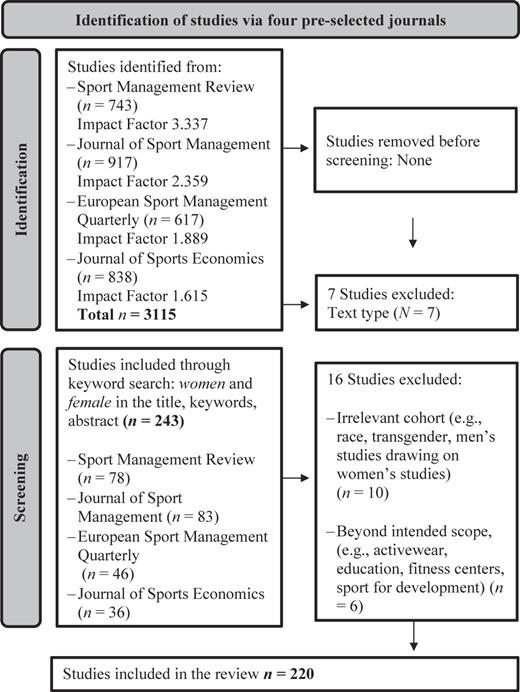
Review selection and screening protocol adapted from PRISMA-ScR (PRISMA extension for Scoping Reviews) (Tricco et al., 2018)
Review selection and screening protocol adapted from PRISMA-ScR (PRISMA extension for Scoping Reviews) (Tricco et al., 2018)
Charting the data
To develop the initial coding framework, I used a deductive approach based on the self-declared aims and scope statements of the four journals included in this review: Sport Management Review, Journal of Sport Management, European Sport Management Quarterly, and Journal of Sports Economics (JSE, 2023; ESMQ, 2023; Sailofsky et al., 2022; SMR, 2023). I systematically reviewed each journal’s description to identify key thematic areas emphasized in their aims and scope statements on their websites, including reference to the focus, purpose and topics they invite for submission. I extracted core content terms – such as governance, marketing, gender, economic impact, and consumer behaviour – and organized them into thematic clusters reflecting recurring subject areas across the journals.
Table 1 presents the resulting coding framework, which maps each theme against the journals that explicitly reference it in their aims and scope. This table served as the foundation for the deductive coding process allowing me to classify articles according to the declared focal areas of the journals. Where necessary, I expanded or refined this framework through inductive coding during the review to capture emerging sub-themes not initially listed in the aims and scope (e.g., women fans under consumer behaviour). This approach ensured alignment between the thematic analysis and the editorial direction of the journals, while also allowing for the identification of gaps or underrepresented areas in the literature on women in sport management and economics.
Clusters of key content words used in the selected journals self-declared scope and aims, extracted from the journals’ websites
| Cluster | Theme | SMR | ESMQ | JSE | JSM |
|---|---|---|---|---|---|
| Governance and Organizational Structures | Corporate governance (Int. associations, leagues, and clubs) | x | x | x | x |
| Ownership | x | ||||
| Organizational behaviour, theory, and strategy | x | ||||
| Facility management | x | x | |||
| Event management | x | x | |||
| Public sector and public finance | x | ||||
| Workplace and HR-related Issues | Human resources | x | |||
| Operations | x | ||||
| Gender and Representation in Sport | Gender | x | |||
| Diversity | x | ||||
| Competitive and Market Dynamics | Competitive balance and regulation | x | |||
| Economic impact | x | ||||
| Branding, Media and Promotion | Communications | x | |||
| Media | x | ||||
| Public relations | x | ||||
| Advertising | x | ||||
| Sponsorship | x | x | |||
| Licensing | x | ||||
| Consumer Behaviour and Fans | Marketing | x | x | x | |
| Consumer behaviour | x | x | |||
| Societal impact | x |
Source(s): Author’s own work based on journals aims and scope, see JSE (2023) ESMQ (2023), Sailofsky et al. (2022), SMR (2023)
I imported all 220 articles into MAXQDA and coded them deductively using the framework illustrated in Table 1 and developed from the self-declared scope and aims of the four selected journals: Sport Management Review, Journal of Sport Management, European Sport Management Quarterly, and Journal of Sport Economics. Table 1 helped visualize the thematic emphasis of leading journals, serving as a benchmark to identify alignment and divergence between editorial priorities and actual published research.
I applied this framework to each article in MAXQDA and assigned codes according to the articles’ foci. I began the coding process by reviewing each article’s title, abstract, introduction, method and conclusion, and reviewed additional sections as needed to understand the study’s focus and themes. I created sub-codes when necessary to capture more specific research foci (e.g., within consumer behaviour, I added sub-codes for women fans and fans of women’s sport to differentiate between the two different roles women had in these studies). In addition to the thematic coding, I coded each article for the following characteristics: year of publication, location of research subject, and sport industry segment.
I categorized research locations based the context of the data collection. Most studies were situated within a single geographic context – for example an event in a specific location, athletes or a team from a specific country or administrators in a specific organization and location. When studies examined international sporting events (e.g., the Olympics or athletes competing at the Olympics) or policies with no specific geographical anchor (e.g. international ethics standards), I coded them as international/non-specified. Moreover, several studies took a comparative perspective, in such cases I coded for all the locations mentioned leading to 331 occurrences of locations across the 220 articles.
I also coded each article based on the sport industry segment it addressed. For example, whether the focus was on professional sports, the National Collegiate Athletic Association (NCAA), international competitions (e.g., the Olympics of a World Cup), national federations, or community sports (e.g., grassroots programs, local clubs, or organized recreational sport).
Throughout the coding process, I used MAXQDA’s code memo feature to systematically document and refine inclusion and exclusion criteria as well as the rationale underpinning each code. Upon completing the thematic coding of all 220 articles, I conducted a thorough inspection of the text segments associated with each code to assess their homogeneity – understood here as the internal coherence and consistency of meaning within each thematic category. This step was essential to ensure the analytical rigour and thematic precision. For example, all segments coded under Ambassadors and Endorsements were collectively reviewed to confirm that they reflected a consistent conceptual focus and interpretive intent.
Collating, summarizing and reporting results
Following the completion of the thematic coding across all 220 articles, I systematically recorded the frequency of individual themes as well as their co-occurrences with geographical contexts and industry segments. This dual-layered analysis enabled a nuanced understanding not only of which thematic areas have received larges research focus but also how these themes are distributed across different regional landscapes and institutional settings within sport management and economics research.
By mapping co-occurrences between themes and both locations and industries – visualized in the radar chats below – the analysis reveals patterns of concentration and omission in the current literature. For instance, it highlights thematic clusters that dominate certain segments (e.g. governance in professional sports) while also exposing underrepresented combinations (e.g., gender studies in community sports or within specific non-Western contexts). This approach offers a clearer view of where research has been densely situated and where there are notable absences.
In additional to the frequency analysis, I synthesized key findings from the coded segment within each theme cluster to extract the dominant narratives characterizing each inquiry. This synthesis forms the foundation of the thematic review presented in the following section, which consolidates these coded insights into an integrated overview of current research on women in sport management and economics.
Findings
Chronological trends in research on women in sport
Over the past 3 decades, and as illustrated in Figure 2, research on women in sport management and economics has grown at a slower pace than the overall increase in publications in these journals. While there has been a slight upward trend since 2008, the proportion of research on women has remained stagnant, making up only 7.1% of all articles in Sport Management Review, Journal of Sport Management, European Sport Management Quarterly, and the Journal of Sport Economics. Additionally, over half (52.3%) of these studies examine both men’s and women’s experiences, meaning that only 3.5% of the published research focuses exclusively on women in sport. This small percentage highlights the persistent gap in the field, reinforcing the need for further scholarly attention on this population.
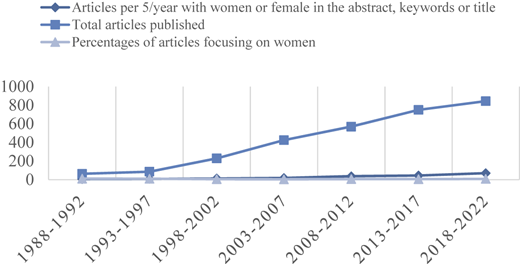
Research on women in selected sport management and economics journals as a percentage of total publications (First issue – 2023) (Source: Author’s own work)
Research on women in selected sport management and economics journals as a percentage of total publications (First issue – 2023) (Source: Author’s own work)
While more studies on women have emerged in the last decade, this growth does not match the expansion of research in sport management and economics as a whole. The following sections examine the themes, industries, and geographic location of this research, identifying where key gaps remain.
Thematic overview
This section addresses the first research question: “what themes have been explored in sport management and economics on women across different roles, including athletes, professionals, and consumers?”. The thematic analysis reveals that the existing literature can be broadly categorized into four overarching clusters. The most prominent of these is Organizational and Institutional Dimensions of Women in Sport which synthesizes three thematically connected areas from Table 1: Gender and Representation in Sports, HR-related Issues, and Governance and Organizational Structures. This comprises encompasses 52% of the total thematic content reflecting a strong research focus on women’s roles and participation within structured sport and the structures and policies affecting them. The second cluster, Competitive and Market Dynamics, accounts for 18% of the research and addresses themes such as competitive balance, regulation, and market potential. The third cluster, Branding, Media and Promotion, represents 16% of the literature and includes topics related to social media, reputation and brandings, advertising and sponsorship. Finally, Consumer Behaviour and Fans comprises the remaining 13%, focusing on women as sport consumers, fan engagement and fans of women’s sport.
These thematic clusters are further illustrated in Figure 3. It must be noted that there are 64 more theme occurrences counted than total articles as multiple articles focused on more than one area.
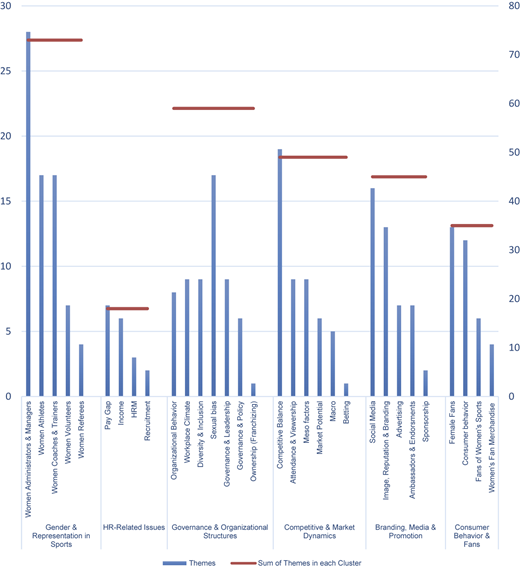
Themes covered in research on women in sports in the examined journals. Blue bars represent the frequency of individual themes; red lines indicate the total number of themes within each cluster (Source: Author’s own work)
Themes covered in research on women in sports in the examined journals. Blue bars represent the frequency of individual themes; red lines indicate the total number of themes within each cluster (Source: Author’s own work)
Gender and representation in sport
As illustrated in Figure 3, the research clustered in Gender and representation in sport is the most exhaustive area of research on women in the examined journals. This includes research on the roles women hold within organizations as leaders, athletes, coaches, referees, and volunteers. The literature highlights that gender inequality in sport leadership is shaped by intersecting cultural, structural, and individual factors. Women often face role incongruity, as leadership in sport is traditionally associated with masculine traits leading to a preference for men as leaders and negative attitudes toward women in management (Burton, 2015; Burton et al., 2011; Ferrand et al., 2010; Koca and Öztürk, 2015). While gender quotas and increased women’s representation in boards and committees have shown some promise – particularly in reducing human resource and financial challenges (Wicker et al., 2020a) – these measures alone are insufficient without deeper cultural change (Adriaanse and Schofield, 2014; Alsarve, 2022). Women continue to be underrepresented in influential leadership roles (Lovett and Lowry, 1995) and are often confined to “pink collar ghetto” (Banu-Lawrence et al., 2020, p. 572) positions in human resources and marketing. Structural barriers, including exclusionary networks and masculine organizational cultures (Katz et al., 2018), persist and hinder women’s access to power (Adriaanse and Schofield, 2013; Banu-Lawrence et al., 2020; Hardin and Whiteside, 2012; Hartzell and Dixon, 2019). Additionally, emotional labour, work-life balance pressures, and subtle forms of discrimination contribute to women’s high dropout rate along the career ladder (Pfister and Radtke, 2006; Sibson, 2010). Although some progress has been made, sustainable change requires a multi-level approach that addresses systemic bias, supports leadership development, and redefines organizational norms to promote genuine gender equity in sport governance.
Existing research on women athletes highlights the specific challenges they face within professional sports contexts. More than half of these studies examine how women athletes construct their personal brands on social media or how they are portrayed in the media, reflecting the pressure to maintain a public image alongside their athletic performance (Cocco et al., 2023; Fink et al., 2004, 2012, 2014; Frank and Mitsumoto, 2023; Geurin, 2017; Geurin-Eagleman and Burch, 2016; Mogaji et al., 2020). Multiple studies also focus on the lack of institutional support and professional environments, emphasizing the additional burden placed on these athletes, their reliance on intrinsic motivation and personal support systems (Gill, 2011; Palmer and Leberman, 2009; Taylor et al., 2022b).
Research on gender and coaching in sport has highlighted persistent disparities in hiring, compensation, and professional advancement. While no evidence supports the existence of a “glass cliff” for women coaches, hiring patterns show that managers tend to recruit candidates of the same sex (Keefer, 2022). Additionally, no significant difference is seen in team performance (Gomez-Gonzalez et al., 2019). Nonetheless, systemic barriers remain; women coaches earn substantially less than men coaches in comparable roles, with this gap largely attributed to sport prestige and institutional demographics (Humphreys, 2000). Men’s dominance is reinforced through gendered organizational norms, informal practices, and decision-making structures that favour men, particularly in managerial and coaching roles (Burton et al., 2012; Greenhill et al., 2009; Pastore, 1992). Women coaches often face limited access to mentorship, networking, and advancement pathways and report greater burdens from administrative duties and recruitment pressures (Shaw and Allen, 2009). Despite these barriers, women coaches are more likely to cite athlete development and gender representation as motivation for remaining in the profession (Pastore, 1992). The persistence of gender stereotypes and organizational biases underscores the need for structural changes to support women’s participation in coaching. Findings indicate that improving coaches’ organizational commitment may help athletic departments increase retention (Turner and Chelladurai, 2005).
Workplace and HR-related issues
Distinct from the cluster focusing on women’s representation in leadership, athletic and coaching roles, the findings within the workplace and HR-related issues cluster shifts the attention to the broader structural and systemic conditions shaping employment in sports organizations. Women and racial minorities are consistently overrepresented in lower-paying, part-time, less influential positions, with significant wage disparities persisting across roles (Hindman and Paulsen, 2022). Gender pay gaps are often attributed not just to individual identity, but to structural factors such as sport type, media attention and licensing deals, institutional revenue, and decision-making preferences (Giddings and Haupert, 2019; Humphreys, 2000; Shmanske, 2000; Sveinson et al., 2022). Research also highlights how overwork climates, gender-career expectations, and lack of family support contribute to women’s higher dropout rate (Cunningham et al., 2010; Taylor et al., 2022a). Moreover, HRM and recruitment research indicates that unconscious bias and normative diversity practices fail to meaningfully disrupt existing hierarchies (Farrell et al., 1998; Hallmann, 2015; Kim et al., 2010). The inclusion of queer- and intersectional theoretical frameworks in research in this cluster adds critical insight into how organizational norms and hiring practices reproduce exclusion, calling for deeper transformation beyond surface-level inclusion efforts (Aitchison, 2005; Knoppers et al., 2022a). These findings underscore that equity in sport requires not only greater representation in leadership, but a reconfiguration of how work is organized, valued and distributed across the sport industry.
Governance and organizational structures
The organizational structures and policies cluster explores how organizational structures and policy frameworks shape the experiences of athletes, staff and teams in women’s sport. While modern governance reforms often aim for efficiency and growth, they face challenges due to uneven implementation and stakeholder resistance (Sam et al., 2018). For example, franchise models like the UK Netball Super League have boosted player performance and national outcomes, but rely heavily on the leadership capacity of individual franchises, raising questions about long-term consistency (Mansfield and Killick, 2012). Within organizations, leadership style has a direct impact on athlete and team outcomes – uncivil leadership behaviours are linked to reduced performance, lower psychological safety, and weaker team cohesion. These negative effects may to be more pronounced for women athletes, partly due to lower self-evaluation scores and greater reliance on interpersonal support structures (Lopez et al., 2020).
Broader organizational structures also reflect gender dynamics. Athletes express a desire for autonomy in team building and decision-making, suggesting that empowering athletes in governance can boost motivation and cohesion (Anderson and Dixon, 2019). At the institutional level, women often report inadequate policies on childcare, job security, and workload expectations, especially during transitions into semi-professional leagues (Taylor et al., 2022a, b). Studies show women consistently advocate for structural equality – equal pay, representations, and resources (Aitchison, 2005) – but organizational outcomes often fall short due to entrenched norms and uneven policy enforcement (Taylor et al., 2022a, b; Trail and Chezzadurai, 2000). These findings underscore the need for inclusive, context-sensitive governance approaches that are centered on athlete’s lived experiences and recognize gender-specific career dynamics.
Competitive and market dynamics
The competitive and market dynamics cluster explores how competition structures, institutional factors, and market behaviour shape the landscape of women’s sport. Research on competitive behaviour shows mixed results: women’s competitive balance is weaker than men’s in soccer leagues in France, Germany, and England, while it is stronger in the WNBA than in the NBA, and in handball there are no significant differences as competitive balance is weak in both genders (Kringstad, 2021). Findings in this area challenge assumptions about innate gender differences in competitiveness, instead attributing observed gaps to structural differences and incentive systems (Krumer et al., 2016). At the macro and meso levels, factors such as quality of youth development, and national investment in women’s sport coincide with international success, particularly in football (Klein, 2004; Noland and Stahler, 2017). Institutional support – like dedicated staff, training frequency, and development programs – has long term impacts on performance outcomes (Brouwers et al., 2012; Jacobs, 2014; Lim et al., 2011).
Shifting from competition to commercial viability, this research emphasizes that the market potential of women’s sport is often misunderstood or undervalued when assessed through models developed for men’s-leagues. Fan behaviour, pricing sensitivity (Qian et al., 2023), and media engagement (Zhang et al., 2011) operate differently across gendered markets, with women audiences and consumers responding to different cues and incentives. For example, pricing and perceived value as well as media visibility (Zhang et al., 2011) and social, community elements (Meier et al., 2016) drive attendance at women’s sport events. As a result, traditional assumptions about demand elasticity, value perception, and content delivery fail to fully capture the economic dynamics at play. To unlock underdeveloped audiences and build sustainable growth, sport organizations must adopt tailored strategies that reflect the unique consumer landscape of women’s sport.
Branding, media and promotion
The branding, media and promotion cluster examines how women athletes and women’s sport are represented, promoted, and engaged with through social-media platforms and communication strategies. The most prominent theme in this cluster is social media, which both mirrors and reinforces existing gender disparities. Studies show that women athletes receive a fraction of the attention (Cuneen and Sidwell, 1998) men athletes do – such as just one in five Olympic-related-tweets (Adá-Lameiras and Rodríguez-Castro, 2023)– and often appear in stereotyped or “sex-appropriate” sport coverage (Fink et al., 2004, 2014; Frank and Mitsumoto, 2023; Kane, 1988). This leads to a lack of women role models for young athletes to emulate and influences how the public values athletes and sports (Cooper and Weight, 2011; Symons et al., 2022; Zhang et al., 2011). Social media platforms, while offering athletes direct branding opportunities, also expose athletes to the pressures, including expectation to post personal or suggestive content and the risk of receiving unwanted messages (Geurin, 2017; Geurin-Eagleman and Burch, 2016). Moreover, athletes often lack structured strategies to manage their online presence, which limits the effectiveness of their personal branding (Cocco et al., 2023; Geurin, 2017). Fan engagement also reflects existing biases: women fans frequently report exclusion and sexist behavior in online communities dominated by men (Fenton et al., 2023), reinforcing the idea that social media often replicates rather than disrupts traditional hierarchies in sport.
The remainder of this cluster explores related promotional strategies, athlete branding and advertising effectiveness. Women athletes are shown to be more effective than their counterparts as endorsers, particularly in conveying empathy and authenticity (Park et al., 2008). Although attractiveness continues to shape perceptions, especially in sports generally considered “gender appropriate” (Dietl et al., 2020). Research finds that factors such as personality, appeal, athlete-product fit, and emotional advertising positively influence consumer engagement and brand equity (Frank and Mitsumoto, 2023). Despite this finding on their effectiveness as endorsers, women athletes often struggle to recognize or develop themselves as brands due to limited media exposure, career pressures, and entrenched gender norms (Fink et al., 2014; Mogaji et al., 2020). These examples indicate that determining the most effective way to promote women athletes and women’s sport is a matter of debate, even among the athletes themselves and that women athletes and their teams often lack the resources to build their brands and market themselves (Delia, 2020; Fink et al., 2014). Frameworks like the Human Brand Pyramid offer a pathway for athletes to build stronger brand identities, moving them from recognition to commercial endorsement (Mogaji et al., 2020). Overall findings in this cluster highlight the need for targeted marketing and communication strategies that account for the unique position of women in sport – strategies that not only amplify visibility but also challenge outdated promotional norms that continue to shape the sports marketplace.
Consumer behaviour and fans
The Consumer behaviour and fans cluster explores how women fans engage with sport and how fans engage with women’s sport, including the distinct preferences, motivations and barriers encountered. Research challenges long-held assumptions that men and women fans differ substantially; however, while many patterns are shared (e.g., the motive factors Challenge, Enjoy, Enhance), nuances exist (Tainsky et al., 2014). For instance, women exhibit unique consumption driven by the desire to connect and socialize (Dwyer et al., 2018). Appearance and cleanliness of service environments (Lee et al., 2011), athlete expertise, and team reputation also shape fan engagement (McDonald et al., 2018), but gendered experiences – especially in online communities (Fenton et al., 2023)– continue to reinforce exclusion and bias. The data also highlight fan diversity across income, age, and life stage, with factors like stadium design, affordability, and childcare shaping access and experience (Sveinson and Toffoletti, 2023).
At the product level, marketing and merchandise strategies often rely on narrow gender norms, limiting how women fans can express their identities as supporters. Fans push back against “Pinkwashed” products (Sveinson and Allison, 2022) and call for greater diversity in women’s fan merchandise apparel that reflects varied femininities and authentic support (Sveinson et al., 2019; Sveinson and Hoeber, 2023). Women fans often face the need to prove their fandom in spaces dominated by (Fenton et al., 2023), factors like media and visibility, cultural messaging, and socializing agents, such as family, influence their access to an interest in women’s sport (Farrell et al., 2011; Sveinson and Toffoletti, 2023). Overall, this research underscores that women fans are not a monolith (Andrijiw and Richardson, 2023; Sveinson et al., 2019) and that more inclusive strategies are essential to reach, retain, and empower them in the sport landscape.
While the majority of research in this cluster focuses on women fans and consumers of men’s sports, a handful of studies also consider fans of women’s sport. This research reveals that traditional marketing approaches based on men’s sports do not fully translate, highlighting the need for tailored strategies that emphasize affordability, value, social connection, and support for women in sport (Qian et al., 2023). Fan engagement is deeply tied to meaningful personal relationships, lifelong influences, and a desire for social justice (Funk et al., 2003), suggesting that teams should leverage both emotional connection and community-building to grow their audiences – especially when working with limited marketing resources (Delia, 2020).
Geographic and industry overview
To address the second research question, on the geographic regions and industries that research on women in sport management and economics has thus far focused, the 220 studies included in this analysis were codes for their geographical and industry focus. A total of 331 occurrences of geographic locations were logged, as several studies adopted a comparative approach, analysing multiple locations. In this section, I explore how each theme is manifested across the different regions and industries illustrating patterns of concentration and omission in the current literature. This approach highlights thematic clusters that dominate certain segments (e.g. governance in professional sports) while also exposing underrepresented combinations (e.g., gender studies in community sports or within specific non-Western contexts).
As illustrated in Figure 4, research on women in sport management and economics is heavily concentrated in a few key regions (Taylor et al., 2022a, b). The United States accounts for the largest share of studies. The second largest congregation of studies falls in the international or non-specified category. An example, of research categorized in this way is Anbarci et al. (2014) which analysed men and women’s line calls in international tennis competitions without any indication or the athlete’s nationality. Australia, Germany, Canada and the United Kingdom emerge as the most frequent locations of research on women in this field beyond the United States. The geographic concentration of literature highlights an important gap. Research on women in sport remains heavily Western-centric, with relatively little attention given to much of Europe, along with Africa, South America, and Asia. Given the diverse social, economic, and policy environments shaping women’s involvement in sport, expanding research to underrepresented regions is crucial for a more comprehensive understanding of their roles.
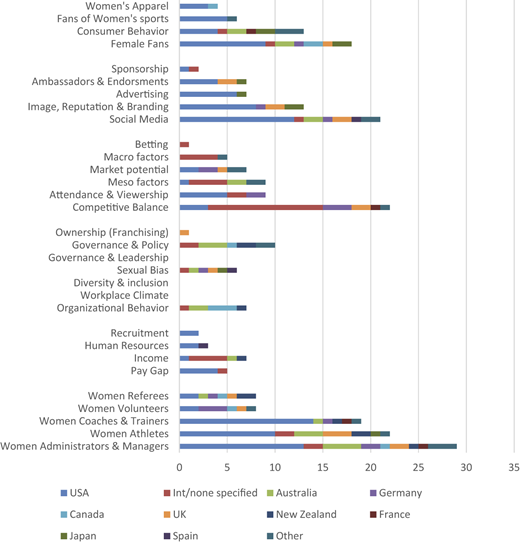
The geographical distribution of the 331 occurrences of locations identified across the 220 studies analysed. As many studies adopted a comparative approach and examined multiple locations, the number of locations exceeds the number of articles (Source: Author’s own work)
The geographical distribution of the 331 occurrences of locations identified across the 220 studies analysed. As many studies adopted a comparative approach and examined multiple locations, the number of locations exceeds the number of articles (Source: Author’s own work)
Beyond geographical distribution, this review also examines the industries covered in research on women in sport. Figure 5 presents the distribution of industry coverage across the included studies. The professional sports industry emerges as the most extensively studied sector, followed by research on the US National Collegiate Academic Association (NCAA) sports context. In contrast, international competitions and national federations have received comparatively little attention.
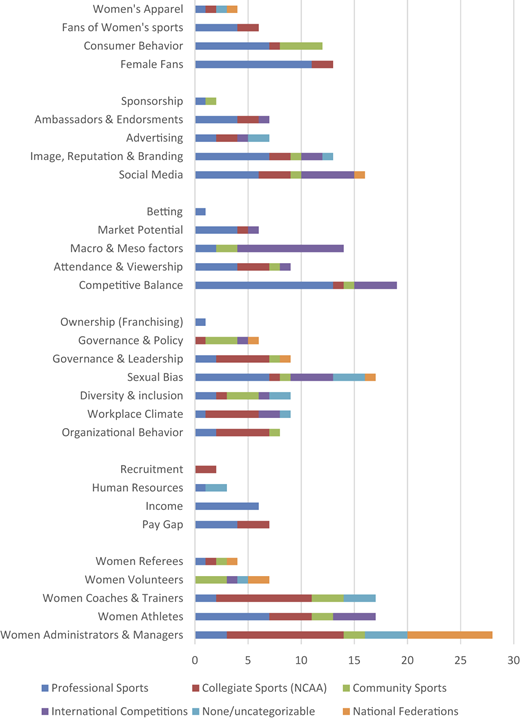
The distribution of the 279 occurrences of themes across industries in the 220 studies analysed. As many studies touched on multiple themes, the number of themes exceeds the number of articles (Source: Author’s own work)
The distribution of the 279 occurrences of themes across industries in the 220 studies analysed. As many studies touched on multiple themes, the number of themes exceeds the number of articles (Source: Author’s own work)
Alignment and discussion
The final research question guiding this review questions the extent to which existing literature contributes to the aims and scope of leading sport management and economics journals and in order to identify where notable gaps remain. This question was addressed by comparing the thematic focus of the 220 reviewed articles (Figure 3) with the aims, scope, and focus of the journals as declared on their websites (Table 1).
As outlined in Table 1, the aims and scope of these journals span a diverse set of themes including governance and organizational structures, Workplace and HR-related issues, Gender and representation in sport, competitive and market dynamics, branding, media and promotion, as well as consumer behaviour and fans. The comparison of the declared scope and aims with the thematic review of the 220 articles on women in sports reveals a strong degree of alignment in areas such as gender and representation in sport along with governance and organizational structures and workplace and HR-related issues. These clusters of themes reflect the interest in organizational and workplace equity which is echoed in the scope of JSM and SMR (Sailofsky et al., 2022; SMR, 2023), both of which explicitly emphasize HR and organizational behaviour as core themes. Within this research strand, most studies in this review focused on gendered hierarchies, leadership barriers, and workplace dynamics.
While these studies highlight some alignment on themes in the clusters related to HR and organizational behaviour aspects, other areas in the journals’ scopes remain underrepresented. Although ownership (JSE, 2023), event management (Sailofsky et al., 2022), facility management (Sailofsky et al., 2022), and public finance (JSE, 2023) are all listed as key themes in journals aims, these topics were largely absent from the research on women. Only one study addresses franchising (Mansfield et al., 2012), and no articles were found on public sector funding or event operations specific to women’s sport. Similarly, research on economic impact – central to JSE’s scope – was not present in the reviewed studies, pointing to a broader gap in understanding how women’s sport contribute to local, regional, or national economies. These omissions suggest opportunities to move beyond discussing the gender gap towards studies that assess the operational, financial and economic aspects of women’s sport.
Themes in the cluster branding, media and promotion, though present in the journals’ scope statements, are less well-covered in the reviewed literature. While there is meaningful research on social media use by women athletes and the persistent underrepresentation of women in mainstream sports coverage, few studies address strategic or operational branding and communication practices of women’s leagues, clubs or events. The near absence of scholarship on licensing and sponsorship is particularly striking given the centrality to the sport business. Only two articles in the entire review addressed sponsorship (Parris et al., 2014; Chanavat et al., 2010) and none focused on licensing, despite this being explicitly included in the scope of both JSM and ESQM. This represents a significant gap in research on the media, marketing and commercial operations of women’s sport.
Regarding research on consumer behaviour and fans, the concentration of studies on women consumers of men’s sport reflects the broader consumption patterns in the industry (Tainsky et al., 2014; Dwyer et al., 2018; Lee et al., 2011; McDonald et al., 2018; Fenton et al., 2023; Sveinson and Toffoletti, 2023), yet this focus may inadvertently perpetuate am imbalanced view of the marketplace. Studies on fans of women’s sport and on gendered consumption motives remain limited sport (Qian et al., 2023; Funk et al., 2003) and geographically skewed (Figure 4), with a disproportionate emphasis on the U.S. professional and collegiate contexts. Given the projected commercial growth of women’s sport (Abrash, 2025), further research is needed to explore fan engagement, consumer loyalty, and brand attachment within women’s sport, particularly outside North America.
In sum, the reviewed literature shows alignment with the journals’ scopes, but reveals notable gaps in several key areas: operations, media, sponsorship and licensing, economic impact, public governance, and marketing. These findings underscore the need to move beyond gender-focused comparisons and explore how strategic decisions, resource allocations, and leadership models play out in the management of women’s sport organizations. This means shifting the research lens from describing inequalities to evaluating interventions, strategies, and organizational outcomes. Future research that addresses these gaps will not only align more fully with these journals priorities but also contribute valuable insight for stakeholders seeking to build sustainable models for women’s sport across divers contexts.
Research should critically assess the ownership structures, governance frameworks, and franchising strategies of women’s teams and leagues. As the only study on franchising demonstrates (Mansfield and Killick, 2012), such models can directly impact performance and sustainability. There is also a need to explore the role of public financing, policy investments, and infrastructure investment in the development of women’s sport-themes largely absent from the reviewed literature.
Despite the centrality to JSE, no studies analysed the economic contribution of women’s sport at local, regional, or national levels. Future research should quantify these impacts using established models from men’s sports while critically interrogating their applicability to women’s contexts. This gap is particularly salient given Hammerschmidt et al.’s (2023) argument that the prevailing commercial logic in sport management research may neglect key socio-economic idiosyncrasies of sport, suggesting the need for more empirically grounded studies that assess broader value creation in women’s sport.
The near-total absence of research on licensing and sponsorship in women’s sport is especially problematic given their centrality in revenue generation and brand-building. Studies like those by Fink et al. (2014) and Mogaji et al. (2020) highlight branding challenges faced by women athletes, but strategic branding at the organizational level, such as leagues or clubs, remains underexplored. As shown by Qian et al. (2023), fan behaviour in women’s sport is shaped by different motivational and cultural dynamics than in men’s leagues. Yet most fan-focused studies remain concentrated in the U.S. Collegiate and professional context. Future work should investigate cross-cultural patters in fan loyalty, brand attachment, and consumer decision-making. Addressing these gaps would not only support the financial viability of women’s sport but also offer academic contributions to sport management theory, particularly in the areas of brand architecture, revenue diversification, and gendered market segmentation potentially creating new conceptual frameworks that more adequately account for the dynamics of women’s sport organizations.
Conclusion
This scoping review examined how women have been studies in sport management and economics research across four of the field’s top-ranked journals. By mapping thematic trends and comparing them with the journals’ stated aims and scopes, this study provides a field-specific analysis of scholarly attention to women as administrators, managers, athletes, coaches, and consumers. The findings reveal that while gender and human resources have received growing interest, the literature remains narrowly focused both thematically and geographically.
Most research centers on US-based professional and collegiate context, limiting global insight into women’s sport. This regional concentration overlooks the diverse governance structures, market dynamics, and cultural frameworks shaping women’s sport. Moreover, the thematic gaps in critical operational areas such as ownership, public financing, licensing, sponsorship, and economic impact. All of which are central to these journal aims and to the business of sport more broadly.
While this review intentionally focused on sport management and economics journals, excluding adjacent disciplines, it offers a coherent overview of how women’s sport and women in sport are addressed within this scholarly domain. Future reviews which bridge disciplinary boundaries could provide valuable complementary perspectives on themes like media, policy, or sociocultural dynamics.
Ultimately, this review calls for a broader more diversified research agenda which moves beyond describing differences and further investigates strategic decisions, commercial models, and structural intervention that shape women’s sport. Incorporating participatory approaches that involve athletes, administrators, and stakeholders can ensure that research reflects the lives experiences and guides meaningful progression. Advancing this agenda will not only align more fully with these journal priorities but also provide the empirical foundation needed to build sustainable models for women’s sport.

