The purpose of this paper is to propose a methodology to create a localised participatory research agenda (LPRA) for social enterprises (SEs) to bridge the gap between the information needs of stakeholders in SE ecosystems (SEEs) and academics.
The methodology incorporates a literature review, semi-structured key informant interviews and a questionnaire. A participatory approach was used engaging stakeholders of the SE sector in Palestine to elaborate the research agenda.
The proposed LPRA methodology, centred on localised and participatory engagement, has shown effectiveness in bridging the gap between stakeholders and academics in SEs research. Piloted in Palestine, it provided relevant insights and enabled the grassroots identification of policy directions to improve the local SEE. Being tested in the specific context of Palestine, the methodology demonstrates considerable adaptability to different maturity levels of SEEs and varied socio-economic environments. Nonetheless, further research is necessary to refine the LPRA methodology and determine its suitability in diverse SE contexts.
The present methodology offers the advantage of involving local stakeholders, enabling their participation in the construction of knowledge and serving as a possible tool for researchers to fulfil the Third Mission of the university. The methodology could be particularly useful in contexts that have uncommon political, economic or social features and need a tailored approach when building research questions and answers for local stakeholders; in contexts where non-local researchers could use the methodology to mitigate biases stemming from the application of non-local perspectives; and when the research is aimed at the creation of useful knowledge for the development of the ecosystem.
Conventional research agendas are typically developed by academics based on literature reviews. Such agendas, even if valuable for furthering research, often do not have a geographical focus and neglect the needs of diverse stakeholders in the SEE. The LPRA for SEs addresses this gap by providing a methodology able to include local SE stakeholders in building a research agenda tailored to address their specific information needs.
1. Introduction
Social enterprises (SEs) are widely recognised as a significant instrument for offering innovative solutions to environmental and social issues. Additionally, they play a crucial role in creating inclusive employment opportunities for individuals who are typically marginalised from the labour market, as noted by Defourny and Nyssen (2006). Scholars often refer to SEs as “hybrid organisations”, aligning the pursuit of social and environmental objectives with economically sustainable business models, as asserted by Battilana and Lee (2014), Doherty et al. (2014) and Eldar (2017).
The substantial contribution of SEs to sustainable development and human flourishing has been thoroughly explored by researchers. The social mission of SEs frequently aligns with the fundamental principles and priorities of sustainable development, as documented by Huybrechts (2017) and Seelos and Mair (2005). In this regard, SEs are viewed as potential catalysts for grassroots innovations, addressing local needs by interpreting the demands articulated by local communities, as highlighted by Seyfang and Haxeltine (2012). The connection between SEs and sustainable development has been extensively examined, with Hudon and Huybrechts (2017) providing in-depth analysis. Recent contributions on this topic underscore the role of SEs, and the social economy in general, in localising the Sustainable Development Goals (Lee, 2020; Neiva et al., 2020).
However, despite the international debate on SEs and their potential role in alleviating societal drawbacks and in promoting human development, in many countries, there is still not a definition or clear understanding of the features of SEs and the role they can play in local and human development. Indeed, this ambiguity poses challenges to the legitimacy of the concept and the formulation of policies supporting the growth of SEs (Short et al., 2009 and Koa et al., 2018).
Consequently, research and academic institutions in such countries are tasked with a significant role in the initial development of the SE ecosystem (SEE), which entails both clarifying the concept of SEs and related terms such as social business (Yunus, 2010), social entrepreneurship and social innovation to diverse stakeholders and proposing culturally, socially and economically sound actions and policies to support their robust development. This role, which falls largely into the Third Mission of universities, could be supported by using research tools that use participatory mechanisms to offer a bridge between their activities and the needs and expectations of external stakeholders (Pinheiro et al., 2015a; Pinheiro et al., 2015b; Compagnucci and Spigarelli, 2020). The design of localised research agendas that can aggregate and address the information needs of local stakeholders, translate them into research questions and, subsequently, deliver useful research results to such stakeholders could be a useful tool to enhance universities’ role in developing the SEE. However, as we will show in the literature review, research agendas often embrace a purely academic perspective overlooking the needs and points of view of other stakeholders such as policy makers and SE support organisations. For this reason, the present paper aims to develop a methodology for constructing research agendas on SEs by directly engaging a diverse array of stakeholders within a specific territory: we term the outcome of this participatory approach a localised participatory research agenda (LPRA). The methodology has been tested in Palestine thanks to a project financed by the Italian Agency for Development Cooperation.
The proposed methodology was tested in Palestine, a country which is plagued by adverse political and economic conditions and faces a multitude of unmet institutional, technical, economic, social, and environmental needs. The already precarious situation has been further exacerbated in the past years by the economic and social repercussions stemming from the COVID-19 pandemic and the current and continuous political unrest in the country. Given the economic, social and environmental challenges hindering Palestine’s attainment of a satisfactory level of human and economic development, SEs could be a valuable tool for addressing pressing social issues while fostering sustainable economic growth. It should be noted that the SEE in Palestine is still at an early stage of development, SEs are not well known to the government and other stakeholders and their potential is still underused (Koa et al., 2018). Therefore, by focusing on this complex environment, the study pursues a twofold aim: providing insights into the adaptability and practical utility of the proposed methodology for a LPRA, while simultaneously supporting the development of the SEE in Palestine by outlining the research questions and topics intended to inform and guide both national and international stakeholders.
The paper is structured in four parts. In the first part, we propose a literature review on research agendas on SEs. In Section 2, we propose a methodology to build a participatory research agenda; in Section 3 of the paper, we describe how such methodology has been used in Palestine, the stakeholders involved and the results. The conclusions analyse the advantages and limits of the methodology and future research avenues.
2. Literature review
Given the methodological focus of our research, this section does not aim at providing a comprehensive literature review of the topic of research agendas; rather, it aims at outlining how most research agendas, on the topics of SEs and related concepts such as social entrepreneurship and social business, have been built.
According to Webster and Watson (2002), a literature review should not only scrutinise past research but also identify crucial knowledge gaps, motivating researchers to address these gaps in future studies. Various approaches to reviewing existing literature have been outlined by authors to gain a comprehensive understanding of a research topic, provide a conceptual foundation for future research and identify areas requiring further investigation (Paré et al., 2015; Paré and Kitsiou, 2017; Snyder, 2019).
First, a narrative literature review offers an overarching view of a topic, recognising general trends over time. This approach involves gathering and synthesising literature to highlight the significance of a specific perspective, allowing researchers to strategically prioritise certain studies to emphasise a particular argument (Paré and Kitsiou, 2017). Integrative or critical reviews serve distinct purposes by assessing, critiquing and synthesising existing literature to foster the emergence of new theoretical and conceptual frameworks. Integrative reviews are commonly applied to new topics, aiming to “reveal strengths, weaknesses, contradictions, controversies, inconsistencies, and/or other important issues with respect to theories, hypotheses, research methods or results” (Paré and Kitsiou, 2017). Systematic reviews aim to identify all empirical research meeting pre-specified inclusion criteria to answer a clearly formulated research question on a particular topic. Researchers can screen all relevant articles on a comprehensive citation database like Scopus or Web of Science. Paré and Kitsiou (2017) also identify scoping reviews (or semi-systematic reviews) that seek to present an overview of a potentially large and diverse body of literature pertaining to a broad topic. The authors posit that scoping reviews determine the value of undertaking a full systematic review to refine the research. Bibliometric analysis is an analytical technique sometimes used in systematic literature reviews to uncover themes, trends, topics and gaps (Lim and Kumar, 2023). Additionally, descriptive reviews extract specific characteristics from each study, such as publication year, research methods and data collection techniques, to identify patterns or gaps. Finally, realist reviews, commonly used in social sciences and management, aim to explain complex contexts, using case studies to test and modify initial theories.
To select meaningful sources for the literature review, a search on SCOPUS was performed using the following keywords “Research Agenda” AND “Social Enterprises” OR “Social Business” OR “Social Entrepreneurship”, in the time range 1996–2023 (4th December 2023). The search generated 118 results that fitted into one of the above-mentioned categories. Among these, 62 were articles, 17 reviews, 21 book chapters, 12 conference papers, 4 editorials, 1 conference review, 1 book and 1 erratum. We decided to select only articles and book chapters, to ensure credibility because of the process of peer-review, which resulted in a list of 82 documents. Of these, over 70% (58 of 82) were published during the period 2018–2023 (Figure 1).
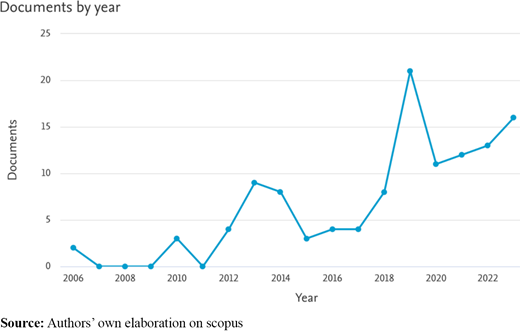
Papers and book chapters by year as a result of the search on Scopus for the words “research agenda” and “social enterprises” or “social business” or “social entrepreneurship”
Papers and book chapters by year as a result of the search on Scopus for the words “research agenda” and “social enterprises” or “social business” or “social entrepreneurship”
All 82 documents were then further analysed using a two-step approach to select those that referred specifically to research agendas for SEs. The first step involved reading all the abstracts and excluding the papers that were not related to the topic of our research, for example, when “Social Business” was associated with “Social Capital” or “Impact Investing”. Papers that consider SEs as a peripheral theme, for example, if the central topic was the “Circular Economy” but addressed SEs within that topic, were still considered. In addition, papers that focused on a specific aspect of social entrepreneurship, such as “Community Engagement” or “Value Creation”, were also kept. Following the first step, the number of documents object of our analysis was reduced to 54. Then, chapters of books and articles that were not accessible online were excluded from the analysis and did not pass to the next step. The number of documents was, thus, reduced to 45. In the second step, we read all the papers and divided them into two distinct clusters: papers proposing future research avenues on a specific topic and papers proposing a broad research agenda for SEs. Documents were excluded if the researchers were solely contributing to future research agendas but not proposing one. The second step resulted in the exclusion of seven papers. Overall, the final list contains 38 publications (cut-off: 4th December 2023, see Appendix_1_research activities for the full list), of which 60.5% (23) propose a broad research agenda for SEs and 39.6% (15) outline research questions and avenues on a specific dimension of SEs (Figure 2).
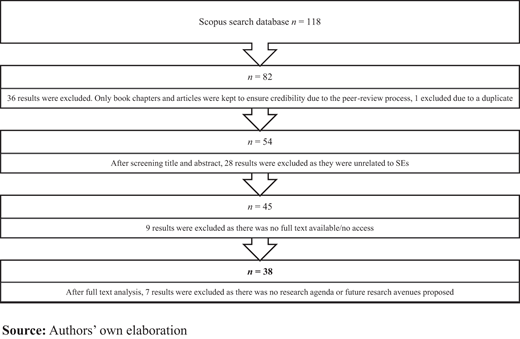
Flow chart depicting the process of the study selection for the literature review
Flow chart depicting the process of the study selection for the literature review
Table 1 shows the research activities used to develop the research agenda or research avenues.
Research activities to elaborate research agendas and research avenues
| Research activities | Research agendas | Research avenues | Total |
|---|---|---|---|
| Integrative literature review | 1 | 8 | 9 |
| Integrative literature review and quantitative study | 0 | 12 | 12 |
| Narrative literature review and quantitative study | 0 | 1 | 1 |
| Systematic literature review | 11 | 1 | 12 |
| Bibliometric analysis | 3 | 1 | 3 |
| Narrative literature review | 4 | 2 | 6 |
| Critical analysis of articles part of a special issue | 1 | 1 | 2 |
| Systematic literature review and critical analysis of articles part of a special issue | 1 | 0 | 1 |
| Narrative literature review and case study | 1 | 0 | 1 |
| Rapid evidence assessment | 1 | 0 | 1 |
| Total | 23 | 15 | 38 |
In all, 11 documents built their research agenda using a systematic literature review to identify the gaps in the current literature; 4 performed a narrative review; 2 critically assessed a chosen number of articles in a Special Issue, of which one also did a systematic literature review; and 3 performed a detailed bibliometric analysis. The research agenda is usually elaborated with the author’s suggestions and conclusions, but in one case (Rapid Evaluation Assessment), the authors’ enlarged the brainstorming to a group of other academics during research workshops and events. The research avenues generally stemmed from an integrative literature review, which allowed the elaboration of a conceptual framework (53.3% of research avenue cases). These conceptual frameworks permitted to outline some precise sub-topics of the SE domain, allowing to identify detailed research avenues and questions. This short literature review shows that there is no evidence of authors involving stakeholders, other than from the academic field. Considering these results, in the next section of this paper, we propose a methodology for the construction of a participatory research agenda for SEs.
3. Methodology
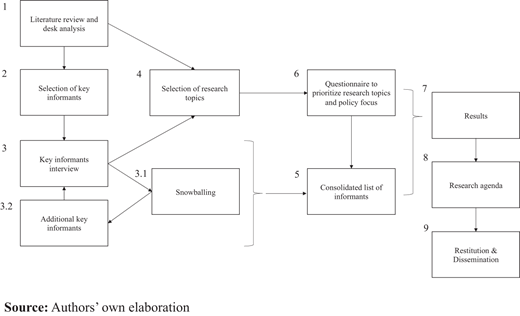
The methodology that was elaborated and applied in the Palestinian context, consisted of seven steps (Figure 1). The first step (Step 1) covered a literature review and desk analysis of policy documents/grey literature on social enterprises (and related concepts such as social entrepreneurship and social business) in Palestine. The aim of this step was to not only understand the existing knowledge and research gaps useful for the construction of the research agenda but also identify an initial list of key informants, such as public officials of relevant ministries, academics and practitioners involved in the field of SEs, for example, consultants, project managers of non-governmental organisations (NGOs) promoting SEs, social entrepreneurs, etc. After the literature review, the research team ended with a first list of 11 key informants (Step 2).
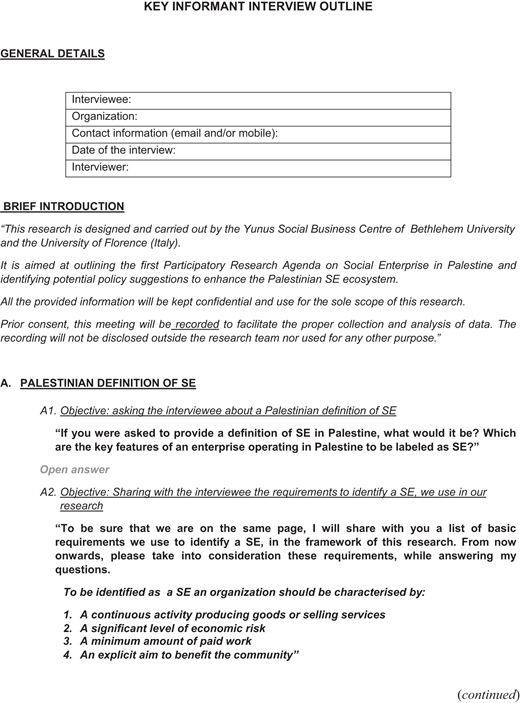
The third step (Step 3) consisted of key informant interviews (KIIs). The interviews were semi-structured ( Appendix_2_KIIs) and served a dual purpose: understanding the topics that the key informants deemed important and needed to be addressed in research on SEs (Step 4); and identify other key informants through the snowballing technique (Step 3.1) (Parker et al., 2019).
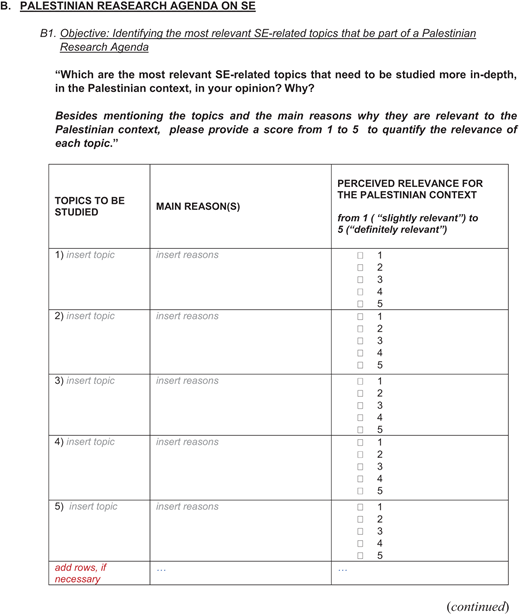
During the interview, the key informants were asked initial questions concerning their role in the organisation and experience in the field of SEs. To ensure that responses pertained specifically to SEs and not to other types of organisations, such as NGOs or for-profit companies engaging in corporate social responsibility, researchers asked the key informants to provide their definition of SE and clarified that all questions in the interview would refer to SEs meeting four criteria among those proposed by EMES: a continuous activity producing goods or selling services; a significant level of economic risk; a minimum amount of paid work; and an explicit aim to benefit the community. These criteria were considered by the research team as the basic criteria for determining the eligibility of the SE in the present research project. The second set of questions sought to identify the topics to be researched, the reason why they should be researched and their relevance for the Palestinian context on a scale from 1 “slightly relevant” to 5 “definitely relevant”.
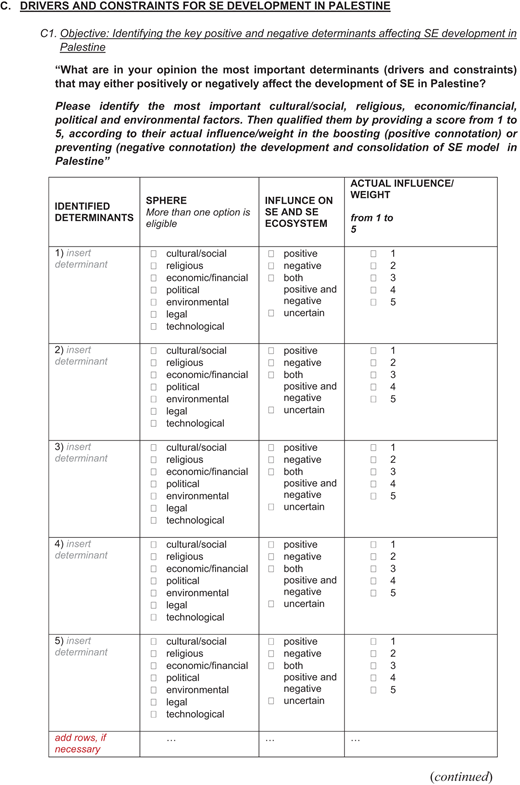
The third set of questions aimed at identifying the drivers and constraints for SE development in Palestine. Interviewees were asked to list the determinants influencing the development of the ecosystem. For each determinant, they had to say if the influence was positive or negative (or neither) and provide a rating on their actual influence from 1 “very limited influence” to 5 “great influence”. This question was included to provide researchers with additional inputs for the research agenda.
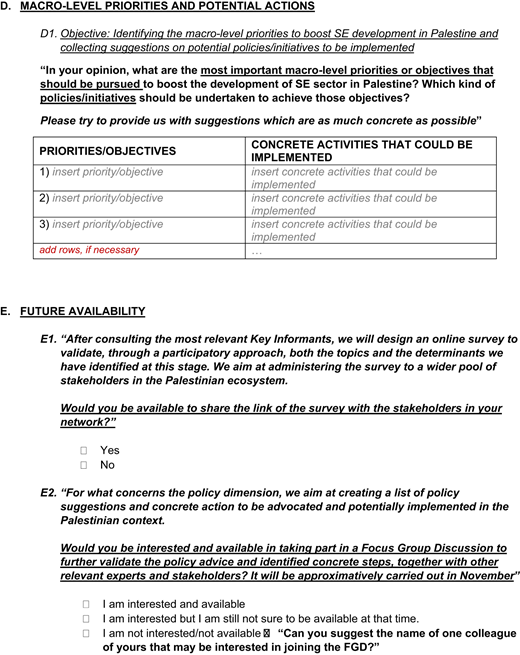
The final set of questions was designed to identify the policy priorities for the development of SEs in Palestine, with the aim of incorporating them into the research agenda. At the end of the interviews, the participants were asked if they would be interested in taking part in the next steps of the research, specifically in answering the questionnaire to prioritise the topics to be researched (Step 6). Interviewees were also asked to identify people involved in the field of SEs and who fitted one of the following requirements: being considered experts of SEs or a related field in Palestine or that are in a decision-making position able to influence the development of the SE sector in the area. This technique increased the initial number of key informants from 11 to 18. The final list of key informants was composed of 13 people working in NGOs/SE Support Organisations, 3 in research centres, 1 in an academic institution and 1 in a semi-governmental organisation (Step 3.2).
The contacts of key informants and additional respondents who expressed their willingness to participate in the subsequent steps of the research and disseminate the questionnaire to their contacts were consolidated in a final list of contacts (Step 5).
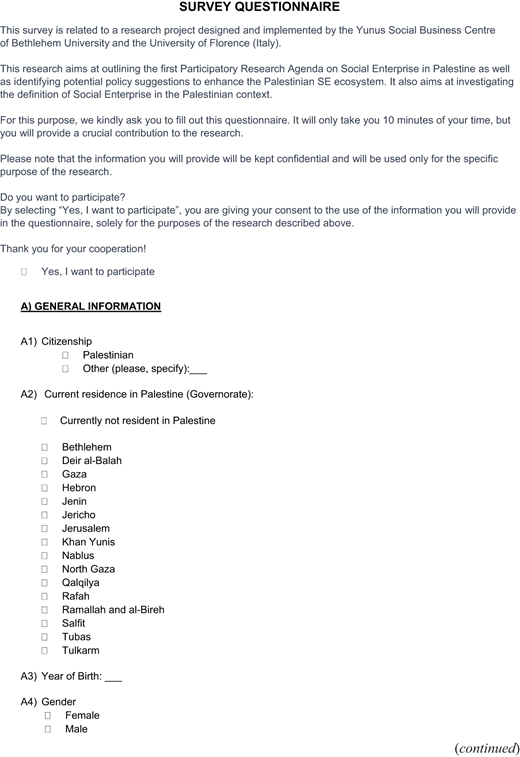
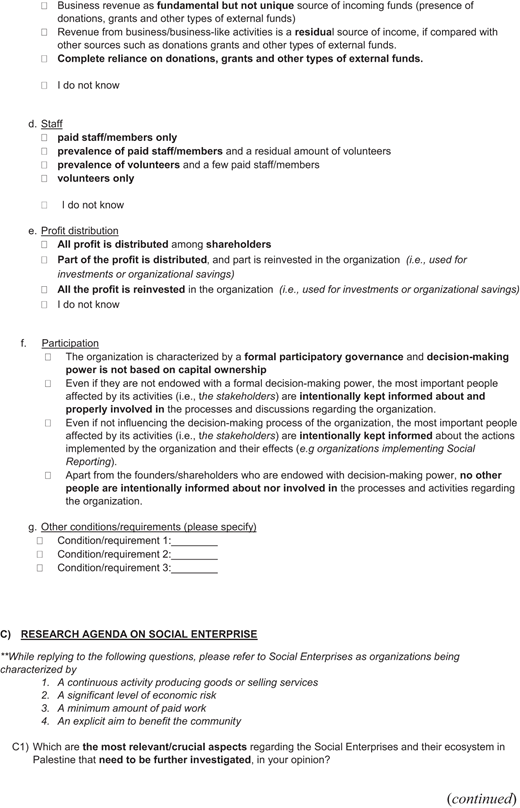
The answers of the key informants were analysed and manually coded to identify the main research topics that were then compared to the research gaps identified in the literature using the constant comparative method (Glaser, 1965). The researchers merged the topics resulting from the literature review and those identified by the key informants and drafted the questionnaire (Step 6) ( Appendix_3_questionnaire).
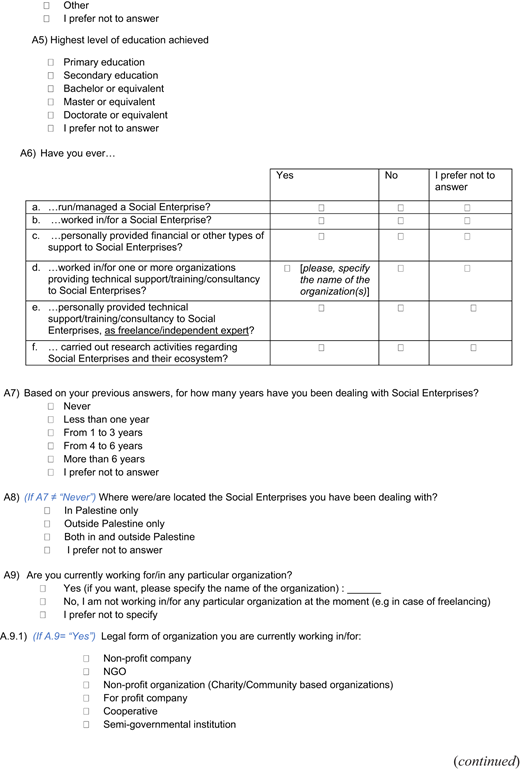
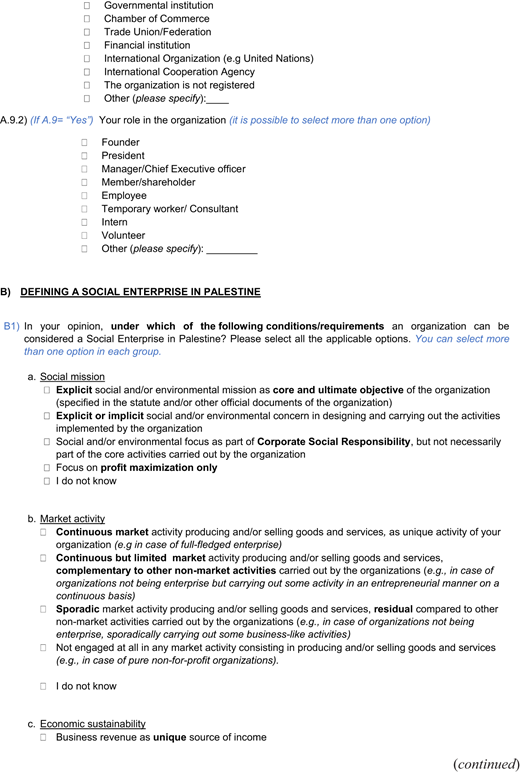
The questionnaire was then translated from English to Arabic by a Palestinian researcher and from Arabic to English by another Palestinian researcher to make sure that the meaning between the two versions was the same. The questionnaire was then piloted to assess whether it was understandable to the audience. Once definitive, the questionnaire was put on an online platform and sent to the consolidated list of informants. The elaborated questionnaire was, thus, distributed to 27 respondents, of which, at the time of the questionnaire, 23 were working in an organisation and 4 as individual experts. More specifically, of the 23 working in an organisation, 11 did in a NGO, 5 in a non-profit organisation (charity or community-based organisation), 3 in an international organisation, 2 in a non-profit company and 2 in a for-profit company. After collecting general demographic information and each respondent’s role and activities, the respondents were asked to define SEs in the Palestinian context by considering some core aspects of SEs: social mission, market activity, economic sustainability, staff, profit distribution and participation. Each of the aspects had different degrees of responses; for example, profit distribution ranged from “All profit is distributed among shareholders” to “All the profit is reinvested in the organisation”. This question had the aim to assess the respondents’ perception of what a SE is in the Palestinian context.
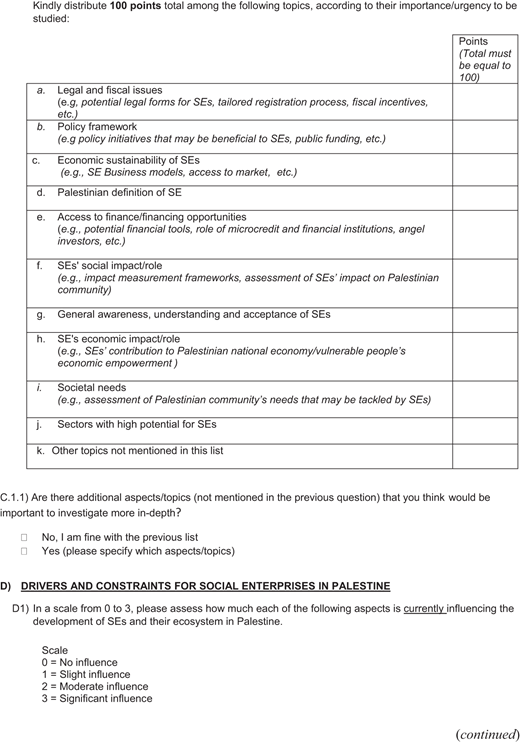
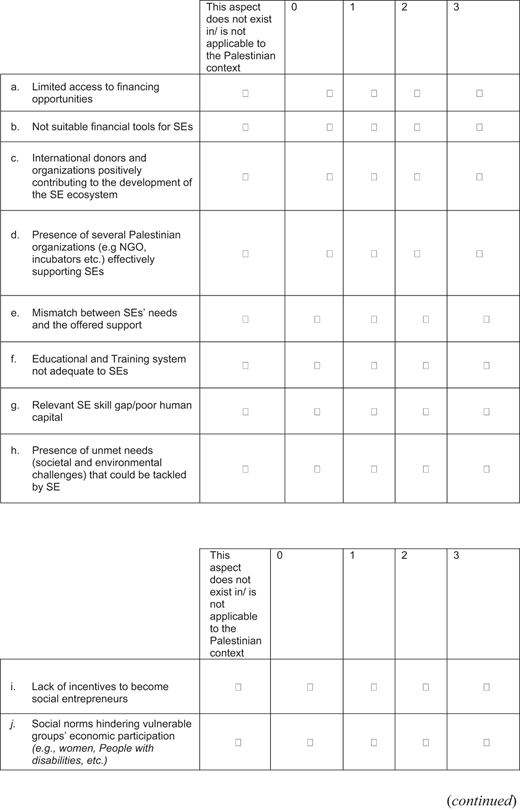
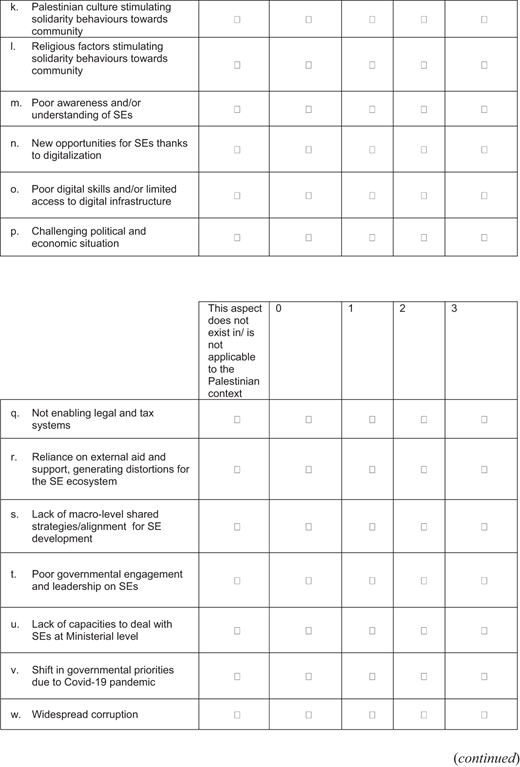
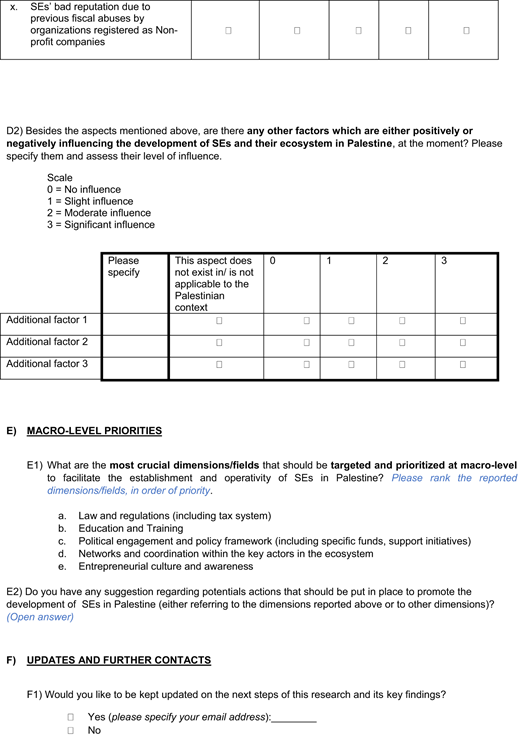
The third set of questions aimed at prioritising the research topics identified in Step 4. To do so, respondents had to distribute 100 points among the topics and had the possibility to add, and give points to, other topics they deemed important. Section 4 covered the drivers and constraints for SEs in Palestine. A comprehensive list of determinants was provided, and stakeholders were required to assess the current influence of each aspect on the development of SEs and their ecosystem in Palestine, using a scale ranging from 1 “very limited influence” to 5 “great influence”. The final section addressed the most crucial dimensions that should be prioritised at the macro-level for the development of the sector. Such questions were also introduced in the KII of Step 3 to provide researchers with additional inputs for drafting the research agenda. The results were then analysed using STATA (Step 7).
After analysing the results, researchers drafted the agenda (Step 8) and organised a Restitution and Dissemination moment to the different stakeholders (Step 9; Figure 3).
4. Data analysis and results
This section presents the data analysis process and results of the KIIs together with the questionnaire administered to the stakeholders.
During Step 3, the key informants identified a total of 28 general topics worthy of research (Table 2), some of which were mentioned more frequently than others and some considered more relevant for Palestine.
Importance and relevance of topics to be researched according to the key informants
| Topic | KII mentions | Sum of points givento the relevance |
|---|---|---|
| Legal framework | 14 | 64 |
| Business models/economic aspects of SEs in Palestine | 8 | 36 |
| Definition of SE in Palestine | 7 | 31 |
| Access to finance/ financing tools and opportunities | 6 | 25 |
| SE awareness and acceptance | 5 | 21 |
| SE impact (social) | 4 | 16 |
| Societal needs | 3 | 15 |
| Features of enabling ecosystems (macro-level) | 2 | 10 |
| Success factors | 2 | 9 |
| Influence of Palestinian culture | 2 | 9 |
| Educational system | 2 | 9 |
| SE impact (economic) | 2 | 9 |
| Policy framework | 1 | 3 |
| Key stakeholders’ analysis | 1 | 3 |
| Sectors with high potentials | 1 | 4 |
| Health sector potentials | 1 | 4 |
| Success stories (from abroad) | 1 | 4 |
| Governmental role | 1 | 3 |
| SE support system | 1 | 4 |
| Environmental sector potentials | 1 | 5 |
| Social aspects of SEs in Palestine | 1 | 5 |
| SE impact (environmental) | 1 | 4 |
| Common understanding of SEs | 1 | 3 |
| Israeli occupation- related factors | 1 | 5 |
| Support for innovation | 1 | 5 |
| SE impact (social)+ economic | 1 | 4 |
| SE potential role | 1 | 5 |
| Private sectors’ involvement | 1 | 5 |
The researchers grouped similar topics to reduce their overall number and to highlight the most important ones. The results of the grouping led to the identification of the following topic list (Table 3).
Grouping of topics to be researched according to key informant interview
| No. | Topics | KII mentions | Relevance |
|---|---|---|---|
| 1 | Legal and policy issues | 14 | 64 |
| 2 | Economic sustainability of SEs | 8 | 36 |
| 3 | Palestinian definition of SE | 7 | 31 |
| 4 | Access to finance/financing opportunities | 6 | 25 |
| 5 | SEs’ social impact/role | 6 | 25 |
| 6 | General awareness, understanding and acceptance of SEs | 5 | 21 |
| 7 | SE’s economic impact/role | 4 | 18 |
| 8 | Societal needs | 3 | 15 |
| 9 | Sectors with high potential for SE | 2 | 10 |
| 10 | Macro-level enabling factors | 2 | 9 |
| 11 | Success factors of SEs in Palestine | 2 | 9 |
| 12 | Influence of Palestinian culture | 2 | 9 |
| 13 | Educational system: role and potentials | 1 | 5 |
| 14 | Private sectors’ involvement in SE: practises and potentials | 1 | 5 |
| 15 | Israeli occupation-related factors influencing SEs | 1 | 5 |
| 16 | Key stakeholders’ analysis | 1 | 5 |
To select the most important topics and include them in the questionnaire for the stakeholders, the researchers decided to insert a cut-off. A topic would be considered worth being included in the questionnaire if it received at least two mentions from the KII and totalled at least ten relevance points (which meant that at least two KII identified the topic as extremely relevant for the Palestinian context). By using this cut-off, the researchers selected nine most pressing topics to be researched (N1-8 in Table 2). Such topics were then translated into questions in the questionnaire ( Appendix_3_questionnaire).
As noted above, the questionnaire was distributed to 27 respondents knowledgeable of the SE sector, most of which were Palestinian (92.60%) and currently living in one of the governorates of Palestine (96%). There was a relatively equal gender representation, 48% of respondents were women. All the respondents were educated, possessing at least a Bachelor or equivalent degree. Of all respondents, 63% had previously worked or currently worked in a SE, 93% worked for one or more organisations providing technical support/training/consultancy to SEs and 44% carried out research activities for SEs and their ecosystem. Therefore, considering the expertise of the stakeholders and their involvement in the SE sector in Palestine, the questionnaire provides valuable information for the elaboration of a stakeholder-oriented and context-based research agenda for SEs.
When respondents were asked to outline the criteria defining SEs in Palestine, they gave responses that can be later used as a base to formulate a definition of an SE that considers the local environment. For example, results show that most stakeholders agree that the social and/or environmental mission should be explicit and the ultimate objective of the organisation (67%) and that business revenue is the fundamental way of generating income, but SEs can also rely on external funds such as donations and grants (67%). Stakeholders acknowledged that an SE should have a majority of paid staff (74%), and 22% expressed that an SE should have paid staff only. Regarding the market activity, stakeholders were less definite, although most agreed that a SE should engage in some kind of market activity, whether continuous or sporadic (93%). For 52% of respondents, market activity should be continuous and the unique activity of the SE; 52% stated that it should be not only a continuous activity but also complementary to other non-market activities, and 30% expressed that the market activity can be sporadic and residual compared to non-market activities. Regarding the participation of stakeholders in the decision-making process of an SE, the respondents stated that the stakeholders should be involved in the processes and discussions (59%) or just informed about the actions implemented by the organisation (44%). In addition, only 19% of respondents stated that there should be a formal participatory governance not based on capital ownership.
Respondents were then asked to allocate a total of 100 points across ten topics, with the intention of determining the most pressing topics to be investigated in the field of SEs and their ecosystem in Palestine. The results show that the most critical topics to be researched, according to the stakeholders working in the field of SEs, are Legal and Fiscal Issues, Economic Sustainability of SEs, General Awareness and Understanding and Acceptance, respectively, although all ten topics were considered worthy of future research. Table 4 presents the ranking of the main topics of the Research Agenda developed through the participatory process with the stakeholders working in the field of SEs.
Ranking of most relevant aspects of a research agenda for social enterprises in Palestine
| Topics | Points allocated |
|---|---|
| Legal and fiscal issues | 492 |
| Economic sustainability of SEs | 354 |
| General awareness, understanding and acceptance | 258 |
| Palestinian definition of SE | 256 |
| SEs’ social impact/role | 254 |
| Access to finance/financing | 252 |
| Policy framework | 250 |
| Societal needs | 224 |
| SE’s economic impact/role | 188 |
| Sectors with high potential of SEs | 163 |
The biggest constraints of SEs in Palestine identified by the stakeholders are: “Poor awareness and/or understanding of SEs”, “The challenging political and economic situation”, “The poor governmental engagement and leadership on SEs” and “Lack of capacities to deal with SEs at Ministerial level”.
Finally, according to 56% of stakeholders, the most crucial dimension to be targeted and prioritised at the macro-level to facilitate the establishment and operability of SEs in Palestine is Law and Regulations. It was followed by Education and Training which was ranked first by 19% of the respondents.
Some other suggestions regarding potential actions that should be put in place to promote the development of SEs in Palestine included: “putting in effect a clear policy regarding SEs in the new upcoming entrepreneurship laws”; “Establishing a legal framework, with a strong and effective judicial system, as soon as possible, coupled with an easy process to register as a SE”; “adding Social Enterprises on the Ministerial Agenda”; and “raising awareness through training in the Palestinian community regarding the impact and benefit of SEs.”
After analysing all the results, the researchers drafted the following research agenda for SEs in Palestine (Table 5). The research agenda comprises 33 research questions to better substantiate the general topics identified by the stakeholders. Research questions were decided by the research team by triangulating information coming from the literature review, KII and the results of the questionnaire. The research agenda was then shown and discussed with stakeholders during the final event of the project and subsequent meetings.
Research agenda for social enterprises in Palestine
| Topics | Research questions |
|---|---|
| Legal and fiscal issues | -Under which legal form(s) should SEs be introduced in Palestine? Should SEs co-opt existing legal forms or a separate legal form should be created for SEs? -How can fiscal policy stimulate SEs in Palestine without having distortive effects? -What laws and regulations, even not directly referring to SEs, could be introduced to enhance the development of SEs? -How does an ineffective and inefficient judicial system affect SEs? |
| Economic sustainability of SEs | -Are current SEs in Palestine economically sustainable? -What are the key drivers of success for Palestinian SEs? -What business models could be adopted by Palestinian SEs to enhance their economic sustainability? To what extent are sustainable SE models replicable and/or scalable? -How does the political situation of Palestine affect the economic sustainability of SEs? What are the survival strategies of SEs in Palestine in the face of multiple crisis? -What is the role of international donors in the economic sustainability of SEs? -Which type of support should the Palestinian SEs be endowed with to improve their economic sustainability? Who are the key SE ecosystem actors that should be involved in this process? |
| General awareness, understanding and acceptance | -What are the cultural and religious factors that help/hinder the development of SEs in Palestine? -How do awareness and acceptance of SEs in Palestine vary according to personal factors such as gender, age, religion, place and education? -What is the perception of SEs among the business (or other type) community in Palestine? -How can the education system in Palestine support building awareness and knowledge of SEs? |
| Palestinian definition of SE | -Should there be a formal definition of SE for Palestine? -How should a Palestinian definition of SE differ from internationally accepted definitions of SE? |
| SEs’ social impact/role | -What is the potential and/or actual social impact of SEs in Palestine? -What are successful examples of impactful SEs in Palestine? -How SEs’ impact could be measured in Palestine? |
| Access to finance/financing | -What funding sources are accessible to SE in Palestine? -How to develop new forms of financing for SEs in Palestine? |
| Policy framework | -What are the best policies to promote SEs in Palestine? -What policies adopted by other countries, could be adopted in Palestine? -How does an unclear policy framework affect the development of the SE ecosystem in Palestine? |
| Societal needs | -Which social needs do/should SEs in Palestine address? -How can SEs in Palestine help to innovate the answer to social needs? |
| SE’s economic impact/role | -What could be/is the overall economic impact of SEs in Palestine? -What role could SEs play in the sustainable economic development of Palestine? |
| Sectors with high potential of SEs | -Are there any economic sectors which are more conducive for the sustainability of SEs? |
5. Conclusions
At present, research agendas in the field of SEs are typically developed by identifying gaps in the existing literature. However, if research agendas were built involving stakeholders within a specific region, then they would have the potential to further the Third Mission of Universities in support of SEs, bridging the gap between academic research and the needs of stakeholders in the SEE.
This paper presented an alternative methodology to build a research agenda, namely, the LPRA. This approach uses a participatory process involving stakeholders in the field of SEs to determine the most pressing topics to be researched regarding SEs and their ecosystem within a territory. The methodology underwent testing in Palestine, aiming to assess its viability and outcomes. While the resulting research agenda from this test may not be exhaustive, it serves as a valuable guide for researchers aiming to address critical questions posed by Palestinian stakeholders about SEs.
During the implementation of the methodology, certain aspects surfaced as areas for improvement in future applications. The first one relates to the involvement of the local academic community in the LPRA. While the primary emphasis of the LPRA should be on involving stakeholders beyond academia, omitting the involvement of the academia community from the outset could hamper a fast uptake of the research agenda by local researchers. It has to be underlined that despite the efforts of the researchers applying the methodology, the low involvement of the local academic community was also because of the low number of local researchers interested in SEs in Palestine at that time. The second noteworthy consideration is that it could be useful to ask stakeholders to not only identify the general topics to be researched but also propose specific research questions. This approach may reduce the research team’s involvement in defining the research questions and enhance the input of the stakeholders. It is worth noting, however, that stakeholders have differing capabilities of articulating research questions and that even in the best-case scenario researchers might still need to integrate stakeholder input with existing academic literature. The third point concerns the geographical context in which future LPRA development and stakeholder involvement will occur. Despite facing numerous challenges, Palestine has a much simpler SEE compared to other countries. The SEE in Palestine is in its early stages, resulting in a limited number of stakeholders to involve and academic literature on SEs specific to the region. On the contrary, more mature ecosystems (e.g. Italy and other European countries) could present challenges to researchers in terms of effort needed to engage a greater number of stakeholders and to navigate extensive academic and grey literature on SEs in the country.
The present methodology offers the advantage of involving local stakeholders, enabling their participation in the construction of knowledge and serving as a possible tool for researchers to fulfil the Third Mission of the university. Because of its participatory approach, the methodology could be particularly useful in the following situations: First, in contexts that have uncommon political, economic or social features and, therefore, need a tailored approach when building research questions and answers for local stakeholders. Second, in contexts where there are few or no local researchers interested in the topic of SEs, non-local researchers could use the methodology to mitigate biases stemming from the application of non-local perspectives, values and theoretical frameworks in the construction of knowledge that should serve local stakeholders. The third situation in which this methodology could prove to be useful is when the research is part of a larger set of activities aimed at developing the SEs ecosystem in a locality. In this case, the participatory approach allows for the continued engagement of local stakeholders and the creation of useful knowledge for the development of the ecosystem.
Additional research is needed to understand the methodology’s limitations and benefits and to further refine it. For instance, testing it across different SEEs could yield valuable insights into engaging larger and more diverse stakeholder groups. Conducting the LPRA during sensitive moments, such as major legal reforms in the SE sector, could provide information on how the methodology copes with power structures, incentives and self-representations of different groups.
The authors would like to thank the Agenzia Italiana per la Cooperazione allo Sviluppo (AICS) for funding this research as part of the “Start Your Business” project (AID 011867). The authors also extend their gratitude to Prof. Mario Biggeri of the University of Florence and Ms. Clara Blundell for their valuable support in reviewing and improving the paper. A special thanks goes to Feras Bali, Issa Ghrayeb, Raed Handal and Elias Mukarker from Bethlehem University for their invaluable support in the field research. Their dedication, insights and efforts were instrumental in the success of this study, and they deeply appreciate their contributions. The authors would also like to express their sincere appreciation to Luigi Bisceglie and Salvatore Guida from VIS NGO for their support and commitment to the project. Their guidance and assistance have been greatly beneficial in carrying out this research.
References
Further reading
Appendix 1
Research activities used for each paper in the literature review
| Future research avenues | ||
|---|---|---|
| Title | Author | Research activities |
| Agents of change? An inter-organisational research agenda on hybrid new ventures | Bergman B. | Normative literature review |
| A framework for antecedents of social entrepreneurial intention: Empirical evidence and research agenda | Bergner S., Palmer C., Devaney M. and Kruse P. | Integrative literature review and quantitative study |
| The Emergence of Dual-Identity Social Entrepreneurship: Its Boundaries and Limitations | Busenitz L.W., Sharfman M.P., Townsend D.M. and Harkins J.A. | Integrative literature review |
| Whose value? Problems in valuing social enterprise and research implications | Chandra Y. | Integrative literature review |
| Traversing the Terrain of Context in Social Entrepreneurship | De Bruin A. and Lewis K.V. | Integrative literature review |
| Social enterprises as hybrid organisations: A review and research agenda | Doherty B., Haugh H. and Lyon F. | Integrative literature review |
| Social impact scaling strategies in social enterprises: A systematic review and research agenda | Islam S.M. | Integrative literature review |
| Advancing research on project management in hybrid organisations: insights from the social enterprise literature | Jewer J., Jugdev K. and Amini M.F. | Systematic literature review |
| Social enterprises in quasi-markets: exploring the critical knowledge gaps | Mason C., Roy M.J. and Carey G. | Normative literature review |
| A mission of service: social entrepreneur as a servant leader | Petrovskaya I. and Mirakyan A. | Normative literature review and quantitative study |
| Managing social-business tensions: A review and research agenda for social enterprise | Smith W.K., Gonin M. and Besharov M.L. | Integrative literature review |
| A Bibliometric Analysis of Social Entrepreneurship and Entrepreneurial Ecosystems | Trabskaia I., Gorgadze A., Raudsaar M. and Myyryläinen H. | Bibliometric analysis |
| Seizing the moment—Strategy, social entrepreneurship, and the pursuit of impact | Williams T.A., Nason R., Wolfe M.T. and Short J.C. | Critical analysis of articles part of a special issue |
| Defining the Universe of Social Enterprise: Competing Metaphors | Young D.R. and Lecy J.D. | Integrative literature review |
| Emotions as the glue, the fuel and the rust of social innovation | Zietsma C. and Toubiana M. | Integrative literature review |
| Research agendas | ||
| Convergences and divergences in sustainable entrepreneurship and social entrepreneurship research: A systematic review and research agenda | Bonfanti A., De Crescenzo V., Simeoni F. and Loza Adaui C.R. | Systematic literature review |
| Social enterprises as rural development actors | Eversole R. and Duniam M. | Literature review and case study |
| A Systematic Literature Review of Technology Social Ventures: State of the Art and Directions for Future Research at the Micro-, Meso- and Macro-Level | Grassi E. and Toschi L. | Systematic literature review |
| Social entrepreneurship research: A review and future research agenda | Gupta P., Chauhan S., Paul J. and Jaiswal M.P. | Systematic literature review |
| Social Entrepreneurship in Tourism, Hospitality and Events: A State of the Art | Gürlek M. | Systematic literature review |
| Pathways to social value and social change: An integrative review of the social entrepreneurship literature | Hietschold N., Voegtlin C., Scherer A.G. and Gehman J. | Systematic literature review |
| Hybrid social entrepreneurship in emerging economies - a research agenda | Holt D. and Meldrum B. | Normative literature review |
| Integrated Organisational Identity: A Definition of Hybrid Organisations and a Research Agenda | Jäger U.P. and Schröe A. | Integrative literature review |
| Researching bricolage in social entrepreneurship | Janssen F., Fayolle A. and Wuilaume A. | Systematic literature review and critical analysis of articles part of a special issue |
| Towards a precise understanding of social entrepreneurship: An integrated bibliometric–machine learning based review and research agenda | Kaushik V., Tewari S., Sahasranamam S. and Hota P.K. | Bibliometric analysis |
| Social entrepreneurship organisations and collaboration: taking stock and looking forward | Kosmynin M. | Systematic literature review |
| Social entrepreneurship as a collaborative practice: literature review and research agenda | Kovanen S. | Systematic literature review |
| Gender and health social enterprises in Africa: A research agenda | McKague K. and Harrison S. | Rapid evidence assessment |
| Towards a geographical research agenda for social enterprise | Muñoz S.-A. | Normative literature review |
| Social Innovation | Nicholls A. and Dees J.G. | Normative literature review |
| Antecedents of the Social Impact of Social Enterprises: A Systematic Review and Agenda for Future Research | Quilloy K., Newman A. and Pyman A. | Systematic literature review |
| Social, Environmental and Sustainable Entrepreneurship Research: What Is Needed for Sustainability-as-Flourishing? | Schaefer K., Corner P.D. and Kearins K. | Systematic literature review |
| SOCIAL BUSINESS PERFORMANCE: IS IT POSSIBLE TO MEASURE? REVIEW AND RESEARCH AGENDA | Schmitt T. and Alberton A. | Systematic literature review |
| Reconsidering capitalism: The promise of social innovation and social entrepreneurship? | Shaw E. and de Bruin A. | Critical analysis of articles part of a special issue |
| Technological interventions in social business: Mapping current research and establishing future research agenda | Soni G., Mangla S.K., Singh P., Dey B.L. and Dora M. | Bibliometric analysis |
| Rural social enterprise — Evidence to date, and a research agenda | Steiner A., Farmer J. and Bosworth G. | Normative literature review |
| A review of entrepreneurship and circular economy research: State of the art and future directions | Suchek N., Ferreira J.J. and Fernandes P.O. | Systematic literature review |
| A Decade of Research Published in the Journal of Social Entrepreneurship: A Review and a Research Agenda | Weerakoon C. | Bibliometric analysis |