This paper adopts a project-based perspective to analyze how strategic renewal evolves in organizations over time. Projects are temporary resource-committing activities that deliberately impose changes on existing business operations and, thereby, generate strategic renewal. Projects can be empirically identified and are, therefore, suited for analyzing manifestations of deliberate and emergent strategies driven by employee behaviors that either comply with or deviate from the official strategy. In the article, we present 10 theoretically derived project categories that can be used to analyze strategic renewal through the enactment of different projects. We also discuss the implications and limitations of the project-based perspective for strategy research and management practice.
Introduction
MTV moved into user-generated digital content through a stealth project — the show “Top Selection” (Miller and Wedell-Wedellsborg, 2013). IBM recognized the potential of the internet early on because a gang of unlikely rebels initiated a project to transform the organization (Hamel, 2000). When USA Today reinvented itself for the internet age, it did so through a variety of projects (O’Reilly, III and Tushman, 2004). These examples from the internet revolution illustrate that strategic renewal can be effectuated through discrete projects, but an exhaustive project-based perspective has not yet been deployed to study strategic renewal.
One fundamental issue in strategic management is firms’ behavior (Rumelt et al., 1994). We argue that a project-based understanding of strategic renewal addresses how strategy is enacted in practice. In so doing, we posit that a project-based understanding can provide insights into several key issues related to strategy. Projects entail decisions with potential strategic consequences and show the “interdependence between contemporaneous decisions, across the decisions of other economic actors, and across time” (Leiblein et al., 2018). Projects are the “vehicles” that bring the firm to the arenas in which it will compete. As such, they are “the means for attaining the needed presence in a particular product category, market segment, geographic area, or value-creation stage” (Hambrick and Fredrickson, 2001, p. 51). Consequently, a focus on projects as the unit of analysis can improve our understanding of how strategic renewal is enacted in practice, thereby helping to explain firms’ behavior as they move toward new competitive arenas. The development of a project-based perspective on strategic renewal also answers the call from Trigeorgis and Reuer (2017, p. 59) to “focus more on the individual project and the business unit as the unit of analysis.”
The strategy literature has attempted to understand strategic renewal through the lens of practices and routines as recurring processes (e.g., Teece et al., 1997). However, organizations do not enact new strategies solely by employing routines, although routines can play an important role. They also develop new business activities by pursuing and executing a multitude of projects (e.g., Felin, 2016; Mirabeau and Maguire, 2014; O’Reilly, III and Tushman, 2004). This makes a project-based analytical lens highly relevant when investigating strategic renewal as a source of firm-specific organizational outcomes. In fact, strategic renewal itself has been referred to as “a project” (Binns et al., 2014). A project is temporary and finite in nature with a terminal point of activity. It differs from conventional routines (i.e., ongoing activities) in several ways, although project work can entail simple routines, such as decision rules (e.g., Eisenhardt and Martin, 2000). Hence, a project-based perspective is arguably a key approach to understanding strategic renewal.1
Projects are more closely related to the explorative execution of (new) opportunities than the exploitation of existing routines (O’Reilly, III and Tushman, 2011). In other words, they are temporary and ad hoc. In the extant strategy literature, the project-based perspective has almost exclusively been associated with the implementation of intended strategic plans or as an exception to specific studies of emergent (unplanned) projects (e.g., Mirabeau and Maguire, 2014). However, a project-based perspective is much broader and covers a full spectrum of project types, including planned, emergent, autonomous, compliant, and deviant projects. As such, this perspective bridges theory and practice to view projects as a means of enacting strategy in organizations (e.g., Englund and Graham, 1999), as supported by the fact that too many initiatives and poor project management skills have been named key barriers for successful strategy implementation.2 The project-based perspective therefore offers nuanced insights that can extend the strategy literature and practice (DeFillippi and Arthur, 1998).
Strategic renewal reflects a change in a firm’s strategy content, course, and capabilities (Agarwal and Helfat, 2009; Floyd and Lane, 2000). It has been defined in a variety of ways. For instance, Argawal and Helfat (2009, p. 282) posit that, “strategic renewal includes the process, content, and outcome of refreshment or replacement of attributes of an organization that have the potential to substantially affect its long-term prospects.” Volberda et al. (2001, p. 160) argue that “strategic renewal can be broadly defined as the activities a firm undertakes to alter its path dependence.” In a similar vein, Schmit et al. (2016, p. 5) define strategic renewal as “the process that allows organizations to alter their path dependence by transforming their strategic intent and capabilities.” Floyd and Lane (2000, p. 155) argue that “strategic renewal is an evolutionary process associated with promoting, accommodating, and utilizing new knowledge and innovative behavior in order to bring about change in an organization’s core competencies and/or a change in its product market domain.” We draw on these perspectives to define strategic renewal as “a change in strategic course, content and/or capabilities enacted through organizational projects, processes, and/or practices.” In so doing, we connect the outcomes of strategic renewal (i.e., a change in course, content, and/or capabilities) with the means (i.e., projects, processes, and/or practices).
Strategy has long been linked to projects (e.g., Andersen, 2013; Englund and Graham, 1999; Pellegrinelli and Bowman, 1994), but early manifestations of the project-based perspective were applied to the implementation of intended strategies in deliberate planning processes. For example, Hewlett–Packard (HP) emphasized systematic project management in which projects were viewed “as a system of interrelated activities that combine to achieve a common goal” with the aim of “fulfill[ing] the overall strategy of the organization” (Englund and Graham, 1999, p. 52). We define projects as “intentional and temporary resource-committing actions that occur alongside an organization’s ongoing operations to achieve new outcomes.” A more detailed explanation of this definition is provided in the next section.
In addition to the planning view of strategy, a few notable studies in the extant literature demonstrate that autonomous projects can alter a strategy by forming an emergent path (e.g., Burgelman, 1983, 1996; Mintzberg, 1978; Mintzberg and Waters, 1985; Mirabeau and Maguire, 2014; Mirabeau et al., 2018). These studies provide granular insights into specific ventures or emergent projects, but they do not focus on the sum of the different types of projects that together form an organization’s strategic-renewal process.
We build on these contributions to develop a comprehensive conceptual framework of strategy-inducing projects. In so doing, we address the following research questions:
How can a project-based perspective (refine and) extend extant views on strategy formation?
Which project types can be identified and studied as (different) strategy-formation mechanisms?
Hence, this study contributes in three major ways. First, it introduces a project-based perspective on strategy as a promising avenue for studying strategic renewal. We show how a project-based perspective relates to and extends various views of strategy. In particular, this perspective views projects as relevant units of analysis for the study of strategic renewal, which has substantial theoretical implications. Second, the paper identifies different types of projects based on the extant literature and offers an analytical framework that encompasses 10 distinct project types. Third, we contribute to discussions of how firms behave (Rumelt et al., 1994) and suggest that projects are the “vehicles” that enable organizations to reach new competitive arenas (Hambrick and Fredrickson, 2001).
In the remainder of the paper, we explicate the background of this perspective and outline our proposed framework. First, we describe the evolution of the field of strategy and discuss why it makes sense to shift from a resource-based view to a project-based view. Second, we define, position, and review projects in the context of strategy. Third, we develop a project typology based on a review of the strategy literature. Fourth, we discuss that model and present a research agenda for a project-based view of strategy. Finally, we consider our study’s contributions and implications for strategic management.
From a Resource-based View to a Project-based View
While routines have long been used to explain the origins of strategic renewal, we argue that they are not the sole mechanism that can explain this phenomenon. Strategic renewal is often caused by groups or individuals initiating ad-hoc projects. This points to an alternative perspective on the path to strategic renewal and changes in strategy content. However, the interplay between routines and projects is intricate, as a new project may create a basis for the subsequent development of new routines and capabilities. Therefore, a project-based perspective can uncover important elements in the explanation of strategic renewal. This introduces a new analytical lens in which projects are the “vehicles” that drive strategic renewal (Hambrick and Fredrickson, 2001).
The strategy field is characterized by eclectic perspectives that observe and define the concept from multiple angles and adopt a wide range of units of analysis (e.g., Mintzberg, 1987). The notion of “microfoundations” is recognized in explanations of dynamic capabilities (e.g., Teece, 2007) and is seen as a way to “decompose macro-level constructs in terms of the actions and interactions of lower-level organizational members” to better “understand how firm-level performance emerges from the interaction of these members” (Foss and Pedersen, 2016, p. 22). In a similar vein, we suggest that projects constitute useful lower-level units of analysis for strategic renewal, which is consistent with the view of strategy as a pattern in a stream of resource-committing decisions and ensuing actions throughout the organization (Mintzberg, 1987). The project-based perspective on strategic renewal represents a concrete materialization of strategy formation. It is consistent with the strategy literature and uses projects as the appropriate unit of analysis in the field of strategic entrepreneurship (Casson and Wadeson, 2007; Foss and Klein, 2018).
The strategy field has focused on the intricate role of dynamic capabilities as the adaptive mechanisms organizations use to respond to environmental change (e.g., Collis, 1994; Eisenhardt and Martin, 2000; Pisano, 2015; Schilke et al., 2018; Teece et al., 1997; Winter, 2003; Zollo and Winter, 2002). Various attempts have been made to explain the nature of dynamic capabilities (e.g., Collis, 1994; Schilke et al., 2018) and disentangle them from related constructs, such as operational capabilities and ad-hoc problem solving (e.g., Winter, 2003). However, consensus on this conceptual challenge is lacking (Peteraf et al., 2013). According to Eisenhardt and Martin (2000), dynamic capabilities in moderately dynamic markets resemble conventional routines, while they are simple and highly experiential routines in high-velocity markets. Although the literature highlights several relevant contingencies, it arguably offers fragmented conceptual clarifications in this regard (Peteraf et al., 2013).
We argue that these challenges can be overcome, at least in part, by looking at projects as an essential and concrete means of renewal when organizations respond to changing conditions. Projects represent a very visible empirical materialization as strategic renewal unfolds in organizations. Several real-world examples illustrate how strategic renewal comes about as an outcome of one or several projects that were not predominantly developed or managed by specific routines. For instance, CIBA Vision, a unit of Novartis, successfully renewed itself through six radical projects — four focused on product development and two revolving around new manufacturing practices — that were kept separate from the routines of daily operations (O’Reilly, III and Tushman, 2004). Projects are new, human-induced initiatives that make things happen and, thereby, change the status quo. To the extent that routines are applied in project work, they may be less related to the conventional conception of routines and more comprised of simple decision rules combined with highly experiential activities (Eisenhardt and Martin, 2000). In sum, as units of analysis, projects have the potential to provide a strong research methodology that can deliver sound explanations for strategic-renewal efforts in organizations.
Definition of Projects
According to the Cambridge Dictionary (2017), a project is “a piece of planned work or an activity that is finished over a period of time and intended to achieve a particular purpose.” Several aspects of this definition deserve explicit consideration. First, a project is intentional, as it intends to “achieve a particular purpose.” Second, a project is temporary, as it is “finished over a period of time.” Therefore, it is different from repetitive and recurring processes or routines. Third, a project comprises implementation and execution (work and activities) where such resources as human effort and ingenuity are committed to achieve a purpose that may be manifested in new physical structures, systems, or operating practices. In other words, a project entails purposeful commitment of resources over a given period of time. Consequently, the strategy literature often views projects as formal mechanisms that can coordinate predefined strategic objectives and ensure that the organization reaches those objectives (see, e.g., Andersen, 2013; Morgan et al., 2007). Similarly, a (recognized) project can be linked to management-control systems, and entail diagnostic or interactive dynamics that can stimulate communication among management levels (Goold and Quinn, 1990; Simons, 1994).
Based on these considerations, we define projects as follows:
Projects are intentional and temporary resource-committing actions that occur alongside an organization’s ongoing operations to achieve new outcomes.
This definition combines the elements of intent, resource commitments, implementation, and temporary and, thereby, differentiates projects from ongoing day-to-day operations, longer-term plans, and general visions (Table 1). It echoes the elements typically emphasized in other project definitions (e.g., Morgan et al., 2007) but adds that projects entail the implementation or execution of actions to achieve new ends that differ from the status quo.
Our definition focuses on temporary efforts that commit resources to actions with the purpose of achieving new outcomes. As such, it relates to the literature that perceives strategy as resource-allocation processes and real-options trajectories (Bower and Gilbert, 2007; Bowman and Hurry, 1993).3 The temporal dimension of projects is particularly relevant for strategists, as projects are implemented over (sometimes longer periods of) time, which implies a beginning and an end. Another characteristic of projects relates to their projection toward a future outcome or preferred end state, which is apparent in the etymological origins of the word project. Consequently, the activities involved in a project — and the related analyses, decisions, and plans — make projects intentional and their execution deliberate, at least for those who initiate and execute them. Although the decision is intended and the implementation is deliberate, a project in itself does not necessarily reflect the intended strategy of the organization, as an individual or a group of people can decide to pursue an autonomous project and deliberately work to execute it outside the official strategy. Such projects are not part of the planned strategy. This is evident in a study of a telecommunications provider by Mirabeau and Maguire (2014), where a manager launched a real-time data metrics project although it did not fit with the predefined strategic plan. That project ultimately became part of the emergent strategy.
Projects and strategy represent two levels of analysis — strategy looks at the formation of firm-level outcomes, while projects are the manifestations of initiatives that will add up to those aggregated firm-level outcomes. Therefore, what may be intentional at the project level can emerge unintentionally at the strategy level because local (lower-level) decision-makers may have the power and resources needed to engage in projects without direct recourse to a higher-level strategic plan. As projects are time-limited endeavors focused on changing the status quo, they differ from day-to-day operations, which are often more continuous in nature and tend to support current business activities. This aspect also distinguishes projects from business processes (Malone et al., 1999).
Our project definition makes it possible to link the aggregated effects of many projects to strategic outcomes, as the activities associated with the various projects will eventually constitute the organization’s realized strategy. The concrete activities carried out in a portfolio of projects focus on “refreshment or replacement of attributes of an organization that have the potential to substantially affect its long-term prospects” (Agarwal and Helfat, 2009, p. 282) and, thus, lead to strategic renewal. In the words of Shenhar et al. (2001, p. 703) “projects in the future will become the engines that drive strategy into new directions.” This resonates with our definition of a project as a concrete move toward new outcomes.
Positioning of the Project-based Perspective
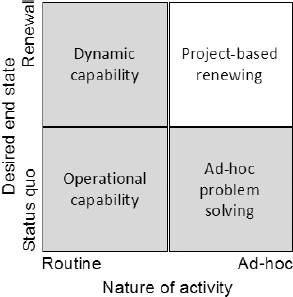
We can distinguish between different strategy formation approaches by focusing on the desired end state and the nature of the activities involved in achieving that end state (Figure 1). The desired end state can be to manage current operations and maintain the status quo or to introduce renewal by changing current operations. The nature of the activity aimed at reaching these end states can predominantly involve repetitive routines with the potential to create economies or largely ad hoc, non-repetitive responses to unique situations. The application of routines to maintain the status quo reflects the use of operational capabilities, while routines utilized to renew existing operations constitute dynamic capabilities (e.g., Helfat and Winter, 2011; Teece et al., 1997; Teece, 2007). This terminology is well established in the strategy literature. In addition, Winter (2003) identifies ad-hoc problem solving as an approach to dealing with unexpected surprises and helping the firm return to the status quo. Similarly, the fourth quadrant in Figure 1 comprises ad-hoc activities where the desired end state is renewal, which corresponds to the project-based perspective of strategic renewal.
A capability is often equated with “a high-level routine (or collection of routines)” where a routine is conceived as a “behavior that is learned, highly patterned, repetitious, or quasi-repetitious, founded in part in tacit knowledge — and the specificity of objectives” (Winter, 2003, p. 991). Dynamic capabilities are defined in a multitude of ways, which has led to widespread academic debate about the validity of the construct (Schilke et al., 2018). We adopt the original definition of dynamic capabilities presented by Teece et al. (1997, p. 516) as constituting “the firm’s ability to integrate, build, and reconfigure internal and external competences to address rapidly changing environments.” This draws on Winter’s (2003) definition of a capability as a high-level routine. Hence, a dynamic capability is a routine that leads to a new end state, while an operational capability is an economizing repetitive routine used during daily operations to maintain the status quo. As Cepeda and Vera (2007, p. 426) suggest, operational capabilities relate to “how you earn your living.”
Winter’s (2003) notion of ad-hoc problem solving, or “firefighting,” is concerned with “putting fires out” so that the organization can return to its prior operational status. Ad-hoc problem solving aims to revert to the original operating state and it is a one-time activity that differs from daily routines. Finally, the concept of project-based renewal captures largely non-routinized activities aimed at renewing and changing current business operations. The four strategy-formation approaches (i.e., operational capabilities, dynamic capabilities, ad-hoc problem solving, and project-based renewing) represent distinct conceptual archetypes.
As alluded to above, the interplay between projects and capabilities can be quite intricate. Helfat and Peteraf (2003) suggest that the evolution of organizational capabilities should be seen through the lenses of the capability life cycle (CLC). They argue that, “The concept of a capability as a set of routines implies that in order for the performance of an activity to constitute a capability, the capability must have reached some threshold level of practiced or routine activity […] Taking a first cut at an activity does not constitute a capability.” (Helfat and Peteraf, 2003, p. 999). Following this line of reasoning, we argue that projects aimed at change represent the so-called “taking a first cut at an activity” needed to develop a capability over time. In other words, a project will typically reside in the “founding and development” stage of the CLC, albeit projects can also be utilized in the renewal, redeployment or recombination of mature capabilities (Helfat and Peteraf, 2003).
Projects in Strategic Management
Strategy research has implicitly alluded to “projects” as a strategy-formation construct (e.g., Bower and Gilbert, 2005, 2007; Burgelman, 1983; Mirabeau and Maguire, 2014), although it has not received explicit attention in comprehensive analyses of strategic renewal. However, references to a project society and the projectification of organizations (Gareis, 1989; Jensen, 2009; Jensen et al., 2016; Lundin et al., 2015; Midler, 1995) suggest that projects are considered an essential aspect of modern management. Although strategy practice may be dominated by the implementation of planned projects (e.g., Andersen, 2013; Englund and Graham, 1999; Pellegrinelli and Bowman, 1994), the literature has been rather vague about the roles of different projects in the strategy process (DeFillippi and Arthur, 1998). This can have important implications for the study of strategic renewal and responsiveness (e.g., Agarwal and Helfat, 2009; Bettis and Hitt, 1995; Teece, 2007; Teece et al., 1997), as projects are the essential means of enacting organizational change (Shenhar et al., 2001, p. 703). The use of projects as an explanans and strategic renewal as an explanandum can provide a valuable perspective for studying how strategic change occurs in organizations. It also resonates with attempts to use projects, rather than opportunities, as the proper unit of analysis in entrepreneurship studies (Casson and Wadeson, 2007; Foss and Klein, 2018). Explicit theorizing about the roles of different project types in the complex strategic-renewal process can arguably bridge the divide between practice and theory, as strategy entails the dynamic management (or lack of management) of multiple projects over time.
The project perspective is related to studies of strategic (project-investment) decisions (Bower and Gilbert, 2005, 2007) in which the commitment of resources is viewed as a driver of strategic outcomes. Burgelman (1983) shows how (low-level) business ventures can become highly influential elements in the official (realized) strategy. Hence, different types of projects can serve as mechanisms for the execution of concrete strategic actions, such that the realized strategy evolves from patterns in resource-committing decisions (e.g., Mintzberg, 1978).
A real-options perspective can complement the strategy-as-projects view, as real-options reasoning considers the effects of sequential and irreversible deployments of resources (Bowman and Hurry, 1993; Mintzberg, 1978). A concrete initiative, an opportunity, or a business proposition can be conceived as a real option in which inherent flexibilities (e.g., staging of commitments, switching of resources, decision deferrals) can be analyzed as options (Andersen et al., 2014). The real-options perspective focuses on irreversible resource-committing decisions and the options embedded in a chain of incremental choices. However, it does not examine the specific handling of real options in different types of strategy projects. As the execution of strategic decisions typically involves a collection of projects, a real-options perspective can uncover essential flexibilities, while a project-based view can be used to analyze how resources are committed across different projects to form the realized strategy.
A Typology for Analyzing Strategy as Projects
The extant strategy research points to numerous project types with different implications for the strategy-making process. Here, we synthesize the strategy literature and identify a typology of different project categories as specific mechanisms for strategic renewal, which can be used to analyze the realization of strategy. We note that “ typology refers to conceptually derived interrelated sets of ideal types … each of which represents a unique combination of the organizational attributes that are believed to determine the relevant outcome(s)” (Doty and Glick, 1994, p. 232). Typologies are not always “just” classification schemes — they can meet the criteria for complex theorizing and become a theoretical frame by: (i) identifying constructs, (ii) specifying relationships between the constructs, and (iii) making those relationships falsifiable (Doty and Glick, 1994). Therefore, we can use a typology as a theoretical frame to understand how strategic outcomes are formed. In the following, we review the extant literature on strategy formulation with the ultimate aim of developing a typology for analyzing strategy as projects.
Strategy Formulation
Strategy formulation is focused on conscious analyses intended to lay out a predetermined course of action (e.g., Andrews, 1971; Chandler, 1962). It is an analytical exercise based on causal assumptions that precedes strategy implementation. The resulting strategic plan outlines the projects needed to pursue a certain strategic course as well as action plans. Hence, “what a company is doing — its de facto strategy — can be summed up by identifying the group of projects in which it invests” where the “projects are temporary initiatives that companies put into place alongside their ongoing operations to achieve specific goals” (Morgan et al., 2007, p. 3).
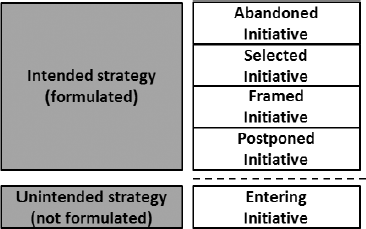
A good strategy often details what a company should not do or what it should stop doing (Porter, 1996). We refer to this thematic category as abandoned initiatives (Figure 2). It is important to determine what the organization should deemphasize in the strategy, which is typically expressed in concepts like divestment effectiveness (Nees, 1981), boundary systems (Simons, 1994), strategic tradeoffs (Porter, 1996), exit rules (Eisenhardt and Sull, 2001), and must stops.
Many visible projects reflect consciously selected initiatives, which are referred to in the literature as intended strategies (Mintzberg, 1978), induced initiatives (Burgelman, 1983), deductive management (Nonaka, 1988), or deductive reasoning (Regnér, 2003). These actions comprise consciously formulated initiatives that outline an intended strategic course, and their implementation is often monitored using diagnostic management-control systems (Simons, 1994).
Other work shows how projects can emerge that are in line with the official strategy but not guided by detailed plans from the strategy-formulation process. These framed initiatives encompass such concepts as logical incrementalism (Quinn, 1980), middle-up-down management (Nonaka, 1988), guided evolution (Lovas and Goshal, 2000), strategy as simple rules (Eisenhardt and Sull, 2001), planned emergence (Grant, 2003), responsible autonomy (Fairtlough, 2005), must-win battles, and effectuation (Sarasvathy, 2008). Framed initiatives often result in the establishment of a combination of boundary and belief systems (Simons, 1994) that are essential for “clan” control (Goold and Quinn, 1990). Framed initiatives can arise when the organization provides the freedom to respond to changing conditions but maintains coordination and alignment (Grant, 2003).
Initiatives can also be adjusted, reconfigured, and even consciously put on hold as postponed initiatives, as reflected in concepts like strategy as real options (Luehrman, 1998), strategy as active waiting (Sull, 2005), and deferral options (Andersen et al., 2014). Initiatives can be postponed as a consequence of environmental uncertainties, unforeseen developments, and resource constraints that may justify a wait-and-see position. They can also be postponed due to disappointing outcomes, a lack of resources, or changed priorities.
In addition to the projects derived from the strategy-formulation process, the literature acknowledges that strategy can emerge in entirely unintended ways if new risks and opportunities arise that were not foreseen in the formulated strategy. We refer to these types of initiatives as entering initiatives (Figure 2). This phenomenon includes strategic issues and surprises (Ansoff, 1975, 1980), inductive management (Nonaka, 1988), inductive reasoning (Regnér, 2003), and transformative (non-predictive control) strategies (Wiltbank et al., 2006). Some of these projects correspond to “autonomous initiatives” (Burgelman, 1983) and are comparable to adapting (Wiltbank et al., 2006) and stealth innovation (Miller and Wedell-Wedellsborg, 2013) where initiatives evolve under the radar. Moreover, many autonomous initiatives never become part of the formal strategy. They may simply vanish without much notice. Such initiatives are referred to as ephemeral initiatives, as they reflect ephemeral autonomous strategic behavior (Mirabeau and Maguire, 2014). Although entering initiatives arise after a strategy has been formulated and, therefore, lie outside the intended strategy, the organization can still consciously initiate activities and projects to proactively prepare for future emergent initiatives. Projects can be initiated in the formulated strategy with the aim of being prepared for issues that may arise along the way.
Strategy Formation
Not all aspects of a formulated strategy are realized as intended and many aspects of a realized strategy might not have been part of the formulated strategy. This results in an emergent strategy (Mintzberg and Waters, 1985). As a strategy can emerge and take form along different routes, we need to consider these more informal aspects of strategy formation.
For instance, employees who conform to strategic directives are more likely to follow the formulated strategy than rebellious employees, who may engage in deviant behavior to counteract the strategy. In either case, employees may simply try to exploit (new) opportunities by launching autonomous initiatives (Burgelman and Grove, 1996) or pursue pet projects in stealth mode (Miller and Wedell-Wedellsborg, 2013). The phenomenon of employee rebellion is documented in narratives of organizational transformation (Courpasson and Thoenig, 2010). Therefore, the conceptual (and empirical) dichotomy between compliant and deviant behavior is relevant when studying the formation of strategies from a project perspective.
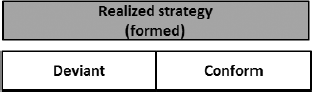
Strategy formulation implies that the strategy is made, thought through, and outlined before the organization takes action to implement it. Another perspective on strategy arises when we study how strategy actually unfolds and takes form through actions that affect the way the organization carries out its business over time (e.g., Mintzberg and McHugh, 1985). We categorize these initiatives as realized (and non-realized) projects, and we determine whether the initiatives are deviant from or conform to the intended strategy (Figure 3). Warren (2003) refers to this as conformity and deviance, and it is related to the concept of “creative deviance” (Mainemelis, 2010). These behaviors can eventually influence strategic outcomes.
Broad organizational support for a formulated strategy is believed to improve the execution of strategic plans (Hambrick and Cannella, 1989; Sull, 2005). The support of middle managers is important because they may engage in deviant behavior if their self-interests are compromised by the strategic plan (Guth and Macmillan, 1986). Although this is an example of destructive deviance, deviance can also be constructive (Warren, 2003). For instance, constructive deviance was documented at Intel in the early 1980s when low-level actors embarked on autonomous initiatives that shifted Intel’s strategic focus toward the evolving market for microprocessors (Burgelman and Grove, 1996). A similar phenomenon was observed at IBM, where the organization’s evolution toward becoming an e-business powerhouse was instigated by a group of frontline employees who started an insurrection aimed at turning the business around (Hamel, 2000). In other words, it is likely that “ideas originate with employees located closer to the bottom of the organizational hierarchy who come up with creative solutions and applying those solutions to resolve problems or pursue opportunities” (Self et al., 2010, p. 17). An extreme example of deviant behavior is a “corporate coup” in which a minor group (often employees) succeeds in replacing a current leader. Deluga (1987, p. 9) explains that “the coup is planned and executed without the leader’s knowledge or public awareness in order to prevent a counter-attack by the target executive.” Whether the deviant behavior is constructive or destructive is often only apparent in hindsight.
In sum, employee deviance is not necessarily unjustified and destructive — it can be constructive. As noted by Goold and Campell (1998), if local managers choose not to cooperate with strategic initiatives introduced from the top, it is not necessarily a sign of attitudinal ailment. Such managers may have good, justifiable reasons for their lack of cooperation. Deviant behavior can have both positive and negative effects on firm performance, and the same is true for compliant behavior (Warren, 2003). An example of destructive compliance is found in the notion of “functional stupidity” in which employees restrict their cognitive capacities in certain myopic ways that reduce their reflexivity and judgment (Alvesson and Spicer, 2012). In other words, employees may blindly comply with directives and routines without raising valid doubts.
As the compliant and deviant behavior of employees is a key dimension of strategy formation, it is useful to assess projects in this light. Therefore, we focus on whether a specific behavior is instrumental to a specific project categorized as predominantly deviant or compliant. The framework covers a single strategy-formulation cycle as well as the subsequent formation and realization of strategic outcomes.
Analyzing Project Portfolios
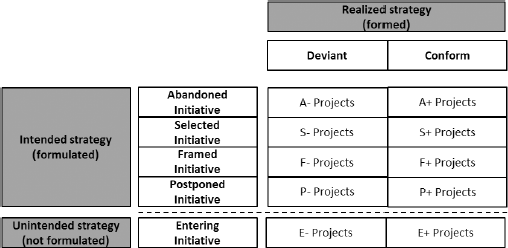
We now develop a comprehensive typology for project categories for both deliberate and emergent strategies with either deviant or compliant behaviors. The typology identifies distinct project types that together can form the basis for analyzing the strategy-formation or strategic-renewal process. This typology encompasses 10 distinct project categories (Figure 4) that make it possible to follow strategic renewal.
The typology enables us to identify and map the various projects pursued by an organization as a basis for analyzing how projects achieve different outcomes and affect the realized strategy. The unit of analysis is the individual projects, the execution of which constitutes the strategic-renewal process in the organization. All of the categories are defined and related to concepts in the literature (Table 2).
Table 2 provides definitions and an overview of the literature in relation to each of the project types derived in Figure 4. As such, it describes the current state of the strategy field in relation to the a priori deduced categories of the matrix in Figure 4. The matrix provides a conceptual language for describing different types of projects in the context of strategic renewal. Therefore, it represents a first step in explicitly studying strategic renewal from a project-based perspective.
An example of how a project-based analysis could be carried out can be found in HP. HP has a streamlined approach to project management. This often results in S+ projects, as the projects are selected and prioritized in accordance with their fit with strategic goals. Their implementation is continuously monitored (Englund and Graham, 1999). For instance, Englund and Graham (1999) describe how a project related to a new line of computer systems was governed by a cross-organizational council that resolved architectural issues and resource conflicts. However, not all projects from the intended strategy were implemented as planned. In one high-profile S — project, HP was moving a division from SAP to a centralized ERP system. However, HP’s solution was affected by programming glitches, which resulted in a significant increase in the order backlog. HP did not have enough manual workarounds to meet customer demand. Although this was not a result of employee resistance, it was arguably a result of employee deviance from procedure. Hence, the project was a failure.4 HP has similarly witnessed the emergence of A— projects. One well-known project in this regard involved the engineer Charles H. House, who worked on a project focused on a large-screen electrostatic monitor, which he was officially told to abandon in the formal strategy. However, he continued to work on the project, which eventually provided HP with access to a new market (House and Price, 2009).
In recent years, HP has experienced internal turmoil, industry changes and subsequent uncertainty, resulting in various strategic initiatives being postponed, resulting in a multitude of P— and P+ projects.5 F—, F+, E—, and E+ projects are also found at HP, as individuals seek to use existing processes to launch their own pet projects. As noted by Englund and Graham (1999, p. 63): “Sometimes people have a pet project and use the process to justify its existence, or a hidden agenda may be at play — perhaps the need to maneuver among colleagues, trading projects for favors.” Moreover, our ‘conform vs. deviance continuum’ seems to make sense for HP’s project portfolio as well, as Rivas and Gobeli (2005) find both enablers and barriers to different kinds of strategic projects at HP. Hence, in a large organization like HP, the typology can provide a conceptual language useful for analyzing and discussing several kinds of projects and their influence on the strategy (see the Appendix for additional examples of each type of project).
Discussion
This study attempted to conceptualize strategy from a project-based perspective. As such, it argued for the use of projects as a relevant unit of analysis when studying how strategic renewal unfolds in organizations. The project-based perspective provides a more nuanced analytical lens that promises a better understanding of how strategic renewal unfolds in organizations. By viewing the realization of strategy as derived from an amalgam of different types of projects, we argue that strategy formation can be analyzed through the activities that an organization (consciously and subconsciously) pursues from a diverse portfolio of concrete, identifiable projects. To operationalize this approach for subsequent empirical work, we developed a conceptual typology of project categories, drawing broadly from the extant strategy literature. This enabled us to establish a framework with relevant language for conceptualizing the projects of any organization. This typology can link projects to specific strategy trajectories, thereby providing a detailed description of the micro-foundational influences on strategic renewal. Hence, this paper presents a way to apply a project-based perspective to the strategy-formation process and introduces a general frame for studying strategic renewal by analyzing various types of projects.
The study contributes to the literature on strategic renewal by providing a new conceptual perspective and methodological approach. The use of a project-based perspective to better comprehend and analyze the execution of strategy is relevant for the strategic management field. It can also answer a number of research questions. For instance, by breaking down the influences of specific projects as they play out across firm-specific portfolios of distinct projects, the project-based strategy perspective can offer new insights about key elements of the strategy-formation process associated with competitive advantage. It holds the potential to uncover the missing link(s) between strategic planning (formulation) and strategic implementation (project execution) as influenced, in part, by many other previously overlooked project types in the portfolio. It may provide insights into the roles played by official and unofficial project leaders, as the diverse projects are executed with the aim of bringing about strategic renewal. These opportunities relate to research questions that arguably go beyond those raised in current strategy debates. The framework and typology developed here can serve as a first step in research focused on these important research questions. Although projects long have figured in the strategy literature, their role has typically been linked to formal strategy implementation, while the much broader influence of various project types that typically go unnoticed is downplayed or ignored in studies of strategic renewal.
The issues linked to concrete projects should be familiar to most practitioners, as projects are the “vehicles” they employ to enact strategic actions on a daily basis. Consequently, a project-based perspective on strategy may help bring strategy research and practice together. If we view strategy formulation through the lens of projects, we may be able to establish closer ties between planning and implementation. A project-based perspective can link formulated strategies to actions through project-related activities. This highlights the need for managers to pay attention to the existence of different types of projects, and to try to understand the interdependencies between projects and their (official and unofficial) leaders. In reality, project-based activities may be one of the most essential elements in strategic management, as they constitute the means to realize strategic outcomes. While this statement should be debated in the academic literature, it is less controversial to acknowledge that projects make up a substantial part of strategy-making in practice. Moreover, because of their widespread use in practice, projects deserve explicit attention in strategy research.
A Research Agenda
The ideas and arguments presented in this essay are intentionally provocative, as we seek to spur thought-provoking, pre-paradigmatic debate around canonical questions in strategy, in line with the mission of Strategic Management Review (Leiblein and Reuer, 2020). Hence, it is our ambition that our essay will inspire future work and debate concerning projects in strategy.
We see ample room to undertake both conceptual and empirical research using a project-based perspective on strategy. Empirical studies can be used to validate the methodological approach. Moreover, the conceptual work may induce cross-fertilization across various aspects of strategic management by considering different types of projects and their influences on strategic outcomes as well as how managerial interventions can affect those outcomes. This highlights a first pressing research question:
Research question #1:How can we empirically validate the project-based perspective and uncover essential interdependencies among different project types?
Although this paper offers support for a project-based view of strategy, empirical work is needed to fully establish the methodology of the strategy-as-projects concept by considering different contextual settings as contingencies that may influence the approach. Moreover, empirical work is needed to further examine the accuracy of the categories outlined in the matrix, while additional conceptual work is required to strengthen the framework and the conceptual boundaries between the project categories. Consequently, we suggest that future research should seek to replicate the project types listed in our exhibits, as doing so would help further strengthen and validate the conceptual basis of project-based strategy. Moreover, future research could design a natural experiment for the typology in order to test the causality of different projects on strategic renewal. Furthermore, the typology could be further developed into an operationalized taxonomy which could be empirically tested and verified in different settings.
Another relevant next step might be to combine the strategy-as-projects categories with the three organizational archetypes proposed by Lundin et al. (2015). In other words, it might be useful to relate the strategy formulation-formation matrix to the three organizational archetypes of project-based organizations (PBOs), project-supported organizations (PSOs), and project networks (PNWs). An empirical study utilizing these concepts could illustrate the diffusion of various project categories among the different organizational types. Moreover, Agarwal and Helfat (2009) distinguish between discontinuous and incremental strategic renewal — project patterns might differ between these two types of renewal. Hence, future studies may investigate the various trajectories of different types of renewal projects.
Research question #2:How can we increase consciousness about project inter-dependencies and enhance capabilities to manage them to ensure better strategic outcomes?
This paper proposes an analytical frame (projects as an explanans) and argues that projects influence strategic outcomes (strategic renewal as an explanandum). However, the proposed framework does not explicitly deal with conscious attempts to coordinate or manage (possibly subconscious) linkages across the projects, which may explain how different strategy-making patterns can be reflected in particular compositions of project categories (Goold and Campell, 1998; Malone et al., 1999; Pedersen and Ritter, 2018). Therefore, interdependencies and coordination can be a focus of future studies.
Research question #3:How can we develop a better understanding of the role played by deviance across the portfolio of different project types?
As most of the boxes in the matrix are discussed in the extant literature, the matrix can serve as an umbrella that covers many contributions in the strategy field. However, two of the proposed project categories have not yet been treated in the extant strategy literature: postponed projects that are continued (“P- Projects”) and framed projects that are subject to deviant behavior (“F— Projects”). These two project categories appear essential for understanding how deviant (employee) behavior influences specific projects and project outcomes, which can then help to explain differences in strategy formation and realization. Moreover, the categories can have different developmental trajectories in organizations as well as different implications for both strategic renewal and the employees involved in the projects. We need further research to enlighten us on these matters.
Contributions and Implications
This study contributes to the strategy literature in three important ways. First, we argue that a project-based perspective of strategy is different from established approaches to analyzing strategy-formation processes and that it provides a fruitful way to study strategic renewal. Second, we develop a matrix that distinguishes among different project types found in an organization’s project portfolio. This matrix is derived from a study of the strategy literature that discusses the roles of projects and their influences on and relationships with strategy formulation and formation. Third, we show that projects act as “vehicles” for concrete strategic-renewal efforts and that they may drive organizations toward new competitive arenas, possibly influenced by more or less deviant behaviors.
The study has several implications. The proposed project typology promises to be an effective way to gain more detailed insights into strategy formation through the execution of projects. It also represents a potential tool for corporate decision-makers wishing to better understand the intricacies of ongoing business initiatives in their organizations. It is particularly promising as a way to analyze strategy-making in high-velocity environments, as strategy may be launched in the form of many small, short-cycled projects rather than as a large, uniform, centrally planned strategic project. Hence, a project-based perspective on strategy can help organizations become more responsive to environmental changes linked to an analytical focus on strategic renewal. However, more studies are needed to develop these specific uses.
Moreover, the implications of deviance for employees in the various project categories are interesting. An employee may face different consequences depending on whether deviant behavior is related to an abandoned initiative (e.g., continuing to work on a project despite managerial orders to stop), a selected initiative (e.g., refusing to work on a project despite managerial orders to do so), or a postponed initiative (e.g., continuing to work on a project that has officially been put on hold). It is therefore relevant to distinguish among types of deviant behavior in the different project categories. This suggests that employee “mavericks” may want to consider “selling” a project as belonging to a certain project category, as the categories provide different options for rebellious action. This is a promising area for future research that can cross-fertilize the literature streams on constructive and destructive deviance as well as issue selling.
Additional research into the project typology is also needed, as we find conceptual arguments for why the different project types are important for strategic renewal. Such research may fill out the contours of our study by applying our conceptual categories and empirically testing them in rigorous analyses.
Appendix A
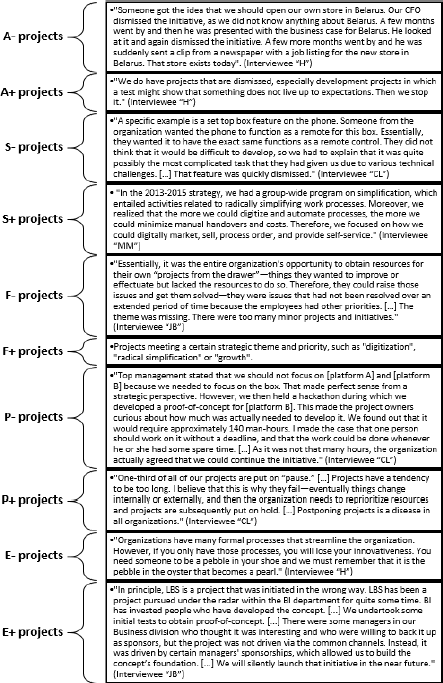
Although this is a conceptual essay, we also tested the typology for face validity in two companies. Below are some of the illustrative examples of projects described by a variety of respondents in the two companies.
We acknowledge that organizations may have routines for dealing with projects. However, a project is, by definition, temporary and outside the scope of current operations. Consequently, projects that focus on a comprehensive strategic reorientation are likely to rely more on experiential activities than routines (Eisenhardt and Martin, 2000). While highly standardized processes for projects exist (e.g., Prince2 and Stagegate), we argue that these routines are ill-suited for strategic-renewal projects.
For example, real options often focus on business opportunities that require the commitment of resources. A real option can be exercised. After the organization commits to the business opportunity, it is executed through a project. Hence, in our definition, an option may be the initial decision to allocate resources to develop a prototype, while the subsequent development and implementation of that decision is a project.