


Emerging optics technologies account for an extraordinary 27.1 per cent growth rate
Emerging optics technologies account for an extraordinary 27.1 per cent growth rate
Diffractive optics,optical computing, and holography represent three areas of emerging optics technology that are poised for significant growth. In general, optics technology began to emerge from laboratories in the 1980s, and through the mid-1990s grew to serve a niche market of high-end specialised applications, mostly within the defence complex. However, in recent years, optics technology has begun to push beyond these niche applications into mainstream optics and consumer products. These technologies stand to figure prominently in the development and implementation of emerging applications such as telemedicine, enhanced entertainment and computing products, and sophisticated promotional projects. In addition, there are still substantial market opportunities in established applications such as the defence industry, where constantly evolving surveillance, communications, and guidance systems require the most advanced optics technologies.
According to a soon-to-be-released Business Communications Company, Inc. study, RG-211, Optics Markets: Diffractive Optics, Optical Computing, and Holography, the market for the three broad areas of emerging optics technology (diffractive optics, optical computing, and holography) is valued at US$140.4 million in 1997 and is forecast to increase to US$590 million in 2002, representing an average annual growth rate (AAGR) of 27.1 per cent (see Table II).
BCC concludes that revenue growth in diffractive optics will be stimulated by its penetration into new commercial and consumer applications, including telecommunications, industrial processing, medical, and CCD cameras. Currently, applications of diffractive optics are dominated by defence and government-related products. Sales of diffractive optics elements are valued at US$18.8 million in 1997 and are projected to increase to US$130.2 million in 2002 at an AAGR of 38.14 per cent.
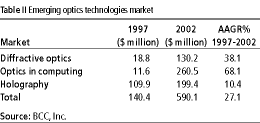
The technologies comprising optics in computing include miniature reflective displays based on spatial light modulators, holographic or volumetric data storage and optical interconnects. Miniature displays have begun to enter the commercial marketplace, initially in high end projection displays. The market for optics in computing applications was valued at US$11.6 million in 1997 and is projected to increase to US$260.5 million in 2002, an AAGR of 68.1 per cent.
BCC points out that holography includes both the standard two-dimensional holograms, as well as emerging technologies of three-dimensional projected displays with full motion and colour for medical and entertainment applications. Currently, the primary market for holography is security or anticounterfeiting tags, but growth in entertainment and advertising applications is expected to create new opportunities and markets in this sector. Revenues for holographic optics are valued at US$110 million in 1997, and are forecast to grow to US$199.4 million in 2002, an AAGR of 10.4 per cent.
RG-211 Optics Markets: Diffractive Optics, Optical Computing and Holography was published in June 1997 and was priced at US$3,150.
For further information contact Michael Harris. Tel: 001 203 853-4266; Fax: 001 203 853 0348; mjhbcc@aol.com

