Policies aiming to control the COVID-19 pandemic framed health guidelines as prosocial behaviors. This research aims to explore whether contextual cues reminding of the COVID-19 pandemic can activate prosocial goals unrelated to the pandemic. It is hypothesized that COVID-19 reminders, such as mask-wearing images, will increase prosocial behavioral intentions.
Five studies (N = 956) test the hypotheses. Study 1 tests whether consumers chronically concerned with the pandemic show higher prosocial intentions. Studies 2–5 test if COVID-19-related media cues increase prosocial intentions when compared with control conditions.
Consumers chronically concerned or exposed to pandemic-related cues showed higher prosocial behavior intentions, were willing to donate more money and showed a higher preference to consume in smaller businesses. This tendency persisted after health policies ceased and was not explained by concerns with the pandemic or mortality salience, suggesting it may result from simple semantic associations between the COVID-19 pandemic and prosocial goals.
Subtle contextual cues can be used to promote prosocial behaviors benefiting from previous associations between health policies and prosocial goals. Future research should further explore the mechanism underlying the reported effect and explore other associations between prosocial behaviors and contextual information.
Public health policies may be used for social marketing strategies and programs promoting prosocial behavior.
Prosocial intentions may be primed by contextual reminders of crises that are strongly associated to a need to act in a prosocial way, such as the COVID-19 pandemic.
This research provides new insights into the consequences of health policy programs focused on the promotion of prosocial behaviors. It also highlights how contextual cues associated with COVID-19 can prime socially responsible behaviors in different domains.
Introduction
On January 30, 2020, the World Health Organization (WHO) declared that the COVID-19 outbreak constituted a Public Health Emergency of International Concern, posing as an imminent threat to global health (WHO, 2020). Global efforts to control the pandemic and ensure public health often highlighted the need for individuals to behave in cooperation and put their individual behavior at the service of a common health goal (e.g. Glover et al., 2020). For the greater good, appeals to health-safety behaviors, such as wearing a mask in public or avoiding physical contact, became social cornerstones of the COVID-19 pandemic (e.g. Fischer and Karl, 2022). Consequently, during the pandemic, public policies built a strong association between the COVID-19 pandemic and the prosocial behaviors required to fight the health crisis. To illustrate, messages by the Portuguese government and municipalities such as “For the health of All! Be responsible! Comply with all recommended measures.”; “[… Keep social distance. Take care of yourself, take care of everyone.”; “Social distancing. Protect yourself and others, stay at home.”; or “The most important piece (jigsaw puzzle) are we all. Taking care of yourself is to take care of all” made clear appeals to cooperation and prosocial attitudes.
Framing this health crisis as dependent on individuals’ cooperative adherence to recommended public health measures may also have impacted other prosocial behaviors. However, whether this crisis can be used to promote other prosocial behaviors has been overlooked by previous research. The present research thus explores this potential consequence of such policies. As a unique contribution to the field, we examine whether merely thinking about the COVID-19 pandemic may activate general cooperation and prosocial goals, thereby increasing prosocial intentions in behaviors and domains unrelated to the pandemic, even after the end of the mandatory safety guidelines. Grounded in behavioral priming literature, five studies test whether exposure to contextual reminders of the pandemic, by increasing the salience of COVID-19-related thoughts, increases general prosocial intentions, and whether this tendency persists after the end of the pandemic.
Cooperation during the COVID-19 crisis
A large part of global efforts to deal with the pandemic focused on individuals’ social responsibility and the need for cooperation (e.g. Andreouli and Brice, 2022). Policymakers emphasized the importance of complying with norms of social/physical isolation, such as avoiding close contact with others or wearing safety masks. The implementation of these measures often relied on appeals to cooperation and prosocial responsibility, highlighting these as key factors to control the pandemic (Fischer and Karl, 2022).
Individuals cooperated, adhering to confinement measures and mask mandates (Zaki, 2020), with some engaging in additional prosocial actions such as helping vulnerable communities or handmaking masks (e.g. Aresi et al., 2022). These behaviors were perceived as promoting the “greater good” and became moralized (e.g. Graso et al., 2021). Indeed, while staying at home and mask use were perceived as ethical mandates and commitment to the common good (Calvillo et al., 2020), behaviors that potentially compromise those goals, such as failing to social distance, were found to elicit moral outrage (Davidson et al., 2020). Consistent with responses to past natural/epidemic crises showing an increase in prosocial actions, contributing to higher group cohesiveness (e.g. Drury, 2018), cooperation became an imperative reaction to the COVID-19 crisis. Indeed, such prosocial/cooperative behaviors developed during the pandemic resulted from a need to contribute at the society level and not necessarily from a need to help specific individuals. For instance, appeals emphasizing the benefits of different measures for society were more effective than those highlighting its individual benefits (e.g. Jordan et al., 2021; Zagefka, 2022).
Prosocial appeals also affected firms and consumer behavior, with companies responding with an unprecedented level of corporate social responsibility (Salam and Bajaba, 2022), and consumers showing sensitivity to such initiatives (Stadler-Blank et al., 2024) and seeking arguably prosocial consumption such as more sustainable and healthier products (e.g. Das et al., 2022; Dangelico et al., 2022).
These findings during the COVID-19 pandemic are consistent with the notion of “catastrophe compassion,” a widespread and consistent tendency to observe an increase in positive social behaviors in the face of negative circumstances such as earthquakes, war, terrorist attacks, hurricanes, tsunamis and pandemics (Zaki, 2020).
Despite the salient impact of the pandemic on people’s lives, thoughts and concerns about COVID-19 experienced a significant reduction over time. In the UK, after the initial lockdowns, rumination and worry related to COVID-19 were reported to have reduced significantly in six weeks (Prudenzi et al., 2023) and continued a steady decline for over nine months (O’Connor et al., 2023). Consistent with this progressive decrease in importance and accessibility in individuals’ minds, consumption of COVID-19-related news (Dan and Brosius, 2021) and online searches quickly decreased after an initial peak, despite increasing risk and cases (Bento et al., 2020). Different coping mechanisms (O’Connor et al., 2023), habituation or “issue fatigue” (Dan and Brosius, 2021) may have reduced attention toward the pandemic; however, thoughts and concerns about COVID-19 were likely to increase in response to contextual reminders, such as information about new lockdowns (Prudenzi et al., 2023).
The present research thus proposes that contexts promoting COVID-19-related thoughts may trigger general prosocial goals that will translate into prosocial intentions in domains beyond those directly addressing the COVID-19 pandemic. This hypothesis is grounded in two nonexclusive theoretical frameworks: behavioral priming and principles of ideomotor action (e.g. Bargh et al., 1996); and the terror management theory (TMT) (Greenberg et al., 1990).
Terror management theory
TMT (Greenberg et al., 1990) posits that individuals are cognitively aware of the inevitability of death and that their tendency for self-preservation may result in existential terror that is managed by giving meaning and value to life through an anxiety-buffering system consisting of maintaining their cultural worldviews, self-esteem and close relationships. Consistent with TMT, reminders of death (mortality salience) have been shown to increase commitment to one’s worldview, self-esteem and relationships and to increase defense of these entities against threats (see Burke et al., 2010 for a meta-analysis and Schindler et al., 2021; Treger et al., 2023 for replication attempts).
Thus, reminders of mortality may intensify the desire to express culturally prescribed prosocial behaviors and attitudes, as a way to affirm people’s faith in their cultural worldview and self-esteem (e.g. Jonas et al., 2002). For instance, following mortality salience, people gave more money to a charity supporting an ingroup cause (but not an outgroup) than people who had been exposed to an aversive control condition (Jonas et al., 2002, Study 2).
During the COVID-19 crisis, the possibility of dying from the virus was highly salient and evident in death toll statistics, vivid images of overburdened hospitals and testimonials from victims of the virus. From the perspective of TMT, this increased perceived risk of dying would contribute to most personal and socioeconomic problems that emerged during the pandemic (Pyszczynski et al., 2021), but it could also increase prosocial behavior as a way to cope with such mortality salience. Thus, contextual reminders of the pandemic may increase mortality salience and foster prosocial behavioral intentions.
Behavioral priming and prosocial behaviors
Another possible explanation for why COVID-19-related cues may increase prosocial behaviors is behavioral priming related to ideomotor principles (see Dai et al., 2023, for a meta-analysis). This hypothesis argues that the conscious mental representation of a behavior can enact that behavior. The activation of perceptual–conceptual representations would thus increase the likelihood of goals, plans and motor behavior consistent with those representations (e.g. Bargh et al., 1996). According to such processes, nonbehavioral concepts could also automatically activate behavioral representations in memory, and guide behavior, unmediated by conscious perceptual or judgmental processes (Bargh et al., 1996). A behavior that a person repeatedly performs in response to a particular situation might become associated in memory with the features of that situation, and the mere perception of the situation might automatically activate the respective behavior or intention (Bargh, 2014).
Different research has thus shown that behaviors and intentions, including prosocial behaviors, could be triggered or increased by priming concepts that were not closely connected to such goals/behaviors (Nelson and Norton, 2005; Mazar and Zhong, 2010). For instance, priming religion, through the word God, promoted prosocial behaviors like helping others and charitable donations (see Shariff et al., 2016). Similarly, the incidental exposure to the category “superheroes” was found to increase helping intentions (Nelson and Norton, 2005).
Consequently, we argue that contextual reminders of the COVID-19 pandemic may activate cooperative/prosocial goals associated with the pandemic through health policies that appealed to cooperation and prosocial behavior to fight the pandemic. The activation of such goals may then translate into intentions to act prosocially in different domains, such as helping others in need, increasing charitable donations or preferring more vulnerable businesses.
Hypotheses and studies overview
The present work argues that consumers associate the COVID-19 pandemic with cooperative, prosocial goals and behaviors because of the measures implemented to fight the pandemic, but also from individuals’ tendency to show compassion and respond prosocially when facing life-threatening catastrophes. Consequently, COVID-19-related thoughts may increase cooperation goals and prosocial intentions. Specifically, it is hypothesized that:
Higher tendency to think about the COVID-19 pandemic is associated with higher prosocial behavioral intentions.
Contextual reminders of the pandemic increase prosocial behavioral intentions, even in domains that are not responding to the COVID-19 pandemic.
Study 1 tests whether consumers showing higher concerns with the pandemic and consequently more likely to think about it, show higher intentions to act prosocially. Studies 2–5 test whether contextual reminders of COVID-19 increase generalized prosocial goals and behavior intentions. Study 2 tests whether COVID-19-related cues increase donation intentions. Study 3 tests whether COVID-19 reminders increase preference for socially responsible consumption options, such as shopping at local stores, when compared with big chains. Studies 4 and 5 test whether general prosocial intentions are higher for those participants exposed to COVID-19-related cues, while exploring mortality salience as an explanation for the effect. Finally, Study 5 tests whether the effect holds after COVID-19-related restrictions have ceased. This research thus proposes that prosocial responses toward health crises like the COVID-19 pandemic may be extended beyond the pandemic period and generalized to different situations of global crisis, where cooperation is quintessential.
The following studies were conducted with participants residing in Portugal. During the COVID-19 pandemic, the Portuguese social context was similar to that of many European countries (e.g. Moreira et al., 2021). The first state of emergency in Portugal was declared (Decree n.2-A/2020, 2020), imposing restrictions, containment and preventive measures, including curfews, appeals to wear a mask or social distancing (e.g. Cordeiro-Rodrigues, 2020; Lopes et al., 2021). This population was thus adequate for the test of the hypotheses; yet, current hypotheses are limited to similar geopolitical and cultural contexts (i.e. westernized cultures following WHO recommendations).
Study 1
The first study proposes testing whether the salience of COVID-19-related thoughts is associated with general prosocial goals. Based on the assumption that higher concerns with the pandemic are associated with more frequent and salient COVID-19-related thoughts, this study tests whether higher concerns with the COVID-19 pandemic predict general prosocial intentions.
Method
Two hundred thirty-four participants (age M = 43.58 years, SD = 14.62; 73% female, 27% male) voluntarily participated in this study. The study was shared on social media platforms for three days during the summer of 2020 (data from Studies 1–4 was collected between July 15, 2020, and of March 3, 2021). For all studies reported in this research, the survey was developed and distributed using Qualtrics (Qualtrics, Provo, UT, USA), and data was analyzed using IBM SPSS Statistics 29.
Concerns with the COVID-19 pandemic was measured with an eight-item, seven-point rating scale, assessing concerns with the different potential impacts of the pandemic (e.g. perceived health threat) and the importance of the sanitizing measures (e.g. importance of wearing a mask) (α = 0.81). Participants also completed a measure of the extent to which the COVID-19 pandemic was considered a social issue (α = 0.77) on an eight-item, seven-point agreement scale (e.g. “I believe that a joint effort is needed to end COVID-19 pandemic.”; “I believe that COVID-19 is a social problem”).
Finally, prosocial behavioral intentions were measured using a composite measure based on two different scales (α = 0.81): the four-item scale by Baumsteiger and Siegel (2019) (α = 0.74); and the five-item scale by Pavey and colleagues (2011) (α = 0.76). Both scales asked participants to rate their willingness to perform different prosocial behaviors, such as “Assist a stranger with a small task” (Baumsteiger and Siegel, 2019) or “Donate goods or clothes to a charity” (Pavey et al., 2011), using a scale from 1 – Definitely would not do this to 7 – Definitely would do this. Participants provided their age and gender. See Supplemental material for details. This and the following studies were exempted from ethical approval for being completely anonymous, not collecting data from vulnerable populations, not posing risks to participants, not collecting any personal sensitive data and not presenting experimental deception. See Supplemental material for procedural details regarding ethical considerations (Fischer and Vacanti-Shova, 2022). The data from Studies 1–5 publicly available at Link to the cited article.
Results
A linear regression of the composite measure of prosocial intentions on the COVID-19 concerns shows that higher concerns with COVID-19 are associated with higher willingness to perform prosocial behaviors [R2 = 0.037, F(1,227) = 2.75, p = 0.003, β = 0.193]. The same pattern was also evident for each of the prosocial intentions scale separately; the Baumsteiger and Siegel’s (2019) scale [R2 = 0.021, F(1,233) = 5.05, p = 0.026; β = 0.146] and the Pavey and colleagues’ (2011) scale [R2 = 0.034, F(1,227) = 7.97, p = 0.005, β = 0.185].
In addition, COVID-19 concerns were also found to be a significant predictor of the extent to which participants thought the pandemic was a social issue [R2 = 0.108, F(1,233) = 28.19, p < 0.001; β = 0.329]. Interestingly, perceptions of the pandemic as a social issue were a significant predictor of the composite measure of prosocial intentions [R2 = 0.083, F(1,227) = 20.52, p < 0.001; β = 0.289] [1].
Discussion
Study 1 shows that higher concerns with the COVID-19 pandemic are associated with higher intentions to engage in general prosocial behaviors. Higher concerns with COVID-19 were assumed to be associated with more frequent thoughts about the pandemic, making prosocial goals and intentions particularly accessible. Interestingly, individuals with higher COVID-19 pandemic-related concerns also see the pandemic more in terms of a social issue, which is consistent with the proposed association between the pandemic and the need to be prosocial. Nonetheless, individuals particularly concerned with the pandemic may show higher prosocial intentions, because they are experiencing specific or stronger emotional responses (e.g. Ye et al., 2020) or higher mortality salience (e.g. Jonas et al., 2002; Zaleskiewicz et al., 2015) related to the pandemic. Thus, to test if thinking of COVID-19 primes general prosocial goals due to the association between prosociality and the pandemic or due to pandemic-related feelings, Studies 2–5 manipulate the salience of the pandemic by contextually inducing COVID-19-related thoughts while measuring prosocial intentions and controlling for participants’ general concerns with the pandemic.
Study 2
In Study 2, it is tested whether contextual reminders of COVID-19 activate general prosocial goals and corresponding behavior intentions that are not directly respond to the pandemic, such as donations (e.g. Olivola and Shafir, 2013).
Method
Two hundred eighteen participants voluntarily took part in this study (Mage = 43.88, SDage = 15.38; 69% female, 31% male). The study was shared on different social media platforms in the summer of 2020 and was active for three days.
The study used a two-group between-subjects design. To prime thoughts related to the COVID-19 pandemic, we used a procedure similar to that of Goldsmith and colleagues (2019) to prime scarcity mindsets. In this procedure, participants are asked to imagine they stopped at a newsstand to buy a magazine and to choose one magazine from three similar options. The goal of the buying decision is to promote engagement in the task itself. In the COVID-19-reminder condition (treatment, n = 119), all three options depicted a cover directly addressing the COVID-19 pandemic. In the control condition (n = 99), all three options presented covers unrelated to the pandemic. For both COVID-19-reminder and control conditions, the magazine covers focused on a central figure, with minimal background elements or objects. In the COVID-19-reminder condition, the magazines depicted individuals wearing face masks; while in the control condition, individuals were depicted in conventional poses without face masks. All the covers used were real magazine covers. No manipulation check questions were asked. See Supplemental material for details. After choosing a magazine, participants were directed to a monetary donation task. Participants were randomly assigned to the COVID-19-reminder or control conditions.
Study 2 used a prosocial-goals measure where participants were asked to imagine they won a prize of 100€ and to decide how much of their winnings they would like to donate to charity, from 0 to 100€ (e.g. Olivola and Shafir, 2013). Subsequently, participants completed three control measures of COVID-19 concerns, rating on a scale from 1 – Not at all to 7 – Completely, how much they considered COVID-19 to be a threat to their health; how much they were concerned with the socioeconomic impact of the pandemic; and how much distress they were experiencing due to COVID-19. Finally, they reported their age and gender. Participants were also asked to quit their participation in the study if they had ever participated in a similar study.
Results
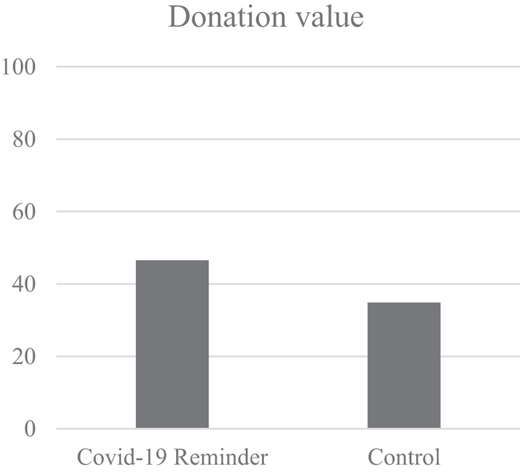
As predicted, participants in the COVID-19-reminder condition were willing to donate more of their prize to a charity (M = 46.50€, SE = 3.24, SD = 35.34) than participants in the control condition [M = 34.83€, SE = 3.16, SD = 31.42, t(216) = 2.55, p = 0.011, d′ = 0.35, 95% CI (2.65, 20.68)], as illustrated in Figure 1. No significant differences were found between the reminder and control conditions on perceptions of COVID-19 as a threat to self-health [Mreminder = 5.04, SDreminder = 1.41, Mcontrol = 4.97, SDcontrol = 1.62, t(216) = 0.35, p = 0.724], as a socioeconomic concern [Mreminder = 6.10, SDreminder = 1.09, Mcontrol = 6.03, SDcontrol = 1.18, t(216) = 0.46, p = 0.648] and on COVID-19-experienced distress [Mreminder = 4.45, SDreminder = 1.58, Mcontrol = 4.67, SDcontrol = 1.60, t(216) = 0.98, p = 0.327].
Discussion
Results from Study 2 indicate that participants in the COVID-19-reminder condition are willing to donate more of a hypothetical monetary prize to a charity than participants in the control condition who are less likely to be thinking of the COVID-19 pandemic. This finding suggests that exposure to COVID-19-related cues may activate general prosocial goals. Interestingly, this manipulation did not affect concerns with COVID-19, which could have accounted for the effect. COVID-19-related cues may thus increase COVID-19-related thoughts, activating prosocial behaviors that are generalized to pandemic-unrelated domains.
Study 3
Study 3 conceptually replicates Study 2 by further testing whether COVID-19 reminders facilitate prosocial consumer decisions, such as shopping at socioeconomically vulnerable local stores.
Method
Two hundred forty-one participants residing in Portugal (Mage = 40.59, SDage = 14.45, 63% female, 37% male) voluntarily took part in this study. The study was posted on social media platforms, and the link was kept active for three days during the summer of 2020. Participants were also asked to quit their participation in the study if they had ever participated in a similar study.
Study 3 used a two-group between-subjects design. It used a similar manipulation to that of Study 2, but presented newspaper covers depicting photos of individuals wearing face masks (treatment condition) or not (control condition) instead of magazine covers. See Supplemental material for details. Participants were randomly assigned to the COVID-19-reminder (n = 121) or to the control condition (n = 120). In Study 3, prosocial goals were measured through a task that required four consumption decisions, in which participants had to decide between purchasing an item (e.g. an apple) in a large business, such as a big-chain supermarket, or in a small business, such as a local grocery, using a scale from 1 – Definitely in the small business to 9 – Definitely in the large business. See Supplemental material for details. Participants were also asked to what extent they considered each business would face economic difficulties over the following 12 months on a scale from 1 – Not likely at all to 7 – Extremely likely. As a control variable, participants’ concerns with COVID-19 were measured using the same scale of Study 1 (α = 0.74). Demographics were collected.
Results
For each dependent variable, we aggregated the responses to the four examined products.
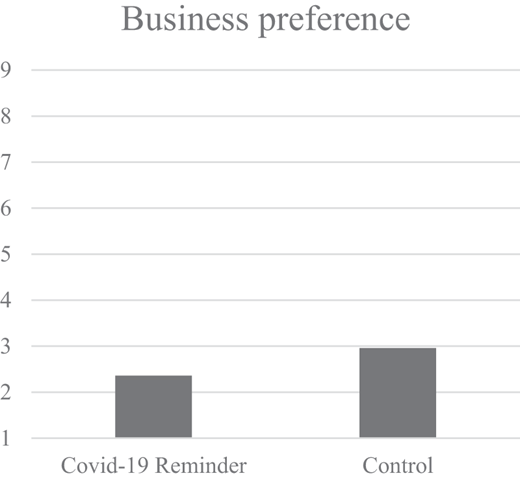
As predicted, participants in the COVID-19-reminder condition had lower preference for large business (M = 2.36, SE = 0.14, SD = 1.49) than participants in the control condition [M = 2.96, SE = 0.16, SD = 1.78, t(239) = 2.84, p = 0.005, d′ = 0.37, 95% CI (0.18, 1.02)], as illustrated in Figure 2.
COVID-19 concerns were not significantly different across the reminder (M = 5.76, SE = 0.07, SD = 0.78) and control condition [M = 5.64, SE = 0.07, SD = 0.76, t(239) = 1.18, p = 0.238]. An ANCOVA revealed that the effect of the COVID-19-reminder manipulation on business preferences holds when controlling for COVID-19 concerns [F(1,238) = 7.75, p = 0.006, η = 0.032], while COVID-19 concerns did not affect preferences [F(1,238) = 0.28, p = 0.596].
Comparisons within participants showed that participants also expected small businesses to more likely to experience economic difficulties in the next 12 months (M = 5.59, SE = 0.07, SD = 1.10) than large store alternatives [M = 2.96, SE = 0.07, SD = 1.15, t(240) = 24.37, p < 0.001, d′ = 1.57, 95% CI (2.42, 2.85)], supporting the assumption that preferring the small business is more consistent with prosocial intentions than preferring the large store. An ANOVA further revealed a non-significant interaction between business-type and the COVID-19-reminder condition (F < 0.001).
Discussion
Study 3 shows that exposure to COVID-19-related media cues increases preferences for more economically vulnerable businesses, suggesting the activation of prosocial goals in the marketplace. Again, concerns with COVID-19 do not seem to drive the effect, as these were not influenced by the pandemic reminder.
Study 4
Behavioral priming processes resulting from strong associations between COVID-19 and prosocial behaviors may explain why exposure to pandemic-related cues is associated to higher prosocial intentions. Nonetheless, according to TMT, an increase in death-related thoughts, may also explain increased prosocial intentions (e.g. Jonas et al., 2002). Study 4 thus replicates the previous studies while testing whether mortality salience can account for the reported effects.
Method
One hundred thirty-one university students residing in Portugal (59.5% female, 40.5% male, mean age = 22.23, SD = 1.71) participated in this study in exchange for course credit. Participants were also asked to quit their participation in the study if they had ever participated in a similar study.
Study 4 used the materials of Study 2 to manipulate the pandemic reminders, randomly assigning participants to one of the conditions in a two-group between-subjects design. Prosocial goals were measured using the four-item scale from Baumsteiger and Siegel (2019) from Study 1 (α = 0.65). An additional question asked to judge intentions to help small businesses on a scale from 1 – Definitely would not do this to 7 – Definitely would do this.
COVID-19 concerns were measured using the three items from Study 2: threat to self-health; socioeconomic impact; and COVID-19-related distress. Participants also rated how optimistic they were feeling about the end of the pandemic (1 – Not at all to 10 – Completely) and how many more months it would take until the end of the pandemic.
Finally, participants were presented a mortality salience scale (Greenberg et al., 1990) where they rated, on a scale from 1 – Not at all to 10 – A lot, how much they had thought of their own death; had emotions of fear; had unpleasant feelings; and thought about others’ death while choosing the magazine (α = 0.91). Demographics were collected.
Results
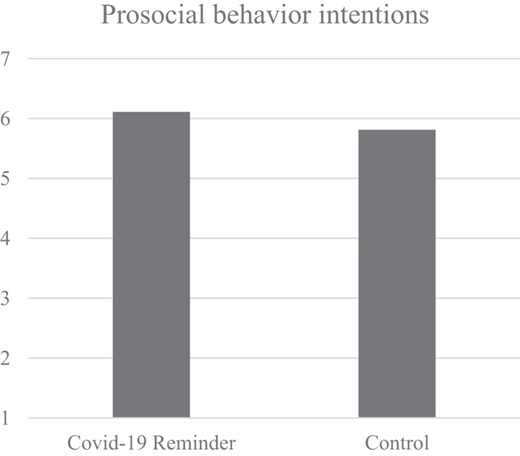
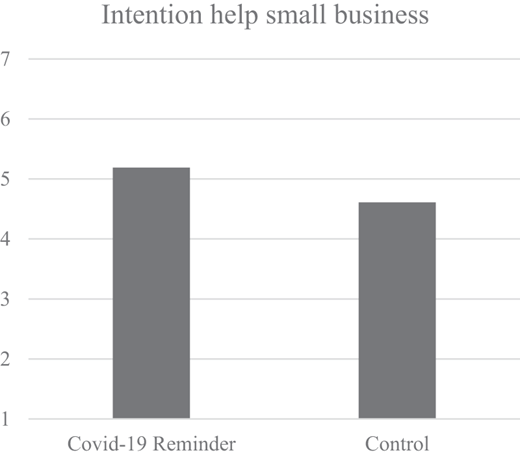
As predicted, participants in the COVID-19-reminder condition revealed significantly higher prosocial behavior intentions (M = 6.11, SE = 0.11) than participants in the control condition [M = 5.81, SE = 0.08, t(128) = 2.16, p = 0.033, d′ = 0.38, 95% CI (0.03, 0.57)] but also higher intentions to help small businesses than the control condition [t(128) = 2.37, p = 0.019, d′ = 0.42, 95% CI (0.10, 1.06)], see Figures 3 and 4.
No differences between the COVID-19-reminder condition and the control condition were found in participants’ optimism regarding the pandemic [t(128) = 0.60, p = 0.547], expected duration of the pandemic [t(128) = 0.32, p = 0.748], nor for the COVID-19-related concerns: threat to self-health [t(128) = 0.42, p = 0.678]; socioeconomic impact of COVID-19 [t(128) = 0.72, p = 0.473]; COVID-19-related distress [t(128) = 0.47, p = 0.641].
Mortality salience was significantly higher in the COVID-19-reminder condition [t(128) = 2.94, p = 0.004, d′ = 0.52, 95% CI (0.43, 2.20)], see Table 1. Nonetheless, an ANCOVA revealed that COVID-19 reminders still resulted in significantly higher prosocial behavior intentions when controlling for mortality salience [F(1,127) = 4.15, p = 0.044, η = 0.032]. Indeed, mortality salience did not significantly affect prosocial intentions [F(1,127) = 0.35, p = 0.853]. In addition, the impact of COVID-19 reminders on intention to help small businesses was also significant when controlling for mortality salience [F(1,128) = 4.58, p = 0.034, η = 0.035].
Discussion
Findings from Study 4 replicate Studies 2 and 3 indicating an increase in prosocial behavior intentions for participants in the COVID-19 reminders condition. However, Study 4 does not support the hypothesis based on TMT that this effect results from mortality salience, as prosocial intentions do not seem to result from such emotional responses toward pandemic-related cues.
Study 5
The observed tendency to show higher prosocial intentions after exposure to pandemic-related media cues is limited to a period within the pandemic before COVID-19-related restrictions/safety guidelines were removed and most of the population got vaccinated. Therefore, the association between prosocial goals and COVID-19 could have been particularly strong during the time in which the data from Studies 1–4 was collected, as the need to fight the pandemic was highly salient. Study 5 explores whether the effect persists in a post-pandemic context.
Method
One hundred thirty-two university students residing in Portugal (57.6% female, 41.7% male, 1% did not disclose their gender; age M = 23.86, SD = 4.37) participated in this study in exchange for course credit. The data was collected between January 18 and 24, 2023; six months after mandatory health-safety procedures, such as social distancing, ceased.
Study 5 used the procedure and materials from Study 4 with some minor changes. After the Baumsteiger and Siegel’s (2019) scale (α = 0.69) participants were asked to rate their intentions to engage in a series of ethical consumer behaviors (six-item scale, α = 0.87) including: buying ethically produced products, second-hand products, from local producers, from small businesses, from sustainable brands and fair-trade products.
COVID-19 concerns were measured using the same three items from previous studies (threat to self-health; socioeconomic impact; and COVID-19-related distress). In addition, participants rated the extent to which COVID-19 was a threat to others’ health; and their optimism regarding the pandemic’s end. Finally, mortality salience was measured with the same scale of Study 4 (α = 0.92). Demographics were collected.
Results
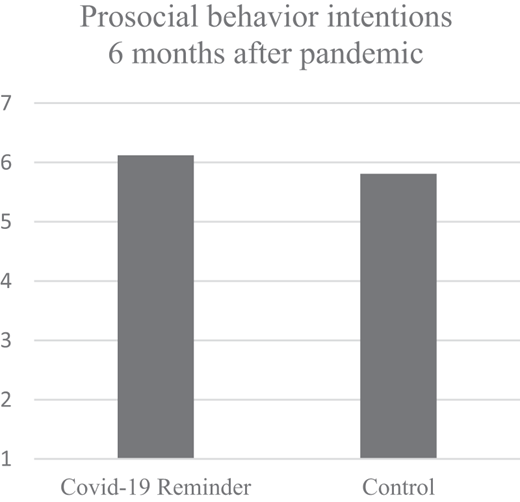
Participants in the COVID-19-reminder condition revealed significantly higher prosocial intentions (M = 6.12, SE = 0.09) than participants in the control condition [M = 5.81, SE = 0.11, t(130) = 2.10, p = 0.037, d′ = 0.37, 95% CI (0.02, 0.61)] six months after most of COVID-19-related safety guidelines had been waived, as seen in Figure 5.
However, there were no significant differences between groups on the ethical consumption scale [MCOVID-19 reminder = 5.55, SECOVID-19 reminder = 0.13; Mcontrol = 5.65, SEcontrol = 0.13; t(130) = 0.56, p = 0.576, d′ = 0.10, 95% CI (−0.26, 0.47)].
Participants in the COVID-19-reminder condition revealed higher mortality salience than participants in the control condition [MCOVID-19 reminder = 3.45, SECOVID-19 reminder = 0.29; Mcontrol = 2.45, SEcontrol = 0.30; t(130) = 2.39, p = 0.018, d′ = 0.42, 95% CI (0.17, 1.83)]. They also reported higher concerns with others’ health [MCOVID-19 reminder = 3.60, SECOVID-19 reminder = 0.20; Mcontrol = 3.28, SEcontrol = 0.17; t(130) = 3.10, p = 0.002, d′ = 0.22, 95% CI (0.25, 1.14)] and higher socioeconomic concerns during the pandemic [MCOVID-19 reminder = 5.85, SECOVID-19 reminder = 0.16; Mcontrol = 5.22, SEcontrol = 0.15; t(130) = 2.96, p = 0.004, d′ = 0.52, 95% CI (0.21, 1.06)]. No other differences between conditions were found {all t’s < 1, except for self-health concerns [t(130) = 1.23, p = 0.110, d′ = 0.22, 95% CI (−0.19, 0.83), see Table 2]}.
The effect of COVID-19 reminders is still significant after controlling for mortality salience [F(1,130) = 3.62, p = 0.059, η = 0.027], replicating findings from Study 4 suggesting that mortality salience cannot explain the observed effects.
Discussion
Study 5 shows that even after most restrictions were removed and appeals to cooperate and act prosocial ceased, exposure to COVID-19-related cues is associated with higher prosocial intentions. This suggests that associations between such behaviors and the pandemic built during its most critical stages were strong and stable, while highlighting the relevance of the reported effects in the long term. These findings are also consistent with evidence suggesting long-term effects of behavioral priming (e.g. Nelson and Norton, 2005). Finally, although mortality salience is higher in the COVID-19-reminder condition, this does not seem to explain prosocial intentions. See Table 3 for a summary of the results.
General discussion
The present research shows that exposure to stimuli depicting COVID-19-related imagery, and the higher salience of thoughts related to the COVID-19 pandemic, was consistently associated with higher reported prosocial intentions. People who chronically think about the pandemic or those who exposed to pandemic-related media cues show higher prosocial intentions and are more willing to donate to charity or to shop in more vulnerable businesses. The present studies further explored whether mortality salience could account for the observed increase in prosocial intentions in response to COVID-19-related cues but failed to find evidence supporting this mechanism. Indeed, the effect persisted regardless of higher concerns and mortality salience associated with COVID-19. Importantly, this effect was observed in prosocial behaviors that are not directly responding to the pandemic and replicated six months after COVID-19 safety measures and appeals to cooperation ceased. Although the present studies do not provide a direct test of the behavioral priming account, the reported findings are consistent with associative processes between COVID-19 and prosocial goals, whereby contextual cues argued to activate the concept of COVID-19 result in the activation of associated prosocial goals and corresponding behaviors. The present research thus suggests that policies framing the pandemic as a public health threat requiring the population to cooperate may have resulted in a strong and stable association between COVID-19 and general prosocial goals that may affect consumer behavior.
Theoretical implications
The present research contributes to the literature on prosocial behavior in response to crisis or catastrophic events, which has shown a tendency to prosocial cooperation in the face of adversity (e.g. Zaki, 2020). These studies explore how media cues of crisis events may activate prosocial behavior intentions, using the context of the recent COVID-19 pandemic to investigate this possibility. The observed indirect effects of pandemic-related cues on prosocial intentions are not only consistent with TMT and mortality salience effects (Greenberg et al., 1990) but also with behavioral priming research showing that contextual cues can activate prosocial behaviors (Shariff et al., 2016). Nonetheless, current findings show that participants consistently show higher prosocial intentions when exposed to pandemic-related media even when death anxiety is controlled for. This suggests that although the mechanisms underlying this effect remain unclear, mortality salience alone cannot account for it and that priming effects resulting from strong associations between the pandemic and prosocial responses may contribute to the effect. This behavioral priming account argues that the activation of perceptual–conceptual representations may increase the likelihood of goals, plans and motor behavior consistent with those representations (Bargh et al., 1996). The COVID-19 pandemic can be semantically and dynamically associated with acts of empathy, generosity and charitable giving. Irrespective of any attempt to manage their reputations, subjects may have automatically behaved more generously when these concepts were activated. Such association was likely promoted by public policies making prosocial appeals concerning specific behaviors to mitigate the pandemic, which may have strengthened the associations between the COVID-19 pandemic and general prosocial goals.
Implications for social interventions and policies
This research highlights how prosocial goals can be primed by contextual cues and how social policies may contribute to and explore such associations. Based on our findings, in future contexts of crisis, governments and institutions could intentionally and directly associate protective measures, such as using masks, social distancing or even avoiding excessive buying, with cooperation and prosocial values, to elicit generalization of prosocial behaviors. Yet, similar generalizations should not occur for messages instigating death-related fear or guilt for noncompliance with safety measures (e.g. “Have you been vaccinated? The virus doesn’t choose age or nationality” while showing a syringe as a gun barrel; “Killing homesickness may kill!”; or “You know who doesn’t miss a party? COVID!”; all used by Portuguese institutions). The current research highlights the possibility of increasing prosocial behaviors in response to catastrophes through behavioral priming and not necessarily as a response to death-related thoughts. Thus, even if high mortality salience helped establish a strong association between the pandemic and prosocial intentions, the possibility of building semantic and behavioral associations between social events and prosocial actions should be explored and leveraged to increase prosocial behaviors.
The present work further highlights how charities, social work institutions as well as small businesses can benefit from a prosocial frame of public health guidelines. For example, appeals to buy local could refer to a global health crisis to activate prosocial goals and facilitate choosing such options, using messages such as “When crisis are global, buy local!” or imagery with references to social distancing or safety masks.
It is noteworthy that the potential implications of the current findings may not apply to contexts where people cannot easily act with self-determination and according to their personal values, live in precarious conditions or in particularly individualistic cultures. Similarly, responses to mortality and prosociality may also vary depending on the meaning and exposure to death and mortality risks, like population suffering from armed conflict.
Limitations and future research
This research suggests that COVID-19-related media cues may increase prosocial intentions; however, it is noteworthy that findings from Studies 1–4 correspond to data collected during a period before countries removed COVID-19-related restrictions, and the population got vaccinated. This means the accessibility of COVID-19-related thoughts, death anxiety and prosocial intentions directly addressing active social policies were likely high, potentially challenging the post-pandemic relevance of current findings. It is thus important to highlight that even in such conditions, exposure to COVID-19-related media cues is associated with higher prosocial intentions, which is consistent with evidence that ruminations related to COVID-19 increased in response to contextual changes, like new lockdowns (O’Connor et al., 2023). Moreover, Study 5 addresses these concerns, replicating the effect six months after COVID-19-related restrictions were removed, and the social relevance of the pandemic was significantly reduced. Nonetheless, future research should further test the temporal limits of this effect.
It is noteworthy that social desirability is often present in studies measuring prosocial intentions, even in experimental designs. Here, participants exposed to COVID-19-related cues could have experienced higher social desirability pressures and acted accordingly. Nonetheless, if social desirability explained current findings, this would suggest that COVID-19-related cues increase individuals’ need to display prosocial behaviors even if for impression management reasons. This points to an alternative or additional explanation based on a potential association between COVID-19 and higher social policing or a sense of being monitored by others that could activate reputational concerns and increase prosocial behaviors (e.g. Haley and Fessler, 2005). A possibility we leave open for future research.
The interpretation of our findings assumes the activation of COVID-19-related associations; however, the stimuli used in the reminder and control conditions differed on multiple dimensions beyond pandemic content. These materials, consisting of real magazine covers, were not pretested and there were no direct control questions to examine and discard potential confounding variables elicited by the covers, such as familiarity with the featured individuals, emotional valence, seriousness, attentional demands, abstraction or specific semantic associations. For example, celebrities/fashion covers may trigger individualism, while COVID-19-related covers may introduce collectivism cues. It is thus unclear whether the observed effects are fully driven by pandemic reminders. The impact of these potentially confounding variables is unclear in magnitude and direction, and processing discrepancies between conditions were expected to be minimal, given the between-subjects design and similar engagement with the materials in the choice task. However, the inability to rule out these alternative explanations urges a cautious causal interpretation of the current findings and future research should use tightly controlled and pretested stimuli to isolate the causal role of pandemic-related concepts.
The present studies also explore ethical/prosocial consumer decisions. However, the effects of COVID-19-related cues in consumer decisions seem limited to the period during the pandemic, potentially indicating higher sensitivity during the pandemic or changes in what are considered ethical/prosocial consumer behaviors. The sample in the reported studies shows some sociodemographic heterogeneity; however, it would be important to consider how different social beliefs and individual differences could moderate the reported effect. For instance, ingroup identification affected COVID-19-related cooperation (Bowe et al., 2022) and catastrophe compassion (Drury, 2018). Individual differences in proneness to believe in conspiracy theories (Pummerer et al., 2022), moral/ethical identities (Tse et al., 2022) or COVID-19-related trauma (Caldas et al., 2021), may also interact differently with COVID-19-related cues when facing an opportunity to act prosocial. It is also important to highlight that this set of studies may suffer from sample bias, especially in studies recruiting via social media, as individuals participating in these studies could have been particularly concerned with COVID-19. In addition, our recruitment strategy did not clearly control whether participants had previous experience in similar studies.
Finally, although the current evidence is consistent with a behavioral priming account of the effect of COVID-19 reminders on prosocial intentions, the studies do not directly test this mechanism. Future research could provide additional evidence for this mechanism by following procedures typically used to test priming effects, such as measuring semantic accessibility for prosociality/cooperation (e.g. Joordens and Becker, 1997). Another possible direction would be to consider participants who did not establish an association between the pandemic and prosocial behaviors, such as those residing in countries that did not promote prosocial policies during the pandemic, or to test the extent to which people consider COVID-19 a social issue as a moderator.
Conclusion
The present research concludes that prosocial appeals associated with the COVID-19 pandemic may have resulted in generalized prosocial intentions when thinking about the pandemic, potentially contributing to populations’ well-being during the challenges of the COVID-19 pandemic. In addition, such associations can be strategically used to increase prosocial behaviors in a post-pandemic context. Using a novel perspective to understand the impact of COVID-19 policies, this research directly contributes to the advance of the interplay between large-scale policies to deal with global crises and global prosocial behavior.
Note
Correlational analysis shows, significant, but low-to-moderate correlations between measures of prosocial intentions and concerns with COVID-19 [r = 0.19, p = 0.003, (0.07, 0.33)]; between prosocial intentions and perceptions of the pandemic as a social issue [r = 0.29, p < 0.001, (0.18, 0.40)]; and between concerns with COVID-19 and perceptions of the pandemic as a social issue [r = 0.33, p < 0.001, (0.21, 0.45)]; with upper confidence intervals below 0.80 suggesting low risks of having discriminant validity issues.
References
Supplementary material
The supplementary material for this article can be found online.