
Obituary
Article Type: Obituary From: Therapeutic Communities: The International Journal of Therapeutic Communities, Volume 36, Issue 2.
David Turner – born 25 August 1949 died 28 June 2014
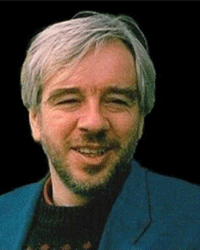
David Turner, our friend and colleague, has died after a long struggle with cancer. David was, without question, one of the most significant figures in UK and European drug policy over the past 50 years. Colleagues, friends and family and many in the TC movement will miss his easy charm and clear thinking.
Originally from northwest England, David came to the addictions field in London in 1971. He began his career – initially as a volunteer and later employee – in the New Horizon day centre in London where he worked alongside Jon Snow; now anchorman at Channel 4 News. By the mid-1970s David was head of the Standing Conference on Drug Abuse (SCODA), the umbrella organisation for voluntary sector agencies in the drugs field and Secretary to the Advisory Council on the Misuse of Drugs (ACMD). When the ACMD published its game-changing Treatment and Rehabilitation report in 1982, David’s hand was clearly discernable in most of its recommendations.
During this time, he was a huge influence on the emerging UK drug treatment scene. He was a member of innumerable drug service management committees including: Phoenix House, Suffolk House, Ley Community, Lifeline, Hungerford Project, Community Drug Project, Inward House, etc. He created the Scottish branch of SCODA, which would later become the Scottish Drugs Forum. And all his work was characterised by his understanding of individual hurt and his compassion for drug users. It was David who first said, “[…] a war on drugs must, inevitably become a war on drug users”. When the harm-reduction bandwagon began to roll in the early 1980s, it was David who argued that harm reduction meant both preventing the harm drug users might do to themselves and the harm they might do to others. He had the foresight to see that these two objectives might not always be compatible and had the potential to fundamentally change the nature of drug treatment.
And when the UK Government introduced its Community Care legislation and refused to ring-fence local authority funding for drug misuse, it was David who saw that this would marginalise residential treatment and campaigned publicly (much to the Government’s acute embarrassment) to reverse that decision. His organisation of a very high-profile boycott and picket of the UK Government’s flagship European Drug Action Week, undoubtedly cost him his job at SCODA. A few years after his departure, SCODA was merged with the Institute for the Study of Drug Dependence, an independent drug-specialist library and archive service to form DrugScope and the organisation he had done so much to create, effectively ceased to exist.
Following his rather shameful dismissal (which must have hurt him terribly), David went on to become a huge influence internationally,working with the International Council on Alcohol & Addictions, the World Health Organisation, Centro Italiano di SolidaretàRoma, the European Federation of Therapeutic Communities, the World Federation of Therapeutic Communities (WFTC) and the Vienna NGO Committee on Drugs (VNGOC). In his work with these various organisations, David was a powerful compassionate presence;usually working quietly in the background.
Much of his work attracted no byline but David seemed genuinely to have had no interest in such things. I once remarked to him that it was a pity that he hadn’t published more. “Oh that’s not what I do”, he laughed. “I think I’m better occupied trying to make things work”. And it was true that this was where he excelled. Elena Goti, the Argentinian psychiatrist, who worked with him on VNGOC told me, “I can summarise his work very simply. He was our brains!”. After the WFTC Institute in Genoa in 2010, when it seemed inevitable that the organisation might collapse into recrimination over the issues of harm reduction and religious affiliation, it was David who patiently talked for hours with the main protagonists and produced the masterful WFTC Genoa Declaration.
In the early 1980s, David and I were on the management committee of the TC, Inward House in Lancaster. David was Chair and had the difficult task of pacifying and sometimes, restraining the founder-director, a volatile and erratic retired psychiatrist called Walter Lyons. Walter was a lovely man, strikingly tall and hugely clumsy (these days, I suppose, we would probably have diagnosed ADHD and dyspraxia), whom David described to me as, “a cross between Alastair Sim and Mr. Pastry”. Towards the end of one particularly heated meeting, Walter made to rise from the arm of the sofa where he had perched (presumably to fire off another salvo on the short-sightedness of the funding authorities). David quietly signalled him to sit down but Walter, leaning back, toppled backwards on to the floor with nothing in sight but his skyward-pointing feet. “Well”, said David, unruffled, “if there are no matters arising other than Walter’s brogues, I think we can close the meeting”.
And really, that was David. He was an immensely witty and entertaining companion – he didn’t tell jokes but his asides and anecdotes were often hilarious. During one conference, a rather pretentious presenter chose to quote Pink Floyd’s Brick in the Wall. “We don’t need no education”, he declaimed drearily and David leaned towards me and whispered, “Oh yes he does. He just used a double-negative!”.
I will remember also his boyish enthusiasm for new things and new experiences. When he passed his driving test – quite late in life – he bought a bright red Volvo with pop-up headlights because that was: “the sexiest thing you could do to a car”. Shortly afterwards, he rang me: “Is everything alright at Lifeline?” “Yes, fine”. “Oh, but what about […]?” “No, that’s sorted now”. “Yes alright but what about […]?”. And finally, the penny dropped: “Well David, I could do with your advice on […]”.“No problem, I’ll pop up”. And so he drove up to Manchester in his bright red Volvo. I like to picture him somewhere on the M6, like Toad of Toad Hall. Not the selfish, self-centred Toad. David may have been the most unselfish person I’ve ever met. But motoring Toad; enjoying the drive, popping the headlights up and down and, somewhere in the back of his mind, hearing a small voice going: “Poop-poop. Poop-poop!”.
He was a kind, compassionate, funny, clever man who saw it as his duty to use his intelligence and insight to support and care for a group of largely unloved people for whom he genuinely cared. Most of all I will remember a modest man who never boasted of his achievements and never criticised failings in others. When I met with his family at his funeral in Barrow-in-Furness,I was surprised to find that they knew very little about his professional life and his huge significance to the field. “Well,he never talked about it much”, one family member told me, “[…] we just used to say, ‘David does something with drugs, but in a good way!’”. He would have liked that, I think.
Rowdy Yates


