


This study aims to investigate the influence of specific socioeconomic factors, namely neighborhood, gender roles and affordability, on the continuous use of clean cooking technologies (CCTs) in households, using evidence from Uganda.
This study adopted an explanatory quantitative design. A questionnaire survey with 379 clean household responses was conducted. The data were analyzed using the Smart Partial Least Squares (PLS) software.
The results indicate that the sustained use of clean cooking technologies in households in Uganda is significantly associated with neighborhood influence, shared gender roles and affordability, collectively accounting for 27.7% of the variance.
The three dimensions of socioeconomic factors under study partially explain the sustained use of CCTs in Uganda. The study does not delve into other socioeconomic factors that could probably account for 72.2% of the variance not explained. The quantitative design may have overlooked the social reality perspectives inherent in qualitative studies that other researchers may endeavor to exploit.
The authors integrated three dimensions of socioeconomic factors – neighborhood influence, gender roles and affordability – with the diffusion of innovation theory (DIT) using Smart PLS to explain the continuous use of CCTs within households.
1. Introduction
The adoption and sustained use of clean cooking technologies (CCTs) is a conduit to curb the health, environmental and economic concerns of the three billion people who continue to rely on traditional methods for their cooking needs. Goal 7 of the sustainable development goals (SDGs) of the United Nations 2030 Agenda calls for universal access to modern, affordable and sustainable energy. This is because the use of CCTs can reduce indoor air pollution by as much as 90%, leading to better respiratory health, controlled blood pressure in pregnant women and lower incidences of diseases such as pneumonia and lung cancer (United Nations Development Program (UNDP), 2021). It is also widely established that CCTs diminish the effects of greenhouse gases (GHGs) on the environment to guarantee the health of future generations (Katutsi et al., 2023; Rosenthal et al., 2018; Owusu-Manu et al., 2021; Yeganeh, 2019). Furthermore, CCTs promote gender parity by lessening the burden of household responsibilities on women and girls, who are often in charge of collecting firewood and cooking.
Against this backdrop, governments, non-governmental organizations (NGOs) and the private sector, alongside international and national bodies, have teamed up to promote the use of CCTs worldwide (Hannan et al., 2018). For example, the Clean Cooking Alliance (CCA) targets the use of CCTs in over 100 million households by 2025, and the Climate and Clean Air Coalition (CCAC) aims to address short-lived climate pollutants in order to protect the climate and improve air quality; The Energy Sector Management Assistant Program (ESMAP) whose goal is to help countries achieve sustainable energy access, improve energy security and transition to a more sustainable and low-carbon energy future and United Nations Capital Development Fund (UNCDF) which extends grants to support integrated national CCTs activities. Largely, the roles played by different NGOs are complementary and aim to secure a conducive environment for future generations. Numerous governments have recommended tax incentives and subsidies to promote the sustained use of CCTs, especially in low-income countries. Notably, tax waivers (subsidies) have been extended to solar cooking equipment to promote clean cooking in several countries including Uganda (Bonah et al., 2021). Despite the concerted efforts, a substantial challenge remains, as close to 80% of households in Uganda fail to continue using their novel technologies beyond the first year of adoption, Uganda Bureau of Statistics (UBOS, 2019). This has been attributed to a wide range of factors, including financial constraints, incompatibility with cultural practices, the intermittent supply of inputs and various socioeconomic and sociocultural norms and traditions (Gill-Wiehl et al., 2021; Yasmin and Grundmann, 2020).
Several studies have emphasized the significance of age, income, marital status, education, sex and location in reflecting socioeconomic variables (Koasidis et al., 2022; Mukoro et al., 2022). This study takes a novel approach by incorporating additional socioeconomic dimensions, specifically neighborhood influence, gender roles and affordability, to explore the concept of the continuous or sustained use of CCTs. Studies that delve into the interplay between these three socioeconomic dimensions in relation to the sustained use of CCTs remain scarce. Mukoro et al. (2022) focused on affordability and gender parity to study the socioeconomic and environmental value of CCTs in Africa. Walekhwa et al. (2009) studied biogas energy adoption in Uganda focusing on affordability and gender-related responsibilities.
The primary objective of this study was to investigate the relationship between neighborhood influence, gender roles and affordability in the sustained use of CCTs in Uganda. Our study contributes to the existing knowledge in the following ways. First, it takes a comprehensive and holistic approach, encompassing all three socioeconomic dimensions of affordability, gender roles and neighborhood influence in the context of the sustained use of CCTs. Second, this study employs Rogers Everett (1995) diffusion of innovation theory (DIT) to investigate the factors that explain the sustained use of CCTs. Third, this study utilized structural equation modeling (SEM) through Smart PLS to analyze data gathered from a questionnaire survey conducted in the Great Kampala Metropolitan area. To the best of our knowledge, this study is among the first to use Smart PLS to examine the sustained use of CCTs in Uganda.
2. Sustainability practices in Uganda
Approximately 90% of Ugandan households use traditional cooking technologies to meet their domestic needs (Ssenono et al., 2021). These include firewood which accounts for the majority at 78.6%, followed by charcoal at 5.6% and crop residues at 4.7% (Marembo et al., 2018). As a result, over 35 million people in Uganda are affected by exposure to cooking stove smoke, with 13,000 people experiencing premature deaths every year (Faisal et al., 2021) Indoor air pollution-related diseases, including upper and lower respiratory infections, account for the second-highest incidence of reported health issues after malaria, mostly among women and children (Faisal et al., 2021). The environmental repercussions are similar, with Uganda losing approximately 120,000 ha of forest cover each year. Considering Uganda's annual population growth rate of 3.7% coupled with a 7.5% yearly surge in energy demand, the pressure on biomass resources is projected to increase significantly (UBOS, 2021). This has attracted significant concern from the government of Uganda's environmental activists, NGOs and development partners (Okolie et al., 2022). Consequently, numerous interventions have been rolled out to ensure universal access to clean cooking solutions. Notably, Uganda Vision 2040 seeks to ensure accessibility to clean, affordable and reliable energy sources and National Development Plan III (NDP111) aims to reduce the proportion of the population using CCTs from 85% to 50%. Several other institutions, including the Ministry of Energy and Mineral Development (MEMD) for the development of policy frameworks, the Center for Research in Energy and Energy Conservation (CREEC) for actionable research, the Electricity Regulatory Authority (ERA) for price regulation and the Uganda National Alliance on Clean Cooking (UNACC) for advocacy all work hand in hand to promote the sustained use of CCTs (Marembo et al., 2018; Okolie et al., 2022).
3. The theoretical foundation and hypothesis development
3.1 Theoretical foundation
This study adopts the DIT Rogers Everett (1995) as a basis for internalizing how innovations are taken up in a social setting. Contextually, we regard innovation as a behavior perceived as novel and capable of improving community livelihoods. With regard to social dynamics, Robinson (2009) refers to the innovation qualities, social interactions and knowledge of the target group to propel faster adoption trajectories. DIT focuses on making innovation easily adaptable to the existing needs of a given society. This means that people are conceptually not driven by change agents but rather see change as a better option in view of the prevailing circumstances. Scholars have linked comparative advantage, cultural compatibility, ease of use, experimental ability, measurable results, peer-to-peer interaction and reinvention to innovation quality as drivers of behavioral change with regard to technology (Robinson, 2009; Rogers, 2003, 2006). By implication, creative efforts in the field of CCTs should build on the success stories evident in communities. Generally, understanding the needs of different innovation stakeholder segments with respect to innovators, early adopters, early majorities and laggards can enable agents to design appropriate strategies to propel attitude change (Kanger et al., 2019). Therefore, the theory comprehensively guides the adoption and diffusion of innovations by a given community in view of the changing socioeconomic environments.
3.2 Hypotheses development
This section provides literature on the sustained use of CCTs with respect to socioeconomic determinants at the household level. In the context of this study, socioeconomic parameters included neighborhood influence, gender roles and affordability. We generated relational literature between these socioeconomic dimensions and the sustained use of CCTs, from which a couple of hypotheses emerged.
3.2.1 Neighborhood influence and sustained use of CCTs
The quality of social interactions in a community supports information-sharing across households and influences the perpetual use of new technologies (Armstrong et al., 2021). Sustained use of CCTs is defined as the continuous use of novel food preparation know-how past the preliminary period of interest (Pillarisetti et al., 2019). It is noteworthy that the adoption and continued use of modern household technologies are a function of the resourcefulness of the surrounding environment (Kuhe and Bisu, 2020). For example, neighborhoods with specialized information hubs, proximal points of sale and efficient delivery systems related to CCTs will induce households to continue using the service (Mahbub et al., 2020). Notably, neighborhoods that have experienced the health benefits associated with sustained use of CCTs over time may induce positive behavioral changes in the community through interaction and positive feedback (Emmanuel and Isaac, 2021). Information-sharing is key to technology diffusion and has been linked to the absorption of innovative household technology systems in several African communities (Ven and Sampedro, 2017). Sharing positive experiences among communities regarding new technologies regenerates fresh assurances that boost sustainability syndromes over time in continuity (Bach et al., 2020). Households more often share information regarding technology efficiency, effectiveness and cleanliness, which progressively encourages sustainability behaviors among wider communities (Rau et al., 2022). For instance, Barua and Agarwalla (2018) noted that it is quite easy to mobilize women in communities to share information on how to safely and economically use clean energy technologies. We note that the literature on household influence and sustained use of CCTs supports Rogers Everett (1995), who postulates that social systems are a powerful tool that influences innovation adopters through interaction. Notably, early innovation adapters often leverage existing literature to make optimal decision choices. However, in the typical Diffusion of Innovation progression, technology deepening is more impactful for the late majority through interaction and information exchange (Rogers Everett, 1995). Thus, we hypothesize the following:
Neighborhood influence has a positive and significant association with sustained use of CCTs.
3.2.2 Gender roles and sustained use of CCTs
Generally, gender roles depict specific responsibilities associated with men or women, based on the cultural orientation of individuals (Fong and Wyer, 2012). In the contemporary world, where women have gained considerable freedom to access the job market, couples are expected to contribute jointly to domestic bills (Lieu et al., 2020). It has been observed that when a couple makes a joint household decision to transition to modern CCTs, such decision choices are often sustainable in the long run (Adams et al., 2023; Fischer et al., 2018). Additionally, shared gender roles in a household are one way to support the sustainable use of CCTs, especially among low-income households who often experience financial constraints (Kumar et al., 2016). The existing literature on CCTs has a differential bearing on women and men based on their gender roles (Ochieng et al., 2021). In Africa, women are often the principal users of clean cooking solutions, and mainstreaming them into the adoption and sustained use of modern cooking energy choices will most likely yield positive results (Leary et al., 2021). Henceforth, role differentiation with respect to CCTs premised on gender has largely influenced the promoters of this initiative towards women biases. A similar study by Ali and Khan (2020) revealed that variables such as gender and social categorization considerably determine access to clean cooking fuels among rural households. Extant literature on gender roles and the sustained use of CCTs is highlighted by DIT in technology adoption. For instance, Yasmin and Grundmann (2020) highlighted the importance of perceptions of innovation, system compatibility with existing practices, cultural value prepositions and shared gender roles and responsibilities for the sustainable use of CCTs. Hence, the theory suggests that differences in gender orientation largely lessen the social gap between the change agent and client in innovation adoption and sustainability campaigns (Rogers Everett, 1995). Therefore, it is important that in sustainability campaigns, opposite sexes between agents and clients should be observed to maximize the sustained use of novel innovation campaign outcomes. In summary, the observation that novel cooking innovations should uphold rather than disrupt prominent household gender roles resolution cannot be overstated (Sharif, 2019). Based on the empirical observations, we hypothesize the following:
Gender roles have a positive and significant influence on the sustained use of CCTs
3.2.3 Affordability and sustained use of CCTs
Globally, millions of households are unable to access and sustain the application of CCTs owing to multiple factors, including equipment price, fuel costs and distance from the supply source (Gill-Wiehl et al., 2021). Emmanuel and Isaac (2021) emphasized the notion of the amount spent on cooking fuel as a proxy for affordability, which, in the long run, supports the sustained use of improved cookstoves. A corresponding works of Vigolo et al., (2018) suggested that affordable technologies significantly entice households to try new varieties of cooking style. Suitable technologies should be made affordable for the community to trigger early adoption and sustained use (Armstrong et al., 2021). Similarly, Rogers (2003) emphasizes that low-income families usually fail to continue using novel innovations beyond their initial uptake due to financial constraints. Empirical research by Kumar et al. (2016) advocates for fairly affordable equipment and fuels for the sustained use of cleaner household technologies. Indeed, localization and affordability intermingle to spur the uptake and sustained use of modern technology systems, especially in low-income communities (Venkateswaran et al., 2018). Therefore, identifying supportive partnerships to provide subsidies to local artisans involved in device manufacturing is a long way to reduce procurement costs and hasten the uptake and sustainable use of CCTs (Armstrong et al., 2021). Generally, market penetration requires long-term sustainable subsidies to mitigate operational costs and make equipment more affordable for long-term compliance (Vigolo et al., 2018). The affordability principle is well documented in SDG 7, which emphasizes the need for widespread access to reasonable and sustainable modern energy by 2030 to guarantee healthy living among households (Kumar et al., 2022). Therefore, it is imperative that governments and the private sector synergize to make CCTs more affordable by providing subsidies or tax waivers on a sustainable basis (Ali and Khan, 2020). The notion of technology affordability is explicit in the DIT literature. This theory uses the concept of “low-cost innovations” as a proxy for affordability (Rogers Everett, 1995). It extends the narrative of how thousands of adapters of improved tomato harvesters were driven away due to high equipment and operational costs. The DIT further alludes to the inability of third-world families to sustain the use of efficient technologies due to their relatively low household incomes. Therefore, it recommends the provision of tax rebates by state governments with respect to financially struggling families to embrace modern household technologies, in line with existing literature. Hence, we hypothesize as follows:
Affordability has a positive and significant influence on the sustained use of CCTs.
3.3 A conceptual framework
The conceptual framework indicates the relationships between the dimensions of socioeconomic factors, that is, neighborhood influence, gender roles, affordability and sustained use of CCTs. This is shown in Figure 1.
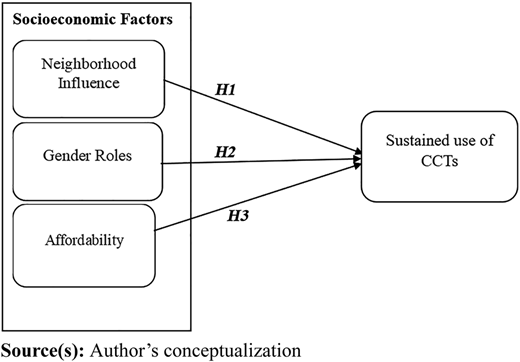
Conceptual framework of socioeconomic factors in relation to sustained use of CCTs
Conceptual framework of socioeconomic factors in relation to sustained use of CCTs
4. Materials and methods
4.1 Design, population and sample
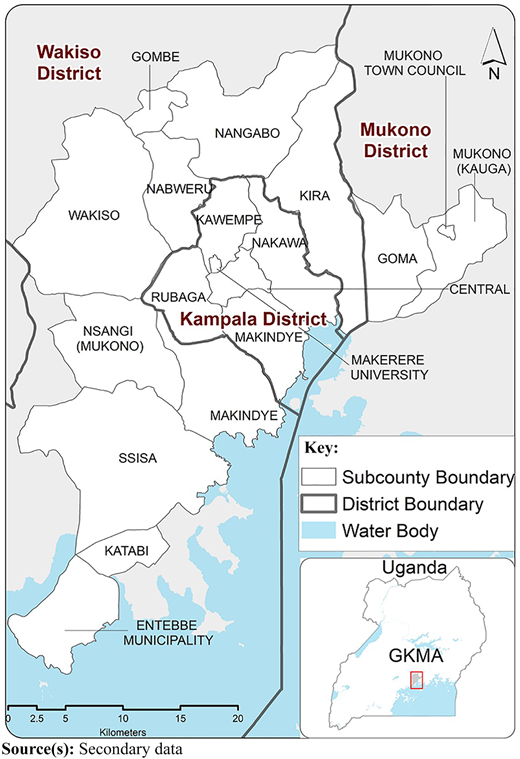
The study adopted an explanatory quantitative design, in which data were gathered using a structured questionnaire. The study was conducted in three urban districts, Kampala, Wakiso and Mukono, in the central region of Uganda, also referred to as the Greater Kampala Metropolitan Area (GKMA). The study area was selected because the highest density of households using CCTs in Uganda resides in this region (UBOS, 2019). The study area is illustrated in Figure 2.
The total population of households in the GKMA is 714,602, spread across 5,116 villages (UBOS, 2020). To ensure a statistically valid sample, we employed Krejcie and Morgan's (1970) statistical table and selected 384 households as respondents for the study. To account for the skewed distribution of households per district, we used the probability proportional to size (PPS) sampling method, which led to the selection of 385 households after rounding off. A multi-stage sampling technique was employed to select households that used CCTs from numerous villages within the three designated districts. This method enhances the representativeness of the sample, particularly when incorporating recognized sources of variation within the study population (Muwanga et al., 2023).
Of the 385 questionnaires issued, only six were not useable because more than 50% of the items were not filled. Thus, 379 responses were useable, representing a response rate of 98%. This was quite encouraging given the poor culture of information-sharing in Africa (Nkundabanyanga, 2017). Households were the unit of analysis, while household heads were the units of inquiry.
4.2 How the study variables were measured and operationalized
The dependent variable, the main focus of this study, is the sustained use of household CCTs, while the predictors are the socioeconomic dimensions of neighborhood influence, gender roles and affordability. We reduced the dimensions to measurable indicators, in accordance with the guidelines of (Saunders et al., 2012). We ensured that the indicators were in line with doctrines of accuracy, relevance and adequacy. These dimensions were measured using items developed by previous scholars drawn from existing literature in comparable study settings (Thong et al., 2006). Most studies relating socioeconomic determinants to the sustained use of household CCTs have been conducted in different geographical settings (Ang'u et al., 2023; Guta, 2020; Owusu-Amankwah et al., 2023). In due regard, some modifications were made to the items where necessary, to suit the local perspective.
Socioeconomic determinants were operationalized using neighborhood influence, gender roles and affordability (Gill-Wiehl et al., 2021; Ochieng et al., 2021; Pakravan and MacCarty, 2020; Tigabu, 2017). Neighborhood influence was measured using items adapted and modified from Pakravan and MacCarty (2020). These included respect for peers' opinions, experiences, popular choices and neighborhood preferences regarding CCTs. The second dimension, gender roles, was measured using items modified from (Ochieng et al., 2021). This included provision of household income, decision making, separation of gender roles and gender segregation with regard to the adoption and sustained use of CCTs. Affordability, the third socioeconomic dimension, was measured using items adapted from (Gill-Wiehl et al., 2021). These include fuel cost, availability of reasonable fuel options, system repair and service expenses and payment modes. Sustained use was conceptualized as the use of CCT for more than a year after acquisition (Tigabu, 2017).
A five-point Likert scale was used to measure respondents' perceptions regarding socioeconomic factors and the sustained use of CCTs. This scale was preferred because it optimizes the response rate and data quality (Meterko et al., 2015). This reduces the margin of errors and allows respondents to be neutral, which makes the survey results more accurate. The questionnaire was self-administered to augment the response rate and completeness of the responses (Saunders and Kulchitsky, 2021). Scholars have associated self-administered data collection methodologies with survey studies that are synonymous with large samples as more appropriate (Bananuka et al., 2019). We then conducted a data analysis using Partial Least Squares (PLS), a robust statistical software often used by social scientists. This package is perceived as suitable and relevant for complex models with several dimensions (Ong and Puteh, 2017).
4.3 Tests for reliability, convergent and content validity and collinearity
To determine whether the research instrument could be simulated in related studies, we conducted Construct Reliability tests using Cronbach's alpha (α) and Composite Reliability (CR) (Field, 2013). Hair et al. (2020) and Petreson (1994) recommended a minimum benchmark of (α > 0.7, CR > 0.7) for Cronbach's alpha (α) and CR coefficients to emulate instrument reliability. The results show (α) coefficient ranges of 0.791 and 0.899 for the respective minimum and maximum bounds and 0.850 and 9.22 for CR. We used six industry experts and four professionals to ascertain the instrument's validity and legitimacy. The content validity index was also used to determine content rationality. This was obtained by dividing the percentage of items declared valid by the total number of items used (Amin et al., 2010). A Content Validity Index was computed and the variables were within the threshold range of 0.7 and above for a valid instrument as recommended by Field (2009). To establish the data indolence of the predictor dimensions, multicollinearity tests were performed. The results revealed variance inflation factor (VIF) indices ranged from 0.534 to 0.704; far below 5.0 maximum limit (Hair et al., 2020). Therefore, the results presented in Table 1 indicate the absence of multicollinearity.
Reliability, convergent and content validity and collinearity of the study dimensions
| Dimension | Alpha | CR | AVE | CVI | VIF |
|---|---|---|---|---|---|
| Sustained use | 0.899 | 0.922 | 1.956 | 0.90 | 0.664 |
| Neighborhood influence | 0.791 | 0.877 | 1.690 | 0.80 | 0.704 |
| Gender roles | 0.795 | 0.850 | 1.534 | 0.74 | 0.534 |
| Affordability | 0.849 | 0.889 | 1.784 | 0.85 | 0.618 |
Note(s): CR: composite reliability, AVE: average variance extracted, CVI: content validity index and VIF: variance inflation factor
Source(s): Primary data
4.4 Discriminant validity
Discriminant validity was tested using heterotrait-monotrait (HTMT) criteria. Determining the extent of dimension disassociation has been widely recommended (Henseler et al., 2014). The nonexistence of discriminant validity in the dataset manifests when HTMT is less than 0.85, a benchmark observed in Table 2.
5. Results
5.1 Background characteristics
A total of 379 households participated in this study. Table 3 presents the contextual characteristics of the sustained use of CCTs in Uganda.
Background characteristics, n = 379
| Count | Valid percent | Cumulative percent | |
|---|---|---|---|
| Gender of respondent | |||
| Male | 213 | 56.2 | 56.2 |
| Female | 166 | 43.8 | 100 |
| Age bracket | |||
| 16–21 yrs | 40 | 10.6 | 10.6 |
| 22–40 yrs | 264 | 69.7 | 80.2 |
| 41–64 yrs | 72 | 19.0 | 99.2 |
| 65 yrs and above | 3 | 0.8 | 100.0 |
| Marital status of household head? | |||
| Married | 199 | 52.5 | 52.5 |
| Single | 112 | 29.6 | 82.1 |
| Divorced | 42 | 11.1 | 93.1 |
| Widow/Widower | 25 | 6.6 | 99.7 |
| Others | 1 | 0.3 | 100.0 |
| Education background | |||
| No schooling | 3 | 0.8 | 0.8 |
| Primary school | 12 | 3.2 | 4.0 |
| Secondary school | 65 | 17.2 | 21.1 |
| Tertiary education | 115 | 30.3 | 51.5 |
| University | 182 | 48.0 | 99.5 |
| Others | 2 | 0.5 | 100.0 |
| Total number living in this household | |||
| 0–9 | 343 | 90.5 | 90.5 |
| 10–19 | 29 | 7.7 | 98.2 |
| 20 and above | 7 | 1.8 | 100.0 |
| Employment status | |||
| Formal employed | 108 | 28.5 | 28.5 |
| Self-employed | 232 | 61.2 | 89.7 |
| Un-employed | 39 | 10.3 | 100.0 |
| Ownership status of the household | |||
| Own | 200 | 52.8 | 52.8 |
| Rent | 179 | 47.2 | 100.0 |
| Cooking technology used | |||
| Electric stoves | 69 | 11.8 | 11.8 |
| Biogas stoves | 87 | 14.8 | 26.6 |
| LPG stoves | 202 | 34.4 | 61.0 |
| Improved cookstoves | 93 | 15.8 | 67.3 |
| Traditional cookstoves | 37 | 6.3 | 83.2 |
| Liquid fuel stoves | 31 | 5.3 | 88.5 |
| Three stone open fire | 50 | 8.5 | 97.0 |
| Solar cookers | 18 | 3.1 | 100 |
Source(s): Primary data
Table 3 shows that male respondents accounted for a higher proportion (56.2%) than female respondents (43.8%). This finding is in line with the 2019/2020 Uganda housing survey, which revealed that the majority (63.5%) of households in GKMA are male-headed. With regard to education level, 48% were degree holders, followed by 30.6% and 16.1% tertiary and secondary education, respectively. Implicitly, the majority of respondents exhibited sufficient knowledge to internalize the research tool, which resulted in a significant valid response rate. Additionally, the results revealed that most respondents were self-employed (61.2%). Given the high unemployment rate in Uganda, self-employment initiatives could have motivated households to start private businesses to meet their basic necessities. Overall, Liquefied petroleum gas (LPG) was the most common, constituting 34.4% of all clean cooking systems, followed by improved cookstoves (15.3%), biogas stoves (14.8%), electric (11.8%) and solar cookers (3.1%). The total number of households using different types of cooking technologies was 587, compared to the total sample of 379. The observed variation is attributed to the use of multiple cooking systems to optimize attendant costs and efficiencies.
5.2 Correlation analysis
Pearson's one-tailed correlation test was performed to establish whether associations existed between variables, as hypothesized in the empirical literature (Field, 2009). According to Hair et al. (2010), the association between direct relationships should be positive and significant as a benchmark for executing higher-order statistical analyses including regression, SEM and SPLs. The correlations between the predictor and criterion variables satisfied the minimum association yardstick, as shown in Table 4.
Correlation analysis
| Variables | Mean | SD | 1 | 2 | 3 | 4 |
|---|---|---|---|---|---|---|
| Neighborhood influence-1 | 3.931 | 0.895 | 1.000 | |||
| Gender roles-2 | 3.514 | 0.910 | 0.359** | 1.000 | ||
| Affordability-3 | 3.821 | 0.884 | 0.648** | 0.402** | 1.000 | |
| Sustained use-4 | 4.053 | 0.770 | 0.425** | 0.277** | 0.408** | 1.000 |
Note(s): **. Correlation is significant at the 0.01 level (1-tailed)
Source(s): Primary data
All the predictor dimensions indicated a moderately positive and significant association with the dependent variable. Therefore, we proceeded to conduct a higher-level analysis.
5.3 Model specification and analysis
Smart PLS (PLS-SEM) software was used to conduct the statistical analysis. It is a non-rigorous modeling method that does not account for assumptions about the data structure (Vinzi et al., 2010). The PLS-SEM model is robust in reasonably complicated models that combine multiple measurement dimensions (Kock and Hadaya, 2018). It is a prediction-focused model that places special emphasis on variances and always operates on non-parametric datasets. Hence, several sample sizes can be accommodated without pausing the analysis challenges. Notably, the estimation of the parameters remains stable as the sample size increases, thereby guaranteeing the data stability. This model has the highest prediction accuracy because of its robustness, which maintains valid causal inferences regardless of data variation (Lewis et al., 2018). PLS-SEM is also helpful when theories explaining a phenomenon are scarce. This is preferable when it is unclear which model specifications should be used. Specifically, PLS-SEM was preferred because of its ability to provide visual representations of relationships between variables, which makes it easier to share findings and insights.
5.3.1 Measurement model analysis
The model structure presents the hypothesized relationships between the underlying dimensions and model routes (Sukhov et al., 2023). The explanatory power of the model was calculated using the coefficient of determination (R2), which takes values between 0 and 1 (Ramos et al., 2020). Accordingly, the greater the proximity of the number to one, the more robust is its explanatory power. Path estimates were computed using a bootstrapping method that included 5,000 separate samples (De Robertis et al., 2023). Figure 3 illustrates the measurement model used to test our hypotheses.
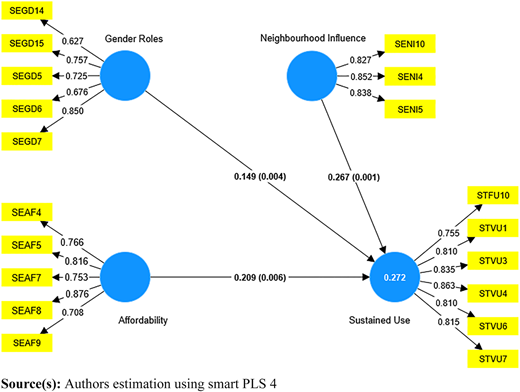
As can be observed in Table 5, which provides bootstrapped estimates for hypothesis testing, neighborhood influence is positively and significantly related to the continued use of CCTs in Uganda (β = 0.267; p < 0.01). This indicates that the consistent use of CCTs varies with the intensity of neighborhood influence among community members. Therefore, H1 is supported. Regarding H2, gender roles are positively and significantly related to the continued use of CCTs in Uganda (β = 0.149; p < 0.04). This finding implies that the continued use of CCTs in a given household is contingent on specific gender roles. Therefore, H2 is also supported. Similarly, affordability was a positive and significant predictor of continued CCT use (β = 0.209; p < 0.06). This result indicates that the continued use of CCTs is premised on their affordability. Therefore, H3 was confirmed. The overall measurement model, neighborhood influence, gender roles and affordability predicted 27.2% of the variance in the sustained use of CCTs in Uganda.
Bootstrapped estimates for hypothesis testing
| Hypothesis | Path analysis | Path coefficients (β) | St. Error | T-statistics | p-value | Status |
|---|---|---|---|---|---|---|
| H1 | AFF ▬► SU | 0.209 | 0.076 | 2.736 | 0.006 | Supported |
| H2 | GR ▬►SU | 0.149 | 0.051 | 2.909 | 0.004 | Supported |
| H3 | NI▬►SU | 0.267 | 0.078 | 3.411 | 0.001 | Supported |
Note(s): AFF = affordability; GR = gender roles; NI = neighborhood influence and SU = sustained use
Source(s): Primary data
Figure 4 represents the exogenous variable and socioeconomic factors, which are the major predictors of the sustained use of CCTs. The results show that gender roles, neighborhood influence and affordability generate an R-square value of 0.99 and a variance of 99% of the socioeconomic factors. According to Hair et al. (2020), an R-squared value above 75% is considered substantial for the predictive potential of the exogenous variables. Hence, neighborhood influence, gender roles and affordability are sufficient to explain the variation in the socioeconomic factors of households in Uganda. Figure 4 illustrates the measurement model for socioeconomic factors.
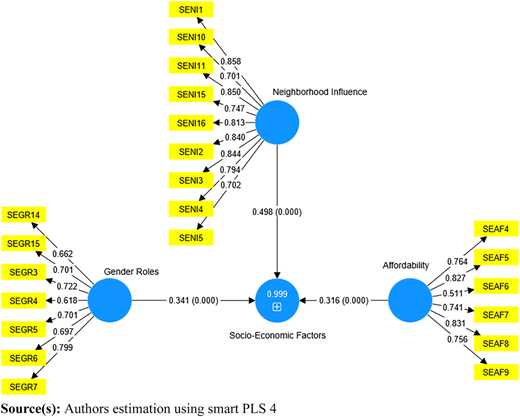
Further examination of the bootstrapped results in Table 6 reveals the validity of gender roles, neighborhood influence and affordability in explaining socioeconomic factors and predictors of sustained use of CCTs. For all the dimensions, the respective path coefficients were positive and statistically significant. In summary, the results are in line with Hair et al.'s (2020) model fit benchmark.
Bootstrapped measurement model estimates for social economic factors
| Path analysis | β | St. Error | T-statistics | p-values |
|---|---|---|---|---|
| Neighborhood influence ▬► socioeconomic factors | 0.498 | 0.010 | 50.347 | 0.000 |
| Gender roles ▬► socio-economic factors | 0.341 | 0.009 | 39.347 | 0.000 |
| Affordability ▬► socio-economic factors | 0.316 | 0.009 | 36.128 | 0.000 |
Source(s): Primary data
6. Discussion of results
This study investigates the role of socioeconomic factors in the continuous use of CCTs in Uganda. The predictor variable was operationalized using three dimensions. These include neighborhood influence, gender roles and affordability. This section aligns with the hypotheses extracted from the works of other scholars in related fields. The results from the hypothesized model indicate that neighborhood influence has a positive and significant relationship with sustained use of CCTs. Contextually, households who value peers' opinions regarding a given phenomenon are most likely to embrace the use of CCTs for a prolonged period of time. Pakravan and MacCarty (2020) suggested that neighbors' opinions concerning the use of a given household technology are correlated with their likelihood of uptake and sustained use of the same. Furthermore, research findings by Bach et al., (2020) emphasize the concept of socialization and peer effects as influencing neighbors' attitudes towards the sustained use of CCTs. The study also suggests that sharing a positive experience of a given know-how with neighborhoods is likely to stimulate the adoption and continuous use of CCTs. Comparable results reveal that an affirmative moment of truth with innovative household technology may induce positive attitudes toward sustained adoption by neighborhoods (Nam et al., 2019). Similar findings reveal that households embrace technology more often if their peers have positive feelings about it (Pakravan and MacCarty, 2020). It has been revealed that when the majority of peers tend to use a particular technology in their households, their counterparts are more likely to use similar technologies to have a balanced sense of belonging. This observation reinforces the significance of social influence in the diffusion of the innovation theory.
Consistent with H2, the findings suggest that gender roles have a positive and significant influence on the sustained use of CCTs. Today, most households have a persistent drive towards shared financial responsibilities. This reduces the financial burden on one party and, in the long run, improves the continuous use of CCTs. Due to increasing access to paid jobs, female-headed households tend to maintain the usage of CCTs because they have free space for other competing activities (Katutsi et al., 2023). Notwithstanding, traditional differences in gender roles still exist, especially in developing countries that decelerate the sustained use of CCTs (Robayo-Abril et al., 2019). Therefore, children should be raised on the gender equity scale across all aspects of their livelihoods to mitigate future gender role stereotyping, which is common among African communities. Where the responsibility to make financial decisions rests on one party in a household, finances are largely constrained (Pakravan and MacCarty, 2020) because of multiple competing activities, such as healthcare, education and food vis-à-vis relatively low incomes. Accordingly, the role of culture in gender stereotyping cannot be overstated and has greatly affected women's entrepreneurship in many traditions (Adom and Anambane, 2020).
In line with H3, affordability had a positive and significant influence on the sustained use of CCTs. This implies that households experiencing consistent financial streams in their accounts are likely to maintain the consistent use of CCTs. The concept of collective access to contemporary, inexpensive and sustainable energy is high on the United Nations 2030 agenda (Ang'u et al., 2023). In due regard, the provision of a subsidy would make sustained use of CCTs affordable and, therefore, adoptable. Often, the cost of CCTs is a burden to households due to financial constraints amidst competing ends (Dziejarski et al., 2023). Government subsidies have been observed to induce rural communities to embrace the use of Liquefied Petroleum Gas (LPGs) in developing countries (Couharde and Mouhoud, 2020). The cost of CCTs is not limited to the cost of purchase per se, but also to expenses related to repair, maintenance and mode of payment. The corresponding findings underscore the importance of equipment and service costs in the sustained adoption of CCTs (Diaz Ruiz and Makkar, 2021). However, a study of rural communities in India revealed that relatively poor communities continued to partially use traditional smoky cooking systems even with the provision of government subsidies (Pillarisetti et al., 2019).
Remarkably, this study is based on the DIT (Rogers Everett, 1995). It mirrors the notion of social systems, in which community interaction propels the sustained use of novel innovations. The dimensions conceived in the study, neighborhood influence and gender roles are closely linked to social interactions, peer-to-peer interfaces and cultural compatibility, which, according to the theory, drive behavioral change. Hence, we believe that the success of CCTs may largely depend on well-packed promotional campaigns that leverage the three dimensions with respect to the study. We also affirm that the study dimensions that explain 99.9% of the variance in socioeconomic factors with respect to CCTs in Uganda reflect the true needs of communities, as theorized by Rogers Everett (1995). In summary, this theory systematically guides how communities may hasten the uptake and sustained use of CCTs in Uganda.
7. Conclusion and policy recommendations
7.1 Conclusion
This study sought to determine the association of three dimensions of socioeconomic factors, namely neighborhood influence, gender roles and affordability, with the sustained use of CCTs in Uganda's households. All three underlying socioeconomic dimensions were positive and significant determinants of continuous use CCTs. They account for approximately 27.2% of the variation in the continuous use of CCTs in households in Uganda. Hence, the influence of socioeconomic factors on the continuous use of CCTs in Uganda has been established. The measurement model, based on theory and empiricism, authenticates the contribution of each factor.
7.2 Policy implications
From a policy standpoint, stakeholders advocating for the sustained use of CCTs should design an integrated policy framework that seeks to promote household interactions among different communities. To put this into context, NGOs promoting a sustained clean cooking system may leverage social networks to penetrate communities beyond early adopters. Well-structured and organized leadership networks are essential for project advocacy. Introducing periodic community meetings where peers occasionally interact to share technology-related experiences is of paramount importance. This is one way of popularizing the sustained use of novel cook-systems in communities. The gender equality program should begin with government efforts to uplift the status of women in communities by enabling easy access to education, gainful employment and finance, including sensitization. Changing gender roles in society are now a concern. We believe that policy frameworks that keep the cost of purchase and maintenance of CCT equipment fairly low will go a long way to induce sustained use of CCTs in Uganda. Notably, close to 50% of Uganda's population survive for less than US$ 1 per day. Therefore, the government must come in with attractive incentive schemes to expedite the sustainable usage of affordable CCTs in line with SDG 7 protocols. Empirically, this study provides focused dimensions that underpin the sustained use of CCTs from a socioeconomic perspective.
7.3 Study limitations and areas for future research
This research focused on the socioeconomic determinants of the sustained use of CCTs. These include neighborhood influence, gender roles and affordability. These three dimensions explained 27.2% of the variance in the sustained use of CCTs. Accordingly, 72.8% of the variance is not explained. This provides a research gap which researchers may exploit. Furthermore, this study employed a quantitative approach, as this methodology aligns well with the study's primary emphasis on investigating the relationships between variables. To corroborate our results, we propose a qualitative design to underpin social reality perceptions of the sustained use of CCTs in Uganda. Finally, the scope of the study was concentrated around the GKMA, which covers the central region of Uganda. We recommend that comparable studies be undertaken in other regions.

