AI-based autonomous vehicles (AVs) are a promising Industry 5.0 solution, but their diffusion is limited due to shared concerns that quality management can help to overcome. Quality 5.0 is a new approach in the literature that ensures respect for human and environmental safeguards, as well as for societal and industrial development. The novelty of this concept warrants further research. This work conceptualizes the promotion of Quality 5.0 in the AVs industry by presenting it from an often under-investigated perspective: the role of artificial intelligence (AI) providers.
This conceptual paper outlines the main actions by which AI providers can be Quality 5.0 enablers in the AVs industry. By integrating current literature on smart mobility, AI, AVs and Quality 5.0, this study provides theoretical propositions and a conceptual framework. Then it presents an illustrative case of an existing AI provider market leader.
AI providers within AVs industry enable Quality 5.0 by developing technical subsystems that support Quality 5.0 components, adopting a holistic approach to data infrastructure management, leveraging generative physical AI and building a network around it.
This paper contributes to the current debate on Quality 5.0 by presenting an underexplored perspective on quality management and the AI-based AVs industry: the AI provider's role as enabler of Quality 5.0.
1. Introduction
Smart cities worldwide are increasing (Kong et al., 2022) and pursuing their socio-environmental purpose by relying on smart mobility (SM) solutions (Vanolo, 2014) that address transportation-related problems, including traffic congestion, environmental degradation and pollution, urban poverty and challenges in urban governance (Bibri, 2021; Gu et al., 2025). The SM industry is increasingly leveraging breakthrough innovations, such as artificial intelligence (AI) (Huang et al., 2025), to improve citizens' quality of life. One of the leading innovative applications of AI is in the automotive sector.
AI enables autonomous vehicles (AVs) to act as independent drivers, mimicking human decision-making and actions on the road (Li et al., 2025). Recent studies have presented AVs as a disruptive mobility innovation, as their implementation can transform transportation and urban planning (Banda and Chandra, 2025), driving an ecosystemic revolution (Asgari et al., 2023). Indeed, AVs are central to reshaping public mobility systems and urban infrastructure by reducing the risk of accidents caused by human error and by excluding marginalized communities (Banda and Chandra, 2025). Although AI enhances the performance of AVs through advanced driver-assistance systems and real-time sensors, helping with obstacle avoidance and path planning, other relevant issues related to public trust in such technologies have not been addressed yet (e.g. Banda and Chandra, 2025; Zhou et al., 2024). For these reasons, the current academic debate focuses on how to ensure the development of high-quality, safe AI-based AVs (Banda and Chandra, 2025; Usman et al., 2024). At the same time, the automotive industry is undergoing a paradigm shift towards “Society 5.0”, grounded in Industry 5.0 solutions (Xu et al., 2021). Given the negative effects of Industry 4.0, where technological progress is pushed to extremes, leading to an underestimation of human needs, experts are now laying the groundwork for a new, human-centric, sustainable industrial revolution (Ciasullo et al., 2024). Accordingly, Quality 5.0 is emerging and differs from traditional quality management (Chiarini and Kumar, 2022) due to the central role of sustainability, citizen engagement and satisfaction (from employees, customers, etc.), alongside corporate social responsibility (Ali and Johl, 2024) as the main production drivers. It also promotes the proactive collaboration of ecosystem actors, grounded in shared responsibility (Ali and Johl, 2024). Quality 5.0 encompasses the use of advanced technologies, such as AI, to enhance real-time quality control and intervention throughout the entire manufacturing process. However, the novelty of such a construct currently calls for a clearer conceptualization under different lenses.
In particular, literature discusses that the development of socio-technical systems (STS) is a prerequisite for Quality 5.0, connecting Industry 5.0 and STS theory to quality literature (e.g. Trist, 1981; Ali and Johl, 2024). In this sense, the main technologies of the fourth industrial revolution – constituting the technical subsystem of STS – are still in place, but are conceived and implemented differently for Quality 5.0 purposes. However, it is still not clear how the actors responsible for their development and deployment could support this socio-technical paradigm shift (Mukherjee et al., 2023; Valette et al., 2023; Ali and Johl, 2024). For these reasons, Industry 5.0 and Quality 5.0 call for studies analyzing the new redefined roles of industrial actors who are both wealth generators and active contributors to solving societal-driven challenges (Sindhwani et al., 2022; Ghobakhloo et al., 2025).
Despite AI being the technology at the center of such debates, management literature lacks studies focusing on companies that provide AI-based software and hardware (i.e. AI providers) to firms that implement them into their processes and products. However, it is also recognized that the design and deployment of a technical subsystem affect the shape of STS and their quality outcomes (Ali and Johl, 2024). To the authors' knowledge, no studies have investigated how AI providers could facilitate the Quality 5.0 approach in the SM context (Bucci et al., 2026). Nevertheless, AI providers are the actors currently providing the technology recognized as crucial both in enabling industries' STS development and driving Quality 5.0 practices (e.g. Capolupo et al., 2025; Ghobakhloo et al., 2025). Prior works have mainly examined how AI affects the performance of AVs and SM solutions, rather than theorizing how companies that provide AI systems enable Quality 5.0 within the industry (e.g. Kuznietsov et al., 2024; Leng et al., 2024; Garikapati and Shetiya, 2024; Morales Matamoros et al., 2025; Fernández Llorca et al., 2025; Bathla et al., 2022). This gap is also reflected in prior research on Quality 4.0, which examined Industry 4.0 technologies, such as AI, to provide insights on their integration with traditional quality management to improve efficiency, reduce costs and performance (e.g. Sader et al., 2022). However, even in this case, the focus remains techno-centric. Indeed, as previously stated, Quality 4.0 differs from Quality 5.0 in its limited consideration of broader socio-environmental goals, its underestimation of the role of actors who enable STS development within industries and its focus on the intra-organizational perspective. Even though related streams on digital ecosystems, platform leadership, and supply chain digitalization are closer to addressing this gap by emphasizing orchestration, connectivity and network-driven performance, they still do not provide theoretical insights on AI providers and their role in enabling Quality 5.0 (e.g. Castillo et al., 2025). Specifically, the current academic debate lacks emphasis on the crucial role of AI providers in enabling high-quality, human-centric AVs, a promising SM solution for the future Society 5.0.
Thus, this conceptual work addresses the knowledge gap by answering the following Research Question (RQ): How do AI providers enable the Quality 5.0 approach in the autonomous vehicles industry?. Our study expands knowledge regarding AVs' technical and social safety and their effective, high-quality implementation, by supporting previous studies that call for the involvement of different transportation ecosystem actors in proactively addressing these concerns and boosting the AVs industry's value delivery (Dias Lousã et al., 2025).
We first present a literature review of AI-driven AVs and Quality 5.0, highlighting SMs and STS constructs as foundations of those research streams. Then, we provide theoretical propositions and a conceptual framework to address the research goal by integrating Quality 5.0 insights and foundations, primarily drawing on Frick and Grudowski's (2023) components and the literature on AI-based AVs. Finally, through a case illustration methodology, we apply our conceptual lens to show how a current global leader in AI for AVs enables Quality 5.0. We consider this case highly aligned with our research goal, as it is widely adopted and globally recognized as a front-runner in AI, particularly for its high-quality products that leverage AI to promote societal development rather than only technological advancements. Moreover, we show how industrial actors providing the technical subsystems called to be part of STS can deliver positive societal outcomes without losing their competitive advantage in the market. By doing so, we support the call to improve companies' willingness to adopt Industry 5.0 principles in their practices (Ghobakhloo et al., 2025). Ultimately, we illustrate the theoretical and practical implications arising from conceptual and case-based considerations, paving the way for further investigation into Quality 5.0, SM and the AVs industry.
2. Theoretical background
2.1 Smart mobility and artificial intelligence: development of autonomous vehicles
The concept of a “Smart City” has been explored from technological, economic and social perspectives (Allam and Newman, 2018), highlighting its people-centricity and sustainability (Lim and Taeihagh, 2019). Studies agree in considering it a value creation catalyst for urban areas (Meijer and Bolìvar, 2016; Albino et al., 2015), boosting the continuous evolution and improvement of smart services, such as transportation, energy and public security, by leveraging new technologies (Gu et al., 2025; Bibri, 2021). Issues in the transportation sector are among the primary reasons for the existence of smart cities. SM refers to “local and supra-local accessibility, availability of ICTs, modern, sustainable and safe transport systems” (Vanolo, 2014, p. 887) and is a phenomenon according to which digital transformation changes the rules of the mobility paradigm to enhance citizens' standard of living (Groth, 2019). Over the years, different SM solutions have rapidly entered the market, leveraging big data management and real-time data analysis enabled by digital technologies that, by being based on the velocity and variety of information assets (Lakshmanaprabu et al., 2019), support decision-making and drive innovative solutions to address citizens' transportation needs. The literature has widely investigated them, primarily focusing on shared mobility services (Liu et al., 2025; Rayle et al., 2016; Firnkorn and Müller, 2015; Shaheen et al., 2015; Li and Zhao, 2018).
The increasing complexity of the mobility sector, combined with the growing importance of safeguarding people and the environment, is driving the demand for AI implementation (Abduljabbar et al., 2019; Li et al., 2025; Abduljabbar et al., 2019; Nikitas et al., 2020). Indeed, various mobility organizations benefit from AI, including urban transport infrastructure authorities, urban mobility solution providers and automotive manufacturers (Li et al., 2025). According to Bawack et al. (2021), AI possesses five generic properties: sensing, comprehending, acting, learning and generating. It is also considered for its potential to automate and personalize the technology's outputs, providing tailored digital solutions (Li et al., 2025). SM services personalization derives from AI's ability to sense, comprehend and learn from data, automating the generation of AI features that enable the development of automated services (Li et al., 2025). AI is also adopted to innovate urban mobility operations, products and services (Nikitas et al., 2020). Cohen and Jones (2020) focused on the travelers' side, while Goswami et al. (2021) focused on energy efficiency. According to Li et al.’s (2025) study, five mobility-specific AI use cases emerge: integrating urban mobility management, personalizing and automating urban mobility, smartifying infrastructure and asset management, developing better urban transport planning and management and enabling automatic driving.
The last use is currently being explored by automotive manufacturers such as Bayerische Motoren Werke (known as BMW) and Tesla, which are investing in the development of AVs. Generally, AVs are based on real-time visual and vehicle performance data collected from IoT sensors, and, as Li et al. (2025) affirm, this enables such digital solutions “to sense and analyze their location and other objects around them, interpret traffic signs and signals, and monitor vehicle performance”. AVs guarantee the effectiveness of smart cities' road safety and improve transportation efficacy by reducing accidents (Lee and Kum, 2019). AVs can be designed with varying levels of autonomy, ranging from driver assistance to full independence (Dias Lousã et al., 2025). Literature on AVs illustrates their transformative impact on daily travel habits and traffic networks. As affirmed by Asgari et al. (2023), they contribute to revolutionizing the entire transportation ecosystem. In socio-economic terms, AVs' impact is massive, reducing traffic accidents and increasing mobility for people who would otherwise be excluded (Banda and Chandra, 2025). Indeed, enhancing mobility for the elderly and citizens with disabilities boosts workforce participation and societal inclusivity. Empirical evidence mainly recognizes AVs' huge role in improving road safety by reducing accidents caused by human errors due to distraction and tiredness while driving. AVs are built on sensors and algorithms, enabling real-time decision-making that controls speed and safe distances among cars. Moreover, when AVs are integrated with SM infrastructure, they can share information with traffic management systems, thereby reducing urban congestion. These and other AVs' properties can be successfully developed only with AI, which helps the cars understand and navigate the environment. According to Menon and Alexander (2020), AI implementation within AVs is fundamental to benefit cities and individuals. Since AI can be applied to different stages of AVs development, the role of AI providers for AVs is to enable the creation of an integrated, effective system of cameras, radar and lidar to make the best real-time decision after rapidly identifying objects and predicting pedestrians' and other drivers’ behaviors (Banda and Chandra, 2025). AI systems enhance AVs' ability to appropriately manage real-time big data from sensors while enabling continuous learning to improve performance (Liu et al., 2025). Recent AI-based AVs are designed to simulate human behaviors and thoughts while driving. They are trained to make safe decisions and respect the rules by applying physical and ethical guidelines. This requires alignment with the digital revolution, evolving infrastructure and mobility services in general. People are increasingly recognizing that quality equals high, sophisticated digital performance (Lakshmanaprabu et al., 2019). Despite the potential benefits of AVs, several security concerns arise regarding their implementation in smart cities, calling for the involvement of all transportation ecosystem actors to support appropriate policy development, companies' strategies and smart cities' infrastructure (Dias Lousã et al., 2025).
2.2 Introducing the foundations of Quality 5.0
2.2.1 Industry 5.0 and socio-technical systems
In the current academic debate, there is increasing concern about how to responsibly guide technological progress and the development and implementation of the disruptive innovations it yields, such as those stemming from the Industry 4.0 revolution. For this reason, current research spanning various fields and sectors is building the theoretical foundations, driven by empirical evidence, of the so-called “Society 5.0”.
Specifically, Society 5.0 relies on a socio-framework that integrates digital technologies and societal processes to solve complex problems and improve the quality of life (Ziatdinov et al., 2024). Empirical evidence indeed showed that Industry 4.0 lacks a responsible, human-centric orientation, leading to trust issues, misunderstandings and the undervaluation of people's needs (Aderibigbe, 2022). Experts paid increasing attention to technological progress rather than the human aspect of industrial applications (Aderibigbe, 2022), overlooking the ethics behind it (Murtarelli et al., 2021). Society 5.0 addresses these issues by advocating a human-centric approach to industry (Bartoloni et al., 2022). In particular, the European Commission introduced “Industry 5.0” as the pathway to address concerns arising from the past industrial revolution (Breque et al., 2021). In particular, the manufacturing industry is shifting towards Industry 5.0, aiming to serve society through new technologies, promote inclusivity and reduce inequalities and advocate for the sustainable development of products and services (Sindhwani et al., 2022). Society 5.0 promotes higher-value-added services, encouraging industries to consider the impact of their activities on the community, ensuring respect for human rights and individuals' aspirations for their lives. Industry 5.0 is a transformative concept that leverages empathy and knowledge sharing, highlighting the crucial role of industry players, such as AI providers, in adopting and promoting this new perspective (Li et al., 2022). In this sense, technologies have the potential to guide the evolution of humankind through their participation, leading to positive outcomes in terms of effectiveness and sustainability (Borges et al., 2021).To make this possible, it is necessary to have a proactive collaboration of all the actors (enterprises, institutions and citizens, etc.) that, according to their capabilities, can support STS development within the different industrial areas and according to their unique needs and challenges (Ali and Johl, 2024; Ghobakhloo et al., 2025; Sindhwani et al., 2022). The STS theory is strongly established in scientific literature; its conceptualization occurred in the 1950–1960s industrial landscape through a foundational study by Emery and Trist, and it has since been increasingly adopted in the organizational and managerial literature (e.g. Emery and Trist, 1960; Trist, 1981; Baxter and Sommerville, 2011; Li et al., 2020). It states that a socio-technical system is built by conceiving, implementing and managing its social and technical subsystems as interdependent, ensuring continuous mutual optimization between the two (Kessler, 2013; Ali and Johl, 2024).
According to various studies, Industry 5.0 aligns with the STS theory, as it requires such an approach to achieve the goals for which it was conceptualized: putting the human at the center and ensuring the sustainability and well-being of society. Indeed, despite STS also being investigated in Industry 4.0 studies, there has been a shift in Society 5.0 from a predominantly technical approach to a socio-technical and sustainability-oriented one (Margherita and Braccini, 2021; Ali and Johl, 2024). Accordingly, the way organizational processes are conceived, implemented and evaluated, as well as the quality of their outputs and outcomes, is changing.
2.2.2 Quality 5.0
As a primary indicator of this change and of a product or service's value, the concept of Quality 5.0 is also emerging (Ciasullo and Ferrara, 2025; Frick and Grudowski, 2023). It involves integrating quality control throughout the entire production chain, where a proactive approach to control and prevent inefficiencies guides and ensures the development and diffusion of Industry 5.0 output. Quality 5.0 represents the fifth evolution of quality management grounded on the merging knowledge between innovation, technology and sustainability, started in 2020 and projected for the society of the future (Frick and Grudowski, 2023), which leverages emerging technologies, such as AI, introducing higher levels of automation of processes, to help ensure sustainability, citizens' satisfaction (whether customers, workers, etc.), suggesting the high relevance of shared social responsibility in both economic, environmental and societal terms (Arsovski, 2019; Nahavandi, 2019). In this sense, a socio-technical perspective on quality approaches is increasingly taking place (Ali and Johl, 2024; Capolupo et al., 2025). In previous quality studies grounded in the Industry 4.0 framework, the importance of fostering socio-technical dynamics to ensure high-quality products has already been introduced (e.g. Ali and Johl, 2022; Capolupo et al., 2025; Ali and Johl, 2024; Ali and Johl, 2023; Ali and Waheed, 2025). In total quality management (TQM) terms, it also means integrating hard and soft TQM practices by leveraging digital systems to pursue organizations' sustainable competitive advantage (Babatunde, 2021). While the former are related to process control, standardization and financial performance, the latter include the human sides of manufacturing, such as employee engagement, communication and leadership effectiveness and style (e.g. Capolupo et al., 2025; Capolupo et al., 2024; Ghobakhloo et al., 2025; Alkhaldi and Abdallah, 2022). Nonetheless, it is the human-centered Industry 5.0 that emphasizes these dynamics as increasingly crucial for the effectiveness of quality delivery in the society of the future (Margherita and Braccini, 2021; Ali and Johl, 2022). In this context, AI is recognized as the main technology enabling advanced Quality 5.0 practices, alongside a call for industrial actors to become facilitators of trustworthy and positive human-AI interaction (Vyhmeister and Castane, 2026; Ikenga and van der Sijde, 2024).
While it is still true that Quality 5.0 success is grounded in adherence to Quality 4.0 principles (Bajic et al., 2023; Frick and Grudowski, 2023; Capolupo et al., 2025), the perspective on the role of technology in it is changing. For instance, while traditional quality management focused on addressing problems arising from post-production defects (Arsovski, 2019), Quality 5.0 predicts them before they emerge, implementing continuous monitoring and new data-analysis strategies and tools that enable this across the entire manufacturing process (Mills, 2020). While Quality 4.0 industries adopted standardized technologies, such as computer-aided design tools and enterprise systems, due to their positive impact on productivity and profit, the Quality 5.0 approach promotes the use of advanced technologies by leveraging their ability to foster a more dynamic and adaptive industrial ecosystem, addressing also socio-environmental concerns (Ghobakhloo et al., 2025; Ali and Johl, 2024; Ghobakhloo et al., 2025). Indeed, Quality 5.0 promotes the development of high-quality products that leverage digital interfaces and sophisticated tools, mainly AI-driven, without compromising people's safety or the environment, thereby ensuring quality.
According to Frick and Grudowski (2023), the six components of Quality 5.0 are: design, production, inspection, data analysis, delivery and feedback. All of them, described in the following section of this paper, emphasize the central role of technology, mainly AI, in carrying out the related activities, implementing the Society 5.0 assumption, for which technology must serve human needs and enhance their ability to achieve them by collaborating with providers and, in general, manufacturing ecosystem actors.
3. Conceptualizing AI providers as enablers of Quality 5.0 in the AVs industry
3.1 Propositions' development and conceptual framework
In line with the Industry 5.0 approach, we propose that the Quality 5.0 approach, which defines quality as the holistic integration of citizens' satisfaction, innovation and sustainable progress, could be easily integrated into AV deployment and development processes, given the nature of the product itself. Supported by the literature on the crucial role that AI as in promoting Quality 5.0 practices, we posit that AI providers play a crucial role in enabling it (Banda and Chandra, 2025; Vyhmeister and Castane, 2026; Ikenga and van der Sijde, 2024), consistent with previous studies that highlight that successful Industry 5.0 processes are grounded on the proactive engagement of companies, tech providers, governments, social groups, worker unions and regulators, aiming at a common purpose (Ghobakhloo et al., 2025).
AVs are SM solutions that promote social and economic inclusivity for marginalized communities. AVs take on the driver's role, mimicking human decision-making by leveraging real-time visual and text data to avoid obstacles and predict the behavior of other vehicles and pedestrians (Banda and Chandra, 2025). Thus, promoting AVs adoption means reducing environmental degradation and optimizing the transportation ecosystem and its resource consumption through digital technologies, automation and predictive and sustainable actions. Their implementation is still limited across countries due to several concerns shared among policymakers, mobility companies and academics, such as safety and ethical issues, as well as the expensive infrastructure required for AVs implementation (Chen et al., 2024). The current state of AVs faces some struggles in managing the complexity of driving environments (Banda and Chandra, 2025). Given the role AI plays in the AVs industry, it is crucial to understand how AI providers can enable a Quality 5.0 approach to their deployment to reduce such barriers and promote the diffusion of AVs. Indeed, AI-based sensors are the pillars driving AVs' power, enabling them to perceive their environment, comprehend mobility data and operate in several driving scenarios without human intervention (Atakishiyev et al., 2024). This does not necessarily mean that all providers of AI-based solutions for AVs contribute to their diffusion within all Quality 5.0 components. Indeed, Industry 5.0 studies require AI systems to be human-centric, consequently, experts are continuously improving them to make them suitable for developing technical subsystems that facilitate the building of STS across different settings, aligning (e.g. Vann Yaroson et al., 2025). In this sense, AI systems are intended as virtuous technical subsystems that sustain quality management practices, along with the processes and tasks used to perform a certain work and are interdependent with the social subsystem, made of constructs such as skills and attitudes (e.g. Capolupo et al., 2025; Bostrom and Heinen, 1977). Accordingly, Industry 5.0 reconfigures and expands industrial actors' areas of action, calling for proactive engagement in addressing global challenges (Zhang and Li, 2023). The Industry 5.0 revolution requires industrial ecosystem actors to continuously revise the development and management of the social and technical components of STS to achieve balanced optimization (Pasmore et al., 2019; Ali and Johl, 2024).
Consequently, we assume the central role of AI providers in enabling a Quality 5.0 approach in industries because of their centrality in technical subsystems development, boosting high-quality products and services of the Society 5.0. In particular, according to the literature Frick and Grudowski (2023), Ali and Johl (2024), the Quality 5.0 principles, such as real-time monitoring, predictive analytics, data-driven process optimization and human-machine collaboration (Arsovski, 2019), mainly refer to AI as the technology that can permit all of it simultaneously (Frick and Grudowski, 2023). We thus formulate the following proposition:
In the AVs industry, AI providers can enable Quality 5.0 socio-technical systems by developing their technical subsystems.
In this sense, the Quality 5.0 approach that AI providers are asked to enable in the AVs industry are necessary to propose a wider perspective on AI-driven AVs production processes, predicting potential problems and addressing them in real time when they occur, being also the main actors called to facilitate collaboration between actors of the sector which are recently working together like never before, as AI companies and automotive ones. This study conceptualizes the central AI providers in promoting a Quality 5.0 approach in AVs industry according to the six Quality 5.0 components proposed by Frick and Grudowski (2023). For each of them, they discuss digital solutions, mainly AI, as key enablers of high-quality results through a 5.0 lens. According to their study, advanced AI-enabled design software plays a crucial role in providing quality control with accuracy and efficiency. Indeed, in the design phase, they enable companies to develop a virtual prototype to test and refine it before creating a physical one. They also state that AI and other sophisticated technologies can be effectively implemented in production processes, allowing real-time monitoring and error analysis, mitigating waste risks, improving the efficient use of time and thus ensuring high-quality products. As for the inspection phase, they focused on AI-powered computer vision systems as drivers of automated defect detection, which are more accurate than traditional methods thanks to their learning capabilities, enabling continuous improvement. In terms of quality, this also permits more reliable control. This is also extended to the data analysis component, as machine learning systems rapidly process large amounts of data continuously provided throughout the manufacturing process. In this way, it is possible to proactively identify whether quality issues are driven by patterns and trends, thereby improving quality control. Then, the real-time tracking and monitoring enabled by AI and IoT systems integration in supply chains improve the quality of delivery processes. Once the product is in the customer's hands, the same advanced technologies can be used to collect their feedback, identify trends and common areas of dissatisfaction and improve customer satisfaction by improving product quality.
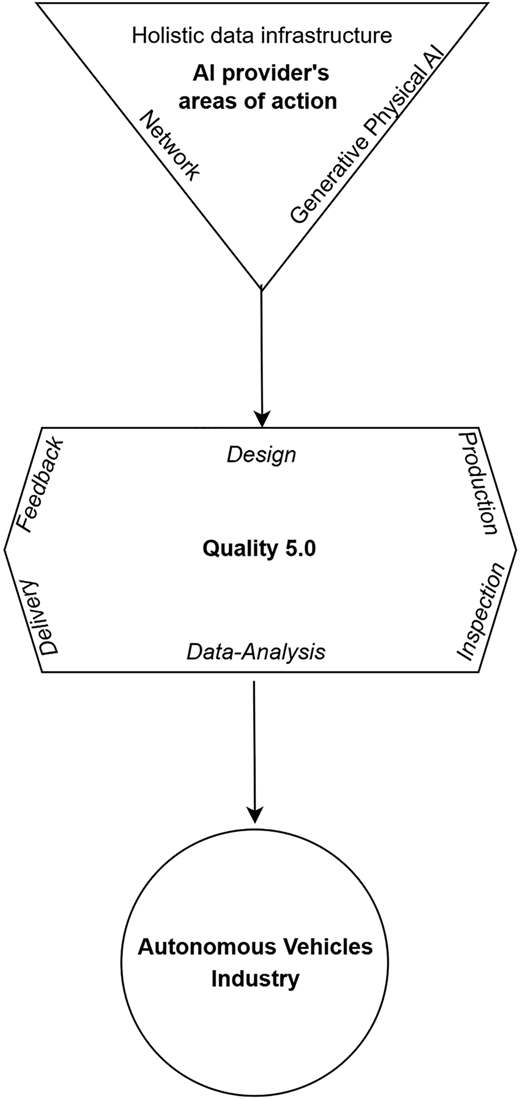
According to the integration between Quality 5.0 and AI-driven AVs, AI providers are thus holding control of three key actions enabling product quality through the six Quality 5.0 activities: (1) Adopting a holistic approach in data infrastructure management, (2) Leveraging generative physical AI and (3) creating a solid network.
Adopting a holistic approach in data infrastructure management means building an AI infrastructure promoting an AI ecosystem made of tools, software and hardware for every stage of AVs development and deployment, reflecting the holistic approach to industrial processes grounded on the use of sophisticated algorithms highly suggested in Quality 5.0 (Frick and Grudowski, 2023; Ali and Johl, 2024). By doing so, monitoring automotive solutions is easier and faster, as AI providers continuously oversee all phases of AI-based AV production. To do so, AI providers can internalize such activities or leverage collaborations with other crucial actors within the AVs industry. We assume that building an AI holistic infrastructure means spreading AI within the value chain and providing AI solutions from pre-training to simulation activities that can be fully integrated, reducing switching costs. Continuous control is another key element of Quality 5.0 and means activating a continuous improvement logic for AVs industry, boosting their success. AI implementation is positively related to the level of AVs' autonomy and safety, presenting AI as essential for AVs' survival (Banda and Chandra, 2025). Then, to adopt a holistic AI infrastructure, AI providers should leverage AI's ability to process large amounts of data in real-time. Deep learning plays a crucial role in AI solutions by enabling data interpretation, leading to an understanding of the driving environmental settings and the consequent rapid response to them, improving technological performance while safeguarding humans, another element of a Quality 5.0 (Tan et al., 2024). Accordingly, such infrastructure supports training AVs to avoid obstacles, elaborate road data and make safe, rapid decisions, consistent with Halim et al. (2016). According to them, AI-powered driving pattern analysis leads to accident prevention. Leveraging AI properties (Bawack et al., 2021) and managing them holistically could be crucial. In mobility terms, thus, such infrastructure is built on Li et al. (2025, p. 1539) ’s AI material properties: “sensing mobility objects and events, comprehending mobility data, automating mobility activities and learning from mobility data”. Generally, sensing and learning refer to “the material property of AI in capturing, perceiving and extracting mobility-related information” (Li et al., 2025, p. 1539), which helps AVs understand the environment in real-time and make safe decisions. We believe that comprehension is reflected in the AI infrastructure elements that help AVs decode visual data expressed in human language, related to images, videos and speech. Automating mobility activities are reflected in the AI infrastructure which enables AVs to perform driving activities, boosting safe automation promoted by Quality 5.0 (Li et al., 2025; Frick and Grudowski, 2023).
Moreover, to truly promote Quality 5.0 AVs, providing traditional AI is not enough: it must be enhanced to reduce the common trust gap towards AVs and help their safe integration within citizens' lives (Usman et al., 2024; Banda and Chandra, 2025). Generative Physical AI emerges as the ideal response, serving as both the catalyst and booster of all AI properties. Generative Physical AI is crucial for AVs diffusion since it addresses the issues related to the accuracy of AVs' interpretation of complex and dynamic environments (Zhang et al., 2024). We assume the crucial role played by Physical AI sensors in allowing reality observation, manifesting its high-performative sensing and learning properties. Indeed, AI sensing property involves “using cameras, sensors and connected devices that record various types of data (image, audio, video, temperature, etc.)” (Li et al., 2025, p. 1539). When data and information are continually generated within the AI infrastructure for AVs, active learning processes guide the development and deployment of AV solutions, leveraging AI learning properties. According to Li et al. (2025, p. 1541), AI learn from experience autonomously and “this is reflected in the features of identifying mobility-related patterns, predicting mobility status, and optimising transport routes and operations”. Moreover, Generative Physical AI extracts meaningful information from real and synthesized data and generates visual insights on them, consistent with Li et al.’s (2025) definition of comprehending AI property related to mobility scenarios. Furthermore, according to the literature, it also leverages actuators that reflect the acting property and it is intrinsically generative, manifesting the ability to generate AI. In general, placing the Generative Physical AI at the center of the AI provider related to AVs enhances this comprehensive understanding of the mobility operating environment, reducing the resistance of related actors by promoting a shared Quality 5.0 vision on AVs grounded on industry actors' (both citizens and companies' members) satisfaction. The relevance of implementing Generative Physical AI in AI-based AVs also regards its specific capability of creating a wide range of different scenarios, starting from a limited number of real data. This resolves the issue of acquiring large sets of training data, as collecting such a substantial amount can be challenging due to privacy concerns and regulations and costly in terms of both time and money. This leads to a set of available data that is not representative of the full range of potential road conditions, reflecting the main concerns also deriving from Industry 4.0 empirical evidence in the literature (Ciasullo and Ferrara, 2025). Instead, Generative Physical AI predicts scenarios, generating datasets by considering different types of factors simultaneously such as object layout and size, location, color and weather conditions. This is consistent with Quality 5.0 literature, which emphasizes the necessity of sustainable development in the industry, guided by predictive and simulation generative AI capabilities (Ali and Johl, 2024). We identify the central role of AI providers of such Generative Physical AI creating synthetic data on a limited base of real ones, in helping companies of all sizes to effectively enter the AVs market to guide the development of society rapidly and safely, without necessarily testing continuously real-world scenarios, reducing consumption, waste and thus costs, while improving performance. However, a crucial aspect of AI-based AV development is related to several notable concepts within innovation literature: the importance of creating a network while developing innovative technology. Indeed, technology needs to be accepted and adopted to be diffused by multiple actors in the market (Rogers, 1995) to create value within society through quality processes. AI developers, to promote the Quality 5.0 approach, need to foster collaboration with technologies and among the various actors in the AVs industry, primarily high-tech companies and carmakers. Indeed, according to Frick and Grudowski (2023) Quality 5.0 emphasizes the collaboration and communication between all the main actors of the manufacturing process. We suggest that AI providers should partner with carmakers who share aligned values and approaches to SM, promoting the creation of a network aimed at boosting AI-driven AV development and diffusion based on Quality 5.0 principles. This is also related to the particular nature of AI and AVs, which are in the early years of diffusion. Moreover, building a network structure enhances access to knowledge and other assets, guiding AVs development. According to Dahlke et al. (2024), new knowledge perfectionates AI-based solutions' output and the effectiveness of their development is based on the transmission of AI knowledge. More actors, thus, means improved quality. According to their study, AI adoption is related to a firm's location within an industry, the firm's strong embeddedness in the AI knowledge network and the existence of a high intensity of direct firm links, which increases the likelihood of AI knowledge transfer. Dahlke et al. (2024, p. 2) confirmed that the effectiveness of such a process highly depends on fruitful collaborations with stakeholders by stating that “the cognitive proximity among the partners […] and the depth of the knowledge being shared” are fundamental to AI-based solutions' virtuous development and improvement. By creating a valid network structure, AI providers treat their offer as a knowledge source and strategic asset Dahlke et al. (2024) and treat, in the same way, their partners. This is consistent with the belief that a technology provider aiming at Quality 5.0 should take into account how their decisions are affecting other people or industries, it should implement a holistic approach in the market and this is possible only by acquiring that by involving the main actors in the value creation process (Ali and Johl, 2024; Frick and Grudowski, 2023)
We affirm that holistic AI infrastructure, generative physical AI and networks are essential for AI providers to effectively drive the promotion of Quality 5.0 in the AVs industry to boost their diffusion and achieve the safer and more inclusive transportation future promised by the SM and Society 5.0 paradigms (Banda and Chandra, 2025; Ciasullo and Ferrara, 2025; Ciasullo et al., 2024).
We thus formulate our second proposition:
In the AVs industry, AI providers can enable the Quality 5.0 approach through holistic data infrastructure management, generative physical AI and connecting a network of actors pursuing it.
Based on the above, we illustrate how the three actions presented above can integrate the six components of Quality 5.0 proposed by Frick and Grudowski (2023), showing how AI providers promote that approach in the AVs industry:
According to Quality 5.0, the design phase is based on leveraging advanced software to simulate scenarios and identify potential flaws even before the physical prototype is built. We posit that this means AI providers can ensure accurate and efficient quality control through a holistic data infrastructure, driving Generative Physical AI outputs leveraging synthetic and real data, thereby reducing resource waste and environmental pollution during the design phase of AVs.
According to Quality 5.0, the production and inspection phases utilize advanced technologies, such as AI, to enhance control over the production process at every step (Production). Moreover, machine learning algorithms are also useful for inspection activities, collaborating with humans to improve the accuracy and speed of quality control (Inspection). Within the AVs industry, we state that AI providers, by building and using an holistic data infrastructure to manage a sophisticated Generative AI (Physical AI) and establishing strong partnerships with AV ecosystem's actors, can acquire and share the necessary knowledge to control the production process and diffuse a certain standard of quality creating value for society, implementing data-driven and diffused continuous improvement, ensuring that the final product meets the highest quality standards and then inspecting it maintain it over time.
According to Quality 5.0, the data analysis phase is crucial in the whole process and is the base of the quality control, especially when it comes to analyzing a large amount of data generated throughout the manufacturing process. Within the AVs industry, this means that AI providers, through a holistic data infrastructure and the Generative Physical AI software, can easily and continuously implement data analysis to control, simulate and predict conditions that directly or indirectly impact quality control.
According to Quality 5.0, the delivery phase is grounded on the intersection between technologies and companies to ensure that the product is diffused correctly. Within the AVs industry, this means that the role of AI providers should not end in providing AI solutions, but by building a solid network composed of all the crucial actors for the deployment of the AI-driven AV solution, according to a holistic and proactive approach promoted by Quality 5.0, they are responsible for how the AVs are safely diffused and implemented.
According to Quality 5.0, AI-driven feedback systems can help companies understand the level of client satisfaction and, in general, the strengths and weaknesses of the product, thereby driving quality improvement based on these considerations. We posit this assumption within the AVs industry, which means that AI providers can leverage their own advanced software and holistic data infrastructure to build a robust feedback system that collects feedback from all network actors, guiding the quality of the product by ensuring a high level of satisfaction and fostering industry development. Based on the above, we formulate our third proposition:
In the AVs industry, AI providers can enable the Quality 5.0 approach by developing AI technologies supporting the processes related to its components.
Our conceptual framework, grounded in our previously theory-driven propositions, is illustrated in the following Figure 1.
4. Methodology
To address the conceptual purpose of this study explicated in our RQ, this framework is thus supported by a case illustration (Eisenhardt, 1989). We examined how an existing international firm, recognized globally as a leader in the AI-driven AV market, supports the deployment of AVs while enabling the Quality 5.0 approach in the AVs industry. Indeed, the 5.0 framework redefines industrial actors' roles (Ali and Johl, 2024; Ghobakhloo et al., 2025; Sindhwani et al., 2022), assuming they are responsible for the well-governed integration of advanced technologies, such as AI, to develop interconnected systems that optimize organizational management, reduce inefficiencies and harms and boost positive socio-environmental outcomes (Xiang et al., 2023; Ghobakhloo et al., 2025). Case illustration methodology has been employed in similar studies in the literature (e.g. Breslin et al., 2021; Abatecola et al., 2018), with the goal of illustrating a specific context within a business case to better explain a conceptual paper. Indeed, the study of a case that addresses research goals (Eisenhardt, 1989) allowed us to observe, explain and explore our assumptions and elements of interest (Yin, 2003). We examined a company that we titled “Omega”. We selected it because it provides AI systems to the great majority of AVs industry actors, playing a key role in driving the quality of their products and processes. Indeed, by analyzing a market leader that heavily influences industrial processes, we strengthen our case illustration and conceptualization, underscoring the crucial role of AI providers as enablers of the adoption of the Quality 5.0 approach. Moreover, Omega promotes a human-centered approach to digital transformation while developing high-quality, high-performing systems, as openly stated by the company's founders, partners and other secondary sources, mainly websites, articles and public statements. For the case illustration, we collected historical evidence from business history literature, founders' interviews, public declarations, annual reports, company websites, archival newspapers and magazines. The analysis aims to identify the firm's main activities as an AI-driven AVs provider, supporting the deployment of its products while addressing societal challenges related to them, presenting it as an enabler for its activity of shaping the technical subsystem of the STS of the Quality 5.0 approach taking place in the AVs industry. Thus, we examined the firm's life, focusing only on events useful for delineating Quality 5.0 according to our framework. The leading information concerns the period from 2021 to the current year (2025).
4.1 Case description
Omega is a pioneering American AI provider and market leader. Omega was founded in 1993, providing highly innovative hardware and software to support the digital development of various industries, including automotive, gaming, energy, healthcare and telecommunications. Omega manifests its leadership in these markets. According to company reports, from 2024 to 2025, revenues increased by 78%, reaching a fourth-quarter revenue of $39.3 billion. Omega provides and refines various types of AI software, then leverages them to offer tailored solutions that meet the specific needs of different industries. The automotive field has the highest revenue trend after the ones related to the historical core business of the company (i.e. Data-Center and Gaming). In 2024, it performed a multi-billion-dollar run-rate business. Omega's automotive and robotics segment's revenue trend for the fourth quarter of FY2025 is 570 million dollars and it rose 103% year-on-year. In particular, according to Omega's Chief Financial Officer (CFO), the sales of Omega's self-driving platforms caused the latest increase in revenue. Indeed, the company is currently working to drive the development of highly performant AVs, thereby advancing global SM innovation.
4.2 Research design
This illustration is driven by secondary data, and the unit of analysis concerns the ways through which AI providers promote Quality 5.0 in the deployment of AVs. In particular, we investigated the line of products aiming at AVs development. The data resources are: (1) Omega website, (2) online documentation, (3) Omega founder's public declaration (in video and text format) and (4) Omega reports related to AVs. This case study illustrates, in practical terms, what we discussed in our conceptual framework, so this last served as the starting point for our data collection and selection of the relevant insights. The goal was to provide a detailed overview of Omega and how it operates in AVs, providing not only the technology to the AVs companies but also enabling them, through different techniques and strategic choices, to pursue the Quality 5.0 approach. For these reasons, data were collected from January to March 2025. The analysis period is 2021–2025 to monitor Omega's impact on the automotive market amid rapid mobility digitalization and AI diffusion following the COVID-19 pandemic. The limitations it imposes indeed negatively affect data on automotive and mobility in general, but its consequences benefit several industries. We first analyzed the company's history in the automotive sector, with a particular focus on AVs. To do so, we studied company reports, public declarations and online documentation, primarily online articles that described Omega's offerings and history. We aimed to provide a generic overview of Omega's role and behavior as an AI provider within the automotive. This first observing stage confirmed Omega as the pioneer in implementing AI in AVs, integrating its own AI software in mobility hardware, reinforcing our case selection for an illustrative successful example. Then, we analyzed company reports to further investigate the matter. They confirm Omega as the core technology leader in the industry. Since 2021, Omega's revenue stream in the automotive market has rapidly grown, as illustrated in the company's commentary on the results of the fourth quarter of 2025: 536 $M in FY2, 566 $M in FY22, $903 M in FY23, $1.091 M in FY24, $1.694 M in FY25. After that, we accessed official archival documentation and collected data concerning Omega's actions and solutions related to AI-based AV development. Then, we integrated the interviews of the company's founder. The following text is the result of a qualitative data analysis separately carried out by the authors with the aim of grouping the insights into themes (e.g. Braun and Clarke, 2006). Then, the authors discussed their themes, identifying common patterns and solving interpretation conflicts by drawing on the conceptual framework and related literature that guided its development. Thanks to these alignment processes, our case illustration discusses the emerging pillars introduced in the conceptual framework and offers practical examples of what was previously theorized.
5. Case illustration: Omega
5.1 Adopting a holistic approach in data infrastructure management
Regarding AVs, Omega adopted a strategic approach by intending such automotive solutions as a holistic ecosystem made of company-made AI-based hardware and software. As stated in an American blog article, what makes Omega's offering so appealing is the breadth of its ecosystem. It declares that the company provides tools for every stage of AV development. To achieve this, the company has provided a computer platform since 2015, designed to offer autonomous car and driver assistance functionality powered by deep learning. According to its founder, Omega adopts a “multiple computers” approach in AVs: the AI training systems, the simulation systems, the synthetic data generation systems and the computer inside the car. Moreover, he also declared that car companies can individually choose how and how many computers to use. The first refers to the advanced computing implementation within AVs through an on-board computer. The second is a platform for fleet data processing and training AI models. Omega declared that approaching AVs in a holistic manner means adopting an end-to-end, software-defined approach designed for continuous innovation. According to the Omega website, all the ecosystem solutions join forces to optimize end-to-end AVs development workflows for peak efficiency and performance. Integrating such technologies means that after simulating miles of driving through Omega's simulation platform, companies can process data through Omega's computer. It is a solution that allows the process in real-time on the road. Data are integrated through a multi-sensor approach, integrating cameras, lidar and radar sensors. According to its website, Omega offers this holistic and integrated system through an AI infrastructure that delivers the tools for streamlining the development and deployment of AV software. It is a fully cloud-native, end-to-end software platform that accelerates data science workflows and streamlines the creation and deployment of production-ready co-pilots and other generative AI solutions, enabling enterprises that rely on AI to seamlessly transition from prototype to full-scale production. This AI infrastructure considers AVs' design and improvement by organizing everything from data preparation and training to optimizing for inference and deploying. According to Omega's blog, the first step of this activity flow is titled “Data Preprocessing and Extract, Transform, and Load,” and it is based on transforming raw sensor data, video processing, auto-labeling and scene mining. The second one, “Training and Optimizations” composed of Graphics Processing Unit (GPU) and Multi-GPU acceleration, mixed-precision training and use of an Omega open-source software library. The third step, called “Simulation and Testing,” consists of two main actions: simulation and replay. This infrastructural approach boosts the creation of diverse datasets. Implementing GenAI within the activities concerning the aforementioned three-step infrastructure is central to offering solutions that effectively rationalize such activity flow, thereby reducing manual effort. The director of multiple robotics and AV labs at one of the most influential universities in the United States declared that Omega's innovative AI infrastructure is helpful and will also be crucial for the future advancement of robotics and AV research.
5.2 Leveraging generative physical AI
Omega's Physical AI is an AI system made of sensors and actuators. The first enables reality observation, while the second enables interaction and transformation of it. It is trained on 20 million hours of video. It removed the scalability barriers to training data for Physical AI development, supporting shared technology advancements. According to the founder, training Physical AI is like teaching the AI to understand the physical mechanisms ruling the world. This algorithm is implementable within all the activities promoted by the AI infrastructure for AVs as illustrated above, as stated on Omega's blog: Physical AI Dataset can help developers scale AI performance during all the phases from pre-training to post-training. Omega Physical AI for AVs is the generative AI platform implemented within a specific digital solution. This last is presented as new leverage of Omega's competitive advantage and one of its partners and clients due to its ability to create realistic, physics-based data in a virtual environment. Omega defines Physical AI as a game-changer, a leverage for automakers that don't have all the cars necessary to collect all the data required to develop safe AVs and for those that are new to the sector. Omega promotes Physical AI as a technology that levels the playing field, allowing both new and established companies to develop competitive systems without waiting years to collect sufficient real-world driving data. Another relevant quote on the centrality of Omega's Physical AI is the one declared by the founder, who confirmed their solution to be the global first Physical AI world foundation model. Moreover, thanks to the open model license, companies can customize it. This is a way to democratize access to highly performing, sophisticated AI algorithms for all companies of all sizes. This promotes a Quality 5.0 approach where the important thing is to serve society's interests. Omega Physical AI uses a limited and small sample of real-world data to generate a great number of synthetic driving scenarios. Then, through randomization techniques aimed at varying factors such as light and textures, it occurs that the generation of the set of annotated images enhances the model's ability to generalize. This process is iterative since it continuously refines the synthetic data and trains the model until all the key performance indicators are performing as expected. As stated by Omega, physical accuracy is the most important thing to bridge the simulation-to-real domain gap in training perception AI models to effectively complete tasks such as avoiding obstacles and merging into traffic. Thanks to Omega's AI infrastructure, the computer system for AVs simulations integrates Physical AI to amplify variations of physically based sensor data. The central role of Physical AI, promoted by Omega, in enabling the diffusion of AI-based solutions emerges within data.
5.3 Creating a solid network
Omega sustains the deployment of AI-driven AVs thanks to a solid network of partnerships with market leaders in the automotive industry to drive the diffusion of AVs. Omega's CFO stated that the great majority of automotive companies that also work on AI systems are collaborating with Omega. This is consistent with Omega's declaration in the 2024 annual report that illustrates how the comprehensive, top-to-bottom and end-to-end approach promoted is what boosts the automotive industry to solve the complex problems arising from the shift to autonomous driving. The main goal of Omega's strategy as an AI provider for the automotive sector is to build a network around AVs development, made up of relevant partners such as automotive market leaders, empowering them and its own offer. These considerations also emerge in the company's declaration on its blog regarding AVs. Omega, building on its expertise in AI and extensive experience in the automotive sector, offers a comprehensive end-to-end solution for the AV market. It engages with a wide network of partners – including automakers, truck manufacturers, tier-one suppliers, sensor makers, research institutions, mapping companies and startups – to design and implement AI systems for AVs. The ecosystem, built around Omega's solutions, emerges as an enhancing force of the AI infrastructure proposal for AVs. Omega established collaborations with numerous automakers, automotive suppliers and tech companies to promote AVs within the market. In this sense, collaboration is the result of a complementary combination that has the potential to accelerate the deployment of AVs while promoting a Quality 5.0 approach. The analysis conducted reveals how collaborations with luxury brands, automotive leaders and high-tech organizations foster AVs innovation and diffusion, ensuring quality in all of the components of the Quality 5.0.
6. Conclusive thoughts and future research
This study is grounded in the alignment between the intents for which Quality 5.0 and SM solutions are now conceived, consistent with the Industry 5.0 revolution. Above all, the switch towards the balanced and intertwined development of societal and technical systems to safeguard humans, the environment and sustainable production, plus the crucial role of industrial actors in this, and, above all, the central role that AI is recognized to play in making this possible. This conceptual study thus provides three theoretical propositions and a conceptual framework, with the aim of paving the way for future research on AI providers, Quality 5.0 and the AVs industry.
The emerging relevance of AI-driven AVs and the potential benefits they offer cities and society at large, in terms of social and economic inclusion, road safety and environmental safeguards, requires insights into how to support their diffusion in line with a Quality 5.0 approach. This study contributes to the debate among academicians and practitioners on Quality 5.0, AI, and AVs by conceptualizing how AI providers, as key strategic actors of new industrial processes, can enable the Quality 5.0 approach in the AVs industry. Indeed, Quality 5.0 studies, grounded in the Society 5.0 and Industry 5.0 frameworks, call on industries to leverage sophisticated technologies, particularly AI, to enable the development of improved STS that deliver high-quality products and services in line with human-centric principles. In particular, we first conceptualized, based on literature falling into different realms, three actions through which they can do it: (1) Building and controlling a holistic data infrastructure; (2) Leveraging Generative Physical AI and (3) Creating a solid network. We then presented an illustrative case study featuring a real AI provider that promotes Quality 5.0, describing its main actions through our conceptual lens. We presented an AI provider market leader operating in the automotive sector (among others) for AVs, and we provided useful strategic insights on the influence of AI providers on the diffusion of AI-based technologies consistent with Quality 5.0. Highlighting the necessity to ground AVs development on and through a holistic AI infrastructure, as requested by Quality 5.0, suggests that AI-based technology solutions should not be studied as single products but as ecosystems of software and hardware to be integrated, monitored and continuously enhanced in quality terms by leveraging an ecosystem approach and advanced technologies. Moreover, our study reveals how AI is feasible across the main steps characterizing AV production: data preprocessing, training, optimization and simulation. This contributes to the innovation management literature on AI and its role in quality management according to a 5.0 lens, illustrating its high applicability across diverse purposes, even in highly context-specific settings. Moreover, by presenting the crucial role of generative Physical AI, we place one of the newest breakthrough innovations at the center of the debate on quality SM. The management literature lacked studies demonstrating how enhanced AI algorithms truly contribute to the Quality 5.0 automotive industry. Then, we presented the relevance of strategic partnerships for AI providers in the automotive sector, confirming the importance of building a solid network and driving the diffusion of a new quality approach in the market.
In particular, we shifted the research focus from AI to the actors that provide it. Indeed, AI is recognized as a key component of technical subsystems that enable industries to pursue the Quality 5.0 approach. However, studies integrating STS and Quality 5.0 give less attention to how actors providing the technical component can enable or slow the development of such STS in industries. In this sense, rather than examining how firms digitalize quality processes or orchestrate multi-actor value creation, we focused on the AI infrastructure provider as a socio-technical shaper of production and quality paradigms. By theorizing the upstream role of the technology provider in determining which quality approach is achievable, we differ from digital quality management studies that analyze quality management practices involving the use of AI for data analysis, defect detection, compliance with quality standards and quality management capabilities at the organizational level. By grounding our conceptualization in the integration of the foundations of Quality 5.0, particularly the Industry 5.0 framework integrated with STS theory, we differ from studies investigating industrial dynamics by adopting a digital ecosystemic or platform leadership perspective. However, given the similarity in the theoretical assumptions at the ground of these research streams, this conceptual study could also inspire future research in these fields by shedding new light on the crucial role AI providers now play in industries and on how they approach their own technology development and deployment could be crucial in Quality 5.0 terms.
In managerial terms, these considerations demonstrate how AI providers can strategically position themselves within the automotive ecosystem to ensure that the actors fully support the industry in which they aim to operate, providing high-quality, high-performing products and services while also safeguarding societal needs. Our study increases the practitioners' and policymakers’ awareness of the crucial role of AI providers in enabling (or impeding) new quality approaches in the AVs industry, laying the ground for a safer society. Future empirical research could deepen understanding of their role in quality management by implementing a comparative case study, selecting a leader and a new company that provides AI algorithms, to investigate the weight of AI providers' reputation and experience as enablers of a Quality 5.0 approach. This logic can also be applied by testing the effectiveness of the three strategic activities illustrated in this study across different industries. Then, future studies could investigate whether and to what extent they can discourage Quality 5.0 practices, thereby obstructing the development of STS that characterize the Industry 5.0 framework.
Ultimately, this study presents the following limitations. First, this conceptual paper, grounded in a single illustrative case, proposes theoretical propositions and a conceptual framework intended not to yield generalizable findings but rather to offer theoretical insights into how AI providers can enable Quality 5.0 in the AVs industry. Secondly, we relied primarily on secondary and self-reported sources for the illustrative case study. This could lead to the reflection of organizational narratives and interpretations of technological developments. Thirdly, our conceptualizations are also limited and developed within a specific temporal context related to the current evolution of AI, a rapidly changing technology and the AVs industry, whose technological, regulatory and market conditions are continually evolving.